Study on the impulsive pressure of tank oscillating by force
towards multiple degrees of freedom
Shigeyuki Hibi1,*
1The National Defense Academy, Department of Mechanical Systems Engineering, 1-10-20 Hashirimizu, Yokosuka, Kanagawa 239-8686, Japan
Abstract. Impulsive loads should be excited under nonlinear phenomena with free surface fluctuating severely such as sloshing and slamming. Estimating impulsive loads properly are important to recent numerical simulations. But it is still difficult to rely on the results of simulations perfectly because of the nonlinearity of the phenomena. In order to develop the algorithm of numerical simulations experimental results of nonlinear phenomena are needed. In this study an apparatus which can oscillate a tank by force was introduced in order to investigate impulsive pressure on the wall of the tank. This apparatus can oscillate it simultaneously towards 3 degrees of freedom with each phase differences. The impulsive pressure under the various combinations of oscillation direction was examined and the specific phase differences to appear the largest peak values of pressure were identified. Experimental results were verified through FFT analysis and statistical methods.
1 Introduction
Impulsive loads[1,2] should be excited under nonlinear phenomena with free surface fluctuating severely such as sloshing and slamming in the field of naval architecture. Many studies about not only the estimation of the impulsive loads but also elastic behavior of structures have been carried out along with the recent developments of the numerical simulation methods. However the number of experiments to verify those numerical techniques is not enough because of the nonlinearity of the phenomena.
In this study an apparatus which can oscillate a tank by force was introduced in order to investigate impulsive pressure on the wall of the tank. This apparatus can oscillate it simultaneously towards 3 degrees of freedom (up-down, left-right and rotation) with each phase differences. It could happen that larger impulsive pressure is excited under oscillating the tank simultaneously towards multiple degrees of freedom than under single direction oscilation. The author examined the impulsive pressure under the various combinations of oscillation direction and identified the specific
phase differences to appear the largest peak values of pressure. Therefor the author showed larger impulsive pressure could appear under the oscillation towards multiple directions in comparison with the oscillation towards a single direction.
In the meantime the uncertainty of the result of experiments has been settled by the GUM[3] (Guide to the Expression of Uncertainty in Measurement) since 1993. Based on this a FFT analysis about measured pressure values was carried out and the confidence interval of them
based on t-distribution was also determined. At
last uncertainty analysis based on the GUM was executed and the reliability of the experiment was assured.
2 Experimental apparatus and
measuring instruments
2.1 Specification of oscillation apparatus
The size of tank is 400400100 (mm)
(Height WidthDepth).
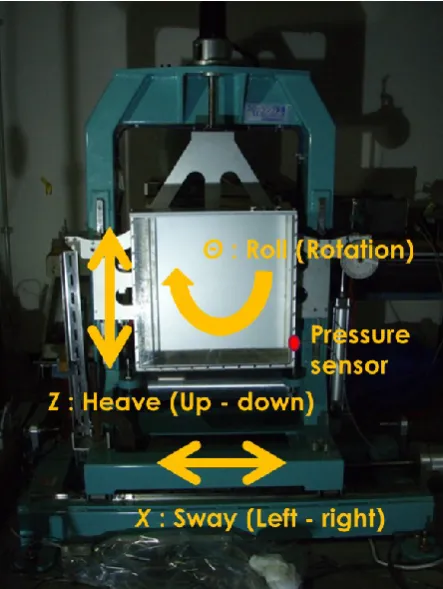
We define the symbols for the oscillation directions of 3 degrees of freedom as follows in Fig.2. Heave oscillation (Up – down) stands for Z and Sway oscillation (Left – right) stands for
X and Roll oscillation (Rotation) stands for .
Fig. 1. Oscillation apparatus with 3 degrees of freedom.
Fig. 2. Oscillation direction and pressure sensor position.
Table 1. Specification of the apparatus about oscillation.
Direction of
oscillation Maximum amplitude Minimum period
Heave (Z)
(Up-down) 50 mm 1.0 sec. Sway (X)
(Left-right) 50 mm 1.0 sec.
Roll ()
(rotation) 45 deg. 1.0 sec.
2.2 Measuring instruments
(1) Potentiometer
In order to confirm the acculacy of the roll oscillation control of a servo motor a potentio-meter is attached to measure a rotation angle at every moment.
(2) Laser displacement gauge
In order to confirm the acculacy of both heave and sway oscillation control of servo motors laser displacement gauges are placed to measure displacements at every moment.
(3) Pressure sensor
A pressure sensor is attached on the right side of the tank mounted on the apparatus. The position of the sensor is 40mm from the bottom. The pressure receiver is a round with a diameter of 8mm.
3Analytical methods for measured data
3.1. FFT (Fast Fourier Transform)analysis
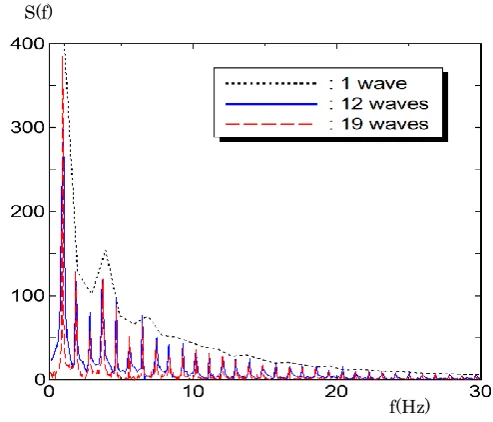
A FFT analysis are applied to the measured pressure data of time history in this study. Frequency components including in each data wave profile are discussed.
3.2 Determining the confidence intervals based on the t-distribution
Independent randam variables subject to the normal distribution X1, X2, ... XN are assumed
that mean values are and variances are 2
(usually unkonwn). Then sample mean X and
unbiased variance u2 are defined by eq. (1).
N
i i
N
i i
X X N
u X N X
1
2 2
1 1 ( )
1 ,
Then randam variable T defined by eq. (2) is
subject to Student’s t – distribution of N −1
degree of freedom.
T
X
/
u/ N
(2)Probability density function of the t –
distri-bution fN1
t is given by eq. (3).
2 / 2
1 1 1
2 1 1
2 N
N N Nt
N N t f (3)
Here is the gamma function.
Therefore in case of a sample of size N the
confidence interval at a confidence level z % is
given by eq. (4).
N u z t x N u z t
x N1( %) N1( %) (4)
3.3 Uncertainty analysis
Uncertainty about measuring according to the GUM guidance is evaluated as follows. First of all we determine factors of dispersion in the measuring procedure.
There are 2 types of methods for the estimation of uncertainty in the GUM guidance. One is called ‘A’ type of uncertainty. Its type is based on a statistical method. We estimate uncertainty of each factor using mean values and standard deviations in this type of uncertainty.
The other is called ‘B’ type of uncertainty. Its type is based on another method (e.g. technical information or some experience) without a statistical approach.
After we select the dispersion factors into 2 types of uncertainty, we combine the result to estimate the total uncertainty. the expanded
uncertainty U is obtained by multiplying the
combined standard uncertainty uc(y) by a
coverage factor k (k = 2. This means the 95%
confidence level).
4 Experiment and discussion
4.1 Investigating phase differences during simultaneous oscillation towards 2 degrees of freedom
The reliability of oscillation amplitude towards each degree of freedom is assured even with a period close to the natural period of the tank by previous study.
In this study we chose 3 pairs of 2 degrees of freedom from 3 one. Those will be subscribed
as follows ( X, Z, XZ). The oscillation
period is uniformly 1.08 (sec.) which is close to the natural period of the tank in case of the water depth is 60 mm (fixed). The oscillation
amplitudes are 15 mm for X and Z and 20
degrees for .
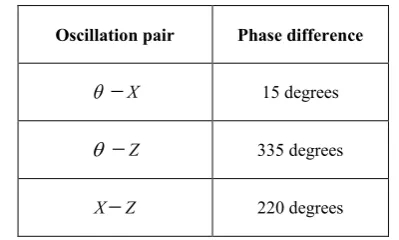
We measured time historys of pressure on the wall of the tank repeatedly while changing the phase difference from 0 degree to 360 degrees. We identified the phase difference which cause the largest peak value of pressure for each oscillation pair ( X, Z, XZ).
The results are shown in Table 2.
Table 2. Phase difference which cause the largest peak value.
Oscillation pair Phase difference
X 15 degrees
Z 335 degrees
XZ 220 degrees
Example results of time history of pressure for each oscillation pair are shown in Figs. 3(a), (b) and (c). In any cases it can be deduced that there is periodicity in the pressure fluctuation, but it is found that the peak values have variations.
4.2 FFT analysis for measured time history of
pressure
interval contains the ones for 12 and 19 period intervals. We can also deduce that although the obtained
peak values varies, the waveform itself seems periodic.
Fig. 3(a).Time history of pressure about X oscillation.
Fig. 3(b).Time history of pressure about Z oscillation.
Fig. 3(c).Time history of pressure about XZ oscillation.
Fig. 4(a).FFT analysis about X oscillation.
Fig. 4(b).FFT analysis about Z oscillation.
Fig. 4(c).FFT analysis about XZ oscillation. p (Pa)
p (Pa)
p (Pa)
S(f) S(f)
S(f)
f(Hz)
f(Hz)
4.3 Estimation of confidence intervals for the confidence level 95%
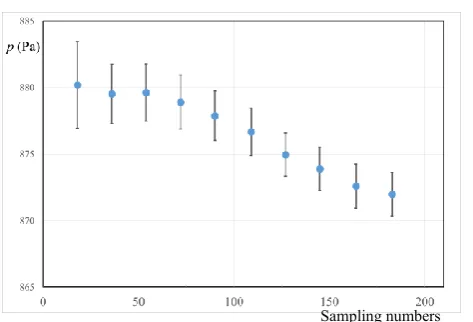
Experiments were repeated as one measurement for 20 seconds. Peak values were extracted from the time history of pressure for each oscillation pair. Next confidence intervals for the confidence level 95 % were determined. The results are shown in the Fig. 4.
Although the width of the confidence interval tends to decrease when the number of samples increases, it is considered that there is a significant width, which may indicate the nonlinearity of the present experimental data.
Fig. 5(a). Estimation of peak values at confidence level 95% about X oscillation.
Fig. 5(b). Estimation of peak values at confidence level 95% about Z oscillation.
Fig. 5(c). Estimation of peak values at confidence level 95% about XZ oscillation.
4.4 Determining the expanded uncertainty
Expanded uncertainty was determined according to the budget table shown in Table 3.
The function fused to estimate the uncertainty
when measuring pressure values is in eq. (5).
f gaV(d)V(20) (5)
Where is the density of water and g is the
gravitational acceleration. ‘a’ is the coefficient for conversion from voltage to pressure. V(d) is the voltage value of an amplifier at the d mm water depth and V(20) is the voltage value of an amplifier at the 20 mm water depth.
The expanded uncertainty calculated from Table 3 is 101.9 (Pa). The number of iterations used here is 11 times. In most cases it can be seen that the peak value varies around a mean value at this interval.
5 Conclusion
In this study impulsive pressure on the tank wall were measured and some information were found about it as below.
・ The fluctuation measured had some
periodism but the peak values had variation.
・From the estimation of confidence intervals
for the measured values at the confidence level 95% significant intervals were found to exist.
・Since characteristics of impulsive pressure
for the oscillation directions of 2 degrees of freedom is known, confirmation of that for the oscillation directions of 3 degrees of freedom is a future task.
Sampling numbers
Sampling numbers
References
1. Hakan Akyildiza, Erdem U¨nal, Ocean Engineering
32, 1503 (2005)
2. P. Temarel, W. Bai, A. Bruns, Q. Derbanne, D. Dessi,S. Dhavalikar, N. Fonseca, T. Fukasawa, X. Gu, A. Nestegård,A. Papanikolaou, J. Parunov, K.H. Song m, S. Wang, Ocean Engineering 119, 274 (2016)
3. JCGM2008, Evaluation of measurement data - Guide to the expression of uncertainty in measurement, (2008)
Table 3. Budget table for the estimation of uncertainty
Cause of
uncertainty uncertaintyType of probabilistic distributionShapes of MeanvalueSensitivityfactor uncertaintyStandard
Coefficient for conversion
from voltage to pressure Repeated experiment A Normal 159.0 3.888 0.8828 Voltage value at the
20mm water depth Repeated experiment A Normal 2.815 1558 0.03199 Calibration of
the pressure sensor Calibration error ofthe pressure sensor B Uniform 2.418 1 4.35 Calibration of
the amplifier Calibration errorof the amplifier B Uniform 5.00 1 9.00 Combined
standart uncertainty 50.96(Pa)
Expanded
uncertainty 101.9(Pa)
Factors of uncertainty :
a
20
V
2 / 2 0pdt
Vp
c
u
u
i
xf
Vamp
u