Article
Active case finding for tuberculosis through TOUCH agents in
selected high TB burden wards of Kolkata, India: A mixed methods
study on outcomes and implementation challenges
Abhijit Dey1
*, Pruthu Thekkur
2,3, Ayan Ghosh4, Tanusree Dasgupta1, SoumyajyotiBandopadhyay4, Arista Lahiri5, Chidananda Sanju S V6 , Milan K.Dinda1, Vivek Sharma1, Namita Dimari1, Dibyendu Chatterjee1, Isita Roy1, Anuradha Choudhury1, Parthiban Shanmugam1, Brojo Kishore Saha7, Sanghamitra Ghosh8, Sharath Burugina Nagaraja9
1. Tuberculosis Health Action Learning Initiative (THALI), Kolkata, West Bengal, Pin- 700107
2. International Union against Tuberculosis and Lung Diseases. Paris, France, Zip-75006
3. The Union South East Asia Office, New Delhi, India, Pin-110016
4. Department of Community Medicine, College of Medicine & JNM Hospital, Kalyani, West Bengal,
Pin-741235
5. Department of Community Medicine, College of Medicine & Sagore Dutta Hospital, Kamarhati,
Kolkata-700058
6. District Tuberculosis Officer, Udupi, Government of Karnataka, India, Pin-576104
7. State Tuberculosis Officer, Govt of West Bengal, India, Pin-700 091
8. General Secretary, Indian Public Health Association (IPHA), HQ, Kolkata, Pin-700073
9. Department of Community Medicine, ESIC Medical College and PGIMSR, Bengaluru, India, Pin-560010
* Correspondence: Dr. Abhijit Dey, 404 Kalikapur, Live Valley Apartment, Mukundapur (PO), Kolkata- 700099.
Telephone- +91-8100650578, Email- [email protected]
Abstract:
Background: Active case finding for TB was implemented in selected sixty high TB burden wards of Kolkata, India. Community volunteers called TOUCH agents (TAs) identified and referred presumptive TB patients (PTBPs) to health facilities for TB diagnosis and treatment. We aimed to describe the ‘care cascade’ of PTBPs identified during July to December, 2018 and to explore the reasons for attrition as perceived by TAs and PTBPs.
Methods: An explanatory mixed methods study with quantitative phase of cohort study using routinely collected data followed by descriptive qualitative study with in-depth interviews was conducted.
Results: Of the 3, 86,242 individuals enumerated, 1132 (0.3%) PTBPs were identified. Only 713 (63.0%) PTBPs visited referred facility for TB diagnosis. TB was diagnosed in 177 (24.8%) and the number needed to screen for one TB was 2,183 individuals. The potential reasons for low yield were stigma and apprehension about TB, distrust about TA, wage loss for attending health facilities and substance abuse among PTBPs.
Conclusion: The yield of ACF was suboptimal with low PTBP identification rate and high attrition rate. Interviewing each individual for symptoms of TB and supporting PTBPs for diagnosis through sputum collection and transport can be adopted to improve the yield.
1. Introduction
Tuberculosis (TB) remains the major public health problem of concern with an estimated 10 million incident TB patients and 1.6 million deaths globally due to TB in the year 2017[1]. In the same year, only 6.7 million TB patients were notified to national TB programs (NTP)[1]. The rest 3.3 million (33% of the estimated) were either undetected or were detected but not notified to NTP. India alone has an estimated 0.8 million patients not notified to NTP[1].
The TB patients undetected or not treated can be a potential threat to TB control efforts as they contribute to uninterrupted transmission of disease. One of the potential reasons for undetected TB patients is the over reliance on passive case finding for diagnosis of TB in low-and-middle income countries (LMICs)[2,3].
The World Health Organization’s (WHO) End TB strategy proposed early diagnosis of TB through Active case findings (ACF) in high risk groups as a key component to end TB epidemic by 2030[4]. ACF requires healthcare providers to actively reach and provide access to communities or population groups that are underserved or at higher risk of TB for TB diagnostic services.
The systematic reviews have reported ACF to be beneficial in increasing the case detection [5,6]. Also, the studies have reported ACF to be beneficial in reducing delay in TB diagnosis, out of pocket expenditure, unsuccessful treatment outcomes and incidence of TB[3,7,8]. The benefits of community based ACF activity depends on selection of high risk group, prevalence of the TB in the selected group, incentives provided to healthcare workers, the diagnostic algorithm adopted, and support provided to patients in completing the cascade of TB diagnosis and treatment.
The ACF activity has sequential stages (‘cascade of care’) through which patient traverses from diagnosis to treatment. Nevertheless, the studies elsewhere have shown as high as 46% attrition rates at various stages[9,10]. Thus, it is essential for ACF projects to monitor attrition at different stages, yield of TB patients, reasons for attrition and challenges in implementing ACF activity. This information can help programme managers to take informed decisions to optimize ACF activity services and the benefits of ACF.
The National Strategic Plan for TB elimination [2017-25] of India recommended ACF among high risk groups as a strategy to detect the ‘missing’ TB patients[11]. Since mid-2018, the NTP conducted five rounds of two week long ACF activity among identified marginalized and vulnerable groups in selected districts of country. The NTP also encouraged partner agencies supporting TB control to implement ACF among high risk groups[11].
The United States Agency for International Development (USAID) funded Tuberculosis Health Action Learning Initiative (THALI) project in West Bengal implemented ACF activity in the sixty high TB burden wards of Kolkata Municipal Corporation (KMC)[12–16]. A part-time, salaried community health volunteer known as Targeted Outreach for Upliftment of Community Health (TOUCH) agent was deployed in each ward to engage with community and conduct ACF. The THALI project ACF was different from that conducted by NTP as the activity was conducted throughout the year by a TOUCH agent (TA) who is not part of general health system.
imperative to fix the deficiencies and improve the efficiency of ACF conducted by THALI and also NTP.
2. Materials and Methods
2.1. Study Design:
We conducted an explanatory mixed methods study with the quantitative part (cohort study using secondary data collected routinely by the THALI Project) followed by qualitative part (descriptive study)[17].
2.2. Study Setting:
The Kolkata is a capital of West Bengal, India. It is one of the largest metro cities in the country with a population of 4.5 million[18]. The Kolkata Municipal Corporation (KMC) is divided into 144 urban wards as administrative units. The KMC has 5600 recognized slums and about 1.4 million individuals (~33% of total population) reside in slums[19].
The KMC is divided into ten urban health districts and each has one district TB officer who reports to city TB officer, a nodal person for delivery of NTP services in KMC. In total, there are 21 tuberculosis units (TU) and 42 designated microscopy centers (DMCs) in KMC[20]. The USAID supported THALI project implements ACF activity in sixty high TB burden wards of KMC since June-2018 through TAs.
2.2.1. Ward selection:
Figure 1: High Tuberculosis (TB) Burden Wards of Kolkata Municipal Corporation (KMC)
2.2.2. TOUCH Agent (TA):
They are mainly female community volunteer residing in the same ward with ability to read and write English language. Those selected as TA are trained on ACF activity. The TA spends at least 3 hours per day, six days a week, in the ward conducting ACF and community sensitization on TB. During each day, the TA visits 20 houses for ACF. TA is paid a fixed compensation of 3000 INR (~43 USD) per month.
2.2.3. Active Case Finding:
Those with symptom suggestive of TB are considered as PTBP and referred to either nearest DMC or the private practitioner based on patient’s preference. All the PTBPs referred are provided with referral slips signed by the TA. At the health facilities, PTBPs are evaluated for TB using sputum smear microscopy, chest X-ray and Xpert MTB/Rif assay as per NTP diagnostic algorithm[21].
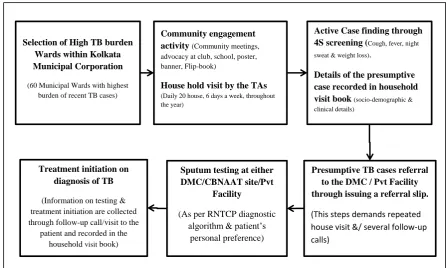
The TA re-visits the house of PTBP within seven days, to collect the information about their visit to referred health facility. In case if patient has failed to visit health facility, the TA counsels patient and repeat house visit is made. If the patient has made the visit, the results of diagnostic test and details of treatment initiation are collected. Also, those diagnosed with TB are visited at least three times for contact tracing and counselling support during TB treatment. (Figure-2)
Figure 2: Flow Diagram of the ACF activity by the TAs under THALI Project
Abbreviations: TA= Touch Agent; DMC= Designated Microscopy Center; CBNAAT= Cartridge Based Nucleic Acid Amplification Test; RNTCP= Revised National Tuberculosis Control Program
2.2.4. Recording:
The TA maintains a “Household visit book” and documents the number of individuals screened and number of individuals with chest symptoms. The socio-demographic, clinical, referral and treatment details of the PTBP are noted in the “Household visit book”. Field coordinator reviews the “Household visit book” for completeness during the supervision visits.
2.3. Study Population
2.3.1. Quantitative:
We included all the PTBPs identified by TA between July and December, 2018 during ACF activity conducted in the selected wards of KMC.
Selection of High TB burden Wards within Kolkata Municipal Corporation
(60 Municipal Wards with highest burden of recent TB cases)
Active Case finding through 4Sscreening (Cough, fever, night sweat & weight loss).
Details of the presumptive case recorded in household visit book (socio-demographic & clinical details)
Community engagement activity(Community meetings, advocacy at club, school, poster, banner, Flip-book)
House hold visit by the TAs (Daily 20 house, 6 days a week, throughout the year)
Treatment initiation on diagnosis of TB
(Information on testing & treatment initiation are collected through follow-up call/visit to the
patient and recorded in the household visit book)
Sputum testing at either DMC/CBNAAT site/Pvt
Facility
(As per RNTCP diagnostic algorithm & patient’s
personal preference)
Presumptive TB cases referral to the DMC / Pvt Facility through issuing a referral slip.
2.3.2. Qualitative:
We included TAs (n=10) and PTBPs (n=7) identified during the study reference period. ‘TA’s were purposively selected using maximum variation sampling with selection of those who had referred maximum and minimum number of PTBPs. The PTBPs were purposively selected using the extreme variation sampling based on whether he/she attended the health facility on referral. The final sample size was guided by the saturation of findings.
2.4. Data variables, sources of data and data collection: 2.4.1. Quantitative:
Using structured proforma, principal investigator extracted the details of PTBPs from ‘household visit book’ during February, 2019. The date of house visit, ward number, age, gender, history of previous TB, family history of TB, tobacco use, alcohol use, diabetes, HIV, presenting symptoms, referral site, visited referred facility, date of visit to referred facility, presence of pulmonary TB, date of TB diagnosis, status of treatment initiation and date of treatment initiation were extracted.
2.4.2. Qualitative:
In-depth interviews were conducted face-to-face in local language (Bengali) by AD (a male medical doctor, MPH, trained in qualitative research) and audio recorded using mobile voice recorder after obtaining consent. The interviewer is working in a THALI project but not involved in implementation of ACF activity. Separate interview schedules were used to interview TAs and PTBPs. The ‘TA’s were interviewed at their residence or workplace. PTBPs were interviewed at their residence. Interviews lasted for an average of 21 minutes (range 8-42 minutes). At the end of each interview, debriefing was done to ensure member checking.
2.5. Data entry and analysis
2.5.1. Quantitative:
Data was double-entered and validated using EpiData entry version 3.1 (EpiData Association, Odense, Denmark). The analysis was done using Stata 11.0 (StataCorp LP, College Station, TX, USA). Key analytic outputs were the number and proportion of PTBPs at each step of diagnosis- treatment pathway. The percentage with 95% CI was used to summarize the proportion of PTBPs at each step.
To assess the independent association of socio demographic and clinical characteristics of PTBPs with ‘not visiting referred health facility for diagnosis’, a multivariable model (modified Poisson regression) with cluster adjustment at ward level was used to calculate adjusted relative risk (aRR) with 95% confidence intervals (CI). Similarly, a multivariable model (modified Poisson regression) with cluster adjustment at ward level was used to assess the factors independently associated with ‘diagnosis of TB’ among those who reached the health facility after referral. A ‘p’ value of <0.05 was considered to be statistically significant.
2.5.2. Qualitative:
3. Results
3.1. Quantitative
Of the total 3, 86,242 individuals were enumerated by TAs from 92,294 houses, 1132 (0.3%) were
identified as PTBPs (Figure-3).
Figure 3: Flowchart depicting number and percentage of participants at different stages of diagnostic and treatment cascade test among PTBPs identified by ACF activity in Kolkata West
Bengal India during July-December 2018
Abbreviations: ACF= Active Case Findings; PTBP= Presumptive TB Patient; HCF= Health Care Facility
The mean age of the PTBPs was 43.1 (standard deviation: 17.1) years and 647 (57.2%) were
males. Tobacco use in last one month was reported by 175 (15.5%) PTBPs and 45 (3.9%) reported use
of alcohol in past one month. Known diabetes was reported by 244 (21.5%) and 13 (1.2%) reported to
have HIV infection. Of the total, 84 (7.4%) had previous history of TB and 118 (10.4%) gave history of
TB among family members in last two years. Cough of ≥2 weeks without any other symptoms indicative of TB was seen in 687 (60.7%). (Table 1)
Number of individuals enumerated and
assessed for TB symptoms- 3, 86,242
Number of individuals initiated on TB
treatment- 166 (93.8%) Number of PTBPs diagnosed with
Tuberculosis- 177 (24.8%)
Number of PTBPS who reached the referred
Table 1: Socio-demographic & clinical profile of the PTBPs identified by ACF activity in Kolkata Municipal Corporation, West Bengal, India during Jul- Dec 2018, N=1132
Characteristics n (%)
Age in years
0-14 36 (3.2)
15-29 206 (18.2)
30-44 323 (28.5)
45-59 280 (24.7)
60-74 184 (16.3)
75 & above 32 (2.8)
Not recorded 71 (6.3)
Gender
Male 647 (57.2)
Female 485 (42.8)
Alcohol use*
Yes 45 (3.9)
No 1087 (96)
Tobacco user* 26 (2.3)
Yes 175 (15.5)
No 957 (84.5)
Presenting Symptoms
Cough with other symptoms 101 (8.9)
Only Cough 687 (60.7)
No cough but other symptoms 344 (30.4)
Previous history of TB
Yes 84 (7.4)
No 1048 (92.6)
History of TB of other family#
Yes 118 (10.4)
No 1014 (89.6)
Diabetes
Yes 244 (21.5)
No/Known 888 (78.5)
HIV
Yes 13 (1.2)
No/Unknown 1119 (98.8)
Of the 1132 PTBPs, 713 (63.0%, 95% CI: 60.1%-65.8%) visited the referred health facility for
diagnosis of TB. Among those who visited referred health facility, the median duration between
referral and reaching the facility was 2 (inter quartile range 1-6). Table 2 shows the factors associated
with not visiting the referred health facility among PTBPs. Female gender (aRR-1.3 (95% CI:
1.1-1.5)), alcohol use (aRR-1.7 (95% CI: 1.3-2.2)), cough as the only symptom (aRR-1.8 (95% CI:
1.5-2.2)) and family history of TB (aRR-1.3 (95% CI: 1.1-1.5)) were independently associated with not
Table 2: Association of socio-demographic & clinical characteristics with not getting TB diagnostic test (Sputum microscopy ,CXR, CBNAAT) among the PTBPs identified by ACF activity in Kolkata Municipal Corporation, West Bengal, India during Jul- Dec 2018, N= 1132
Variable
Total
Not visiting health facility, n (%)*
Unadjusted RR (95% CI)
Adjusted RR (95% CI)$
Total 1132 419 (37.0)
Age in years
0-14 36 10 (27.8) 1 1
15-29 206 63 (30.6) 1.1 (0.6-1.9) 1.3 (0.7-2.2)
30-44 323 117 (36.2) 1.3 (0.8-2.3) 1.5 (0.8-2.5)
45-59 280 93 (33.2) 1.2 (0.7-2.1) 1.4 (0.8-2.3)
60-74 184 64 (34.8) 1.3 (0.7-2.2) 1.4 (0.8-2.5)
75 & above 32 4 (12.5) 0.5 (0.2-1.3) 0.5 (0.2-1.5)
Not recorded 71 68 (95.8) 3.4 (2.0-5.9) 3.3 (1.9-5.6)
Gender
Male 647 211 (32.6) 1 1
Female 485 208 (42.9) 1.3 (1.1-1.5) 1.3 (1.2-1.6)
Alcohol use
Yes 45 28 (62.2) 1.7 (1.4-2.2) 1.7 (1.3-2.2)
No 1087 391 (36.0) 1 1
Tobacco use
Yes 175 74 (42.3) 1.2 (1.0-1.4) 1.2 (1.0-1.4)
No 957 345 (36.1) 1 1
Presenting Symptom
Cough with other symptoms 101 26 (25.7) 1.1 (0.7-1.6) 1.1 (0.8-1.6)
Only Cough 687 312 (45.4) 1.9 (1.6-2.4) 1.8 (1.5-2.2)
No cough but other symptoms 344 81 (23.5) 1 1
Previous history of TB
Yes 84 27 (32.1) 1 1
No 1048 392 (37.4) 1.2 (0.8-1.6) 1.0 (0.8-1.4)
Family history of TB
Yes 118 70 (59.3) 1.7 (1.5-2.0) 1.5 (1.3-1.8)
No 1014 349 (34.4) 1 1
Diabetes
Yes 244 63 (25.8) 1 1
No/Unknown 888 356 (40.1) 1.6 (1.2-1.9) 1.3 (1.0-1.6)
HIV
Yes 13 1 (7.7) 1 1
No/Unknown 1119 418 (37.4) 4.9 (0.7-32.0) 6.0 (0.9-39.8)
* Row percentage, $ cluster adjusted (wards) generalized linear (Poisson) model
Of the 713 PTBPs visiting health facility for diagnosis, 177 (24.8%) were diagnosed with TB.
Thus, the number needed to screen (NNS) one TB was 2,183 (386242/177) individuals .Aged less than
30 years (aRR-2.4 (95% CI: 1.6-3.5)), presence of cough along with other symptoms (aRR-3.3 (95% CI:
2.4-4.4)), no previous history of TB (aRR-3.6 (95% CI: 1.7-7.6)) and family history of TB (aRR-2.7
Table 3: Association of socio-demographic & clinical characteristics with getting positive TB diagnosis among who undergone TB testing during the ACF activity in Kolkata Municipal Corporation, West Bengal, India during Jul- Dec 2018, N= 713
Variable Total Diagnosed as
TB, n (%) *
Unadjusted RR (95% CI)
Adjusted RR (95% CI)$
Total 713 177 (24.8)
Age in years
0-14 26 10 (38.5) 2.7 (1.5-4.8) 2.2 (1.2-3.9)
15-29 143 70 (49.0) 3.4 (2.3-5.0) 2.4 (1.6-3.5)
30-44 206 47 (22.8) 1.6 (1.0-2.4) 1.3 (0.9-2.0)
45-59 187 27 (14.4) 1 1
60-74 120 19 (15.8) 1.1 (0.6-1.9) 1.0 (0.6-1.6)
75 & above 28 3 (10.7) 0.7 (0.2-2.3) 0.7 (0.2-1.8)
Not recorded 3 1 (33.3) 2.3 (0.4-11.9) 2.4 (0.4-14.2)
Gender
Male 436 95 (21.8) 1 1
Female 277 82 (29.6) 1.4 (1.1-1.8) 1.1 (0.9-1.4)
Alcohol user
Yes 17 4 (23.5) 1 1
No 696 173 (24.9) 1.1 (0.4-2.5) 1.3 (0.7-2.5)
Tobacco user
Yes 101 9 (8.9) 1 1
No 612 168 (27.5) 3.1 (1.6-5.8) 2.2 (1.1-4.2)
Presenting Symptoms
Cough with other symptoms 75 50 (66.7) 4.4 (3.3-5.8) 3.3 (2.4-4.4)
Only Cough 375 57 (15.2) 1 1
No cough but other symptoms 263 70 (26.6) 1.8 (1.3-2.4) 1.4 (1.1-2.0)
Previous history of TB
Yes 57 7 (12.3) 1 1
No 656 170 (25.9) 2.1 (1.0-4.3) 3.6 (1.7-7.6)
Family history of TB
Yes 48 29 (60.4) 2.7 (2.1-3.6) 2.7 (2.0-3.6)
No 665 148 (22.3) 1 1
Diabetes
Yes 181 54 (29.8) 1.3 (1.0-1.7) 1.2 (0.9-1.5)
No 532 123 (23.1) 1 1
HIV
Yes 12 1 (8.3) 1 0.8 (0.1-5.8)
No 701 176 (25.1) 3.0 (0.5-19.8) 1
* Row percentage
Abbreviation: TB- Tuberculosis; RR- Relative Risk; aRR- Adjusted Relative Risk; CI- Confidence Interval; ACF- Active Case Finding; r= row percentage
3.2. Qualitative
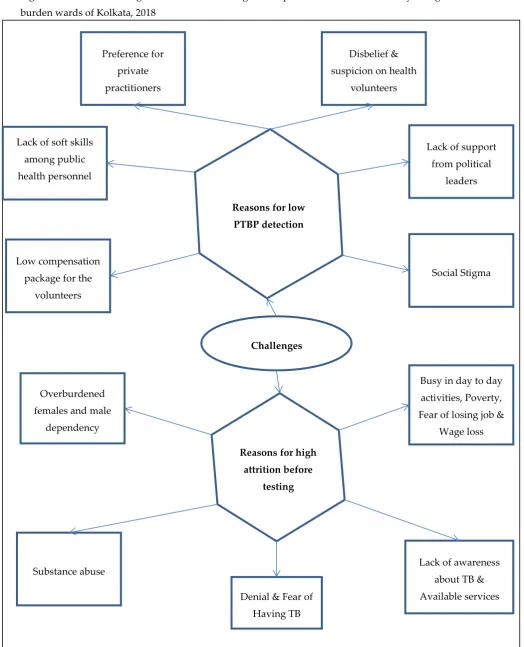
We deduced 38 codes which were clubbed into eleven categories. The categories are described
below under the two broad themes, 1) Challenges in house to house visit and identification of PTBP
Figure 4: Themes and categories related to challenges in implementation of ACF activity in high TB
burden wards of Kolkata, 2018
Challenges Reasons for low
PTBP detection
Reasons for high attrition before
testing
Substance abuse
Busy in day to day
activities, Poverty,
Fear of losing job &
Wage loss
Denial & Fear of
Having TB Low compensation
package for the
volunteers Lack of soft skills
among public
health personnel
Social Stigma Lack of support
from political
leaders Preference for
private
practitioners
Disbelief &
suspicion on health
volunteers
Overburdened
females and male
dependency
Lack of awareness
about TB &
3.2.1. Challenges in house to house visit and identification of PTBP:
The codes related to this theme were grouped and summarized into six categories.
Social stigma:
The TAs reported that there is social stigma about TB and is found to be deterrent for the
activity. They felt people don’t disclose the presence of PTBP in their house if neighbors are around
during the interview.
“When first time we visit any community or household & asked about whether anybody having symptoms like
TB, usually none responds on spot. But after coming back they call us that there is a TB suspect in their family. At the time of my visit there were many people so they didn’t tell that time.”- 38 years old female TA
Lack of support from political leaders:
The TAs reported interference of local political leaders in their activity. The political leaders
deny the presence of disease in their wards and ask the TAs not to conduct ACF activity.
“They ask ‘why you people come to my house often? I don’t have time to entertain your queries. There is no TB
in my Ward’, despite having lots TB patients in and around the party office!”- 27 year old female TA
Suspicion about TAs:
The TAs felt that people were suspicious about them. The people were not aware of the ACF
activity and assumed that the TAs visited the houses with some hidden agenda.
“The community dwellers & the local club initially did not believe that there are many TB patients in their area
& house to house visit is needed to detect more TB case. They were thinking that we have some other motive!”- 55 year old female TA
Preference for private practitioners:
The TAs felt that the community has preference for private healthcare providers. Thus, they
don’t want disclose the details of their symptoms with TAs as they relate them to be from public
health system.
“For any illness, here, people prefer to go to Private clinic if they can afford. If cant spent money then prefer to
go to homeopath, unani or even quacks. For maintaining privacy also sometime they prefer private clinic. They
don’t tell us anything.”- 28 year old female TA
The TAs felt inappropriate way of handling patients at the public health facilities further
dampen their relationship with the community. They refer the patient to health facilities and
patients are treated badly
“This is actually the biggest challenges for us to get the report timely. When parents visit TU for CBNAAT
report, the person sitting at TU sometime behaves rudely & sends back the parents. Sometime they say this test cost 1 lakh so you have to wait! ”—38 years old female TA
Unjustified pay to the job done:
The TAs complained that they are paid less for the amount of efforts they put in the field. They
also felt, low salary as one of the reason for high attrition among the TAs.
“What can we do with this 3000? People in other project with similar job profile getting three four times the
salary we are getting.. That’s why many people are leaving this project… I’ve also applied for..” - 45 years
old female TA
3.2.2. Challenges in PTBPs visit to referred health facility for TB diagnosis
The codes related to this theme were grouped and summarized into five categories.
Loss of wages and fear of losing jobs:
The TAs felt the loss of wages on missing a work-day among daily wage labors and
non-availability of leaves for salaried employees hinders the PTBPs from visiting the referred health
facility.
“…… she (a PTBP who had not gone for testing) said that she couldn’t go DMC due to fear of wage loss. As
sudden leave can trigger deduction of pay and employer may become angry! So, she planned for testing on any suitable next day.” - 60 yrs female TA
Lack of awareness about the available TB services at health facilities:
The TAs reported that a few of the PTBPs they had identified had difficulties in identifying health
facility in their locality to avail TB services.
“Till now people are not getting government services in my area , that is ward no. XX, they are not aware
of the available government services.”—45 years female TA
Denial and apprehension of having TB disease:
The TAs reported that those PTBPs who have awareness about TB are apprehensive to get
themselves tested for the disease. Such patients try to deny that they may have disease and avoid
“I was unable to arrange for sputum test for all identified presumptive case. Because I couldn’t convince
few patients that sputum test is needed for them. Patients actually don’t want to believe that they may
have TB.”—53 years old female TA
Substance abuse:
The TAs reported that the substance abuse among PTBPs as one of the potential reason for them
not visiting the health facilities. They felt it was difficult to get the investigation done for drug
addicts and alcoholics.
“Not all patients have gone for testing. Especially who are addicted with hashish (Marijuana), have not
gone to DMC, not even given the phone number. I have at least three such case. Even after detection of TB many people, especially the rickshaw-puller & the ganja addicts don’t wear mask (Govt used to provide the
mask after AFB +ve).”- 45 years old female TA
Overburdened females and male dependency:
The TAs felt it is difficult to mobilize female patients for health facility as they are pre-occupied
with household works during the day time. Also, they are dependent on males to take them to
health facilities.
“I have told many times to my husband but he said that he will arrange but he is yet to arrange. I don’t
4. Discussion
This is one of the first mixed methods study to assess the ‘care cascade’ and explore the challenges in implementation of ACF for TB in India. Our study has a few key findings. First, the ACF activity had low PTBP detection rate with only three out of thousand apparently healthy individuals enumerated during house-to-house visit having symptoms suggestive of TB. Second, there was high attrition of PTBP prior to diagnosis with only two out of three PTBP referred visiting the health facility. Third, among PTBPs who undergo diagnostic test, the sputum positivity rate was high with one out four having diagnosed with TB. Fourth, the NNS for one TB patient was relatively high. Fifth, the stigma about TB, suspicion about TA, lack of support from political leaders and low salary for TAs were the major challenges in conducting house-to-house visit for identifying the PTBPs. Sixth, the wage loss, apprehension about the diagnosis, substance abuse and male dependency of the females for seeking care at health facility were the major challenges for PTBPs to visit the referred health facility.
The study has several strengths. First, it was conducted under programmatic settings and reflects the field realities. Second, we used mixed methods design which provided considerable insights on challenges in implementation of ACF and enabled us to interpret the quantitative results. Third, the study has a relatively large sample size and there was no selection bias as we included all the individuals enumerated during study reference period in sixty wards where ACF is implemented. Fourth, we used double data entry and validation using EpiData software and thus data entry errors were minimized. Fifth, we adhered to STrengthening the Reporting of Observational studies in Epidemiology (STROBE) and COREQ guidelines for reporting the study findings.
The study has a few limitations. First, as details of diagnostic tests that PTBPs underwent were not recorded routinely, we failed to determine the uptake of various diagnostic tests for TB. Second, as it was as a retrospective study using routinely collected data, we failed to capture and adjust in our model for potential confounders like socioeconomic status, distance from referred health facility, employment status, education level and marital status. Thus, the factors associated with ‘not visiting health facility’ among PTBPs have to be interpreted with caution. Third, the qualitative exploration was limited only to TAs & PTBPs. Thus, we failed to capture experiences of other stakeholders involved in ACF activity like field supervisor, project leads & programme managers of NTP.
We further discuss our study findings in detail. First, the study had low rate of PTBP detection, whereas the previous studies on ACF have consistently shown high rates of PTBP detection[23–25]. The TAs failed to enquire about symptoms suggestive of TB individually from all those enumerated. As the ACF activity was conducted during the daytime, the symptoms of individuals away from home were enquired from adult informants. The studies in the past have shown that the detection rate of PTBP could be low if the symptoms are not elicited individually[26]. The informants might not be aware of the TB symptoms and thus, could have failed to identify the PTBPs among those absent during interview. As explored in qualitative study, the other potential reasons for low rate of PTBP detection were hesitancy to disclose the details of TB symptoms due to stigma and distrust about TAs.
encourage PTBPs to visit health facility. The qualitative interviews provided good insight about potential reasons for such high attrition. The wage or work loss due to travel and visit to health facilities during day time was one of the major reasons. Among the females, the attrition rate was high as they were dependent on male family members to visit health facility. The difficulties in counselling PTBPs with alcohol and other substance abuse also contributed to attrition. The other important issue was general distrust and unhappiness about public health system among public. Thus, these reasons warrants for provision of financial support and assistance to PTBPs to undergo diagnostic tests.
Third, the rate of TB diagnosis among those PTBPs visiting health facility was high. This could be due to the fact that only those with perceived need reached the health facility. Though PTBPs were identified by ACF activity, the decision to visit largely depended on severity of symptoms and thus mimicked the passive case finding. Also, the TAs might have given more preference to referral and linkage of PTBPs with severe and multiple symptoms rather than those with mild symptoms.
Fourth, the overall yield of ACF was low and NNS for TB was high. The previous studies have reported lower NNS on mass screening in high burden TB settings. The potential reason for high NNS might be the low detection and high attrition rate of PTBPs. Though, the NNS is high, the activity is still worth as it indirectly sensitizes the households on TB symptoms and thus creates awareness in community. The regular visit to the same community (six days a week) is gradually leading to good rapport building with the community[16]. This might improve the overall case detection in the community and contribute in TB control efforts.
Based on the study findings there are few implications and recommendations for ACF activities. This model can be replicated in other high TB burden area considering the following recommendations.
First, the house visits needs to be scheduled in the non-working hours of the days to ensure presence of majority of the household members during visit. The feasibility of visits by healthcare workers during early morning or late evening hours needs to be explored. Also, revisits to houses on holidays can be made to probe for symptoms among those not present during initial visit.
Second, the sputum collection and transportation mechanisms need to be established. The healthcare workers can collect the sputum samples from the PTBPs and transport it to diagnostic facilities. Also, the evening clinics can be set up to provide chest x-ray services to working PTBPs. The mobile voice call or SMS reminders to PTBPs can be tried to improve uptake of diagnostic tests.
Third, there is need for establishing robust database management system for tracking of individual PTBPs and programme monitoring. The healthcare workers can enter the PTBPs details directly in the hand held data capture devices instead of documenting it in registers. This will reduce the efforts in digitalizing these registers and data loss. Provision of internet connectivity with the device can be made for real time data sharing & prompt corrective actions. The database also has to include details on investigations to assess the yield with combination of various diagnostic tests. The indicators like proportion of PTBPs detected and proportion of PTBPs undergoing diagnostic tests for TB can be included in the programme monitoring. The healthcare workers can be incentivized based on these indicators.
The yield of ACF was suboptimal with low PTBP identification rate and high attrition rate. Interviewing each & every individual of the households for symptoms of TB and supporting PTBPs for diagnosis through sputum collection and transport system can be adopted to improve the yield.
Supplementary Materials: The dataset is available on
https://www.dropbox.com/home?preview=ACF+study+Data+files_Abhijit.rar
Author Contributions:
Conceptualization (CO-PIs)- Abhijit Dey, Pruthu Thekkur, Sharath BN and Ayan Ghosh;
Data collection -Quantitative- Abhijit Dey, Tanusree Dasgupta, Isita Roy, Anuradha Choudhury, Dibyendu Chatterjee and Namita Dimari;
Data collection –Qualitative- Abhijit Dey and Tanusree Dasgupta; Data entry- Abhijit Dey, Namita Dimari and Dibyendu Chatterjee;
Data curation- Abhijit Dey, Pruthu Thekkur, Ayan Ghosh, Tanusree Dasgupta, Vivek Sharma, Namita Dimari, Dibyendu Chatterjee, Isita Roy, Anuradha Chanda, Brojokishore Saha and Sharath Nagaraja;
Formal analysis- Abhijit Dey, Pruthu Thekkur, Chidananda SV, Vivek Sharma, Namita Dimari and Sharath Nagaraja;
Funding acquisition-Pruthu Thekkur;
Investigation-Abhijit Dey, Ayan Ghosh, Tanusree Dasgupta, Soumyajyoti Bandopadhyay, Arista Lahiri, Milan Dinda, Vivek Sharma and Anuradha Chanda;
Methodology-Abhijit Dey, Pruthu Thekkur, Soumyajyoti Bandopadhyay, Arista Lahiri, Chidananda SV, Sanghamitra Ghosh and Sharath Nagaraja;
Project administration-Milan Dinda, Isita Roy, Parthiban Shanmugam and Brojokishore Saha; Resources- Tanusree Dasgupta, Milan Dinda, Vivek Sharma, Isita Roy, Parthiban Shanmugam and Brojokishore Saha;
Software-Abhijit Dey, Pruthu Thekkur, Chidananda SV, Vivek Sharma, Namita Dimari, Dibyendu Chatterjee and Sharath Nagaraja;
Supervision-Ayan Ghosh, Tanusree Dasgupta, Soumyajyoti Bandopadhyay, Milan Dinda, Anuradha Chanda, Parthiban Shanmugam, Brojokishore Saha, Sanghamitra Ghosh and Sharath Nagaraja;
Validation-Abhijit Dey, Pruthu Thekkur, Tanusree Dasgupta, Milan Dinda, Vivek Sharma, Anuradha Chanda, Parthiban Shanmugam and Sharath Nagaraja;
Visualization-Abhijit Dey, Pruthu Thekkur, Ayan Ghosh, Soumyajyoti Bandopadhyay, Arista Lahiri, Chidananda SV, Vivek Sharma, Dibyendu Chatterjee, Parthiban Shanmugam and Sharath Nagaraja; Writing – original draft, Abhijit Dey, Pruthu Thekkur and Sharath Nagaraja;
Writing – review & editing-Ayan Ghosh, Tanusree Dasgupta, Soumyajyoti Bandopadhyay, Arista Lahiri, Chidananda SV, Milan Dinda, Vivek Sharma, Namita Dimari, Dibyendu Chatterjee, Isita Roy, Anuradha Chanda, Parthiban Shanmugam, Brojokishore Saha and Sanghamitra Ghosh.
Appearing before the local ethics committee- Ayan Ghosh, Soumyajyoti Bandopadhyay and Arista Lahiri
Mentoring- Pruthu Thekkur, Sharath BN, Milan Dinda, Sanghamitra Ghosh and Brojo Kishore Saha
The training program, within which this paper was developed, and the open access publication costs were funded by the Department for International Development (DFID), UK and La Fondation Veuve Emile Metz-Tesch (Luxembourg). THALI project is funded by United States Agency for International Development (USAID), USA. The funders had no role in study design, data collection and analysis, decision to publish, or preparation of the manuscript.
Acknowledgments:
This research was conducted through the Structured Operational Research and Training Initiative (SORT IT), a global partnership led by the Special Programme for Research and Training in Tropical Diseases at the World Health Organization (WHO/TDR). The model is based on a course developed jointly by the International Union Against Tuberculosis and Lung Disease (The Union) and Medécins sans Frontières (MSF/Doctors Without Borders). The specific SORT IT programme which resulted in this publication was jointly developed and implemented by: The Union South-East Asia Office, New Delhi, India; the Centre for Operational Research, The Union, Paris, France; Medécins sans Frontières (MSF/Doctors Without Borders), India; Department of Preventive and Social Medicine, Jawaharlal Institute of Postgraduate Medical Education and Research, Puducherry, India; Department of Community Medicine, All India Institute of Medical Sciences, Nagpur, India; Department of Community Medicine, ESIC Medical College and PGIMSR, Bengaluru, India; Department of Community Medicine, Sri Manakula Vinayagar Medical College and Hospital, Puducherry, India; Karuna Trust, Bangalore, India; Public Health Foundation of India, Gurgaon, India; The INCLEN Trust International, New Delhi, India; Indian Council of Medical Research (ICMR), Department of Health Research, Ministry of Health and Family Welfare, New Delhi, India; Department of Community Medicine, Sri Devraj Urs Medical College, Kolar, India; and Department of Community Medicine, Yenepoya Medical College, Mangalore, India.
We are thankful to local community; to the TOUCH agents & their supervisors, the patients & THALI project support staffs for supporting this work.
References
1. World Health Organization GLOBAL TUBERCULOSIS REPORT 2018; WHO, Geneva, Switzerland, 2018;
2. Ho, J.; Fox, G.J.; Marais, B.J. Passive case finding for tuberculosis is not enough. Int. J. mycobacteriology 2016, 5, 374–378.
3. Golub, J.E.; Mohan, C.I.; Comstock, G.W.; Chaisson, R.E. Active case finding of tuberculosis:
historical perspective and future prospects. INT J TUBERC LUNG DIS 9(11)1183–1203 © 2005 Union Rev. 2005.
4. World Health Organization The End TB Strategy. (2015). WHO, Geneva, Switzerland. http://www.who.int/tb/post2015_TBstrategy.pdf (Accessed 23rd November 2018).
5. Lönnroth, K.; Tomlin, K.; Afnan-Holmes, H.; Schaap, A.; Golub, J.E.; Shapiro, A.E.; Glynn, J.R.; Kranzer, K.; Corbett, E.L.; Afnan-Holmes, H.; et al. The benefits to communities and
individuals of screening for active tuberculosis disease: a systematic review [State of the art series. Case finding/screening. Number 2 in the series]. Int. J. Tuberc. Lung Dis. 2013, 17, 432– 446.
6. Mhimbira, F.A.; Cuevas, L.E.; Dacombe, R.; Mkopi, A.; Sinclair, D. Interventions to increase tuberculosis case detection at primary healthcare or community level services. Cochrane Database Syst. Rev. 2015, 2015.
7. Shewade, H.D.; Gupta, V.; Satyanarayana, S.; Kharate, A.; Sahai, K.N.N.; Murali, L.; Kamble,
S.; Deshpande, M.; Kumar, N.; Kumar, S.; et al. Active case finding among marginalised and vulnerable populations reduces catastrophic costs due to tuberculosis diagnosis. Glob. Health
Action 2018, 11, 1494897.
8. Shewade, H.D.; Gupta, V.; Satyanarayana, S.; Pandey, P.; Bajpai, U.N.; Tripathy, J.P.; Kathirvel, S.; Pandurangan, S.; Mohanty, S.; Ghule, V.H.; et al. Patient characteristics, health
seeking and delays among new sputum smear positive TB patients identified through active case finding when compared to passive case finding in India. PLoS One 2019, 14, e0213345.
9. B. M. Prasad, S. Satyanarayana, S. S. Chadha, A. Das, B. Thapa, S. Mohanty, S. Pandurangan, E. R. Babu, J. Tonsing, K.S.S. Experience of active tuberculosis case finding in nearly 5 million
households in India. pu 2016, 6.
10. Myint, O.; Saw, S.; Isaakidis, P.; Khogali, M.; Reid, A.; Hoa, N.B.; Kyaw, T.T.; Zaw, K.K.;
Khaing, T.M.M.; Aung, S.T. Active case-finding for tuberculosis by mobile teams in Myanmar: Yield and treatment outcomes. Infect. Dis. Poverty 2017, 6.
11. Central TB Division Directorate General of Health Services Revised National Tuberculosis Control Programme: National strategic plan for tuberculosis elimination 2017–2025; 2017;
12. USAID U.S. Announces $21 Million in Awards to Address and Treat TB in India | U.S.
https://in.usembassy.gov/u-s-announces-21-million-in-awards-to-address-and-treat-tb-in-in
dia/ (accessed on Aug 11, 2019).
13. The Union Abstract Book-47th World Conference on Lung Health of of the International Union Against Tuberculosis and Lung Disease; 2016;
14. Saha, I.; Paul, B. Private sector involvement envisaged in the National Strategic Plan for Tuberculosis Elimination 2017–2025: Can Tuberculosis Health Action Learning Initiative
model act as a road map? Med. J. Armed Forces India 2019, 75, 25–27.
15. Official Website of Kolkata Municipal Corporation KMC signs MOU with USAID funded
project THALI Available online:
https://www.kmcgov.in/KMCPortal/outside_jsp/THALI_18_07_2017.jsp (accessed on Dec 10,
2018).
16. Nari-O Sishu-Kalyan Kendra Tuberculosis Health Action Learning initiative (THALI) |
www.noskk.in Available online:
http://www.noskk.in/?post_causes=tuberculosis-health-action-learning-initiative-thali (accessed on Aug 10, 2019).
17. Creswell, J.W.; Plano Clark, V.L. Designing and conducting mixed methods research; SAGE Publications, 2007; ISBN 1412927927.
18. Census 2011; Government of India Kolkata City Population Census 2011 | West Bengal.
19. Department of Municipal Affair Government of West Bengal Total number of slum Pockets ,
Slum population percentage of Slum population , total number of CDS , NHC and NHG formed in the urban local bodies. 1–3.
20. Kolkata Municipal Corporation Official Website of Kolkata Municipal Corporation Available online: https://www.kmcgov.in/KMCPortal/jsp/KMCHealthServiceHome.jsp (accessed on
Aug 10, 2019).
21. Central TB Division TOG-Chapter 3-Case finding & diagnosis strategy :: Ministry of Health and Family Welfare Available online: https://tbcindia.gov.in/showfile.php?lid=3216
(accessed on Aug 10, 2019).
22. Tong, A.; Sainsbury, P.; Craig, J. Consolidated criteria for reporting qualitative research
(COREQ): a 32-item checklist for interviews and focus groups. Int. J. Qual. Heal. Care 2007, 19, 349–357.
23. Aye, S.; Majumdar, S.S.; Minn Oo, M.; Tripathy, J.P.; Satyanarayana, S.; Thu, N.; Kyaw, T.D.; Wut, K.; Kyaw, Y.; Lynn Oo, N.; et al. Evaluation of a tuberculosis active case finding project
in peri-urban areas, Myanmar: 2014-2016. Int. J. Infect. Dis. 2018, 70, 93–100.
24. Lorent, N.; Choun, K.; Malhotra, S.; Koeut, P.; Thai, S.; Eam Khun, K.; Colebunders, R.;
25. Oshi, D.; Omeje, J.; Oshi, S.; Alobu, I.; Chukwu, N.; Nwokocha, C.; Emelumadu, O.;
Ogbudebe, C.; Meka, A.; Ukwaja, K. An evaluation of innovative community-based approaches and systematic tuberculosis screening to improve tuberculosis case detection in
Ebonyi State, Nigeria. Int. J. Mycobacteriology 2017, 6, 246.
26. Prasad, B.M.; Satyanarayana, S.; Chadha, S.S. Lessons learnt from active tuberculosis case finding in an urban slum setting of Agra city, India. Indian J. Tuberc. 2016, 63, 199–202.
27. Delva, G.J.; Francois, I.; Claassen, C.W.; Dorestan, D.; Bastien, B.; Medina-Moreno, S.; Fort, D. St.; Redfield, R.R.; Buchwald, U.K.; St Fort, D.; et al. Active Tuberculosis Case Finding in
Port-au-Prince, Haiti: Experiences, Results, and Implications for Tuberculosis Control Programs. Tuberc. Res. Treat. 2016, 2016, 1–11.
28. Armstrong-Hough, M.; Turimumahoro, P.; Meyer, A.J.; Ochom, E.; Babirye, D.; Ayakaka, I.; Mark, D.; Ggita, J.; Cattamanchi, A.; Dowdy, D.; et al. Drop-out from the tuberculosis contact