ISSN(Online): 2319-8753 ISSN (Print) : 2347-6710
I
nternational
J
ournal of
I
nnovative
R
esearch in
S
cience,
E
ngineering and
T
echnology
(An ISO 3297: 2007 Certified Organization)
Vol. 4, Issue 9, September 2015
Use of
Recycled Plastic Waste as Partial
Replacement for Fine Aggregate in Concrete
B.Harini
1&K.V.Ramana
2P.G. Student, Dept. of Civil Engineering, G.Pulla Reddy Engineering College, Kurnool, Andhra Pradesh, India1
Assistant Professor, Dept. of Civil Engineering, G.Pulla Reddy Engineering College, Kurnool, Andhra Pradesh, India2
ABSTRACT: Concrete is combination cement, aggregates and water. Due to enormous growth in concrete, aggregates
are facing crisis. Apart from this growth of plastic has provoked the methods to solve environmental issue caused by plastic. We have made an experiment by partially replacing fine aggregate with plastic an investigation has been carried out. The strength properties of M30 grade concrete are studied with different plastic percentage proportions. The various plastic proportions are 5%,6%,8%,10%,15%,20% by volume. We studied strength properties of these mixes. There is decrease in compressive strength when the ratio of plastic to aggregate was increased .We have taken the mix for which compressive strength was least and to that mix we have partially replaced cement with silica fume of 5%,10%,15% by weight. The strength properties were again studied, It was noticed that when cement was partially replaced by 10%, 15% of silica fume was higher than reference mix.
KEYWORDS: PET plastic, Silica fume, Water absorption capacity, Compressive strength, Tensile strength, Flexural
strength.
I.INTRODUCTION
ISSN(Online): 2319-8753 ISSN (Print) : 2347-6710
I
nternational
J
ournal of
I
nnovative
R
esearch in
S
cience,
E
ngineering and
T
echnology
(An ISO 3297: 2007 Certified Organization)
Vol. 4, Issue 9, September 2015
II. RELATED WORK
Simiha Akcozoglu (2009) had made investigation by using PET plastic, concluded that use of shredded PET granules
due to its low unit weight reduces the unit weight of concrete which results in reduction in dead weight of building will help to reduce the seismic risk of building the earth quake forces linearly dependent on dead weight .
Mariaenrica Frigione (2010)had conducted an investigation on using recycled PET bottles as fine aggregate in
concrete and concluded the workability, compressive strength, split tensile strength is slightly lower than reference concrete and moderately higher ductility.
Semiha Akcaozoglu (2011)had conducted an investigation on mortars by using PET as aggregate and studied the
effect of Granulated Blast Furnace Slag , Fly ash on light weight mortars and concluded that the use of fly ash has decreased compressive strength ,flexural strength , tensile strength when compared to cement specimens .Both Granulated Blast Furnace Slag and fly ash increased carbonation depths of specimens .For this reason carbonation reducing measures must be taken when using these mineral admixtures .
R.V.Silva (2012)had conducted an investigation on concrete containing paste waste as aggregate and influence of
curing conditions on the durability related performance of concrete. He concluded that workability decreases with increasing amount of coarser ,flakier and irregular shaped plastic aggregates. The gap between these values widened as all concrete specimens wore cured in progressively drier environments with reductions varying between 11.1%,28.3% of coarser plastic aggregate specimens cured .
Brahim Safi(2013)had conducted an investigation by using plastic waste a fine aggregate in self compacting mortars.
Concluded that this plastic waste type can be used successfully as fine aggregate in self compacting mortars (or concrete). Fluidity is significantly improved by the presence of these waste. Reduction in Compressive strength was between 15 % and 33% for mortar containing 20 % to 50% plastic waste.
III.MATERIALS AND THEIR PROPERTIES
The materials used in this investigation are
1. ZUARI OPC 53 grade cement confirming IS 12269:1987 2. Silica Fume confirming ASTM C1240 and IS 15388:2003 3. Natural river sand
4. Recycled PET Plastic 5. Coarse aggregate 6. Water
7. Master Glenium sky 8233 formely B-233 as admixture of BASF company
Cement
The fineness of cement is 3%, specific gravity of cement is 3.13, standard consistency of cement is 31%, Initial setting time is 60 minutes and final setting time is 250 minutes.
Silica Fume
Silica Fume is also called as micro silica. The colour of silica fume is white. The Specific gravity is 2.3 and size of silica fume is 10 μm
Natural river sand
Uncrushed natural river sand is used as fine aggregate in this investigation .As per IS 383:1970 fine aggregate properties were tested and concluded that the fine aggregate in this investigation falls in zone-II .The water absorption capacity is 1%, fineness modulus is 2.60,specific gravity is 2.65.
Plastic
Plastic used in this investigation is PET (polyethylene terepthalate ) .The water absorption capacity is 0.12%, specific gravity is 1.32, size is below 4.75 mm
Coarse aggregate
ISSN(Online): 2319-8753 ISSN (Print) : 2347-6710
I
nternational
J
ournal of
I
nnovative
R
esearch in
S
cience,
E
ngineering and
T
echnology
(An ISO 3297: 2007 Certified Organization)
Vol. 4, Issue 9, September 2015
Water
Tap water is used in this investigation.
Admixture
Master Glenium SKY 8233 is used .It is a super plasticizer based on polycarboxylic ether .This free from chloride and low alkali .It is compatible with all types of cements .The aspect of admixture is light brown, relative density is 1.08±0.01 at 25.The PH is ≥6, specific gravity is 1.08.
IV. EXPERIMENTAL RESULTS
Mix proportion
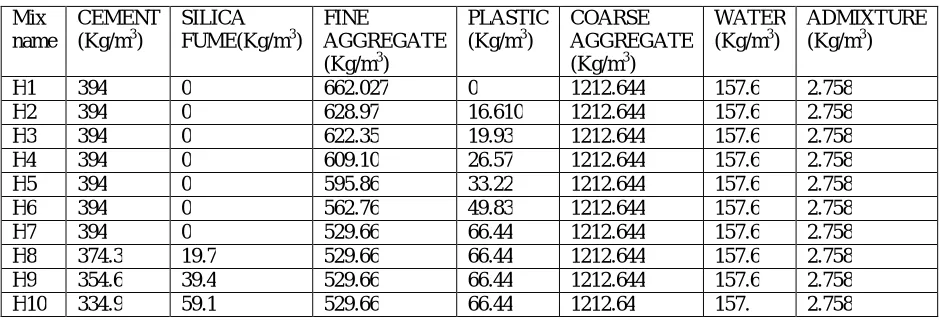
The mix design was made confirming IS 10262:2009 .Ten mixes were made in this investigation including reference mix other than the reference mix ,the mixes were made by partially replacing plastic to fine aggregate of percentage 5%,6%,8%,10%,15%,20%. By taking the mix with least compressive strength was enhanced it with silica fume as partial cement replacer of percentage 5%,10%,15% .The w/c ratio is 0.40.The mix proportions are shown in table 1.
Table 1: Mix proportion of M30 grade with w/c of 0.40
Mix name
CEMENT (Kg/m3)
SILICA FUME(Kg/m3)
FINE
AGGREGATE (Kg/m3)
PLASTIC (Kg/m3)
COARSE AGGREGATE (Kg/m3)
WATER (Kg/m3)
ADMIXTURE (Kg/m3)
H1 394 0 662.027 0 1212.644 157.6 2.758
H2 394 0 628.97 16.610 1212.644 157.6 2.758
H3 394 0 622.35 19.93 1212.644 157.6 2.758
H4 394 0 609.10 26.57 1212.644 157.6 2.758
H5 394 0 595.86 33.22 1212.644 157.6 2.758
H6 394 0 562.76 49.83 1212.644 157.6 2.758
H7 394 0 529.66 66.44 1212.644 157.6 2.758
H8 374.3 19.7 529.66 66.44 1212.644 157.6 2.758 H9 354.6 39.4 529.66 66.44 1212.644 157.6 2.758
H10 334.9 59.1 529.66 66.44 1212.64 157. 2.758
Workability
In this investigation workability was measured in terms of slump. The slump results are shown in table 2.
Table 2: Slump values Mix
name
Slump in mm Degree of workability
H1
120
HighH2
130
HighH3
135
HighH4
140
HighH5
142
HighH6
145
HighH7
150
HighH8
150
HighH9
150
HighISSN(Online): 2319-8753 ISSN (Print) : 2347-6710
I
nternational
J
ournal of
I
nnovative
R
esearch in
S
cience,
E
ngineering and
T
echnology
(An ISO 3297: 2007 Certified Organization)
Vol. 4, Issue 9, September 2015
Compressive strength
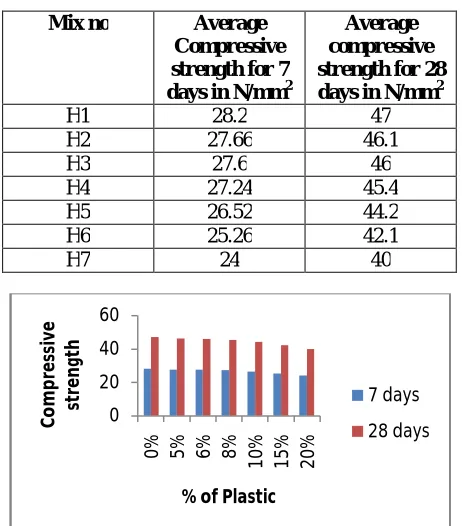
The results of the compressive strength for the waste plastic concrete mixes at 7 days 28 days are shown in table 3, table 4. By increasing the waste plastic to fine aggregate ratio the results shown a tendency to decrease on compressive strength . This is because there is poor adhesive strength between the surface of the waste plastic and the cement paste. The graphical representation is shown in fig 1, fig 2.
Table 3 Compressive strength of concrete for 7 days and 28 days
Mix no Average
Compressive strength for 7
days in N/mm2
Average compressive strength for 28
days in N/mm2
H1 28.2 47
H2 27.66 46.1
H3 27.6 46
H4 27.24 45.4
H5 26.52 44.2
H6 25.26 42.1
H7 24 40
Fig 1 Compressive strength verses percentage of plastic for 7 days and 28 days
Table 4 Compressive strength of concrete with silica fume for 7 days and 28 days
Mix name Average
Compressive strength for 7
days in N/mm2
Average compressive strength for 28
days in N/mm2
H7 24 40
H8 27.108 45.18
H9 28.8 48
H10 29.4 49
0 20 40 60
0
% 5% 6% 8%
1
0
%
1
5
%
2
0
%
C
o
m
p
re
ss
iv
e
st
re
n
gt
h
% of Plastic
7 days
ISSN(Online): 2319-8753 ISSN (Print) : 2347-6710
I
nternational
J
ournal of
I
nnovative
R
esearch in
S
cience,
E
ngineering and
T
echnology
(An ISO 3297: 2007 Certified Organization)
Vol. 4, Issue 9, September 2015
Fig 2 Compressive strength verses percentage of silica fume for 7 day and 28 days
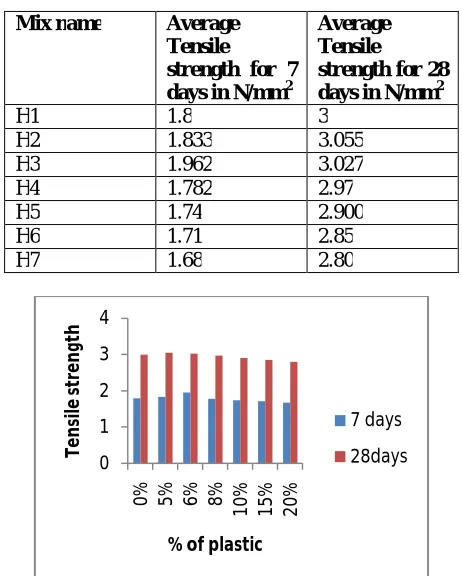
Tensile strength To understand the influence of the replacement percentage of fine aggregate with plastic aggregate at
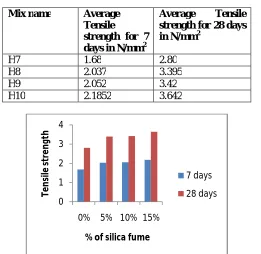
7 days and 28 days on tensile behavior of concrete ,the concrete specimens were tested under split tensile test, the experimental results are presented in table 5 and table 6. The graphical representation is shown in Fig 3, Fig 4.
Table 5 Tensile strength of concrete for 7 days and 28 days
Mix name Average
Tensile
strength for 7
days in N/mm2
Average Tensile
strength for 28
days in N/mm2
H1 1.8 3
H2 1.833 3.055
H3 1.962 3.027
H4 1.782 2.97
H5 1.74 2.900
H6 1.71 2.85
H7 1.68 2.80
Fig 3 Tensile strength verses percentage of plastic for 7 days and 28 days 0
10 20 30 40 50 60
0% 5% 10% 15%
C
o
m
p
re
ss
iv
e
s
tr
e
n
gt
h
% of silica fume
7 days
28 days
0 1 2 3 4
0
% 5% 6% 8%
10
%
15
%
20
%
Te
n
si
le
s
tr
e
n
gt
h
% of plastic
7 days
ISSN(Online): 2319-8753 ISSN (Print) : 2347-6710
I
nternational
J
ournal of
I
nnovative
R
esearch in
S
cience,
E
ngineering and
T
echnology
(An ISO 3297: 2007 Certified Organization)
Vol. 4, Issue 9, September 2015
Table 6 Tensile strength of concrete with silica fume for 7 days
Mix name Average
Tensile
strength for 7
days in N/mm2
Average Tensile
strength for 28 days
in N/mm2
H7 1.68 2.80
H8 2.037 3.395
H9 2.052 3.42
H10 2.1852 3.642
Fig 4 Tensile strength verses percentage of silica fume for 7 days and 28 days
Flexural strength
The results of the flexural strength tests for the plastic concrete mixtures are shown in table 7, table 8. The graphical representation is shown in Fig 5, Fig 6.
Table 7 Flexural strength of concrete for 7 days and 28 days 0
1 2 3 4
0% 5% 10% 15%
T
e
n
si
le
s
tr
e
n
gt
h
% of silica fume
7 days
28 days
Mix name Average
Flexural
strength in
N/mm2 for 7
days
Average Flexural
strength in N/mm2 for
28 days
H1 2.76 4.6
H2 2.64 4.4
H3 2.52 4.2
H4 2.4 4.0
H5 2.37 3.95
H6 2.31 3.85
ISSN(Online): 2319-8753 ISSN (Print) : 2347-6710
I
nternational
J
ournal of
I
nnovative
R
esearch in
S
cience,
E
ngineering and
T
echnology
(An ISO 3297: 2007 Certified Organization)
Vol. 4, Issue 9, September 2015
Figure 5:Flexural strength verses percentage of plastic for 7 days and 28 days
Table 8 Flexural strength of concrete with silica fume for 7 days and 28 days
Mix name Average
Flexural
strength in
N/mm2 for 7
days
Average Flexural
strength in
N/mm2 for 28
days
H7 2.25 3.75
H8 2.7 4.5
H9 2.76 4.6
H10 2.88 4.8
Fig 6 Flexural strength verses percentage of silica fume for 7 days and 28 days
V. CONCLUSIONS
1. As percentage of plastic increases workability also increases because the plastic which is used as aggregate is smooth .As well as water absorption capacity of plastic is also low.
2. By partially replacing fine aggregate with 20% of plastic in concrete the compressive strength has been decreased by 14.89% when compared to reference mix .By taking the mix which has least compressive strength(i.e where partial replacement of plastic is high) we have enhanced it by using a partial replacement to cement of silica fume by 5% ,10%,15%. The mix in which 15% of silica fume is used as binder the compressive strength increased by
0 1 2 3 4 5
0
% 5% 6% 8%
1
0% 15% 20%
Fl
e
xu
ra
l
st
re
n
gt
h
% of plastic
7 days
28 days
0 1 2 3 4 5 6
0% 5% 10% 15%
Fl
e
xu
ra
l s
tr
e
n
gt
h
% of silica fume
7 days
ISSN(Online): 2319-8753 ISSN (Print) : 2347-6710
I
nternational
J
ournal of
I
nnovative
R
esearch in
S
cience,
E
ngineering and
T
echnology
(An ISO 3297: 2007 Certified Organization)
Vol. 4, Issue 9, September 2015
3. The tensile strength increases when fine aggregate is partially replaced by 6% of plastic however replacing plastic more than 6% to the fine aggregate will lead to decrement in tensile strength. Same as above observation tensile strength increased by 30.07% when silica fume is used.
4. The flexural strength at each curing age is prone to decrease with the increase of the waste plastic and aggregate ratio. This trend can be attributed to the decrease in adhesive strength between the surface of waste plastic particles and the cement paste .
5. The density of concrete decreased when plastic content increased.
6. Because plastic has more water tightness capacity when compared to natural aggregate this can help in arresting micro cracks.
7. By using recycled waste plastic in concrete can reduce the land fill and environmental issues .
8. This type of aggregate replacement is useful where aggregates are in crisis .By this we can conserve natural resources .
REFERENCES
1. Alexandra M. da Silva, Jorge de Brito ,Rosário Veiga,” Incorporation of fine plastic aggregates in rendering mortars “,Construction and Building Materials 71 (2014) 226–236
2. Brahim Safi , “The use of plastic waste as fine aggregate in the self-compacting mortars: Effect on physical and mechanical properties “,Construction and Building Materials 43 (2013) 436–442
3. F. Mahdi , H. Abbas , A.A. Khan ,” Strength characteristics of polymer mortar and concrete using different
4. compositions of resins derived from post-consumer PET bottles “,Construction and Building Materials 24 (2010) 25–36
5. IS: 383-1970, “Specification for coarse and fine aggregate “, Bureau of Indian Standards, New Delhi, 1970
6. IS: 2386-1963, “Methods of test for aggregates of concrete, part I, III & IV”, Bureau of Indian Standards, New Delhi, 1963
7. IS :10262-2009,”Guidelines for concrete mix design proportioning” , Bureau of Indian Standards, New Delhi, 2009.
8. R.V. Silva , J. de Brito Nabajyoti Saikia ,” Influence of curing conditions on the durability-related performance of concrete made with selected plastic waste aggregates “,Cement & Concrete Composites 35 (2013) 23–31
9. Semiha Akcaozog˘lu , Cengiz Duran Atis, Kubilay Akcaozog˘lu ,” An investigation on the use of shredded waste PET bottles as aggregate in lightweight concrete “,Waste Management 30 (2010) 285–290
10. Semiha Akcaozog˘lu , Cengiz Duran Atis ,” Effect of Granulated Blast Furnace Slag and fly ash addition on the strength properties of lightweight mortars containing waste PET aggregates “,Construction and Building Materials 25 (2011) 4052–4058
11. Shetty, M. S., “Concrete Technology”, S. Chand and company, New Delhi, 2005
12. Shi Yin, Rabin Tuladhar, Feng Shi, Mark Combe, Tony Collister, Nagaratnam Sivakugan ,” Use of macro plastic fibres in concrete: A review ”, Construction and Building Materials 93 (2015) 180–188
13. Shutong Yang,Xiaoqiang Yue, Xiaosong Liu, Yao Tong ,” Properties of self-compacting lightweight concrete containing recycled plastic particles “,Construction and Building Materials 84 (2015) 444–453
BIOGRAPHY
B.Harini Post Graduate Student, Structural Engineering Department, Civil Engineering,
G.PullaReddy Engineering College, Kurnool, Andhra Pradesh, India.
K.V.Ramana obtained his Master’s degree from university college of Engineering JNTUK,