Study and Implementation of Lean Technique
in Construction Industry- A Case Study
[1]
Rishav Sarma Bardalai,[2]Assistant Professor. Arunima Jayakumar
[1]
Department of Civil Engineering, SRM University, Kattankulathur, Chennai, India.
[2]
Assistant Professor, Department of Civil Engineering, SRM University, Kattankulathur, Chennai, India.
ABSTRACT: Various studies in the construction industry have been conducted to develop the best practice that is only not capable of improving organization profit but also assists in producing a systematic work process which will encourage the optimal use of resources. The application of this lean concept will introduce a work approach that practices the best implementation in construction procedure and process. The main objective is to found to hinder the implementation of the lean construction concept within the various value chain of the construction industry. Considering the size of the construction industry there is much to gain from increased efficiency; increased profitability for the company, improved work environment for the workers and from a society. Knowledge of construction activities, processes and waste together with lean theory gave way to a tool that can be used within the construction industry as was aimed for. The tool is a first step to understanding waste in a construction project or company together with an approach to prioritize where waste reduction activities are most crucial. The main tools for the collection of data included questionnaires, interviews and site observations. The questionnaires included sources of waste, barriers to implement lean and measures to overcome lean technique
I. INTRODUCTION
Construction activity is an integral part of a country’s infrastructure and industrial development. It includes hospitals, schools, townships, offices, houses and other buildings; urban infrastructure (including water supply, sewerage, drainage); highways, roads, ports, railways, airports; power systems; irrigation and agriculture systems; telecommunications etc. Covering as it does such a wide spectrum, construction becomes the basic input for socio-economic development. Besides, the construction industry generates substantial employment and provides a growth impetus to other sectors through backward and forward linkages. It is, essential therefore, that, this vital activity is nurtured for the healthy growth of the economy.In the past, researcher have indicated that the waste in construction can occur at any stage of the construction project. Waste in the construction industry has been the subject of several research projects around the world in recent years. Several researcher have stated that there are numerous waste in the construction now a days. Since construction has a major and direct influence on many other industries by means of both purchasing inputs and providing the products to all other industries, eliminating or reducing waste in the construction industry could yield great cost savings to the society.
Waste can be classified as unavoidable waste (or natural waste), in which the investment necessary for its reduction is higher than the economy produced, and avoidable waste, in which the cost of waste is higher than the cost to prevent it. Waste can also be categorized according to its source; namely the stage in which the root causes of waste occurs. Waste may result from the processes preceding construction, such as materials manufacturing, design, materials supply, and planning, as well as the construction stage. Some of the main classification of waste in construction are in design, procurement, material handling, operation and residual.
transferred elsewhere, in which unnecessary cost and time may be incurred by materials wastage
.
The main objective are to bring out the importance of lean technique in construction industry, to identify the sources and causes of materials waste on construction sites and to provide a compendium on waste arising from storage and handling of high waste generating building materials used in Indian construction industry and to assess the views of construction professionals on the level of contribution of some waste minimization measures to waste reduction, and the level of practice of such measures in the construction industry.II. METHODOLOGY
The literatures are studied and reviewed for various wastage in construction industry is understood to have a clear knowledge on wastage by case study. The factors that are responsible for wastage are to be identified and the solution for the problem are to be generated and an efficient solution is to be reached, along with the factors which are responsible for the barriers of implementing lean technique are to be studied and result analysis is made with the study of construction industry in India and then it is forecasted for future year. The methodology is as follows:
III. CASE STUDY - WASTAGE IN CONSTRUCTION
The DLF Capital Green Project is a housing project constructed in a central location of Delhi where the Client of the project is DLF Universal Ltd and the main contractor is Larsen and Toubro Ltd along with Architect Hafeez Contractor, Structural design Manish Consultant and Project Management consultant as Turnner, India. The job description of the project includes: Construction of all Structural, Finishing (Inclusive of Façade works), MEP& External Development Works for Residential Flats in 23 Towers & their associated basements, on Tower Basement areas & Community Buildings & Handing over to the Owner’s Customers at DLF Capital Greens. The site is located at 15, Shivaji Marg, Moti Nagar New Delhi – 110015.The original value of the contract is 964cr whereas the revised value is calculated as 973cr. The contract period is 33 months. The status of the contract agreement is executed. The DLF capital green housing project consists of 23 towers divided into 3 phases with various floor area and built up area. The plot area is 37.9 acre and the total built up area is calculated as 8000000 sqft.
The phase 2 consists of Tower 1, 2,3,4,15,16,17,18,19 and 20 & the phase 3 includes Tower 21, 22 and 23.
Definition of waste
According to Koskela , waste can be defined as “any inefficiency that results in the use of equipment, materials, labour or capital in larger quantities than those considered as necessary in the construction of a building”. Waste can be classified as unavoidable waste (or natural waste), in which the investment necessary for its reduction is higher than the economy produced, and avoidable waste, in which the cost of waste is higher than the cost to prevent it. The percentage of unavoidable waste depends on the technological development level of the company. Waste can also be categorized according to its source; namely the stage in which the root causes of waste occurs. Waste may result from the processes preceding construction, such as materials manufacturing, design, materials supply, and planning, as well as the construction stage. Bossink and Brouwers classified the main waste causes in construction into:
Design
Procurement
Materials Handling
Operation
Residual
Direct waste
According to Skyoles and Skyoles (1987), waste that can be prevented and which involves the actual loss or removal and replacement of material is called direct waste. Most of the times, the cost of direct waste do not end up in the cost of material, but followed with the cost of removing and disposing. Thus, by preventing direct waste straightforward financial benefits can be obtained. Direct waste can occur at any stage of the construction process before the delivery of material to the site and after incorporating the materials at the building.
Table 1 Categories of direct waste
Categorie s
Reason Example DLF Capital Green (Wastage %) Tend er (AC E) Actual Delivery Waste During the transportation of material to the site, unloading and placing in addition to the initial storage
Bricks, Blocks, Glass, Bulk Material
5% 10%
Cutting and conventio nal waste Cutting material into various size and uneconomical shapes Formwork, tiles and reinforcement
3% 9%
Applicati on and residue waste Hardening of the excess material Paint, mortar and plaster
Nil 3%
Waste caused by Damage occurred by Painted surfaces
Indirect waste:
Indirect waste occurs when materials are not physically lost; causing only a monetary loss.
Waste due to concrete slab thickness larger than that specified by the structural design. Indirect waste arises principally from substitution of materials, waste caused by over allocation, where materials are applied in superior quantity of those indicated or not clearly defined in contract documents, from errors. Waste caused by negligence, where materials are used in addition to the amount required by the contract due to the construction contractor’s own negligence.
Category Reason Example DLF Capital Green Tende r Actua l Substitution waste Substitution of material in work, which will incur losses to either contractor or client
Use of facing for common
bricks,fixed blocks for brick mortar,readymix concrete
5% 10%
Execution waste
Contractor doesnot receive any payment for the work done
Excess thickness of slab- concrte waste
2.5% 10%
Negligence waste
Site error because of the condemmed work or use of additional material
Over excavation of foundation resulting in use of additional concrete, wrong drawing,handing over status of concrete
2% 1%
Operational Waste
Unavailability of proper quantityof material on site
Formwork,Reinforc ement,Low Equipment utility,concrete order.
2% 5%
Table 2 Categories of indirect waste
AREA OF DEVIATION OF WORK FROM ORIGINAL PLAN(TOWER 12)
There are various activities where deviations has been seen. In tower 12 where according to the schedule prepared before the starting of the work was 217 days from 17/02/2014 to 27/10/2014 but since after the incident that took place on 17/05/2014 in the site, it was noticed that the critical and major activities were stopped like external plastering, IPS flooring etc. due to several issues related with manpower and safety. The activities that were lagging in tower 12 according to the planed schedule are:
Water proofing
Kitchen counter
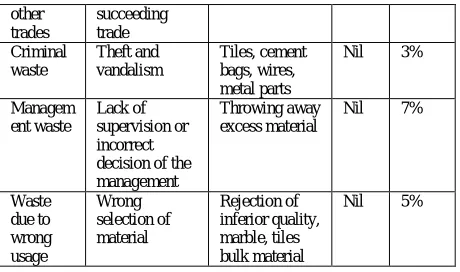
other trades succeeding trade Criminal waste Theft and vandalism Tiles, cement bags, wires, metal parts
Nil 3%
Managem ent waste
Lack of supervision or incorrect decision of the management
Throwing away excess material
Nil 7%
Waste due to wrong usage Wrong selection of material Rejection of inferior quality, marble, tiles bulk material
IPS Flooring
Common Area Plastering
Balcony plaster
Balcony railing fixing etc.
These were due to cost issues, changes in methodology, change in management and drawings. The various type of incident in the site can cause loss in labor productivity which can result in delay in the delivery of the project to the client. Although the minor activity like housekeeping went off but the major activity were not executed for which the whole project got affected and thus will lead to the delay in the delivery of the project to the client. The deviation can also be seen due to some of the other factors like
Cycle time
Repetition
Rework
Variation in plastering thickness
RISK REVIEW GRAPH OF VARIOUS ACTIVITY
Risk analysis is the process of defining and analyzing the hazards that can cause affect to a certain project. Few steps to asses risk are
Identify the hazard
Identify who can be harmed
Identify the current control and decide if more is required
Record the finding
Review as necessary
The risk assessment of a project is done based on the assessment guide. A sample guide is shown how risk of a project is calculated.
Figure 1: Sample Risk Assessment Guide
The risk assessment of a construction project is done as follows:
Identification the type of project
Identification of the Patient Risk group
Using of the matrix to relate the patient risk group and type of construction.
There are various risk that is seen in DLF Capital Green site out of which the risk are classified as follows:
Execution Risk
Contractual Risk
Legal Risk
The execution risk consists of
Availability of skilled Masons for Block work and plastering
Availability of Blocks for Block work
Plastering of 23 Lakh Sqm Area
Safety.
The causes of the execution risk are:
`Unavailability of sufficient masons might affect Block work & Plastering schedule
Unavailability of sufficient blocks might affect Block work schedule & Plastering Schedule. Supply of Blocks need to be increased to 6000 Cum /month
Plastering to be done by mechanical means& requirement is 3700 Sqm/Day &there is shortage of Experienced agencies to do the work.
Unsafe Act & Condition The risk mitigation plan adopted are:
Engage more workmen for Block work & Plastering and start the work in all the 23 towers simultaneously.
Get materials from various vendors to ensure availability of enough stock.
SOP to be followed at site
The contractual/financial/legal risk consists of:
Water Proofing Sales Rate in Contract BOQ
Escalation in prices
Wastage of Material
Liquidated damages.
The causes of contractual/financial/legal risk are:
Rates are under estimated during bidding Stage .Execution of the item can decrease the project Margin.
Minimum wage expect to revise 3-4 times during the contract duration
Delay in project completion.Effect: 0.5% per week to 5% of contract value.
As per contract, the client has a right to encase the BG on account of non-performance by L&T. The risk mitigation plan are:
Proper monitoring of the project schedule.Proper monitoring on the quality of work.IV. RESULTS AND DISCUSSION
This chapter reports and discusses the survey findings. After the questionnaire survey was carried out, statistical analyses were undertaken on the responses using various methods described in the research methodology.
The average years of experience of the firms surveyed in the construction market are between 10 and 20 years. This implies that all the firms have significant experience in the building industry to ensure reliability and accuracy of data. With regards to the average number of permanent and temporary employees in the firms, none of the firms contacted was willing to disclose the records. The main reason given was that those records were confidential to them. The respondents, however, indicated that they had enough employees and could recruit additional employees when necessary.. For the construction organizations, project managers were interviewed. Fifty five percent of the project managers 45% of the quantity surveyor were the main respondent in the survey. The study further showed that 60% of the senior consultants hold Bachelor degree and 40% holds masters degree. The results also showed that majority of the firms (72.5%) had private sector clients. 12.5% of consultancy firms had public sector clients and 15% have got both private and public clients as indication of how well they are doing in the construction sector.
wastage in the construction industry. The above results with literature which list the causes of waste resulting from design and documentation include Variations in the design while construction is in progress is the main source of waste according to the respondents to Lack of information in the drawings is the minor wastage seen in the wastage of design and documentation wastes.
The waste like poor logistics assignment, accidents due to negligence and choice of wrong construction method as the major causes of waste as a result of operational activities on construction sites.
From the result the waste like substitution of a material by a more expensive one ( with an unnecessary better performance), wrong bundling of orders, ordering errors (eg., ordering significantly more or less) and purchased products that do not comply with specification above are the major causes of waste as a result of procurement.
This result confirms findings in literature which list concrete, cement/mortar, timber, blocks and steel as the major materials wasted on construction sites
A structured questionnaire survey was conducted to identify measures which were considered best in minimizing materials wastage and to provide empirical evidence on levels of significant contribution of waste minimization
measures to waste reduction. The results further show construction should target for continuous improvement; thus
reduction of costs, increase quality and productivity, timely delivery of materials to construction sites, management should train employee on lean concepts, communication should be improved among stakeholders in construction projects, construction managers should be committed to accommodate changes are the five most important measures which can minimize the wastage of materials on construction sites.
The barriers to implementation of Lean Construction identified from literature and confirmed by industry practitioners were ranked according to their mean scores and standard deviations. The results 9 show that the five strongest
barriers to implementation of LC in India are fragmented nature of the industry, extensive use of subcontractors, lack of long term relationship with suppliers, delays in decision making and waste accepted as inevitable, in that order. The weakest barriers include inefficient use of quality standards, lack of supply chain integration and poor project definition among others. The traditional construction process is characterized by its fragmented nature with loosely coupled actors who only take part in some of the phases of the process . The success of lean construction is highly dependent on having a cohesive team working towards congruent goals and objectives. Extensive use of subcontractors as a barrier to the implementation of LC in India confirms results from. literature. Sub-contractors are mainly responsible for specialists works and contractors typically hire sub-contractors who do not have direct contracts with the client. Most sub-contractors work with inadequate resources and have low expertise, thereby often compromising quality. Poor supervision of sub-contractors may result in lack of solution to critical problems involved in LC. Extensive use of sub-contractors who often lack technical expertise constitute a serious barrier to lean construction
FEW LEAN TECHNIQUE PRACTISED IN VARIOUS L&T PROJECTS IN NEW DELHI
Figure 3: Proper Professional Motivation
Figure 4: No Vertical Opening in the site
Figure 5: Proper utilization of Environment Day
.
V. CONCLUSION
The main objective of the case study is to implement and assess the values of different lean construction techniques for the various activities in the DLF Green Project as well as various construction projects. Lean techniques in the construction industry has provided tools for operational planning and control, supply, visualization, and continuous improvement. Emerging techniques have started to change the way constructors manage their own operations. The last planner is a technique that can be implemented in the site for the successful execution of the work. The last planner process starts with the reverse phase schedule, i.e .a detailed work plan specifying handoffs between trades for each phase. Based on the RPS, a “lookahead” schedule provides the activities to be completed during the coming weeks and the backlog of ready work. Each planner should prepares weekly work plans to control the workflow. If assignments are not completed on time, planners must determine the root cause of the variance and develop an action plan to prevent future recurrences of the problem
.
LAST PLANNER SYSTEM : The planning team, led by the project manager, focused on operational planning and
schedule, Six Week look ahead, Variance analysis and Percentage Plan complete chart. Increased visualisation that consists of commitment chart, mobile signs and project milestones.It can be also put into focus that huddle meeting is one of the important lean technique that can be implemented in site which consists of All foreman meeting, Start-of-the-day meeting, First run study(Plan, Do, Check, Act) and Five S(Short, Straighten, Standardize, Shine and Sustain).
MECHANISATION: It is one of the most important that can be implemented in the site in which plastering can be done mechanically instead of manually. The plaster machines are the one that can help in reducing the time in doing the work. Thus in turn help in more amount of work done in less amount of time.
SOPHISTICATED PRODUCTS: Products like fixo block, readymade plaster etc. which can help in reduce time in the
construction in the site thus increasing the strength and durability of the structure.
USE OF READY MIX PLASTER in the site can led to reduce in the waste along with time, material, logistics and
cost. The various advantage of ready mix plaster includes:
Excellent homogenous mixing
High availability
Simple severing and maintenance
Long tool service life
Good Accessibility
Easy logistics
Good Productivity
LOGISTICS: It is one of the more important issue that have to be seen properly in which it can be implemented by
supplying the material at the workable area by the suppliers in time. Even proper arrangement of the materials in the work place can help in fast work process in the site.
ARCHITECTURAL FEATURES: It can have great impact on time, waste of material and money. The most of the
critical activities lay in the construction of the architectural structure in the total structure. So architectural structure should be take care off with proper supervision of the engineer along with proper consultation of the architect.
USE OF GLASS FIBRE REINFORCED CONCRET: The use of glass fibre reinforced concrete is a most advanced
technique that can be used in the most of the architectural features in the towers. The main benefit of GFRC are
Highly durable and safe.
Design freedom since GFRC is able to be moulded into almost any shape and colour
Requires very low maintenance
Installation is quick and cost effective
Weather and fire resistant
Economical
Energy resistant
PROPER PLANNING AND MONITORING: In DLF Capital Green Project the most critical activities which are
going in the site are External Plastering, Internal Plastering, IPS Flooring, Toe wall/MS railing and block work along with safety works.
In External and internal plastering the it was noticed that there was lack of supervision and workers were not active as they should be. So from my point of view is it would be very helpful if they are fixed to do a certain work for that day and if they won’t complete the work given by the engineer on the same day they should have the right to reduce the wage for the same day in which the work was not completed on time.
The organisation can also implement an informal meeting of all project foremen was replaced with the weekly work plan meeting, which focused on the completion of assignments during the following week. The discussions during the meetings addressed overlapping activities and identified potential problems on the job site. Actions agreed to at the meetings were recorded in minutes and were reviewed the following week.
Look Ahead schedule is one of the most important lean technique which can be implemented in the site which consists of updated picture of project assignment to be completed.
Percentage Plan Complete chart is the one that can also be implemented in the site in which it gives an overview of the completed work in the last week and it can be basically divided into two levels in project and the subcontractor level.
Commitment chart is the one that emphasize the importance of safety in the construction site. Here attendees can asked to give examples of how to maintain safety practices on a job site. At the end of the presentation, a commitment pledge can be signed by all employees and posted in the trailer throughout the project.
The project personal can also provide their input in the design of safety signs which can be designed and posted later on various areas of the site in which it can be put with colourful and funny expression that can attract the attention of all people on the job site.
The project milestone is one of the important document that can be put in site in which signs can be designed and completion date of each task can be plotted floor wise throughout the project which can help the more involvement of the workers on the site.
REFERENCES
1. Bruno Pontes Mota, Ricardo Mota and Thaís da C. L. Alves, (2008) “Implementing Lean Construction Concepts in a Residential Project”.
2. Michael J. Wodalski, Benjamin P. Thompson, Gary Whited, Awad S. Hanna (2011) “Applying Lean Technique in the delivery of Transportation Infrastructure Construction Projects”.
3. Patricia Tzortzopoulo and Carlos Torres Formoso (1999) “Consideration on Application of Lean Construction Principle to Design Management”.
4. Shardy Abdullah1, Arman Abdul Razak, Abu Hassan Abu Bakar1 and Izran Sarrazin2 Mohammad “Towards Producing Best Practice in the Malaysian Construction Industry: The Barriers in Implementing the Lean Construction Approach”.
5. David Umstot (2013) “Introduction to Lean Construction”.
6. Arleroth, Jens Kristensson, Henrik (2011) “Waste in Lean Construction- A Case Study”.
7. CIRIA (2013) “Implementing Lean in Construction”.