The International Conference on Engineering and Built Environment (ICEBE) 2013
Title: IMPLEMENTATION OF LEAN CONSTRUCTION CONCEPT AMONG CONTRACTORS IN MALAYSIA
Authors: Mohamad Luthfi Ahmad Jeni (Corresponding Author), Assoc. Prof. Dr Zainal Abidin Akasah
Affiliation: Faculty of Engineering Technology, Universiti Tun Hussein Onn Malaysia
Email address: [email protected]
Contact No. : 01126712003 (Mobile)
IMPLEMENTATION OF LEAN CONSTRUCTION CONCEPT AMONG
CONTRACTORS IN MALAYSIA
M.L.A ~ e n i ' and Z.A ~ k a s a h '
Faculty of Engineering ~ e c h n o l o ~ ~ ' , Faculty of Civil & Environmental ~ n ~ i n e e r i n ~ ~
Universiti Tun Hussein Onn Malaysia
ABSTRACT
Malaysian construction industry is growing rapidly at the moment. In conjunction of this expanding, fresh and innovative methods have been introduced to enhance the management of the project. Lean construction as discussed and debated by previous researchers is measured as a theory or approach that needs to be introduced within the construction industry, especially to increase the sector's productivity level through the taking away of activities and actions deemed as being wastage in the construction procedure or process. The objectives of this research are to summarize the lean construction concept in a comprehensible model, to assess the awareness of the lean construction concept among local contractors and finally to identify the potential barriers of implementing the lean construction in Malaysia. At the end of the study, the result gained are the beneficial information on the awareness of the industrial players especially contractors and designers regarding the concept of lean construction as well as the level of it implementation in the Malaysian construction industry.
Keywords: Lean Construction, Implementation of Lean Construction, Potential Barrier, Construction Industry.
INTRODUCTION
undertaken by the construction firms according to the needs and suitability in line with the objectives and principles established in the lean construction concept itself (Ballad and Howell, 2003).
DATA COLLECTION PROCESS
Set of questionnaires are distributed to the selected contractors, consultants and Government Agency. The scopes of this study are the Class A and B contractors, consultants and government agency in Malaysia. All questionnaires are standard, to ease the data analysis and also to set a standard response from the respondent. 300 questionnaires are sent out to the respondents. To ease the response of the selected respondent, a self-addressed stamped envelope is provided along with the questionnaire.
RESULT AND DISCUSSION
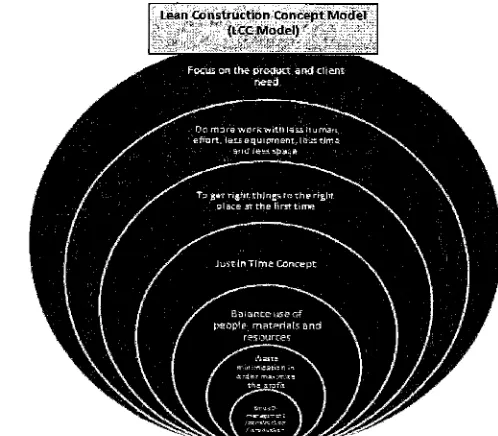
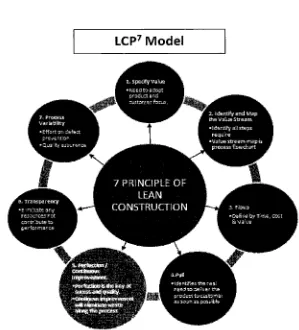
From literature study, the main lean construction concepts and principles are critically studied and can be summarised as LCC and L C P ~ Models in Figure
[image:3.599.168.417.379.597.2]1 and 2, respectively.
FIGURE 1 Lean Construction Concept Model (LCC Model)
LCP7
Model
FIGURE 2 Lean Construction Principle Model (LCP')
According to the response gained from the questionnaires, majority of the respondents are aware of implementation of the Lean Construction Concept and
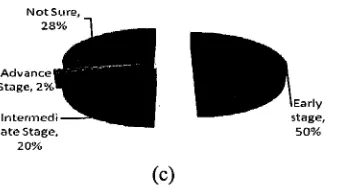
the result is as shown in Figure 3(a). The respondents' awareness reflects similarly to the perception on implementation of lean construction in local industry, as shown in Figure 3(b). However, based on the survey, half of the respondents believe that the implementation is still at early stage, as shown in Figure3 (c).
Not Su*e,,
28Y0
Yes, 57%
Not Sure, -
28%
Intermedl
ate stage, 50%
20%
[image:5.595.219.395.102.196.2](c)
FIGURE 3 Lean Construction Implementation: (a) Awareness, (b) Perception, (c) Level of application
The reasons behind the average implementation of lean construction are thoroughly studied and Table 1 and 2 show the summary of the ranked barrier at management and design stage, respectively.
TABLE 1 Ranked Barrier in Management Stage
Potential Barrier N Mean Rank
Lack of customer I client focus 108 3.35 5
Lack of training 108 3.41 2
Fragmentation of profession 108 3.40 4 Absence of long term planning 108 3.46 1 Ineffective management practice 108 3.4 1 3
TABLE 2 Ranked Barriers in Design Stage
--
Potential Barrier N Mean Rank
Quality assessment focus on conformance 108 3.4 1 1
Fragmentation
of
profession 108 3.362
Fragmentation of supply chain 108 3.36 3
Wait and see attitude 108 3.34 4
Ineffective Management 108 3.33 5
Absence of planning 108 3.27 6
CONCLUSION
REFERENCES
Abd. Ghani. (2006). The Importance of Preliminaries Item. Masters Degree, Universiti Teknologi Malaysia, Skudai.
Atkin, B. and Pothecary, E. (1994). Building Futures. University of Reading, UK.
Ballard, G. and Howell, G. (2003) 'Lean project management', Building Research & Information, 3 1(2), pp. 1 19- 133, [Online]. Available at: http://taylorandfrancis.metapress.coml (Accessed: 13 July 20 1 1).
Ibrahim M.M. and Ong C.K. (2003) Reviewing the Potential of Applying Lean Production Principles to Malaysian Construction Industry. Proceedings of 5th
Madon, Z. (2005). The Understanding of Contract Documentation in Project Implementation. Masters Degree, Universiti Teknologi Malaysia, Skudai.
Moser, L., and Dos Santos, A. (2003). "Exploring the Role of Visual Controls on Murman, E., et al. (2002). Lean Enterprise Value: Insights from MITS LeanAerospace Initiative, Palgrave, New York.
Ong C.K. (2002). Implementing lean principles in Malaysia Construction Industry. Masters Degree, Universiti Teknologi Malaysia, Skudai.
Richard, F. and Anita, N. (2003). 7 Data Analysis (Second Edition), Hong Kong, Blackwell Science Ltd, pp. 176-1 80
Russell, R and Taylor,B.W. (2006), Operations Management - 5th Edition
,
John Wiley & Sons, IncSamsul, H.B. (2008). Collaborative usage of ICT DBMS in Construction Cost Control: The Post Contract Perspectives. Masters Degree, Universiti Teknologi Malaysia, Skudai.
Tan, W. (2004). Practical Research Methods. Singapore: Pearson Prentice Hall.