R E S E A R C H
Open Access
Improved differential fault analysis on
lightweight block cipher LBlock for wireless
sensor networks
Kitae Jeong
1, Changhoon Lee
2*and Jong In Lim
1Abstract
LBlock is a 64-bit lightweight block cipher which can be implemented in both constrained hardware environments, such as wireless sensor network, and software platforms. In this paper, we study the security of LBlock against a differential fault analysis. Based on a random nibble fault model, we propose two versions of the attack on LBlock. In the first attack, we inject random nibble faults to the input register of round 29. As a result, it can recover the secret key of LBlock using an exhaustive search of 225and five random nibble fault injections on average. This attack can be simulated on a general PC within a few seconds. In the case of second attack, random nibble faults are induced to the input register of round 30. This attack can recover the secret key of LBlock using an exhaustive search of 230and seven random nibble fault injection on average. This attack can be simulated on a general PC within 1 h. These results are superior to known differential fault analytic result on LBlock.
Introduction
Differential fault analysis (DFA), one of the side channel attacks, was first proposed by Biham and Shamir on DES in 1997 [1]. This attack exploits faults within the compu-tation of a cryptographic algorithm to reveal the secret information. So far, DFAs on many block ciphers such as DES, Piccolo, LED, SEED, and ARIA have been pro-posed [2-7]. It means that DFA poses a major threat to the security on block ciphers.
LBlock [8] proposed in ACNS 2011 is a 64-bit lightweight block cipher suitable for both constrained hardware environments such as wireless sensor network and software platforms. It is based on the 32-round variant Feistel structure with 64-bit block size and 80-bit key size. There were several cryptanalytic results on LBlock. For example, the proposers of LBlock explored the strength of LBlock against some attacks such as differen-tial cryptanalysis, integral attack, and related-key attack [8]. Also, Karakoc et al. [9] and Liu et al. [10] proposed impossible differential cryptanalysis on a reduced version
*Correspondence: [email protected]
2 Department of Computer Science and Engineering, Seoul National University of Science and Technology, Gongneung-ro, Nowon-gu, Seoul, 139–743, South Korea
Full list of author information is available at the end of the article
of LBlock, respectively. On the other hand, in [11], a differ-ential fault analysis on LBlock was proposed. Based on a random bit fault model, the proposed attack needs at least 7 fault injections.
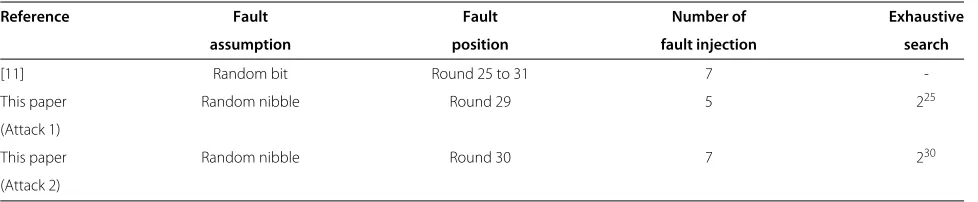
In this paper, we propose a differential fault analysis on LBlock. Based on the random nibble fault model, we con-sider two fault assumptions. In the first attack (Attack 1), it is assumed that several random nibble faults are injected to the input register of round 29. We can compute the exact fault position by checking the corresponding ciphertext differences. Based on the simulation results, this attack requires an exhaustive search of 225 and five random nibble faults on average, and can recover the 80-bit secret key of LBlock within a few seconds on a general PC. In the case of second attack (Attack 2), to recover the 80-bit secret key of LBlock, we inject several random nib-ble faults to the input register of round 30. This attack requires an exhaustive search of 230 and seven random nibble faults on average. It can also recover the 80-bit secret key of LBlock within 1 h on a general PC. Consider-ing that the proposed attack in [11] requires at least 7 fault injections, our results are superior to it (see Table 1).
This paper is organized as follows. In the ‘Description of LBlock’ section, we briefly introduce the structure of LBlock. In the ‘Attack 1 - fault position: round 29’ and
Table 1 Comparison between DFA results on LBlock
Reference Fault Fault Number of Exhaustive
assumption position fault injection search
[11] Random bit Round 25 to 31 7
-This paper Random nibble Round 29 5 225
(Attack 1)
This paper Random nibble Round 30 7 230
(Attack 2)
‘Attack 2 - fault position: round 30’ sections, our attacks on LBlock are presented. Finally, in the last section, we give our conclusion.
Description of LBlock
In this section, we introduce the structure of LBlock briefly. The notations used in this paper are as follows. Here, a 32-bit valueX = (X7,X6,· · ·,X0), where Xi is a nibble value.
• P=(PL,PR): a 64-bit plaintext. • C=(CL,CR): a 64-bit ciphertext.
• Ir=(IrL,IrR): a 64-bit input value of roundr (r=1, 2,· · ·, 32).
• Kr =(Kr,7,Kr,6,· · ·,Kr,0): a 64-bit round key of roundr.
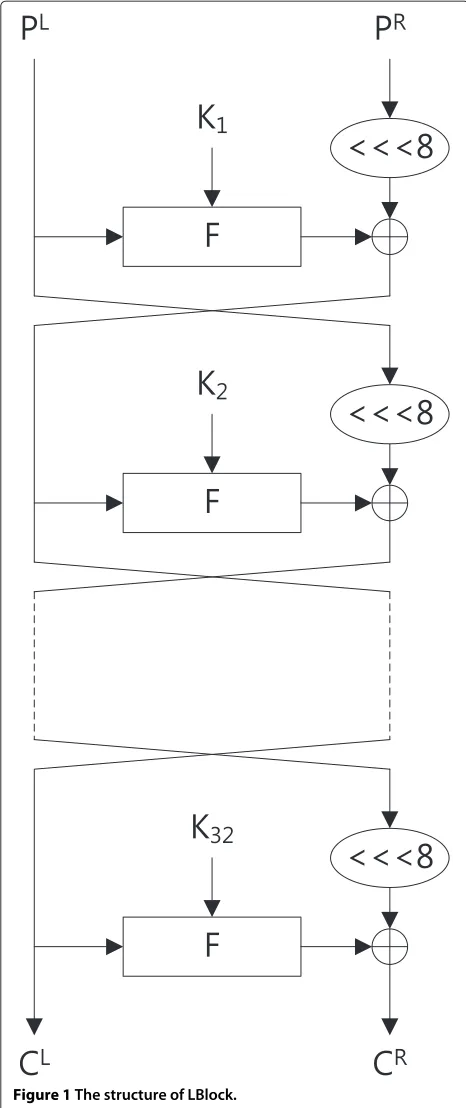
LBlock is a 64-bit block cipher and supports the 80-bit secret key. As shown in Figure 1, the structure of LBlock is a 32-round iterative structure which is a variant of Feistel network. To generate a 64-bit ciphertext C = (CL,CR) from a 64-bit plaintextP =(PL,PR), LBlock executes the following procedure. Here,≪is a left circular rotation.
(1) I1=(I1L,Ir1)←(PL,PR).
(2) Forr=1, 2,· · ·, 32, do the following:
Ir+1=(IrL+1,IrR+1)=
F(IrL,Kr)⊕(IRr ≪8),IrL
.
(3) (CL,CR)←(I33R,I33L).
(4) OutputC=(CL,CR)as a 64-bit ciphertext.
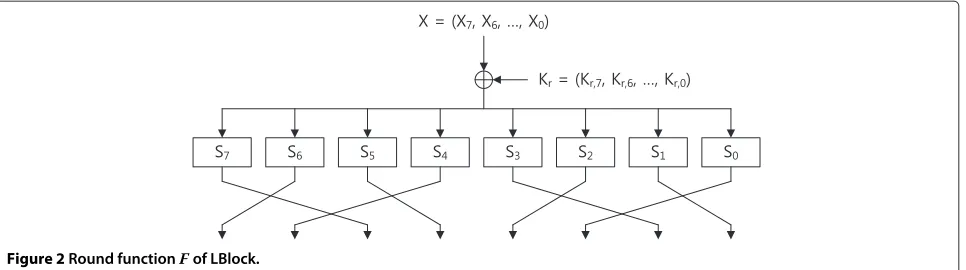
The round functionFis defined as follows (see Figure 2). Here, S andPdenote the confusion and diffusion func-tions.
F:{0, 1}32× {0, 1}32 −→ {0, 1}32
(X,Kr) −→ U=P(S(X⊕Kr))
The confusion functionSdenotes the nonlinear layer of round functionF. It consists of eight 4×4 S-boxesSiin
parallel(i = 1, 2,· · ·, 8). The contents of these S-boxes are listed in Table 2.
S: {0, 1}32 −→ {0, 1}32
Y =(Y7,Y6,· · ·,Y0) −→ Z=(Z7,Z6,· · ·,Z0)
Z7=S7(Y7), Z6=S6(Y6), Z5=S5(Y5), Z4=S4(Y4) Z3=S3(Y3), Z2=S2(Y2), Z1=S1(Y1), Z0=S0(Y0).
The diffusion function P is defined as a permutation of eight nibble words, and it can be expressed as the following equations:
P: {0, 1}32 −→ {0, 1}32
Z=(Z7,Z6,· · ·,Z0) −→ U=(U7,U6,· · ·,U0)
U7=Z6, U6=Z4, U5=Z7, U4=Z5 U3=Z2, U2=Z0, U1=Z3, U0=Z1.
The 80-bit secret keyK is stored in a key register and denoted asK = (k79,k78,k77,k76,· · ·,k1,k0). Output the
leftmost 32 bits of current content of registerKas round subkeyK1, and then operate as follows:
Fori=1, 2,· · ·, 31, update the key registerKas follows:
(1) K ←(K≪29).
(2) (k79,k78,k77,k76)=S9((k79,k78,k77,k76)). (3) (k75,k74,k73,k72)=S9((k75,k74,k73,k72)).
(4) (k50,k49,k48,k47,k46)←((k50,k49,k48,k47,k46)⊕i). (5) Output the leftmost 32 bits of current content of
registerK as a round keyKi+1of roundi+1.
Table 3 presents the partial secret keys used in each round key of LBlock. For example, a round key K29 of
round 29 includes a 32-bit partial secret key(k67,k66,· · ·, k37,k36).
Attack 1 - fault position: round 29
Figure 1The structure of LBlock.
(1) The attacker has the capability to choose one plaintext to encrypt and obtain the corresponding right/faulty ciphertexts.
(2) The attacker can induce random byte faults to the input register of round 29.
(3) The location and value of faults are both unknown.
From the above assumptions, a random nibble fault can be induced to the input byte register I29,L i of round 29 (i = 0, 1,· · ·, 7). Note that in Attack 1, we do not con-sider events injecting random nibble faults toIR29,i. They are considered in Attack 2, where random nibble faults are injected toI30,L i. Thus, the number of all possible fault positions is 8. For the simplicity of notations, we denote each case byE29,L i. For example,EL29,7means an event that a random nibble fault is injected toI29,7L .
Computation of the exact fault position
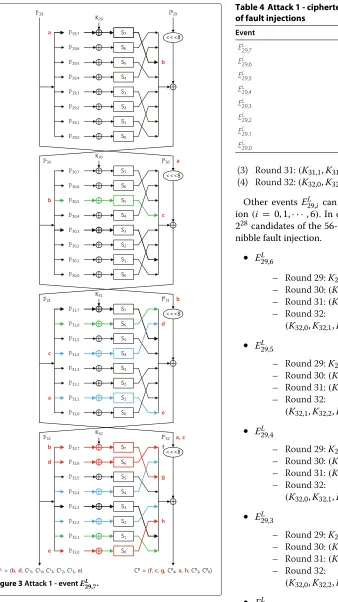
First, we assume that a random nibble fault was injected to I29,7L , that, is an eventEL29,7was occurred. Figure 3 presents the differential propagation under this assumption.
According to our fault assumption, the input difference I29ofI29has the following pattern. Here,a=0.
I29=I29L,I29R
=[(a, 0, 0, 0, 0, 0, 0, 0), (0, 0, 0, 0, 0, 0, 0, 0)] .
Then, as shown in Figure 3, the output difference of round function F of round 29 is computed as follows. Here,bis an output difference of S-boxS7takingaas an
input difference(b=S7(a)). Thus, the input difference of
round 30 has the following pattern:
I30=I30L,I30R
=[(0, 0,b, 0, 0, 0, 0, 0), (a, 0, 0, 0, 0, 0, 0, 0)] .
The input differenceI31 of round 31 is computed as
follows. Here,cis an output difference of S-boxS5takingb
as an input difference(c=S5(b)). Note that, in round 30, awas moved fromIR30,7toI31,1L by an 8-bit left circular rotation.
I31=
I31L,I31R=[(0, 0, 0,c, 0, 0,a, 0), (0, 0,b, 0, 0, 0, 0, 0)] .
Similarly, the input differenceI32of round 32 has the
following pattern. Here,d=S4(a)ande=S1(a).
I32=
I32L,I32R=[(b,d, 0, 0, 0, 0, 0,e), (0, 0, 0,c, 0, 0,a, 0)] .
Hence, when a random nibble fault was injected toI29,7L , that is an event EL29,7, the ciphertext difference has the following pattern.
Here,f =S6(d),g=S7(b), andh=S0(e).
Figure 2Round functionFof LBlock.
exact fault position from the patterns of the ciphertext differences.
Computation of round keys for each fault position
We assume that an eventEL29,7has occurred. That is, it is assumed that a random nibble fault was induced toI29,7L . In this case, we can compute 228candidates of the 56-bit
round key by executing the following procedure:
(1) K32,7. Guess 4-bitK32,7and compute the output difference of S-boxS7in round 32 (see red lines in Figure 3). Then, check that this value is equal to
C5R. The probability passing this test is2−4. Thus, we can expect that only the rightK32,7has survived. (2) K32,6. Guess 4-bitK32,6and compute the output
difference of S-boxS6in round 32 (see red lines in Figure 3). Then, check that this value is equal to
C7R. Since the filtering probability is2−4, we can compute the rightK32,6.
(3) K32,0. Guess 4-bitK32,0and compute the output difference of S-boxS0in round 32 (see red lines in Figure 3). Then, check that this value is equal to
C2R. The probability passing this test is2−4. Thus, we can expect that only the rightK32,0has survived.
Table 2 Contents of S-boxes used in LBlock
S-box Contents
S0 14, 9, 15, 0, 13, 4, 10, 11, 1, 2, 8, 3, 7, 6, 12, 5
S1 4, 11, 14, 9, 15, 13, 0, 10, 7, 12, 5, 6, 2, 8, 1, 3
S2 1, 14, 7, 12, 15, 13, 0, 6, 11, 5, 9, 3, 2, 4, 8, 10
S3 7, 6, 8, 11, 0, 15, 3, 14, 9, 10, 12, 13, 5, 2, 4, 1
S4 14, 5, 15, 0, 7, 2, 12, 13, 1, 8, 4, 9, 11, 10, 6, 3
S5 2, 13, 11, 12, 15, 14, 0, 9, 7, 10, 6, 3, 1, 8, 4, 5
S6 11, 9, 4, 14, 0, 15, 10, 13, 6, 12, 5, 7, 3, 8, 1, 2
S7 13, 10, 15, 0, 14, 4, 9, 11, 2, 1, 8, 3, 7, 5, 12, 6
S8 14, 9, 15, 0, 13, 4, 10, 11, 1, 2, 8, 3, 7, 6, 12, 5
S9 4, 11, 14, 9, 15, 13, 0, 10, 7, 12, 5, 6, 2, 8, 1, 3
(4) (K31,4,K32,4). Guess 8-bit(K31,4,K32,4)and compute the output difference of S-boxS4in round 31 (see blue lines in Figure 3). Then, check that this value is equal toCL6. Since the filtering probability is2−4, we can get24candidates of(K
31,4,K32,4).
(5) (K31,1,K32,2). Guess 8-bit(K31,1,K32,2)and compute the output difference of S-boxS1in round 31 (see blue lines in Figure 3). Then, check that this value is equal toCL0. Since the filtering probability is2−4, we can get24candidates of(K31,1,K32,2).
(6) (K30,5,K31,6,K32,1). Guess 12-bit(K30,5,K31,6,K32,1) and compute the output difference of S-boxS5in round 30 (see green lines in Figure 3). Then, check that this value is equal toC6R. Since the filtering probability is2−4, we can get28candidates of
(K30,5,K31,6,K32,1).
(7) (K29,7,K30,3,K31,7,K32,3). Guess 16-bit
(K29,7,K30,3,K31,7,K32,3)and compute the output difference of S-boxS7in round 29 (see bold black lines in Figure 3). Then, check that this value is equal toCL7. Since the filtering probability is2−4, we can obtain212candidates of(K29,7,K30,3,K31,7,K32,3).
According to the above procedure, we can obtain 228 candidates of the following 56-bit round key by using one random nibble fault injected toIL29,7.
(1) Round 29:K29,7. (2) Round 30:(K30,3,K30,5).
Table 3 Partial secret key used in round keys
Round Partial secret key
1 (k79,k78,· · ·,k49,k48)
2 (k50,k49,· · ·,k20,k19)
. . .
. . .
29 (k67,k66,· · ·,k37,k36)
30 (k38,k37,· · ·,k8,k7)
31 (k9,k8,· · ·,k0,k79,k78,· · ·,k58)
Figure 3Attack 1 - eventEL
29,7.
Table 4 Attack 1 - ciphertext differences for the positions of fault injections
Event Ciphertext difference
EL
29,7 [(?, ?, 0, 0, 0, 0, 0, ?),(?, ?, ?, 0, ?, ?, 0, 0)] EL
29,6 [(0, 0, 0, ?, 0, ?, ?, 0),(?, ?, 0, 0, ?, ?, 0, ?)] EL
29,5 [(?, ?, ?, 0, 0, 0, 0, 0),(?, 0, ?, ?, 0, 0, ?, ?)] EL29,4 [(?, 0, ?, 0, 0, 0, 0, ?),(0, 0, ?, ?, 0, ?, ?, ?)]
EL29,3 [(0, 0, 0, ?, ?, ?, 0, 0),(?, ?, 0, 0, ?, ?, ?, 0)]
EL29,2 [(0, ?, ?, 0, 0, 0, 0, ?),(?, ?, 0, ?, ?, ?, 0, 0)]
EL29,1 [(0, 0, 0, 0, ?, ?, ?, 0),(0, 0, ?, ?, ?, 0, ?, ?)] EL
29,0 [(0, 0, 0, ?, ?, 0, ?, 0),(0, ?, ?, ?, 0, 0, ?, ?)]
(3) Round 31:(K31,1,K31,4,K31,6,K31,7).
(4) Round 32:(K32,0,K32,1,K32,2,K32,3,K32,4,K32,6,K32,7).
Other eventsE29,L i can be explained in a similar fash-ion(i = 0, 1,· · ·, 6). In detail, in each event, we can get 228 candidates of the 56-bit round key from one random nibble fault injection.
• EL29,6
– Round 29:K29,6. – Round 30:(K30,1,K30,7).
– Round 31:(K31,0,K31,2,K31,3,K31,5). – Round 32:
(K32,0,K32,1,K32,2,K32,4,K32,5,K32,6,K32,7).
• EL29,5
– Round 29:K29,5. – Round 30:(K30,4,K30,6).
– Round 31:(K31,1,K31,4,K31,6,K31,7). – Round 32:
(K32,1,K32,2,K32,3,K32,4,K32,5,K32,6,K32,7).
• EL29,4
– Round 29:K29,4. – Round 30:(K30,4,K30,6).
– Round 31:(K31,1,K31,4,K31,6,K31,7). – Round 32:
(K32,0,K32,1,K32,2,K32,3,K32,4,K32,5,K32,7).
• EL29,3
– Round 29:K29,3. – Round 30:(K30,1,K30,7).
– Round 31:(K31,0,K31,2,K31,3,K31,5). – Round 32:
(K32,0,K32,2,K32,3,K32,4,K32,5,K32,6,K32,7).
• EL29,2
– Round 29:K29,2. – Round 30:(K30,3,K30,5).
– Round 32:
Recovery of the secret key from candidates of round keys In the previous subsection, we presented the method to obtain the candidates of round keys by injecting random nibble faults to the input register of round 29. In this sub-section, we explain the method to recover candidates of the secret key of LBlock using candidates of round keys.
As shown in Table 3, the partial secret key used in (K29,K30,K31,K32)is as follows:
80-bit secret key information. Thus, from the keysched-ule of LBlock, we can easily compute candidates of the secret key of LBlock by using candidates of round keys computed in the previous subsection. However, in the case that the number of candidates of round keys is very large, we require the exhaustive search with the large compu-tational complexity. On the other hand, from the above relation, we can check that each round key include the common partial secret key information. Thus, if equations are constructed by using this property, we can decrease the number of candidates of the secret key of LBlock.
To decrease the number of candidates of the secret key, we consider equations as shown in Table 5. The total filter-ing probability is 2−41. Here, ‘&’ means ‘AND’ operation, andS9−1andS−81are the inverse functions of the S-boxes S9andS8, respectively.
DFA on LBlock (Attack 1)
Now, we are ready to propose a differential fault analysis on LBlock under an assumption that random nibble faults are injected to the input register of round 29. Our attack procedure is as follows:
(1) Collection of right ciphertext. Choose a plaintext P and obtain the corresponding right ciphertext C=(CL,CR).
(2) Collection of faulty ciphertext. After inducing an i th random nibble fault toI29L =(I29,7L ,I29,6L ,· · ·,I29,0L )of round 29, get the corresponding faulty ciphertextCi (i=1,· · ·,n).
(3) Computation of fault positions. ComputeCiby using(C,Ci)and then compute the exact fault positions from Table 4.
(4) Computation of the candidates of
(K29,K30,K31,K32). According to the fault positions computed in step 3, compute the candidates of
(K29,K30,K31,K32)by using the method in ‘Computation of round keys for each fault position’ section.
(5) Recovery of the 80-bit secret key. Using the method in ‘Recovery of the secret key from candidates of round keys’ section, compute the candidates of the secret key by using the candidates of
(K29,K30,K31,K32). Then, recover the 80-bit secret key of LBlock by using one trial encryption.
We simulated our attack on a general PC 10, 000 times. Based on the simulation results, we can obtain about 225 candidates of the secret key by using five fault injections on average. Thus, we do an exhaustive search for them. Since the filtering probability is 2−64, the expected number of wrong secret keys passing our attack algorithm is 2−39(= 225 · 2−64). It means that the possibility that a wrong key can pass our attack algorithm is very low. Based on the simulation results, we can always recover the 80-bit secret key of LBlock within a few seconds by using five fault injections on average.
Attack 2 - fault position: round 30
In this section, we propose the second attack (Attack 2) where random nibble faults are induced to the input reg-ister of round 30. Since the attack procedure of Attack 2 is similar to that of Attack 1, we briefly discuss the attack procedure of Attack 2.
Our fault assumption is as follows.
• The attacker has the capability to choose one plaintext to encrypt and obtain the corresponding right/faulty ciphertexts.
• The attacker can induce random byte faults to the input register of round 30.
• The location and value of faults are both unknown.
Table 5 Attack 1 - equations to decrease the number of candidates of the secret key
Related secret key Equation Filtering probability
(k58,k59,k60) {(S−91[K32,7])1} =(K32,0&0x7) 2−3
(k37,k38) (K32,2&0x3)=(K30,72) 2−2
(k35,k36) (K32,12)=(K30,7&0x3) 2−2
(k33,k34) (K32,1&0x3)=(K30,62) 2−2
(k31,k32) {(K32,02)⊕0x1} =(K30,6&0x3) 2−2
(k29,k30) {(K32,0&0x3)⊕0x3} =(K30,52) 2−2
(k7,k8,k9) {(S−91[K31,7])1} =(K30,0&0x7) 2−3
k60 [{(S−91[K32,7])3} ⊕0x1]=(K29,6&0x1) 2−1
(k57,k58,k59) [{(S−91[K32,7])&0x7} ⊕0x7]=(K29,51) 2−3
k56 {(S−81[K32,6])3} =(K29,5&0x1) 2−1
(k53,k54,k55) {(S−81[K32,6])&0x7} =(K29,43) 2−3
k52 (K32,53)=(K29,4&0x1) 2−1
(k49,k50,k51) (K32,5&0x7)=(K29,31) 2−3
k48 (K32,43)=(K29,3&0x1) 2−1
(k45,k46,k47) (K32,4&0x7)=(K29,21) 2−3
k44 (K32,33)=(K29,2&0x1) 2−1
(k41,k42,k43) (K32,3&0x7)=(K29,11) 2−3
k40 (K32,23)=(K29,1&0x1) 2−1
k39 {(K32,22)&0x1} =(K29,03) 2−1
(k36,k37,k38) {(S−91[K30,7])1} =(K29,0&0x7) 2−3
consider events injecting random nibble faults toI30,R i in Attack 2. Thus, the number of all possible fault positions is 8.
Table 6 shows the patterns of ciphertext differences for the positions of fault injections in Attack 2. Here, ‘?’ means a nonzero value. For example, the differential propagation under an eventEL30,7is shown in Figure 4. From this table, we can check that the patterns of the ciphertext differ-ences for each event are different from each other. Thus, in Attack 2, we can compute the exact fault position from the patterns of ciphertext differences.
Table 6 Attack 2 - ciphertext differences for the positions of fault injections
Event Ciphertext difference
E30,7L [(0, 0, 0, ?, 0, 0, ?, 0),(?, ?, 0, 0, 0, 0, 0, ?)] EL
30,6 [(0, 0, ?, 0, 0, 0, 0, ?),(0, 0, 0, ?, 0, 0, ?, ?)] EL
30,5 [(?, ?, 0, 0, 0, 0, 0, 0),(?, ?, ?, 0, 0, 0, 0, 0)] EL
30,4 [(?, ?, 0, 0, 0, 0, 0, 0),(?, 0, ?, 0, 0, 0, 0, ?)] EL
30,3 [(0, 0, ?, 0, 0, 0, 0, ?),(0, 0, 0, ?, ?, ?, 0, 0)] EL
30,2 [(0, 0, 0, ?, 0, 0, ?, 0),(0, ?, ?, 0, 0, 0, 0, ?)] EL
30,1 [(0, 0, 0, 0, ?, ?, 0, 0),(0, 0, 0, 0, ?, ?, ?, 0)] EL
30,0 [(0, 0, 0, 0, ?, ?, 0, 0),(0, 0, 0, ?, ?, 0, ?, 0)]
Recall that, in Attack 1, we get 228candidates of the 56-bit round key from one random nibble fault injection. In Attack 2, we obtain 212candidates of the 28-bit round key from one random nibble fault injection.
• EL30,7
– Round 30:K30,7. – Round 31:(K31,3,K31,5).
– Round 32:(K32,1,K32,4,K32,5,K32,6).
• EL30,6
– Round 30:K30,6. – Round 31:(K31,1,K31,7).
– Round 32:(K32,0,K32,2,K32,3,K32,5).
• EL30,5
– Round 30:K30,5. – Round 31:(K31,4,K31,6).
– Round 32:(K32,1,K32,4,K32,6,K32,7).
• EL30,4
– Round 30:K30,4. – Round 31:(K31,4,K31,6).
Figure 4Attack 2 - eventEL
30,7.
• EL30,3
– Round 30:K30,3. – Round 31:(K31,1,K31,5).
– Round 32:(K32,0,K32,2,K32,5,K32,6).
• EL30,2
– Round 30:K30,2. – Round 31:(K31,3,K31,5).
– Round 32:(K32,1,K32,4,K32,6,K32,7).
• EL30,1
– Round 30:K30,1. – Round 31:(K31,0,K31,2).
– Round 32:(K32,0,K32,2,K32,3,K32,5).
• E30,0L
– Round 30:K30,0. – Round 31:(K31,0,K31,2).
– Round 32:(K32,0,K32,2,K32,3,K32,5).
Using the candidates of round keys, the method to com-pute the candidates of the secret key of LBlock in Attack 2 is similar to that in Attack 1. Recall that the partial secret key used in(K30,K31,K32)is as follows:
• K30:(k38,k37,· · ·,k8,k7).
• K31:(k9,k8,· · ·,k0,k79,k78,· · ·,k58). • K32:(k60,k59,· · ·,k30,k29).
From the above relation, (K30,K31,K32) includes all
80-bit secret key information. Thus, from the keysched-ule of LBlock, we can easily compute candidates of the secret key of LBlock by using candidates of the round keys. To decrease the number of candidates of the secret key, we consider seven equations related to round 30 to 32 as shown in Table 5. The total filtering probability is 2−16.
The attack procedure of Attack 2 is as follows:
(1) Collection of right ciphertext. Choose a plaintext P and obtain the corresponding right ciphertext C=(CL,CR).
(2) Collection of faulty ciphertext. After inducing an i th random nibble fault toI30L =(I30,7L ,I30,6L ,· · ·,I30,0L )of round 30, get the corresponding faulty ciphertextCi (i=1,· · ·,n).
(3) Computation of fault positions. ComputeCiby using(C,Ci)and then compute the exact fault positions from Table 6.
(4) Computation of candidates of(K30,K31,K32). According to the fault positions computed in step 3, compute candidates of(K30,K31,K32).
(5) Recovery of the 80-bit secret key. Compute candidates of the secret key by using the candidates of(K30,K31,K32). Then, recover the 80-bit secret key of LBlock by using one trial encryption.
passing our attack algorithm is 2−34(= 230 · 2−64). It means that the possibility that a wrong key can pass our attack algorithm is very low. Based on the simula-tion results, we can always recover the 80-bit secret key of LBlock within 1 h by using seven fault injections on average.
Conclusion
In this paper, we have presented DFA on LBlock suit-able for wireless sensor networks. The proposed attack has two versions, Attack 1 and Attack 2. To recover the 80-bit LBlock, Attack 1 requires an exhaustive search of 225 and five random nibble fault injections on average.
It is executed within a few seconds on a general PC. In the case of Attack 2, this attack is executed within 1 h by using seven random nibble faults. These results are superior to known differential fault analytic result on LBlock.
Competing interests
The authors declare that they have no competing interests.
Acknowledgements
This work was supported by a Korea University grant for author KJ. Also, this research was supported by the The Ministry of Knowledge Economy (MKE), Korea, under the Information Technology Research Center (ITRC) support program (NIPA-2013-H0301–13-3007) supervised by the National IT Industry Promotion Agency (NIPA).
Author details
1Center for Information Security Technologies (CIST), Korea University,
Anam-dong, Seongbuk-gu, Seoul, 136–713, South Korea .2Department of Computer Science and Engineering, Seoul National University of Science and Technology, Gongneung-ro, Nowon-gu, Seoul, 139–743, South Korea .
Received: 3 April 2013 Accepted: 22 May 2013 Published: 3 June 2013
References
1. E Biham, A Shamir, inProceedings of Advances in Cryptology - CRYPTO 1997, ed. by B Kaliski. Differential fault analysis of secret key cryptosystems (Springer Berlin, 1997), pp. 513–525
2. K Jeong, J Sung, S Hong, C Lee, A new approach of differential fault analysis on block ciphers with s-box. Inf. - An Int. Interdiscip. J.16(3(A)), 1915–1928 (2013)
3. K Jeong, Security analysis of block cipher piccolo suitable for wireless sensor networks. Peer-to-Peer Netw. Appl (2013).
doi:10.1007/s12,083–012–0196–9
4. K Jeong, C Lee, inProceedings of The 6th International Symposium on Digital Forensics and Information Security(DFIS-12), ed. by J Park, V Leung, C Wang, and Shon T. Differential fault analysis on block cipher led-64 (Springer Netherlands, 2012), pp. 747–755
5. K Jeong, Y Lee, J Sung, S Hong, Differential fault analysis on block cipher seed. Math. Comput. Model.55(1–2), 26–34 (2012)
6. W Li, D Gu, J Li, Differential fault analysis on the aria algorithm. Inf. Sci.
178(19), 3727–3737 (2008)
7. R Malhotra, A Jain, Fault prediction using statistical and machine learning methods for improving software quality. JIPS.8(2), 241–262 (2012) 8. W Wu, L Zhang, inProceedings of ACNS 2011, ed. by J Lopez, Tsudik G.
Lblock: A lightweight block cipher (Springer Berlin, 2011), pp. 327–344 9. F Karakoc, J Demirci, A Harmanci, inProceedings of WISTP 2012, ed. by I
Askoxylakis, H Pohls, and Posegga J. Impossible differential cryptanalysis on reduced-round Lblock (Springer Berlin, 2012), pp. 179–188
10. Y Liu, D Gu, Z Liu, W Li, inProceedings of ISPEC 2012, ed. by M Ryan, B Smyth, and G Wang. Impossible differential attacks on reduced-round Lblock (Springer Berlin, 2012), pp. 97–108
11. L Zhao, T Nishide, K Sakurai, inProceedings of COSADE 2012, ed. by W Schindler, Huss S. Differential fault analysis of full Lblock (Springer Berlin, 2012), pp. 135–150
doi:10.1186/1687-1499-2013-151
Cite this article as:Jeonget al.:Improved differential fault analysis on lightweight block cipher LBlock for wireless sensor networks.EURASIP
Journal on Wireless Communications and Networking20132013:151.
Submit your manuscript to a
journal and benefi t from:
7Convenient online submission
7Rigorous peer review
7Immediate publication on acceptance
7Open access: articles freely available online
7High visibility within the fi eld
7Retaining the copyright to your article