R E S E A R C H
Open Access
Performance analysis and power allocation
strategy in single-antenna cognitive overlay
systems
Wei-Lun Lin
1*, Chih-Hao Lin
2and Fan-Shuo Tseng
2Abstract
A power allocation strategy is proposed for single-antenna overlay cognitive radio networks, in which the secondary user helps transmit the signal of the primary user while concurrently conveying its own signal by means of a
superposition coding technique. The study commences by deriving analytical expressions for the bit error rates (BERs) of the primary and secondary users. A power allocation strategy is then proposed for minimizing the total power consumption of the two users while simultaneously satisfying their respective BER constraints. The analytical BER formulas are not convex, and hence the optimization process presents a significant challenge. Accordingly, two more tractable BER approximations for the primary and secondary users are proposed to transfer the non-convex problem into a convex one. The simulation results confirm the effectiveness of the proposed power allocation strategy under various channel environments.
Keywords: Cognitive radio; Overlay design; Cooperative relaying; Superposition coding; Power allocation
1 Introduction
Cognitive radio (CR) transceiver design has received sig-nificant attention in recent years due to the ability it pro-vides to make more efficient use of the spectrum resources [1–3]. By assigning the CR users different priorities, i.e., primary users (or non-cognitive users), denoted as UA, and secondary users (or cognitive users), denoted asUB, both types of user are able to coexist in a neat way and fully utilize all of the spectrum resources. As a result, CR provides a highly promising solution for future wireless systems [4].
In developing CR networks, the aim is forUBto max-imize its use of the spectrum resources without severely affecting the transmissions ofUA. Existing CR schemes can be broadly classified as either interweave, underlay, or overlay [3, 5–17]. For convenience in the following discussions, letTAandRAdenote the primary transmit-ter and primary receiver, respectively, and letTBandRB
*Correspondence: [email protected].
1Department of Communications Engineering, Feng Chia University, Taichung, 40724 Taiwan
Full list of author information is available at the end of the article
denote the secondary transmitter and secondary receiver, respectively.
In interweave networks, UB transmits its signal to
the intended receiver only if the spectrum is not
occu-pied by UA. The performance of the interweave CR
schemes is thus dominated by the ability of the users to sense the spectrum occupancy [11, 12]. If the users fail to detect spectrum holes, performance degradation inevitably occurs. Thus, spectrum detection is a critical issue in interweave CR networks. Furthermore, each user consumes a distinct channel in the interweave CR model, and hence the capacity of the system to accommodate users is restricted. The underlay CR model improves spec-trum utilization by allowingUBto convey its signal over the same channel as that used by UAprovided that the transmissions ofTBdo not interfere with those ofRAtoo severely. To minimize interference at RA, TB should be designed such that the power of its interference falls below a certain predefined threshold [2, 3, 13–15]. However, the error performance of RB may still be unsatisfactory due to additional constraints imposed atRA. It is noted that this effect is particularly apparent whenTBis located physically close toRA.
The overlay CR model is designed to overcome the poor error performance atRBby enablingTBto helpUArelay its signal while concurrently transmitting its own signal. This assistive function can be realized using either some form of cooperative relaying technique or a superposition
coding (SC) scheme [5, 14–17]. For the case where TB
is equipped with multiple antennas [6], the zero-forcing beamformer can be used to convey the signals ofUAand
UBconcurrently using a random vector quantization feed-back mechanism [5, 14]. In [7], the primary and secondary systems operate simultaneously using the space-time code originally developed for multiple-input multiple-output systems. More specifically, Alamouti code is applied at the secondary transmitter such that the signals received at the receiver can be decoupled and interference-free sig-nals obtained. The overlay designs in [5–7, 14, 18], rely on either precoding or the use of space-time coding at
TB. However, for some applications such as sensor and body networks, allocating single antenna at each node can practically save power and cost [19, 20].
It was shown in [21] and [19] that through the assis-tance ofTBthe error performance ofUAcan be enhanced such that the required quality-of-service (QoS) is guar-anteed. However, an efficient CR design is crucial when space diversity is not available at the transceiver pairs of
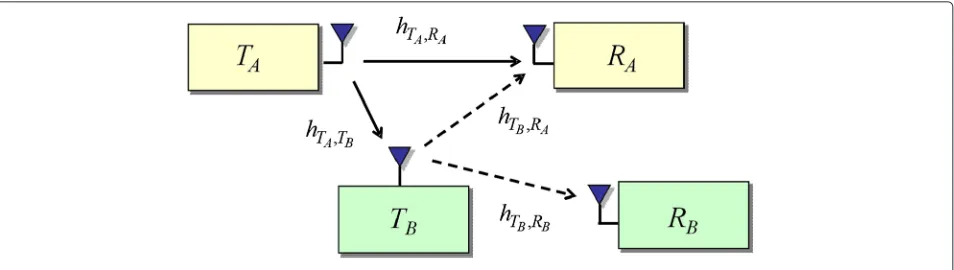
UAandUB. Accordingly, this study focuses specifically on the problem of QoS-controlled overlay CR design with no space diversity. In developing the proposed overlay design, an assumption is made that the signals are transmitted in two phases, as shown in Fig. 1. In the first phase,TA broadcasts its signal to both RA and TB. In the second
phase, TB performs decode-and-forward (DF) over the
received signal fromTA. Specifically, ifTBfails to decode the received signal fromTA,TBtransmits only its own sig-nal. However, if decoding is successful, TB transmits an SC-combined signal comprising the signals of bothUA’s andUB’s signals toRAandRBwith an appropriate power gain.RAcombines the two signals received fromTAand
TBusing a maximum ratio combining (MRC) technique
and then decodes the signal. Similarly, RB decodes the SC-combined signal fromTB.
Due to the signal transmission protocol used in the con-sidered overlay CR network, the error performances of
UAandUBare inherently affected by both the transmit-ted powers ofTAandTBand the power allocation factor used in the SC scheme. To evaluate the respective effects of these factors on the error performance, this study com-mences by analyzing the BERs ofUAandUB, where the BER is expressed as a function of the transmitted powers ofUAandUBand the power allocation ratio applied in the SC scheme. A power allocation strategy for the SC scheme is then proposed to minimize the total power consump-tion of the two users while simultaneously satisfying their respective BER constraints (i.e., QoS requirements). The analytical BER formulations are not convex, and hence determining the optimal solution for the power alloca-tion ratio is challenging, even for numerical methods. To address this problem, two more tractable BER formulas are proposed forUA’s andUB’s BER. The optimum power allocation factor is then determined by solving these two approximations with the proposed non-iterative and iter-ative approaches. The validity of the proposed power allocation strategy under various channel link conditions is demonstrated by means of numerical simulations.
The remainder of this paper is organized as follows. Section 2 introduces the signal model of the overlay transceiver structure and derives the related analytical BER formulations. The approximated BER expressions are then formulated. Section 3 describes the proposed opti-mal power allocation strategy based on the approximated BER expressions. Section 4 presents and discusses the simulation results. Finally, Section 5 provides some brief concluding remarks.
2 System model and BER performance
2.1 System model
Figure 1 shows the overlay spectrum-sharing system con-sidered in the present study. Note that each node is
equipped with only a single antenna. The received signals
yR(1A) ∈ Candy(T1B) ∈ CatRAandTBin the first phase can be expressed respectively as
y(R1)
In (1) and (2), sA denotes the signal transmitted by
UA. Moreover, hTA,RA ∼ G0 Here,G0(σ2)denotes a zero-mean complex Gaussian dis-tribution with varianceσ2; finally,n(1)
respectively, with varianceσn2,R
A andσ
2
n,TB; andPAis the transmitted power ofTA.
WhenTBreceives the signal fromTAin the first phase, it performs a DF operation on the received signalsA. IfsA is decoded correctly, thenTB combinessA andsB using SC1. However, if the decoding process fails, thenTB sim-ply transmits its own signalsB. Note that in the present study, it is assumedRAlearns the result of the DF opera-tion through a control signal. Thus, the received signal at
RAandRBin the second phase are expressed respectively as
0 , otherwise
(3) respectively, with variance σT2
B,RA and σ
denote the noise received at RA and RB, respectively, with varianceσn2,RA andσn2,RB;PBis the transmitted power ofTB; andδis the power allocation factor applied for combining signalssA andsBin the SC scheme. The largerδis the larger portion of the composite signal allocating tosA.
2.2 BER performance
In evaluating the BER performance of the considered overlay CR scheme, the following discussions commence by deriving analytical formulas for the BERs in decoding
sA at RA andsB at RB, respectively. Tight approximated
BER expressions are then derived to facilitate the SC power allocation optimization process.
2.2.1 BER performance in decoding sAfor UA
Decoding signal sA at RA involves two diverse cases, namelyTBdecodessAcorrectly andTBdecodessA incor-rectly. For the former case,TBtransmits the SC-combined signal shown in (3) and (4) to RA and RB concurrently in the second phase. It is thus necessary to first decode
sB correctly and then to subtract sB from y(R2A). Since sB is subtracted first, the SC power allocation factor δ is restricted to the interval [ 0, 0.5] to avoid serious degra-dation in decodingsA. Then, MRC is adopted to combine the extracted signals for decodingsAfrom the two phases. Note that ifRAfails to decodesB, MRC is not performed, andsAis decoded merely based on the signaly(R1A). Here, we denotePRA,I
e,sA as the BER ofsAatRAfor this case. For the latter case,TBincorrectly decodessA, whereRA detectssAthroughy(R1A). DenotePTe,BsAandP
RA,II
e,sA as the BERs ofsAatTBandRA, respectively. The overall average BER denoted asPe,Acan then be evaluated as separately derived in the following. Without loss of gen-erality, forsAandsB, binary phase shift keying is adopted and an equal probability of the data symbol outcomes is assumed.
SincesA is corrupted only by the fading channel gain
hTA,RA, the conditioned BER can be expressed as [22]
The channel gains are assumed to be complex Gaussian distributed. As a result, PTB
e,sA can be easily obtained by averagingPTB
e,sA
received signaly(R2A) subtracts the correctly decodedsB to bey˜(R2A), then an MRC operation is optimally performed over the received signalsy(R1A)andy˜R(2A).2SincesBneeds to be correctly decoded first,sBrequires a larger amount of power to be allocated, which means 0≤ δ ≤ 0.5. Other-wise, the error occurs even when the noise is absent. Let the BER of this case be denoted asPRA,I,(MRC)
e,sA . The corre-sponding BER conditioned on the channel gains required for decodingsAcan be derived as
PRA,I,(MRC)
For the latter case, ifsBis decoded incorrectly, we only usey(R1A)to detectsA, and the corresponding BER is equal to be computed as
PRA,I
Here, we can observe that the formulation of (10) is more complicated than that of (6) sincesBis decoded from a composite signal in (3), while sA is decoded from the received signal in (2). The BER in decodingsAatRAcan be obtained with the assistance of (8)–(10) as
PRA,I form using the approximation given in Appendix A, where
Pe,Ais obtained as a function ofδ,PA, andPB.
2.2.2 BER performance in decoding sBfor UB
Determining the BER ofUBalso requires the considera-tion of two separate cases, namelyTBdecodessAcorrectly
and incorrectly. First, consider the case whereTBdecodes
sAcorrectly. In this scenario,RBreceives an SC-combined
composite signal from TB in the second phase.
Conse-quently, sB can be directly decoded from the composite signaly(R2)
B using (4). As for the derivation ofP RA,I e,sB
hTB,RA in (10), the conditional BER in decodingsBatRB, denoted asPRB,I
with exponential distribu-tion,PRB,I
For the case whereTBdecodessAincorrectly,TBmerely transmitssBtoRB. Thus, the BER in decodingsB, denoted can be determined from the BERs given above as
Pe,B=
2.2.3 Approximate BER expressions
To facilitate the power allocation optimization process, this section derives two more tractable approximations for
The BERPe,Aderived in (5) can be approximated as
Pe,A≈%Pe,A=
σ2
n,TB 4σ2
TA,TBPA
×
σ2
n,RA 4σ2
TA,RAPA
+
1− σ
2
n,TB 4σT2
A,TBPA
×
σ4
n,RA 16σT2
A,RAσ 2
TB,RAPAPB
1 (1−2δ)2 +
3 δ
. (16)
Note that the detailed derivation is provided in Appendix A.
Meanwhile, BERPe,B derived in (15) can be approxi-mated as
Pe,B ≈%Pe,B
=
σ2
n,TB 4σT2
A,TBPA
×
σ2
n,RB 4σT2
B,RBPB
+
1− σ
2
n,TB 4σT2
A,TBPA
×
σ2
n,RB 4σT2
B,RBPB 1 (1−2δ)2
. (17)
The detailed derivation is provided in Appendix B.
Figure 2 compares the approximated BER curves with true BER curves forσ2
TA,TB/σ 2
n,TB =5 dB,σ 2
TA,RA/σ 2
n,RA =0 dB,σT2B,R
A/σ 2
n,RA=10 dB,σ 2
TB,RB/σ 2
n,RB=10 dB,PA=PB=1,
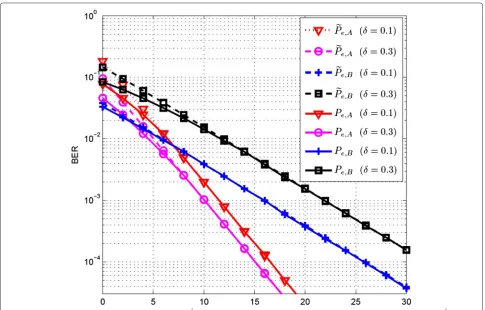
andδ = 0.1 and 0.3. As shown, the approximated BER
values are in good agreement with the actual values; par-ticularly in the high SNR region. Notably, the BER ofUA has a diversity gain of two, whereas that ofUBhas a diver-sity gain of one. The lower diverdiver-sity gain ofUBarises since it only uses a link to transmit signals.
3 Optimal power allocation
3.1 Optimization of power allocation
The previous section has analyzed the BER performance of the primary and secondary users in the considered overlay CR network. Observing the analytical results in (5) and (15), it is seen that the BERs forUAandUB are closely related to the transmitted power, i.e.,PA andPB and the SC power allocation factorδ. Taking the BER as the benchmark of the provided QoS, this section proposes a strategy for determining the SC allocation factor which minimizes the total power consumption of the two users,
PA+PB, while simultaneously achievingPe,A≤BERAand
Pe,B ≤ BERB, where BERAand BERB are the predefined
Fig. 2Comparison of approximated and true BER curves #
σ2
TA,TB/σ 2
n,TB= 5,σ 2
TA,RA/σ 2
n,RA= 0,σ 2
TB,RA/σ 2
n,RA=σ 2
TB,RB/σ 2
n,RB= 10 dB,PA=PB=1
QoSs of the two users. The optimization problem can thus be formulated as
(P1) min
As shown in (5) and (15), the optimization constraints have the form of non-convex functions. Thus, the optimal solution of (18) is almost impossible to obtain, even when using numerical methods. Thus, to facilitate the optimiza-tion process,Pe,AandPe,Bare replaced respectively with
%Pe,Ain (16) and%Pe,Bin (17). The optimization problem can then be reformulated as
(P2) min
The optimal solutions of the proposed optimization (P2) can be sophisticatedly solved though it is still not convex. We have to mention that the proposed approximations (16) and (17) are conservative approximations meaning that the approximated BERs are the upper bounds of the true BERs, and consequently the QoS requirements are always satisfied. Moreover, the BER approximations are tight when the channel quality of the link TA
-to-RA or TB-to-RA is favorable, or equivalently the QoS requirements are assumed to be moderately low. For brevity, defineηa = σn4,RAσn2,TB/ are monotonically decreasing with increasingPA and/or
PBfor any fixed δ. Hence, the minimum total transmit-ted power (PA + PB) can be achieved solely with %Pe,A and %Pe,B being satisfied by the minimum requirement of BER, i.e., %Pe,A = BERA and %Pe,B = BERB. With these two equalities, (19) can be solved by optimizing the parameterδonly. Specifically, with%Pe,B = BERB, we
Here,PBcan be alternatively represented by
PB= ηd some straightforward manipulations, it is shown that
P3A+
The closed-form solution ofPAcorresponding to (22) has the form [23]
where
To simplify (23), define
fQ(δ)=
(23) can then be reformulated as
PA= − Thus, (29) can be rewritten as
PA= − solution which satisfies both constraints since the other two solutions either contradict the basic power assump-tion or the BER constraint, i.e., PA≥ 0 or %Pe,A ≥ 1, respectively.
From (20),PBcan be reformulated as
PB=
Finally, by adding an auxiliary variable t along with the results in (30) and (31), (19) can be rewritten as the following optimization problem:
(P3) min and (28), respectively. The problem formulated in (32) is essentially a convex optimization problem. Thus, the solu-tions ofPAandδcan be obtained via numerical methods, such as the simple steepest descent method, whilePBcan be obtained via (31).
3.2 Iterative approach
(P4−1) min PA
PA
s.t.
%Pe,A≤BERA
%Pe,B≤BERB
PA≥0 (33)
(P4−2) min PB
PB
s.t.
%Pe,A≤BERA
%Pe,B≤BERB
PB≥0 (34)
(P4−3) min
δ δ s.t.
%Pe,A≤BERA
%Pe,B≤BERB
0≤δ≤0.5. (35)
Since (P4−1)–(P4− 3) are convex problems, we can
iteratively solve the solutions through the cvx tool [24]. It
is noteworthy that the iterative approach can essentially obtain a local solution and is sensitive to the initial condi-tion, while the proposed non-iterative approach has only one local solution which suggests it is also a global solu-tion. Thus, it is expected that the performance of the non-iterative approach is superior to the non-iterative approach. More discussion is provided in the following section.
4 Simulation results
This section evaluates the performance of the proposed power allocation method under realistic overlay CR net-work conditions. In performing the simulations, it is assumed that all of the channel links suffer fading with independent and identically distributed (i.i.d.) Rayleigh-distributed amplitudes. Letσn2,T
B = σ
2
n,RB = σ 2
n,RA = 1, BERA = 10−3, and BERB = 5 × 10⁻³. Furthermore, let three levels of channel quality be considered, namely
σ2
TA,RA,σ 2
TA,TB,σ 2
TB,RA,σ 2
TB,RB
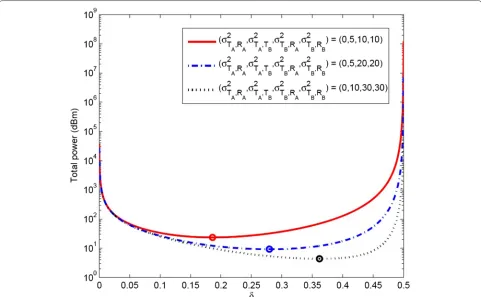
= (0, 5, 10, 10), (0, 5, 20, 20),(0, 10, 30, 30)dBm. For convenience, let the three cases be referred to as case 1, case 2, and case 3, respectively. Figure 3 shows the results for the variation of the power consumption with the power allocation fac-tor. Note that the circles represent the solution obtained
Fig. 3Variation of total power consumption with power allocation factorδgiven different channel conditions #
σ2
s =1,σn2,TB=σ 2
n,RB=σ 2
n,RA= 1,
BERA= 10−3and BERB= 5×10⁻³
using the proposed method. It is seen that the circles are coincident with the point of minimum total power
con-sumption in every case. In other words, the optimumδ
obtained in (32) coincides perfectly with the numerical results. In addition, it is observed that the total power consumption in case 2 is less than that in case 1 since the channel quality in case 2 is better than that in case 1. Finally, it is seen that a larger value ofδresults in a higher σ2
TB,RB. This result is intuitively reasonable since when σ2
TB,RB increases, BERBis more easily satisfied, and hence a greater amount of power is allocated to UA in the SC scheme.
Further simulations were performed to investigate the variation of the total power consumption associated to the fixed power allocation, the iterative approach, and the proposed design. LetσT2
A,RA/σ 2
n=0 dB,σT2A,TB/σ 2
n=15 dB, σ2
TB,RB/σ 2
n = σT2B,RA/σ 2
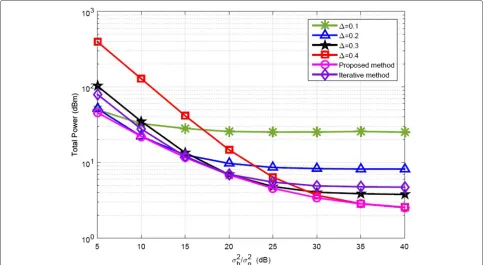
n = σh2/σn2, δ = 0.1, 0.2, 0.3, 0.4. Figures 4 and 5 show the results obtained for the
total power consumption and the resultant BERs ofUB
andUAof the proposed design, respectively. As shown in Fig. 4, for a givenδ, the power consumption decreases as δ decreases. This result follows intuitively since the sig-nal ofUAis potentially conveyed through two links, i.e.,
TA-to-TB-to-RAandTA-to-RA, whereas the signal ofUB is transmitted through only one link, i.e.,TB-to-RB. Due to the fixed channel quality of TB-to-RB, TB is able to
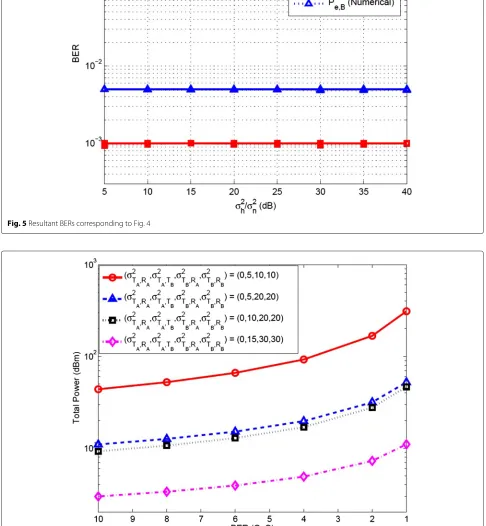
use approximated constant power consumption to main-tain the BER atRB. A smaller value ofδindicates thatUB offers a lower level of assistance. Thus, the power con-sumption at TA must be increased, and hence the total power consumption also increases. Since the optimum value ofδis obtained by the proposed SC allocation fac-tor strategy, the minimal power consumption can also be obtained. The iterative approach performs worse than the proposed design since the iterative approach is a subop-timal method. Figure 5 shows the resultant BER corre-sponding to the proposed design (the curve related to the optimumδ) in Fig. 4. The results confirm that the resul-tant BERs are consistent with the required QoS consresul-tants. Sinceδ represents the power allocated toUA, the power
ofUA must be increased to enableRAto conduct MRC
whenδis small, which ensures thatRAsatisfies the QoS constraint.
A final series of simulations was performed to inves-tigate the power consumption given different
chan-nel link qualities and QoS constraints. Let BERA =
BERB = γ. Four different link qualities were considered, namely
σ2
TA,RA,σ 2
TA,TB,σ 2
TB,RA,σ 2
TB,RB
= (0, 5, 10, 10), (0, 5, 20, 20),(0, 10, 20, 20),(0, 15, 30, 30) dBm. As shown in Fig. 6, for a given link quality, the power consump-tion increases with a decreasing BER. Furthermore, for a constant BER, the power consumption given a channel
Fig. 4Total power consumption as function of power allocation factor (δ= 0.1, 0.2, 0.3, 0.4), the iterative approach, and the proposed design. #
σ2
TA,RA/σ 2
n= 0 dB,σT2A,TB/σ 2
n= 15 dB,σT2B,RB/σ 2
n=σT2B,RA/σ 2
n=σh2/σn2
Fig. 5Resultant BERs corresponding to Fig. 4
link quality of(0, 5, 20, 20)is almost identical to that for a channel link quality of(0, 10, 20, 20). However, for channel link qualities of(0, 5, 10, 10)and(0, 5, 20, 20), a significant difference in the power consumption is observed. These findings are to be expected since, in the former case, only linkTA-to-TBhas a good channel quality. As a result, the power of
UAis decreased, while that ofUBis potentially increased under the SC scheme. By contrast, in the latter case, both linksTB-to-RAandTB-to-RBhave favorable channel quality. Consequently, the powers allocated toUAandUBare both decreased, with the result that the total power consumption is also decreased.
5 Conclusions
This paper has considered the problem of optimizing the power allocation strategy in cooperative spectrum-sharing cognitive CR systems. Given the use of a SC scheme atTB, analytical expressions have been derived for the
cor-responding BERs at RA and RB. To determine the optimal SC power allocation factor, two more tractable BER
expressions have been proposed for UA and UB. The allocation problem has been formulated as an optimization
problem in which the aim is to minimize the total power consumption of the two users while simultaneously sat-isfying their BER constraints. Notably, the proposed BER approximations enable the optimization problem to be expressed as a convex formulation amenable to numerical processing. The simulation results have confirmed the abil-ity of the proposed power allocation strategy to achieve the optimal power distribution over a range of realistic CR conditions.
Appendix A: Derivation ofPe,A The second term of (11), denoted asIRA
1 , can be computed as
IRA
1 =
∞
0
∞
0
PRA,I e,sB
hTB,RA P RA,II e,sA
hTA,RA
×e− hTA,RA2
γTA,RA − hTB,RA2
γTB,RA
dhTA,RA 2
dhTB,RA 2
=
⎛ ⎜ ⎜ ⎜ ⎜ ⎜ ⎝
1 2
1
j=0
∞
0
Q
⎛ ⎜ ⎜ ⎜ ⎜ ⎜ ⎝
2PBσ 2
TB,RA σ2
n,RA
√
1−δ+(−1)j√δ2
' () *
:=TB,RA(j)
x
⎞ ⎟ ⎟ ⎟ ⎟ ⎟ ⎠
e−xdx
⎞ ⎟ ⎟ ⎟ ⎟ ⎟ ⎠
×
⎛ ⎝ ∞
0
Q
⎛ ⎝
2PAσT2A,RA σ2
n,RA
y
⎞ ⎠e−ydy
⎞ ⎠
(36)
wherexandyare exponentially distributed random variables with unit mean.TB,RA(j)is further defined as
TB,RA(j)=
PBσT2B,RA σ2
n,RA
√
1−δ+(−1)j√δ
2
. (37)
The Q-function can be expressed as [22]
Q
√
2ax
= π1
π
2
0
e−sin2axθdθ, (38)
IRA
The first term, denoted asIRA
= 1
Note that the approximation given in (45) is followed by ignoring the second term of (44) wheneverPAσ
2 approaches infinity, i.e.,
1
Combining (39) and (45) gives
PRA,I
e,SA can be asymptotically approximated as
Finally, substituting (47), (48), and (49) into (11), we have
e,sB can be asymptotically approximated using the derivation in (48) as
PRB,II
Finally, substituting (49), (51), and (52) into (15) gives
Endnotes
1It is noteworthy that dirty paper coding (DPC) may be
applied atTBto conveysAandsBwhich is theoretical optimal in a 2-user SISO Gaussian broadcasting channel system [25]. However, DPC relies on the perfect channel state information to achieve optimal performance and is vulnerable to channel estimation error. Thus, DPC is not considered herein for it violating our economic scenario where only the statistical channel variance is required.
2Ifs
Bis not detected in advance, a MRC operation can not optimally be adopted to facilitate the design of power allocation.
Abbreviations
BER: Bit error rate; CR: Cognitive radio; DF: Decode-and-forward; DPC: Dirty paper coding; MRC: Maximum ratio combining; QoS: Quality-of-service; SC: Superposition coding.
Author details
1Department of Communications Engineering, Feng Chia University, Taichung,
40724 Taiwan.2Institute of Communications Engineering, National Sun
Yat-sen University, Building F, No. 70, Lienhai Rd., Kaohsiung, 80424 Taiwan.
Received: 16 June 2015 Accepted: 6 October 2015
References
1. J Mitola, Dissertation, KTH (2000)
2. S Haykin, Cognitive radio: brain-empowered wireless communications. IEEE J. Sel. Areas. Commun.23, 201–220 (2005)
3. A Goldsmith, S Jafar, I Maric, S Srinivasa, Breaking spectrum gridlock with cognitive radios: an information theoretic perspective. Proc. of the IEEE. 97, 894–914 (2009)
4. R Prasad, P Pawelczak, J Hoffmeyer, H Berger, Cognitive functionality in next generation wireless networks: standardization efforts. IEEE Commun. Mag.46, 72–78 (2008)
5. R Blasco-Serrano, J Lv, R Thobaben, E Jorswieck, A Kliks, M Skoglund, in Proceedings of IEEE CROWNCOM. Comparison of underlay and overlay spectrum sharing trategies in MISO cognitive channels, (2012) 6. R Manna, R Louie, Y Li, B Vucetic, Cooperative spectrum sharing in
cognitive radio networks with multiple antennas. IEEE Trans. Signal Process.59, 5509–5522 (2011)
7. V Bohara, S Ting, Y Han, A Pandharipande, inProceedings of IEEE CROWNCOM. Interference-free overlay cognitive radio network based on cooperative space time coding, (2012)
8. N Devroye, P Mitran, V Tarokh, Achievable rates in cognitive radio channels. IEEE Trans. Inf. Theory.52, 1813–1827 (2006) 9. A Jovicic, P Viswanath, Cognitive radio: an information-theoretic
perspective. IEEE Trans. Inf.55, 3945–3958 (2009)
10. R Zhang, Y-C Liang, Exploiting multi-antennas for opportunistic spectrum sharing in cognitive radio networks. IEEE J. Top. Signal Process.2, 88–102 (2008)
11. J Ma, G Zhao, Y Li, Soft combination and detection for cooperative spectrum sensing in cognitive radio networks. IEEE Trans. Wirel. Commun. 7, 4502–4507 (2008)
12. Y Zou, Y-D Yao, B Zheng, A cooperative sensing based cognitive relay transmission scheme without a dedicated sensing relay channel in cognitive radio network. IEEE Trans. Signal Process.59, 854–858 (2011) 13. R Blasco-Serrano, J Lv, R Thobaben, E Jorswieck, M Skoglund,
Multi-antenna transmission for underlay and overlay cognitive radio with explicit message learning phase. EURASIP J. Wirel. Commun. Netw.7, 1–21 (2013). doi:1687-1499-2013-195
14. N Zhao, H Sun, Robust power control for cognitive radio in spectrum underlay networks. KSII Trans. Internet and Inf. Syst.7, 1214–1229 (2011)
15. N Zhao, F Yu, H Sun, M Li, Adaptive power allocation schemes for spectrum sharing in interference alignment (IA)-based cognitive radio network. IEEE Trans Veh. Technol, 1–14 (2016).
doi:10.1109/TVT.2015.2440428
16. C-S Ricardo, L Jing, T Ragna, J Eduard, K Adrian, S Mikael, inProceedings of IEEE CROWNCOM. Comparison of underlay and overlay spectrum sharing strategies in MISO cognitive channels, (2012)
17. P Popoviski, E Carvalho, Improving the rates in wireless relay systems through superposition coding. IEEE Trans. Wireless Commun.7, 4831–4836 (2008)
18. F-S Tseng, C-Y Hsu, Robust multiple antenna cooperative spectrum sharing design with random vector quantization. IEEE Trans. Veh. Technol. 63, 3232–3249 (2014)
19. Y Han, A Pandharipande, S Ting, Cooperative decode-and-forward relaying for secondary spectrum access. IEEE Trans. Wireless Commun.8, 4945–4950 (2009)
20. I Maric, R Yates, G Kramer, Capacity of interference channels with partial transmitter cooperation. IEEE Trans. Inf. Theory.53, 3536–3548 (2007) 21. O Simeone, I Stanojev, S Savazzi, Y Bar-Ness, U Spagnolini, R Pickholtz, Spectrum leasing to cooperating secondary and hoc networks. IEEE J. Selected Areas in Commun.26, 203–213 (2008)
22. M Simon, M Alouini,Digitial Communication over Fading Channels - A Unified Approach to Performance Analysis. (Wiley-Interscience, New York, 2000)
23. G Cardano,ARS MAGNA or The Rules of Algebra(Dover, USA,1968) 24. http://cvxr.com/cvx/. Accessed 2 October 2015
25. S Yang, J Belfiore, inProceedings of the 43rd Allerton Conference. The impact of channel estimation error on the DPC region of the two-user Gaussian broadcast channel (Monticello, IL, USA, 2005)
Submit your manuscript to a
journal and benefi t from:
7Convenient online submission
7Rigorous peer review
7Immediate publication on acceptance
7Open access: articles freely available online
7High visibility within the fi eld
7Retaining the copyright to your article