R E S E A R C H
Open Access
Robust resource allocation for cognitive
relay networks with multiple primary users
Weiwei Yang and Xiaohui Zhao
*Abstract
A robust resource allocation (RA) algorithm for cognitive relay networks with multiple primary users considering joint channel uncertainty and interference uncertainty is proposed to maximize the capacity of the networks subject to the interference threshold limitations of primary users’ receivers (PU-RXs) and the total power constraint of secondary user’s transmitter and relays. Ellipsoid set and interval set are adopted to describe the uncertainty parameters. The robust relay selection and power allocation problems are separately formulated as semi-infinite programming (SIP) problems. With the worst-case approach, the SIP problems are transformed into equivalent convex optimization problems and solved by Lagrange dual decomposition method. Numerical results show the impact of channel uncertainties and validation of the proposed robust algorithm for strict guarantee the interference threshold requirements at different PU-RXs.
Keywords: Cognitive relay networks, Robust resource allocation, Channel and interference uncertainty, Worst-case approach, Lagrange dual decomposition method
1 Introduction
Cognitive radio (CR) is a promising technology to allevi-ate the looming spectrum scarcity crisis by opportunistic accessing the licensed spectrum [1]. In underlay mode of CR networks (CRNs), secondary users (SUs) can share the same radio spectrums allocated to primary users (PUs), provided that the interference to PUs’ receivers (PU-RXs) generated by SUs’ transmitters (SU-TXs) are below the specified interference thresholds [2]. At the same time, orthogonal frequency division multiplexing (OFDM) is widely accepted as a potential air interface physical layer technology for CRNs owing to its high flexibility for allocating radio resources [3]. In OFDM-based CRNs, SUs adopt OFDM modulation and cannot cause mutual interference. However, there exists the sce-nario of severe channel attenuation between the pair of SUs, and large power requirement for reliable data transmission can bring harmful interference to PU-RXs and degrade system performance in both CRNs and the licensed networks. Therefore, end to end transmission for
*Correspondence: [email protected]
College of Communication Engineering, Jilin University, Nanhu Road, Changchun 130012, China
conventional CRNs cannot satisfy the quality of service (QoS) requirements of PUs.
In order to increase spectrum efficiency, extend cover-age area, and achieve spatial diversity gain, cooperative relay technique is introduced into CRNs [4–6]. Decode-and-forward (DF) [7] and amplify-Decode-and-forward (AF) [8] are most widely known relay transmission protocols. In DF case, relay decodes the signal received from cognitive source, encodes it, and forwards the regenerated signal to cognitive destination. As for AF protocol, relay amplifies the signal received from cognitive source with amplify fac-tor and then forwards it to cognitive destination. With the help of cooperative relays, the transmit power of cognitive source is reduced and the interference to PU-RXs is miti-gated, which can prohibit the performance degradation of primary network.
Resource allocation (RA) is a very important issue for CRNs with cooperative relays, which can further improve the system performance. Most existing literatures on RA for OFDM-based relay CRNs assume that perfect channel state information (CSI) is available [9, 10]. In [9], a joint subcarrier selection and power allocation scheme using variational inequality in OFDM-based cognitive relay net-works is proposed to maximize the system throughput. In [10], an asymptotically optimal subcarrier pairing, relay
selection, and power allocation scheme is obtained in DF relayed OFDM-based cognitive system under the individ-ual power constraints in source and relays. These opti-mization problems with perfect CSI are referred as the nominal problems [11]. Due to time varying and ran-dom nature of wireless system, this assumption is invalid. Therefore, the solutions to nominal problems are not robust.
Robust optimization theory has been applied in CRNs to overcome uncertainty parameters in nominal problems in recent years [12, 13]. Worst-case approach [14] and Bayesian approach [15] are widely used in robust opti-mization problems. For worst-case approach, uncertainty parameters belong to a predefined uncertainty region, so that this approach can strictly guarantee QoS of PU-RXs for all realizations of the uncertainty in that region. Cur-rently, most works on worst-case approach focus on how to find a proper set to describe the characteristics of the uncertainty parameters. However, there is no unified way to define an uncertainty set, and the main principle is to preserve the convexity of the original nominal prob-lem and obtain a solvable optimization probprob-lem. In [16], the authors study robust beamforming and power allo-cation problem in cognitive relay networks with imper-fect CSI modeled by Gaussian random variables. In [17], the robust ergodic uplink resource allocation problem for secure communication with imperfect CSI in relay-assisted CRNs is investigated. The channel uncertainty set is represented by an ellipsoid uncertainty region. In [18], the authors study robust worst-case interference control and use general norm and polyhedron model to describe channel uncertainty set in underlay CRNs. Bayesian approach handles uncertainty parameters with certain statistical properties and satisfies QoS of PU-RXs in a probabilistic manner. Generally, worst-case approach is more appealing since the interference to PU-RXs should be below the interference threshold under any circum-stances, even in the presence of the worst-case scenario.
Recently, some research works have been conducted on robust RA in cognitive relay networks consider-ing the impacts of uncertainty parameters [19–21]. In [19], the authors propose a joint relay pre-coder and power allocation design to minimize the sum mean-square error (MSE) of the transceiver node with channel uncertainties between SU and SU. In [20], the out-age performance of cognitive relay networks is ana-lyzed with the channel uncertainties between SU and PU. In [21], robust resource allocation problem for cooperative CRNs is optimized with the channel uncer-tainties between SU and SU, SU and PU. However, the interference uncertainty is not considered in these works.
Different from most existing literatures, this paper investigates the robust RA problem for OFDM-based
cognitive relay network with multiple PUs, where chan-nel uncertainty and interference uncertainty are all con-sidered. Ellipsoid set and interval set are jointly used to characterize the uncertainty region sets. Under the total power budget constraint of SU-TX and relays, the optimization objective is to maximize capacity of the cognitive relay network while maintaining the interference to PU-RXs under their prescribed thresh-olds. The major contributions of this work are as follows.
1. Robust RA problem is solved through robust relay selection and power allocation separately under the consideration of both channel uncertainty and interference uncertainty characterized by ellipsoid set and interval set.
2. Robust relay selection and power allocation problems are formulated as semi-infinite programming (SIP) problems. And they are converted into equivalent convex optimization by worst-case approach and solved by Lagrange dual decomposition method. 3. Closed form analytical solutions to robust relay
selection and power allocation have been derived. Numerical results show that the proposed robust algorithm outperforms the non-robust ones for ensuring QoS of multiple PU-RXs under the influence of the uncertainties.
The rest of this paper is organized as follows. The sys-tem model and nominal RA problem formulation are described in Section 2. The robust RA problem is pro-posed and solved in Section 3. The performance of the proposed robust algorithm is illustrated with simulation results in Section 4. Finally, conclusions are drawn and future works are given in Section 5.
2 System model and nominal RA problem formulation
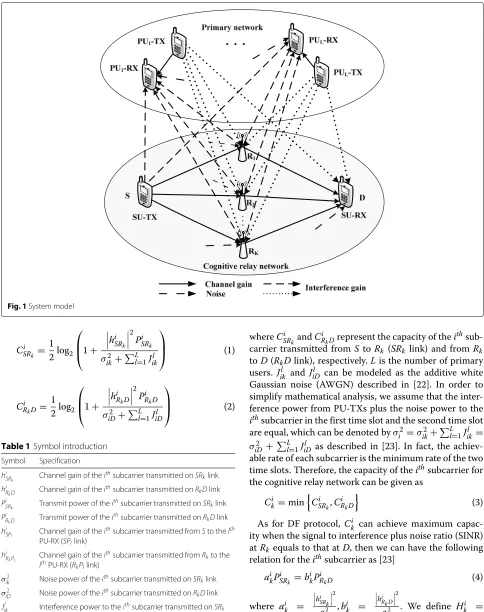
2.1 System model
Fig. 1System model
CSRi
k =
1 2log2
⎛ ⎜ ⎝1+
hiSR
k
2PSRi
k σ2
ik+
L l=1Jikl
⎞ ⎟
⎠ (1)
CRi
kD=
1 2log2
⎛ ⎜ ⎝1+
hiR
kD
2PRi
kD σ2
iD+
L
l=1JiDl
⎞ ⎟
⎠ (2)
Table 1Symbol introduction
Symbol Specification
hiSR
k Channel gain of thei
thsubcarrier transmitted onSR klink hiR
kD Channel gain of thei
thsubcarrier transmitted onR kDlink Pi
SRk Transmit power of thei
thsubcarrier transmitted onSR klink Pi
RkD Transmit power of thei
thsubcarrier transmitted onR kDlink hi
SPl Channel gain of thei
thsubcarrier transmitted fromSto thelth
PU-RX (SPllink)
hi
RkPl Channel gain of thei
thsubcarrier transmitted fromR kto the lthPU-RX (R
kPllink) σ2
ik Noise power of theithsubcarrier transmitted onSRklink σ2
iD Noise power of theithsubcarrier transmitted onRkDlink Jl
ik Interference power to theithsubcarrier transmitted onSRk
link caused by thelthPU-TX
JliD Interference power to theithsubcarrier transmitted onR kD
link caused by thelthPU-TX
whereCSRi
k andC i
RkDrepresent the capacity of thei th sub-carrier transmitted fromS toRk (SRk link) and fromRk toD(RkDlink), respectively.Lis the number of primary users. Jikl and JiDl can be modeled as the additive white Gaussian noise (AWGN) described in [22]. In order to simplify mathematical analysis, we assume that the inter-ference power from PU-TXs plus the noise power to the ithsubcarrier in the first time slot and the second time slot are equal, which can be denoted byσi2=σik2+Ll=1Jikl =
σ2 iD +
L
l=1JiDl as described in [23]. In fact, the achiev-able rate of each subcarrier is the minimum rate of the two time slots. Therefore, the capacity of theithsubcarrier for the cognitive relay network can be given as
Cki =min
CiSR
k,C i RkD
(3)
As for DF protocol,Cki can achieve maximum capac-ity when the signal to interference plus noise ratio (SINR) atRkequals to that atD, then we can have the following relation for theithsubcarrier as [23]
aikPiSR
k =b i
kPiRkD (4)
where aik = hi
SRk
2
σ2
i
,bik = hi
RkD
2
σ2
i
. We define Hki =
hiSRk2hiRkD2
hi SRk
2
+hi
RkD
2 andαki =
Hki σ2
i
channel gain and the equivalent channel gain of theith subcarrier in the two time slots, respectively. The total transmit power on the ith subcarrier in the two time slots is
Pik=PSRi k +PiRkD (5)
According to (4) and (5), the maximum capacity of the ithsubcarrier can be rewritten as
Cki = 1 2log2
1+αikPki (6)
Note that in cognitive relay network, both SU-TX and relays have to take the interference thresholds of differ-ent PU-RXs into account. Therefore, the interferences introduced to thelthPU-RX in the two time slots are
ISPl =
from the total subcarriers transmitted betweenSand all relays (SR link) and between all relays andD(RDlink), respectively.ρki is a binary factor indicating whether the ithsubcarrier is allocated toRk. AndIthl is the interference threshold of thelthPU-RX.
According to the definition ofHki andPki, (7) and (8) can be rewritten as
ISPl =
2 is defined to represent the
normal-ized channel gain of theithsubcarrier forSPllink andSRk
link, andGik,l,D = malized channel gain of theithsubcarrier forRkPllink and RkDlink.
2.2 Nominal RA problem formulation
The optimization objective is to maximize the capacity of the cognitive relay network while maintaining the inter-ference to PU-RXs below their interinter-ference thresholds under the total power constraint. Mathematically, this optimization can be formulated as
Nominal RA problem (P0):
max
whereC1 andC2 are the interference constraints of the lthPU-RX in the first time slot and the second time slot, respectively. C3 is the transmit power constraint, and Ptotal is the maximum total transmit power. C4 andC5
are the relay selection constraints to indicate that only one relay is selected by each subcarrier to guarantee the exclu-siveness of subcarrier. Ifρki = 1,Rkis allocated to theith subcarrier, otherwise not.
Apparently,P0is a mixed binary integer programming problem, and it is difficult to achieve a joint relay selection and power allocation solution. Therefore, we will solve this problem by dividingP0into two sub-problems, i.e., relay selection and power allocation separately. Firstly, we allocate subcarriers to relays through supposing uniform power distribution over subcarriers (i.e.,Pik = Ptotal
N ). Sec-ondly, power allocation is carried out under the given relay selection scheme. Note that relay selection scheme needs to solve a discrete optimization problem, which is NP-hard. Thus, we relax the integrality constraint onρik fromρki ∈ {0, 1}to ρki ∈ (0, 1] and relax Kk=1ρki = 1 to Kk=1ρki ≤ 1, which can transform the discrete opti-mization problem into a continuous linear optiopti-mization problem [24].
Nominal relay selection problem (P1):
max
This timeP1is a convex problem, and we can obtain an optimal solution toρkiafter applying Karush-Kuhn-Tucker (KKT) conditions [24]. Therefore,Rkwith maximumρkiis allocated to theithsubcarrier, which can be expressed as
K(i)=argmaxρki k
whereK(i)∈[1 :K] presents the relay selected by theith subcarrier. Under this relay selection scheme,P0can be converted into
Nominal power allocation problem (P2):
max
P2 is also a convex optimization problem with linear constraints so that an optimal power allocation analytical solution can also be obtained by using KKT conditions. We define this nominal relay selection and power alloca-tion algorithm under the assumpalloca-tion of the perfect CSI as non-robust algorithm.
3 Robust RA algorithm
In cognitive relay networks, channel gain is very impor-tant information for RA. However, perfect channel gain is extremely difficult to obtain due to estimation errors, quantization errors, and feedback delays. The interference power at relay and SU-RX are also inaccuracy due to the measurement errors. The assumption of perfect CSI is so idealistic that it can lead to system performance degra-dation. In this paper, we study robust RA problem with joint channel uncertainty and interference uncertainty. Based on the robust optimization theory, the uncertainty parameter is modeled by the sum of the estimated value (i.e., nominal value) and additive error (i.e., perturbation part). Mathematically, the uncertainty parameter can be expressed asg= ¯g+Δg, wheregis the actual value,g¯is the estimated value, andΔg is the estimated error. We adopt ellipsoid set to describe the channel uncertainty and inter-val set to describe interference uncertainty respectively. According to the definition of the ellipsoid uncertainty, Hki,GiS,k,l, andGik,l,Dcan be formulated as
whereH,G, andF denote the channel uncertainty sets.
εl ∈[ 0, 1), ηl ∈[ 0, 1), and δl ∈[ 0, 1) are the maximum deviations ofHki,GiS,k,l, andGik,l,D, respectively. We define
ψas the uncertainty set ofαik. Based on the definition of the interval uncertainty,αikcan be formulated as
ψ =αi
kα¯ik+Δαki : Δαik≤ξkiα¯ki
(21)
where ξki ∈[ 0, 1) is the upper bound of the uncertainty that determines the size of the uncertainty region. After-wards, we study robust RA problem with these uncer-tainty parameters. According to (18)–(21), P1 can be transformed as
Robust relay selection problem (P3):
max
P3is a SIP problem [25] subject to an infinite number of constraints with respect to the sets ofH, G, F , and
ψ . Through worst-case approach, we can make all the constraints be in the worst-case scenario, andP3is trans-formed into an equivalent problem with finite constraints. We first transform (22) byΔαki = −ξkiα¯ik, which denotes the worst-case equivalent channel gain. Then, according to the Cauchy-Schwartz inequality [26], we have
max
Similarity,C1 andC2 inP3can be further formulated as
We can see that the transformedP3is convex and it can be solved by the Lagrange dual decomposition method [27]. The optimal robust relay selection factorρki can be derived in the form of
ρi Lagrange multipliers updated by the sub-gradient method with recursive forms
ϕl(t+1) = positive step sizes. In the sequel, we optimize the robust power allocation problem after obtaining the robust relay selection factor.
Robust power allocation problem (P4):
max
Obviously, P4 is still a SIP problem, so we need to transform it into an equivalent optimization prob-lem limited by the finite constraints with the worst-case approach. First, (31) can be reformulated as
max
andC2 inP4can be formulated as
C1 :
We can see that the transformedP4is also convex and its Lagrange function is
LPiK(i) multipliers. (35) can be solved by the dual decomposition method, i.e.,
min
μl,νl,ωg˜({μl},{νl},ω) (36)
The dual function of (35) is defined as
˜
g({μl},{νl},ω) max Pi
K(i)0
L({PiK(i)},{μl},{νl},ω) (37)
Substituting (35) to (37), we can get
We can get the optimal solution of (38) though
optimiz-allocation is derived in the form of
PiK(i)∗=
The Lagrange multipliers can be updated by the sub-gradient method as
μl(t+1) =
iterations are repeated until the robust power allocation process converges. We define this robust relay selection and power allocation algorithm under the influence of different uncertainty parameters as robust algorithm.
The computational complexity of the proposed robust algorithm can be counted roughly as follows. We address the robust resource allocation problem with two steps, i.e., relay selection and power allocation separately. First, we allocate subcarriers to relays assuming uniform power distribution over subcarriers. Each subcarrier selects the best relay (i.e., the relay with highestρik∗) for itself with computational complexityK. We assumeT1is the
num-ber of iterations with sub-gradient method to get ρik∗. AfterNsubcarriers all finish the relay selection, the com-putational complexity of this relay selection procedure is
O(NK T1). Then, power allocation is carried out under the given relay selection scheme. The power allocation problem is decomposed intoN parallel power allocation sub-problems. In every sub-problem, we assumeT2is the
number of iterations to obtain PiK(i)∗ with sub-gradient
method. After N evaluations, the computational com-plexity of the power allocation is O(NT2). To sum up, the overall computational complexity isO(N(K T1+T2)),
which is linear toN.
4 Simulation results
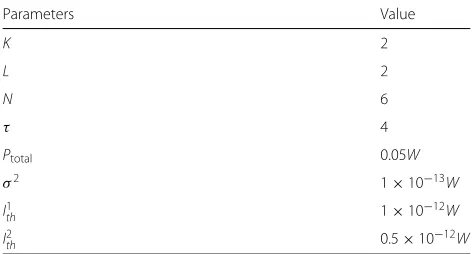
In this section, we use Monte Carlo simulation with MAT-LAB software to show the effectiveness and the outper-formance of our proposed robust algorithm. Setting of simulation parameters are described in Table 2. Chan-nel gains hiSR
frequency flat Rayleigh fading channels. They are inde-pendent and identically distributed (i.i.d.) circularly sym-metric complex Gaussian (CSCG) random variables (RVs) and distributed ash ∼ CN0, (1+1d)τ
, where τ is the path loss coefficient anddis the distance among differ-ent nodes in the system. Without lose of generality and to make the realization of the proposed algorithm simple and better understood, we assumeσ2=σ2
i,ξ =ξki,εl=εH¯ki, ηl=ηG¯iS,k,l, andδl =δG¯ik,l,D, respectively. For notational brevity, letζ = ξ = ε = δ = ηandζ ∈ [0, 1) repre-sent the normalized upper bound for the all uncertainty regions. The simulations have been conducted for 20,000 independent channel realizations.
Figure 2 shows the relay selection factors of all subcar-riers in both robust algorithm and non-robust algorithm. The relays in these two algorithms are distinguished by different colors. Based on the relay selection scheme in these two algorithms,Rkwith maximumρki is allocated to theithsubcarrier. In other words, each subcarrier selects the best relay for itself. As for non-robust algorithm, we can observe that the relays selected by subcarriers are R1,R2,R2,R1,R1, andR1in sequence. Whenζ = 0.1, the
robust relay selection results are the same as the non-robust algorithm which validates the non-robustness of the proposed robust relay selection scheme.
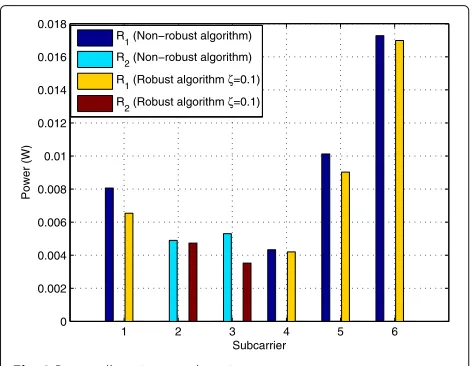
Under the aforementioned relay selection scheme, Fig. 3 illustrates the power allocation schemes to subcarriers for the two algorithms. We can see that the power allocated to subcarriers in the non-robust algorithm is higher than that
Table 2Setting of simulation parameters
1 2 3 4 5 6 0
0.1 0.2 0.3 0.4 0.5 0.6 0.7 0.8 0.9
Subcarrier
Relay selection factor
ρ
R
1 (Non−robust algorithm) R
2 (Non−robust algorithm) R
1 (Robust algorithm ζ=0.1) R
2 (Robust algorithm ζ=0.1)
Fig. 2Relay selection factor of subcarrier
in robust algorithm. According toC1 andC2 inP4, we can find that the transmit power in the robust algorithm has to be reduced to keep the interference thresholds of PU-RXs below their preset limit values under the influence of the uncertainties.
Figure 4 shows the saved power versus the increase number of iterations. We define the saved power as the difference value of the total transmit powerPtotaland the
actual transmit powerNi=1PiK(i). We find that the saved power in non-robust algorithm converges to zero, which indicates that the non-robust algorithm makes full use of the total transmit power. However, due to the existing uncertainties, the robust algorithm cannot take advan-tage of the total transmit power. Moreover, the saved power increases with the increase of uncertainties, since the robust algorithm has to reduce more transmit power to cope with the increasing uncertainties.
1 2 3 4 5 6
0 0.002 0.004 0.006 0.008 0.01 0.012 0.014 0.016 0.018
Subcarrier
Power (W)
R1 (Non−robust algorithm)
R
2 (Non−robust algorithm) R1 (Robust algorithm ζ=0.1)
R
2 (Robust algorithm ζ=0.1)
Fig. 3Power allocation to subcarrier
5 10 15 20 25 30 35 40
0 0.005 0.01 0.015 0.02 0.025 0.03 0.035 0.04 0.045 0.05
Number of iterations
Saved power (W)
Non−robust algorithm Robust algorithm (ζ=0.1) Robust algorithm (ζ=0.15) Robust algorithm (ζ=0.2) Robust algorithm (ζ=0.25)
Fig. 4Saved power
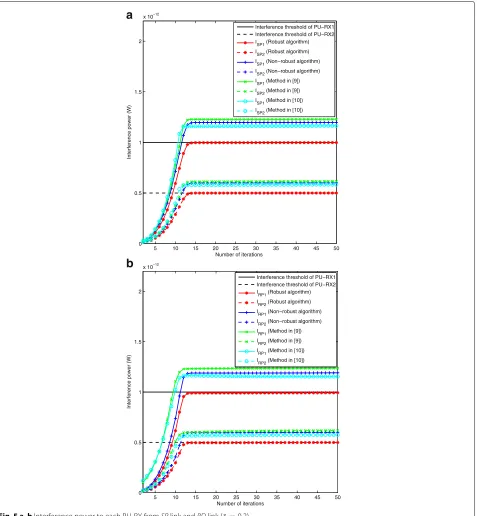
Figure 5 demonstrates the interference power to each PU-RX fromSRlink andRDlink in the proposed robust algorithm, non-robust algorithm, method in [9], and method in [10]. In this paper, we assume different PU-RX has different interference threshold. It is also more suitable to practical systems than the assumption that the interference constraints of different PU-RX under the same interference level. Figure 5a, b shows that the pro-posed robust algorithm can strictly guarantee the inter-ference threshold of each PU-RX, and the interinter-ference to each PU-RX in non-robust algorithm, method in [9]and method in [10] are all exceed their interference thresholds, which means that the non-robust algorithm cannot satisfy the QoS of PU-RXs with uncertainty parameters.
Figure 6 shows the capacity convergence results of the two algorithms with the increase number of iterations. We can see that the two algorithms can quickly converge to the equilibrium points. It can also be observed that, although we have maximized the capacity of the cognitive relay network through the robust algorithm with uncer-tainty parameters, the capacity of the robust algorithm is still lower than that of the non-robust algorithm with perfect CSI. The reason is that the non-robust algorithm can make full use of the total transmit power regard-less of the influence of the uncertainty parameters on the interference power to PU-RXs, but the robust algorithm reduces the transmit power to overcome the uncertainties for the QoS of PU-RXs. In addition, the capacity of the robust algorithm decreases with the increase of the uncer-tainty parameter. Figures 5 and 6 indicate that the robust algorithm outperforms the non-robust algorithm for the perspective of ensuring the QoS of PU-RXs at the expense of system capacity loss.
5 10 15 20 25 30 35 40 45 50 0
0.5 1 1.5 2
a
b
x 10−12Number of iterations
Interference power (W)
Interference threshold of PU−RX1 Interference threshold of PU−RX2 I
SP1 (Robust algorithm)
I
SP2 (Robust algorithm)
I
SP1 (Non−robust algorithm)
I
SP2 (Non−robust algorithm)
I
SP1 (Method in [9])
I
SP2 (Method in [9])
I
SP1 (Method in [10])
I
SP2 (Method in [10])
5 10 15 20 25 30 35 40 45 50
0 0.5 1 1.5 2
x 10−12
Number of iterations
Interference power (W)
Interference threshold of PU−RX1 Interference threshold of PU−RX2 I
RP1 (Robust algorithm)
I
RP2 (Robust algorithm)
I
RP1 (Non−robust algorithm)
I
RP2 (Non−robust algorithm)
I
RP1 (Method in [9])
I
RP2 (Method in [9])
I
RP1 (Method in [10])
I
RP2 (Method in [10])
Fig. 5 a, bInterference power to each PU-RX fromSRlink andRDlink (ζ=0.2)
that the interference thresholds of different PU-RXs are the same. From Fig. 7, we can see that the capacity of the robust algorithm is lower than that of the non-robust one and decreases with the increase of the uncertainties in accordance with Fig. 6. Moreover, we can find that the capacity of these two algorithms increases with the increase of the interference threshold at first. When power allocation reaches its maximum in the two algorithms, the
capacity does not change and becomes constant regard-less of the increase of interference threshold.
5 10 15 20 25 30 35 40 0
1 2 3 4 5 6
Number of iterations
Capacity (bit/s/Hz)
Non−robust algorithm Robust algorithm (ζ=0.1) Robust algorithm (ζ=0.15) Robust algorithm (ζ=0.2) Robust algorithm (ζ=0.25)
Fig. 6Convergence of capacity
that the capacity of the two algorithms increases with the increasing power budget at the beginning. However, when the interference to PU-RXs reaches the preset thresholds, the capacity stops increasing and remains constant despite of the increase of power budget.
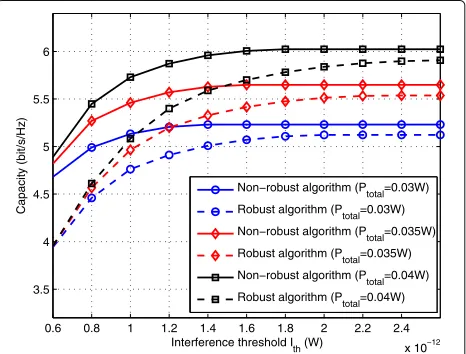
Figure 9 gives the effect of the interferencethreshold and the power budget on the capacity under the assumption ofζ = 0.2 .With the increase of the interference thresh-old, the capacity increases in both robust and non-robust algorithm initially. However, when interference threshold becomes larger to some extent, interference constraint becomes inactive. Power budget becomes the limiting constraint and plays a dominant role. We can also observe that the higher power budget is, the larger the capacity is.
0.6 0.8 1 1.2 1.4 1.6 1.8 2 2.2 2.4
x 10−12 3.5
4 4.5 5 5.5 6 6.5 7
Interference threshold I th (W)
Capacity (bit/s/Hz) Non−robust algorithm
Robust algorithm (ζ=0.05) Robust algorithm (ζ=0.1) Robust algorithm (ζ=0.15) Robust algorithm (ζ=0.2)
Fig. 7Capacity versus interference threshold
0.0153 0.02 0.025 0.03 0.035 0.04 0.045 0.05 0.055 0.06 3.5
4 4.5 5 5.5 6
Power budget Ptotal (W)
Capacity (bit/s/Hz) Non−robust algorithm Robust algorithm (ζ=0.05) Robust algorithm (ζ=0.1) Robust algorithm (ζ=0.15) Robust algorithm (ζ=0.2)
Fig. 8Capacity versus power budget
5 Conclusions
In this paper, we have studied robust RA problem in the underlay OFDM-based cognitive relay network with joint channel uncertainty and interference uncertainty. Based on worst-case approach and Lagrange dual decom-position method, closed form analytical solutions to robust relay selection and power allocation have been derived. Numerical results demonstrate the robustness of the proposed robust relay selection scheme. The robust algorithm is superior to the non-robust algo-rithms in terms of guaranteeing the interference thresh-olds of different PU-RXs, but the capacity of the robust algorithm is little lower than that of non-robust algo-rithm for overcoming the uncertainties and also decreases with the increase of the uncertainties. In our future
0.6 0.8 1 1.2 1.4 1.6 1.8 2 2.2 2.4
x 10−12 3.5
4 4.5 5 5.5 6
Interference threshold I th (W)
Capacity (bit/s/Hz)
Non−robust algorithm (P total=0.03W) Robust algorithm (Ptotal=0.03W)
Non−robust algorithm (P
total=0.035W) Robust algorithm (P
total=0.035W) Non−robust algorithm (P
total=0.04W) Robust algorithm (P
total=0.04W)
works, we will extend this frame work to two-way cog-nitive radio networks with multiple SUs or multiple antennas.
Acknowledgements
The work of this paper is supported by the National Natural Science Foundation of China under grant No. 61571209.
Authors’ contributions
WY contributed in the conception of the study and design of the study and wrote the manuscript. Furthermore, WY carried out the simulation and revised the manuscript. XH helped to perform the analysis with constructive discussions and helped to draft the manuscript. All authors read and approved the final manuscript.
Competing interests
The authors declare that they have no competing interests.
Publisher’s Note
Springer Nature remains neutral with regard to jurisdictional claims in published maps and institutional affiliations.
Received: 9 February 2017 Accepted: 29 May 2017
References
1. S Haykin, Cognitive radio: brain-empowered wireless communications. IEEE J. Sel. Areas Commun.23(2), 201–220 (2005)
2. R Zhang, Y-C Liang, S Cui, Dynamic resource allocation in cognitive radio networks. IEEE Signal Process. Mag.27(3), 102–114 (2010)
3. SW Wang, WJ Shi, CG Wang, Energy-efficient resource management in OFDM-based cognitive radio networks under channel uncertainty. IEEE Trans. Commun.63(9), 3092–3102 (2015)
4. N Mokari, S Parsaeefard, H Saeedi, P Azmic, Cooperative secure resource allocation in cognitive radio networks with guaranteed secrecy rate for primary users. IEEE Trans. Wirel. Commun.13(2), 1058–1073 (2014) 5. X-T Doan, N-P Nguyen, C Yin, DB Costa, TQ Duong, Cognitive full-duplex
relay networks under the peak interference power constraint of multiple primary users. Eurasip J. Wirel. Commun. Netw.2017(1), 1–10 (2017) 6. MG Adian, H Aghaeinia, Optimal resource allocation for opportunistic
spectrum access in multiple-input multiple-output-orthogonal frequency division multiplexing based cooperative cognitive radio networks. IET Signal Process.7(7), 549–557 (2013)
7. HY Huang, Z Li, JB Si, L Guan, Underlay cognitive relay networks with imperfect channel state information and multiple primary receivers. IET Commun.9(4), 460–467 (2015)
8. JV Hecke, PD Fiorentino, V Lottici, F Giannetti, L Vandendorpe, M Moeneclaey, Distributed dynamic resource allocation for cooperative cognitive radio networks with multi-antenna relay selection. IEEE Trans. Wirel. Commun.16(2), 1236–1249 (2017)
9. J Peng, S Li, CL Zhu, WR Liu, ZF Zhu, KC Lin, A joint subcarrier selection and power allocation scheme using variational inequality in OFDM-based cognitive relay networks. Wirel. Commun. Mobile Comput.16(8), 977–991 (2016)
10. M Shaat, F Bader, Asymptotically optimal resource allocation in OFDM-based cognitive networks with multiple relays. IEEE Trans. Wirel. Commun.11(3), 892–897 (2012)
11. K Yang, YH Wu, JW Huang, Distributed robust optimization for communication networks. IEEE INFOCOM. 1831–1839 (2008) 12. A Ben-Tal, LE Ghaoui, A Nemirovski, Selected topics in robust convex
optimization. Math. Program.112(1), 125–158 (2007)
13. QZ Li, Q Zhang, JY Qin, Robust beamforming for cognitive multi-antenna relay networks with bounded channel uncertainties. IEEE Trans. Commun.
62(2), 478–487 (2014)
14. L Wang, M Sheng, Y Zhang, X Wang, C Xu, Robust energy efficiency maximization in cognitive radio networks: the worst-case optimization approach. IEEE Trans. Commun.63(1), 51–65 (2015)
15. P-J Chung, H Du, J Gondzio, A probabilistic constriant approach for robust transmit beamforming with imperfect channel information. IEEE Trans. Signal Process.59(6), 2773–2782 (2011)
16. S Mohammadkhani, MH Kahaei, SM Razavizadeh, Robust beamforming and power allocation in cognitive radio relay networks with imperfect channel state information. IET Commun.8(9), 1560–1569 (2014) 17. N Mokari, S Parsaeefard, H Saeedi, P Azmi, E Hossain, Secure robust
ergodic uplink resource allocation in relay-assisted cognitive radio networks. IEEE Trans. Signal Process.63(2), 291–304 (2015) 18. S Parsaeefard, AR Sharafat, Robust worst-case interference control in
cognitive radio networks. IEEE Trans. Veh. Technol.61(8), 3731–3745 (2012)
19. P Ubaidulla, M-S Alouini, S Aissa, Multi-pair cognitive two-way relaying and power allocation under imperfect CSI. IEEE VTC.14(6), 1–5 (2013) 20. X Zhang, J Xing, Z Yan, Y Gao, W Wang, Outage performance study of
cognitive relay networks with imperfect channel knowledge. IEEE Commun.17(1), 27–30 (2013)
21. S Mallick, R Devarajan, RA Loodaricheh, VK Bhargava, Robust resource optimization for cooperative cognitive radio networks with imperfect CSI. IEEE Trans. Wirel. Commun.14(2), 907–920 (2015)
22. G Bansal, M Hossain, V Bhargava, Optimal and suboptimal power allocation scheme for OFDM-based cognitive radio systems. IEEE Trans. Wirel. Commun.7(11), 4710–4718 (2008)
23. H Soury, F Bader, M Shaat, M-S Alouini, Joint subcarrier pairing and resource allocation for cognitive networks with adaptive relaying. Eurasip J. Wirel. Commun. Netw.2013(1), 1–15 (2013)
24. S Boyd, L Vandenberghe,Convex optimization. (Cambridge University Press, Cambridge UK, 2004)
25. R Rembert, JJ Rckmann,Semi-infinite programming. (Springer Science and Business Media, New York, 1998)
26. R Bhatia, C Davis, A Cauchy-Schwarz inequality for operators with applications. Linear Algebr. Appl.223, 119–129 (1995)