REPEATED OCCURRENCES IN THE MOUSE OF LETHAL ALLELES
OF T H E SAME COMPLEMENTATION GROUP]
DOROTHEA BENNETT AND L. C. DUNN
Cornell University Medical College, N e w York City, and
Columbia University Nevis Biological Station, Irvington-on-Hudson, N e w York Received January 17, 1964
HE study of three newly arisen lethal alleles at a complex locus in the house Tmouse has provided a n opportunity to compare the effects of lethal alleles from different sources and especially to compare members of the same comple- mentation group with respect to secondary effects.
The genetics of this locus has been summarized and described recently (DUNN,
BENNETT, and BEASLEY 1962). Alleles of three main types have been studied:
( 1 ) a lethal, T, with dominant phenotypic effect, T/+ being short-tailed; (2) several recessive lethals, tL, T/tl being tailless; ( 3 ) several viable alleles tu, T/t" being tailless and tv/tv being viable with a normal tail. The recessives, thus, are recognized as alleles which interact with T to produce a tailless phenotype. They vary among themselves in effects on early development including time of death of lethal homozygotes, in degree of distortion of transmission ratios through sperm, in degree of reduction of recombination near T , in effects on fertility of male compounds, and in effects on viability of compounds in certain combinations.
The questions to be discussed below concern only the second category, the recessive lethals. When two such alleles from different sources such as tn and t" complement each other, that is, when tn/tx has a normal tail and some degree of viability after birth, then tn and tx are assigned to different complementation classes. When, on the other hand, no complementation is detected, and tn/t" is indistinguishable in time of death and syndrome of abnormalities from tn/tn and tx/t", then t" is assigned to the same complementation class t n . These opera- tions are possible with each recessive lethal which forms with T a balanced lethal line, matings within which produce only tailless offspring at birth, i.e. matings T/tn X T/tn produce viable zygotes T / t n ; tn/tn, and T/T dying before birth. Where matings between tailless animals from balanced lethal lines with recessive lethals from different sources regularly produce some normal-tailed off spring, these can be shown to be t n / t x and the t-alleles concerned assigned to different complement a tion groups.
The recessive t-lethals available in this laboratory had by these criteria been classified into five complementation groups, designated by the symbol of the first allele in each group to be recognized: t o , ts, tl*, t"', tW5. Two questions then arise:
Do lethals in the same complementation group differ when examined by other Research carried out under National Science Foundation Grant G 14749, Public Health Service Grant RG 9912, and contract AT (30-1) 180) with the U.S. Atomic Energy Commission.
950 D. BENNETT A N D L. C. D U N N
criteria? Do recessive lethals at this locus, originating in new independently occurring exceptions, belong to one of the established groups or to additional ones?
These questions bear on the structure of this region of the ninth linkage group.
It has been shown that with one exception lethal t-alleles interfere with recombi- nation over a length of at least nine crossover units which is the distance between
T and the nearest marker tf (tufted). They are thus presumably connected with some form of chromosomal aberration such as inversion, duplication, or deficiency which interferes with recombination. Furthermore, one t-lethal may give rise to a different one. Numerous exceptions of this sort have been analysed and all previously studied ones which arose from balanced lines carrying a marker in this region, e.g. T tf/t" were found to be t"tf. The most llkely explanation for the origin of the new alleles is thus exceptional recombination, although with only the marker tufted available a recombinational process cannot in fact be distin- guished from conversion or mutation phenomena. If such new alleles were found always to be exact replicates of others previously found, we might be led to sus- pect that the region consists of a limited number of blocks or units, between which rearrangement may occur by such exceptional recombination. If this were so, the simplest model would predict that the number of blocks would be related to the number of groups of replicate alleles, i.e. the number of complementation groups.
Five criteria may be used in comparing lethal alleles: (1) complementation; (2) embryological comparison; (3) male transmission ratio, i.e. frequencies with which sperm carrying T and t (in matings of T / t by +/+) effect fertilization; (4) degree of interference with recombination; ( 5 ) degree of complementation when alleles in the same complementation group are combined with lethal alleles belonging to other complementation groups.
These methods have been applied to three lethal t-alleles, t"'L', t 1 0 3 " , t'L?L, which
were observed in the laboratory to have arisen anew in exceptions from balanced lethal lines. (Alleles are numbered in order of recognition; tZ" means derived from an ancestor captured in the wild.)
Origin of the new t-alleles: tfL2' arose from the balanced lethal T / t Z 1 l 7 stock ( t L U 5 group). It occurred in a single normal tailed t h 1 7 / t 1 1 2 1 animal from which it was extracted. The marker gene tufted had not at that time been introduced into the T/t'"'" line, so it is not known whether or not recombination was involved in the origin of tLoZ1.
t*u7" occurred in a normal-tailed exceptional offspring from the T t f / t " I L stock
(t"' group). Subsequent extraction and genetic analysis showed that the original
animal carrying t103" had been of genotype t f f r 2 / t " 3 0 tf, and thus indicated that a recombinational process could have been involved in its origin.
RECURRENT LETHAL ALLELES 95 1
from 16143. Its parents were, however, only one generation removed from the wild ancestor which carried tW'O and from which the tWI0 stock was derived. It is possible that the mother of 16143 was not in fact T tf/tWI0 but T tf/tws2, already carrying the new allele. In that case, tZu32 might have arisen in the wild parent in the absence of the marker tufted, so that recombination could not be detected. The evidence that the mother was in fact T tf/ tZo10 rests on the fact that with two different T tf/ tWIo males she produced 23 tailless offspring, and no normal tailed ones; with this large number of offspring, it would be unlikely that she carried an allele other than tWIO. Most likely, therefore, tZU3* arose from tZU1O with- out detectable recombination. The point is an important one, because if true this would be the only known case of the origin of a t-allele without apparent recombi- nation. It may indicate that the t-locus extends along a length of chromosome longer than that between the two markers, and that unequal crossing over of the type which may produce new t-alleles can take place outside of the marked region.
RESULTS
Establishment of lethality: Tailless lines of genotype T/tx were established for each one of these three new alleles. The data in Table 1 demonstrate that all three bred as balanced lethal systems, thus proving that each of the new alleles was in fact a lethal.
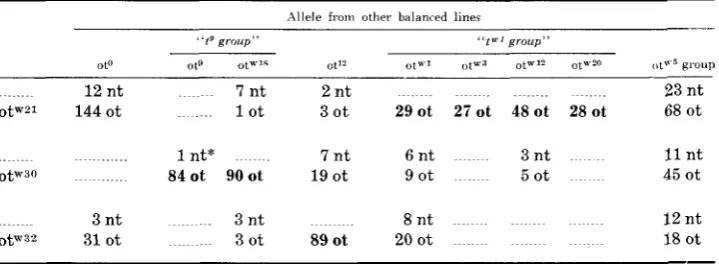
Complementdon tests: Once these new alleles had been diagnosed as lethals, the next step in their identification was to test them for complementation with other known lethal alleles. Representatives of all identified complementation groups were used in these tests. Matings were made between tailless animals of
two different genotypes, and the criterion of nonidentity was the production of at least two normal tailed offspring. In some cases much larger numbers were collected to obtain a quantitative estimate of the degree of complementation, but this aspect will be discussed in a later section.
Table 2 shows that tw2' declared itself as nonidentical to all alleles except tW', tWs, tW12, and t W 4 0 . These four alleles were already known to be members of the
same complementation group and embryologically indistinguishable from one another (BENNETT, DUNN, and BADENHAUSEN 1959). Thus tZo21 becomes a fifth member of the tW' group.
TABLE 1
Inter-se matings of tailless animals carrying a lethal allele tw21, tW", or tw32
~ ~~ ~
Tailless parents Tailless offspnng Normal-tailed offspnng
T / t W z 1
x
T / P 1 616 4 twz1/twa1*1 t w 2 1 / t w = t
T/tw30
x
T p S O 171 0T / t W S 2 x T/tw3* 468 1 P 9 2 / t W 3 5 tft
952 D. BENNETT A N D L. C. D U N N
TABLE 2
Complementation tests of leihal alleles t w 2 1 , tx'zo and tw3' ,with other identified lethal t-alLeles
Allele from other balanced lines
" t s group" "te" group"
oto 019 ot"'f Oti" "tu1 <,tU.D Otw12 ot"?O ut"' group
12 n t 7 nt 2 n t 23 n t
o t w 2 1 144 ot 1 ot 3 o t 29ot 27ot 4 8 o t 28ot 68 o t
1 nt* 7 n t 6 n t 3 n t I1 n t
0 t w 3 0 840t 90ot 19 ot 9 ot 5 o t 45 ot
3 nt 3 n t 8 n t I 2 n t
0 t w 3 2 31 ot 3 o t 890t 2 0 0 t I8 ot
Figures indicating lack of complementation are printed in bold face. o t = tailless, n t = n o r m a l tail.
* This normal tailed animal war studied and proved to be a valid exception of genotype i g / t w 4 0 , t V c l 0 being a new viable allele newly arisen i n a gamete of the t"30 parent.
The allele t W 3 0 can be seen to be noncomplementary with both t 9 and t"18. These
alleles had previously been found to be indistinguishable from one another on the basis of any of the criteria mentioned in the introduction (P. VAN VALEN, personal communication). It showed complementation with t I 2 , tW' group and ttG5
group. The t9 complementation group thus now consists of three members, t9, The allele ttGS2, on the basis of the data in Table 2, is seen to complement all alleles except t 1 2 . Those two alleles now form the t12 complementation group.
On the basis of these complementation data therefore, the three "new" lethals being reported here appeared not to be new, but newly arisen replicates of pre- viously known lethals at locus T .
Morphological and embryological comparisons: Once the three lethals had
been classified as to complementation group, a comparison of their embryological effects with those of other members of the same group was made. This was done to refine the diagnosis of similarity of noncomplementary alleles, on the assump- tion that members of the same complementation group may not necessarily show identical or even closely similar effects on development, but still interact to pro- duce a zygote which is lethal before birth.
Four members of the t'"' group have been previously reported on in detail; they were seen to produce a syndrome of effects unique among themselves
(BENNETT, DUNN and BADENHAUSEN 1959; BENNETT, BADENHAUSEN and
DUNN 1959). This group is distinguished among t-lethals as having the latest lethal period, and the longest range in time over which death occurs. Death of tW1/twl individuals occurs sometimes as early as nine days of gestation while others apparently survive until parturition, but are always born dead. From 13 days on, the abnormal embryos present externally a typical picture: they have normal tails, are reduced in size, have microcephaly and always are severely edematous. Since this picture is so typical, we examined litters of embryos from t1018 tW3O
RECURRENT LETHAL ALLELES 953
TABLE 3
Results of dissection of pregnant females from matings T/tW21XT/tW21 and T/tw*lXT/twl group and diagnosis of embryos found in late period of gestation (13-19 days postfertilization)
~
Matings
Dead
Total Normal (type not Typical
embryos embryos recogruzable) t m ' / t w ' type
T p 2 1
x
T / F 1 119 55 63 1T/tW'group
x
T / t W P 1 20 9 9 2matings of T / t W s 1 X T / t W Z 1 and T/ttoZ1 X T / t W 1 group by gross inspection only, between 13 and 19 days of gestation. The data in Table 3 indicate that both types of crosses produced embryos and stillborn off spring which were indistinguishable from the ones produced by other members of the tZU1 group. The proportion of abnormal embryos found alive during this period is low, but is about the same as that found for other members of the tW1 group.
The tlDSO allele failed to complement t9 and tWl8. Detailed embryological studies
have been published only for tW18 (BENNETT and DUNN 1960). t W 1 8 / t W 1 8 embryos
showed a pattern of abnormalities which were based apparently on a n overgrowth of the primitive streak and were distinct from any produced by other t-alleles. Abnormal embryos clearly showed a bulge in the primitive streak region by seven days of gestation; this overgrowth frequently led, in later stages, to a mechani- cally produced duplication of the neural tube. Embryos presumed homozygous for or of genotype tWS0/tW18 showed exactly comparable disturbances of growth. These embryos were recovered from timed pregnancies derived from matings between T / t w S o X T / t W S O , and T / t W S O X T/tWl8; most were studied between seven and nine days when the abnormalities typical of t"'* were most easily recognized. Table 4 gives a resum6 of the numbers studied and the results.
Another very interesting effect of tW18 noted in the previous paper was its
effect in promoting the formation of "twin" decidual capsules; these apparently represent implantations occurring so close together i n the uterus that a decidual capsule common to the two embryos is formed. Apparently under normal con- ditions some kind of control mechanism based probably on mechanical agitation by the uterus results i n the spacing of preimplantation embryos in the uterus so that when implantation occurs they have the maximum possible distance
TABLE 4
Results of dissections of pregnant females from matings T/tw30
x
T/tw30 or T/tW30 X T/tggroup and diagnosis of embryos seven to ten days postfertilization
Dead
Total Normal (type. not
Matings embryos embryos T / T recogmzable) i 9 / P type
T/tw30 x T/tw90 62' 45 2 1 14
T / t s group
x
T/tWSO 93t 46 11 16 20* Includes five cases of double implantation in one decidual capsule.
954 D. BENNETT A N D L. C. D U N N
between them (MCLAREN and MICHIE 1959). Thus “twin” capsules are rarely formed in litters of normal size; the rate in some of our stocks of the ttb5 group was six twin capsules in 1209 implants in 165 litters. Matings of t1”I8 mothers however produced nine such double capsules in 685 implants in 82 litters. It appears that this effect is dependent on maternal genotype, not on the genotype of the embryos, because the embryos involved in the double capsules are of all possible combinations, namely T/T-T/T, T/T-normal, T/T-t1V18/t1018, normal- normal, normal-t’0’8/tw18, and tto18-tW18.
It now appears that t1&+O has the same effect. In 15 litters studied from T/t“’” mothers mated with either T/tlV’o or T / F 8 males there were ten “twin” capsules. Thus ttUsO is indistinguishable from tw18 both in its effect in homozygous condition
on embryonic development, and in its apparent effect in heterozygous condition on preimplantation spacing of embryos.
The “new” lethal t L 0 j 2 forms a complementation group with t”. This is the
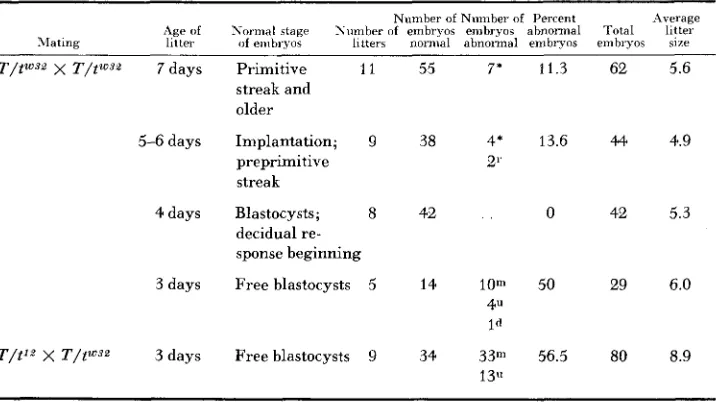
earliest acting lethal factor yet described in mammals; in homozygous condition it prevents the embryos from making the transition from morula to blastocyst. Also typical of t J 2 homozygotes at the morula stage are abnormally shaped nucleoli, and a deficiency in cytoplasmic RNA (SMITH 1956). Matings were made of T/tCVs2 x T/ttVy2, and of T/twYZ x T/tl2 and embryos studied histologi- cally at about 3 to 3% days after fertilization. This is the period during which, on the average, normal morulae transform into blastocysts. As Table 5 shows, these litters contained two categories of embryos; one of healthy normal blasto- cysts, and one of pale-staining abnormally organized morulae, which corres- ponded in every way with the description of tlL/t’L homozygotes given by SMITH.
TABLE 5
Results of dissections o f females pregnant from matings T/t““’ x T/tWs2 or T/tm’32 X T/t12
~~ ~ ~ ~~~
Numher of Nnmher of Percent Average Age of Normal stage Nuniber of embryos embryos abnonnal Total litter >rating litter of embryos litters normal abnormal embryos embryos size
T / t W s 9 X T / t w s s 7 days Primitive 11 55 7’ 11.3 62 5.6
streak and older
preprimitive 21’
streak
5-6days Implantation; 9 38 4’ 13.6 44 4.9
4days Blastocysts; 8 42 . . 0 42 5.3
decidual re- sponse beginning
3 days Free blastocysts 5 14 10m 50 29 6.0
4“ Id
T/t12 X T / W z 3 days Free blastocysts 9 34 3 3 m 56.5 80 8.9
1311
RECURRENT LETHAL ALLELES 955
Litters examined a day later contained only apparently normal embryos. The litter size on the two later days was only slightly more than half its previous value, indicating the death and disappearance of the abnormal morulae. Thus tW32 proves to be embryologically indistinguishable from t 1 2 .
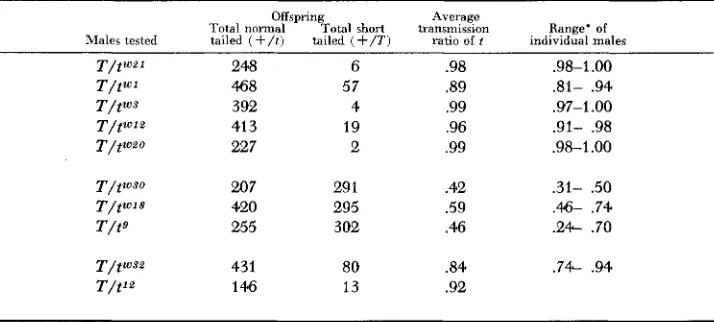
Transmission ratio comparisons: All lethal t-alleles which have so far been studied have a n effect in male heterozygotes on the ratio in which they transmit the t-allele to their offspring. The transmission ratio can be easily tested by mat- ing males of genotype T/t" to normal females
+/+;
the proportion of effective sperm carrying T and t" can be estimated directly from the proportion of short- tailed ( T / + ) and normal-tailed ( t " / + ) offspring. Different lethal t-alleles are transmitted in widely different ratios, some being as high as 99 percent t and some as low as 42 percent t.Table 6 demonstrates that the three different complementation groups under consideration here have average ratios which are clearly different from one another. Within groups, however, the male ratios do not offer any clear evidence for distinguishing one allele as different from another. Variability among differ- ent males carrying the same allele is high, especially in the case of alleles such as the t9 group which show the lowest overall ratio, and this factor makes it diffi- cult to judge which differences are meaningful. The only difference in this group of data which may have meaning is that between tWSO and tW18. The difference between a ratio of 42 percent for tWSO and 59 percent for tW18 is a large one and seems significant. However, the fact that the ranges of transmission ratio for individual t W " O and tWJ8 males overlap makes us reluctant to use the difference in average ratio as a criterion of partial genetic difference between these two noncomplementary alleles.
TABLE 6
Comparison of male transmission ratios of tw21, tw30, and tW32 with the other t-alleles in the same genetic complementation group. Results are shown of testcrosses
of tailless T / t n male x normal
+/+
femaleOffspring Average
Total noma1 Total short transmission Range' of
Males tested tailed ( + / t ) tailed ( + / T I ratio of f individual males
248 468 392 413 227 207 420 255 431 146 6 57 4 19 2 29 1 295 302 80 13 .98 .89 .99 .96 .99 .42 .59 .46 .84 .92
.98-1
.oo
.81- .94 .97-1.00 .91- .98 .98-1 .oo.31- .50 .46- .74 .24- .70 .74- .94
956 D. B E N N E T T A N D L. C . D U N N
EfJects on recombination: Another criterion of similarity which can be used is the effect of lethal t-alleles on recombination in their vicinity. All lethal alleles known suppress regular recombination in the T-tf interval (about nine crossover units), except f o r the two alleles, t9 and tf0'*, which fall in the same complementa- tion group (DUNN, BENNETT and BEASLEY 1962). It has now been found that
tWSO also permits some recombination, 6/121 animals scored, in this interval. The
fact that only the three members of this group permit recombination in their region may be taken as additional evidence of their similarity.
Complementation tests of the twl group alleles with to: A fourth method by which noncomplementary alleles can be compared is their degree of complemen- tation with other lethal alleles. Although two lethal alleles must be considered complementary and therefore nonidentical if they produce any normal-tailed (t"/tn) compounds at all, it has been found that as a rule complementation is not complete. I n other words, the proportion of normal-tailed compounds found at birth is in most cases less, sometimes considerably less, than the expected pro- portion. Thus complementation in this situation can be estimated quantitatively. When the five members of the tLv' group were crossed with stocks containing to (e.g. T/tZU' x T / t o ) each test resulted in a diagnosis of complementation be- cause of the appearance of normal-tailed compounds (e.g. t7"/to). Table 7 shows, however, that the degree of complementation of the first three alleles (each tracing directly to a heterozygote captured in the wild) differs strikingly from the very low degree characteristic of both of the last two alleles each of which arose in an exception from a balanced line carrying a lethal allele of the tfui group. We have no evidence that this sharp difference is due to the difference in manner of origin of these alleles but it suggests that tZ*20 and tZU2' resemble each other in some property which distinguishes them, as a kind of subgroup of the t'"' group.
D I S C U S S I O N
The chief outcome of our complementation studies has been to show that each
of three newly arisen lethals resembles the lethals in one of the complementation groups which had already been recognized. This shows that the numbers of com- plementation groups with the properties of t-alleles is definitely limited. Although
TABLE 7
Complementation tests of alleles of the ''t'v1 group" by to. Results of matings of T/W
group males (tailless) with T/to (tailless) females
Expected Ohsrived
proportion propoi tion Percent Offspring with of nonnal of normal of expected Allele normal tails Tailless tailed young tailed young proportion found
T / t w l 51 77 .47 .40 85
T/tW3 21 26 .50 .45 90
T / t w I * 10 25 .49 .29 59
T / t w 2 o 11 179 .50 .06 1.2
RECURRENT LETHAL ALLELES 95 7
20 balanced lethal lines ( T / t " ) have been examined embryologically and genet- ically we have found only five different (i.e. complementary) groups of t-lethals: to, t9, tie, tW1, tW5. Twelve of the 20 lines studied contained alleles taken from different wild populations, and thus some of these may trace to a common an- cestral allele which underwent dispersion. However, seven lines originated under observation in exceptions from known balanced lethal lines, and the t-alleles in these are thus known to be of independent origin. Of these seven, only two (t" and t12) established new complementation groups, while five appeared to be recurrences (usually by apparent recombination) of lethals already identified.
If five out of seven lethals known to be of independent origin turn out to be recurrences, then the total potential number of complementation groups is surely quite small.
This conclusion was partially confirmed by comparison of other properties of alleles which on genetical and embryological grounds had been assigned to the same complementation group.
In general, two of the three subsidiary effects of derived alleles, those on transmission ratio and recombination, were all indistinguishable within com- plementation groups and did not provide a basis of judgement sufficient for prov- ing differences among lethal alleles in one group.
With respect to the strength of complementation interactions, however, the members of one group ( tZU1) appeared to have attributes which were not identical. Two of the alleles in that group (tWe0 and tW2I) showed a very marked difference in their ability to complement to, as compared with the other three members.
It seems unlikely that a difference of the magnitude observed can be explained by factors extraneous to the t-locus such as background genotype or different degrees of heterosis produced by crossing different lines. W e feel that the most likely hypothesis is a structural difference among the alleles of that group which is reflected detectably only in their complementation reactions with to. If we return now to the idea of deficiency or duplication, we might postulate that tWzo and tw2' include the same region as tW1, tWS and tWIz, but are slightly more extensive and extend into the to region so as to be partially overlapping with it. On this hypothesis embryos to/tWZ0 and t0/tWz1 would be homozygous for a defective region common to both to and tWZ0-tZoZ1 and their prenatal viability because of this should be lower than that of to/tlul, to/tws, or to/tZU1%.
The tentative conclusion to be drawn from this type of study is that some complementation groups at the t-locus may be broken down into subgroups on the basis of specific other criteria, and consequently that the chromosomal basis for different members of lethal t-allele complementation groups may not be identical.
SUMMARY
958 D. B E N N E T T A N D L. C. D U N N
criteria from the members of one of the five t-lethal complementation groups already known.
These observations were taken to support the view that the chromosome region within which the t-lethals occur is subject to structural change (e.g. deficiency or duplication) connected with exceptional recombination occurring at a limited number of points, since five out of seven independently arisen lethals represent recurrences of aberrations previously observed.
In addition, two members (tw*" and t W L 1 ) of one complementation group dif- fered widely from the other three members (tIC1, tLUJ, tZLIL) in the degree of com- plementation with a different lethal ( t o ) as judged by the proportion of compound embryos which survived to birth. This was taken as an indication that the extent of aberration (e.g. deficiency or duplication) may differ amongst members of the same complementation, and in some cases may partially overlap the area of aber- ration characteristic of a contiguous complementation group.
LITERATURE CITED
DUNN, L. C., D. BENNETT, and A. B. BEASLEY, 1962
BENNETT, D., L. C. DUNN, and S. BADENHAUSEN, 1959
BENNETT, D., S. BADENHAUSEN, and L. C. DUNN, 1959
BENNETT, D. and L. C. DUNN, 1960
SMITH, L. J., 1956
MCLAREN, A., and D. MICHIE, 1959
Mutation and recombination in the vicinity of a complex gene. Genetics 47 : 285-303.
lethal t-alleles in the mouse. J. Morphol. 105: 105-143.
populations of wild house mice. Genetics 44: 795-802.
partial duplication. J. Exptl. Zool. 143: 203-219.
lethal ( 2 1 2 ) in the house mouse. J. Exptl. Zool. 132: 51-84.
oirs of the Society for Endocrinology, No. 6 : 65-74.
The embryological effects of four late
A second group of similar lethals in
A lethal mutant ( t " ' 8 ) in the house mouse showing
A morphological and histochemical investigation of a preimplantation