T H E AFFECTED SIB METHOD. I. STATISTICAL FEATURES
O F T H E AFFECTED SIB-PAIR METHOD
UZI MOTRO’ A N D GLENYS THOMSON’
Genetics Department, Mulford Hall, University of Calqornia, Berkeley, CaliJornia 94720 Manuscript received July 7, 1983
Revised copy accepted March 21, 1985
ABSTRACT
The distribution of the number of HLA haplotypes shared by sibs affected with the same HLA-linked disease can be used to obtain information on the genetics of the disease. Since the inception of the use of sib-pair methods for the analysis of the HLA-associated diseases, the question has been raised of how to include families with more than two affected sibs in the sib-pair analysis. This paper presents appropriate weighting schemes. A procedure for estimating the frequency of the disease allele in the general population, under the as- sumptions of single-allele recessive, additive, dominant and intermediate models, with negligible recombination (0 = 0) between the disease-predisposing gene and the HLA region, and no selective disadvantage of the trait, is also given. Cluster-sampling techniques are used in the analysis.
ULTIPLE case family studies have provided a method for detecting the
h’f
presence of a human leukocyte antigen (HLA)-linked disease-predispos- ing gene (CUDWORTH and WOODROW 1975; BOBROW et al. 1975). These initial studies investigated the distribution of sharing of HLA haplotypes among sibs affected with a disease. Deviations of the sharing of HLA haplotypes from random expectations were taken as evidence of the existence of an HLA-linked “disease” gene (CUDWORTH and WOODROW 1975). The use of such data has been extended by theoretical studies so that now affected sib data are used to detect the presence of HLA-linked “disease” genes, as well as to try and de- termine the mode of inheritance of the “disease” genes. The affected sib-pair method has been applied to data on a number of diseases, including multiple sclerosis, hemochromatosis, insulin-dependent diabetes mellitus (IDDM), celiac disease, juvenile rheumatoid arthritis, adult rheumatoid arthritis and Graves’ and Hashimoto’s diseases (THOMSON and BODMER 1977a,b; KIDD et al. 1977; SUAREZ, HONE and REICH 1979; SPIELMAN, BAKER and ZMIJEWSKI 1980; SVEJGAARD, PLATZ and RYDER 1980; WALKER and CUDWORTH 1980; GREEN-BERG and ROTTER 198 1 ; STEWART et al. 198 1 ; WEITKAMP 198 1 ; GREENBERG, HODGE and ROTTER 1982; KHAN, KUSHNER and WEITKAMP 1983).
The theory of the affected sib-pair method has been investigated by a num- ber of workers, who have made different assumptions about the penetrance
’
Present address: Department of Statistics, The Hebrew University, Jerusalem, Israel.’
To whom reprint requests should be addressed.526 U. MOTRO AND G . THOMSON
parameters for the genotypes at the “disease” locus and the value of the re- combination fraction between the “disease” gene and the HLA loci. The dif- ferent models that have been investigated include consideration of “quasire- cessive” and “quasidominant” models (DAY and SIMONS 1976), strict recessive and dominant models (THOMSON and BODMER 1977a,b), a model with general penetrance values for the three “disease” genotypes (SUAREZ 1978), extension of the general model to also include recombination (SUAREZ, RICE and REICH
1978; SPIELMAN, BAKER and ZMIJEWSKI 1980; PAYAMI, THOMSON and LOUIS 1984) and models that take account of family size information (GREEN, HENG and WOODROW 1983; EWENS and CLARKE 1984).
It is an implicit assumption in all but the GREEN, HENG and WOODROW (1983) and EWENS and CLARKE (1984) approaches cited above that affected sib pairs are obtained by simple random sampling. Obviously, this is not the case in practice, since the sampling units are families and not affected sib pairs. Sib pairs from families with more than two affected sibs are not statistically independent. Also, such sibships do not have the same distribution of parental genotypes at the disease locus as sibships with only two affected offspring. They are biased in the direction that the frequency of the disease-predisposing allele is higher among their parents than it is among parents of families with only two affected sibs (RUBINSTEIN, GINSBERG-FELLNER and FALK 198 1). This implies that affected sib trios, quartets, etc. cannot be excluded from the sib- pair analysis, since the use in the analysis of only families with two affected sibs would not satisfy the conditions under which the probabilities of affected sib pairs sharing two, one, or zero HLA haplotypes were derived.
In this paper we will deal with the question of how to include families with more than two affected sibs in the sib-pair analysis. T h e question of ascertain- ment bias enters into our considerations since the probabilities with which families having two, three, etc. affected sibs enter our sample are pertinent to the calculations.
A method will be developed for estimating the frequency of the disease- predisposing allele in the general population, under the assumptions of single- allele recessive, additive, dominant and intermediate models, zero recombina- tion and no selective disadvantage of the trait. Cluster-sampling techniques will be used in our analysis.
THE DISTRIBUTION OF THE NUMBER OF SHARED HLA HAPLOTYPES AMONG AFFECTED SIB PAIRS
We assume that there is an HLA-linked gene, with alleles D and d , which is involved in predisposing individuals to disease. We consider an intermediate model (SPIELMAN, BAKER and ZMIJEWSKI 1980; SVEJGAARD, PLATZ and RYDER
T h e case X = 0 corresponds to a strict recessive mode of inheritance for the disease susceptibility allele
D ,
h = 1 corresponds to a strict dominant mode of inheritance and X = 1/2 corresponds to an additive model.T h e distribution of the number of shared haplotypes among affected sibs has been derived, assuming Hardy-Weinberg equilibrium at the disease suscep- tibility locus, and that sib pairs are chosen at random, by SUAREZ (1978) for the general model of disease predisposition, where all three genotypes
DD,
Dd
and dd are disease susceptible. It is assumed that the disease-predisposing gene is very tightly linked to the HLA region such that recombination is negligible (0 = 0). For the intermediate model to be considered here, the probabilities that a randomly chosen affected sib pair will share two, one or zero haplotypes denoted X, Y and Z, respectively, are given in (la)-(lc).
( 1 4 (1
-
2x2)pD+
2x2
(1
-
2x)2p:+
2(1-
2X) (1+
2qp;+
(1+
4 q p D+
4x2(1b) 2(1
-
2x)p;+
2x
(2-
x)p,
+
2x2(1
-
2h)2p;+
2(1-
2h)(l+
2x)p;
+
(1+
4 x ) p D+
4x2x
= P(2) =Y = P(1) =
(1
-
2X)2~;
+
4X(1-
2X)p;+
4X2pDz
= P(0) = (1-
2xyp:+
2(1-
2X)(1+
2x)p;
+
(1+
4qp,+
4x2 ( 1 4where
p D
is the frequency of the disease susceptibility allele D .denoted p (p = 2X
+
Y), is given byT h e mean of S, the number of shared haplotypes
per
affected sib pair,(2)
2(1
-
2X)p;+
2(1-
X)(1+
3X)p~+
6X2E ( S ) = p =
(1
-
2x)2p;+
2(1-
2X)(1+
2x)p;+
(1+
4x)pD+
4x2T h e variance of S, denoted (r' is given by
Var(S) = U' = 2A/B2 (3)
where
A = (1
-
2X)'p;+
(1-
2X)'(2+
6X-
5X2)p$+
(1-
2X)(1+
8X+
15X2 30X3)pi+
x(2
+
9x+
20x2-
58x3)~;+
x 2 ( i+
4x+
i6x*)pD+
2x4and
B = (1
-
2x)2p:+
2(1-
2X)(l+
2yp;+
( 1+
4X)p,+
4x2T H E INCLUSION OF PAIRS FROM FAMILIES WITH MORE T H A N TWO AFFECTED
SIBS IN T H E SIB PAIR ANALYSIS
528 U. MOTRO AND G. THOMSON
not satisfied. In the actual collection of sib-pair data, sampling is of families who have two or more affected children. Thus, affected sib pairs are sampled by cluster sampling (COCHRAN 1977), the clusters being the families. Each cluster size is given by the number of affected sib pairs in the family (one for a family with two affected sibs, three for a family with three affected sibs, ($)
for a family with K affected sibs.) In this section we address the question of how to include pairs from families with more than two affected sibs in the sib- pair analysis.
T h e weighting scheme we propose derives from a moments approach. (Max- imum likelihood solutions cannot be used in this case due to the nonindepend- ence of sib pairs in families with more than two affected sibs.) Our approach in determining the appropriate weighting scheme is that pairs from families with more than two affected sibs are included in the analysis in such a way as to be equivalent to random sampling, the condition under which the X, Y and Z values in (la)-(lc) were derived. This procedure is the only one that will give X, Y and Z values that are independent of the family size distribution and the absolute penetrance x of the DD genotype (see APPENDIX). T h e appropriate weighting scheme to use will depend on the ascertainment procedure by which families were obtained.
Let us first consider the case in which ascertainment of families is by incom- plete truncate selection (CAVALLI-SFORZA and BODMER 1971,
p.
853), that is, all families with at least two affected children have the same probability (regardless of family size or the number of affected sibs) of entering our sample. Thus, families with a particular number of affected children are represented in our sample in proportion to the number of families of this type in the general population. Now, families with, for example, three affected sibs contribute three sib pairs to the total population of all affected sib pairs (families with two affected sibs contribute one pair, and families with four affected contribute six pairs, etc.), under our hypothetical scheme of random sampling from the total population of all available sib pairs. Thus in the case of incomplete trun- cate selection, in which families are represented in the sample in proportion to their number in the general population, the equivalent procedure is that every sib pair from all families is given equal weight in the contribution to the X, Y and Z values, that is, families with three affected sibs contribute all three sib pairs etc. as they do under random sampling. For other ascertainment schemes a weighting of the sib-pair contributions must be made (see APPENDIX).We consider a general case in which we assume that the probability of selection of a family is a function of the number of affected sibs in the family. For any two families, one w i t h j affected and another with
k
affected children, we assume that the ratio of these probabilities is b&. Denote by m, (i = 1,2,
3,
. . .
, n ) the cluster size of the ith family in our sample of n families. This family has m, affected sib pairs, and each sib pair is characterized by the number of shared haplotypes (2, 1 or 0). Let U,, v, and w, (U,+
v,+
w, = m,)T h e appropriate estimates of the proportion of affected sib pairs sharing two, one and zero haplotypes are, respectively, given by
(4)
2
z,.
p
p ii = l bi i - 1 bi bi
and the corresponding estimate of p (=
2X
+
Y),
the number of shared hap- lotypes per sib pair is(si = 2 ~ , i
+
vi) and(COCHRAN 1977).
Remarks
1. T h e weights given to the
ui,
vi, wi, mi and si values compensate for theover- or underrepresentation in our sample of families with different numbers of affected children. For incomplete truncate selection bi = 1, i = 1,
. . .
, n ,and all families contribute with equal weight all their sib pairs to the analysis, as discussed above. If families are ascertained with probabilities directly pro- portional to the number of affected sibs in the family (incomplete single selection,
CAVALLSI-FORZA and BODMER 1971, p. 853), then b j / h = j / k , and a family
with, say, four affected sibs is twice as likely to be sampled than is a family with only two affected children. T o overcome this bias, we give the data from the former family only half the weight of that given to the data from the latter family.
2 . (Missing observations): If, for a cluster of size m , data is available for only
m’ (m’
<
m ) of its elements, the sum of observations for the whole cluster can be estimated by the sum over the m’ elements, multiplied by m / m ’ . Thus, if, for a family with m affected sib pairs, the number of shared haplotypes can be obtained only for m’ of the sib pairs, then s (the sum of the number of shared haplotypes) can be estimated by (m/m’)s’, where s’ is the sum over the m’affected sib pairs for which data is available, etc.
530 U . MOTRO AND G . THOMSON
is not followed, then the
2,
and2
values obtained do not have the expecta- tions given in (1a)-(lc). They then have expectations that are complicated functions of family size and number of unaffected children. The strength of the approach presented here is that, if the appropriate weighting is given, then the simplicity of the X , Y and 2 values, in that they are functions only of the disease allele frequencyPD
and the ratio X of the penetrance of disease heter- ozygotes to homozygotes is maintained.ESTIMATING T H E FREQUENCY OF T H E DISEASE ALLELE IN THE GENERAL POPULATION
When the appropriately weighted estimates
i,
9
and have been obtained for data from a patient population, these can be used to obtain estimates of the disease-predisposing allele frequency,PD,
for specified modes of inherit- ance, that is, specified X values, where X [see (la)-(lc)] denotes the relative penetrance of the heterozygotesDd
to homozygotesDD.
Obviously, one would initially estimate p D values and test the observed data
against expectations under additive and recessive models, as these are the two simplest alternative models to first consider in disease modeling. (The expec- tations for additive and dominant models are very similar, and since the theory for additive models is much simpler, consideration will be restricted to this model.) Estimates of p D could also be obtained and tested against expectations
for specified values of A, for example, to test against previously estimated values of
A.
It is possible to obtain joint estimates using the appropriately weighted sib- pair haplotype sharing data, for both X and P D (LOUIS, THOMSON and PAYAMI
1983). No test of goodness of fit of these estimates can be carried out, since only two of the X , Y and Z values are independent and these have been used to estimate the two parameters.
Maximum likelihood estimates (MLEs) of $10 for recessive and additive
models can be obtained under the assumption of random sampling from the population of sib pairs. However, since we must take account of the fact that sampling is of families and, hence, that our sib pairs are not all statistically independent, we must use a moments method (MOOD and GRAYBILL 1963) and appropriate cluster-sampling techniques (COCHRAN 1977).
For a specified value of
A,
ifF ,
an estimate for p , the mean number of shared haplotypes per affected sib pair, is substituted in (2), this yields a cubic equation inp ,
(for X # 0 or %).5
is estimated by the sample mean number of shared haplotypes per affected sib pair using the moments method [see ( 5 ) ] .If we use first order approximations from a Taylor expansion, the approxi- mate variance of f i D , which is an upper bound given the restriction 0 5
p ,
5var($D) = Var(i)/[d(Po)I2 ( 8 )
where p ’ ( p D ) is the first derivative with respect to given in (2). Equation (8) can be written as
of the expression &ID)
Var(jD) = B 4 Var(i)/C2 (9)
where B is given after (3), and
c
= ~ ( 1-
2~)3p;+
4(1-
2 ~ ) 2 ( 1-
x)(1+
3x)p;+
2(1-
2X)(1+
4X+
1 1X2-
30X3)pi+
8X2(1-
2X)(1+
6X)pD+
2X2(1+
2X)(6X -1)For a recessive mode of inheritance
(A
= 0), the solution of (’7) isand an upper bound for the variance of $D is 4Var(;)/p4. (Under the assump-
tion of random sampling of sib pairs the moments estimate in the recessive case is the same as the MLE.)
For the additive model
(A
=Yz),
the solution of(7)
isif
;
>
1.5 3 - 2 ; .if 1 5
;
I 1.5and an upper bound for Var(fiD) is (1
+
3$D)4Var(;)/4 [from (9) using (3)]. (The MLE, for the additive model, under the assumption of random mating, is only the same as the moments estimate when n l = n / 2 , where n l is the number of sib pairs in the sample of size n sharing 1 haplotype. T h e MLE isfi,
= no/(2n:!-
no) if n2 2 no, and $ D = 1 if n2<
no, where n2 and no are the numbers of sib pairs in the sample sharing 2 and 0 haplotypes, respectively.)EXAMPLE
We consider data from the study of WALKER and CUDWORTH (1980), con- cerning families with at least two IDDM-affected children. (The data on fam- ilies with more than two affected sibs was kindly supplied by A. G. CUD-
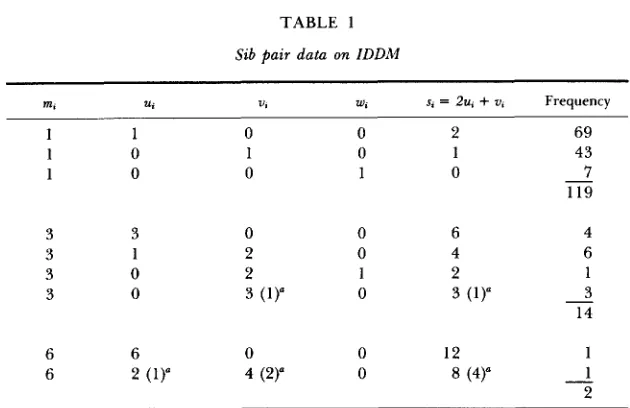
WORTH.) In total, the data set comprised n = 135 families, 119 of which had two affected children, 14 had three affected and two families had four affected children. We summarize these data in Table 1.
We consider three different ascertainment schemes: I, incomplete truncate selection [all families with at least two affected children have the same proba- bility of being sampled; hence, see discussion before (4), bi = 1,
i
= 1,532 U . MOTRO AND G . THOMSON
TABLE 1
Sib pair data on IDDM
U, U, W , s, = 2u,
+
U, Frequency1 0 0 3 1 0 0 6 2 (1)"
0 1 0 0 2 2 3 (1)"
0
4 (2)"
2 1 0 6 4 2
3 (1)"
12
8 (4)"
69 43 7 119 4 6 1 3 14 1 1 2 - -
-
The data are drawn from WALKER and CUDWORTH (1980) and unpublished results of A. G. CUDWORTH. The parameters m,, U,, U,, and w,, represent the number of affected sib pairs in the family sharing two, one and no haplotypes, respectively.
In three families with three affected and in one family with four affected children, one of the sibs was either a recombinant or untyped. The numbers in parentheses are the available data, and the numbers to their left are the estimated values.
bilities directly proportional to the number of affected sibs in the family, thus
bj/bk = j / k ) and 111, incomplete sib-pair selection [families are ascertained pro- portional to the number of affected sib pairs in the family, thus b j / b k =
Under the assumption that the mode of inheritance of the disease-predis- posing allele is recessive, the following estimates of the disease allele frequency are obtained (10): I, $ D = 0.3308 (SD = 0.0452); 11, $ D = 0.3285 (SD = 0.0436);
In this case very similar estimates for the frequency of the disease allele (and their standard deviations), under the assumption of a recessive mode of inher- itance, have been obtained for each of the three modes of ascertainment. (For all three cases the estimate $D = 0.0 is obtained for the additive case.)
Note that incomplete sib-pair selection can also be analyzed by taking one sib pair from each family. Such a procedure involves loss of information. However, this has been the standard procedure to take account of the lack of independence of sib pairs from families with more than two affected sibs.
(4)/(91.
111, $D = 0.3235 (SD = 0.0445).
independent. On the other hand, since the distribution of the number of shared haplotypes is different for families having different numbers of affected children, we cannot consider using only one affected sib pair from each family. (The only case for which we could would be where ascertainment is by incom- plete sib-pair selection.) Alternate statistical tests that take account of clustering and ascertainment bias in our data collecting will be discussed elsewhere (E. J.
LOUIS, unpublished).
DISCUSSION
T h e distribution of the number of haplotypes shared by sibs affected with the same disease can be expressed in an explicit form (SUAREZ 1978); this distribution depends on the mode of inheritance of the disease, as well as on the frequency of the disease-predisposing allele. T h e distribution of the num- ber of shared haplotypes among affected sib pairs in a sample can be used to estimate
PD
values and test the observed data against expectation for specifiedX values, which will usually be restricted to recessive and additive (dominant) models. (These estimates apply to single-allele single-locus models with the assumption of zero recombination between the predisposing gene and the HLA region and no selective disadvantage of the trait.) T h e sample data can also be used to give estimates of the degree of dominance X of the disease allele and its frequency for an intermediate model. In practice this requires numer- ical iterations by computer (LOUIS, THOMSON and PAYAMI 1983).
This paper presents procedures for obtaining estimates for the frequency of the disease-predisposing allele, for recessive, additive and dominant models, and for intermediate models for a specified value of A. When using affected sib-pair data for statistical inference, an important fact must be taken into consideration, namely, that in most cases affected sib pairs are not selected by simple random sampling. Usually, we select families, and, since sib pairs be- longing to the same family are not statistically independent, this has to be taken into account in our data treatment. Moreover, families with different numbers of affected sibs may be ascertained with different probabilities. Since the distribution of the number of shared haplotypes for sib pairs belonging to families with only two affected children is different from sib pairs belonging to families with, say, three affected children [as has been shown empirically by WEITKAMP ( 1 98 l ) , and theoretically by RUBINSTEIN, GINSBERG-FELLNER and FALK (198 l)], appropriate compensation should be given to overcome the over- or underrepresentation of families with different sizes of affected siblings.
Detailed treatment has been given to the IDDM data of WALKER and CIJD-
5 34 U. MOTRO AND G . THOMSON
selection). If the mode of inheritance is recessive, the three assumed ascertain- ment patterns yield very similar estimates for the frequency of the disease- predisposing allele, namely, 3 2 4 3 % . An additive mode of inheritance was rejected for all three ascertainment patterns.
IDDM data collected by WEITKAMP (1981) have also been analyzed. For these data a recessive mode of inheritance for the HLA-linked disease-predis- posing allele is again not rejected for the three ascertainment patterns. How- ever, in this case, the three ascertainment patterns give a wider range for the estimate of
p,,
namely, 0.41 36 (incomplete truncate selection), 0.3846 (‘ incom- plete single selection) and 0.352 1 (incomplete sib-pair selection). For these data an additive mode of inheritance is not rejected when the ascertainment of families is assumed to be incomplete truncate selection or incomplete single selection.Since one can usually not be certain of the extent of bias inherent in the ascertainment of families with multiple affected sibs, we suggest that sib-pair data be analyzed under all three ascertainment patterns outlined above. Pro- vided the number of families with three or more affected sibs is sufficiently small compared to the number of families with two affected sibs, the analysis of the data under these different ascertainment patterns will not usually lead to vastly different estimates of the disease allele frequency, nor to different conclusions regarding the mode of inheritance of the HLA-linked disease- predisposing allele. This is not the case if we consider the data analyzed by WEITKAMP (1 98 1). However, preliminary examination of an extension of Weit- kamp’s data set on haplotype sharing in families with three or more affected sibs indicates that, with the larger data set, the deviations in haplotype sharing in the families with three or more affected sibs, compared to that in families with two affected sibs, are not as large as the deviations found in the original data (PAYAMI et al. 1985).
Analysis of Caucasian haplotype sharing data for autoimmune thyroid disease gives very different results, both in terms of estimates of disease allele fre- quencies and tests of mode of inheritance hypotheses, for the three ascertain- ment schemes (H. PAYAMI, personal communication). In this case there is evidence that incomplete sib-pair selection is the appropriate ascertainment scheme.
We stress that one cannot predict a priori the effects of the three ascertain- ment procedures on the allele frequency estimates and the test of mode of inheritance. Unless there is strong evidence in favor of a particular ascertain- ment scheme, we suggest analyzing the data under all three ascertainment schemes, as detailed above.
Such disease allele frequencies are often too high to be compatible with the population prevalence of the disease, given estimated penetrance values (see for example SPIELMAN, BAKER and ZMIJEWSKI 1980; LOUIS, THOMSON and PAYAMI 1983). Consideration of an intermediate mode of inheritance, instead of a recessive model, for IDDM leads, of course, to a lower estimate of
p,.
This does not necessarily imply a large decrease in the population prevalence of the disease, since heterozygous individuals will now contribute to the patient pool. T h e different (A,
P D )
estimates for IDDM given by LOUIS, THOMSON and PAYAMI (1983) do not lead to large differences in the predicted relative values of M Z twin concordance rates and recurrence risks in sibs and parents or children, and these are also similar to the values for the recessive case. None of the estimated parameter sets yield population rates that are compatible with the observed values. These results imply the necessity of investigating two- locus disease-predisposing models as well as more realistic single-locus models, T h e strength of using affected sib-pair haplotype-sharing data to estimate disease allele frequencies and test modes of inheritance for single-allele single- locus models is that these estimates are unaffected by the presence of additional non-HLA-linked loci that predispose to disease, for which there is increasing evidence for IDDM, provided the penetrance values in the multilocus system have a multiplicative structure and there is no linkage disequilibrium between the loci (THOMSON 1981; HODGE and SPENCE 1981; LOUIS, THOMSON and PAYAMI 1983). T h e effect of breaking the assumptions of non-zero recombi- nation and selective disadvantage of the trait are well understood (RISCH 1982; PAYAMI, THOMSON and LOUIS 1984). T h e disease allele frequency is overesti- mated when non-zero recombination is ignored and usually underestimated when the selective disadvantage of the trait is ignored. However, the haplotype- sharing distributions for additive and recessive models still fall on the classical additive and recessive curves, giving considerable robustness to our tests.In the classical sib-pair analysis information on family size and the haplotype- sharing distribution of unaffected sibs are ignored. Family size information is not always available. Also, more complex disease susceptibility models which are being analyzed using a sib-pair approach, for example, multiple-allele sin- gle-locus models for IDDM and other HLA-associated disease (LOUIS, PAYAMI and THOMSON 1984), and more particularly models investigating the genetic interrelationship of the HLA-associated diseases (PAYAMI and THOMSON 1984), may not be amenable to an analysis that takes account of these factors. T h e data obviously should be analyzed taking account of family size information when possible (GREEN, HENG and WOODROW 1983; EWENS and CLARKE 1984), as well as the haplotype sharing of unaffected sibs and the affectional status of parents. These approaches should be seen as complementary. Discrepancies in results obtained from the different methods could indicate which assumptions of the models are incorrect.
536 U. MOTRO AND G. THOMSON
sib-pair results, and the results of analyses including information on the family size, as well as analysis by the AGFAP antigen genotype frequencies among patients (AGFAP) (THOMSON and BODMER 1977a,b; THOMSON 1981, 1983b; GREENBERG, HODCE and ROTTER 1982) method using population data, can give information about the validity of the assumptions of the models.
This research was supported by National Institutes of Health grant H D 12731. We thank ESTHER HUDES for her careful reading of the manuscript and helpful suggestions.
LITERATURE CITED
BOBROW, M., J. G. BODMER, W. F. BODMER, H. MCDEVITT, J. LORBER and P. SWIFT, 1975 T h e search for a human equivalent of the mouse T-locus-negative results from a study of HL-A types in spina bifida. Tissue Antigens 5: 234-237.
The Genetics of Human Populations. Freeman,
San Francisco.
COCHRAN, W. G., 1977
CUDWORTH, A. G. and J. C. WOODROW, 1975
DAY, N. E. and M. J. SIMONS, 1976
EWENS, W. J. and C. P. CLARKE, 1984
CAVALLI-SFORZA, L. L. and W. F. BODMER, 1971
Sampling Techniqua, Ed. 3. John Wiley, New York.
Evidence for HLA-linked genes in ‘?juvenile”
Disease susceptibility genes: their identification by multiple
Maximum likelihood estimation of genetic parameters of HLA-linked diseases using data from families of various sizes. Am. J. Hum. Genet. 36: 858- 872.
GREEN, J. R., C. L. HENC and J. C. WOODROW, 1983 Inference on inheritance of disease using repetitions of HLA haplotypes in affected siblings. Ann. Hum. Genet. 47: 73-82.
GREENBERG, D. A., S. E. HODCE and J. I. ROTTER, 1982 Evidence for recessive and against dominant inheritance at the HLA “linked” locus in coeliac disease. Am. J. Hum. Genet. 34:
263-277.
GREENBERG, D. A. and J. 1. ROTTER, 1981 T w o locus models for gluten sensitive enteropathy: population genetic considerations. Am. J. Med. Genet. 8: 205-214.
HODGE, S. E. and M. A. Spence, 1981 Some epistatic two locus models of disease. 11. T h e confounding of linkage and association. Am. J. Hum. Genet. 33: 396-406.
KHAN, M. A., I . KUSHNER and L. R. WEITKAMP, 1983 Genetics of HLA associated diseases: rheumatoid arthritis. Tissue Antigens 22: 182-185.
KIDD, K. K., D. BERNOCO, A. 0. CARBONARA, V. DANEO, U. STEICER and R. CEPELLINI, 1977 Genetic analysis of HLA-associated diseases: the “illness susceptible” gene frequency and sex ratio in ankylosing spondylitis. pp. 72-80. In: HLA and Disease, Edited by J. DAUSSET and A. SVEJGAARD. MUNKSGAARD, COPENHAGEN.
Affected sib methods. pp. 662-663. In: Histo-
compatibility Testing 1984, Edited by E. ALBERT, M. BAUR and W. MAYR. Springer Verlag,
New York.
T h e affected sib method. 11. T h e intermediate diabetes mellitus. Br. Med. J. 3: 133-135.
case family studies. Tissue Antigens 8: 109-1 19.
LOUIS, E. J., H. PAYAMI and G. THOMSON, 1984
LOUIS, E. J., G. THOMSON and H . PAYAMI, 1983 model. Ann. Hum. Genet. 47: 225-243. MOOD, A. M. and F. A. GRAYBILL, 1963
PAYAMI, H. and G. THOMSON, 1984
Introduction to the Theory ofStatistics. McGraw Hill, New
Genetic interrelationship amongst HLA associated diseases using the affected sib method. pp. 663-664. In: Histocompatibility Testing 1984, Edited by E. ALBERT, M. BAUR and W. MAYR. Springer Verlag, New York.
PAYAMI, H., G. THOMSON and E. LOUIS, 1984 The affected sib method. 111. Selection and recombination. Am. J. Hum. Genet. 36: 352-362.
1V: sib trios. Ann. Hum. Genet. In press.
Affected sib pair marker allele sharing: the effect of reduced fertility, variable family size, and a second unlinked locus (Abstr.). Am. J. Hum. Genet. 34: 191A.
Genetics of type I diabetes mellitus: a single, recessive predisposition gene mapping between HLA-B and GLO. Am. J. Hum. Genet.
Gene dosage and susceptibility to insulin
HLA family studies and multiple sclerosis: a common gene, dominantly expressed. Hum. Immunol. 3: 13-29.
The affected sib pair IBD distribution for HLA-linked disease susceptibility genes. Tissue Antigens 12: 87-93.
Is juvenile diabetes determined by a single gene closely linked to HLA? Diabetes 2 8 527-532.
The generalized sib pair IBD distribution: its use in the detection of linkage. Ann. Hum. Genet. 42: 87-94.
Insulin-dependent diabetes mellitus. pp. 638-656. In: Histocompatibility Testing 1980, Edited by P. TERASKI. U.C.L.A. Tissue Typing Laboratory, Los Angeles.
THOMSON, G., 1981 A review of theoretical aspects of HLA and disease associations. Theor. Pop. Biol. 2 0 168-208.
THOMSON, G., 1983a Theoretical aspects of HLA disease associations. pp. 77-88. In: Human
Genetics, Part B: Medical Aspects, Edited by B. BONNE-TAMIR. Alan R. Liss Inc., New York.
Investigation of the mode of inheritance of the HLA associated diseases by the antigen genotype frequencies amongst diseased method. Tissue Antigens 21: 8 1-104.
The genetics of HLA and disease associations. pp. 545-564. In: Measuring Selection in Natural Populations, Edited by F. B. CHRISTIANSEN, T. FENCHEL and 0. BARNDORFF-NIELSON. Springer-Verlag, New York.
The genetic analysis of HLA and disease associations. pp. 84-93. In: HLA and Disease, Edited by J. DAUSSET and A. SVEJGAARD. Munksgaard, Copenhagen.
Type 1 (insulin-dependent) diabetic multiplex families. Diabetes 2 9 1036- 1039.
HLA and disease: predictions for HLA haplotype sharing in families.
Communicating editor: W. J. EWENS PAYAMI, H., G. THOMSON, U. MOTRO, E. J. LOUIS and E. HUDFS, 1985
RISCH, N., 1982
RUBINSTEIN, P., F. GINSBERG-FELLNER and C. FALK, 1981
The affected sib method
33: 865-882.
SPIELMAN, R. S., L. BAKER and C. M. ZMIJEWSKI, 1980
STEWART, G. J., J. G. MCLEOD, A. BASTEN and H. V. BASHIR, 1981
SUAREZ, B. K., 1978
SUAREZ, B., S. HOKE and T. REICH, 1979
SUAREZ, B. K., J. RICE and T. REICH, 1978
SVEJEAARD, A., P. PLATZ and L. P. RYDER, 1980 dependent diabetes. Ann. Hum. Genet. 4 4 135-150.
THOMSON, G., 1983b
THOMSON, G. and W. F. BODMER, 1977a
THOMSON, G. and W. F. BODMER, 1977b
WALKER, A and A. G. CUDWORTH, 1980
WEITKAMP, L. R., 1981
Am. J. Hum. Genet. 33: 776-784.
APPENDIX
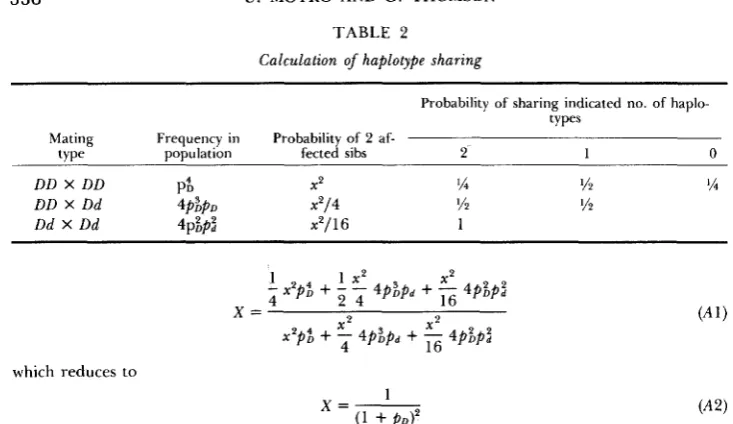
Assuming random sampling of sib pairs and a single-allele single-locus recessive mode of inher- itance, with zero reconibination between the disease susceptibility locus and the HLA region and no selective disadvantage of the trait, the probabilities of affected sib pairs sharing two, one and zero HLA haplotypes identical by descent, denoted X, Y and Z, respectively, are derived from Table 2.
538 U. MOTRO AND G . THOMSON
TABLE 2
Calculation of haplotype sharing
Probability of sharing indicated no. o f haplo-
'Y Pes Mating Frequency in Probability o f 2 af-
type population fected sibs 2 1 0
D D X DD P i X2 % Y' Y4
DD X Dd 4pipLJ x'/4 Y2 Y2
Dd X Dd 4PfP;Pg x'/ 1 6 1
1 1 x 2 X2
-
4 xzp;+
- 2 4-
+
-
16 4pfp3X =
which reduces to
We now consider family size in our calculations. For families of total size two, all of the expressions in Table 2 are appropriate. For families of size three, we must consider the probabilities of the family having two affected sibs us. three affected. For matings of type DD X D D , these two types of family will be represented in the general population in proportions 3x2(1 - x) and 2, respec- tively. These expressions appropriately involve the terms (x/2) and (x/4) for matings of type
DD X Dd and Dd X D d , respectively. All other expressions in Table 2 are appropriate. For families of size four, and mating type DD X D D , families with two, three and four affected sibs will be represented in the general population in proportions 6x2(1
-
x)', 4x3(1-
x ) and x4, respectively. In this caseX =
4
pb[1/zbzx2+
1/s(b23~'(1-
X )+
a s b s ~ ~ )+
1/4(b26~~(1 - x)'+
013bs4~'(1 - X)+
0 1 4 6 4 ~ ~ )+
. .
. ] { I1/zbzX2
+
~ s ( b z 3 ~ ' ( 1-
X )+
013bsx')+
1 / 4 ( b 2 6 ~ ' ( 1-
x)'i [
1
+
~usbs4~'(1 - X )+
a4b4x4+
. .. . .
T h e s,(i = 2, 3, . . .) represent the proportion of families of size i in the general population, the ratio of the probabilities of selection in our sample of a family with j affected us. a family with k affected children is b,/b&, k = 2, 3 , . . .) and a,(i = 3, 4, . . .) represent the weight we will give families with i affected sibs us. families with two affected sibs.
T h e only weighting scheme that will allow reduction as before from ( A l ) to (A2) is
01, = (i)bz/b,