Improved Privacy of the Tree-Based Hash protocols
using Physically Unclonable Function
Julien Bringer1
, Herv´e Chabanne1
and Thomas Icart1,2
1
Sagem S´ecurit´e
2
Universit´e du Luxembourg [email protected]
Abstract. In 2004, Molnar and Wagner introduced a very appealing scheme dedicated to the identification of RFID tags. Their protocol relies on a binary tree of secrets which are shared – for all nodes except the leaves – amongst the tags. Hence the compromise of one tag also has implications on the other tags with whom it shares keys. We describe a new man-in-the-middle attack against this protocol which allows to break privacy even without opening tags. Moreover, it can be applied to some other RFID protocols which use correlated keys as the one described recently by Damg˚ard and Pedersen at CT-RSA 2008.
We introduce a modification of the initial scheme to allow us to thwart this and to strengthen RFID tags by implementing secrets with Physical Obfuscated Keys (POKs). This doing, we augment tags and scheme privacy, particularly general resistance against physical threats.
Keywords.RFID tags, Tree-Based Hash Protocol,POK,PUF, Privacy.
1 Introduction
Radio Frequency Identification (RFID) tags are made of a small chip con-taining a unique identification number. They communicate in the air with the system via a reader. One of their main applications is to track objects on which they are attached.
already been addressed in [2], the compromise of tags still leaks information about the keying material of the system.
To thwart this, we want to increase the resistance of tags against physical threats. Physical Obfuscated Keys (POKs) have been introduced by Gassend [6] as a mean to securely store a secret inside a chip. They are strongly related to Physical Unclonable Functions (PUFs). Indeed, POKs were introduced as a proposition to implement keys in a more secure manner. They are built such that their observations by an adversary corrupt the chip and then de-stroy them. Note that the use of PUFs inside RFID tags has already been considered in [3,15].
The main achievement of this paper is to describe how to replace each secret by twoPOKsduring the Tree-Based Hash protocol. They are activated alternately and each one taken separately does not reveal anything on the secret. Cryptographic computations are carried out with two steps, where during a step, only one POK is activated. Moreover an adversary can gain access only to onePOKby sacrificing the chip. By construction the underlying key is thus safe from this compromise of onePOK.
Our paper is as follows. In Sect. 2, we recall the principles of the Tree-Based Hash protocol [11] and those of POKs. In Sect. 3 and 4, we describe our privacy model. In Sect. 5, we explain why some private informations leak with a Tree-Based Hash protocol. In fact, we show a new attack against [11] and [5] where an adversary is able to track tags even without compromising any tags. In Sect. 6, we describe our modification of the protocol. Section 7 examines the security of our proposition and Section 8 examines the privacy of our scheme to formally prove them in the random oracle model. Section 9 concludes. Security proofs and practical implementations are sketched in appendices A and B.
2 Preliminaries
2.1 The protocol [11] in a nutshell
In the following, we describe the general principles of the Tree-Based Hash protocol and invite the readers to go through [11] to get full details.
During system initialization, a Trusted Center generates a tree of secrets (keys), for instance a binary one. Each leaf is associated to a tag. A tag knows all keys K1, . . . , Kd along the path from the root to its leaf. Let F denotes
an appropriate public pseudo-random function. When a tag is challenged by a reader which sends to it a random valuer, it responds by generating a new value each time – FK1(r, r
0), F
K2(r, r
0), . . ., F
Kd(r, r
random value generated and transmitted by the tag. The Trusted Center can easily check to which key corresponds the received value in its tree of secrets by verifying for a given (r, r0):
1. to which node corresponds FK1(r, r 0),
2. between the 2 children of this node, which one is associated withFK2(r, r 0), 3. repeat this verification, level after level from the root to the leaves, 4. and then identify which leaf (tag) comes with FKd(r, r
0).
A practical example. To get a better idea of the involved figures, we take back the example given in [11]. They have 220
tags. The binary tree is replaced by a tree with a branching factorQ= 210
and is made of two levels. Each tag stores two 64-bit secrets. Using a Tree-Based identification protocol enables to reduce the number of tests a Trusted Center needs to do. In this example, a Trusted Center has to compute only 2×210
times the function F, 210
for each round, instead of 220 without this protocol. This improvement is very
interesting, because if the system’s size isS, the number of computation for the Trusted Center is always inO(logQ(S)Q) computation.
It should be noted that this protocol is very similar to a popular RFIDs singulation algorithm: the tree walking algorithm [1]. Using this protocol leads to an optimized singulation.
2.2 Physical Unclonable Function and Physically Obfuscated Key
Gassend in [6] introduces the concept of PUF. A Physical Unclonable Func-tion (PUF) is a function that maps challenges (stimuli) to responses, that is embodied by a physical device, and that has the following properties:
1. easy to evaluate,
2. hard to characterize, from physical observation or from chosen challenge-response pairs,
3. hard to reproduce.
For a given challenge, a PUF always gives the same answer. The hardness of characterization and the reproduction is hard; i.e. it is impossible to reproduce or to characterize thePUFthanks to a reasonable amount of resources (time, money,. . .). PUF can thus be viewed as pseudo-random function1 where the
randomness is insured thanks to physical properties. In the rest of this paper, 1
PUFsare formalized as perfect random functions, i.e. functions with maximal output’s entropy.
We also writeGenPUF(12k
) for a generator of random, independentPUFs. One kind of PUF, as mentioned in [15] as I-PUF for Integrated Physical Unclonable Function, has other interesting properties:
1. The I-PUF is inseparably bound to a chip. This means that any attempt to remove thePUFfrom the chip leads to the destruction of the PUFand of the chip.
2. It is impossible to tamper with the communication (measurement data) between the chip and thePUF.
3. The output of the PUFis inaccessible to an attacker.
These properties insure the impossibility to analyze physically aPUFwithout changing its output. Hence, physical attacks corrupt the PUF and the chip leaving the attacker without any information about the PUF. Silicon PUF have been already described in [7] and can be taken as relevant examples of I-PUF, they are based on delay comparison among signals running through random wires. Moreover, they only require a few resources to be implemented. A practical example of implementation is described in [14].
In [6], it is shown how to implement a key with aPUF, this implementation is called a Physically Obfuscated Key (POK), by applying a fixed hard-wired challenge to thePUF. In fact, using different challenges, severalPOKs can be obtained from onePUF. In the sequel, we refer to a POK as a value, stored in a tag, which is accessible only when the underlyingPUFis stimulated.
2.3 How we use POKs
The key has to be stored digitally when involved in some computations, what-ever the use of the tag is. Consequently, it could be possible to get a dump of the volatile memory and then to obtain the value of the key. This type of attack has been considered in [2] with a general line of defense for POKs: split the computations with the key in two steps. Of course, the difficulty we encounter is to cope with cryptographic computations and to find a way to split them.
A keyK of the tree would be hard-wired thanks to twoPOKsK0 andK00 such thatK =K0⊕K00where the two partsK0 and K00 are different for each tag.
3 Security Model
Here we propose to apply to RFID systems the following security model for completeness and soundness. This is a simplification of [16].
3.1 Adversary Model
We sketch the possible actions of an adversary over a system. The system contains a Trusted CenterTCwhich wants to communicate withN tags. We assume that the protocol is a challenge-response protocol: to authenticate a tag, the Trusted Center sends a challenge and then waits for a response from the tag.
– SendTC: this function enables the adversary to interact with the TC. Using this function, he gets a challengea0 and he possibly tries to answer
by playing the role of a tag, in order to gain information over the key material. Nevertheless, he does not receive the result of the identification.
– SendTag: this function enables an adversary to communicate with a tag. SendTag(T, a0) means the adversary sends a0 to the tag T. This leads to the complete output from the tag.
– Result: this function allows an adversary to determine whether a bit string, taken as input by the function, is a valid communication transcript of the protocol.Resultgives the authentication result theTCwould have produced for a sent challenge and a response from a tag which are read in the input bit string.
– Corrupt: this function enables the adversary to open a tag to get all the memory, volatile and non-volatile. Corruptenables an adversary to get keys – if any – inside a tag and to get the volatile memory at any moment of the tag computation.
We also suppose that an adversary has access to any random oracle which may be used in the protocol.
3.2 Completeness
Definition 1. The scheme is complete when the probability of a genuine tag to fail during the identification process is negligible. I.e. for all tags T,
PrResultaTC0 ,SendTagT, aTC0 =f alse|aTC0 =SendTC()
3.3 Soundness
Definition 2. The scheme is sound, if any polynomially bounded adversary
A cannot produce a valid communication transcript CA, except with a
negli-gible probability. Furthermore, CA must neither lead to the identification of a
corrupted tag nor be an eavesdropped communication. I.e.
Pr (Result(CA) =true)
is negligible.
These definitions are the adaptation of the usual correctness and sound-ness in the model. Correctsound-ness ensures a legitimate tag identifies itself with an overwhelming probability. Soundness ensures that no adversary can im-personate a tag. Nevertheless, in the definition of soundness, we assume that adversaries are active. For instance, they can impersonate a TC or eaves-dropped communications or even corrupt tags to get information on secrets of the system.
4 Privacy Model
We present here our model of privacy. To define privacy, we define a game. An adversary relevant against privacy is able to win this game with a non negligible probability.
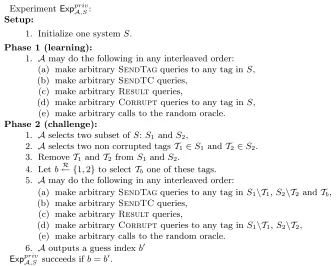
Thanks to the experiment described in Fig. 1, A is an adversary who wants to find a privacy leakage in the protocol (where ←R denotes an element taken at random). The privacy is defined as the advantage of the adversary over two tags amongst two systems of tags he had chosen. If the advantage of
Ais negligible, this means he is not able to link any tag insideS1 and S2. If
Ais relevant for this game, he is able to construct subsystems with a special property: given a tag, he can determine in which subsystem it belongs. This definition is more general than anonymity and untraceability. If tags can be identified from an adversary or can be traced, it is easy for an adversary to construct subsystems in order to succeed at our game.
Definition 3. A protocol in a RFID system isprivate if for a polynomially bounded adversary A following the experiment ExpprivA,S, then
Pr[b0 =b]−Pr[b0 6=b]
ExperimentExpprivA,S:
Setup:
1. Initialize one systemS.
Phase 1 (learning):
1. Amay do the following in any interleaved order: (a) make arbitrarySendTagqueries to any tag inS, (b) make arbitrarySendTCqueries,
(c) make arbitraryResultqueries,
(d) make arbitraryCorruptqueries to any tag inS, (e) make arbitrary calls to the random oracle.
Phase 2 (challenge):
1. Aselects two subset ofS:S1andS2,
2. Aselects two non corrupted tagsT1∈S1 andT2∈S2.
3. RemoveT1 andT2 fromS1 andS2.
4. Letb← {R 1,2}to selectTb one of these tags.
5. Amay do the following in any interleaved order:
(a) make arbitrarySendTagqueries to any tag inS1\T1,S2\T2 andTb,
(b) make arbitrarySendTCqueries, (c) make arbitraryResultqueries,
(d) make arbitraryCorruptqueries to any tag inS1\T1,S2\T2,
(e) make arbitrary calls to the random oracle. 6. Aoutputs a guess indexb0
ExpprivA,S succeeds ifb=b0.
Fig. 1.Privacy experiment
information over tags inside the system. That is why we introduce our privacy definition which can be seen as a kind of trade-off between [9] and [16].
5 A new privacy leakage against Tree-Based Hash protocols
The original Tree-Based Hash protocol proposed in [11] had been proved to have some privacy leakage in [4,12,13]. Opening a tag, while keys are not protected, leads to the knowledge of shared keys in the system. Note that in one version of the protocol in [11](the one described in section 2.1), there are cases where it is possible to determine whether two tags share keys even without getting physically the keys.
Let us denote C1T(r) = FK1(r, r
0), . . . , CT
d (r) = FKd(r, r
0) the outputs of the tag T for the challenge r. CiT(r) = FKi(r, r
0) is the output needed to authenticate at the depth i in the tree of keys. Suppose the CiT(r) are independent from each other. As a consequence, CiT(r) can be computed without the knowledge ofC1T(r), . . . , CiT−1(r), Ci+1T (r), . . . , CdT(r). In this case,
using oneResultquery and twoSendTagqueries, it is possible to determine whether two tags share one key.
Getting a random challengerfromSendTC, the adversary can use Send-Tag(T, r) andSendTag(T0, r). He is then in possession of two communica-tionsC1T(r), . . . , CdT(r) andCT
0
1 (r), . . . , CT
0
d (r). For instance, to test whether
the two tags have the same first key, the adversary uses theResultquery on the communication r, C1T0(r), C2T(r), . . . , CdT(r)
. If this communication is an admissible one, this means T and T0 share the same first key. Otherwise, they do not. Of course, it is possible to do the same for a key at a different position.
This attack is practically feasible as the adversary only needs to interact with two tags and a reader. In fact, it is a general privacy threat that concerns RFID systems using correlated keys inside tags. As soon as the different com-ponents of a response (the Ci above) are not linked together, an adversary
can mix the answers of several tags to learn if they share keys.
6 Our Proposition
6.1 System Parameters
Because of PUFand use of different random values for each key inside a tag, our protocol strengthens tags against the privacy leakage described in the previous section (see section 8 for this result).
We now give the parameters of our scheme. Our RFID system is made of N tags, the tree of key has a branching factor Q and a depth d. We use a pseudo-random functionH implemented by a hash function.
The length of the random challenge a0 sent by the TCislr, the length of
keys islK and the length of the output of the hash function islH. The number
of tagsN is usually smaller than 240. A probability is considered negligible as
soon as it is negligible in at least one of the following parameters:N, lr, lK, lH.
These systems is denotedS(N, Q, d, lr, lH, lK).
Setup. To create our system of tags, we need a generator function: Gen(1k)
outputs a random element of sizek. To create our system of tags, we first use Q+Q2
+. . .+Qd times the functionGento create our tree of keys. Each key
is an output of Gen(1lK). During the creation of a new tag, a set of keys is
given, which enabled it to identify itself. The set of keys is made thanks to our tree of keys, which means it represents a path from the root to a leaf. All the tags have of course different sets of keys, with possiblyd−1 keys shared. For one tagT, it is denoted asK1T, . . . , KdT. A tag is created with a newPUF
obtained fromGenPUF(12lK
). As shown before, each key is implemented inside a tag via two POKs. To generate the value of thesePOKs, we once more use Gen. For eachKiT,Gen(1lc) outputs a challengec. This challenge is hard-wired
with thePUF and outputs PUF(c) =Ki0T. The couple of POKsassociated to the key KiT is (Ki0T, Ki00T = Ki0T ⊕KiT). As the PUF is considered to be a perfect random-function, Ki0T and Ki00T are considered to be random values of entropy lK.
6.2 The Protocol
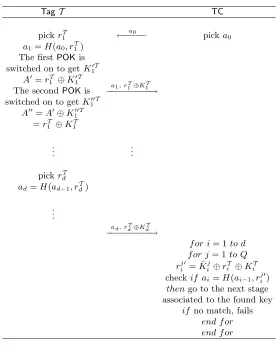
In Fig. 2 is the description of our new protocol, where ˆKij denotes the key at the depthion thejth branch of the tree. TheTCsends to the tag a challenge a0, which is a random value. The tag T computes a random value rT1 and
sends a1 = H(a0, r1T). The tag switches on the first POK to get K10T and
computes A0 =rT1 ⊕K10T. This operation erases in volatile memoryr1T. The
secondPOK is switched on to get K100T, and this erases K10T. Finally the tag
TagT TC
pickrT 1
a0
←−−−−− picka0 a1=H(a0, rT
1)
The firstPOKis switched on to getK0T
1 A0=rT
1 ⊕K10T
The secondPOKis switched on to getK00T
1 A00=A0⊕K100T
=rT1 ⊕K T 1
a1, r1T⊕K1T
−−−−−−−−−→
..
. ...
pickrdT
ad=H(ad−1, rTd)
.. .
ad, rdT⊕KdT −−−−−−−−−→
f or i= 1to d f or j= 1to Q rji0= ˆKij⊕riT ⊕K
T
i
checkif ai=H(ai−1, rij0)
thengo to the next stage associated to the found key
if no match, fails
end f or end f or
Fig. 2.The identification protocol
r2T and computesa2 =H(a1, r2T) and sends it to theTC. It computesrT2 ⊕K2T
using the same tricks as before. It repeats these operations d−1 times.
Then the Trusted Center (TC) tries amongst all the key ˆK1j in the tree’s
first level whether it gets the equality H(a0, r1T ⊕K1T ⊕Kˆ j
1) =a1. If it finds
one correct key, it searches the next key amongst the possible keys in the tree. If the operation is successful for thed levels then the tag is authenticated.
7 Security Analysis
In our protocol,SendTagoutputs (a1, rT1 ⊕K1T, . . . , ad, rT
d ⊕KdT) andResult
returns whether the 2d+ 1-tuple (a0, a1, rT1 ⊕K1T . . . , ad, rdT ⊕KdT) is correct.
7.1 Restriction on the Corrupt query due to POKs
In our case, we make the hypothesis that corrupting a tagT leads an adversary to the knowledge of only one of the three possible type of sets:
1. ai−1, riT and ai=H(ai−1, riT),
2. ai−1, riT, ai =H(ai−1, riT) and riT ⊕Ki0T,
3. ai−1, ai=H(ai−1, riT),riT ⊕Ki00T and riT ⊕KiT.
Note that in the two first cases, an adversary does not learn the final output. Thanks to the possible actions of the adversary as defined in Sect. 3.1, we can prove:
Theorem 1. Corruptqueries leak at most as many information on the key material as SendTag queries.
Proof.Getting ai−1, riT and ai is trivially of no interest. Getting ai−1, riT, ai
andriT⊕Ki0T is equivalent as gettingai−1,riT andKi0T. Asai−1,riT, andKi0T
are random, this leaks no information about KiT. Finally, getting ai−1, ai,
riT ⊕Ki00T and riT ⊕KiT is equivalent as getting ai−1, ai, Ki00T and rTi ⊕KiT.
Because Ki00T is random, this is equivalent as getting ai−1, ai, and riT ⊕KiT
which is exactly a part of an output of aSendTagquery. 2 In the sequel, we do not distinguishCorruptfromSendTag in proofs.
Remark 1. Formalizing Corrupt this way is convenient for our model and our proofs. The reality behind this formalization is still an open implementa-tion issue. More concretely, the ability of an adversary to obtain a key from aPOKwithout destroying the tag has to be evaluated precisely. This topic is however outside the scope of this paper.
7.2 Completeness and Soundness
Theorem 2. Our scheme is complete. If H is a random oracle, then our scheme is sound.
8 Privacy Analysis
As shown before in Sect. 5, this is an important point to determine whether an adversary gains any advantage using different outputs from different tags while he is usingResultqueries. In this paper, the protocol described has the property that an adversary cannot use different outputs from tags to make a new one which has a good probability of being admissible. This is shown in the following.
Proposition 1. An adversary, by mixing different outputs from different tags in a Result query gets a positive answer only with a negligible probability.
Proof.A uses the SendTag query on tags in S. Then he uses the Result query. His query is of the form a0, . . . , aT
1
i−1, rT
2
i−1⊕KT
2
i−1, aT
3
i , rT
4
i ⊕KT
4
i , . . .
To be a valid communication, it has to exist a key ˆK such that aTi 3 = H(aTi−11, rT
4
i ⊕KT
4
i ⊕K). We also have the equalityˆ aT
3
i = H(aT
3
i−1, rT
3
i ).
If the first equality occurs, whileT1, T3 and T4 represent different tags, this
leads to a collision on the output of the random oracle as rTi 3 and riT4 are generated randomly andaTi−11 and aTi−31 are outputs from the random oracle. So this proves this communication is valid with a negligible probability. 2
Hence, in the sequel, we suppose an adversary never uses differentSendTag outputs in one Resultquery.
Remark 2. Furthermore, ifAtries someResultqueries on a randomly mod-ified communication from one tag, he gets a positive answer with a negligible probability. Consequently, Resultquery can just be used to verify whether a communication fromone tag is valid or not.
As above, the random oracle H represents the hash function used in our protocol and we assume that the random generator in each tag is perfect.
Theorem 3. Our protocol, in the random oracle model, is private.
Proof.We denote M the maximum number of computation made by A. Let Li,lpC be the list of all the communications of A with tags in Si during the
learning phase and Li,cpC during the challenge phase except Tb. Let LbC be
the communication with Tb. Let LlpR and L cp
R the Result (or SendTC or
Corrupt) queries used in the experiment. Let Llp = L1,lp C ∪L
2,lp
C ∪L
lp R and
Lcp=L1C,cp∪LC2,cp∪LcpR. LetL 1
beL1C,lp∪L1C,cpand L2 beL2C,lp∪L2C,cp. To determine whether Tb is in S1 or S2, A has to determine whether Tb
shares keys with tags in S1 or in S2. To achieve this, either he made some
– Case 1:Adid not make any random oracle query. SoAcan obtain a clue that Tb is in Si just by looking at Llp, Lcp and LbC. We already proved in
Sect. 8 that use of Resultonly helps to verify whether a communication from one tag is valid or not. To get a useful information,Ahas to compare the communications in L1, L2 and Lb
C. Amongst triplets (aTi−1, aTi , rTi ⊕
KiT), A has to find one triplet of LbC and one of L1
∪L2
such that they have two elements equal. In this case, if the third elements are equal then the two tags share one key, otherwise they have different keys. Because there are only polynomially many triplets, and because the probability to get such a collision is negligible, the overall probability to find a collision is negligible, as the advantage of Ain this case is.
– Case 2: A made some random oracle queries but none of the form H(aTi , rTi ⊕KiT ⊕K) where ˆˆ K is a key in S1 or S2 and aTi , riT ⊕KiT
is a part of an output from a tag. In this case,Ahas no more information than in the previous case, and the conclusion is the same
– Case 3: A made some random oracle queries and one of them is of the formH(aT
i , rTi ⊕KiT ⊕K). This meansˆ Agot a key of this system. As we
already proved in a previous remark, this event has a negligible probability to happen.
The overall advantage of A is negligible in the security parameters for a
polynomially bounded adversary. 2
9 Conclusion
Following a general trend in inserting PUFs inside RFIDs, we modify the Tree-Based Hash protocols to allow the integration of POKs. Because of the fact that keys inside a tag are now physically obfuscated, we show that an adversary is not able to impersonate a tag. Moreover, we prove our tag system has no privacy leakage. We thus believe that our work helps to strengthen the security of the overall protocol.
References
1. Auto-ID Center. Draft protocol specification for a 900 MHz Class 0 Radio Frequency Identification Tag, 2003.
2. G. Avoine, L. Butty´an, T. Holczer, and I. Vajda. Group-based private authentica-tion. In Proceedings of the International Workshop on Trust, Security, and Privacy for Ubiquitous Computing (TSPUC 2007), IEEE., 2007.
4. Levente Butty´an, Tam´as Holczer, and Istv´an Vajda. Optimal key-trees for tree-based private authentication. InPrivacy Enhancing Technologies, pages 332–350, 2006. 5. Ivan Damg˚ard and Michael Østergaard Pedersen. RFID security: Tradeoffs between
security and efficiency. InCT-RSA 2008, 2008.
6. Blaise Gassend. Physical random functions. Master’s thesis, Computation Structures Group, Computer Science and Artificial Intelligence Laboratory, MIT, 2003.
7. Blaise Gassend, Dwaine E. Clarke, Marten van Dijk, and Srinivas Devadas. Silicon phys-ical random functions. In Vijayalakshmi Atluri, editor,ACM Conference on Computer and Communications Security, pages 148–160. ACM, 2002.
8. Jorge Guajardo, Sandeep S. Kumar, Geert Jan Schrijen, and Pim Tuyls. FPGA Intrinsic PUFs and Their Use for IP Protection. In Pascal Paillier and Ingrid Verbauwhede, edi-tors,CHES, volume 4727 ofLecture Notes in Computer Science, pages 63–80. Springer, 2007.
9. Ari Juels and Stephen A. Weis. Defining strong privacy for RFID. InPERCOMW’07, pages 342–347, Washington, DC, USA, 2007. IEEE Computer Society.
10. D. Molnar and D. Wagner. Privacy and security in library RFID: issues, practices, and architectures. InProceedings of the ACMConference on Computer and Communications Security, pages 210–219, 2004.
11. David Molnar, Andrea Soppera, and David Wagner. A scalable, delegatable pseudonym protocol enabling ownership transfer of RFID tags. InSelected Areas in Cryptography, pages 276–290, 2005.
12. Yasunobu Nohara, Sozo Inoue, Kensube Baba, and Hiroto Yasuura. Quantitative eval-uation of unlinkable id matching systems. In Workshop on Privacy in the Electronic Society, 2006.
13. Karsten Nohl and David Evans. Quantifying information leakage in tree-based hash protocols (short paper). InICICS, pages 228–237, 2006.
14. G. Edward Suh and Srinivas Devadas. Physical unclonable functions for device authen-tication and secret key generation. InDAC, pages 9–14. IEEE, 2007.
15. Pim Tuyls and Lejla Batina. RFID-tags for anti-counterfeiting. In David Pointcheval, editor, CT-RSA, volume 3860 of Lecture Notes in Computer Science, pages 115–131. Springer, 2006.
16. Serge Vaudenay. On privacy models for rfid. In Kaoru Kurosawa, editor,ASIACRYPT, volume 4833 ofLecture Notes in Computer Science, pages 68–87. Springer, 2007.
A Security Proofs
Completeness
In our scheme, errors could occur because of collisions in the output of the hash function. For instance, a part of a communication (ai−1, H(ai−1, riT), rTi ⊕KiT)
could lead to an error when for a tag T0, we get the equality H(ai−1, riT) =
H(ai−1, rTi ⊕KiT ⊕KT
0
i ). This could appear with a probability at most Q 2lH.
Because there ared stages, the overall probability to fail in the identification isO(2dQlH) which is negligible in the parameters.
Soundness.
We first remark the following. Let us define a family of functionsHa,bderived
from {0,1}lb to {0,1}lH such that H
a,b(x) =H(a, b⊕x). AsH is a random
oracle, we can consider that an adversary has a negligible probability to find a preimage ofHa,b(x) whatever aand b are. If there are polynomially many
ai andbj, an adversary has a negligible probability to findxeven if he knows
Hai,bj(x) for allai andbj.
Now, we denote L1 the list of all the communications produced via the
SendTag queries, L2 the communications sent to the TC either with the SendTCquery or the Resultquery.
To simplify the notation, we prove that the scheme is sound with d= 1. This is a sufficient condition, as the difficulty to authenticate increases with d. We denote M, the maximum number of operations made byA.
AssumeAhas received the challengeaTC0 and outputs the couple (a1, x1).
We overestimate the probability of success ofA. There are two cases:
– Case 1: Adid not use the random oracle to outputa1. This means:
• either aTC
0 had been tested by A thanks to the SendTag query, this
could arise with a probability less than M 2lr,
• or he tried a random answer. In this sub-case, he has a probability of success less than M.Q2lH .
– Case 2: A used the random oracle to output a1. So we denote a1 =
H(aTC
0 , x01). This means
• either there is no key ˆK like x01 =x1⊕K. The probability of successˆ
is thus less than M.Q2lH ,
• or there is a key ˆK in the key material such that x01 = x1 ⊕ K.ˆ
Consequently A possesses one key. He could achieve this only using the information from L1 and L2. A only knows triplets of the form
a0, H(a0, rT), rT ⊕KT
for some tagsT. A change of variable leads to: a0, Ha0,rT(K
T), rT. Thanks to the previous remark, we can con-clude that the probability A got one key is negligible.
We can conclude that our scheme is sound as the overall probability of any adversary is negligible.
B Practical example
We propose for our protocol, as an example, the following parameters:
– the size of the reader challenge lr is 64, – the size of any POKlK is 100
– the size of the output of H lH is 64. For instance, the first 64 bits of
They have been chosen to minimize the non-volatile memory inside the tag and the communication between tags and readers, but they should lead to a sufficient security to insure the secrecy of the keys and the impossibility to authenticate without the knowledge of the keys. We useAES as it is possible to implement it with not too many gates and because the problem to find a preimage or any collision is usually believed intractable.
Security can be improved by increasing the parameters:
– the size of the reader challenge lr is 64, – the size of any POKlK is 116
– the size of the output of H lH is 64. For instance, the first 64 bits of
AESai−1,1..12||ri(ai−1||ri,1..64).
The two tables Tab. 1 and Tab. 2 summarize the concrete resources used in our scheme in the two previous cases for some example parameters. We use a branching factor of 210
in all cases.
Tag Tag→TC TC
numbers non-volatile computation communication computation memory
220
200 bits 2AESand 2 random 328 bits 2×210
230
300 bits 3AESand 3 random 492 bits 3×210 Table 1.Resources needed in the first case
Tag Tag→TC TC
numbers non-volatile computation communication computation memory
220
232 bits 2AESand 2 random 360 bits 2×210
230