Authenticated Key Transport Protocol Based on RSA”
SeongHan Shin, Kazukuni Kobara, and Hideki Imai
Research Center for Information Security, AIST, 1-18-13, Sotokannda, Chiyoda-ku, Tokyo 101-0021 Japan [email protected],{kobara,imai}@iis.u-tokyo.ac.jp
May 16th, 2006
Abstract. In this paper, we prove the security of theRSA-AKEprotocol [9] in the random oracle model. The proof states that theRSA-AKEprotocol is secure against an adversary who gets the client’s stored secretor the server’s RSA private key.1
To our best knowledge, theRSA-AKEprotocol is the most efficient among their kinds (i.e., RSA and password based AKE protocols). The other security properties and efficiency measurements of theRSA-AKEprotocol remain the same as in [9].
1
The Model and Security Definitions
In this section we introduce an extended model building on [1, 5] and security definitions for the LR-AKE security and perfect forward secrecy.
We denote byC andS two parties that participate in a key exchange protocolP. Each of them may have several instances called oracles involved in distinct, possibly concurrent, executions ofP where we denote C (resp., S) instances by CI (resp.,SJ), or byU in case of any instance. For thej-th session in our protocol, the party C remembers a low-entropy secret pw drawn from a small dictionary of passwordDPassword, whose cardinality isD, and holds another secretαj oninsecure devices along with the counterpart’s RSA public key (e, N). On the other hand, the partyS stores a verification data pj and its RSA private key (d, N). Here we suppose a far more powerful adversary (rather than an active one, considered in [3, 6, 1], who has the entire control of the network) by giving additional access to theLeakoracle that simulatesinsecure devices of the partyC andimperfect serverS. Let us show the capability of adversaryAeach query captures:
– Execute(CI,SJ): This query models passive attacks, where the adversary gets access to honest executions ofP between the instancesCI andSJ by eavesdropping.
– Send(U, m): This query models active attacks by having A send a message to instance U. The adversary A gets back the response U generates in processing the message m according to the protocolP. A querySend(CI,Start) initializes the key exchange protocol, and thus the adversary receives the initial flow the partyC should send out to the partyS.
– Reveal(U): This query handles the misuse of a session key (e.g., use in a weak symmetric-key encryption) by any instance U. The query is only available to A if the instance actually holds a session key and the latter is released toA.
– Leak(U): This query handles the leakage of ”stored” secrets by any instance U. The adversary A gets back the secrets (αj,(e, N) and (d, N)) where the former (resp., the latter) is released if the instance corresponds toCI (resp.,SJ). The query is available to Asince the stored secrets might be leaked out due to a bug of the system or physical limitations in the sense that they should be stored on insecure devices all the time.
– Test(U): This oracle is used to see whether or not the adversary can obtain some information on the challenge session key by giving a hint on the latter. TheTest-query can be asked at most once by the adversaryAand is only available toAif the instanceU is ”fresh” (see below). This query is answered as follows: one flips a private coinb ∈ {0,1} and forwards the corresponding session key
SK (Reveal(U) would output) ifb= 1, or a random value except the session key ifb= 0.
Definition 1 (Freshness)We say that an instance isfresh(or has a freshsession key) if the following conditions hold: (1) the instance has computed and accepted a session key; (2) no Corrupt-query has been asked byAbefore the session key is accepted; and (3) noReveal-query has been asked to the party C nor its partnerS in the instance.
The aim of the adversary is to break the privacy of the session key (a.k.a., semantic security) in the context of executingP. The LR-AKE security is defined by the gameGamelr−ake(A, P), in which the adversary Ais provided with random coin tosses, some oracles and then is allowed to invoke any number of queries as described above, in any order. When playing this game, the ultimate goal of the adversary is to guess the bitbinTest-query by outputting this guessb. We denote LR-AKE advantage, by Advlr−akeP (A) = 2 Pr[b = b]−1, as the probability that A can correctly guess the value of b. We formally define the LR-AKE security; this will be necessary for stating meaningful results about our protocol.
Definition 2 (LR-AKE Security) A protocolP is said to be LR-AKE secure if, when adversary A (with access to Leakoracle) asksqsqueries toSend oracle and passwords are chosen from a dictionary of size D, the adversary’s advantage Advlr−akeP (A)in attacking the protocolP is bounded by
O(qs/D) +(·), (1)
for a negligible function(·)in a security parameter. The first term represents the fact that the adversary can do no better than guess a password during each query toSend oracle.
For the security notion of perfect forward secrecy, one has to account for a new type of query, the
– Corrupt(U): This oracle is used to see whether or not the disclosure of ”long-term” secrets of the involving parties does compromise the semantic security of session keys from previous sessions (even though that compromises the authenticity and thus the security of new sessions). WithCorrupt-query to instanceU, the adversaryAgets back the long-term secrets (pw and its relevant secretpj) but does not get any internal data.
Definition 3 (Perfect Forward Secrecy) Suppose an adversary A with the ability to make the
Corrupt-query as well as the other queries described above. A protocol P is said to provide perfect forward secrecy if the adversary’s advantage, denoted byAdvpfs−akeP (A) = 2 Pr[b=b]−1, in attacking
P is negligible in a security parameter.
1.1 Computational Assumption
Next we define the standard RSA function on which the underlying computational assumption holds.
Definition 4 (RSA Function) An RSA generator RSAKeyGen with associated security parameter l
is a randomized algorithm that takes no input and returns a pair ((e, N),(d, N))such that (1) p, q are distinct and odd primes with each being about l/2 bits long, (2) N =pq where2l−1 ≤N <2l and (3)
e, d ∈Z
ϕ(N) are integers satisfying ed≡1 modϕ(N). We call N an RSA modulus,(e, N) the public key and (d, N)the private key. The RSA function is a family of functions RSAN,f :ZN →ZN defined by RSAN,f(w) ≡ wf mod N for all w ∈ ZN. That is, the encryption function RSAN,e is defined by
RSAN,e(x) =y ≡xemodN and the decryption function RSA
N,d is RSAN,d(y) =x≡yd modN both of which are permutations onZN and inverses of each other.
The computational assumption of the RSA function is equivalent to one-wayness (non-invertibility) of RSA: given (N, e, y =RSAN,e(x)) it is hard to computex. Formally,
Definition 5 (One-wayness of RSA)Suppose that the RSA function is defined by Definition 4 and an adversaryIis given the RSA instance(N, e, y=RSAN,e(x)). The RSA function is said to beone-way if the success probability of I, defined as
SuccowRSA(I) = Pr[x=x|x← I(N, e, y)], (2)
is negligible in the security parameterl.
2
Our Protocol
Before presenting an efficient and leakage-resilient RSA-based AKE (for short,RSA-AKE) protocol, we will start by giving a considered situation and some notations to be used.
2.1 Considered Situation
Consider the following situation where a client is communicating with many disparate servers2. In particular, we focus on unbalanced wireless networks where the client has easy-to-be-lost/stolen devices (e.g., mobile phones or PDAs) with very-restricted computing power but some memory capacity itself, on the other hand, each server has its database and enormous computing power enough to generate a pair of RSA keys and to perform the RSA decryption function. Here, we do not assume that each server is completely secure against possible attacks (e.g., virus, hackers or insider attacks). In addition, neither PKI nor TRM is available.
2 For the sake of simplicity, we assign the servers consecutive integeri≥1 whereSi can be regarded as the
ClientC (Mobile Device) ServerSi(i≥1)
[Initialization]
αi1←R ZN,pi1≡αi1+pwmodN
(e, N)
(e, N),(d, N)←RSAKeyGen(1l) pi1
-1, αi1,(e, N) 1, pi1,(d, N)
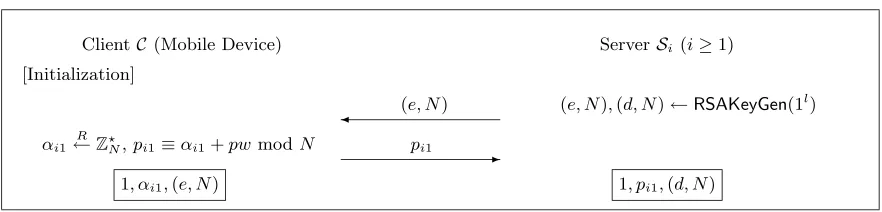
Fig. 1.The initialization of RSA-based AKE (RSA-AKE) protocol where the enclosed values in rectangle rep-resent stored secrets of client and server, respectively
2.2 Notations
Letkandldenote the security parameters, wherekcan be thought of as the general security parameter for hash functions (say, 160 bits) and l (l > k) can be thought of as the security parameter for RSA (say, 1024 bits). LetDbe a dictionary size of passwords (say, 36 bits for alphanumerical passwords with 6 characters). Let{0,1} denote the set of finite binary strings and{0,1}k the set of binary strings of lengthk. IfA is a set, then a←R A indicates the process of selectingaat random and uniformly over
A. Let ”||” denote the concatenation of bit strings in{0,1}. Let us define secure hash functions. WhileG:{0,1}→Z
N\{1}denotes a full-domain hash (FDH) function, the other hash functions are denoted Hj : {0,1} → {0,1}k for j = 1,2,3 and 4. Here G and Hj are distinct random functions one another. LetC andS be the identities of client and server, respectively, with representing each ID∈ {0,1} as well.
2.3 The RSA-AKE Protocol
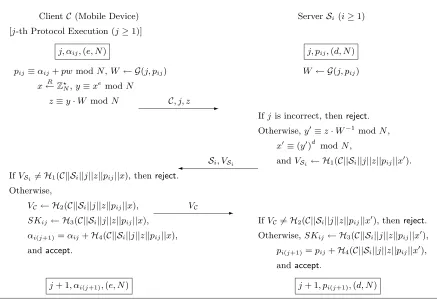
Here we propose an efficient and leakage-resilient RSA-based AKE (RSA-AKE) protocol suitable for the above-mentioned situation. The whole protocol is illustrated in Fig. 1 and 2.
Initialization During the initialization phase, client C registers a verification data to one of the dif-ferent servers Si (i≥1). At first, server Si sends its RSA public key (e, N), which is generated from
RSAKeyGen(1l), to the client. The latter picks a secret valueαi1 randomly chosen in ZN and registers securely a verification datapi1 to serverSi:
pi1≡αi1+α0modN (3)
and sets the termα0=pw wherepw is the client’s password3. Since bothαi1andpi1 are in the set of
the same length, each is a share of (2,2)-threshold secret sharing scheme forα0[7].
Then client C remembers his password pw and additionally stores the secret value αi1 and the
RSA public key (e, N) on insecure devices (e.g., mobile devices or smart cards) which may happen to leak αi1 and (e, N). The serverSi also stores the verification datapi1 and its RSA private key (d, N) on its databases both of which may be leaked out. Finally, they set a counter j as 1. Note that this initialization is done only once.
j-th Protocol Execution When client C wants to share an authenticated session key securely with server Si, they run thej-th (j ≥1) execution of theRSA-AKEprotocol as follows. At the start of the
j-th protocol execution, clientCand serverSihold (j, αij,(e, N)) and (j, pij,(d, N)), respectively, where
pij≡αij+pw modN. The clientCshould recover the verification datapij by adding the secret value
αij stored on devices with the passwordpwremembered in his mind. Then the client chooses a random valuexfromZ
N and sends (C, j, z) to serverSi after calculatingz using a mask generation function as the product of an encryption ofxunder the RSA public key (e, N) with a full-domain hash of (j, pij). If the received counterjis correct, the server divides zby a hash of the counter and its verification data
3 The passwordpwis drawn from password spaceD
ClientC (Mobile Device) ServerSi(i≥1)
[j-th Protocol Execution (j≥1)]
j, αij,(e, N) j, pij,(d, N)
pij≡αij+pwmodN,W ← G(j, pij)
x←R Z
N,y≡xe modN
z≡y·W modN C, j, z
-W ← G(j, pij)
Ifjis incorrect, thenreject.
Otherwise,y≡z·W−1 modN,
x≡(y)d modN,
andVSi← H1(C||Si||j||z||pij||x). Si, VSi
IfVSi=H1(C||Si||j||z||pij||x), thenreject. Otherwise,
VC← H2(C||Si||j||z||pij||x),
SKij← H3(C||Si||j||z||pij||x),
αi(j+1)=αij+H4(C||Si||j||z||pij||x), andaccept.
VC
-IfVC =H2(C||Si||j||z||pij||x), thenreject.
Otherwise,SKij← H3(C||Si||j||z||pij||x),
pi(j+1)=pij+H4(C||Si||j||z||pij||x), andaccept.
j+ 1, αi(j+1),(e, N) j+ 1, pi(j+1),(d, N)
Fig. 2.Thej-th protocol execution ofRSA-AKEprotocol where the enclosed values in rectangle represent stored secrets of client and server, respectively
pij, and then decrypts the resultant value under its RSA private key (d, N) so as to obtain x. Then, serverSi computes and sends its authenticatorVSi to clientC.
Upon receiving (Si, VSi) from the server, clientC computes his authenticator VC and a session key
SKij, as long as H1(C||Si||j||z||pij||x) is equal to VSi, and sends VC to serverSi. If the authenticator
VC is valid, server Si actually computes a session key SKij that will be used for their subsequent cryptographic algorithms (e.g., AES or HMAC).
At the end of thej-th protocol execution, clientCrefreshes the secret valueαij to a new oneαi(j+1) without changing his password4. In the same way, serverSi also refreshes the verification data pij to a new one pi(j+1). Finally, client C stores
j+ 1, αi(j+1),(e, N)
on his devices and server Si stores
j+ 1, pi(j+1),(d, N)
on its databases for the next session.
3
Security
In this section we show theRSA-AKEprotocol of Fig. 2. is provably secure in the random oracle model [2]5, under the assumption that inverting an RSA instance is hard, by Definition 2.
3.1 Security Proof
In order to simplify the security proof, we omit the indexiand only consider the first two flows of the
j-th protocol execution (unilateral authentication ofS toC). The latter is due to the well-known fact that the basic approach in the literature for adding authentication to an AKE protocol is to use the
4 Notice that the frequent change of passwords might incur the risk of password to be exposed, simply because people tends to write it down on somewhere or needs considerable efforts to remember new passwords. 5 Note that security in the random oracle model is only a heuristic: it does not imply security in the real world
– For a hash-query Hi(q) (resp.,Hi(q)), such that a record (i, q, r) appears inΛHi (resp.,ΛH
i), the answer isr. Otherwise one chooses a random elementr← {R 0,1}ki, answers with it, and adds the record (i, q, r) to
ΛHi (resp.,ΛHi). Rule H(1)
Nothing to do. % To be defined later
– For a hash-queryG(j, q), such that a record (j, q, r, , ) appears inΛG, the answer isr. Otherwise the answer
r is defined according to the following rule: Rule G(1)
Choose a random elementr←R ZN. The record (j, q, r,⊥,⊥) is added toΛG. Note: the fourth and fifth components of the elements of this list will be explained later.
Fig. 3.Simulation of the hash functions:G andHi oracles
distributed Diffie-Hellman key or the shared secret to construct a simple ”authenticator” for the other party [1, 5]. Therefore, the security proof with unilateral authentication can be extended to one with mutual authentication by simply adding the authenticator ofC (the third flow) as in Fig. 2. However, this makes a proof more complicated.
Here we assert that theRSA-AKEprotocol distributes semantically-secure session keys and provides unilateral authentication for the serverS.
Theorem 1 (LR-AKE/UA Security) Let P be the RSA-AKE protocol of Fig. 2., where passwords are chosen from a dictionary of sizeDand the client’s stored secret (i.e.,αij,(e, N)) is provided through the Leak-query. For any adversaryA within a polynomial time t, with less than qs active interactions with the parties (Send-queries),qp passive eavesdroppings (Execute-queries), and askingqg andqh hash queries toG and anyHi respectively,Advlr−akeP (A)≤4εandAdvS−authP (A)≤ε, withεupper-bounded by
3qS
D + 10Succ ow
RSA
q2h, t+ 2q2hτlaw
+ qC 2k1 +
6qS + (qC+qp)2+ (qg+qh)2
2l+1 , (4)
whereqC andqS denote the number ofC andSinstances involved during the attack (each upper-bounded
by qp+qs), k1 is the output length of H1,l is the security parameter, and τlaw is the computational time needed for modular multiplication or modular division.
Informally speaking, an adversary who knows the client’s stored secret cannot determine the correct password through off-line dictionary attacks since generating the valid authenticator after computingz
falls into on-line dictionary attacks (which can be easily prevented and detected).
Proof 1. In this proof, we incrementally define a sequence of games starting at the real game G0
and ending up atG5. We use Shoup’s lemma [8] to bound the probability of each event in these games.
Game G0:This is the real protocol in the random oracle model. We are interested in the following
two events:
– S0 (for semantic security) which occurs if the adversary correctly guesses the bit binvolved in theTest-query;
– A0 (forS-authentication) which occurs if an instanceCI accepts with no partner instance SJ with the same transcript ((C, j, z),(S, VS))
Advlr−akeP (A) = 2 Pr[S0]−1 ,AdvS−authP (A) = Pr[A0]. (5)
In any gameGn below, we study the eventAn and the restricted eventSwAn=Sn∧ ¬An.
Game G1:In this game, we simulate the hash oracles (G,H1,H3 andH4, but as well additional hash
functions Hi : {0,1} → {0,1}ki (for i = 1,3,4) that will appear in the Game G
3) as usual by
Send-queries toC
We answer to theSend-queries to aC-instance as follows: – ASend(CI,Start)-query is processed according to the following rules:
Rule C1(1)
Computepj≡αj+pwmodN. Rule C2(1)
Generate (x, y≡xe modN), and computeW ← G(j, pj) andz≡y×W modN. Then the query is answered with (C, j, z), and the instance goes to an expecting state.
– If the instanceCI is in an expecting state, a querySend(CI,(S, VS)) is processed by computing the alleged authenticator, the session key and the refreshed secret. We apply the following rules.
Rule C3(1)
Compute the expected authenticator and the session key
VS ← H1(C||S||j||z||pj||x),SKC← H3(C||S||j||z||pj||x). Rule C4(1)
Compute the refreshed secretαj+1=αj+H4(C||S||j||z||pj||x). IfVS =VS, the instance accepts. In any case, it terminates.
Send-queries toS
We answer to theSend-queries to aS-instance as follows:
– A Send(SJ,(C, j, z))-query is first processed by checking that j is the correct counter, and in the case of correctjit is processed by computing the authenticator, the session key and the refreshed secret. We apply the following rules:
Rule S1(1)
ComputeW ← G(j, pj), y≡z×W−1 modN andx≡(y)dmodN. Rule S2(1)
Compute the authenticator and the session key
VS← H1(C||S||j||z||pj||x),SKS← H3(C||S||j||z||pj||x). Rule S3(1)
Compute the refreshed secretpj+1=pj+H4(C||S||j||z||pj||x). Finally the instance accepts, and the query is answered with (S, VS).
Other queries
– An Execute(CI,SJ)-query is processed using successively the above simulations of the Send-queries: (C, j, z)←Send(CI,Start), (S, VS)←Send(SJ,(C, j, z)),Send(CI,(S, VS)), and then outputting the tran-script ((C, j, z),(S, VS)).
– A Reveal(U)-query returns the session key (SKC or SKS) computed by the instanceU (if the latter has accepted).
– ALeak(CI)-query returns the stored secret (αj,(e, N)) by the instanceCI.
– ATest(U)-query first getsSKfromReveal(U), and flip a coinb. Ifb= 1, we return the value of the session keySK, otherwise we return a random value drawn from{0,1}k3.
Fig. 4.Simulation of theRSA-AKEprotocol
Game G2:For an easier analysis in the following, we first forward any query toHi to G:
Rule H(2)
The queryq is parsed asq=C||S||j||z||pj||x, then one queriesG(j, pj).
The number of queries to G thus becomes qg ≤qg+qh. Furthermore we exclude games in which some events (Coll2) are unlikely to happen:
– collision of the partial transcript (C, j, z): any adversary tries to find out at least one pair (j, z), coinciding with the challenge transcript, involving the honest party C, and then obtain the corresponding session key (i.e., the same as the challenge session key) using theReveal-query;
– collision on the output ofG.
Both probabilities are bounded by the birthday paradox:
Pr[Coll2]≤(qC+qp) 2+q2
g
2l+1 . (6)
Game G3:In order to make the authenticators and the session keys unpredictable to any adversary,
Rule C3/S2(3)
Compute the authenticator
VS ← H1(C||S||j||z).
Compute the session key
SKC/S ← H3(C||S||j||z).
We also use the private oracleH4(instead ofH4) so that the refreshed secrets are unpredictable to any adversary as well. We modify the simulation by using the following rules:
Rule C1(3)
Choose two random elements (βj, γj)←R (ZN)2, and setαj ←βj andpj ←γj. Rule C4/S3(3)
Computeαj+1=αj+H4(C||S||j||z) andpj+1=pj+H4(C||S||j||z). Since the secret x = x =RSAN,d
z×W−1 depends on (e, N), z and the parties (the common secret pj), the gamesG3andG2are indistinguishable unless some specific hash queries are asked,
denoted by eventAskH3=AskH13∨AskH3w13∨AskH4w133, whereW =G(j, pj):
– AskH13: C||S||j||z||pj||RSAN,d
z×W−1 has been queried by A to H1 for some transcript ((C, j, z),(S, VS));
– AskH3w13:C||S||j||z||pj||RSAN,d
z×W−1has been queried byAtoH3for some transcript ((C, j, z),(S, VS)), where some party has accepted, but eventAskH13 did not happen;
– AskH4w133:C||S||j||z||pj||RSAN,d
z×W−1has been queried byAtoH4for some transcript ((C, j, z),(S, VS)), where some party has accepted, but bothAskH13 andAskH3w13 events did
not happen.
After this modification, we do no longer need to know the value x nor to compute the value x
either. Thus we can simplify the corresponding rules: Rule C2(3)
Generate a random pair (ˆx, z=RSAN,e(ˆx)). Rule S1(3)
Do nothing.
Finally, one can notice that the actual password is not used any more. By the isomorphic property of RSAN,f from ZN to ZN, the new valuez is perfectly indistinguishable from before, since there exists a unique pair (x, y),
x=RSAN,d
z×W−1= ˆx×RSAN,d
W−1 y=RSAN,e(x) such thatz=y×W.
The authenticator is computed with a random oracle that is private to the simulator, then one can remark that it cannot be guessed by the adversary, better than at random for each attempt, unless the same partial transcript (j, z) appeared in another session with a real instance CI. But such a case has already been excluded (in GameG2). Similarly, this can be applied to the session key.
Pr[A3]≤2qkC1 Pr[SwA3] = 1
2 . (7)
Since collision of the partial transcript has been excluded, the event AskH1 can be split in three disjoint sub-cases:
– AskH1-Passive3: the transcript ((C, j, z),(S, VS)) comes from an execution between instances of
C and S (Execute-queries or forward of Send-queries, relay of part of them). In this case both (j, z) and the RSA key pair have been simulated where the latter has been provided through theLeak-query;
– AskH1-WithS3: the execution involved an instance of S, but (j, z) has not been sent by any
instance of C. This means that the RSA key pair has been simulated, but (j, z) has been produced by the adversary;
– AskH1-WithC3: the execution involved an instance ofC, but an instance of S has not been
in-volved during the attack. This means that both (j, z) and the RSA key pair have been simulated.
Game G4:In order to evaluate the above events, we introduce a random RSA instance (N, e, ρ), where
ρ is a uniformly distributed random element in Z
˜
N (or equivalently, because of the isomorphism property,σis randomly drawn fromZ
follows: Rule G(4)
Generate a random pair (u, v=RSAN,e(u)), and with a random bit bcomputer←v, ifb= 0, and r←v·ρ, ifb= 1. Then, the record (j, q, r, u, b) is added toΛG.
The probability remains unchanged because of the homomorphic property.
Game G5:It is now possible to evaluate the probability of the event AskH(or more precisely, the
sub-cases). First, one can see that the password is never used during the simulation ofG4. It doest
not need to be chosen in advance, but at the very end only. Then, an information-theoretic analysis can be done which simply uses cardinalities of some sets. This is crucial that the entire simulation is basically independent from the chosen password.
To this aim, we first exclude a few more games, wherein for some pair (j, z), involved in a commu-nication between an instanceSJand either the adversary or an instanceCI, there exist two distinct valuespj, and thus elementsW, sinceW =G(j, pj) such that both the tuples (j, z, pj,RSAN,d(z/W)) are in ΛH (which event is denotedCollH5):
|Pr[AskH5]−Pr[AskH4]| ≤Pr[CollH5]. (8)
With the following lemma, the eventCollH5 can be upper-bounded.
Lemma 1 For any pair(j, z)involved in a communication with an instanceSJ, unless one can in-vert the RSA instance, there is at most one valid elementW obtained fromGsuch that(j, z, pj,RSAN,d (z/W))in ΛH:
Pr[CollH5]≤2SuccowRSA(qh2, t+ 2q2hτlaw). (9)
Proof. We show the proof by contradiction. Here we assume that there exists (j, z) involved in a communication, andW0=RSAN,e(u0)·b0·ρandW1=RSAN,e(u1)·b1·ρ, both obtained from the G oracle, such that the tuples (j, z, pji,RSAN,d(z/Wi)) are inΛH, fori= 0,1. Then,
Z def= RSAN,d(z/W1)
RSAN,d(z/W0)
=RSAN,d(W0/W1). (10)
With probability of 1/2, the bits b0 and b1 involved in W0 and W1 are distinct. Without loss of
generality, we may assume that bi=ifori= 0,1:
Z =RSAN,d
RSAN,e(u0)
RSAN,e(u1)·ρ
= u0
u1·RSAN,d(ρ) = u0
u1·σ . (11)
As a consequence, σ=u0/(u1·Z). By either guessing the two queries asked to theHi or checking
for each pair the validity of the computed σ, one concludes the proof. In order to conclude the proof, let us study separately the three sub-cases of AskH1, and then
AskH3w1 and AskH4w13 (keeping in mind the absence of several kinds of collisions: for partial transcripts, forG, and forpj inH-queries):
– AskH1-Passive: about the passive transcripts (in which both (j, z) and the RSA key pair have been simulated), one can state the following lemma:
Lemma 2 For any pair(j, z)involved in a passive transcript, unless one can invert the RSA instance, there is no valid elementW such that (j, z, pj,RSAN,d (z/W))inΛH:
Pr[AskH1-Passive5]≤2SuccowRSA(qh, t+ 2qhτlaw). (12)
Proof.Assume that there exist (j, z) involved in a passive transcript andW =RSAN,e(u)·b·ρ
such that the tuple (j, z =RSAN,e(ˆx), pj, Z def= RSAN,d(z/W)) is in ΛH. Then, as above, with
probability of 1/2,b= 1:
Z =RSAN,d
RSAN,e(ˆx)
RSAN,e(u)·ρ
= xˆ
u·RSAN,d(ρ) = ˆ
x
u·σ . (13)
As a consequence,σ= ˆx/(u·Z). By either guessing the query asked to theHi or checking the
– AskH1-WithS: the above Lemma 1, applied to games where the eventCollH5did not happen (and withoutG-collision), states that for each pair (j, z) involved in a transcript with an instanceSJ, there is at most one elementpj such that forW =G(j, pj), the corresponding tuple is inΛH. Thus, the probability for the adversary (who may have obtainedαj in theLeak-query, denoted by eventLeak5) over a random password is upper-bounded by:
Pr[AskH1-WithS5]≤qS
2l +
qS
D . (14)
– AskH1-WithC: this may correspond to an attack where the adversary tries to impersonate S toC (break unilateral authentication). But each authenticator sent by the adversary has been computed with at most onepj. Thus, the above Lemma 2 also applies to this case:
Pr[AskH1-WichC5]≤2SuccowRSA(qh, t+ 2qhτlaw). (15)
AboutAskH3w1(when the above three events did not happen), it means that only executions with an instance ofS may lead to acceptance (and eitherC or the adversary). Exactly the same analysis as for AskH1-PassiveandAskH1-WithSleads to
Pr[AskH3w15]≤q2Sl +
qS
D + 2Succ ow
RSA(qh, t+ 2qhτlaw). (16)
AboutAskH4w13(when both of the eventsAskH1andAskH3w1did not happen), the same analysis as for AskH3w1leads to
Pr[AskH4w135]≤ q2Sl +
qS
D + 2Succ ow
RSA(qh, t+ 2qhτlaw). (17)
As a conclusion, we get an upper-bound for the probability ofAskH5by combining all the cases:
Pr[AskH5]≤3qS 2l +
3qS
D + 8Succ ow
RSA(qh, t+ 2qhτlaw). (18)
Combining equations (6), (7), (9) and (18), one gets either
Pr[A0]≤ 2qkC1 +∆ Pr[SwA0] = 1
2 +∆ , (19)
where
∆≤2SuccowRSA
qh2, t+ 2q2hτlaw
+ 8SuccowRSA(qh, t+ 2qhτlaw) + 3qS
D +
3qS
2l +
(qC+qp)2+qg2 2l+1
≤ 3qS
D +
6qS+ (qC+qp)2+qg2
2l+1 + 10Succ
ow
RSA
qh2, t+ 2qh2τlaw
. (20)
One can get the result as desired by noting that Pr[S0]≤Pr[SwA0] + Pr[A0].
Theorem 2 (LR-AKE/UA Security)Let P be theRSA-AKEprotocol of Fig. 2., where the server’s stored secret (i.e., (d, N)) is provided through the Leak-query. For any adversary A, with less than
qsactive interactions with the parties (Send-queries),qp passive eavesdroppings (Execute-queries), and asking qg andqh hash queries to G and any Hi respectively, AdvPlr−ake(A)≤4ε andAdvS−authP (A)≤ε, withε upper-bounded by
qC
2k1 +
6(qp+qS) + 3(qC+qp)2+ 2(qg+qh)2
2l+1 , (21)
whereqC andqS denote the number ofC andSinstances involved during the attack (each upper-bounded
byqp+qs),k1 is the output length ofH1 andl is the security parameter.
Informally speaking, an adversary who knows the server’s RSA private key cannot perform even on-line dictionary attacks since the authentication depends on the strong secretpj.
Game G0:This is the same asG0 of Proof 1.
Game G1:In this game, we modify the simulations of the hash oracle G and theLeak query in Fig.
3 and 4, respectively, as follows:
– For a hash-queryG(j, q), such that a record (j, q, r) appears in ΛG, the answer isr. Otherwise
one chooses a random elementr←R Z
N, answers with it, and adds the record (j, q, r) to ΛG;
– ALeak(SJ)-query returns the stored secret (d, N) by the instanceSJ.
The remaining is the same asG1 of Proof 1. From this simulation, we can easily see that the game
is perfectly indistinguishable from the real attack.
Game G2:This is the same asG2 of Proof 1.
Game G3:This is the same asG3 of Proof 1 except the sub-cases (AskH1-WithSandAskH1-WithC)
ofAskH1:
– AskH1-WithS3: the execution involved an instance of S, but (j, z) has not been sent by any
instance ofC. This means that the RSA key pair has been simulated and provided through the
Leak-query, but (j, z) has been produced by the adversary;
– AskH1-WithC3: the execution involved an instance ofC, but an instance of S has not been
in-volved during the attack. This means that both (j, z) and the RSA key pair have been simulated where the latter has been provided through theLeak-query.
Game G4: Actually, we don’t need to introduce an RSA instance in the simulation of the oracle G since the adversary knows the RSA private key through theLeak-query.
We first exclude an event (denoted by CollH4), wherein for some pair (j, z) there exist two distinct
valuespj, and thus elementsW, sinceW =G(j, pj) such that both the tuples (j, z, pj,RSAN,d(z/W)) are in ΛH. As a result, the probability ofCollH4is bounded by the birthday paradox:
Pr[CollH4]≤ q 2
h
2l+1 . (22)
This implies that for each pair (j, z) there is at most one elementpj such that, forW =G(j, pj), the corresponding tuple is in ΛH.
In order to conclude the proof, let us evaluate separately the three sub-cases of AskH1, and then
AskH3w1 and AskH4w13 (keeping in mind the absence of several kinds of collisions: for partial transcripts, forG, and forpj inH-queries):
– AskH1-Passive: about the passive transcripts (in which both (j, z) and the RSA key pair have been simulated), the probability for the adversary over a randompj is upper-bounded by:
Pr[AskH1-Passive4]≤ qp
2l . (23)
– AskH1-WithS: this may correspond to an attack where the adversary tries to impersonateC to S. But eachz sent by the adversary has been computed with at most onepj. Thus,
Pr[AskH1-WithS4]≤ q2Sl . (24)
– AskH1-WithC: this may correspond to an attack where the adversary tries to impersonate S toC (break unilateral authentication). But each authenticator sent by the adversary has been computed with at most onepj. Thus,
Pr[AskH1-WichC4]qC
2l . (25)
AboutAskH3w1(when the above three events did not happen), it means that only executions with an instance ofS may lead to acceptance (and eitherC or the adversary). Exactly the same analysis as for AskH1-PassiveandAskH1-WithSleads to
AboutAskH4w13(when both of the eventsAskH1andAskH3w1did not happen), the same analysis as for AskH3w1leads to
Pr[AskH4w134]≤ qp+2lqS . (27)
As a conclusion, we get an upper-bound for the probability ofAskH4by combining all the cases:
Pr[AskH4]≤ 3qp+ 32qlS+qC . (28)
Combining equations (6), (7), (22) and (28), one gets either
Pr[A0]≤ 2qkC1 +∆ Pr[SwA0] = 1
2 +∆ , (29)
where
∆≤3qp+ 3qS+qC
2l +
q2h+ (qC+qp)2+qg2
2l+1 .
(30)
One can get the result as desired by noting that Pr[S0]≤Pr[SwA0] + Pr[A0].
It is of practical significance to note that in the real world applications theLeak-query is limited by thephysical power of an adversary which are usually much less, whereas theSendandExecute-queries are directly relevant to interactions with the parties.
References
1. M. Bellare, D. Pointcheval, and P. Rogaway. Authenticated Key Exchange Secure against Dictionary At-tacks. InProc. of EUROCRYPT 2000, LNCS 1807, pages 139-155. Springer-Verlag, 2000.
2. M. Bellare and P. Rogaway. Random Oracles are Practical: A Paradigm for Designing Efficient Protocols. InProc. of ACM CCS ’93, pages 62-73, 1993.
3. M. Bellare and P. Rogaway. Entity Authentication and Key Distribution. InProc. of CRYPTO ’93, LNCS 773, pages 232-249. Springer-Verlag, 1993.
4. R. Canetti, O. Goldreich, and S. Halevi. The Random Oracle Methodology, Revisited. InProc. of the 30th ACM Symposium on Theory of Computing (STOC), pages 209-218, ACM, 1998.
5. D. Catalano, D. Pointcheval, and T. Pornin. Trapdoor Hard-to-Invert Group Isomorphisms and Their Ap-plication to Password-based Authentication.Journal of Cryptology, 2006. The extended abstract appeared at CRYPTO 2004. Available athttp://www.di.ens.fr/∼pointche/pub.php? reference=CaPoPo06. 6. S. Halevi and H. Krawczyk. Public-Key Cryptography and Password Protocols. ACM Transactions on
Information and System Security, Vol. 2, No. 3, pages 230-268. ACM Press, August 1999.
7. A. Shamir. How to Share a Secret. InProc. of Communications of the ACM, Vol. 22(11), pages 612-613, 1979.
8. V. Shoup. OAEP Reconsidered.Journal of Cryptology, Vol. 15(4), pages 223-249, September 2002. 9. S. Shin, K. Kobara, and H. Imai. Efficient and Leakage-Resilient Authenticated Key Transport Protocol
Based on RSA. InProc. of ACNS2005, LNCS 3531, pages 269-284. Springer-Verlag, 2005.