Volume 3, No. 3, May-June 2012
International Journal of Advanced Research in Computer Science
RESEARCH PAPER
Available Online at www.ijarcs.info
ISSN No. 0976-5697
Learning Style detection Model using Questionnaire & Solutions
Mr.S.R.Jadhao* and Prof.M.A.Pund
Computer Science & Engineering Deptt PRMIT & R
Badnera,Amravati,
Keywords: Learning Management System, e-learning, Moodle, VLE, Questionnaire
India [email protected]*
Abstract: E-Learning platforms are very successful in e-education but provide little Adaptivity. Personalized courses which adapt to the needs of each individual learner improve the learning progress. In this project we would like to discuss an integration of two different approaches, namely the CMS Moodle (Modular Object-Oriented Dynamic Learning Environment) and Adaptive/Personalized eLearning Service. Providing Adaptivity based on learning styles can support learners and make learning easier for them. However, for providing proper Adaptivity, the learning styles of learners need to be known first. In this we are using questionnaires in order to identify learning styles; we present student driven learning by a system which analyses the actual behavior and actions of students. Learning styles are learners’ preferences in learning. Almost every learning style model has its own assessment tool in the form of a questionnaire. Adaptivity in VLE incorporating learning styles should be studied to detect more accurately students’ learning behavior and develop VLE which adapts to students’ individual learning styles.
I. INTRODUCTION
Learning is a complex process where student’s motivation, teacher, learning material and several other aspects interact with each other. Nowadays the traditional classroom teaching has changed more and more into a virtual environment where different issues about learning has to be taken into account. The students have to be motivated in the learning situation and the material has to be easily at hand.
e-Learning is defined as interactive learning in which the learning content is available online and provides automatic feedback to the student’s learning.e-Learning systems are increasingly becoming a significant part of the strategy for delivering online and flexible learning. At present, an Explosion is occurring in the demand for e-Learning all over the world [22].
E-learning is defined as interactive learning in which the learning content is available online and provides automatic feedback to the student’s learning activities [(Berry 2005), (Dougiamas 2007)].
II. LITERATURE REVIEW & RELATED WORK
This literature review is aimed at identifying the literature relevant to Learning, analyzing and evaluating existing e-Learning System. e-e-Learning supports the world-wide trend of offering online joint courses over the internet, which includes institutes in different countries.
e-Learning offers institutes a number of benefits, such as access anytime and anywhere, better integration of application technology tools, opportunities for independent learning, improved motivation, and access to novel learning styles [(Dougiamas and Taylor 2002), (Berry 2005)] [25].
e-Learning = enhanced learning,
There is no consistent stranded architecture for e-learning systems. All the available architectures depend on the kinds of e-learning products than an institute requires.
Some well known CMSs :
• BlackBoard • WebCT • Sakai • ATutor
In e-learning more generally, personalized and adaptive learning support is more important than in traditional classrooms. One of the key features of Adaptive Systems is that the system should be able to adapt accordingly for each individual user, thus offering a more personalized courses to a user [4].
People differ from each other in the way they prefer to learn. Some like to read things whereas others want to listen. Whatever the best way is it changes between situations and people use multiple learning styles. People differ from each other in learning styles but also in other areas incorporating learning. Some of these areas are motivation, self confidence and learning speed. An assessment tool will be developed in the form of a questionnaire to get information about students’ interest and knowledge on learning styles. The questionnaire was tested in action when it was addressed to students. One aim of this project was based on to develop questionnaires for students about their studying habits and preferences. This was considered because of the interest in knowing better students’ backgrounds and how they prefer to learn. The aim was to produce questionnaire for students which could be addressed at the beginning [3].
A. Learning style questionnaires:
style but it has to take into account that they have also limitations. One should not label his own style too narrowly [5].
B. Learning Style Models:
There are several theories pertaining to learning styles, such as
a. Felder-Silverman learning style model (Felder 88), b. Honey and Mumford (Honey and Mumford 1982), c. Kolb’s Learning style model (Kolb 1984).
Each proposes different descriptions and classifications of learning styles. In our work, we are focusing on the Felder-Silverman learning style model (FSLSM). Most other learning style models classify learners into a few groups, whereas Felder and Silverman describe the learning style of a learner in more detail, distinguishing between preferences on four dimensions [11] (active/reflective, sensing/intuitive, visual/ verbal and sequential/global), so that each learner has a preference for each of these four dimensions[27].
C. Felder-Silverman model:
The Felder-Silverman learning style model (FSLSM) was created by Richard Felder and Linda Silverman in 1988. It focuses on aspects of learning styles on engineering students. The model had five dimensions in the original version but was changed to four when one dimension was deleted. The learning style dimensions according to Felder are:
• sensory/intuitive • visual/verbal • active/reflective • sequential/global.
Sensory learners like learning facts and solving problems with known methods while intuitives prefer discovering possibilities. Active learners like to try things out or do something active. Reflective learners prefer thinking about things on their own. Sequential learners learn in small steps when global learners understand things in large steps. (Felder2002).
The Felder-Silverman learning style model (FSLSM) is considered the most appropriate to be used in a computer-based educational system (Carver 1999). Based on this model a corresponding psychometric assessment instrument was created. It was called the Felder-Solomon’s Index of Learning Styles (ILS). It is a 44-item questionnaire where learners’ personal preferences for each dimension are expressed with values between +11 to -11 per dimension, with steps +/-2. This range comes from the eleven questions that are posed for each dimension. (Gomez 2007; Graf 2007)[5].That is why FSLSM, shown in Fig. 3, is most appropriate for educational systems; and our work is based on it.
Table 1. Felder-silverman learning style model
Dimensions Definitions
Verbal Require written or spoken
Visual Remember what they have seen
Sequential Learn in linear steps
Global Holistic or learn in large leaps
Active Learn by trying things
Reflective Learn by thinking things out
Sensing Learn concrete material and tend
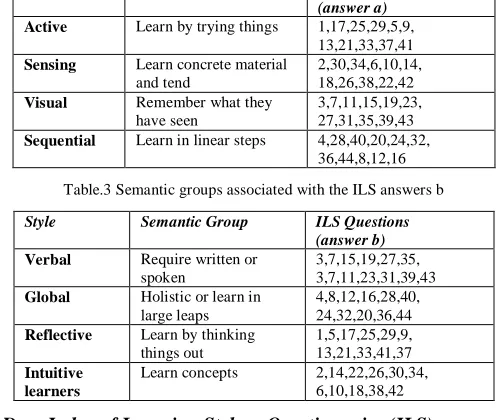
Table III&IV shows the proposed groups as well as the related answers of ILS questions (Felder and Soloman, 1997) for each group. A question may appear twice in the table, if the two possible answers to the question point to two different groups.
The semantic groups within the dimensions provide relevant information in order to be able to identify learning styles. For example, if a learner has a preference for trying things out and tends to be more impersonal oriented, he/she would have a balanced learning style on the active/reflective dimension. However, a learner has also a balanced learning style if he/she prefers to think about the material and tends to be more social oriented. Although both learners have different preferences and therefore different behavior in an online course, both are considered equally according to the result of ILS. Considering the proposed semantic groups leads therefore to more accurate information about learners’ preferences and to a more accurate model for identifying learning styles based on the behavior of learners in an online course [21].
Table. 2 Semantic groups associated with the ILS answers a
Style Semantic Group ILS Questions
(answer a) Active Learn by trying things 1,17,25,29,5,9,
13,21,33,37,41 Sensing Learn concrete material
and tend
2,30,34,6,10,14, 18,26,38,22,42
Visual Remember what they
have seen
3,7,11,15,19,23, 27,31,35,39,43 Sequential Learn in linear steps 4,28,40,20,24,32,
36,44,8,12,16
Table.3 Semantic groups associated with the ILS answers b
Style Semantic Group ILS Questions
(answer b)
Verbal Require written or
spoken
3,7,15,19,27,35, 3,7,11,23,31,39,43
Global Holistic or learn in
large leaps
4,8,12,16,28,40, 24,32,20,36,44 Reflective Learn by thinking
things out
For each of the 44 questions below select either "a" or "b" to indicate your answer. Please choose only one answer for each question. If both "a" and "b" seem to apply to you, choose the one that applies more frequently.
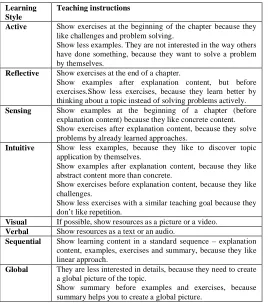
To implement the Felder-Silverman Learning Styles Model we use a collection of rules where each rule proposes a set of teaching instructions for one learning style (Savic and Konjovic, 2009). Table 4 shows the rules.
Table. 4 Rules of Teaching Instructions for each Learning Style in the Felder-Silverman Model.
Learning Style
Teaching instructions
Active Show exercises at the beginning of the chapter because they like challenges and problem solving.
Show less examples. They are not interested in the way others have done something, because they want to solve a problem by themselves.
Reflective Show exercises at the end of a chapter.
Show examples after explanation content, but before exercises.Show less exercises, because they learn better by thinking about a topic instead of solving problems actively.
Sensing Show examples at the beginning of a chapter (before
explanation content) because they like concrete content. Show exercises after explanation content, because they solve problems by already learned approaches.
Intuitive Show less examples, because they like to discover topic application by themselves.
Show examples after explanation content, because they like abstract content more than concrete.
Show exercises before explanation content, because they like challenges.
Show less exercises with a similar teaching goal because they don’t like repetition.
Visual If possible, show resources as a picture or a video. Verbal Show resources as a text or an audio.
Sequential Show learning content in a standard sequence – explanation content, examples, exercises and summary, because they like linear approach.
Global They are less interested in details, because they need to create a global picture of the topic.
Show summary before examples and exercises, because summary helps you to create a global picture.
III. PROPOSED SYSTEM ANALYSIS AND DESIGN
A. System Architecture:
In the Proposed work Using Personalized Learning System; a learner model is normally generated for each user by first offering them a pre-test within the System itself. This is done by re-directing the user to a page with the appropriate questionnaire if he has not already filled it out on a previous
visit. If the latter, then the user is simply directed to his course and does not need to re-take the pre-test again (Unless of course he wishes to rebuild the course at any stage). As a step towards extracting away from the specific limitations of creating the learner model within the System, we looked at different ways of creating this model within Moodle.
Thus, by adding the pre-test and learner model to Moodle, instead of leaving it to the AHS to determine, we can greatly increase the information contained therein, and offer a more flexible approach to creating the adaptive course for the user. For implementation, the pre-test questionnaire will be implemented in PHP, and is offered within Moodle [1].
The results of this questionnaire are then checked and an output added to database and a personalized course is then generated. The reference literature identifies two main families of e-learning systems: the popular and feature-rich LMSs and the prototypal and experimental systems developed by universities which are focused on personalization and provide learners with an intelligent support throughout their learning process. The work described in this seminar is part of the Open Learning project, in which public and private stakeholders contribute by their different expertise in education and learning to help e-learning providers improve their learning offer by adopting an innovative learning content delivery system centered on the personalization of the learning experience.At first the learner performs a learning style test and gets an answer which tells what observation channels learners prefers to use in learning and what kind of learner one is. If a learner disagrees with the result s/he can read the test.
According to the result the learner can choose the most suitable learning objects and activities from the learning environment. The teacher should provide enough different learning materials in the e-learning environment so that all students are satisfied. The different learning styles should be taken into account also when making exercise works and exams [4].
Figure 1: Learning Style Detection Model
The purpose of this Project is demonstrating that one of the most widely used LMSs, Moodle (www.moodle.org), can be integrated with a form of customization by creating personalized learning content sequences based on the learner’s knowledge and learning styles. Personalization is obtained by combining Moodle [10].
Some of Activities or Leaning Objects
• Forums • Assignment • Chat • Quiz • Wiki etc.
personalization technique is Course Sequencing, in which the learning activities which make up courses are sequenced based on key information about the student.
The personalization engine dynamically adapts the course to the student’s needs. It adopts a three-step approach: i) modeling the learner according to his/her knowledge and learning styles ii) producing a personalized course and iii) adapting the course throughout the learning process.
The system allow teachers to provide and share documents, assignments, quizzes, etc. with their students, helping students to learn easily and teachers to create high quality online courses. It also gives easy access to the teacher and the student outside official working hours, as well as reducing the administrative burden of the curriculum through the exploitation of the means and tools.
The proposed model has four components, which are browser, server, login/registry and database. It will offer the exercise services for Moodle as a new activity to help students to train themselves anytime and anywhere. This section focuses on these components, as follows:
a. Browser:
In the exercise model, there are three main users: administrator, teacher and student. The first one, the administrator, has the ability to use almost all the functions on the system, such as add or remove student, lecturer and section etc. The second actor is the lecturer who can access specific functions of administration, such as add new section to
existing module. The third user is the student who can browse, answer the exercises, and update her /his personal information.
b. Server:
The server is the most important component in our model, which has modules and exercise services in Moodle. The exercise part is the part of the module that users cannot access directly. The proposed model offers users a list of modules, and allows them to choose a module that meets their needs. Then, the model directs the users to the exercise page, and allows them to begin the training exercise.
c. Login/Register:
The browser can log in as normal but if they do not have a username and password, then the system directs them to register before gaining access; they can then navigate to the exercises and visit the site as often as they wish. The system allows students to update and check their personal information including their password. Teachers cannot register themselves; the only person who can add teachers is the administrator.
d. Databases:
Moodle has a large database (approximately 200 tables) and is therefore complicated to deal with. Our system should only add new tables for exercise activities and these are purely related to exam exercises.
B. Method:
a. Learning – Style Inventory:
The Learning – Style Inventory describes the way a student learns and how he/she deals with ideas and day to- day situations in his/her life. Felder and Silverman formulated a learning style assessment instrument, consisting of 44 questions known as Index of Learning Styles (ILS) questionnaire (Felder & Soloman, 1997). It is a 44-item questionnaire where learners’ personal preferences for each dimension are expressed with values between +11 to -11 per dimension, with steps +/-2. This range comes from the eleven questions that are posed for each dimension. (Gomez 2007; Graf 2007)[5].
b. Pre-test:
Participants were given a knowledge assessment test in order to determine their knowledge in the domain. They had to answer a total of ten questions concerning to the domain.
c. The Educational Material:
preferred module and following their own learning sequence throughout the educational material. Consequently, such a structure of the educational material is appropriate for personalized learning [28].
d. Post-test:
The post-test was the same as the pre-test. One score was extracted from the questionnaire intended to reflect students’ performance after interaction with the system and after performing the activities requested.
e. Procedure:
The procedure included four phases: (1) In the first phase
and after students logged on to Moodle, they were first administered the Learning – Style Inventory and next they were administered the pre-test. They were asked to read each question carefully and to select the correct answer to the best of their knowledge. (2) In the second phase the students worked with Moodle for about, studying the proposed educational materials and submitted the proposed self – assessment tasks, exercises and activities. (3)In the third phase, students were administered the post-test. (4) Finally in
the fourth phase, students were administered the feedback.
The pre- and post-tests included the same questions in order to compare students’ performance before and after interaction with Moodle.
IV. DESIRED IMPLICATIONS
E-learning system supports following features: Theory ,Exercises,Questionnaires & Solutions
In this proposed system we will implement the above given features. It creates a content that is common to both styles, Theoretical and Active. Concepts are represented by “theory”, “example”, “exercise”, and “activity”. The concept “exercise” consists of “text”, and a “solution” and depending on the style, the concept “solution” may have an “activity” associated to it. In summary, each style has a common and a specific content for every concept, and different paths of contents are generated to be visualized depending on the style. As Fig. 3 illustrates, the sequence for a theoretical student would be “theory”, and “examples”, with the option of also doing “activities”; however, the sequence for an active student would be “theory”, “exercises” with their “text” and “solution” (in case they want to access it), plus “activities” and the option of going to “examples”[5].
V. CONCLUSION
The following conclusions were made. VLE has to be clear and functional to obtain good learning results. The VLEs are successful in e-learning but take learning styles poorly into consideration. To make the VLE adaptive for different learning styles, learners’ behavior in learning environments has to be studied. The challenge is to get enough information to process. With the obtained data, student models can be created and thereby find the students’ learning preferences.
The proposed approach is based on the idea that students’ behavior can give relevant hints for identifying their learning style preferences. Therefore, to obtain information about the learner’s learning styles, learner’s need to fill out a questionnaire.
Moodle can be developed further to be more adaptive to learning styles. With these add-ons or extensions students’ learning styles can be defined automatically and taken into account by offering tailored courses in VLE. Moodle’s adaptability is not a problem in developing it to better incorporate learning styles. The extensions are to be included to the VLE so it can be adaptable to different learning styles.
VI. REFERENCES
[1] Ekaterina Vasilyeva1,2, Mykola Pechenizkiy2, Paul De Bra2: “Adaptation of Feedback in e-learning System at Individual and Group Level”.
[2] Beatriz Florian1, 3, Christian Glahn2, Hendrik Drachsler2, Marcus Specht2, Ramón Fabregat1: “Activity-Based Learner-Models for Learner Monitoring and Recommendations in Moodle”.
[3] MuesserCemal Nat, Dr. Simon Walker, Dr. Liz Bacon, Prof. Mohammad Dastbaz; “Designing personalisation in LAMS”,2010 European LAMS & Learning Design Conference.
[4] Zivana KOMLENOV, Zoran BUDIMAC, Mirjana IVANOVIC: “Introducing Adaptivity Features to a Regular Learning Management System to Support Creation of Advanced eLessons”, Informatics in Education, 2010, Vol. 9, No. 1, 63– 80, Institute of Mathematics and Informatics, Vilnius
[5] ESSI KANNINEN: LEARNING STYLES AND E-LEARNING.
[6] M. Aleksy, T. Butter, M.Schader. “Architecture for the development of context-sensitive mobile applications”. Mobile Information Systems 4( 2) (2008), 105-117.
[7] B. Alexander, Going Nomadic: “Mobile Learning in Higher Education.” Educause Review 39(5) (2004), 28-35.
[8] del Puerto Paule Ruiz , Jesús Fernández Díaz ,Francisco Ortín Soler , Juan Ramón Pérez Pérez , “Adaptation in current e-learning systems”, M.P.P. Ruiz et al. /, Computer Standards & Interfaces 30 (2008) 62–70.
[9] F.XHhafa, S.Caballe, i.Rusatraazo,L.Barolli: “implementing a mobile campus using a MLE Moodle”, 2010 international Conference on P2P, Parallel, Grid ,Cloud and internet Computing 207-214.
[11] S. Caball´e, F. Xhafa, Th. Daradoumis, A.A. Juan, eds. “Architectures for Distributed and Complex M-Learning Systems:Applying Intelligent Technologies”,. In: IGI Global, Hershey, PA,USA, (2009)
[12] J. Carroll, “Making Use - Scenario-Based Design of Human-Computer Interactions”,. The MIT Press, London, (2000)
[13] Chryssafidou E., Sotiriou S., Koulouris P., Stratakis M.,Miliarakis A., Barajas M., Milrad M., Spikol D. (2009).”Developing Tools that Support Effective Mobile and Game Based Learning: The COLLAGE Platform”. Architectures for Distributed and Complex M-Learning Systems: Applying Intelligent Technologies. IGI Global: Hershey, PA
[14] EXPLOAR: http://www.ea.gr/ep/exploar
[15] R. Luckin, B. du Boulay, H. Smith, J. Underwood, G.Fitzpatrick, J. Holmberg, L. Kerawalla, H. Tunley, D. Brewster and D. Pearce. “Using Mobile Technology to Create Flexible Learning Contexts”,. Journal of Interactive Media in Education, 2005(22).
[16] F. Meawad, G. Stubbs. “Supporting Mobile Access to VLE Resources through MobiGlam” , Architectures for Distributed and Complex M-Learning Systems: Applying Intelligent Technologies. IGI Global: Hershey, PA, (2009)
[17] M-Learning.org: http://www.m-learning.org
[18] MLE-Moodle: http://mle.sourceforge.net/mlemoodle/
[19] M-Voice Learning: http://innovauoc.org/m-voicelearning
[20] N.J.P. Race. “Engage:enabling personalised learning across vle platforms using mobile devices”,. Tech. rep., Lancaster University. (2006)
[21] Sabine Graf,Silvia Rita, Viola,Kinshuk,.”Automatic Student Modelling For Detecting Learning Style Preferences in Learning Management Systems”.
[22] A.Bajahzer,Aljan A, H. Zedan:”Exercises Services for Learning in Higher Education with OSS”,. iADiS international Conference WWW/internet 2008.
[23] A. Zoakou, A. Tzanavari, G.A. Papadopoulos & S. Sotiriou. “A methodology for eLearning scenario development: the UNITE approach”. The 6th Conference on e-Learning Copenhagen Business School, Ireland, (2007), 683-92.
[24] Sabine Graf,”Fostering Adaptivity in E-Learnig Platforms:A Meta-Model Supproting Adaptive Courses*”.
[25] Abdullah Bajahzer, Ajlan Al-Ajlan, Hussein Zedan: “EXERCISE SERVICES FOR E-LEARNING IN HIGHER EDUCATION WITH OPEN SOURCE SOFTWARE (MOODLE)”, IADIS International Conference WWW/Internet 2008.
[26] www.jisc.ac.uk/elearning_pedagogy.html
[27] Farman Ali Khan, Sabine Graf2, Edgar R. Weippl, A Min Tjoa, “Integrated Approach for the Detection of Learning Styles & Affective States”.
[28] Sabine Graf,Silvia Viola and Tommaso Leo,Kinshuk.”In-Depth Analysis of the Felder-Silverman Learning Style Dimensions”:Journal of Research on Technology in Education ,2007,40(1),xx-xxx
[29] Alexandra Gasparinatou, Maria Grigoriadou, “The Impact of Different Learning Styles On Learners' Studying Preferences in the Domain of Computer Local Networks”, IADIS International Conference on Cognition and Exploratory Learning in Digital Age (CELDA 2008).