Rich Source-Side Context for Statistical Machine Translation
Kevin Gimpel and Noah A. Smith
Language Technologies Institute School of Computer Science
Carnegie Mellon University Pittsburgh, PA 15213, USA {kgimpel,nasmith}@cs.cmu.edu
Abstract
We explore the augmentation of statistical ma-chine translation models with features of the
contextof each phrase to be translated. This work extends several existing threads of re-search in statistical MT, including the use of context in example-based machine translation (Carl and Way, 2003) and the incorporation of word sense disambiguation into a translation model (Chan et al., 2007). The context fea-tures we consider use surrounding words and part-of-speech tags, local syntactic structure, and other properties of the source language sentence to help predict each phrase’s transla-tion. Our approach requires very little compu-tation beyond the standard phrase extraction algorithm and scales well to large data sce-narios. We report significant improvements in automatic evaluation scores for Chinese-to-English and English-to-German translation, and also describe our entry in the WMT-08 shared task based on this approach.
1 Introduction
Machine translation (MT) by statistical modeling of bilingual phrases is one of the most successful ap-proaches in the past few years. Phrase-based MT systems are straightforward to train from parallel corpora (Koehn et al., 2003) and, like the origi-nal IBM models (Brown et al., 1990), benefit from standard language models built on large monolin-gual, target-language corpora (Brants et al., 2007). Many of these systems perform well in competitive evaluations and scale well to large-data situations
(NIST, 2006; Callison-Burch et al., 2007). End-to-end phrase-based MT systems can be built entirely from freely-available tools (Koehn et al., 2007).
We follow the approach of Koehn et al. (2003), in which we translate a source-language sentencef
into the target-language sentenceeˆthat maximizes a linear combination of features and weights:1
heˆ,aiˆ = argmax
he,ai
score(e,a,f) (1)
= argmax
he,ai
M
X
m=1
λmhm(e,a,f) (2)
where a represents the segmentation of e and f
into phrases and a correspondence between phrases, and each hm is a R-valued feature with learned
weight λm. The translation is typically found
us-ing beam search (Koehn et al., 2003). The weights
hλ1, ..., λMi are typically learned to directly
mini-mize a standard evaluation criterion on development data (e.g., the BLEU score; Papineni et al., (2002)) using numerical search (Och, 2003).
Many features are used in phrase-based MT, but nearly ubiquitous are estimates of the conditional translation probabilitiesp(eji | f`k) andp(f`k | eji)
for each phrase pair heji,flki in the candidate sen-tence pair.2 In this paper, we add and evaluate
fea-1In the statistical MT literature, this is often referred to as a “log-linear model,” but since the score is normalized during nei-ther parameter training nor decoding, and is never interpreted as a log-probability, it is essentially a linear combination of feature functions. Since many of the features are actually probabilities, this linear combination is closer to amixture model.
2
We will usexjito denote the subsequence ofxcontaining theith throughjth elements ofx, inclusive.
tures that condition on additional context features on thesource(f) side:
p(eji |Phrase =f`k,Context =hfk1−1,fF`+1, ...i)
The advantage of considering context is well-known and exploited in the example-based MT com-munity (Carl and Way, 2003). Recently researchers have begun to use source phrase context informa-tion in statistical MT systems (Stroppa et al., 2007). Statistical NLP researchers understand that condi-tioning a probability model on more information is helpful only if there are sufficient training data to ac-curatelyestimatethe context probabilities.3 Sparse data are often the death of elaborate models, though this can be remedied through careful smoothing.
In this paper we leverage the existing linear model (Equation 2) to bring source-side context into phrase-based MT in a way that is robust to data sparseness. We interpret the linear model as a mix-ture of many probability estimates based on different context features, some of which may be very sparse. The mixture coefficients are trained in the usual way (“minimum error-rate training,” Och, 2003), so that the additional context is exploited when it is useful and ignored when it isn’t.
The paper proceeds as follows. We first review re-lated work that enriches statistical translation mod-els using context (§2). We then propose a set of source-side features to be incorporated into the translation model, including the novel use of syntac-tic context from source-side parse trees and global position withinf (§3). We explain why analogous target-side features pose a computational challenge (§4). Specific modifications to the standard training and evaluation paradigm are presented in§5. Exper-imental results are reported in§6.
2 Related Work
Stroppa et al. (2007) added souce-side context fea-tures to a phrase-based translation system, including conditional probabilities of the same form that we use. They consider up to two words and/or POS tags of context on either side. Because of the aforemen-tioned data sparseness problem, they use a
decision-3An illustrative example is the debate over the use of bilex-icalized grammar rules in statistical parsing (Gildea, 2001; Bikel, 2004).
tree classifier that implicitly smooths relative fre-quency estimates. The method improved over a stan-dard phrase-based baseline trained on small amounts of data (<50K sentence pairs) for Italian→English and Chinese→English. We explore a significantly larger space of context features, a smoothing method that more naturally fits into the widely used, error-driven linear model, and report a more comprehen-sive experimental evaluation (including feature com-parison and scaling up to very large datasets).
Recent research on the use of word-sense dis-ambiguation in machine translation also points to-ward our approach. For example, Vickrey et al. (2005) built classifiers inspired by those used in word sense disambiguation to fill in blanks in a partially-completed translation. Gim´enez and M`arquez (2007) extended the work by considering phrases and moved to full translation instead of fill-ing in target-side blanks. They trained an SVM for each source language phrase using local features of the sentences in which the phrases appear. Carpuat and Wu (2007) and Chan et al. (2007) embedded state-of-the-art word sense disambiguation modules into statistical MT systems, achieving performance improvements under several automatic measures for Chinese→English translation.
Our approach is also reminiscent of example-based machine translation (Nagao, 1984; Somers, 1999; Carl and Way, 2003), which has for many years emphasized use of the context in which source phrases appear when translating them. Indeed, like the example-based community, we do not begin with any set of assumptions aboutwhich kindsof phrases require additional disambiguation (cf. the applica-tion of word-sense disambiguaapplica-tion, which is moti-vated by lexical ambiguity). Our feature-rich ap-proach is omnivorous and can exploitanylinguistic analysis of an input sentence.
3 Source-Side Context Features
We see this as an opportunity to include many more features in phrase-based MT without increas-ing the cost of decodincreas-ing at runtime. This discussion is reminiscent of an advantage gained by moving from hidden Markov models to conditional random fields for sequence labeling tasks. While the same core algorithm is used for decoding with both mod-els, a CRF allows inclusion of features that consider theentireobserved sequence—i.e., more of the ob-servable context of each label to be predicted. Al-though this same advantage was already obtained in statistical MT through the transition from “noisy channel” translation models to (log-)linear models, the customary set of features used in most phrase-based systems does not take full advantage of the observed data.
The standard approach to estimating the phrase translation conditional probability features is via rel-ative frequencies (hereeandf are phrases):
p(e|f) = Pcount(e,f)
e0count(e0,f)
Our new features all take the form p(e | f,fcontext), where eis the target language phrase,
f is the source language phrase, andfcontext is the context of the source language phrase in the sentence in which it was observed. Like the context-bare con-ditional probabilities, we estimate probability fea-tures using relative frequencies:
p(e|f,fcontext) = Pcount(e,f,fcontext)
e0count(e0,f,fcontext)
Since we expect that adding conditioning vari-ables will lead to sparser counts and therefore more zero estimates, we compute features for many dif-ferent types of context. To combine the many differently-conditioned features into a single model, we provide them as features to the linear model (Equation 2) and use minimum error-rate training (Och, 2003) to obtain interpolation weights λm.
This is similar to an interpolation of backed-off es-timates, if we imagine that all of the different con-texts are differently-backed off estimates of the com-plete context. The error-driven weight training ef-fectively smooths one implicit context-rich estimate p(e | f,fcontext) so that all of the backed-off
es-timates are taken into account, including the orig-inalp(e | f). Our approach is asymmetrical; we have not, for example, estimated features of the form p(f,fcontext |e).
We next discuss the specific source-side context features used in our model.
3.1 Lexical Context Features
The most obvious kind of context of a source phrase
f`k is the m-length sequence before it (fkk−1−m) and them-length sequence after it (f``++1m). We include context features form ∈ {1,2}, padding sentences withmspecial symbols at the beginning and at the end. For each value ofm, we include three features:
• p(e|f,fkk−1−m), the left lexical context;
• p(e|f,f``++1m), the right lexical context;
• p(e|f,fkk−−1m,f``++1m), both sides.
3.2 Shallow Syntactic Features
Lexical context features, especially when m > 1, are expected to be sparse. Representing the context by part-of-speech (POS) tags is one way to over-come that sparseness. We used the same set of the lexical context features described above, but with POS tags replacing words in the context. We also include a feature which conditions on the POS tag sequence of the actual phrase being translated.
3.3 Syntactic Features
If a robust parser is available for the source lan-guage, we can include context features from parse trees. We used the following parse tree features:
• Is the phrase (exactly) a constituent?
• What is the nonterminal label of the lowest node in the parse tree that covers the phrase?
• What is the nonterminal label or POS of the high-est nonterminal node that ends immediately be-fore the phrase? Begins immediately after the phrase?
• Is the phrase strictly to the left of the root word, does it contain the root word, or is it strictly to the right of the root word? (Requires a parse with head annotations.)
S[support] Syntactic Features: Not a constituent NP covers phrase VBP to left PP to right Right of root word
PP Shallow Lexical Phrase
PP
NP VP
IN DT NN , PRP VBP DT NN IN DT NN IN NN CC NN , ... NP SBAR NP
NP NP
NP
.. ... .
... Positional Features: Not at start Not at end
Second fifth of sentence Covers 18.5% of sentence (quantized to 20%)
Against this background , we support the report of the committee on transport and tourism , which...
In dieser Hinsicht unterstützen wir den Bericht des Ausschusses für Verkehr und Fremdenverkehr , in...
Syntactic
NP
VBP
[image:4.612.119.497.55.248.2]PP
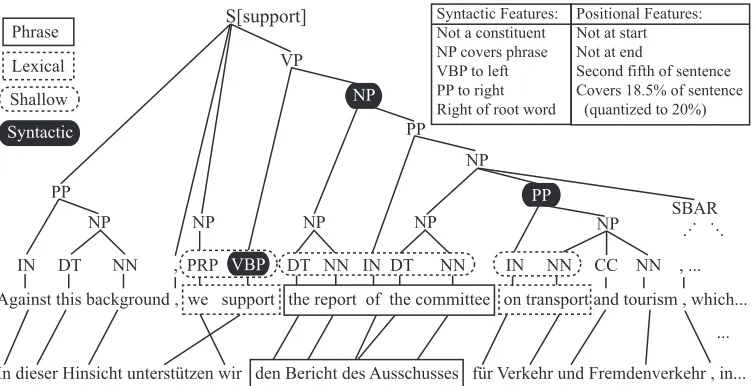
Figure 1: A (partial) sentence pair from the WMT-07 Europarl training corpus. Processing of the data (parsing, word alignment) was done as discussed in§6. The phrase pair of interest is boxed and context features are shown in dotted shapes. The context features help determine whether the phrase should be translated as “der Bericht des Ausschusses” (nominative case) or “den Bericht des Ausschusses” (accusative case). See text for details.
3.4 Positional Features
We include features based on the position of the phrase in the source sentence, the phrase length, and the sentence length. These features use information from the entire source sentence, but are not syntac-tic. For a phrasef`kin a sentencef of lengthn:
• Is the phrase at the start of the sentence (k= 1)?
• Is the phrase at the end of the sentence (`=n)?
• A quantization ofr = k+ `−k+1
2
n , the relative
po-sition in(0,1)of the phrase’s midpoint withinf. We choose the smallestq ∈ {0.2,0.4,0.6,0.8,1}
such thatq > r.
• A quantization ofc = `−kn+1, the fraction of the words in f that are covered by the phrase. We choose the smallestq ∈ {401,201 .101 ,15,13,1}such thatq > c.
An illustration of the context features is shown in Fig. 1. Consider the phrase pair “the report of the committee”/“den Bericht des Ausschusses” extracted by our English → German baseline MT system (described in §6.3). The German word “Bericht” is a masculine noun; therefore, it takes the article “der” in the nominative case, “den” in the ac-cusative case, and “dem” in the dative case. These three translations are indeed available in the phrase table for “the report of the committee” (see Table 1, “no context” column), with relatively high entropy.
The choice between “den” and “der” must be made by the language model alone.
Knowing that the phrase follows a verb, or ap-pears to the right of the sentence’s root word, or within the second fifth of the sentence should help. Indeed, a probability distribution that conditions on context features gives more peaked distributions that give higher probability to the correct translation, giventhiscontext, and lower probability given some othercontexts (see Table 1).
4 Why Not Target-Side Context?
While source context is straightforward to exploit in a model, including target-side context features breaks one of the key independence assumptions made by phrase-based translation models: the trans-lations of the source-side phrases are conditionally independentof each other, givenf, thereby requir-ing new algorithms for decodrequir-ing (Marino et al., 2006).
(tag-Shallow: 2 POS on left Syntax: of root Positional: rel. pos.
g no context ∗“PRP VBP” “VBN IN” ∗right left ∗2nd fifth 1st fifth
den bericht des ausschusses 0.3125 1.0000 0.3333 0.5000 0.0000 0.6000 0.0000
der bericht des ausschusses 0.3125 0.0000 0.0000 0.1000 0.6667 0.2000 0.6667
[image:5.612.76.545.56.116.2]dem bericht des ausschusses 0.2500 0.0000 0.6667 0.3000 0.1667 0.0000 0.1667
Table 1: Phrase table entries for “the report of the committee” and their scores under different contexts. These are the top three phrases in the baseline English→German system (“no context” column). Contexts from the source sentence in Fig. 1 (starred) predict correctly; we show also alternative contexts that give very different distributions.
gers and parsers) for thesourceside can be used to improve the translation model, exploiting analysis tools for other languages.
5 Implementation
The additional data required to compute the context features is extracted along with the phrase pairs dur-ing execution of the standard phrase extraction algo-rithm, affecting phrase extraction and scoring time by a constant factor. We avoid the need to modify the standard phrase-based decoder to handle context features by appending a unique identifier to each to-ken in the sentences to be translated. Then, we pre-compute a phrase table for the phrases in these sen-tences according to the phrase contexts. To avoid extremely long lists of translations of common to-kens, we filter the generated phrase tables, remov-ing entries for which the estimate ofp(e | f) < c, for some small c. In our experiments, we fixed c = 0.0002. This filtering reduced time for exper-imentation dramatically and had no apparent effect on the translation output. We did not perform any filtering for the baseline system.
6 Experiments
In this section we present experimental results using our context-endowed phrase translation model with a variety of different context features, on Chinese→
English, German → English, and English →
Ger-Chinese→English (UN)
Context features BLEU NIST METEOR
None 0.3715 7.918 0.6486
Lexical 0.4030 8.367 0.6716
Shallow 0.3807 7.981 0.6523
Lexical + Shallow 0.4030 8.403 0.6703
Syntactic 0.3823 7.992 0.6531
Positional 0.3775 7.958 0.6510
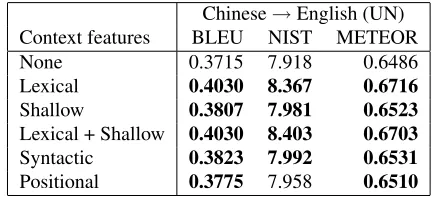
Table 2: Chinese→English experiments: training and testing on UN data. Boldface marks scores significantly higher than “None.”
man translation tasks. Dataset details are given in Appendices A (Chinese) and B (German).
Baseline We use the Moses MT system (Koehn et al., 2007) as a baseline and closely follow the exam-ple training procedure given for the WMT-07 and WMT-08 shared tasks.4 In particular, we perform word alignment in each direction using GIZA++ (Och and Ney, 2003), apply the “grow-diag-final-and” heuristic for symmetrization and use a max-imum phrase length of 7. In addition to the two phrase translation conditionalsp(e | f) andp(f | e), we use lexical translation probabilities in each direction, a word penalty, a phrase penalty, a length-based reordering model, a lexicalized reordering model, and ann-gram language model, SRILM im-plementation (Stolcke, 2002) with modified Kneser-Ney smoothing (Chen and Goodman, 1998). Mini-mum error-rate (MER) training (Och, 2003) was ap-plied to obtain weights (λmin Equation 2) for these
features. A recaser is trained on the target side of the parallel corpus using the script provided with Moses. All output is recased and detokenized prior to evalu-ation.
Evaluation We evaluate translation output using three automatic evaluation measures: BLEU (Pap-ineni et al., 2002), NIST (Doddington, 2002), and METEOR (Banerjee and Lavie, 2005, version 0.6).5
All measures used were the case-sensitive, corpus-level versions. The version of BLEU used was that provided by NIST. Significance was tested using a paired bootstrap (Koehn, 2004) with 1000 samples (p <0.05).6
4http://www.statmt.org/wmt08
5METEOR details: For English, we use exact matching, Porter stemming, and WordNet synonym matching. For Ger-man, we use exact matching and Porter stemming. These are the same settings that were used to evaluate systems for the WMT-07 shared task.
6
[image:5.612.76.293.581.680.2]Chinese→English
Testing on UN Testing on News (NIST 2005)
Context features BLEU NIST METEOR BLEU NIST METEOR
Training on in-domain data only:
None 0.3715 7.918 0.6486 0.2700 7.986 0.5314
Training on all data:
None 0.3615 7.797 0.6414 0.2593 7.697 0.5200
Lexical 0.3898 8.231 0.6697 0.2522 7.852 0.5273
Shallow:≤1 POS tag 0.3611 7.713 0.6430 0.2669 8.243 0.5526
Shallow:≤2 POS tags 0.3657 7.808 0.6455 0.2591 7.843 0.5288
Lexical + Shallow 0.3886 8.245 0.6675 0.2628 7.881 0.5290
Syntactic 0.3717 7.899 0.6531 0.2653 8.123 0.5403
Lexical + Syntactic 0.3926 8.224 0.6636 0.2572 7.774 0.5234
Positional 0.3647 7.766 0.6469 0.2648 7.891 0.5275
All 0.3772 8.176 0.6582 0.2566 7.775 0.5225
[image:6.612.104.511.52.248.2]Feature selection (see Sec. 6.4) 0.3843 8.079 0.6594 0.2730 8.059 0.5343
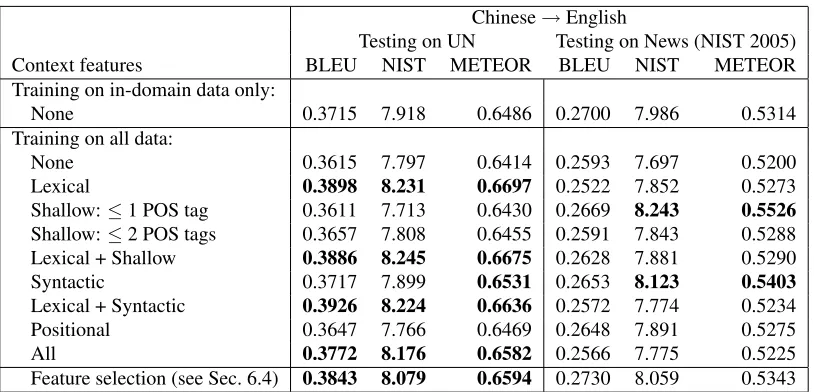
Table 3: Chinese→English experiments: first row shows baseline performance when training only on in-domain data for each task; all other rows show results when training onalldata (UN and News). Left half shows results when tuning and testing on UN test sets; right half shows results when tuning on NIST 2004 News test set and testing on NIST 2005. For feature selection, an additional set of unseen data was used: 2000 held-out sentences from the UN data for the left half and the NIST 2003 test set for the right half. Boldface marks scores that are significantly higher than the first row, in-domain baseline.
6.1 Chinese→English
For our Chinese→English experiments, two kinds of data were used: UN proceedings, and newswire as used in NIST evaluations.
UN Data UN data results are reported in
Ta-ble 2. Significant improvements are obtained on all three evaluation measures—e.g., more than 3 BLEU points—using lexical or lexical and shallow tures. While improvements are smaller for other fea-tures and feature combinations, performance is not harmed by conditioning on context features. Note that using syntactic features gave 1 BLEU point of improvement.
News Data In News data experiments, none of our features obtained BLEU performance statistically distinguishable from the baseline of 0.2700 BLEU (neither better, nor worse). The News training pus is less than half the size of the UN training cor-pus (in words); unsurprisingly, the context features were too sparse to be helpful. Further, newswire are less formulaic and repetitive than UN proceedings, so contexts do not generalize as well from training to test data. Fortunately, our “error-minimizing mix-ture” approach protects the BLEU score, which the λmare tuned to optimize.
Combined UN + News Data Our next
experi-ment usedallof the available training data (>200M words on each side) to train the models, in-domain λm tuning, and testing for each domain separately;
see Table 3. Without context features, training on mixed-domain data consistently harms perfor-mance. With contexts that include lexical features, the mixed-domain model significantly outperforms thein-domain baseline for UN data. These results suggest that context features enable better use of out-of-domain data, an important advantage for statis-tical MT since parallel data often arise from very different sources than those of “real-world” transla-tion scenarios. On News data, context features did not give a significant advantage on the BLEU score, though syntactic and≤1 POS contexts did give sig-nificant NIST and METEOR improvements over the in-domain baseline.
6.2 German→English
English→German
Context features BLEU NIST METEOR
None 0.2069 6.020 0.2811
Lexical 0.2018 6.031 0.2772
Shallow 0.2017 5.911 0.2748
Syntactic 0.2077 6.049 0.2829
Positional 0.2045 5.930 0.2772
Lex. + Shal. + Syn. 0.2045 6.061 0.2817
All 0.2053 6.009 0.2797
[image:7.612.74.297.53.180.2]Feature selection 0.2080 6.009 0.2807
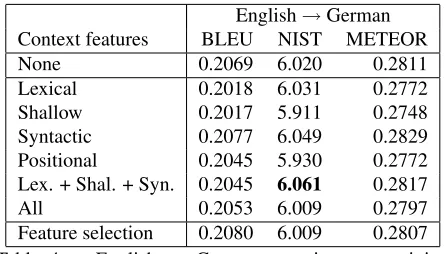
Table 4: English → German experiments: training and testing on Europarl data. WMT-07 Europarl parallel training data was used for training, dev06 was used for tuning, devtest06 was used for feature selection and de-velopmental testing, and test07 was used for final testing. Boldface marks scores significantly higher than “None.”
6.3 English→German
English → German results are shown in Table 4. The baseline system here is highly competitive, hav-ing scored higher on automatic evaluation measures than any other system in the WMT-07 shared task (Callison-Burch et al., 2007). Though most results are not statistically significant, small improvements do tend to come from syntactic context features. Comparing with the German→English experiment, we attribute this effect to the high accuracy of the English parser compared to the German parser.
6.4 Feature Selection
Translation performance does not always increase when features are added to the model. This mo-tivates the use of feature selection algorithms to choose a subset of features to optimize perfor-mance. We experimented with several feature se-lection algorithms based on information-theoretic quantities computed among the source phrase, the target phrase, and the context, but found that a sim-ple forward variable selection algorithm (Guyon and Elisseeff, 2003) worked best. In this procedure, we start with no context features and, at each iteration, add the single feature that results in the largest in-crease in BLEU score on an unseen development set afterλm tuning. The algorithm terminates if no
features are left or if none result in an increase in BLEU. We ran this algorithm to completion for the two Chinese→English tune/test sets (training onall data in each case) and the English→German task;
see Tables 3 and 4. In all cases, the algorithm fin-ishes after≤4 iterations.
Feature selection for Chinese → English (UN) first chose the lexical feature “1 word on each side,” then the positional feature indicating which fifth of the sentence contains the phrase, and finally the lex-ical feature “1 word on right.” For News, the fea-tures chosen were the shallow syntactic feature “1 POS on each side,” then the positional beginning-of-sentence feature, then the position relative to the root (a syntactic feature). For English→ German, the shallow syntactic feature “2 POS on left,” then the lexical feature “1 word on right” were selected.
In the case where context features were most helpful (Chinese → English UN data), we found feature selection to be competitive at 2.28 BLEU points above the no-context baseline, but not the best achieved. In the other two cases (Chinese→English News and English → German Europarl), our best results were achieved using these automatically se-lected features, and in the Chinese→English News case, improvements on all three scores (including 1.37 BLEU points) are significant compared to the no-context baseline trained on the same data.
6.5 WMT-08 Shared Task: English→German
Since we began this research before the release of the data for the WMT-08 shared task, we per-formed the majority of our experiments using the data released for the WMT-07 shared task (see Ap-pendix B). To prepare our entry for the 2008 shared task, we trained a baseline system on the 2008 data using a nearly identical configuration.7 Table 5 com-pares performance of the baseline system (with no context features) to performance with the two con-text features chosen automatically as described in
§6.4. In addition to the devtest06 data, we report re-sults on the 2007 and 2008 Europarl test sets. Most improvements were statistically significant.
7 Future Work
In future work, we plan to apply more sophisticated learning algorithms to rich-feature phrase table esti-mation. Context features can also be used as condi-tioning variables in other components of translation
devtest06 test07 test08
System BLEU NIST METEOR BLEU NIST METEOR BLEU NIST METEOR
Baseline 0.2009 5.866 0.2719 0.2051 5.957 0.2782 0.2003 5.889 0.2720
[image:8.612.97.522.55.103.2]Context 0.2039 5.941 0.2784 0.2088 6.036 0.2826 0.2016 5.956 0.2772
Table 5: English→German shared task system results using WMT-08 Europarl parallel data for training, dev06 for tuning, and three test sets, including the final 2008 test set. The row labeled “Context” uses the top-performing feature set{2 POS on left, 1 word on right}. Boldface marks scores that are significantly higher than the baseline.
models, including the lexicalized reordering model and the lexical translation model in the Moses MT system, or hierarchical or syntactic models (Chiang, 2005). Additional linguistic analysis (e.g., morpho-logical disambiguation, named entity recognition, semantic role labeling) can be used to define new context features.
8 Conclusion
We have described a straightforward, scalable method for improving phrase translation models by modeling features of a phrase’s source-side context. Our method allows incorporation of features from any kind of source-side annotation and barely affects the decoding algorithm. Experiments show perfor-mance rivaling or exceeding strong, state-of-the-art baselines on standard translation tasks. Automatic feature selection can be used to achieve performance gains with just two or three context features. Per-formance is strongest when large in-domain training sets and high-accuracy NLP tools for the source lan-guage are available.
Acknowledgments
This research was supported in part by an ARCS award to the first author, NSF IIS-0713265, su-percomputing resources provided by Yahoo, and a Google grant. We thank Abhaya Agarwal, Ashish Venugopal, and Andreas Zollmann for helpful con-versations and Joy Zhang for his Chinese segmenter. We also thank the anonymous reviewers for helpful comments.
A Dataset Details (Chinese-English)
We trained on data from the NIST MT 2008 con-strained Chinese-English track: Hong Kong Hansards and news (LDC2004T08), Sino-rama (LDC2005T10), FBIS (LDC2003E14), Xinhua (LDC2002E18), and financial news
(LDC2006E26)—total 2.5M sents., 66M Chinese words, 68M English. For news experiments, the newswire portion of the NIST 2004 test set was used for tuning, the full NIST 2003 test set was used for developmental testing and feature selection, and the NIST 2005 test set was used for testing (900-1000 sents. each). We also used the United Nations paral-lel text (LDC2004E12), divided into training (4.7M sents.; words: 136M Chinese, 144M English), tuning (2K sents.), and test sets (2K sents.). We removed sentence pairs where either side was longer than 80 words, segmented all Chinese text automat-ically,8 and parsed/tagged using the Stanford parser with the pre-trained “xinhuaPCFG” model (Klein and Manning, 2003). Trigram language models were trained on the English side of the parallel corpus along with approximately 115M words from the Xinhua section of the English Gigaword corpus (LDC2005T12), years 1995–2000 (total 326M words).
B Dataset Details (German-English)
For German↔ English experiments, we used data provided for the WMT-07 shared task (1.1M sents., 26M German words, 27M English). We used dev06 for tuning, devtest06 for feature selection and de-velopmental testing, and test07 for final testing (2K sents. each). We removed sentence pairs where either side was longer than 50 words and parsed/tagged the German and English data using the Stanford parser (Klein and Manning, 2003) (with pre-trained “germanFactored” and “englishPCFG” models). 5-gram language models were trained on the entire target side of the parallel corpus (37M German words, 38M English).
8Available at http://projectile.is.cs.cmu.
References
S. Banerjee and A. Lavie. 2005. METEOR: An auto-matic metric for MT evaluation with improved corre-lation with human judgments. InProc. of ACL Work-shop on Intrinsic and Extrinsic Evaluation Measures for MT and/or Summarization.
D. M. Bikel. 2004. A distributional analysis of a lexical-ized statistical parsing model. InProc. of EMNLP. T. Brants, A. C. Popat, P. Xu, F. J. Och, and J. Dean.
2007. Large language models in machine translation. InProc. of EMNLP-CoNLL.
P. F. Brown, J. Cocke, S. A. Della Pietra, V. J. Della Pietra, F. Jelinek, J. D. Lafferty, R. L. Mercer, and P. S. Roossin. 1990. A statistical approach to machine translation. Computational Linguistics, 16(2):79–85. C. Callison-Burch, P. Koehn, C. Fordyce, and C. Monz,
editors. 2007. Proc. of the 2nd Workshop on Statisti-cal Machine Translation.
M. Carl and A. Way. 2003. Recent Advances in Example-Based Machine Translation. Kluwer Academic. M. Carpuat and D. Wu. 2007. Improving statistical
ma-chine translation using word sense disambiguation. In
Proc. of EMNLP-CoNLL.
Y. Chan, H. Ng, and D. Chiang. 2007. Word sense dis-ambiguation improves statistical machine translation. InProc. of ACL.
S. Chen and J. Goodman. 1998. An empirical study of smoothing techniques for language modeling. Techni-cal report 10-98, Harvard University.
D. Chiang. 2005. A hierarchical phrase-based model for statistical machine translation. InProc. of ACL. G. Doddington. 2002. Automatic evaluation of machine
translation quality usingn-gram co-occurrence statis-tics. InProc. of HLT.
D. Gildea. 2001. Corpus variation and parser perfor-mance. InProc. of EMNLP.
J. Gim´enez and L. M`arquez. 2007. Context-aware discriminative phrase selection for statistical machine translation. InProc. of the 2nd Workshop on Statistical Machine Translation.
I. Guyon and A. Elisseeff. 2003. An introduction to vari-able and feature selection. Journal of Machine Learn-ing Research, 3:1157–1182.
D. Klein and C. D. Manning. 2003. Fast exact inference with a factored model for natural language parsing. In
Advances in NIPS 15.
P. Koehn, F. J. Och, and D. Marcu. 2003. Statisti-cal phrase-based translation. InProc. of HLT-NAACL, pages 127–133.
P. Koehn, H. Hoang, A. Birch, C. Callison-Burch, M. Federico, N. Bertoldi, B. Cowan, W. Shen, C. Moran, R. Zens, C. Dyer, O. Bojar, A. Constantin, and E. Herbst. 2007. Moses: Open source toolkit for
statistical machine translation. InACL demonstration session.
P. Koehn. 2004. Statistical significance tests for machine translation evaluation. InProc. of EMNLP.
Jos´e B. Marino, Rafael E. Banchs, Josep M. Crego, Adri`a de Gispert, Patrik Lambert, Jos´e A. R. Fonollosa, and Marta R. Costa-juss`a. 2006. N-gram-based machine translation. Computational Linguistics, 32(4):527– 549.
M. Nagao. 1984. A framework of a mechanical trans-lation between Japanese and English by analogy prin-ciple. InProc. of the International NATO Symposium on Artificial and Human Intelligence. Elsevier North-Holland, Inc.
NIST. 2006. NIST 2006 machine translation evaluation official results.
F. Och and H. Ney. 2003. A systematic comparison of various statistical alignment models. Computational Linguistics, 29(1).
F. J. Och. 2003. Minimum error rate training for sta-tistical machine translation. In Proc. of ACL, pages 160–167.
K. Papineni, S. Roukos, T. Ward, and W.-J. Zhu. 2002. BLEU: a method for automatic evaluation of machine translation. InProc. of ACL.
H. Somers. 1999. Review article: Example-based ma-chine translation.Machine Translation, 14(2). A. Stolcke. 2002. SRILM—an extensible language
mod-eling toolkit. InProc. of ICSLP.
N. Stroppa, A. van den Bosch, and A. Way. 2007. Exploiting source similarity for SMT using context-informed features. InProc. of TMI.