19 |
P a g e
FACE DETECTION USING SKIN COLOR
SEGMENTATION
Gayatri A.Patil
1, K.V.Joshi
21,2
Department of Electronics and Telecommunication,
R.C. Patel Institute of Technology,
Shirpur, Dist,-Dhule, MS, (India)
ABSTRACT
Face detection is used to locate faces in images. This algorithm has a simple procedure which is divided into two
steps, first to segment image into skin color regions, and second, to divide this regions contain human face or not .It
uses RGB model in combination with HSV model and fuzzy classifier to quickly locate faces in images. The
algorithm is based on skin color segmentation and knowledge based approach, RGB and HSV color models are
used for skin color segmentation. Basically, this color models are used to remove non-skin like pixels from an
image. Each skin region is actually represents a human face or not, checked by using human face features based on
knowledge of geometrical properties of human face. The experiment result shows that, the algorithm gives
satisfactory output.
Keywords:
Fuzzy Model, HSV Model, Skin color SegmentationI INTRODUCTION
Face detection is technology to determine human face in videos and images. The aim of face detection is to detect
faces in images in videos. This is the first step in many applications such as face recognition, facial expression
analysis, content based image retrieval, surveillance system and intelligent human computer interaction. Therefore,
the performance of these systems depends on the efficiency of face detection. Face detection is an easy task for a
human, but still there is difficulties as faces are subjected to lots of variations of image appearance, such as pose
variation (front, non- front), occlusion, image orientation, illumination and facial expression.In the early stage, face
detection algorithms mainly focused to detect the frontal human face. However,newer algorithms try to consider the
different view of face as core of face detection.
The first of face detection system has been developed since in early 1970’s. Due to the limitation of computation,
system cannot be satisfied the requirement of users, which is identify passport photograph real time. Face detection
is an important part of face recognition as it is the first step to any automatic face recognition system [1].
Many methods have been implemented to resolve each variation.. For example, template-matching methods [2] are
used for face localization and detection by computing the correlation of an input image to a standard face pattern.
The feature invariant approaches [3]are used for feature detection of eyes, mouth, ears, nose, etc. and
20 |
P a g e
detection algorithms that are use neural networks, and support vector machine [3]. For color images, variousliteratures have shown that is possible to separate human skin regions from complex background based on either
YCbCr or HSV color space [5]. Nevertheless, implementing the methods altogether is still a great challenge.
II SKIN COLOR SEGMENTATION
Color is a useful piece of information for skin detection. The skin detection is the most common and first approach
for detecting meaningful skin color , skin color detection may avoid exhaustive search for faces in an entire image.
In this step, we describe that how non skin color is rejected from an Image so that the image may contains only skin
like areas, which will be our skin color segmented image for further processing.
The goal of skin color segmentation is to reject non-skin color regions from the input image. It is based on the fact
that the color of the human face across all races agrees closely in its chrominance value and varies mainly in its
luminance value HSV model has the best performance for skin pixel detection as compared to chrominance(YCbCr)
model and RGB model. In the HSV color model, H means for hue component, which describes the shade of the
color, S stands for saturation component, which describes how pure the hue (color) is while V stands for value
component, which describes the brightness.
Fig.1 The Flowchart of Face Detection Algorithm
First problem is come in the way of face detection, is chosen proper color model for skin color segmentation. There
are several color models and each has specific work field and strength. We used four color models for skin color
segmentation, these are RGB, YCbCr, HSV, and LAB color models. After skin like pixels detection, we convert this
21 |
P a g e
human face in segmented image. Next step of face detection after segmentation is based on knowledge of humanface. Work of next step is to remove non human face skin area from segmented image, by using Knowledge-based
methods or human face features [1].
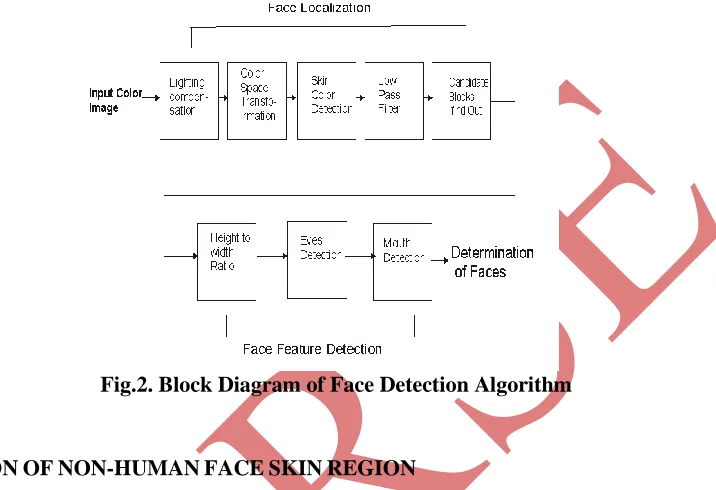
After classifying face as skin and non-skin pixels .Rejection of non face pixels is performed as shown in fig.2
Fig.2. Block Diagram of Face Detection Algorithm
III.
REJECTION
OF
NON-HUMAN
FACE
SKIN
REGION
This is the main step in this algorithm. After classifying image into skin and non skinregions,skin regions is gone
through steps as shown in fig2.to find out most probable human face region using human face feature method and
region properties of human face,then these stages of this step remove non human face like regions by using their
properties which are fixed according to the human face. At finally, when binary image is totally passed from this
step, image contains only highly probable human faces like regions. We retrieve the locations of these human faces
from a filtered or passed binary image from this step. We plot rectangular around these highly probable human faces
in original image. Here, we describing following non human face rejections methods:
Fig. 3 a) An example of Sij b) Removal of Noise using 5 by 5 filter
3.1 Removal of Noise
In order to remove high frequency noise fast, we implement a low pass filter by a 5×5 mask. First, we segment Sij
into 5 × 5 blocks, and calculate how many white points in a block. Then, every point of a 5×5 block is set to white
22 |
P a g e
of black points is more than a half, this 5×5 block is modified to a complete black block. Fig. 3(b) shows anexample that we remove high frequency noise from Fig. 3(a). Although this fast filter will bring block effect, it can
be disregarded due to that our target is to find where is human skin.[16]
3.2 Find out the skin-color blocks
After performing the low pass filter, there are several skin color regions may be human face will be in Si,j. In order
to mark these region, we store fore vertices of rectangle for every region. First, we find the leftmost, rightmost,
upmost, and downmost points. By these four points, we create a rectangle around this region. Fig. 1(b) shows an
example that store (1,1), (1,5), (5,1), and (5,5) to describe the candidate region. Thus, we can get several skin-color
blocks called candidate blocks to detect facial feature.
3.3 Height to Width Ratio Detection
Height to width ratio detection after the step of face localization, we can get several regions which may be human
face. Then, the feature of height to width ratio, mouth, and eyes are detected sequentially for every candidate block.
Because any of these three detections can reject the candidate blocks, low computation module has high priority to
process. Height to width ratio is a very fast and simple detection.
Let the size of candidate block is h × w. We define that if the height to width ratio (h : w) is out of range between
1.5 and 0.8, it should be not a face and this candidate block will be discarded. Note that the range is determined by
experiments. If the ratio is between 1.5 and 0.8 may be a face, the block should be processed by the following two
detections.
3.4 Bounding Box Properties of Human Face
After passing from above methods, the binary image now passed from this stage, this stage reject non human face
skin region based on height to width ratio [4, 6, and 8]. Generally, height to width ratio of skin regions is measurable
factor because it is also big factor for rejecting non human face like regions. If height to width ratio of skin region is
less than by threshold value, then this skin region will be discarding from class of probable human faces. Here we
decided 1.902 threshold values for height to width ratio. For determining height to width ratio of each skin region,
we used region properties based Bounding Box MATLAB function.
IV.EXPERIMENTAL RESULTS
Our face detection method was implemented with MATLAB 8.0. We tested our programming on 20 images which
have single and multiple faces. We collected these images from our friends and internet. Following table shows the
strength of algorithm.
Table 1.Detection rate of proposed face detection algorithm
Number of images Face Detection rate %
False Positive Rate %
23 |
P a g e
Fig.4 Face Detected from Own Created Dataset
V. CONCLUSION
The objective of our paper is to develop an acceptable and efficient face detection algorithm to solve the challenge
in face detection technology under varying conditions. In this paper, we applied a strong approach for face detection,
the human skin areas are estimated by using skin color segmentation method. The skin color distribution in
histogram map gives an idea to choose appropriate thresholds value for detecting skin pixels. Four color models are
used for proposed skin color segmentation algorithm. This segmented image is converted into binary format image,
this binary image has human face regions and non human face regions. Rejection of non human face regions
methods decide which region is human face and which is not human face. The experimental results shows that, this
algorithm justice the robustness of this method.
We want to increase its speed and to overcome on false face detection rate for increasing accuracy of the system in
future. There are some recommendations for further improvements can be made in term of training examples for
getting good results. The proposed Algorithm for this thesis detects only human faces in an image, After detecting
human faces in an images there should be some extra features detection in future work, such as eyes, a nose and
mouth detections in faces.
24 |
P a g e
VI DISCUSSION
RGB and HSV color models are used for skin color segmentation. These color models with thresholds, help to
remove non skin like pixels from an image. We checked each skin region, that skin region is actually represents a
human face or not, by using human face features based on knowledge of geometrical properties of face .Using low
pass filter the extra pixels in the white blocks are removed. After that it passes through height to width detection ,it
is useful to remove the non-face like regions. The experiment result shows that, the algorithm will gives hopeful
results.
REFERENCES
[1] Paul viola, Michael Jones,“Robust real time face detection”,in second interna- tional workshop on statistical and
computational theories of vision-modeling, learning, computing, and sampling, pp.1- 25 Vancouver, Canada,
July 2001.
[2] E. Hjelmays, and B. K. Low, “Face detection: a survey”, Computer Vision and Image Understanding, vol. 83,
pp. 236-274 No. 3, Sept. 2001.
[3] Visal kith, Mohamed El Sharkawy, Tonya Bergeson-Dana, Salwa El Ramly and Said El Noubi, “A feature and
appearance method for eye Detection on gray intensity face images”, in Computer Engineering & Systems
,pp-21-25, ICCES 2008.
[4] Suzuki Y,Shibata T, “Multiple-Clue Face Detection Algorithm using Edge Based Feature vectors”, IEEE
transaction on Acoustics, Speech, and Signal, Processing, vol.5, pp.35 35, sept. 2004.
[5] Rein-Lien Hsu, Abdel-Mottaleb, M., Jain and A.K.,“Face detection in colorImages”,International Conference on
Image Processing, 2001.
[6] Hwei-Jen Lin, Shwu-Huey Yen, Jih-Pin Yeh, and Meng-JuLin,“Face Detection Based on Skin Color
Segmentation and SVM Classification”, The Second Inter- national Conference on Secure System Integration
and Reliability Improvement.
[7] Xutao Zhang, Yudong Guan, ShenWang, Jianquan Liang and TaifanQuan, “Face recognition in color images
using principal component analysis and fuzzy support vector machines”, Systems and Control in Aerospace and
Astronautics,2006.
[8] Pham The Bao, Jin Young Kim and Seung You Na,“Fast multi face detection in color images using fuzzy logic”
,Intelligent Signal Processing and Communi- cation Systems, ISPACS 2005.
[9] LidiyaGeorgieva, Tatyana Dimitrova, Nicola Angelov,“RGB and HSV colour models in colour identification of
digital traumas Images”, International Conference on Computer Systems and Technologies - CompSysTech2005
[10] Wen Chen , Yun Q. Shi and GuorongXuan ,“Identifying Computer Graphics Using HsvColor Model And Statistical Moments Of Characteristic Functions”, International Conference on Multimedia and Expro, 1, pp.
449- 452, 2003.
[11] TD. Teodorescu, KA. Maiorescu and 1-L. Nagel,“TwoColor based Face Detection algorithms: A Comparative
25 |
P a g e
[12] Aamer Mohamed, Ying Weng, Jianmin Jiang and Stan Ipson,“Face Detection based Neural Networks usingRobust Skin Color Segmentation”, 5th Interna- tional Multi-Conference on Systems, Signals and Devices,2008
[13] W. Zhao, R. Chelappa, A. Rosenfeld,“Face Recognition: A Literature Survey” ACM Computing Surveys, Vol.
35, No. 4, pp. 399458. 2003 24
[14] Garcia C., Zikos G., Tziritas G.,“ Face Detection in Color Images using Wavelet Packet Analysis”, Proceedings
of the 6th IEEE International Conference on Multimedia Computing and Systems, p.703-708,June, 1999.
[15] Akshay Bhatia, SmritiSrivastava, and AnkitAgarwal,“Face Detection using Fuzzy Logic and Skin Color
Segmentation in Images”,Third International Conference on Emerging Trends in Engineering and
Technology,2010
[16] Singh Raghuvanshi,DheerajAgrawal,“ Human Face Detection by using Skin Color Segmentation, Face Features and Regions Properties”, International Journal of Computer Applications (0975 8887) Volume 38 No.9,