C54xx Family of Low-cost Digital Signal Processors
Muhammad Yasir Malik
Abstract. Resource constraints in smart devices demand an efficient cryptosystem that allows for low power and memory consumption. This has led to popularity of comparatively efficient Elliptic curve cryptog-raphy (ECC). Prior to this paper, much of ECC is implemented on re-configurable hardware i.e. FPGAs, which are costly and unfavorable as low-cost solutions.
We present comprehensive yet efficient implementations of ECC on fixed-point TMS54xx series of digital signal processors (DSP). 160-bit prime field ECC is implemented over a wide range of coordinate choices. This paper also implements windowed recoding technique to provide better execution times. Stalls in the programming are mini-mized by utilization of loop unrolling and by avoiding data dependence. Complete scalar multiplication is achieved within 50msec in coordinate implementations, which is further reduced till 25 msec for windowed-recoding method. These are the best known results for fixed-point low power digital signal processor to date.
Keywords: Elliptic curve cryptosystem, efficient implementation, digi-tal signal processor (DSP), low power
1
Introduction
No other information security entity has been more extensively studied, re-searched and applied as asymmetric cryptography, thanks to its ability to be cryptographically strong over long spans of time. Asymmetric or public key cryptosystems (PKC) have their foundations in hard mathematical problems, which ensure their provable security at the expanse of implementation costs. So-called “large numbers” provide the basis of asymmetric cryptography, which makes their implementation expensive in terms of computation and memory requirements.
encryp-tion scheme, elliptic curve cryptography and McEliece cryptosystem are most commonly names amongst many others.
Public key cryptography enjoys utilization in many security applications thanks to its ability to render various security assurances. In present day, they are an essential security segment of almost all the operations involving two or more parties. Their wide acceptance leads to creation of efficient and secure protocols that accommodate near-to-perfect protection. On a lower note, in spite of huge developments in the capacity and processing capabilities of em-bedded systems, asymmetric cryptography is still considered a scheme for “big boys”. This is a point of concern for researchers that many interesting applications i.e. smart cards, car security and wireless sensor networks are not fully able to reap the benefits of public key deployment. However hybrid in-frastructure, which is combination of symmetric and asymmetric parameters, is in place in many appliances.
1.1 Comparison of RSA and ECC
Of all the above mentioned public key cryptosystems, elliptic curve cryptog-raphy (ECC) is of utmost interest due to fewer bits involved in its operation, making it an attractive choice for a variety of applications. Use of PKC on smart devices with restricted resources can be materialized by utilizing ECC. Small key sizes of ECC provide the same level of security as conventional cryptosystems which are based on integer factorization and discrete logarith-mic problems. Ratio of security delivered to the key size of ECC is also larger than RSA or other cryptosystems, indicating better security of ECC for given key size. A comparison of equally secure cryptosystems is given in Table 1.
Table 1. Comparison of RSA and ECC
RSA key length ECC key length Ratio MIPS year
512 106 5:1 104
768 132 6:1 108
1024 160 7:1 1011
2048 210 10:1 1020
1.2 ECC Variants
Processors 3
can also be accomplished in elliptic curves. This renders new algorithms like ECDH, ECDSA and ECMQV etc based on the principles of Diffie-Hellman key exchange protocol, digital signature scheme DSA and authenticated pro-tocol of key agreement, MQV.
1.3 Applications of ECC
The described factors call for wider role of ECC in present-day cryptography, specifically in resource-starved applications thanks to its faster implementa-tions and low power and bandwidth consumpimplementa-tions. Trust in ECC security cause inclusion of many ECC protocols in internationally distinguished proto-cols such as IEEE Std 1363-2000, ISO CD 14888-3, ANSI X9.62 etc.
In last ten years, there has been tremendous work on the different ways and methodologies to enhance the implementation capabilities of ECC. Many novel approaches are introduced to speed up either overall system or the criti-cal operation of scriti-calar multiplication to find for any given point on the curve . Scalar multiplication is most significant process in ECC, and can account for about 70-80% of the total computations. In spite of the volume of research into ECC, it is interesting to note however, that the work done on the hardware and especially on the less expensive platforms is still sparse.
In the light of the fact that many appliances now need PKC to impose security in their structure, there is an ever-increasing demand of less expensive light-weight crypto hardware. Vehicle security, wireless sensor networks and many more exciting fields like these need asymmetric cryptography in their ranks. Due to resource limitation, these applications have to apply either hybrid cryptography (combination of symmetric and asymmetric cryptography) or only symmetric cryptosystems. Even though special-purpose PKC hardware can be utilized for arranging asymmetric cryptosystems in many applications, their implementation on less costly hardware is still a dilemma.
1.4 ECC on Hardware
effi-cient ECC operations but lack major support in deployment because of high expense. Till date, few works have been done on ECC for DSPs, with our contribution being at the forefront.
1.5 Our Contributions
In this work, we will address following points.
Present different implementation choices of ECC for TMS320C54xx, a very popular family of DSPs being manufactured by Texas Instruments. Implement ECC for different coordinates including the newly introduced
Edward and Inverse Edwards curves.
Use of efficient programming techniques to optimize performance of ECC. Point out programming techniques for efficient performance of ECC. Implement a new windowed-NAF of scalar to enhance the capability and
performance of hardware.
Compare our results with previously performed research works on ECC.
2
Related Works
Comprehensive details of cryptosystem implementations on different catego-ries of hardware can be found in [1] and [2]. Several cryptosystems have been restructured and exercised on DSPs in the past, with particular emphasis on RSA. Implementations concerning elliptic curve cryptography (ECC) and its components on different platforms are also in literature.
As mentioned earlier, last decade saw an expansion in research on ECC in terms of hardware actualization. Many new hardware architectures and calcu-lation-saving techniques are developed, to make ECC realizable in practice. The platforms put to use for this objective vary from simple [3], in which au-thors use an 8-bit Atmel ATmegal28 µcontroller, operating at 8MHz. They were able to achieve ECC over prime field in less than a second. Software and hardware co-design for a µcontroller is presented in [4], using Dalton 8051 and special hardware accelerator composed of an elliptic curve acceleration unit (ECAU) and an interface with direct memory access (DMA) to enable fast data transfer between the ECAU and the external RAM (XRAM) attached to the 8051 µcontroller. ECAU accomplished full scalar multiplica-tion over prime field in 118 msec, when Dalton 8051 is clocked at 12MHz.
Processors 5
prime field are given in [7,8,9], in which architectures are based on systolic array Montgomery modular multipliers. Many other papers are also available for reconfigurable-hardware designs [10], LD algorithm [26] and the configuration by use of Karatsuba multipliers to name a few. Authors in [10] present efficient ECC over NIST primes P-224 and P-256 on commercial Xil-inx’sVirtex-4SX55 FPGA.
In the line of DSP platforms, the earliest works are featured in [11, 12, 13, 14, 15]. Montgomery multiplication algorithm is a popular method to improve speed of modular multiplications in public-key cryptosystems. Work in [11] suggests enhanced Montgomery multiplication based on DSP architectures. An efficient processor over prime field implemented on DSPTMS320C6201 is proposed in [12]. It uses a Montgomery multiplier with a 16-bit digit size, which can be used for carrying out RSA, DSA and ECDSA, and elliptic doubling to increase speed. Authors in [13] present processor us-ing MAC2424 -bit) for , taking into account the precomputations required by the signed window scalar multiplication method. In [14], a windowing mechanism by combining NAF and variable-length slid-ing window, used in implementation of elliptic curve digital signature on TMS320VC5402, is given to decrease the complexity of point multiplication. ECC and its components over are implemented on fixed point TMS320VC5416 DSP in [15], achieving scalar multiplication in 63.4 msec.
3
Preliminaries
In this section, we briefly describe ECC, the systems of coordinates used by it and DSP which we use for implementations.
3.1 Elliptic Curves
Definition 1. An elliptic curve E over a field is defined by an equation
(1)
where , and ∆≠ 0, where ∆ is the discriminant of and must be non-zero to ensure no point on the curve has two or more distinct tangent lines.
their addition can be given as . On the curve, tangent-and-chord process is applied to perform this operation, with two defined cases of and . In the first case, point doubling is carried out while point addition is done in the later case. Scalar multiplication is the basic cryp-to function of ECC, and it uses point addition and point doubling cryp-to find , which is the result of adding the point to itself times
( times).
The length of depicts the key size of corresponding ECC cryptosystem, and can be in the range of 160-521 bits.
Security of ECC relies on the elliptic curve discrete logarithm problem (ECDLP), defined as follows:
Definition 2. Given the prime modulus , the curve constants and and two points and , find a scalar such that , where is the scalar multiplication as defined above.
The equation (1) can be reduced by admissible changes of variables. If the characteristic of is not equal to 2 and 3, then equation (1) is rewritten as
(2)
where , and . This equation represents Weierstrass equation in its simple form, and is the most commonly used repre-sentation of ECC.
Points on curve when shown according to two-dimensional enti-ties , such as are said to be using affine coordinates. Although they are the most basic form of curves, they exercise expensive in-version operation over prime fields. Point addition and point doubling in these coordinates require one inversion process each, making the choice of affine coordinates too costly for practical utilization.
3.1.1 Jacobian Projective Coordinates
For efficient implementation of scalar multiplications, these points are con-verted into three-point coordinates such as Jacobian projective coordinates, with the curve projective equation and point at in-finity as Each point in affine coordinate representation can be represented by a reciprocal form in projective Jacobian coordinates
such that,
Processors 7
Affine-to- Jacobian projective:
Jacobian projective-to-Affine: implying
Various representations of operations on point addition and point doubling are in literature, however we chose most efficient for our implementations. This provides clear insight into the performance improvements taking into account the recent developments in the algorithms.
Let and be two points in Jacobian coordinates such that then where is the point addition of and , is given as:
where , , and are subordinates for storing intermediate values.
Similarly, for the point doubling is obtained as:
Both of these operations are in simple form, using more variables than re-quired, and can be further reduced by eliminating the repeated calculations and through optimized choice of a, in the elliptic curve equation.
3.1.2 Lopez-Dahab(LD) Coordinates
Lopez-Dahab (LD) are another popular coordinate system with the projective elliptic curve equation,
and point of infinity at
(LD) coordinates are preferable instead of affine, and sometimes Jacobian coordinate due to lesser field multiplications to perform a point addition and their flexibility of computing the point addition in mixed coordinates i.e. add-ing points represented in distinct coordinate systems.
The formulae for point conversion between affine and LD projective coordi-nates are:
Affine-to-LD projective:
Point addition of two points and
2 can be shown as, as provided in [16]:
Simple point addition in this coordinate system takes , where denotes a multiplication, represents a squaring and is an addition.
Mixed addition requires and one multiplication by , as given in [17].
Author in [18] gives doubling of point , that requires
and one multiplication by a, and is given by
3.1.3 Edwards curves
In [19], author proposes new normal form of elliptic curves with an addition law symmetric in and coordinates. All elliptic curves can be transformed to this normal form by field extension.
An Edwards curve, over a field is given by the equation,
, where }.
Edwards addition law for adding any two points and on this curve is shown as
Neutral element of this addition is and the inverse of any point
Processors 9
The curve equation can be set to , with the identity at
Any point following the above curve equation with condition
, coincides to the affine point
Point addition of two points with coordinates at and
is shown as:
It takes computations.
Doubling of a point = , uses .
3.1.4 Inverted Edwards Curves
Inverted Edward curves represent an affine point as ( / , / ). The curve equation to represent any point on the Edward curve is,
satisfying the condition .
Computing ( : : ) converts standard Edwards coordinates
to inverted Edwards coordinates and vice versa.
Point addition of two points with coordinates
and takes computations, and is done as:
Procedure for point doubling in inverted Edwards curve is:
and takes .
If doubling is followed by addition in inverted Edwards curve, deploying point tripling offers reduced calculations and resources. The following calcu-lations take .
3.2 Scalar representation
Most efficient scalar multiplication algorithms follow Horner polynomial rep-resentation:
Definition: Let the scalar is in the form,
then the scalar multiplication can be calculated as,
Hamming weight (the number of one’s) in such representation is nearly half of total number of bits, where m is the length of the scalar and can be from bits for practical systems. Running time of this procedure is approximately,
.
and represent number of point additions and doubling respectively.
3.2.1 Windowed Non-Adjacent Form ( NAF)
Definition: A non-adjacent form of a scalar is given by expression
where non-zero constant is odd, and there are no adjacent non-zero digits, for length .
Processors 11
NAF of width , such as
The running time for -NAF is
3.2.2 New method for windowed-recoding
In [21], a new technique for recoding of scalar based on one’s complement is given. In this work, we will elaborate the method and implement it, some-thing which has not been done before.
Definition: We can write one’s complement of any number with bit length as
. Reordering of this equation gives
This representation can be windowed for any width , and it provides the running time of
One point addition costs , whereas the cost of a point doubling is
. By using the proposed process, considerable computations can be saved as they offer more flexibility in terms of storage needs due to pre-computations and optimized performance based on the platform competence.
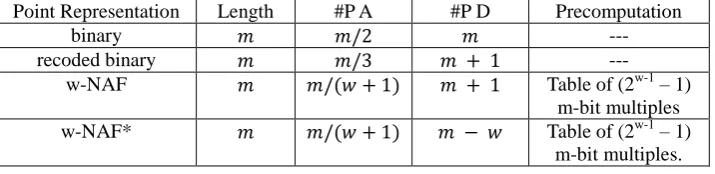
Table 2. Performance comparison of different point representations
Point Representation Length #P A #P D Precomputation
binary ---
recoded binary ---
w-NAF Table of (2w-1 – 1) m-bit multiples w-NAF* Table of (2w-1 – 1)
4
54xx Family Digital Signal Processor
We bring into play fixed- point digital signal processor TMS320VC5416, which belongs to C54xx family of DSPs by Texas Instruments, for our im-plementations, analysis and comparisons. Its multi-bus architecture works with three 16-bit data memory buses and a program memory bus. It houses 40-bit Arithmetic Logic Unit (ALU) including a 40-bit barrel shifter and two independent 40-bit accumulators. Eight auxiliary registers AR0~AR7 can be exploited during programming. The DSP accommodates 128k x 16-bit on-chip RAM and a -bit on-chip ROM for program memory [27]. It offers 6.25-ns and 8.33-ns single-cycle execution times, which corresponds to their operations at 160 and 120 MIPS respectively.
Now we will describe some techniques to enhance performance of DSP.
4.1 Data Dependence
As we are using assembly for our implementation, the problems due to data dependence such as write after read (WAR), read after write (RAW) and write after write (WAW) may arise. Some variables need to be used multiple times and when it happens in consecutive instructions, data dependence may lead to errors in the program.
As shown in the following example, the value in register AR2 is being used multiple times in consecutive instructions; firstly its value is loaded to accu-mulator A, then it is being multiplied by the value in A (squaring process). The result is again stored in the same register. This causes stalls because of the consumption of only one register (or variable) in chronological order.
DLD *AR2,A MPYU *AR2,A STL A,*AR2-
To remove the problems arising from data dependence, stalls (NOPs in pro-gramming) are inserted between the instructions. Scheduling remains the fa-vored procedure to avoid these problems, in which order of execution of in-structions is altered and thus less stalls are required.
4.2 Loop unrolling
To decrease the control dependence, loop is replicated several times. This process may increase the code length and memory storage requirements, but nonetheless helps in attaining better performance as the number of NOPs de-creases.
Processors 13
x[i] = x[i] + a;
The above statements can be loop unrolled as shown. for (i=0; i<100; i=i+4) {
x[i] = x[i] + a; x[i+1] = x[i+1] + a; x[i+2] = x[i+2] + a; x[i+3] = x[i+3] + a; }
5
Simulations and Results
As discussed earlier, we use 160-bit over for implementation and examina-tion. This section contains the simulation results for our implementations on C54x DSP, which is running at 160 MHz.
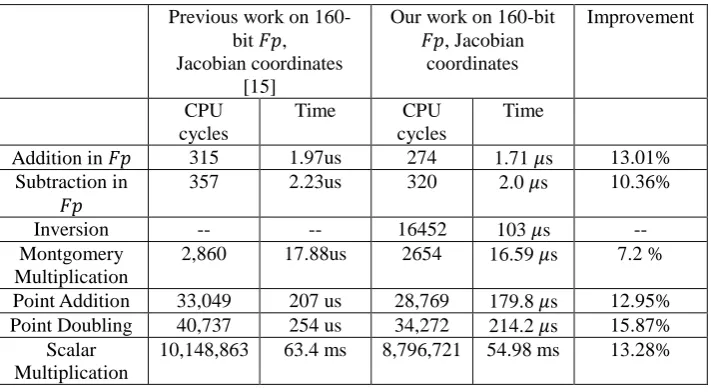
Table 3. show the improvement in the results for Jacobian coordinates by our procedure, as compared to the earlier work on the similar platform. Develop-ment achieved in our work here is mainly due the use of data dependence and loop unrolling. To keep the code length from being too lengthy and ambigu-ous, loops are unwound for five times at the maximum.
Restricted number of registers in C54x allows us to make use of memory to store variables, thus reducing reliance on registers and the data stored in them.
Table 3. Performance comparison of 160-bit elliptic curves over using Jacobian coordinates
Previous work on 160-bit , Jacobian coordinates
[15]
Our work on 160-bit , Jacobian
coordinates
Improvement
CPU cycles
Time CPU
cycles
Time
Addition in 315 1.97us 274 1.71 s 13.01% Subtraction in
357 2.23us 320 2.0 s 10.36%
Inversion -- -- 16452 103 s --
Montgomery Multiplication
2,860 17.88us 2654 16.59 s 7.2 %
Point Addition 33,049 207 us 28,769 179.8 s 12.95% Point Doubling 40,737 254 us 34,272 214.2 s 15.87%
Scalar Multiplication
Our work achieves considerable improvements in the previous work on the same curves and coordinates. Overall performance improves by an impressing 13.28 percent, and time executed by complete scalar multiplication de-creases to about 55 msecs. It shows that efficient programming can be vital to overall contribution to an efficient cryptosystem.
Now we present the efficient implementations of ECC using other coordinate systems, including and using the recently developed results on Edwards and Inverted Edwards curves.
Table 4. 160-bit elliptic curves over over Lopez Dahab (LP)
CPU cycles Execution time %age Improvement
Point addition 37,604 235 s -13.8 %
Point doubling 25,114 157 s 38.35 %
Scalar multiplication
7,001,756 43.77 ms 31.0 %
Table 5. 160-bit elliptic curves over over Edwards curves
CPU cycles Execution time %age Improvement
Point addition 33448 209 s -1.2 %
Point doubling 24,591 153.7 s 39.63 %
Scalar multiplication
6,750,609 42.19 ms 33.48 %
Table 6. 160-bit elliptic curves over over Inverse Edwards curves
CPU cycles Execution time %age Improvement
Point addition 31,591 197.44 s 4.4 %
Point doubling 22,506 140.66 s 44.75 %
Scalar multiplication
6,105,734 38.16 ms 39.84 %
Processors 15
of precomputations and memory storage for caching the multiples of elliptic point, each of them is 160 bit in length here.
Average Hamming weight of a w-NAF expression is . Recoding algorithms decrease the point additions for scalar multiplication, whereas the number of point doubling may remain same. New recoding algorithm (Section 3.2.2) also reduces the point doublings in terms of for . Table 2. show the parameters for the scalar multiplication performed on In-verse Edwards points to maximize the realization.
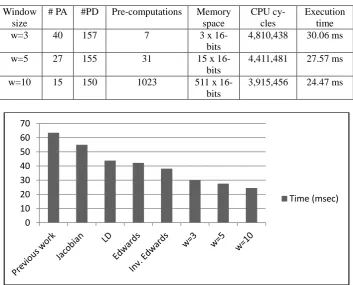
From Table 7. it is clear increasing the parameter improves the performance in terms of execution times. Times needed for scalar multiplication is reduced to 30.06, 27.57 and 24.47msecs depending on the selection of window size. But this improvement comes at the cost of pre-computations and memory. In this case, optimized parameters can be selected as per the need of applications.
Table 7. 160-bit elliptic curves over over w-NAF form
Window size
# PA #PD Pre-computations Memory space
CPU cy-cles
Execution time
w=3 40 157 7 3 x
16-bits
4,810,438 30.06 ms
w=5 27 155 31 15 x
16-bits
4,411,481 27.57 ms
w=10 15 150 1023 511 x
16-bits
3,915,456 24.47 ms
Figure 1. Scalar mulplications of 160-bit elliptic curves over different coordinates 0
10 20 30 40 50 60 70
In above figure, all implementations on DSP over different coordinates of size 160-bit are shown.
6
Discussions
Processors 17
7
References
[1] Dormale, G.M., and Quisquater, J.: High-speed hardware implementations of Elliptic Curve Cryptography: A survey.J. Syst. Archit.53, 72-84 (2007) [2] Batina, L., Ors, S.B., Preneela, B., and Vandewalle, J.: Hardware architec-tures for public key cryptography. Integration ,the VLSI Journal, vol.34, no.1-2, , pp.1–64 (2003)
[3] Gura, N., Patel, A., Wander, A., Eberle, H., Shantz, S.C.: Comparing Ellip-tic Curve Cryptography and RSA on 8-bit CPUs. In CHES (2004) 119-132 [4] Koschuch, M., Lechner, J., Weitzer, A., Grobschadl, J., Szekely, A., Tillich, S., and Wolkerstorfer, J.: Hardware/Software Co-Design of Elliptic Curve Cryptography on an 8051 Microcontroller. CHES2006, LNCS 4249, pp. 430-444 (2006)
[5] Nguyen, N., Gaj, K., Caliga, D., El-Ghazawi, T.: Implementation of ellip-tic curve cryptosystems on a reconfigurable computer. IEEE Field-Programmable Technology (FPT), pp.60–67 (2003)
[6] Bajracharya, S., Shu, C., Gaj, K., El-Ghazawi, T.: Implementation of ellip-tic curve cryptosystems over GF(2n) in optimal normal basis on a reconfigu-rable computer. Field Programmable Logic and Applications (FPL), LNCS 3203, pp.1001–1005 (2004)
[7] Orlando, G., Paar, C.: A scalable GF(p) elliptic curve processor architec-ture for programmable hardware. Cryptographic Hardware and Embedded Systems(CHES), LNCS2162, pp.356–371 (2001)
[8]B. Ors, S., Batina, L., Preneel, B., Vandewalle, J.: Hardware implementa-tion of an elliptic curve processor over GF(p). Applicaimplementa-tion-Specific Systems, Architectures, and Processors (ASAP), pp.433–443 (2003)
[9] Batina, L., Bruin-Muurling, G., B. Ors, S.: Flexible hardware design for RSA and elliptic curve cryptosystems. The Cryptographer’s Track at RSA Conference (CT-RSA), LNCS 2964, pp. 250–263 (2004)
[10] Guneysu, T. and Paar, C.: Ultra High Performance ECC over NIST Primes on Commercial FPGAs. Proceedings of the 10th international work-shop on Cryptographic Hardware and Embedded Systems (CHES '08), Elisa-beth Oswald and Pankaj Rohatgi (Eds.), Springer-Verlag, Berlin, Heidelberg, 62-78 (2008)
[11] Gastaldo, P., Parodi, G., and Zunino. R.: Enhanced Montgomery Multi-plication on DSP Architectures for Embedded Public-Key Cryptosystems. EURASIP Journal on Embedded Systems (2008)
Crypto-graphic Hardware and Embedded Systems (CHES), LNCS1717, pp.61–72 (1999)
[13] Chung, J.W., Sim, S.G., Lee, P.J.: Fast implementation of elliptic curved defined over GF(pm) on CalmRISC with MAC2424 coprocessor. Crypto-graphic Hardware and Embedded Systems(CHES), LNCS1965,pp.57–70 (2000)
[14] Qin. Y., Li. C., Xu. S.: A Fast ECC Digital Signature Based on DSP. In-ternational Conference on Computer Application and System Modeling (ICCASM), (2010)
[15] Malik. M.Y.: Efficient implementation of elliptic curve cryptography using low-power digital signal processor. Proceedings of the 12th Internation-al Conference on Advanced Communication Technology (ICACT'10). IEEE Press, Piscataway, NJ, USA, 1464-1468 (2010)
[16] Higuchi. A., and Takagi. N.: A fast addition algorithm for elliptic curve arithmetic in GF(2n) using projective coordinates. Information Processing Letters, 76: 101–103 (2000)
[17] Al-Daoud, E., Mahmod, R., Rushdan, M., and Kilicman. A.: A new addi-tion formula for elliptic curves over GF(2n). IEEE Trans. On Comput., 51(8): 972–975 (2002)
[18] Lange, T.: A note on López-Dahab coordinates. Tatra Mountains Mathe-matical Publications, 33, 75-81 (2006)
[19] Edwards. H.M.: A normal form for elliptic curves. Bulletin of the Ameri-can Mathematical Society, Vol. 44, No. 3, pp. 393-422 (2007)
[20] Bernstein. D.J., and Lange. T.: Faster addition and doubling on elliptic curves. Asiacrypt 2007, pages 29–50 (2007)
[21] Huang, X., Shah, P., and Sharma. D.: Fast Algorithm in ECC for Wireless Sensor Network. Proceedings of the International MultiConference of Engi-neers and Computer Scientists Vol II, (2010)
[22] Henríquez, F.R., Saqib, N.A., Pérez A., and Koç, C.K.: Cryptographic Algorithms on Reconfigurable Hardware. Series on Signals and Communica-tion Technology. Springer (2007)
[23]Aigner, H., Bock, H., H'utter. M., and Wolkerstorfer.: A low-cost ECC coprocessor for smartcard. Cryptographic Hardware and Embedded Systems-CHES2004, LNCS3156, pp. 107-118. Springer Verlag (2004)
[24] N. Koblitz, N.: Elliptic curve cryptosystems. Mathematics of Computa-tion 48, 203-209 (1987)
[25] V. Miller, V.: Uses of elliptic curves in cryptography. Advances in Cryp-tology (Crypto'85), LNCS 218, 417-426 (1986)
arithme-Processors 19
tic in GF(2n). Technical Report IC-98-39, Relatorio Tecnico (October 1998) [27] TMS320VC5416 Fixed-point digital signal processor, Data manual, Lit-erature number: SPRS095J, March 1999- Revised April 2003.
[28] Standard for efficient cryptography, SEC1: Elliptic Curve Cryptography, Certicom Research, September 20, Version 1.0 (2000)