Article
Zinc Finger and X-Linked Factor (ZFX) Binds to
Human SET Transcript 2 Promoter and
Transactivates SET Expression
Siliang Xu 1, Shi-Wen Jiang 2,3,*, Fengbiao Guo 3,4, Tristan Senkowski 3, Jinping Li 3, Haibin Chen 4, Alberto Romero 3, Yugui Cui 1 and Jiayin Liu 1,*
1 The State Key Laboratory of Reproductive Medicine, Clinical Center of Reproductive Medicine,
First Affiliated Hospital, Nanjing Medical University, Nanjing 210029, China; [email protected] (S.X.); [email protected] (Y.C.)
2 Department of Obstetrics and Gynecology, Second Affiliated Hospital of Wenzhou Medical University,
Wenzhou 325027, China
3 Department of Biomedical Science, Mercer University School of Medicine, Savannah, GA 31404, USA;
[email protected] (F.G.); [email protected] (T.S.); [email protected] (J.L.); [email protected] (A.R.)
4 Department of Histology and Embryology, Shantou University Medical College, Shantou 515000, China;
* Correspondence: [email protected] (S.-W.J.); [email protected] (J.L.); Tel.: +1-912-3500-411 (S.-W.J.); +86-25-8371-8836 (J.L.)
Abstract: SET protein carries out multiple functions including those for protein phosphatase 2A (PP2A) inhibition, histone modification, DNA repair and gene regulation. SET overexpression has been detected in brain neurons of Alzheimer's disease patients, follicle theca cells of Polycystic Ovary Syndrome (PCOS) patients, and ovarian cancer cells, indicating that SET may play a pathological role for these disorders. SET transcript 2, produced by a specific promoter, represents a major transcript variant in different cell types. In this study, we characterized the transcriptional activation of human SET transcript 2 promoter in HeLa cells. Promoter deletion experiments and co-transfection assays indicated that ZFX, the Zinc finger and X-linked transcription factor, was able to transactivate the SET promoter. A proximal promoter region containing four ZFX-binding sites was found to be critical for the ZFX-mediated transactivation. Mutagenesis study indicated that the site located closest to the transcription start site accounted for most of the ZFX-mediated transactivity. Manipulation of ZFX levels by overexpression or siRNA knockdown confirmed the significance and specificity of the ZFX-mediated SET promoter activation. Chromatin immunoprecipitation results verified the binding of ZFX to its cognate site in the SET promoter. These findings have led to identification of ZFX as an upstream factor regulating SET gene expression. More studies are required to define the in vivo significance of this mechanism, and specifically, its implication for several benign and malignant diseases related to SET dysregulation.
Keywords: SET; I2PP2A; ZFX; transcriptional regulation; gynecologic cancers
1. Introduction
Studies have shown that SET is a multitasking protein involved in diversified physiological processes [3,4]. Through physical interaction with protein phosphatase 2A (PP2A), SET inhibits PP2A phosphatase activity, modifies protein phosphorylation status, and regulates multiple cell functions [5,6]. For example, increased SET level in brain neurons causes tau protein hyperphosphorylated, which contributes to the formation of intracellular neurofibrillary tangles, and ultimately, leading to the pathogenesis of Alzheimer's disease (AD) [7,8]. An increased SET expression and decreased PP2A activity in follicle theca cells of Polycystic Ovary Syndrome (PCOS) patients have been cited to explain the hyperandrogenism in this disease [9,10]. Through PP2A-independent pathways, SET can also regulate cell function. As a part of the complex inhibiting the histone acetyltransferase, SET is involved in histone acetylation modification and chromatin remodeling [11]. Moreover, SET protein is able to specifically recognize the downstream target gene promoters and serve as a transcription factor [12].
Accumulated data have shown that through PP2A-dependant and PP2A-independent pathways SET plays a critical role in the cell cycle regulation, and contributes to the development of hematological malignancies and solid tumors, especially gynecologic cancers [13,14]. In breast cancers, SET overexpression is a frequent molecular event associated with shorter overall and event-free survival of patients [15]. A close correlation between SET expression levels and tumor differentiation was observed in epithelial ovarian cancer [16]. Indeed, two novel anti-SET reagents, OP449 and FTY720, were found to promote cell death induced by cisplatin in ovarian cancer cell lines [17], again pointing to the significance of SET for cancer biology. There is also data indicating that in the cervical cancer HeLa cells, forced SET overexpression and manipulation of SET cytoplasmic localization affect cell motility, implicating SET in cancer metastasis [18].
Taken together, SET dysregulation, most significantly, its overexpression, has been observed in cells/tissues involved in Alzheimer's disease, PCOS, and cancers. However, the molecular mechanism(s) of SET gene regulation is not well understood. Through the use of alternative promoters, SET gene produces four mRNA variants with distinct exon 1 of divergent lengths (Figure S1), leading to the synthesis of four SET protein isoforms with different sizes [19]. Among the four transcription variants, the transcript 1 (TAF-Iα) and transcript 2(TAF-Iβ)represent two major transcripts [20]. Studies have shown that transcript 2 is expressed more widely than transcript 1 [2]. Nagata et al. demonstrated that CCRF-CEM, Jurkat, PEER, and NALM-6 cell lines representing early stage hemopoietic lineages only express transcript 2 [2]. In xenopus oocytes and porcine testes, SET transcript 2 is also the major variant participating in the gonad development. Quantitatively, the expression levels of transcript 2 tend to be more stable than those of transcript 1 [2]. Several studies have concentrated on the transcriptional regulation of transcript 1, and found Sp1 and NFkB to be the transcription factors regulating transcript 1 promoter activity [19,21,22]. However, the regulation of SET transcript 2 promoter remains to be a knowledge gap. The current study is designed to characterize the transcription regulation of transcript 2 promoter. Identification of the cis-elements and binding proteins controlling transcript 2 expression will help us to better understand the SET regulation as a possible pathologic mechanism in the aforementioned benign and malignant diseases.
2. Results
2.1. Identification of the core promoter region regulating the expression of SET transcript 2
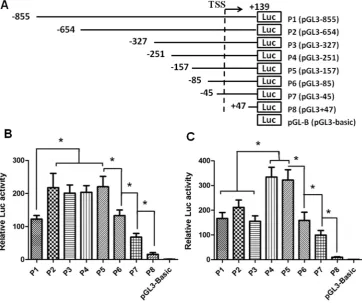
HeLa cells, deletion to -654 bp from the TSS (P2, pGL3-654) caused a significant increase in promoter activity, indicating the presence of a negative regulatory element(s) in -855/-654 region. In HEK 293 cell lines, however, there appeared to be a suppressive element(s) in -327/-251 region. Thus the SET gene transcription might be regulated in a cell-specific manner. On the other hand, in both cell lines, further deletion (P5, pGL3-157; P6, pGL3-85; P7, pGL3-47; and P8, pGL3+47) of the promoter led to a stepwise reduction in luciferase activity in both cell lines. A significant reduction was noted to occur between P5 and P8, which corresponds to the region -157/+47. Thus the 204 bp region harbors a strong positive regulatory cis-active element(s) that is indispensable for the promoter activity of the human SET gene.
Figure 1. Activity of truncated SET transcript 2 promoters in HeLa and HEK 293 cells. (A) Schematic presentation of serial deletions in human SET transcript 2 promoter. Promoters of different lengths (P1 to P8) were subcloned into the pGL3-Basic luciferase vector. TSS: Transcription start site. (B) and (C) Luciferase activities in transfected HeLa and HEK 293 cells, respectively. Transfection was performed with 100 ng of reporter plasmid DNA and 2.5 ng of pRL-TK reference plasmid DNA in 96-well plates. At 24 h post-transfection, the firefly and renilla luciferase activities were measured. The firefly luciferase activity was standardized with the correspondent renilla luciferase activity. Data is presented as means±SD from three independent experiments. (*, p<0.05).
2.2. Identification of crucial transcription factor(s) controlling SET promoter activity
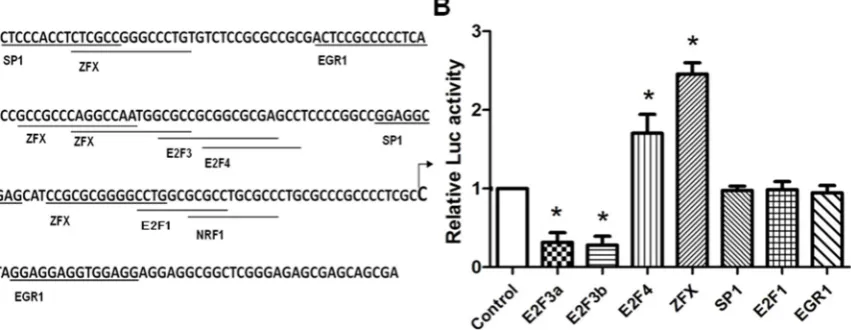
suggest the presence of an E2F3a-related, negative regulatory element further downstream of the deleted region. Since SET was found to be overexpressed in cancer cells, from pathologic point of view, we are more interested in factors upregulating SET expression, and the E2F3a activity was not pursued further. On the other hand, E2F4 and ZFX overexpression significantly increased SET promoter activity, to 1.8-fold and 2.3-fold (p<0.05), respectively. In this study, we elected to focus on ZFX, the factor appeared to account for a large portion of the SET promoter activity.
Figure 2. Identification of crucial transcription factors controlling SET transcript 2 expression. (A) Positions and sequences of cis-elements in the SET core promoter (-157/+47). The transcription start site is indicated by an arrow. (B) HeLa cells were co-transfected with 100 ng of P5 plasmid and 100 ng of plasmid expressing transcription factors. At 24 h post-transfection, cells were lysed and luciferase activities were measured. Data is presented as means±SD from three independent experiments. (*, p<0.05).
2.3. ZFX transactivates human SET promoter
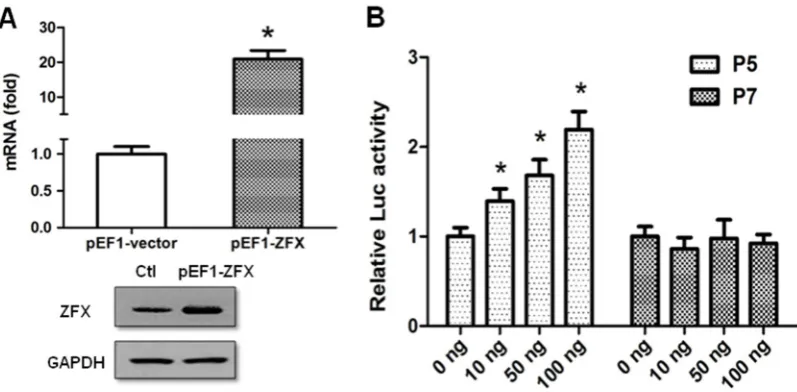
Figure 3. ZFX transactivates human SET transcript 2 promoter. (A) HeLa cells were transfected with 100 ng of pEF1-ZFX or pEF1-vector (control). At 48 h post-transfection, total RNA and proteins were isolated and ZFX expression was determined. Top panel: Results of real-time PCR showing a dramatic increase of ZFX RNA mRNA following ZFX overexpression. Bottom panel: Results of Western blotting showing an increased ZFX protein expression. GAPDH protein expression was determined and the results indicated equal protein loading. (B) Dose-dependent effect of ZFX on SET promoter activity. HeLa cells were co-transfected with increasing amounts of pEF1-ZFX (0-100 ng, pEF1-vector was used as “stuffer” to keep a constant DNA amount) and 100 ng of P5 or P7 reporter plasmid. Luciferase activity was measured at 24 h post-transfection. Quantitative data is presented as means±SD from three independent experiments. (*, p<0.05).
2.4. Mutagenesis study on the putative ZFX-binding sites
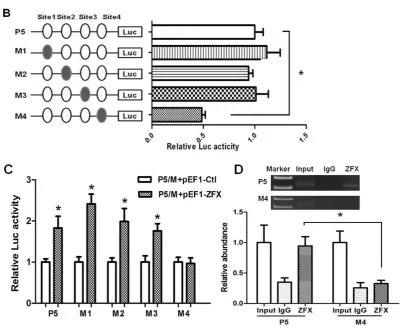
To determine the significance of each ZFX-binding site, site-directed mutagenesis was performed (Figure 4). Four plasmids with each containing a mutation on individual ZFX-binding site were constructed and designated as M1-4 (Figure 4A). The activities of mutant promoters and the parental P5 wild type promoter were compared. As shown in Figure 4B, mutation of the first, second and third binding sites had no significant effect on promoter activity, whereas mutation of the fourth binding site led to a 50% reduction of promoter activity.
To confirm the above observation, the mutant promoters were examined in the presence of ZFX overexpression. Results of co-transfection experiments with reporters containing mutant promoters and ZFX expression vector indicated that mutation of the fourth site (Site4) led to a blockade of the ZFX-mediated transactivation (Figure 4C). Taken together, these data provided strong evidence for a significant role of the fourth ZFX site in ZFX regulation on SET promoter.
2.5. SiRNA-mediated knockdown verified the significance of Site4
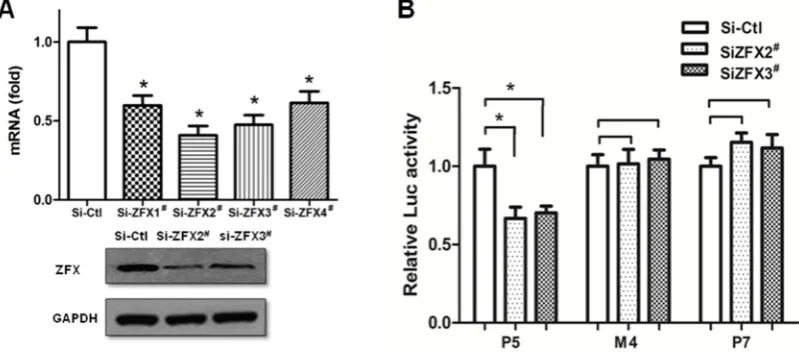
To further confirm the key function of ZFX-binding Site4, endogenous ZFX expression was knocked down with specific siRNAs. Four siRNA sequences were tested for ZFX inhibition. Results of real-time PCR and Western blotting demonstrated that two siRNAs effectively reduced the ZFX expression, accomplishing the knockdown of mRNA (55-65% reduction) and protein (70-80%) levels by Si-ZFX2; and knockdown of mRNA (40-50%) and protein (55-65%) levels by Si-ZFX3# (Figure 5A).
As shown in Figure 5B, ZFX downregulation by either Si-ZFX2# or Si-ZFX3# readily led to a significant
reduction of wild type (P5) promoter activity. But removal of the ZFX-binding Site4, either by mutation (M4) or deletion (P7) rendered insensitivity to changes of ZFX level. Thus, Site4 plays a dominant role for the ZFX regulation of SET promoter.
Figure 5. Removal of ZFX-binding site led to a loss of response to ZFX knockdown. (A) HeLa cells were transfected with either the non-specific siRNA Ctl) or one of four ZFX-targeting siRNAs (Si-ZFX1#, Si-ZFX2#, Si-ZFX3# and Si-ZFX4#). Si-ZFX2# and Si-ZFX3# were found to be the most effective
for ZFX knockdown. Top panel: Measurement of ZFX mRNA levels using GAPDH as an internal reference gene. Bottom panel: Western blotting detection of ZFX protein, with GAPDH detected as a control for protein loading. (B) When ZFX expression was knocked down, a decreased reporter activity was observed. No change of reporter activity was observed in P7 in which Site4 was deleted. Similarly, no change in reporter activity was observed in M4 in which Site4 sequences were mutated. Results are presented as means±SD from three independent experiments. (*, p<0.01).
2.6. ZFX binds to native SET gene promoter
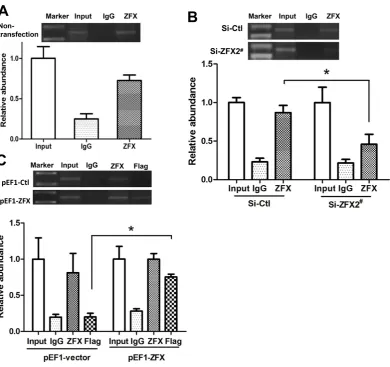
ChIP assays were performed to investigate if ZFX was able to bind to the native SET promoter in HeLa cells. The precipitated DNA was subjected to PCR amplification with primers flanking the genomic region (-147/+26) containing the four ZFX-binding sites. As shown in Figure 6A, ZFX antibodies, but not non-specific IgG, immunoprecipitated the SET promoter DNA, demonstrating the ZFX binding to the native SET promoter.
ChIP experiments were also conducted following manipulation of ZFX expression. As demonstrated in Figure 6B, following ZFX knockdown with Si-ZFX2#, a decrease in the DNA band
Figure 6. Binding of ZFX to the SET transcript 2 promoter confirmed with ChIP assay. ChIP experiments were conducted using ZFX antibody (2 µg) or Flag antibody (2 µg). In (A), (B) and (C), the top panels show representative results of ChIP. The bottom panels present results of densitometry analysis based on three independent experiments. ZFX-binding results were standardized by those of input, setting input value as 1. Data is presented as means±SD from three independent experiments. (*, p<0.01). (A) Untransfected HeLa cells were used in the ChIP assay. ZFX binding to endogenous SET promoter was readily detected. (B) Upon ZFX knockdown using Si-ZFX2#, a significant reduction
in ZFX binding to endogenous SET promoter was observed. (C) ZFX binding to endogenous SET promoter was detected in cells transfected with ZFX-expressing pEF1-ZFX or control pEF1-vector, and Flag antibody detected a strong binding of SET promoter by overexpressed ZFX.
3. Discussion
In this study, we started with the deletion analysis, to reveal the importance of the -157/+47 region for SET transcript 2 promoter activity in both HEK 293 and HeLa cells. Overexpression of potential transcription factors led to identification of ZFX as an activator of SET promoter. Mutagenesis analyses led to identification of the Site4 as the potent element accounting for much of the promoter capacity. This view was supported by the results of siRNA-mediated ZFX knockdown experiments. Chromatin immunoprecipitation experiments confirmed a direct interaction of ZFX with its cognate sequences. It is noteworthy that the activation followed a dose-dependent pattern, and the SET promoter was sensitive to either overexpression or downregulation of the ZFX level. Thus, proper SET expression appears to rely on an appropriate level of ZXF protein, and accurate bi-directional regulation may exist in cells.
canonical Sp1/3-binding sites, yet only the first and third sites contribute to the promoter activity [23]. We compared the four sites with the consensus ZFX-binding sequences (G)GGCCT [24] and found that actually Site3, not Site4, was the closest match. It should be pointed out that in this case the reported “consensus” sequences were empirical rather than laboratory-verified, and the affinity between ZFX protein and these putative binding sequences has not been experimentally measured or compared. It remains a question whether the specific sequence or the special location of Site4 may distinguish it from other sites. Future studies including in vitro binding experiments using purified ZFX, and swapping of the position between Site4 and other sites in a reporter plasmid, may help to clarify this question.
The SET transcript 2 promoter is TATA-less and G/C-rich, and contains multiple Sp1 sites with high alignment score. However, reporter assay showed that Sp1 overexpression failed to impact the transcript 2 promoter activity. This is a sharp contrast to the transcript 1 promoter that was reported to be activated by Sp1 in HEK 293, HeLa and Acute Myeloid Leukemia (AML) cells HL-60 and HEL [21,22]. Such a discrepancy points to the distinct transcriptional regulation between the two SET transcripts. Alternatively, the lack of response by transcript 2 promoter to Sp1 overexpression may be attributed to a relatively high level of Sp1 that has saturated the SET promoter. Since we have focused on ZFX and did not perform Sp1 knockdown experiment, the possible role of Sp1 for transcript 2 promoter regulation should not be excluded.
ZFX contains a large acidic transcriptional activation domain, a nuclear localization sequence and a C-terminal DNA-binding domain consisting of zinc fingers [25,26]. As a transcriptional activator, ZFX accounts for many genes’ expression in mouse embryonic stem cells (ESCs) [27]. ZFX could also transactivate c-Myc and the MHC class I HLA-A11 promoters in glioma stem cells (GSCs) and Leydig cells [28,29]. Besides, ZFX has been found to be overexpressed in several solid cancers, including breast cancer [30], prostate cancer [31], Acute T-Lymphoblastic and Myeloid Leukemia [32], hepatocellular carcinoma [33] and non-small cell lung carcinoma [34]. Revelation of ZFX-mediated transactivation of SET provides one mechanism by which ZFX may be implicated in multiple cell functions.
In summary, SET transcript 2 is a major transcription variant found in many cell types. We have characterized the SET transcript 2 promoter and demonstrated that the Zinc finger and X-linked factor ZFX transactivates the promoter through binding to a site closely located to the transcription start site. The pathophysiological significance of ZFX-mediated SET activation remains to be investigated. Similarly, the upstream signal that controls ZFX expression needs to be identified. Given extensive involvements of SET in Alzheimer's disease, PCOS, and cancers, identification of ZFX as a potent SET regulator is a meaningful step, and further investigations into the ZFX-SET signaling network may provide useful information for the development of new therapeutic modality against several human diseases.
4. Materials and Methods
4.1. Cell Culture
HeLa and human embryonic kidney (HEK) 293 cells were purchased from the American Type Culture Collection (ATCC). Cell cultures were maintained in the Dulbecco's modified Eagle's medium containing 10% fetal bovine serum (FBS, Invitrogen, Carlsbad, CA, USA). The medium was supplemented with penicillin and streptomycin (100 units/ml for each antibiotics). Cell cultures were incubated in a humidified incubator conditioned to 37°C and 5% CO2 atmosphere.
4.2. Plasmid Constructs and Small Interfering RNA (siRNA)
luciferase coding sequences in pGL3-Basic plasmid (Promega, Madison, WI, USA), generating vector pGL3-855. Truncated SET promoters were produced by PCR using the combination of a common reverse primer (R, Table 1) with a specific forward primer (F2-F8, Table 1), and subcloned into pGL3-Basic. The ZFX site mutants at positions -146/-133, -99/-86, -93/-80 and -69/-56 were generated with primers Fr and Re (Table 1). Sequences of subcloned fragments were verified by DNA sequencing. The plasmids expressing various transcription factors (E2F4, E2F1, pcDNA3-EGR1, pCMV-Sp1, pCMV-E2F3a, or pCMV-E2F3b) were obtained from the nonprofit plasmid repository (Addgene, Cambridge, MA, USA). The pEF1-ZFX plasmid with the Flag epitope [28] was a generous gift from Dr. Shideng Bao, Lerner Research Institute, Cleveland Clinic, USA.
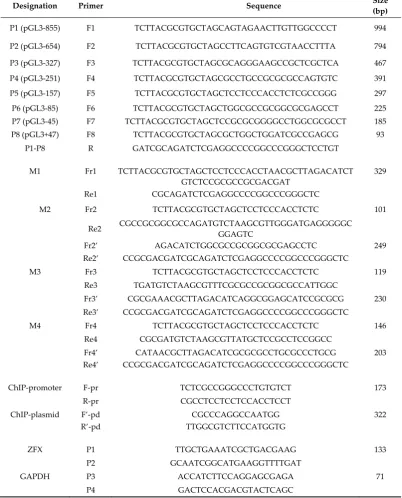
Table 1. Sequences of primers used for DNA cloning, nucleotide mutation, ChIP assay and real-time PCR.
Designation Primer Sequence Size
(bp)
P1 (pGL3-855) F1 TCTTACGCGTGCTAGCAGTAGAACTTGTTGGCCCCT 994
P2 (pGL3-654) F2 TCTTACGCGTGCTAGCCTTCAGTGTCGTAACCTTTA 794
P3 (pGL3-327) F3 TCTTACGCGTGCTAGCGCAGGGAAGCCGCTCGCTCA 467
P4 (pGL3-251) F4 TCTTACGCGTGCTAGCGCCTGCCGCGCGCCAGTGTC 391
P5 (pGL3-157) F5 TCTTACGCGTGCTAGCTCCTCCCACCTCTCGCCGGG 297
P6 (pGL3-85) F6 TCTTACGCGTGCTAGCTGGCGCCGCGGCGCGAGCCT 225
P7 (pGL3-45) F7 TCTTACGCGTGCTAGCTCCGCGCGGGGCCTGGCGCGCCT 185
P8 (pGL3+47) F8 TCTTACGCGTGCTAGCGCTGGCTGGATCGCCGAGCG 93
P1-P8 R GATCGCAGATCTCGAGGCCCCGGCCCGGGCTCCTGT
M1 Fr1 TCTTACGCGTGCTAGCTCCTCCCACCTAACGCTTAGACATCT
GTCTCCGCGCCGCGACGAT
329
Re1 CGCAGATCTCGAGGCCCCGGCCCGGGCTC
M2 Fr2 TCTTACGCGTGCTAGCTCCTCCCACCTCTC 101
Re2 CGCCGCGGCGCCAGATGTCTAAGCGTTGGGATGAGGGGGC
GGAGTC
Fr2’ AGACATCTGGCGCCGCGGCGCGAGCCTC 249
Re2’ CCGCGACGATCGCAGATCTCGAGGCCCCGGCCCGGGCTC
M3 Fr3 TCTTACGCGTGCTAGCTCCTCCCACCTCTC 119
Re3 TGATGTCTAAGCGTTTCGCGCCGCGGCGCCATTGGC
Fr3’ CGCGAAACGCTTAGACATCAGGCGGAGCATCCGCGCG 230
Re3’ CCGCGACGATCGCAGATCTCGAGGCCCCGGCCCGGGCTC
M4 Fr4 TCTTACGCGTGCTAGCTCCTCCCACCTCTC 146
Re4 CGCGATGTCTAAGCGTTATGCTCCGCCTCCGGCC
Fr4’ CATAACGCTTAGACATCGCGCGCCTGCGCCCTGCG 203
Re4’ CCGCGACGATCGCAGATCTCGAGGCCCCGGCCCGGGCTC
ChIP-promoter F-pr TCTCGCCGGGCCCTGTGTCT 173
R-pr CGCCTCCTCCTCCACCTCCT
ChIP-plasmid F’-pd CGCCCAGGCCAATGG 322
R’-pd TTGGCGTCTTCCATGGTG
ZFX P1 TTGCTGAAATCGCTGACGAAG 133
P2 GCAATCGGCATGAAGGTTTTGAT
GAPDH P3 ACCATCTTCCAGGAGCGAGA 71
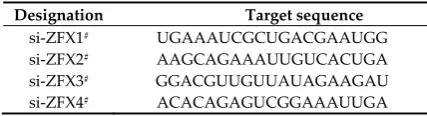
Four ZFX-specific siRNAs and a RISC-free control siRNA were designed and synthesized by Dharmacon (Lafayette, CO, USA). The efficiency of ZFX-specific siRNAs for ZFX knockdown was assessed with real-time PCR and Western blotting. The designation and target sequences of ZFX-specific siRNAs are documented in Table 2.
Table 2. Designation and sequences of siRNAs used for ZFX knockdown.
Designation Target sequence
si-ZFX1# UGAAAUCGCUGACGAAUGG
si-ZFX2# AAGCAGAAAUUGUCACUGA
si-ZFX3# GGACGUUGUUAUAGAAGAU
si-ZFX4# ACACAGAGUCGGAAAUUGA
4.3. Transient Transfection and Luciferase Assay
Transient transfection with plasmid DNA or siRNAs was carried out in HEK 293 and HeLa cells using the Effectene transfection kit (Qiagen, Valencia, CA, USA) and the HiPerFect transfection kit (Qiagen, Valencia, CA, USA), respectively. Cells were seeded in 96-well plates with 100 µl of antibiotics-free medium 24 h before transfection. Following 7 h exposure to transfection reagents, the medium was changed to regular one. At 24 h post-transfection, cells were lysed and luciferase activity was measured using the Dual Reporter assay system (Promega, Madison, WI, USA) on the LB960 microplate luminometer. The pGL3-Basic vector was used as a blank control, while the pRL-TK (Promega, Madison, WI, USA) plasmid expressing the renilla luciferase was used as an internal reference to standardize the luciferase activity. For dose-response experiment, 0-100 ng of ZFX expressing plasmid (pEF1-ZFX) and 100 ng of promoter reporter plasmid/2.5 ng of pRL-TK plasmid were co-transfected into HeLa cells. Transfection experiment was performed in triplicate. At least three independent experiments were repeated.
4.4. Chromatin Immunoprecipitation (ChIP) Assay
CHIP assay was performed using the EZ-CHIP kit (Millipore, Billerica, MA, USA). Briefly, approximately 1x10⁷ cells were fixed with 1% formaldehyde and sonicated on ice with 15 s bursts that was repeated fifteen times with 15 s intervals. Optimization experiments were performed in order to obtain an optimal length of 200-1000 bp (Figure S2) of chromatin fragments. Target chromatin fragments were enriched with 2 µg anti-ZFX antibody (Cell Signaling, Beverly, MA, USA) and immunoprecipitated with protein G agarose beads. In a parallel experiment, non-immunized rabbit IgG was used as a negative control. In ZFX overexpression experiments, 2 µg anti-FLAG M2 antibody (Sigma, Saint Louis, MO, USA) was applied as a verification approach. After extensive washing of beads, DNA was freed following protease K digestion. DNA was purified and analyzed using PCR with a pair of primers encompassing the putative ZFX-binding sites of SET promoter (Table 1). To assess ZFX binding to SET promoter sequences in the luciferase reporter plasmid, PCR was performed using a forward primer targeting the SET promoter sequences and a reverse primer targeting the vector sequences (Table 1). Following gel electrophoresis, DNA bands were quantified with densitometry analysis.
4.5. RNA Extraction and Real-Time Quantitative-PCR
pattern with the predicted size confirmed the accomplishment of specific amplification (Figure S3). The ZFX mRNA levels were calculated according to the 2-ΔΔCt method. The threshold cycles were determined in triplicate with the use of 7900 Real-Time PCR System (Applied Biosystems, CA, USA).
4.6. Western Blotting Analysis
At 72 h post-transfection, cellular proteins were extracted from HeLa cells with RIPA buffer (Boston BioProducts, Boston, MA, USA) containing 5 mM sodium fluoride (NaF), 1 mM sodium vanadate (Na3VO4), and 1 mM phenylmethylsulfonyl fluoride (PMSF), supplemented with 1% Protease Inhibitor Cocktail (100X, Thermo Scientific, Rockford, USA). Protein concentration was measured with the Bradford Assay. 50 µg of protein was loaded and separated in an 8% polyacrylamide SDS-gel and electrotransferred onto polyvinylidene fluoride membranes. The membranes were incubated with primary antibodies, followed by incubation with matching HRP-conjugated secondary antibodies. Color development was carried out using the ECL reagents (Pierce, Rockford, IL, USA). GAPDH was detected and the results were used as protein loading controls. The primary antibodies used were: anti-ZFX (1:1000, Cell Signaling, Beverly, MA, USA) and anti-GAPDH (1:1000, Santa Cruz, Texas, USA).
4.7. Statistical Analysis
Averages and standard deviations (SD) were calculated for each experimental group. All statistical analyses were performed with the use of SPSS 13.0 Software (SPSS, Chicago, IL, USA). One way analysis of variance (ANOVA) was used to evaluate quantitative data containing more than two groups. Data passed ANOVA test were further analyzed using the student’s t test for one-to-one comparison. Statistical significance was set at the level of p<0.05.
Supplementary Materials: Supplementary materials can be found at www.mdpi.com/link.
Acknowledgments: We are grateful to Shideng Bao from Lerner Research Institute, Cleveland Clinic in USA for generously supplying the pEF1-zfx plasmid. This project was supported by Georgia Research Alliance (GRA) Scholarship (Shi-Wen Jiang), Beijing Natural Science Foundation (No. 7142026), Jiangsu Provincial science and technology Department Wenzhou Municipal Science and Technology Bureau (Y20100175), China 973 Program (2012CB944703,2012CB944902), and National Natural Science Foundation of China (81370754, 31301182). Author Contributions: X.S., J.S. and L.J. conceived and designed the study, analyzed the results and wrote the paper. X.S. carried out the experiments. L.J., G.F., T.S., C.H., A.R. and C.Y. provided experimental support. All authors reviewed the results and approved the final version of the manuscript.
Conflicts of Interest: The authors declare no conflict of interest.
Abbreviations
ZFX PCOS TAF-1β
I2PP2A AD ChIP AML
Zinc finger and X-linked factor Polycystic Ovary Syndrome Template Activating Factor-1β
protein phosphatase 2A inhibitor Alzheimer's disease
Chromatin immunoprecipitation Acute Myeloid Leukemia
References
1. Von Lindern, M.; van Baal, S.; Wiegant, J.; Raap, A.; Hagemeijer, A.; Grosveld, G. Can, a putative oncogene associated with myeloid leukemogenesis, may be activated by fusion of its 3' half to different genes: Characterization of the set gene. Mol. Cell. Biol.1992, 12, 3346–3355.
2. Nagata, K.; Saito, S.; Okuwaki, M.; Kawase, H.; Furuya, A.; Kusano, A.; Hanai, N.; Okuda, A.; Kikuchi, A. Cellular localization and expression of template-activating factor i in different cell types. Exp. Cell Res. 1998,
3. Zhang, P.; Compagnone, N.A.; Fiore, C.; Vigne, J.L.; Culp, P.; Musci, T.J.; Mellon, S.H. Developmental gonadal expression of the transcription factor set and its target gene, p450c17 (17alpha-hydroxylase/c17,20 lyase). DNA Cell Biol.2001, 20, 613–624.
4. Chasseigneaux, S.; Clamagirand, C.; Huguet, L.; Gorisse-Hussonnois, L.; Rose, C.; Allinquant, B. Cytoplasmic set induces tau hyperphosphorylation through a decrease of methylated phosphatase 2a. BMC Neurosci.2014, 15, 82.
5. Janghorban, M.; Farrell, A.S.; Allen-Petersen, B.L.; Pelz, C.; Daniel, C.J.; Oddo, J.; Langer, E.M.; Christensen, D.J.; Sears, R.C. Targeting c-myc by antagonizing pp2a inhibitors in breast cancer. Proc. Natl. Acad Sci. USA 2014, 111, 9157–9162.
6. Li, J.; Yang, X.F.; Ren, X.H.; Meng, X.J.; Huang, H.Y.; Zhao, Q.H.; Yuan, J.H.; Hong, W.X.; Xia, B.; Huang, X.F., et al. Stable set knockdown in breast cell carcinoma inhibits cell migration and invasion. Biochem. Biophys. Res. Commun.2014, 453, 7–12.
7. Arif, M.; Wei, J.; Zhang, Q.; Liu, F.; Basurto-Islas, G.; Grundke-Iqbal, I.; Iqbal, K. Cytoplasmic retention of protein phosphatase 2a inhibitor 2 (i2pp2a) induces alzheimer-like abnormal hyperphosphorylation of tau.
J. Biol. Chem.2014, 289, 27677–27691.
8. Bolognin, S.; Blanchard, J.; Wang, X.; Basurto-Islas, G.; Tung, Y.C.; Kohlbrenner, E.; Grundke-Iqbal, I.; Iqbal, K. An experimental rat model of sporadic alzheimer's disease and rescue of cognitive impairment with a neurotrophic peptide. Acta Neuropathologica2012, 123, 133–151.
9. Gao, L.L.; Liu, X.Q.; Xu, B.Q.; Jiang, S.W.; Cui, Y.G.; Liu, J.Y. Set/pp2a system regulates androgen production in ovarian follicles in vitro. Mol. Cell. Endocrinol.2013, 374, 108–116.
10. Xu, B.; Gao, L.; Cui, Y.; Gao, L.; Dai, X.; Li, M.; Zhang, Y.; Ma, X.; Diao, F.; Liu, J. Set protein up-regulated testosterone production in the cultured preantral follicles. Reprod. Biol. Endocrinol.2013, 11, 9.
11. Okuwaki, M.; Nagata, K. Template activating factor-i remodels the chromatin structure and stimulates transcription from the chromatin template. J. Biol. Chem. 1998, 273, 34511–34518.
12. Zhang, P.; Mellon, S.H. Multiple orphan nuclear receptors converge to regulate rat p450c17 gene transcription: Novel mechanisms for orphan nuclear receptor action. Mol. Endocrinol.1997, 11, 891–904. 13. Shin, K.S.; Shin, F.Y.; Bae, S.C.; Kim, S.R.; Jeong, G.B.; Kwak, S.J.; Ballermann, B.J.; Kim, E.G. Expression of
set is modulated as a function of cell proliferation. J. Cell Biochem.1999, 74, 119–126.
14. Canela, N.; Rodriguez-Vilarrupla, A.; Estanyol, J.M.; Diaz, C.; Pujol, M.J.; Agell, N.; Bachs, O. The set protein regulates g2/m transition by modulating cyclin b-cyclin-dependent kinase 1 activity. J. Biol. Chem. 2003, 278, 1158–1164.
15. Rincon, R.; Cristobal, I.; Zazo, S.; Arpi, O.; Menendez, S.; Manso, R.; Lluch, A.; Eroles, P.; Rovira, A.; Albanell, J., et al. Pp2a inhibition determines poor outcome and doxorubicin resistance in early breast cancer and its activation shows promising therapeutic effects. Oncotarget2015, 6, 4299–4314.
16. Ouellet, V.; Le Page, C.; Guyot, M.C.; Lussier, C.; Tonin, P.N.; Provencher, D.M.; Mes-Masson, A.M. Set complex in serous epithelial ovarian cancer. Int. J. Cancer2006, 119, 2119–2126.
17. Yin, X.; Zhang, N.; Di, W. Regulation of lc3-dependent protective autophagy in ovarian cancer cells by protein phosphatase 2a. Int. J. Gynecol. Cancer2013, 23, 630–641.
18. Lam, B.D.; Anthony, E.C.; Hordijk, P.L. Cytoplasmic targeting of the proto-oncogene set promotes cell spreading and migration. FEBS Lett.2013, 587, 111–119.
19. Asaka, M.N.; Murano, K.; Nagata, K. Sp1-mediated transcription regulation of taf-ialpha gene encoding a histone chaperone. Biochem. Biophys. Res. Commun.2008, 376, 665–670.
20. Kim, E.G.; Choi, M.E.; Ballermann, B.J. Spatially restricted expression of set mrna in developing rat kidney.
Am. J. Physiol.1994, 266, F155–F161.
21. Pippa, R.; Dominguez, A.; Malumbres, R.; Endo, A.; Arriazu, E.; Marcotegui, N.; Guruceaga, E.; Odero, M.D. Myc-dependent recruitment of runx1 and gata2 on the set oncogene promoter enhances pp2a inactivation in acute myeloid leukemia. Oncotarget 2016.
22. Feng, Y.; Li, X.; Zhou, W.; Lou, D.; Huang, D.; Li, Y.; Kang, Y.; Xiang, Y.; Li, T.; Zhou, W., et al. Regulation of set gene expression by nfkb. Mol. Neurobiol.2016.
23. Xu, H.G.; Ren, W.; Zou, L.; Wang, Y.; Jin, R.; Zhou, G.P. Transcriptional control of human cd2ap expression: The role of sp1 and sp3. Mol. Biol. Rep. 2012, 39, 1479–1486.
25. Gokhman, D.; Livyatan, I.; Sailaja, B.S.; Melcer, S.; Meshorer, E. Multilayered chromatin analysis reveals e2f, smad and zfx as transcriptional regulators of histones. Nat. Struct. Mol. Biol.2013, 20, 119–126. 26. Cellot, S.; Sauvageau, G. Zfx: At the crossroads of survival and self-renewal. Cell2007, 129, 239–241. 27. Ouyang, Z.; Zhou, Q.; Wong, W.H. Chip-seq of transcription factors predicts absolute and differential gene
expression in embryonic stem cells. Proc. Natl. Acad. Sci. USA2009, 106, 21521–21526.
28. Fang, X.; Huang, Z.; Zhou, W.; Wu, Q.; Sloan, A.E.; Ouyang, G.; McLendon, R.E.; Yu, J.S.; Rich, J.N.; Bao, S. The zinc finger transcription factor zfx is required for maintaining the tumorigenic potential of glioblastoma stem cells. Stem Cells 2014, 32, 2033–2047.
29. L'Haridon, M.; Paul, P.; Xerri, J.G.; Dastot, H.; Dolliger, C.; Schmid, M.; de Angelis, N.; Grollet, L.; Sigaux, F.; Degos, L., et al. Transcriptional regulation of the mhc class i hla-a11 promoter by the zinc finger protein zfx. Nucleic. Acids Res. 1996, 24, 1928–1935.
30. Yang, H.J.; Lu, Y.; Zheng, Y.B.; Yu, X.F.; Xia, X.H.; He, X.M.; Feng, W.L.; Xing, L.; Ling, Z.Q. Shrna-mediated silencing of zfx attenuated the proliferation of breast cancer cells. Cancer Chemoth. Pharm.2014, 73, 569–576. 31. Amini, S.; Fathi, F.; Mobalegi, J.; Sofimajidpour, H.; Ghadimi, T. The expressions of stem cell markers: Oct4, nanog, sox2, nucleostemin, bmi, zfx, tcl1, tbx3, dppa4, and esrrb in bladder, colon, and prostate cancer, and certain cancer cell lines. Anat. Cell Biol. 2014, 47, 1–11.
32. Weisberg, S.P.; Smith-Raska, M.R.; Esquilin, J.M.; Zhang, J.; Arenzana, T.L.; Lau, C.M.; Churchill, M.; Pan, H.; Klinakis, A.; Dixon, J.E., et al. Zfx controls propagation and prevents differentiation of acute t-lymphoblastic and myeloid leukemia. Cell. Rep. 2014, 6, 528–540.
33. Lai, K.P.; Chen, J.; He, M.; Ching, A.K.; Lau, C.; Lai, P.B.; To, K.F.; Wong, N. Overexpression of zfx confers self-renewal and chemoresistance properties in hepatocellular carcinoma. Int. J. Cancer 2014, 135, 1790– 1799.
34. Li, K.; Zhu, Z.C.; Liu, Y.J.; Liu, J.W.; Wang, H.T.; Xiong, Z.Q.; Shen, X.; Hu, Z.L.; Zheng, J. Zfx knockdown inhibits growth and migration of non-small cell lung carcinoma cell line h1299. Int. J. Clin. Exp. Pathol. 2013,
6, 2460–2467.