IJSRR, 8(2) April. – June., 2019 Page 1
Research article Available online www.ijsrr.org
ISSN: 2279–0543
International Journal of Scientific Research and Reviews
Path Induced Geodesic Graphs
A Arul Asha
1and S. Joseph Robin
*2Department of Mathematics, Scott Christain College, Nagercoil - 629001, India. e-mail 1: [email protected]
Affiliated to Manonmaniam Sundaranar University, Abishekapatti, Tirunelveli - 627 012, Tamil Nadu, India, email: [email protected]
ABSTRACT
Let 𝐺 be a connected graph with at least two vertices. A connected geodetic set 𝑆 ⊆ 𝑉(𝐺) is
said to be a path induced geodetic (pig) set of 𝐺if < 𝑆 > contais a path 𝑃, where 𝑉(𝑃) = 𝑆. The
minimum cardinality of a path induced geodetic set of 𝐺 is called a path induced geodetic number
of𝐺 and is denoted by 𝑝𝑖𝑔𝑛(𝐺). Some properties satisfied by this concept are studied. It is prove
that 𝑝𝑖𝑔𝑛(𝐺) ≥ 1 + 𝑑. It is shown that for any positive integers 2 ≤ 𝑑 < 𝑝, there exists a path
induce geodesic graph 𝐺 such that 𝑝𝑖𝑔𝑛(𝐺) = 1 + 𝑑, where 𝑑 is the diameter of 𝐺 and 𝑝 is the
order of 𝐺.In this paper we investigate how the path induced geodetic number is affected by
adding a pendant edge to 𝐺. It is proved that if 𝐺′is a graph obtained from 𝐺 by adding a pendant
edge, then 𝑝𝑖𝑔𝑛(𝐺′) ≥ 𝑝𝑖𝑔𝑛(𝐺) + 1.
KEYWORDS:
geodesic, geodetic number, connected geodetic number, path induced geodeticnumber, path induced geodesicgraphs.AMS Subject Classification:
05C12.*Corresponding author:
A S. Joseph Robin
Affiliated to Manonmaniam Sundaranar University,
Abishekapatti, Tirunelveli - 627012
IJSRR, 8(2) April. – June., 2019 Page 2
1. INTRODUCTION
By a graph 𝐺 = (𝑉, 𝐸), we mean a finite undirected connected graph without loops or
multiple edges. The order and size of G are denoted by p and q respectively. For basic graph
theoretic terminology, we refer to Harary 1. The distance d(u,v) between two vertices 𝑢 and 𝑣 in
a connected graph 𝐺 is the length of a shortest 𝑢𝑣 path in 𝐺. An 𝑢𝑣 path of length 𝑑(𝑢, 𝑣) is
called an 𝑢𝑣 geodesic. A vertex 𝑥 is said to lie on a 𝑢 − 𝑣 geodesic 𝑃 if 𝑥 is a vertex of 𝑃
including the vertices 𝑢 and 𝑣. The eccentricity 𝑒(𝑣) of a vertex 𝑣 in 𝐺 is the maximum distance
from 𝑣 and a vertex of 𝐺. The minimum eccentricity among the vertices of 𝐺 is the radius, rad
𝐺or𝑟(𝐺)and the maximum eccentricity is its diameter, diam 𝐺 of 𝐺.Twovertices 𝑢 and 𝑣 of 𝐺 are
antipodal if 𝑑(𝑢, 𝑣) = 𝑑𝑖𝑎𝑚 𝐺 or 𝑑(𝐺). A vertex 𝑣 is said to be an extreme vertex if the subgraph
induced by its neighbours is complete. A 𝑔𝑒𝑜𝑑𝑒𝑡𝑖𝑐 𝑠𝑒𝑡 of 𝐺 is a set 𝑆 ⊆ 𝑉(𝐺) such that every
vertex of 𝐺 is contained in a geodesic joining some pair of vertices in 𝑆. The
𝑔𝑒𝑜𝑑𝑒𝑡𝑖𝑐 𝑛𝑢𝑚𝑏𝑒𝑟 𝑔(𝐺) of 𝐺 is the minimum order of its geodetic sets and geodetic set of order
𝑔(𝐺) is called 𝑔 − 𝑠𝑒𝑡 or 𝑔𝑒𝑜𝑑𝑒𝑡𝑖𝑐 𝑏𝑎𝑠𝑖𝑠. The geodetic number of a graph was introduced and
studied in 1,2, 3, 4. A connected geodetic set of a graph 𝐺 is a geodetic set S such that the subgraph
G[S] induced by S is connected. The minimum cardinality of a connected geodetic set of 𝐺 is the
connected geodetic number of 𝐺 and is denoted by 𝑔𝑐(𝐺). A connected geodetic set of cardinality
𝑔𝑐(𝐺) is called a 𝑔𝑐-set of 𝐺 or a connected geodetic basis of 𝐺. The connected geodetic number of
a graph was introduced and studied in [5, 7, 8]. A connected geodetic set 𝑆 ⊆ 𝑉(𝐺) is said to be a
path induced geodetic(pig) set of 𝐺 if < 𝑆 > contains a path 𝑃 with 𝑉(𝑃) = 𝑆. The minimum
cardinality of a path induced geodetic set of 𝐺 is called a path induced geodetic number of 𝐺 and is
denoted by 𝑝𝑖𝑔𝑛(𝐺). The path induced geodetic number of a graph was introduced in and
studied[6]. The concept on path-induced geodetic numbers of graphs can be applied in travel time
saving, facility location, goods distribution, and other things in which this concept will be of great
help. First, we have to remark that not all connected graphs have path-induced geodetic set.Note that
the path induced geodetic set does not exists for all connected graphs. For example a tree with more
than two vertices do not have a the path induced geodetic set. This motivates us to define a path
induced geodesic graphs. The following theorems are used in sequel.
Theorem 1.1[1]. For a connected graph 𝐺, 𝑔(𝐺) = 2 if and only if there exist peripheral vertices
𝑢 and 𝑣 such that every vertex of 𝐺 is on a diametral path joining 𝑢 and 𝑣.
Theorem1.2[5]. Eachextreme vertex of a graph connected 𝐺 belongs to every path induced geodetic
IJSRR, 8(2) April. – June., 2019 Page 3
Theorem1.3[5]. Every cut vertex of a connected graph 𝐺 belongs to every path induced geodetic set
of 𝐺.
Theorem 1.4.[6] For a connected graph 𝐺, 𝑔𝑐(𝐺) ≥ 1 + 𝑑, where 𝑑 is the diameter of 𝐺.
2.PATH INDUCED GEODESIC GRAPHS
Definition 2.1. A connected graph 𝐺 is said to be a path induced geodesic graph if 𝐺 has a path
induced geodetic set.
Example 2.2.The complete graph, cycle, path graph, complete bipartite graph 𝐾𝑚,𝑛 (4 ≤ 𝑚 ≤ 𝑛) are
some examples of path induced geodesic graphs. A connected graph with more than two end edges is
not a path induced geodesic graph.
Theorem 2.3. Let 𝐺 be a path induced geodesic graph. Then2 ≤ 𝑔𝑐(𝐺) ≤ 𝑝𝑖𝑔𝑛(𝐺) ≤ 𝑝.
Proof. A connected geodetic set needs at least two vertices. Therefore 𝑔𝑐(𝐺) ≥ 2. Since every
path induced geodetic set of 𝐺isaconnectedgeodetic set of 𝐺, we have 𝑔𝑐(𝐺) ≤
𝑝𝑖𝑔(𝐺). Since 𝑉(𝐺) has a spanning path, 𝑉(𝐺) is a path induced geodetic set and so 𝑝𝑖𝑔𝑛(𝐺) ≤
𝑝. Thus 2 ≤ 𝑔𝑐(𝐺) ≤ 𝑝𝑖𝑔𝑛(𝐺) ≤ 𝑝. ∎
Example 2.4. The bounds in Theorem 2.3 is sharp. For 𝐺 = 𝐾2, 𝑔𝑐(𝐺) = 2. For the graph 𝐺 given
in Figure 2.1, 𝑆1 = {𝑣2, 𝑣3, 𝑣4, 𝑣5}, 𝑆2 = {𝑣1, 𝑣2, 𝑣3, 𝑣5}and 𝑆3 = {𝑣1, 𝑣2, 𝑣3, 𝑣4} are the only
three 𝑔𝑐-sets of 𝐺 so that 𝑔𝑐(𝐺) = 4. Also 𝑆1 and 𝑆2 the only two pig-sets of 𝐺 so that 𝑝𝑖𝑔𝑛(𝐺) =
4. Thus 𝑔𝑐(𝐺) = 𝑝𝑖𝑔𝑛(𝐺). For the path 𝐺 = 𝑃𝑝, 𝑝𝑖𝑔𝑛(𝐺) = 𝑝. Also the bounds in Theorem 2.3
is strict. For the wheel 𝐺 = 𝐾1+ 𝐶6, with 𝑥 as vertex set of 𝐾1 and the vertex set of
𝐶6: 𝑣1, 𝑣2, 𝑣3, 𝑣4, 𝑣5, 𝑣6, 𝑆 = {𝑥, 𝑣1, 𝑣3, 𝑣5} is a 𝑔𝑐-sets of 𝐺 so that 𝑔𝑐(𝐺) = 4 and 𝑆 =
{𝑣1, 𝑣2, 𝑣3, 𝑣4, 𝑣5} is a pig-set of 𝐺 so that 𝑝𝑖𝑔(𝐺) = 5. Thus 2 < 𝑔𝑐(𝐺) < 𝑝𝑖𝑔𝑛(𝐺) < 𝑝.
Theorem 2.5. For the wheel 𝐺 = 𝐾1 + 𝐶𝑝−1,(𝑝 ≥ 4), 𝑝𝑖𝑔𝑛(𝐺) = 𝑝 − 2.
Proof : Let 𝐶𝑝−1 be a 𝑣1, 𝑣2, … , 𝑣𝑝−1 and 𝑥 be the vertex of 𝐾1. Then 𝑥 is a vertex of degree 𝑝 − 1.
Let 𝑆 = {𝑣1, 𝑣2, … , 𝑣𝑝−2}. Then 𝑆 is a connected geodetic set of 𝐺. Since < 𝑆 > contains a path
𝐺
Figure 2.1
𝑣2 𝑣3
𝑣5 𝑣4
IJSRR, 8(2) April. – June., 2019 Page 4 𝑃: 𝑣1, 𝑣2, … , 𝑣𝑝−2, 𝑆 is a path induced geodetic set of 𝐺 so that 𝑝𝑖𝑔𝑛(𝐺) ≤ 𝑝 − 2. We show that
𝑝𝑖𝑔(𝐺) = 𝑝 − 2. Suppose that 𝑝𝑖𝑔𝑛(𝐺) ≤ 𝑝 − 3. Then there exists a path induced geodetic set 𝑆′
with |𝑆′| ≤ 𝑝 − 3. If 𝑥 ∈ 𝑆′, then there is no path in 𝑃′ < 𝑆′ > with 𝑉(𝑃′) = 𝑆′. If 𝑥 ∉ 𝑆′, then <
𝑆′ > is not connected, which is a contradiction to 𝑆′ a path induced geodetic set of 𝐺. Therefore
𝑝𝑖𝑔𝑛(𝐺) = 𝑝 − 2. ∎
Theorem. 2.6. Let 𝐺 be a path induced geodesic graph with exactly one vertex of degree 𝑝 − 1
which is not a cut vertex of 𝐺. Then 𝑝𝑖𝑔𝑛(𝐺) ≤ 𝑝 − 1.
Proof : Let 𝑥 be a vertex of degree 𝑝 − 1. Then 𝑆 = 𝑉 − {𝑥}.Since 𝑆 is not a cut vertex of 𝐺, < 𝑆 >
is connected and < 𝑆 > contains a path 𝑃 with 𝑉(𝑃) = 𝑆. Hence 𝑆 is a path induced geodetic set of
𝐺 so that 𝑝𝑖𝑔𝑛(𝐺) ≤ 𝑝 − 1. ∎
Remark, 2.7. The bound in Theorem 2.6 is sharp. For the graph 𝐺 given in Figure 2.2, 𝑆 =
{𝑣2, 𝑣3, 𝑣4, 𝑣5} is a 𝑝𝑖𝑔-set of 𝐺 so that 𝑝𝑖𝑔𝑛(𝐺) = 4. Since 𝑝 = 5, We have 𝑝𝑖𝑔𝑛(𝐺) = 𝑝 − 1.
Also the bound in Theorem 2.4 is strict. For the wheel 𝐺 = 𝐾1+ 𝐶𝑝−1,(𝑝 ≥ 4), 𝑝𝑖𝑔𝑛(𝐺) = 𝑝 − 2.
𝑣1
Theorem 2.8.Let 𝐺 be a path induced geodesic graph with a vertex 𝑥 of degree 𝑝 − 1, which is a cut
vertex of 𝐺. Then every path induced geodetic set of 𝐺 contains every neighbour of 𝑥.
Proof : If each neighour of 𝑥 is an extreme vertex of 𝐺, then the result follows from Theorem 1.2. If
not there exists 𝑢, 𝑣 ∈ 𝑉 such that 𝑢 and 𝑣 are not adjacent. Let 𝑤 be a vertex of 𝐺 in 𝑢 − 𝑣
geodesic 𝑢, 𝑤, 𝑣 with 𝑤 ≠ 𝑥. Let 𝑆 be a path induced geodetic set of 𝐺. Then by Theorem 1.3, 𝑥 ∈ 𝑆.
Suppose that 𝑤 ∉ 𝑆. Then < 𝑆 > is either a star or disconnected. Then there is is no path 𝑃 such
that 𝑉(𝑃) = 𝑆. Therefore 𝑆 is not a path induced geodetic set of 𝐺, which is a contradiction.
Therefore every path induced geodetic set of 𝐺 contains every neighbour of 𝑥. ∎ 𝑣1
𝑣2
𝑣3 𝑣5
𝑣1
𝑣2
𝑣2
𝑣1
𝑣3 𝑣4 𝑣5
G
IJSRR, 8(2) April. – June., 2019 Page 5
Theorem 2.9. Let 𝐺 be a path induced geodesic graphwith a vertex of degree 𝑝 − 1, which is a cut
vertex of 𝐺. Then 𝑝𝑖𝑔𝑛(𝐺) = 𝑝 if and only if 𝐺 − 𝑥 contains exactly two components.
Proof. Let 𝑥 bea cut vertex of 𝐺 which is of degree 𝑝 − 1.Let 𝑝𝑖𝑔𝑛(𝐺) = 𝑝. Then 𝑆 = 𝑉(𝐺) is the
unique pig-set of 𝐺. Let 𝑃 be a path in < 𝑆 > with 𝑉(𝐺) = 𝑆.Suppose that 𝐺 − 𝑥 contains more than
two components. Then𝑥 occur more than once in the path 𝑃 so that 𝑃 is not a path of 𝐺, which is a
contradiction. Therefore 𝐺 − 𝑥 contains exactly two components. Conversly, let 𝐺 − 𝑥 contains
exactly two components. We prove that 𝑝𝑖𝑔𝑛(𝐺) = 𝑝. Let 𝑆 be a pig-set of 𝐺. By Theorems 1.3 and
2.8 , 𝑆 = 𝑉(𝐺).Since𝐺 − 𝑥 contains exactly two components, there is a path 𝑃 in < 𝑆 > with
𝑉(𝑃) = 𝑆. Hence 𝑆 = 𝑉(𝐺) is the unique pig-set of 𝐺 so that 𝑝𝑖𝑔𝑛(𝐺) = 𝑝. ∎
Theorem2.10.Let 𝐺 be a path induced geodesic graph. Then 𝑝𝑖𝑔𝑛(𝐺) ≥ 1 + 𝑑,where 𝑑 is the
diameter of 𝐺.
Proof. This follows from Theorems 1.4 and 2.3. ∎
Theorem2.11.Let 𝐺 be a path induced geodesic graphsuch that 𝑔(𝐺) = 2, then 𝑝𝑖𝑔𝑛(𝐺) = 1 + 𝑑.
Proof. Let 𝑔(𝐺) = 2. Then byTheorem 1.1, there exist peripheral vertices 𝑢 and 𝑣 such that every
edge of G lies on a diametral path joining 𝑢 and 𝑣. Let 𝑃 ∶ 𝑢 = 𝑢0, 𝑢1, 𝑢2, … , 𝑢𝑛 = 𝑣 be a
diametral path of 𝐺. Let 𝑆 = {𝑢0, 𝑢1, 𝑢2, … , 𝑢𝑛}. Then it is clear that 𝑆 is a path induced geodetic set
of 𝐺 so that 𝑝𝑖𝑔𝑛(𝐺) ≤ | 𝑆 | = 1 + 𝑑𝑖𝑎𝑚(𝐺). Now the theorem follows from Theorem 2.10.
∎
Theorem 2.12. For any positive integers 2 ≤ 𝑑 < 𝑝, there exists a apath induced geodesic graph𝐺
such that 𝑝𝑖𝑔(𝐺) = 1 + 𝑑,where 𝑑 is the diameter of 𝐺 and𝑝is the order of𝐺.
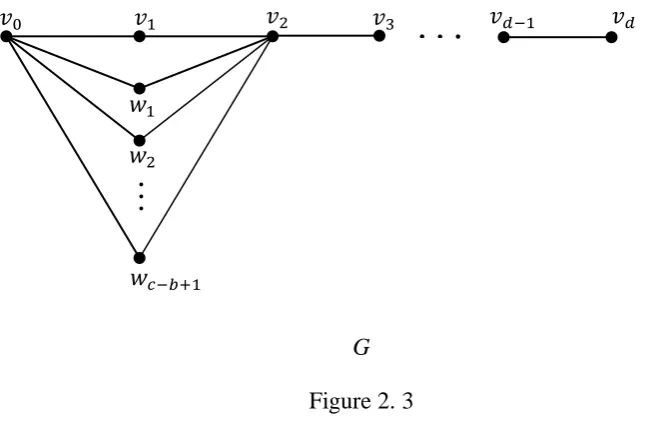
Proof. let 𝑃𝑑: 𝑣0, 𝑣1, 𝑣2, . . . , 𝑣𝑑 be a path of length 𝑑.Let 𝐺 be a graph obtained from 𝑃𝑑 by
adding 𝑝 − 𝑑 new vertices 𝑢1, 𝑢2, 𝑢3, . . . , 𝑢𝑝−𝑑 to 𝑃𝑑 and join each 𝑢𝑖(1 ≤ 𝑖 ≤ 𝑝 − 𝑑) to 𝑣0 and
𝑣3 there by producing the graph 𝐺 of Figure 2.3 such that the diameter of 𝐺 is 𝑑 andthe order
of𝐺is𝑝. Let 𝑆 = {𝑣2, 𝑣3, . . . , 𝑣𝑑} be the set of all end vertices and cut vertices of 𝐺. By Theorems
1.2and 1.3, every path induced geodetic set of 𝐺 contains 𝑆. It is clear that 𝑆 is not a path induced
geodetic set 𝐺.It is easily verified that𝑆 ∪ {𝑥} is not a path induced geodetic set 𝐺 and so 𝑝𝑖𝑔𝑛(𝐺) ≥
1 + 𝑑. Let 𝑆′ = 𝑆 ∪ {𝑥}.Then < 𝑆′ > is connected and 𝑆′ contains a path 𝑃𝑑 with 𝑉(𝑃𝑑) = 𝑆′.
Since each vertex of 𝐺 lies on a 𝑥 − 𝑦 geodesic with𝑥, 𝑦 ∈ 𝑆′, 𝑆′ is a path induced geodetic set 𝐺
IJSRR, 8(2) April. – June., 2019 Page 6
Theorem 2.13..Let 𝐺 be a path induced geodesic graph with at most one cut end edge. Let 𝐺′ be a
graph obtained from 𝐺 by adding an end edge 𝑥𝑦 at a vertex 𝑥 which is not a cut vertex of 𝐺. Then
𝑝𝑖𝑔𝑛(𝐺′) ≥ 𝑝𝑖𝑔𝑛(𝐺) + 1.
Proof. Consider a pig-set 𝑆 of 𝐺. Let 𝑃 be a path on 𝐺 such that 𝑉(𝑃) = 𝑆. Let 𝑢 ∈ 𝑆 and let
𝑃′: 𝑦, 𝑥, 𝑥
1, 𝑥2, … 𝑥𝑛 = 𝑢, be a path on 𝐺. Then 𝑆′ = 𝑆 ∪ {𝑦1𝑥, 𝑥1, 𝑥2, … 𝑥𝑛, 𝑦} is a connected geodetic
set of 𝐺. Let 𝑃′′ = 𝑃 ∪ 𝑃′. Since 𝑉(𝑃′′) = 𝑆′, 𝑆′is a path induced geodetic set of 𝐺′ and so
𝑝𝑖𝑔𝑛(𝐺′) ≥ 𝑝𝑖𝑔𝑛(𝐺) + 1. ∎
Theorem 2.14. Let 𝐺 be a path induced geodesic graph with at most one end edge. Let 𝐺′ be a
graph obtained from 𝐺 by adding an end edge 𝑥𝑦 at a vertex 𝑥, which is not a cut vertex of 𝐺. Then
𝑝𝑖𝑔𝑛(𝐺′) = 𝑝𝑖𝑔𝑛(𝐺) + 1 if and only if 𝑥 is a vertex of some pig-set of 𝐺.
Proof. First, assume that there is a pig-set 𝑆 of 𝐺 such that 𝑥 ∈ 𝑆. Then there a path 𝑃 in <
𝑆 >such that 𝑉(𝑃) = 𝑆. Since 𝑦 is an end edge of 𝐺, 𝑥 is a cut vertex of 𝐺, by Theorems 1.2 and 1.3,
𝑥 and 𝑦 belong every path induced geodetic set of 𝐺′. Let 𝑆′ = 𝑆 ∪ {𝑦}. We show that 𝑆′ is a pig-set
of 𝐺′. Let 𝑃′ be a path in 𝐺′ such that 𝑉(𝑃′) = 𝑉(𝑃) ∪ {𝑦}. Therefore
𝑉(𝑃′) = 𝑆′. We show that 𝑆′ is a connected geodetic set of 𝐺. Let 𝑢 be a vertex of 𝐺′. If 𝑢 = 𝑥 or 𝑦,
then it is clear that 𝑢 lies on every 𝑥 − 𝑦 geodesic in 𝐺. Therefore 𝑢 ≠ 𝑥 and 𝑢 ≠ 𝑦. Then it
follows that 𝑢 is a vertex of 𝐺. Since 𝑆 is a pig-set of 𝐺, 𝑢 lies on a 𝑤 − 𝑧 geodesic in 𝐺 with
𝑤, 𝑧 ∈ 𝑆. If both 𝑤, 𝑧 ∈ 𝑆 ∪ {𝑦}, then 𝑢 also lies on a 𝑤 − 𝑧 geodesic in 𝐺′ with 𝑤, 𝑧 ∈ 𝑆′ . If 𝑢
lies on a 𝑤 − 𝑥 geodesic in 𝐺 with 𝑤 ∈ 𝑆 ∪ {𝑦}, then 𝑢 also lies on 𝑥 − 𝑤 geodesic in 𝐺′. Thus
𝑆′ is a geodetic set of 𝐺′. Since < 𝑆′ > is connected and 𝑉(𝑃′) = 𝑉(𝑃) ∪ {𝑦} = 𝑆′, 𝑆′ is a path
induced geodetic set of 𝐺′ and so that 𝑝𝑖𝑔𝑛(𝐺′) ≤ |𝑆′| = |𝑆 ∪ {𝑦}| = 𝑝𝑖𝑔𝑛(𝐺) + 1. Then from
G
Figure 2. 3
…
𝑤𝑐−𝑏+1
wc – b + 1
𝑤2 𝑤1 𝑣1
IJSRR, 8(2) April. – June., 2019 Page 7
Theorem 2.13 we have 𝑝𝑖𝑔𝑛(𝐺′) = 𝑝𝑖𝑔𝑛(𝐺) + 1. Conversely, suppose that 𝑝𝑖𝑔𝑛(𝐺′) =
𝑝𝑖𝑔𝑛(𝐺) + 1. Suppose that 𝑥 does not belong to any pig-set of 𝐺. Let 𝑆′ be an pig-set of 𝐺′. Since
𝑦 is an end vertex of 𝐺′ and 𝑥 is a cut vertex of 𝐺′ , by Theorems 1.2 and 1.3, 𝑥, 𝑦 ∈ 𝑆′. Let 𝑆 =
𝑆′ − {𝑦} Then 𝑆 ⊆ 𝑉 (𝐺) and 𝑝𝑖𝑔𝑛(𝐺′) = |𝑆′ | = |𝑆| + 1 = 𝑝𝑖𝑔𝑛(𝐺) + 1. Let 𝑢 be any vertex of
𝐺. Then 𝑢 is also a vertex of 𝐺′ and so 𝑢 lies on a geodesic 𝑃 in 𝐺′ joining a pair of vertices 𝑤, 𝑧 ∈
𝑆 ′. If 𝑤 ≠ 𝑢 and 𝑧 ≠ 𝑢, then 𝑤 ∈ 𝑆 and 𝑧 ∈ 𝑆 so that 𝑢lies on a geodesicjoining a pair of
vertices in 𝑆. Otherwise, let 𝑤 ≠ 𝑢 and 𝑧 = 𝑢. Then it follows that 𝑢 lies on a geodesic in 𝐺 joining
𝑤 and 𝑥 in 𝑆. Thus, 𝑆 is a geodetic set of 𝐺 and since |𝑆| = 𝑝𝑖𝑔𝑛(𝐺), it follows that 𝑆 is an pig-set
of 𝐺. Since 𝑥 ∈ 𝑆, this is contradiction to our assumption. This completes the proof.
∎
Corollary 2.15. Let 𝐺′ be a graph obtained from 𝐺 = 𝐾𝑝(𝑝 ≥ 2) or 𝐺 = 𝐶𝑝(𝑝 ≥ 4) or 𝐺 =
𝐾𝑚,𝑛(4 ≤ 𝑚 ≤ 𝑛) by adding an end edge 𝑥𝑦 at a vertex 𝑥. Then 𝑝𝑖𝑔𝑛(𝐺′) = 𝑝𝑖𝑔𝑛(𝐺) + 1.
Proof.This follows from Theorem 2.14. ∎
Corollary 2.16. Let 𝐺′ be a graph obtained from 𝐺 = 𝑃𝑝(𝑝 ≥ 2) by adding an end edge 𝑥𝑦 at an end
vertex 𝑥. Then 𝑝𝑖𝑔𝑛(𝐺′) = 𝑝𝑖𝑔𝑛(𝐺) + 1.
Proof.Since 𝐺′ is the path 𝑃𝑝+1(𝑝 ≥ 2), we have 𝑝𝑖𝑔𝑛(𝐺′) = 𝑝 + 1 = 𝑝𝑖𝑔𝑛(𝐺) + 1. ∎
Theorem 2.17. Let 𝐺 be a graph obtained from the cycle 𝐶𝑝−2 (𝑝 ≥ 5) by attaching two end edges
to two adjacent vertices of 𝐶𝑝−2 (𝑝 ≥ 5) . Then 𝑝𝑖𝑔𝑛(𝐺) = 𝑝.
Proof. Let 𝐶𝑝−2 be 𝑣1, 𝑣2, … , 𝑣𝑝−2.Without loss of generality, let 𝑥 and 𝑦 be attached with 𝑣1 and
𝑣2. Then 𝑃1: 𝑥, 𝑣1, 𝑣2, 𝑦 and 𝑃2: 𝑥, 𝑣1, 𝑣𝑝−2, … , 𝑣2, 𝑦 are the only paths in 𝐺. Let =
{𝑥, 𝑣1, … , 𝑣𝑝−2, 𝑣2, 𝑦} . Then𝑆 is a connected geodetic set of 𝐺. Since 𝑉(𝑃2) = 𝑆, 𝑆 is a path induced
geodetic set of 𝐺 so that 𝑝𝑖𝑔𝑛(𝐺) ≤ 𝑝.We prove that 𝑝𝑖𝑔𝑛(𝐺) = 𝑝. If 𝑝𝑖𝑔(𝐺) < 𝑝, then there
exists a path induced geodetic set 𝑆′ with |𝑆′| < 𝑝. Then it is easily verified that there is no path
𝑃′ with 𝑉(𝑃′) ≠ 𝑆′. Hence 𝑝𝑖𝑔𝑛(𝐺) = 𝑝. ∎
REFERENCES
1. F. Buckley and F. Harary, Distance in Graphs, Addition-Wesley, Redwood City, CA, 1990.
2. G. Chartrand and P. Zhang, The forcing geodeticnumber of a graph, Discuss. Math. Graph
Theory 1999 ; 19 : 45–58.
3. G. Chartrand, F. Harary and P. Zhang, On the geodeticnumber of a graph, Networks
2002 ; 39 : 1–6.
4. F. Harary, E. Loukakis and C. Tsouros, The geodeticnumber of a graph, Math. Comput.
IJSRR, 8(2) April. – June., 2019 Page 8
5. D. A. Mojdeh and N. J. Rad, Connected Geodomination in Graphs, Journal of Discrete
Mathematical Sciences & Cryptography 2006; 1(9) : 177–186.
6. RuthlynN.Villarante and Imelda S. Aniversario, The path induced geodetic numbers of
some graphs, JUSPS-A 2017 ; 29(5) : 196-204.
7. A. P. Santhakumaran, P. Titus and J. John, The upper connected Geodetic number and
Forcing connected geodetic Number of a Graph, Discrete Applied Mathematics 2009 ;
157(7) : 1571-1580.
8. A. P. Santhakumaran, P. Titus and J. John, On the connected geodetic number of a graph,