255
Technology Impact On E- Banking Towards
Customer Satisfaction In Public & Private
Sectors Bank [With Special Reference To Vellore
District Of Tamil Nadu- India]
M. Shuaib Ahmed, Dr. S. Abdul Sajid
Abstract: Banking segments in India have been on the up of late due to high liquidity, changing demographic profiles, changing interest rates and increasing demand for the consumer. Brief scrutiny of the Indian banking industry would extract the reasons behind the current scenario governed by the Banking Regulation Act of India, 1949. The Indian banking industry can be broadly classified into two major categories: Non-scheduled banks and Scheduled banks. This research paper aims to study the impact of internet banking services on customer satisfaction at public and private sector banks. Questionnaires were designed by the researchers. The primary data have been collected by using a structured questionnaire from 525 selected respondents as random bases. Research Tools for Data Analysis, collected has been analyzed using SPSS. The statistical tools such as percentage, Chi-square and independent Sample Test (Z Test) have been used for data analysis. The study attempted to explain the various means of internet banking services which might lead to customer satisfaction. This paper showed that the banking service over the internet has a positive impact on customer satisfaction. This study recommended that both sector banks should focus on spreading the knowledge of electronic banking services to the customers. This study highlighted that electronic banking services highly recommend and should spread the technical awareness among current and potential customers, and develop suitable groundwork for electronic banking services for customer satisfaction.
Index Terms: Internet Banking, Online banking, Customer Satisfaction, Remote Banking, IT
—————————— ——————————
1.
INTRODUCTION
The awe-inspiring styles of innovation in technology and unbreakable line composite of it with information technology made a prototype swing in the banking industry. Technology itself fashioned its world in the sphere of anthropological beings. Advent of Internet banking happened in early 1990. This commencement of Internet Banking created an extraordinary system in Internet banking. It is a kind of systems that enable financial institution customers, individuals or businesses, to access accounts, transact business, or obtain information on financial products and services through the Internet. The Government of India enacted the IT Act, 2000 (Information Technology Act). This Act came into effect from the 17 of October 2000. The persistence of this Act, in framework of banking, was to provide legal recognition to electronic transactions and other means of Electronic Commerce. The working group set by Reserve Bank of India, has been working as a supervisory body on the different aspect of the Internet banking. Bank was discoverer the use Internet banking for some of its services. In Indian banks use the Internet banking system to provide Internet banking solution. In the current scenario,
Indian customers are moving towards Internet banking, slowly but steadily have started providing Internet banking services. There is a clear need to develop a better understanding of how customers appraise these services and helping hand up satisfaction. Customer satisfaction is one of the main aspects determining the success or failure of any internet banking services. Customers' satisfaction has tended to lag behind because practitioners have focused mainly on issues of usability and measurement of use. Therefore, customer perception and preferences on internet banking have a significant impact on bank's success. As India is taking massive leaps towards globalization E-banking is the sector to be studied with great interest. The question of how attitude towards elements of existing banking service might influence the consumer's decision to use internet banking has not been investigated. As customers get more and more educated, getting insight about modern banking via internet banking has go forward as primary area of concern for all leading and upcoming banks in India. This study provides an insight analysis on this aspect. The research will assist bank direction to ascertain a better understanding of customers' satisfaction towards internet banking offered by the both Banks.
2 REVIEW OF LITERATURE
Adam Ahmed Musa Hamid et al., (2018) in this research paper, showed that the banking service over the internet has a positive impact on customer satisfaction and also focus on spreading the knowledge of the internet banking services to the customers. Inder Pal Singh, Dr. Payal Bassi (2017) in this research, to satisfy the need of the customers, both banks provide various internet services to their customers. It is concluded that for proper use of internet services a bank should provide an attractive and easy to use interface. Proper security concerns should be provided by the banks to the customers so that customers can easily use these internet services provided by the banks. Alhaliq, H. A., & AlMuhirat, A. A. (2016) examined the extent of customer satisfaction with ——————————————
M. Shuaib Ahmed, Research Scholar, Department of Commerce, C Abdul Hakeem College, Thiruvalluvar University, India. PH. +91 9940501575, E-mail: mshuaibahmedmba@@mail.com
electronic banking services in the banking sector and found that banks have succeeded in attaining significant customer satisfaction due to the better quality of the services available and better performance and facilitating electronic transactions. Ling, G. et al. (2015) emphasized the importance of application of Internet banking as a viable tool to enhance and create customer satisfaction. According to this study the main problem the large number of customers are not willing to use the Internet banking services offered. In this study the authors decided five factors which can influence customer satisfaction toward Internet banking include convenience and speed, security and privacy, web design and content, and service quality. Navaratnaseelan, J and Elangkumaran, P. (2014) stated that there is a positive relationship between service quality and customer satisfaction through the SERVQUAL model in the commercial bank. The researchers examined the quality dimensions such as tangibility, reliability, assurance, responsiveness and empathy and found that there is a strong positive relationship between service quality and customer satisfaction. Krishnamoorthy, V. and R. Srinivasan (2013) authors determines that it is so difficult for the bank to keep in mind their existing customer. Bank need to work out on some important issues for their long lasting survival, like make some new innovation in the product as per the needs and wants of the customer or they need to develop strong trust and relationship surrounded by the existing customer.
2.1 RESEARCH PROBLEM
Customers are spirit for any commercial. In banking industry is highly service oriented business. When there is service concern, it always deals with the perceptual decision taking of the customer. Here in this paper tried out to figure out the reason for the perception of the people residing in Vellore District, for choosing the banking service on the basis of cost, convenience, facility and general factors like modernization of the bank, swiftness for attending customer.
2.3 RESEARCH GAP
It has been observed that none of the reviewed study addresses the issues such as analyzing services related to E- banking, technological developments in scheduled commercial banks, different aspects affecting the customer satisfaction towards internet banks problems and forecasts of E-bank, responses of the customers on internet banking in Vellore district region. The study tries to find the research gap and fill it with the analysis of the research.
2.4 RESEARCH OBJECTIVE
To study the various internet banking facilities offered by the selected public and private banks to its customers.
To know the purpose of using internet banking services. To identify the level of satisfaction of customers
outwards their usage of internet banking and.,
To provide suggestions to improve satisfaction level of the customers.
2.5 RESEARCH LIMITATION
The sector is very vast and it was not possible to cover every nook and corner of this sector. Some of the limitations of the study are:
Study is conducted only in some selected Branches of Vellore Region Bank.
Authenticity of the collected data through Questionnaires.
No possible way the researcher can ensure that the always understood the true context of each question.
2.6 RESEARCH SCOPE
This study will be helpful to point out the important areas where banker lacks in providing internet banking. The actions which can increase the satisfaction level of customers on internet banking and motivate them to use internet banking efficiently. This study brings the attentions of management towards the importance of training and development of customers of internet banking.
3 RESEARCH METHODOLOGY
Research design used for the present study is descriptive in nature. Data required for this study is mainly collected through from primary data. Study is based on the random sampling of 525 bank customers both from private sector banks and public sector banks customers located in Vellore District and well-structured questionnaire has been used to collect data with likert 5 scale aiming to measure the customer satisfaction towards internet banking. The collected data has been applied simple percentage, CHI-SQUARE and Independent Samples Test (Z test) research tools used in SPSS 16.0.
3.1 Statistical Tools for Data Analysis
The data collected has been analyzed using Statistical Packages for the Social Sciences (SPSS) and statistical tools such as percentage, Chi-Square and Independent Samples Test (Z test) have been used for data analysis.
3.2 Percentage Analysis
Percentage analysis is the method to represent raw streams of data as a percentage (a part in 100 - percent) for better understanding of collected data.
Number of respondent
Percentage analysis = ……….. X 100 Total number of respondents
TABLE 1
RESPONDENTS OF DEMOGRAPHIC PROFILE
Demographi c Profile
Classification s
Frequenc y
Per cen t
Cumulativ e Per cent
Gender
Male
326 62.
1
62.1
Female
199 37.
9
100.0
Total 525 100
Age
18-22 52 9.9 9.9 23-26
147 28.
0
37.9
27-32
221 42.
1 80
33-36
105 20.
0
100.0
37-42 - -
Above 43 - -
Total 525 100
Education Qualification
Illiterate - - High school 199 37.
9
37.9
Intermediate
115 21.
9
257 Degree
84 16.
0
75.8
Master’s
Degree 127
24. 2
100.0
Others (please specify)
- -
Total 525 100
Marital Status
Married 263
50. 1
50.1
Single
262 49.
9
100.0
Widow - -
Divorced - -
Total 525 100
Profession
Government Employee 105
20. 0
20.0
Private
Employee 273
52. 0
72.0
Self-Employee 63
12. 0
84.0
Student 21 4.0 88.0
House Wife 63 12. 0
100.0
Total 525 100
Income
10,001-15,000 21 4.0
4.0
15,001
-20,000 85
16. 2
20.2
20,001 -25,000 178
33. 9
54.1
25,001-
30,000 136
25. 9
80.0
30,001
-35,000 42 8.0
88.0
35,001
-40,000 63
12. 0
100.0
Above
40,000 - -
Total 525 100
IBS Usage
Less than 1
Year 178
33. 9
33.9
1 -5 Years 305 58. 1
92.0
6 – 10 Years 42 8.0 100.0 Above10
Years - -
Total 525 100
Bank
Public Bank
312 59.
4
59.4
Private Bank 213 40. 6
100.0
Total 525 100
3.3INDEPENDENT SAMPLES TEST (Z TEST)
The Z-test compares sample and population means to define if there is a significant difference .It requires a simple random sample from a population with a Normal distribution and where the mean is known.
1. Hypothesis 0 (Ho): There is no significant different between Gender and Customer Support.
2. Hypothesis 1 (H1): There is significant different between Gender and Customer Support.
TABLE 3
RELATIONSHIP BETWEEN GENDER AND CUSTOMER SUPPORT
Z Test Gender N Mean Std.
Deviation T Value P Value
Customer Support
Male
326 21.68 1.259
7.0746 .000 Female 199 22.58 1.501
Sources: Primary Data 1* Significance Level
Data Interpretation
From the above Data analysis results shown, there is a significant different between Gender and Customer. Since P-value .000 the null hypothesis is rejected and alternate hypothesis accepted at 1 % Level of Significant (Table 3).
3.4 CHI-SQUARE
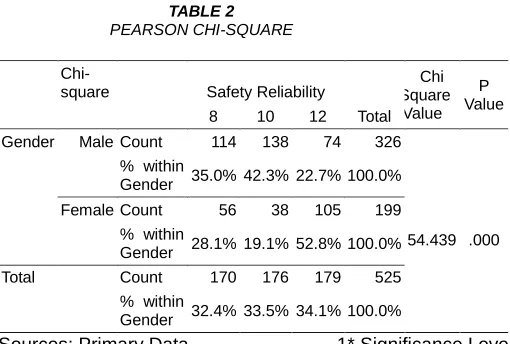
Chi-square is a statistical test usually used to anticipate between Gender and Safety Reliability, observed data with data we would expect to obtain according to a specific hypothesis. This can be calculated using the formula
1. Hypothesis 0 (Ho): There is no association between Gender and Safety Reliability.
2. Hypothesis 1 (H1): There is an association between Gender and Safety Reliability.
Sources: Primary Data 1* Significance Level TABLE 2
PEARSON CHI-SQUARE
Chi-square Safety Reliability Total
Chi Square
Value P Value 8 10 12
Gender Male Count 114 138 74 326
54.439 .000 % within
Gender 35.0% 42.3% 22.7% 100.0% Female Count 56 38 105 199
% within
Gender 28.1% 19.1% 52.8% 100.0% Total Count 170 176 179 525
% within
Gender 32.4% 33.5% 34.1% 100.0%
Data Interpretation
On the basis of above analysis, there is a relationship between Gender and Safety Reliability. Since P-value .000 the null hypothesis is rejected and alternate hypothesis accepted at 1 % Level of Significant (Table 2).
4
R
ESEARCHF
INDINGSResults of this study provide banking assessment makers’ awareness into the insight about E- banking among Indian customers and that is the most important practical contribution of this study. Internet banking is gaining popularity in India and finding of this study allow banks to fine tune their internet banking product. Based on the findings of this study the following suggestions could be arrived:
while opening account. This can also be concluded that private sector respondents are more aware of the E-banking facilities as compared to public sector banks. Consumers are using various services provided by their
respective banks and the highest used services are the ATM & online transaction across various income and age groups of responders.
4.1RESEARCH SUGGESTION
The following suggestions are offered based on the study as well as some general suggestions observed while doing the study.
Electronic channel mostly used by male and people living in Vellore District. It is suggested that the bankers should take measures for creating awareness and educate all kinds of people about electronic channels.
The young generations are more aware about E-Banking system then older generation. The older generation having less confident on E-Banking. Due to its complexity and operating methodology. It is suggested that the bankers should take measures for developing confidence about E-Banking operations among older generations. The high income groups of customers are having more
awareness about E-Banking services than other income group customers. Therefore, the bankers should take necessary steps to create awareness to other income group of customers by way of conducting seminars, exhibition, customer meet, advertisements etc.,
Majority remarkable of internet banking services are available. The banking sectors should take efforts to make popular the other internet banking services such as account opening, cheque book request, statement of D-mat accounts, online bill payments, real time gross settlement, national electronic fund transfer, downloaded personal banking transactions etc.
User ID and password is one of the major struggle faced by the customers because it requires to using alphanumeric combinations in the user ID. It is found very difficult for the customers to use the alphanumeric letter, number and symbol used in their password. Therefore, the banks should allow to adopting any one format whether number or letters with proper security measures.
5
RESEARCH
CONCLUSION
This research paper aims make an original contribution to the existing knowledge by investigating the impact of customer satisfaction on internet banking in Vellore District, followed by Core Services, Problem Resolution, Cost Saved, Convenience and Risk and Privacy Concerns were the major factors that strongly affect the overall satisfaction of online consumers. On the other hand, Feature Availability and Consumer Extension were found to moderately affect the overall satisfaction of customers using Online or E- banking services. In order to promote customer satisfaction, it is predictable for banks give due emphasis to all the above-mentioned factors. In closing, the researcher would like to add that a proactive and creative approach by banks, for example, providing consumer education re: Internet banking and friendly customer service will help improve the consumer confidence, and eventually overall customer satisfaction.
6
FURTHER
RESEARCH
• Further research should be approved out with amplified
sample size to oversimplify the results of the study.
• Access to list of customers using e-banking in Vellore District, can enable to use prospect sampling method to ensure that review sample is better evocative of the responders.
• Additional provision excellence influences which disturb consumer gratification can also be supplementary for further research.
• Bank specific research i.e. private and public or local and foreign banks may generate more clear results regarding customer satisfaction in e-banking sector in Vellore District.
ACKNOWLEDGMENTS
The authors kindly acknowledged thankful to our faculty members who provided insights and expertise that greatly assisted the writing of the research paper. We would also like to spread out our greatest gratitude to Prof Dr.S.Shamsuddin and Prof Dr.T.Afsar Basha for genuine and continuous support. Family and Public for their support and cooperation in providing related information for these research articles.
REFERENCES
[1] Dr. M. Vasan., Customers' Satisfaction Towards Internet Banking Of ICICI Bank Limited - A Study In Erode City, GBAMS- June 2014-December 2015.
[2] Inder Pal Singh S/O Roop Singh*, Dr. Payal Bassi., A Review On Customer Satisfaction With Internet Banking In Public And Private Bank, [Singh* Et Al., 6(1): January, 2017].
[3] Mr. Lakshmi Narayana.K, Mr. Sri Hari.V, Dr.P. Paramashivaiah., A Study on Customer Satisfaction towards Online Banking services with reference to Bangalore city, Vol- 2 No. 2 Apr2013, ISSN 2320 – 2939 (Print) ISSN 2320-2793 (online).
[4] Thanh Nguyen, Mohini Singh., Impact of Internet Banking on Customer Satisfaction and Loyalty: A Conceptual Model.
[5] Dr. Geeta Sharma, Mr. Surendra Malviya., International Journal of Business and Management Invention ISSN (Online): 2319 – 8028, ISSN (Print): 2319 – 801X, Volume 3 Issue 3-March. 2014.
[6] M.E. Doddaraju., A Study on Customer Satisfaction towards Public and Private Sector Banking Services [with Special Reference to Anantapur District of Andra Pradesh], ISSN 2248-9878 Volume 3, Number 6 (2013), pp. 651-658.
[7] M. Raj Mohan,Dr. S. Franklin John., Customers Satisfaction on Internet Banking in Public and Private Banks in Tirupur District, IJEMR – January 2016 - Vol 6 Issue 01 - Online - ISSN 2249–2585 Print - ISSN 2249-8672.
[8] Rangsan.Nochai and Titida. Nochai., The Impact of Internet Banking Service on Customer Satisfaction in Thailand: A Case Study in Bangkok, International Journal of Humanities and Management Sciences (IJHMS) Volume 1, Issue 1 (2013) ISSN 2320–4044 (Online). [9] Sadaf Firdous, Rahela Farooqi., Impact Of Internet
Banking Service Quality On Customer Satisfaction, Journal of Internet Banking and Commerce, April 2017, vol. 22, no. 1
259 Conference on Technology innovation and industrial
Management, 29-31 May, Phuket,Thailand.
[11] Adam Ahmed Musa Hamid, Nabil Mohamed Abdo Alabsy , Mohanad Abbas Mukhtar., The Impact of Electronic Banking Services on Customer Satisfaction in the Sudanese Banking Sector, International Business Research; Vol. 11, No. 6; 2018 ISSN 1913-9004 E-ISSN 1913-9012.
[12] Aravindan, P. and Punniyamoorthy, (2000), Service Quality Model to Measure Customer Satisfaction, Delivering Service Quality, Mc Millan India Ltd.
[13] Aruna Dhade and Manish Mittal (2008), Preferences, Satisfaction Level and Chances of Shifting: A Study of the Customers of Public Sector and New Private Sector Banks', ICFAI University Journal of Bank Management, Vol. 7(2), pp. 62-74.
[14] Bala Shanmugam, Director, Banking and Finance Research Unit, Monasha University, Vol.8 (1), 2003. [15] Bijith Marakarkandy, Ashish Daptardar (2011) Evaluation
of Internet Banking Sites from the Dimensions of Functionality, Vol. X (1), February2011, pp.60-70.
[16] Carolin Wilson, Competing for Your Bank's Customers
community Banker, Washington, Vol.9 (12),
December2000, pp.16-21.
[17] Cooper R G (1997), Examining some Myths about New Product winners, The Human side of Managing technological innovation, pp.550-560, Oxford.
[18] Daniel E (1999), Provision of Electronic Banking in the UK and Republic of Ireland, International Journals of Bank Marketing, Vol.17, No.2, pp.72-82.
[19] Chang.W and Paytnter.J (2002) An Evaluation of Internet Banking in New Zealand, proceedings of the 35’Th annual Hawaii, International Conferences available at http:// ieeexplore.ieee.org/xpl/tech form.jsp.
[20] L.Biff Motley, Bank Marketing, Washington, Customer Satisfaction Vs Customer Service, Vol.32 (1), January 2000, pp.60-61.
[21] Kaleem and Ahmad.S (2008), Bankers Perception of Electronic Banking in Pakistan, Journals of International Banking and Commerce, Vol.13 (1).
[22] Agarwal, Jyoti (2012). International Journal of Computing and Business Research (IJCBR) ISSN (Online): 2229-6166, Volume 3, Issue 1, January.
[23] Chavan, Jayshree (2013). International Journal of Business and Management Invention ISSN (Online): 2319 – 8028, ISSN (Print): 2319 – 801X www.ijbmi.org Volume 2, Issue 1, January. PP.55-62 [3] Doddaraju M.E. (2013), Global Journal of Management and Business Studies. ISSN 2248- 9878 Volume 3, Number 3 pp.
287-294 © Research India Publications
http://www.ripublication.com/gjmbs.htm
[24] Jamal, A. and Naser, K. (2002), Customer satisfaction and retail banking: an assessment of some of the key antecedents of customer satisfaction in retail banking, International Journal of Bank Marketing, Vol. 20 No. 4, pp. 146-60.
[25] Keerthe P and Vijyalakshmi R (2009), A Comparative Study on the Perception Level of the Service Offered By Banks, Indian Journal of Marketing, Vol.39, No.8, P.40-41.
[26] Kumar, M., Kee, F.T. and Charles, V. (2010), Comparative evaluation of critical factors in delivering service quality of banks: an application of dominance
analysis in modified SERVQUAL model, International Journal of Quality & Reliability Management, Vol. 27 No. 3, pp. 351-77.
[27] Kumar Snehal. And Mistry H. July (2013), Measuring Customer Satisfaction In Banking Sector ( With Special Reference To Banks Of Surat City), Asia Pacific Journal of Marketing & Management Review ISSN 2319-2836
Vol.2 (7), Online available at
indianresearchjournals.com,Pg132-138.
[28] Ladhari, R. (2008), Alternative measure of service quality: a review, Journal of Managing Service Quality, Vol. 18 No. 1, pp. 65-86. [9] Mishra, A.A. (2009), A study on customer satisfaction in Indian retail banking, IUP Journal of Management Research, Vol. 8 No. 11, pp. 45-61. [29] Naeem, H. and Saif, I. (2009), Service quality and its
impact on customer satisfaction: Empirical evidence from the Pakistani banking sector, The International Business and Economics Research Journal, Vol. 8 No. 12, p. 99. [30] Ms. Pallavi Gupta, Dr. Chhaya Mangal Mishra, Dr. Tazyn
Rahman A Comparative Study On Customer Satisfaction In Indian Public Sector And Private Sector Banks (With Special Reference To Delhi And NCR Region) International Journal of Social Science & Interdisciplinary Research ISSN 2277 -3630 IJSSIR, Vol. 2 (8), August (2013) Online available at indianresearchjournals.com Pg.69 to76.
[31] Prabhakaran, S. and Satya, S. (2003), An insight into service attributes in banking sector, Journal of Services Research, Vol. 3 No. 1, pp. 157-69. [13] Sangwan, D.S. (2009), Human Resource Management in Banks, National Publishing House, New Delhi.