University of Windsor University of Windsor
Scholarship at UWindsor
Scholarship at UWindsor
Electronic Theses and Dissertations Theses, Dissertations, and Major Papers
1-1-2005
Translating SQL queries to EJB-QL queries.
Translating SQL queries to EJB-QL queries.
Yang Gao
University of Windsor
Follow this and additional works at: https://scholar.uwindsor.ca/etd
Recommended Citation Recommended Citation
Gao, Yang, "Translating SQL queries to EJB-QL queries." (2005). Electronic Theses and Dissertations. 6936.
https://scholar.uwindsor.ca/etd/6936
Translating SQL Queries to EJB-QL Queries
by
Yang Gao
A Thesis
Submitted to the Faculty of Graduate Studies and Research
through the School of Computer Science
in Partial Fulfillment of the Requirements for
the Degree of Master of Science at the
University of Windsor
Windsor, Ontario, Canada
2005
1*1
Library and Archives CanadaPublished Heritage Branch
395 W ellington Street Ottawa ON K1A 0N4 Canada
Bibliotheque et Archives Canada
Direction du
Patrimoine de I'edition
395, rue W ellington Ottawa ON K1A 0N4 Canada
Your file Votre reference ISBN: 0-494-09789-2 O ur file Notre reference ISBN: 0-494-09789-2
NOTICE:
The author has granted a non exclusive license allowing Library and Archives Canada to reproduce, publish, archive, preserve, conserve, communicate to the public by
telecommunication or on the Internet, loan, distribute and sell theses
worldwide, for commercial or non commercial purposes, in microform, paper, electronic and/or any other formats.
AVIS:
L'auteur a accorde une licence non exclusive permettant a la Bibliotheque et Archives Canada de reproduire, publier, archiver,
sauvegarder, conserver, transmettre au public par telecommunication ou par I'lnternet, preter, distribuer et vendre des theses partout dans le monde, a des fins commerciales ou autres, sur support microforme, papier, electronique et/ou autres formats.
The author retains copyright ownership and moral rights in this thesis. Neither the thesis nor substantial extracts from it may be printed or otherwise reproduced without the author's permission.
L'auteur conserve la propriete du droit d'auteur et des droits moraux qui protege cette these. Ni la these ni des extraits substantiels de celle-ci ne doivent etre imprimes ou autrement reproduits sans son autorisation.
In compliance with the Canadian Privacy Act some supporting forms may have been removed from this thesis.
While these forms may be included in the document page count,
Conformement a la loi canadienne sur la protection de la vie privee, quelques formulaires secondaires ont ete enleves de cette these.
1 0
^
3 0^
Abstract
In multi-tier applications it is common to have a relational database at the backend, a
presentation tier at the front, and an object tier in between. Presentation tier will
access the objects tier, which will in turn access the database. Obviously, there is a
need to build a mapping between the object and the relational models. In particular,
we need to study the translation techniques between object and relational queries.
Enterprise Java Beans (EJB) is a technique supporting this kind of object tier. In
addition to the translation from EJB Query Language (EJB-QL) to SQL, which is
needed to execute the EJB-QL, we also need to study the translation from SQL to
EJB-QL when generating the object layer from legacy database application.
This thesis proposes an algorithm to translate SQL queries to equivalent EJB-QL
queries. Since EJB-QL is an object query language, our work is based on translation
techniques between relational and object query languages, and extends the existing
works in the following aspects:
1) Existing works described the translation of a small subset o f SQL queries with
many restrictions. Our approach expands this subset to a larger one.
2) Our translation techniques are tailored to EJB-QL.
3) As far as we know, existing works are neither implemented nor tested. We applied
and tested our system with real data from an industry product.
Key words: schema mapping, CMP field, CMR field, relational query graph, object
Acknowledgements
I am very happy to take this opportunity to convey my thankfulness to all people who
helped me a lot during the whole process of my graduate study.
Firstly, I would like to thank my supervisor, Dr. Jianguo Lu, who gave me instructive
help and valuable advice. Without his patience and valuable guidance, it could be
impossible to complete this thesis fluently. Besides, he is a so nice person who can be
regarded as a sincere friend in study and life.
Secondly, I would like to thank my external reader Dr. Jianwen Yang, my internal reader
Dr. Alioune Ngom, Dr. Joan Morrissey and the committee Chair Dr. Arunita Jaekel, for
their time and instructive suggestions and comments.
Thirdly, I would like to thank all my friends and colleagues, who discussed with me on
such topic and provided useful suggestions and experience during the research.
Finally, I would like to give my special thanks to my parents, my husband, who gave me
Table of Contents
Abstract... iii
Acknowledgements... iv
List of Figures...viii
List of T ables...ix
Chapter 1 Introduction...1
1.1 M otivation... 1
1.1.1 Multi-tier Applications...1
1.1.2 System M igration... 1
1.1.3 Enterprise Java Beans (EJBs) Upgrade... 2
1.2 Enterprise JavaBens (EJB s)... 3
1.2.1 Entity B ean ... 3
1.2.2 Session B eans... 3
1.2.3 Message Driven B eans... 4
1.3 Thesis Overview... 4
Chapter 2 SQL vs. EJB-QL...5
2.1 EJB Query Language (EJB-QL)...5
2.2 SQL vs. E JB -Q L... 5
2.2.1 General Syntax... 5
2.2.2 Navigation vs. Jo in ...6
2.2.3 Return Types... 8
2.2.4 Query dom ain... 9
2.2.5 Directionality... 10
2.3 Subquery... 11
2.3.1 Limitations in EJB-QL 2 .0 ... 12
2.3.2 EJB-QL development...13
Chapter 3 Schema Mapping... 14
3.1 Introduction...14
3.2 O/R mapping in E J B ... 15
4.1 Related Work... 23
4.2 Our Approach... 26
4.3 Constructing a Relational Query Graph (RQG) from a relational query... 27
4.4 Object Query Graph (OQG)... 31
4.5 Translating RQG to O Q G ... 33
4.5.1 Translating the vertices in RV... 34
4.5.2 Translating the join edges in RE1... 35
4.5.3 Translating the edges in RE2...38
4.6 Generate EJB-QL query from OQG... 40
4.6.1 Obtaining the FROM clause...41
4.6.2 Obtaining the SELECT clause...41
4.6.3 Constructing WHERE clause...42
4.7 Translation Difficulties...54
4.7.1 The selection of starting vertex...54
4.7.2 Different types of nesting queries... 57
Chapter 5 System Implementation... 62
5.1 Overall Architecture...62
5.2 Assumptions...63
5.3 Features... 64
5.4 Additional tools needed... 64
5.5 User Interface... 65
Chapter 6 Experiment and Evaluation...67
6.1 Experimental System...67
6.2 Evaluation M ethod...68
6.3 Experiment 1 - BANKING database system ... 69
6.3.1 Testing procedure...69
6.3.2 Testing Result... 72
6.3.3 Result Analysis... 81
6.4.2 Testing Result... 84
6.4.3 Result Analysis... 85
Chapter 7 Conclusions and Future W orks...87
7.1 Conclusions...87
7.2 Future Works...89
7.2.1 Relational Schema and EJB M apping... 89
7.2.2 Translation upgrading with the changes of EJB specification... 89
7.2.3 Further integration of J2EE-compliant servers...90
Bibliography... 91
List o f Figures
Figure 1-1 3-tier scenario... 1
Figure 1-2 2-tier scenario...2
Figure 3-1 The E-R schema of the Banking System... 16
Figure 3-2 Partially translated object schema applied relation mapping rule...18
Figure 3-3 Partially translated object schema applied 1:1/1 :m relationship mapping rule 19 Figure 3-4 Final translated object schema applied all mapping rules... 21
Figure 4-1 The RQG of Example 4.9...31
Figure 4-2 The OQG fo r... 33
Figure 4-3 The intermediate graph after step 1 for Example 4.3...35
Figure 4-4 The process o f translation of join edges in R E 1 ... 36
Figure 4-5 The translated Object Query Graph of Example 4.3...40
Figure 4-6 Traversing diagram for eliminating implicit join edges... 43
Figure 4-7 The Object Query Graph eliminated implicit join edges of Example 4.3...49
Figure 5-1 The overall architecture of SQL2EJBQL Translation System... 63
Figure 5-2 The GUI of SQL2EJBQL Translation system ... 66
Figure 6-1 The diagram for testing procedure... 69
List o f Tables
Table 2-1 The relational schema of the Banking System ...7
Table 2-2 The object schema (abstract schema) of the banking system exam ple...8
Table 2-3 The development of EJB-QL from 2.0 to 3.0... 13
Table 4-1 The comparison of my thesis and the related approaches...26
Table 4-2 The possible translations of sub-select clause of Example 4.3... 42
Table 4-3 The table storing starting vertex, IDV and path for Example 4 .3 ...47
Table 4-4 The table storing all vertices, corresponding IDVs and paths for Example 4.3...49
Table 6-1 Mappings between tables and entity beans...71
Table 6-2 Testing result analysis...82
Chapter 1
Introduction
1.1 Motivation
1.1.1 Multi-tier Applications
Multi-tier applications have become the norm for building enterprise software today. A
multi-tier application usually has at least three tiers, i.e., presentation tier, object tier and
database tier. The database works at the backend, the presentation tier is at the front,
and the object tier stands in between. Presentation tier will not access database directly.
Instead, it will access the objects, which will in turn access the database. Figure 1-1
illustrates the interactions between three tiers. In object tier, object-oriented queries are
used to retrieve data from backend systems, typically a relational database. Obviously,
building a mapping between the object and the relational models is needed. In
particular, we need to study the translation techniques between object and relational
queries.
Object/relational mapping
Object tier Database tier
(relational database) Presentation tier
Figure 1-1 3-tier scenario
1.1.2 System Migration
applications to 3-tier ones becomes more and more important. As shown in Figure 1-2,
a 2-tier model intermingles presentation logic and business logic in one tier, and uses
SQL queries to retrieve data from relational database directly. Consequently, the
translation from SQL queries to object-oriented queries plays an important role in the
migration from 2-tier to multi-tier model.
r .... ...n
Presentation Business
SQL queries ✓ ... \ Database tier
Logic Logic (relational database)
Figure 1-2 2-tier scenario
1.1.3 Enterprise Java Beans (EJBs) Upgrade
EJBs are server-side components that run in an Enterprise Java Bean (EJB) container
[SUN01]. EJB is a technique supporting the object tier in a multi-tier model [LLH+01].
EJB Query Language (EJB-QL), an object query language [C04][H04], resides in the
finder methods of EJBs to access the relational database. When an EJB-QL is executed,
it needs to be translated into SQL statement by the EJB container.
Furthermore, when EJB 1.0 was first developed in 1998, queries in those finder
methods are most likely SQL-based. EJB-QL was not used until the introduction of
EJB2.0 in 2001. Over the past several years many EJBs are developed and deployed,
When the EJB container is upgraded to EJB2.0, SQL queries have to be translated into
EJB-QL. So, in addition to the translation from EJB Query Language (EJB-QL) to
1.2 Enterprise JavaBens (EJBs)
There are three kinds of enterprise java beans: entity beans, session beans, and message
driven beans.
1.2.1 Entity Bean
Entity beans are persistent objects that represent data in the database such as a relational
database. For example, an instance of Customer entity bean could correspond to a row
in the customer table. So changes to an entity bean result in changes to the database.
The entity bean provides methods to select, add, modify, and delete underlying data.
The slection of certain rows of the table corresponds to the selection of a group of beans
satisfying certain condition. The selection of beans is accomplished by the finder
method in the entity bean.
The EJB specification defines the Entity beans in two different categories: Container
Managed Persistence (CMP) beans and Bean Managed Persistence (BMP) beans. CMP
bean relies on the Container Provider’s tools to generate methods that perform data
access on behalf of the entity bean instances. BMP bean is more complicated than CMP
because it relies on the bean developer to code the persistence logic into the bean class.
In order to do this the developer must know what type of database is being used and
how the bean’s fields map to that database. In this thesis, we only interested in CMP
entity beans.
1.2.2 Session Beans
Session beans are defined as an extension of the client application. They are the verbs
1.2.3 Message Driven Beans
Message driven beans are JMS message consumers that implement some business logic.
1.3 Thesis Overview
With EJB technology as the background, this thesis proposed an algorithm of
translation from SQL queries to equivalent EJB-QL queries. Since EJB-QL is an object
query language, our work is based on translation techniques between relational and
object query languages. The related work was explored, and compared with our
approach. A tool named “SQL2EJBQL Translator”, which supports an automated
translation, is designed to translate the SQL statements in finder methods in
CMP 1.0/1.1 entity beans to EJB-QL.
The rest of this thesis is organized as follows: In Chapter 2, the difference between
SQL and EJB-QL is described. Chapter 3 describes the schema mapping between the
relational and object schema, which is the first step of SQL to EJB-QL translation.
Chapter 4 first introduces the approaches of the previous related papers, then explains
algorithm proposed in this thesis. The overall architecture and design details of the
translation tool are described in Chapter 5. The experiments and evaluation results will
be given in chapter 6. Chapter 7 gives a conclusion of this thesis and discusses the
Chapter 2
SQL vs. EJB-QL
Before the discussion of query translation, we introduce EJB Query Language (EJB-
QL), as well as the difference between EJB-QL and SQL.
2.1 EJB Query Language (EJB-QL)
The syntax of EJB-QL is defined in the EJB 2.0 specification [SUN01]. It is an object
query which has path expressions allowing navigation over the relationships defined
between entity objects [AAG+01]. That is, a query can begin with one entity bean and,
from there, navigate to the related beans. For example, the query can start with an
Order bean and then navigate to the Order's line items. It can also navigate to the
products referenced by the individual line items, and so forth.
At runtime, EJB-QL usually executes in the native language of the underlying data
store. For example, a container that uses a relational database for persistence might
translate EJB-QL statements into SQL statements, while an object-database container
might translate the same EJB-QL statements into an object query language.
2.2 SQL vs. EJB-QL
2.2.1 General Syntax
The general syntax of the SQL and EJB-QL are very complicated. Here we give a brief
<select-statement> ::= [ALL|DISTINCT] <select-clause> <from-clause>
[<where-clause>}
Similar to SQL, an EJB-QL query contains a SELECT clause, a FROM clause, and an
optional WHERE clause. Here is a part of the BNF syntax of EJB-QL:
EJ B -QL::= [ALL|DISTINCT] <select_clause> <from_clause>
[ <where_clause> ]
We focus on the subquery led by EXISTS, IN, and comparison predicates in where clause.
We do not support the translation of groupby, order by, and having clauses.
2.2.2 Navigation vs. Join
EJB-QL allows entity objects and entity relationships to be easily navigated by path
expressions. A path expression is denoted by an identification variable followed by the
navigation operator ( .) and a CMP field or CMR field. The type of the path expression
is the type of the CMP field or CMR field to which the expression navigates.
This navigation in a path expression is composed using “inner join” semantics. This is
the primary difference between EJB-QL and SQL. EJB-QL navigates to related beans,
whereas SQL joins tables. In EJB-QL, when your return result is a variable that
traverse a relationship by the navigation operator (t. theAccount), behind the
scenes, a SQL JOIN condition might occur.
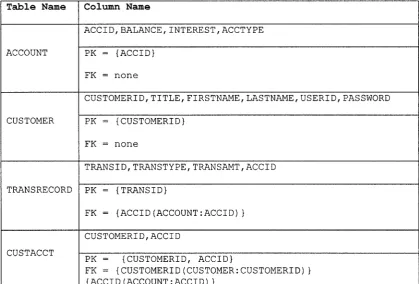
For example, the following SQL query bases on a banking system database schema
illustrated in Table 2-1:
SELECT t.*
FROM TRANSRECORD T, ACCOUNT a
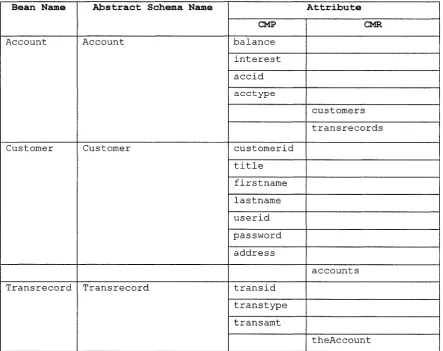
The equivalent EJB-QL which is against the corresponding object schema (abstract
schema in EJB) (Table 2-21) is:
SELECT object (t) FROM Transrecord t
WHERE t .the A c c o u n t .acctype = 'checking'
Table Name Column Name
ACCOUNT
ACCID,BALANCE,INTEREST,ACCTYPE
PK = {ACCID}
FK = none
CUSTOMER
CUSTOMERID,TITLE,FIRSTNAME,LASTNAME,USERID,PASSWORD
PK = {CUSTOMERID}
FK = none
TRANSRECORD
TRANSID,TRANSTYPE,TRANSAMT,ACCID
PK = {TRANSID}
FK = {ACCID(ACCOUNT:ACCID)}
CUSTACCT
CUSTOMERID,ACCID
PK = {CUSTOMERID, ACCID}
FK = {CUSTOMERID(CUSTOMER:CUSTOMERID)} {ACCID(ACCOUNT:ACCID)}
Table 2-1 The relational schema o f the Banking System
The relationships between the tables are as follows:
ACCOUNT (many)< - > (many) CUSTOMER
ACCOUNT (one) <-> (many) TRANSRECORD
Bean Name Abstract Schema Name Attribute
CMP CMR
Account Account balance
interest
accid
acctype
customers
transrecords
Customer Customer customerid
title
firstname
lastname
userid
password
address
accounts
Transrecord Transrecord transid
transtype
transamt
theAccount
Table 2-2 The object schema (abstract schema) o f the banking system example
2.2.3 Return Types
The SELECT statement of SQL allows one to retrieve records from one or more tables
in the database. The return type can be the columns of tables.
In EJB-QL, the query in a finder method must return an entity bean or a collection of
entity beans in which the finder method is defined. For example, a finder method for a
2.2.4 Query domain
The FROM clause of an EJB-QL query defines the domain o f the query by declaring
identification variables. An Identification variable designates an instance of an entity
bean, it ranges over the abstract schema type of an entity bean. The FROM clause can
contain multiple identification variable declarations separated by a comma (, ), all
identification variables must be declared in the FROM clause.
An identification variable always designates a reference to a single value. It is declared
in one of the two following ways:
■ A range variable is declared using the abstract schema name of an entity bean.
Range_variable_declaration ::=abstract_schema_name [AS]
identifier
■ A collection member identification variable is declared using a collection
valued path expression. The identification variable declarations are evaluated
from left to right in the FROM clause. A collection member identification
variable declaration can used the result of a preceding identification variable
declaration of the query string.
Collection_member_declaration ::= IN
(collection_valued_path_expression)[AS] identifier
For example, the following FROM clause contains two identification variable
declaration clauses. The identification variable declared in the first clause is used in the
second one. The range variable declaration C u s to m e r AS c designates the
identification variable c as a range variable whose type is the abstract schema type,
Because the clauses are evaluated from left to right, the identification variable a can
use the results of the navigation on c.
FROM Customer AS c, IN (c.accounts) a
So the domain of the query may be constrained by path expressions.
In the FROM clause of SQL, all tables appearing in WHERE clause must be declared
in FROM clause, while in EJB-QL it is different. Only the entity bean for which the
finder method is defined, which we call it “root” bean, the bean that has many to one
relationship with the root bean needs to be defined in FROM clause, or when query
needs to compare multiple values ranging over the same abstract schema type, multiple
range variable declarations may therefore be defined in FROM clause. Those beans,
which can be navigated from the “root” bean, are not necessarily declared in FROM
clause. For example, the following SQL query is based on the database schema in
Table 2-1,
SELECT OBJECT(t) FROM Transrecord t
WHERE t .the A c c o u n t .accttype = 'saving'
And EJB-QL query based on abstract schema shown in Table 2-2,
SELECT OBJECT(al)
FROM Account al, Account a2 WHERE al.balance > a2.balance
2.2.5 Directionality
The directionality of a relationship specifies the direction in which you can navigate a
relationship. Because foreign keys are used to join tables, relationships in a relational
implement a one-to-one relationship, and the code to join the two tables is virtually the
same. For example, suppose two tables O R D E R and S H I P M E N T hold a one-to-one
relationship. When the foreign key is implemented in the S H I P M E N T table, the SQL
code which joins two tables would be
SELECT * FROM ORDER,SHIPMENT
WHERE S H I P M E N T .ORDERID = O R D E R .ORDERID
Having the foreign key implemented in the O R D E R table, the SQL code would be
SELECT * FROM ORDER, SHIPMENT
WHERE SHIPMENT.SHIPMENTID = ORDER.SHIPMENTID
The directionality in entity beans may not correspond to the inherent directionality of
the database schema. An entity bean can provide for directionality even though the
database not do so easily, and vice versa [RAJ+01]. In EJB-QL, if the relationship
between two entity beans is unidirectional, the relationship traversal is restricted. For
example, if you declare that O r d e r has a one-to-one relationship with Shipment,
but you do not define the reverse one-to-one relationship that S h i p m e n t has with
Order, you can get S h i p m e n t from Order, but not O r d e r from shipment.
2.3 Subquery
EJB-QL 2.0 does not support subquery, but some application server vendors extend the
standard EJB-QL to support subqueries. For example, WebLogic Server supports the
subqueries as the operands of: the comparison operators ( [NOT] IN, [NOT] EXISTS)
and arithmetic operators (<, >, <=, >=, =, <> with ANY and ALL)[BEA04]. IBM
1. Subquery return type
A subquery should only specify a single element in the SELECT clause. The
return type can be one of a number of different types, such as:
- Single CMP field type subqueries
- Aggregate Functions
- an entity bean
2. Nesting predicates
- Comparison predicate
- IN predicate
- EXISTS predicate
2.3.1 Limitations in EJB-QL 2.0
Compared with SQL, EJB-QL has many limitations and hence not every SQL query
can be translated into EJB-QL. EJB-QL is a powerful new technology that promises to
improve portability of entity beans in CMP, but it covers just those aspects of SQL that
is standard anyway, without enabling one to utilize advanced features provided by
different databases where appropriate. Here are some restrictions in EJB-QL 2.0:
• Currently, container-managed persistence does not support inheritance. For this
reason, two entity beans of different types cannot be compared in EJB-QL.
• String and Boolean comparison is restricted to = and o in EJB-QL.
• EJB-QL does not support “outerjoin”.
• EJB-QL does not support any kind of subqueries.
EJB-QL does not support ORDER BY, GROUP BY and HAVING clauses.
2.3.2 EJB-QL development
The development of EJB specification started from version 1.0 and now is reaching
version 3.0. There are significant changes from 1.1 to 2.0. The EJB 2.0 specification
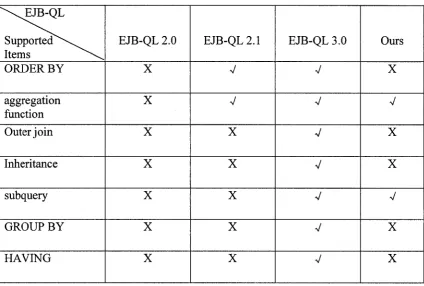
introduces EJB-QL. EJB2.1 [SUN03] adds the support of aggregation functions and
ORDER BY clause in EJB-QL. EJB3.0 [SUN05] adds the support for inheritance,
outerjoin, GROUP BY clause, HAVING clause and subqueries. Table 2-3 describes the
development of EJB-QL from 2.0 to 3.0, it also compares the EJB-QL which supported
by our translation system with different versions of EJB-QL specification.
\ E J B - Q L
S u p p o r t e a \ ^ Items
EJB-QL 2.0 EJB-QL 2.1 EJB-QL 3.0 Ours
ORDER BY X V V X
aggregation function
X V V V
Outerjoin X X V X
Inheritance X X V X
subquery X X V V
GROUP BY X X V X
HAVING X X V X
Chapter 3
Schema Mapping
SQL is based on a relational model, while EJB-QL is based on entity beans, i.e.,
objects. To translate SQL to EJB-QL, the first step is to construct a mapping between
relational and object models. This chapter describes the basics of the mapping and our
approach in constructing such a mapping.
3.1 Introduction
The mapping between the relational and the object models in EJB can be viewed as the
traditional object/relational mapping problem that has been extensively studied for a
long time. A variety of methods have been proposed [AAK97] [RSH96] [FV95]
[PTK95][CSG94][YL93][J97], many of them are in the area of database reverse
engineering. Unfortunately, there is no standard way to specify the actual O/R mapping
with CMP entity beans.
The EJB specification does not provide for a particular mapping method between an
object model and a relational database schema. Typically programmers define the
mapping in deployment descriptor, and EJB containers use the deployment descriptor
to map the entities and relationships to normalized database tables. The mapping
capability of the EJB container varies from implementation to implementation, which
An EJB container is just a specific persistence framework to leverage the power of the
Enterprise JavaBeans component model, with a mapping tool put on top of it. The
mapping tool generates information that maps the entity bean's container-managed
fields to a data source, such as a column in a relational database table. This mapping
information is stored in an XML file. Lots of sophisticated O/R mapping products are
available for integration with application servers, such as TopLink[P03][ORA03],
Cocobase [TH002][TH003], and BeanMaker [DB04], etc.. Most of these tools may
perform the O/R mapping either automatically from existing database or based on
simple specifications supplemented by the user through an easy-to-use GUI interface.
In WebSphere Application Developer, EJB object persistency mapping is aided with
tools to map tables to CMP EJBs, using the top-down, bottom-up, or meet-in-the-
middle methodology. For the bottom-up approach, tools are available to map existing
database tables to EJB entities. For top-down, smart guides are available for creating
EJBs and mapping the associated EJB entity object model to database tables. For meet-
in-the-middle schemes, tooling is available for mapping EJB fields to columns and for
composers (computing one CMP field value out of multiple columns), converters (type
conversion and simple computation on one column), etc.
3.2 O/R mapping in EJB
O/R mappings in EJB define how EJB objects and their attributes are to be represented
in the database. To simplify the procedure, here we assume that there is a one-to-one
correspondence between tables and entity beans, and the relationships between entity
demonstrate the general mapping rules which map the exampled relational schema to
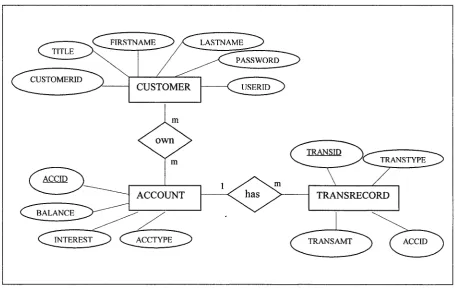
an object schema (abstract schema) of entity beans. Figure 3-1 is the ER-schema of
exampled database, which models a bank with many customers. A customer may have
multiple bank accounts and an account may be owned by multiple customers. A
transaction record is generated for each banking transaction, such as deposit,
withdrawal, or transfer of money between two accounts. A bank account may have
many transaction records.
LASTNAME TITLE
PASSWORD
CUSTOMERID
own
TRANSID
TRANSTYPE
m
ACCID
has
BALANCE
I N T E R E S T ^ ) ( ^ A C C T Y P E TRANSAMT ACCID
A C C O U N T C U S T O M E R
T R A N S R E C O R D
Figure 3-1 The E-R schema o f the Banking System
General Mapping Rules
In the following we present the general mapping rules of schema transformation,
namely, relation mapping rule and relationship mapping rule. We will demonstrate
described below in two parts. The first part describes the rule itself. The second part
illustrates the rule with the help of an example.
Rule 1: relation mapping rule
This rule is to map each database relation (table) which is not represent a relationship
to a single entity bean. Each non-foreign key column is mapped to a persistent field
(CMP field) of the entity bean created for this table. SQL data types are mapped onto
the corresponding Java types.
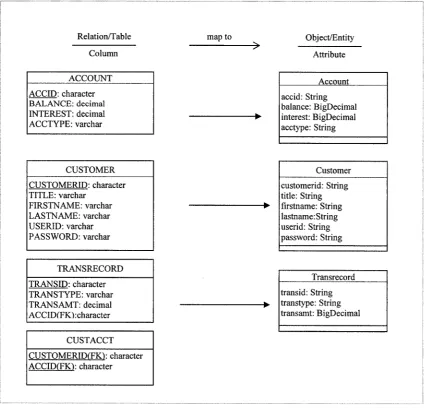
Example of banking system: Up to this step, the partially translated schema will be the
Relation/Table Column map to > Object/Entity Attribute _________ ACCOUNT
ACCID: character BALANCE: decimal INTEREST: decimal ACCTYPE: varchar
►
_________Account
accid: String balance: BigDecimal interest: BigDecimal acctype: String
CUSTOMER
CUSTOMERID: character TITLE: varchar
FIRSTNAME: varchar LASTNAME: varchar USERID: varchar PASSWORD: varchar
TRANSRECORD
TRANSID: character TRANSTYPE: varchar TRANSAMT: decimal ACCID (EKl: character
CUSTACCT
CU STOMERIDIFKl: character ACCIDfFKL character
Customer
customerid: String title: String firstname: String lastname: String userid: String password: String
Transrecord
transid: String transtype: String transamt: BigDecimal
Figure 3-2 Partially translated object schema applied relation mapping rule
Rule 2: one-to-one or one-to-many relationship mapping rule
In relational database, a one-to-one or one-to-many relationship between two tables
is represented by a foreign key dependency. It is mapped to object references
(CMR fields) in both entity beans. Each object reference in one bean refers to the
other one.
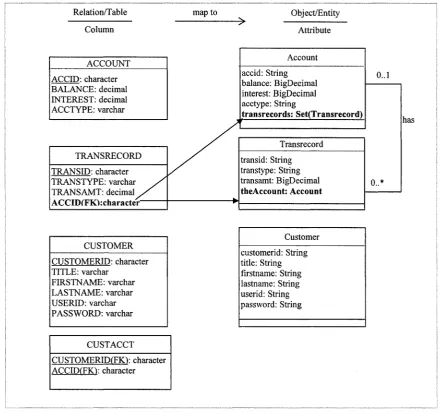
Example of banking system: There is a one-to-many relationship between two
foreign key A C C I D in table TRANSRECORD, and it is mapped to a pair of
references (CMR fields) - t r a n s r e c o r d s in class A c c o u n t and
t h e A c c o u n t in class Transrecord, t r a n s r e c o r d s is a set/multi-valued
CMR field which refers to the objects of class T r a n s r e c o r d ; t h e A c c o u n t is a
single-valued CMR field referring to the object of class Account. After applying
this rule, the partially translated object schema is:
Relation/Table map to Object/Entity
Column Attribute
Account
0..1 ACCOUNT
ACCID: character accid: String balance: BigDecimal
interest: BigDecimal acctype: String
transrecords: Set(Transrecord) BALANCE: decimal
INTEREST: decimal ACCTYPE: varchar
---^
Transrecord
0..*
TRANSRECORD transid: String
transtype: String transamt: BigDecimal theAccount: Account TRANSID: character
TRANSTYPE: varchar TRANSAMT: decimal
has
CUSTOMER
CUSTOMERID: character TITLE: varchar
FIRSTNAME: varchar LASTNAME: varchar USERID: varchar PASSWORD: varchar
Customer
customerid: String title: String firstname: String lastname: String userid: String password: String
CUSTACCT
CUSTOMERIDfFKl: character ACCID(FK'): character
Rule 3: many-to-many relationship mapping
In the relational database, the many-to-many relationship is implemented as an
association table. This table only contains two foreign keys, each pointing to the
table of one o f the related entities. Many-to-many relationship between two tables,
two set/multi-valued object references (CMR fields) are introduced in. If the
association table has its own attribute, this table should be mapped to an entity.
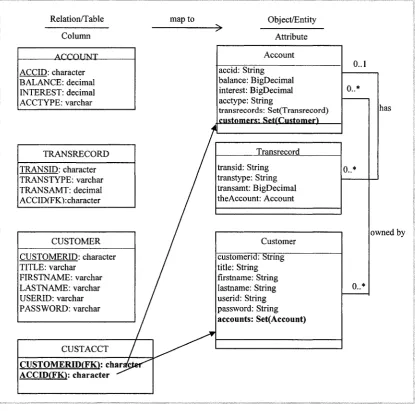
Example of banking system: There is a one-to-many relationship between two
tables A C C O U N T and CUSTOMER. The relationship is represented by the
association table CUSTACCT, and it is mapped to a pair of set/multi-valued
references (CMR fields) - a c c o u n t s in class C u s t o m e r and c u s t o m e r s in
class Account, a c c o u n t s is a CMR field which refers to the objects of class
Account, and c u s t o m e r s is a CMR field referring to the object of class
Relation/Table
Column
map to
ACCOUNT
ACCID: character BALANCE: decimal INTEREST: decimal ACCTYPE: varchar
TRANSRECORD
TRANSID: character TRANSTYPE: varchar TRANSAMT: decimal ACCIDfFKLcharacter
CUSTOMER
CUSTOMERID: character TITLE: varchar
FIRSTNAME: varchar LASTNAME: varchar USERID: varchar PASSWORD: varchar
CUSTACCT
CUSTOMERIDfFIQ: char: ACCIDtFKl: character
Object/Entity
Attribute
Account
accid: String balance: BigDecimal interest: BigDecimal acctype: String
tran sreco rd s: S e t(T ran sreco rd )
customers: SetiCustomert___
0..1
0..*
Transrecord
transid: String transtype: String transamt: BigDecimal theAccount: Account
0..*
owned by Customer
customerid: String title: String firstname: String
lastname: String 0..*
userid: String password: String accounts: Set(Account)
has
Figure 3-4 Final translated object schema applied all mapping rules
Finally, by applying the above schema mapping rules, this relational schema in Table
2-1 is transformed to the object schema (abstract schema) showed in Figure 3-4.
Inheritance is among the most powerful features of object-oriented technology.
Unfortunately, it is not supported by EJB specification. Some EJB containers provide
support for it as an extension to the specification. For example, in IBM’s WebSphere
and all derived entity beans are mapped to the same database table or multiple tables
Chapter 4
Query Translation
Since EJB-QL is nearly identical to object-oriented Query Language, the translation
from SQL to EJB-QL is similar to the translation to Object Query Language (OQL).
4.1 Related W ork
A few works have been done on the translation between SQL and object queries
languages [MYK93] [VA95] [MK98] [YZM+95] [MYK95] [CRD94] [RC95].
[MYK93][VA95][MK98][CRD94] address the translation from SQL queries to object
oriented queries. All of them use graphs to represent queries in the translation. One
difference among them is that the target languages are different with each other. In
[VA95], the SQL queries are translated to methods which are expressed in TM 2
[BAZ93][FKS94], a language for describing conceptual schemas of object-oriented
databases, which allows the specification of data structures in terms of Classes and
Sorts, and provides a computationally complete, functional data manipulation language
for method and constraint specification. [CRD94] uses XSQL which is an extension to
the SQL query. The target language used in [MYK93][MK98] is OQL, which is an
SQL-like query language with special features dealing with complex objects, values
and methods [P01].
The goal o f my thesis is to describe tactics for translating queries that contain nested
blocks, aggregate functions, grouping and quantifiers. We use EJB-QL as target
language to describe these tactics. However, the approach works just as well for other
object oriented query languages that enjoy some or all of these features.
Since the syntax o f EJB-QL is more similar to OQL, there are some strong similarities
between the translation algorithms of [MYK93][MK98] and the one proposed in this
thesis, but three important differences can be pointed out.
1) N esting queries: [MYK93] does not discuss the translation of nested queries, in the
assumption that there are unnesting algorithms [K82] that transform nested queries into
an equivalent collection of simple queries. But this approach is inadequate for our
purpose.
2) Semijoin a n d antijoins: as for the translation of subqueries, [MK98] proposed their
solutions to translate queries with nesting predicates IN, NOT IN, EXISTS, and NOT
EXISTS. However, their approach assumes these semijoins or antijoins are key based.
For example, for a subquery o f the form R.A (NOT) IN (SELECT S.B...), A and B
should have key-foreign key relationship. Our approach removes this assumption and
hence can translate more queries.
From the annotation they defined on the object schema and the definitions on the
semijoin and antijoins, we understand that both of these two kinds of joins can be
translated into object references between classes in the object schema. And these
references in the object schema are based on foreign keys and association tables of the
joins. This requires the subquery with (NOT) EXISTS predicate of a SQL statement to
be correlated, which means the inner query should contain a join predicate that
references the relation of the outer query, and this join is key based join. For example,
in the following two queries, A and B should be a pair of key and foreign key.
Example 4.1. Queries that should have key-foreign key relationship between A and B,
in [MK98]’s approach.
se l e c t R.* f r o m R w h e r e R . A IN (select S.B f r o m S)
Example 4.2. A query Q2 =
se l e c t R.* f r o m R w h e r e E X I S T S
(select S.* f r o m S w h e r e R . A = S.B)
In my thesis, the joins and antijoins are expanded to any attributes. Meanwhile, the
uncorrelated subqueries with (NOT) EXISTS predicates are also considered to be
translated.
3) A ggregate functions: Both [MYK93] and [VA95] didn’t mention the translation of
SQL query which includes aggregate functions. Although EJB-QL 2.0 does not support
aggregate functions, many application servers do support them. For example, IBM
WebSphere allows to use aggregation functions (AVG, COUNT, MAX, MIN and SUM)
in a subselect clause . In my thesis, the subquery with the form of R.A = (SELECT
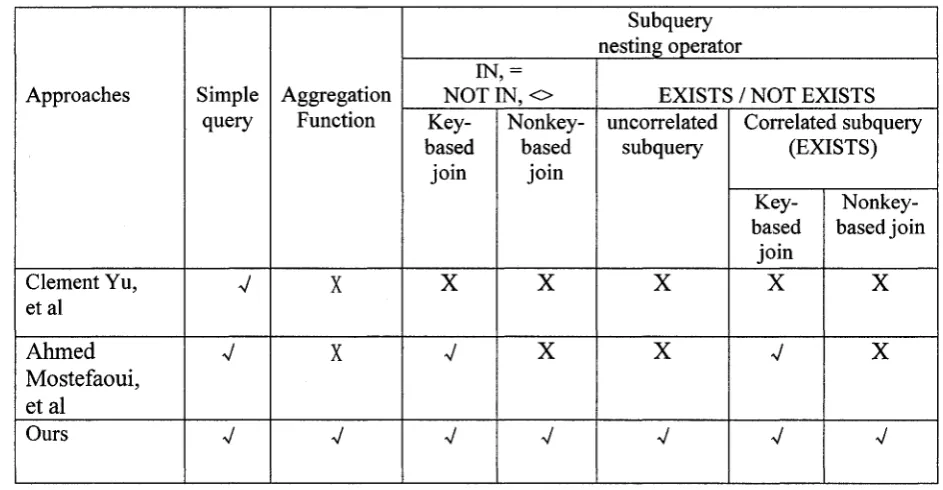
The following table makes the comparison between my thesis and the related
approaches.
Subquery nesting operator
Approaches Simple Aggregation
IN
NOT I N , o E X IS T S /N O T EXISTS query Function
Key-based join Nonkey-based join uncorrelated subquery Correlated subquery (EXISTS) Key-based join Nonkey- based join Clement Yu, et al
V X X X X X X
Ahmed Mostefaoui, et al
V X V X X V X
Ours V V V V V V V
Table 4-1 The comparison o f my thesis and the related approaches
4.2 Our Approach
Having compared with the related approaches of the query translation, this section
describes our approach to the translation of SQL queries to EJB-QL. We focus on the
translation of the subqueries with IN, EXISTS and comparison predicates.
As mentioned in 2.2.3, to satisfy the specification of EJB-QL defined in a finder method
[IBM03][SUN01], the value of the query result which is specified by the SELECT
clause, must be an entity bean in which the finder method is defined. So it is required
that the SELECT clause of the outmost SQL statement can not have aggregation
CUSTOMER.*) [GW99]. In the SELECT clause o f subqueries, aggregation function
can be used, but only single element can be specified. WHERE clause specifies the
qualification conditions of a query. We assume that the relational WHERE clause
contains qualification conditions in conjunctive form.
Our translation methodology consists of three steps. In the first step, a relational query
graph (RQG) of the given query is constructed. In the second step, the RQG is
transformed to its corresponding object query graph (OQG). Finally, the translated
EJB-QL is obtained from the transformed OQG.
The above three steps will be discussed in the following three sections. We will use the
example as below.
Example 4.3. Consider the following SQL query defined on the relational schema
Table 2-1. This query finds the largest account of a particular customer,
select ax.*
from ACCOUNT a lr CUSTOMER Ci, CUSTACCT cai where cx.CUSTOMERID=?
and ai.BALANCE =
(select MAX(a2.BALANCE)
from ACCOUNT a2, CUSTACCT ca2
where ca2. CUSTOMERID = cx. CUSTOMERID and a2.ACCID = ca2.ACCID)
and ca2.ACCID = ax.ACCID
and Ci. CUSTOMERID = cax.CUSTOMERID
4.3 Constructing a Relational Query Graph (RQG) from a relational query
directed edges RE2. In [MK98] a directed edge represents semijoin (with the
conditions IN and EXISTS) or a special kind of antijoins (with the conditions NOT IN
and NOT EXISTS), whereas in our definition, a directed edge represents a nesting
operator which leads to a subquery.
Definition 1 (RQG). Given relational query Q, we define its RQG as an annotated
graph: RQG(Q) = RQG(RV,RE1,RE2), where RV is a set of vertices, RE1 is a set of
undirected edges, and RE2 is a set of directed edges that are defined as follows:
- A vertex v in RV corresponds to either: 1) Relation Tuple Variable (RTV)4,
denoted by RTV(v), or 2) the predicate “EXISTS”. Vertex v is associated with a
number which indicates the depth, or the level, of the subquery or query where
the tuple variable is defined. The outermost query is of level 0.
Each vertex can be annotated with a set of selection operations on its
corresponding RTV.
- An undirected edge ej between vertices vj and V2 in RE1 represents a join
predicate. The annotation on ei is a join condition of the form < RTV(v;).a op
RTV(v2).b>, where a and b are the attributes of RTVs RTV(v/) and RTV(v^)
respectively, and op is a comparison operator such as ‘=’ and ‘> \ The vertices
reside in two ends can be either in the same or different query levels.
- A directed edge e2 from vertex v; to vertex V2 in RE2 indicates a nesting
operator such as “IN”, “NOT IN”, “EXISTS”, “NOT EXISTS”, or a
comparison operator (such as “> ’, ‘= ’, etc) with quantifier such as ANY and
4 Relation Tuple Variable is a variable that “ranges over” named relation. SQL does not require the explicit
ALL. Aggregation function can appear at the right side of operator. The
annotation ANNO on e2 has the following forms:
a) RTV(v/).a op [quantifier] * [ Agg] * (RTV(v2).b). Where op is (NOT) IN or
comparison operator “ >”, etc.); a and b are non-key attributes of
RTYs RTV(v7) and RTV(v2).
b) op [Agg] * (RTV (v2). b). Where op is EXISTS; v7 represents to EXISTS
predicate; b is non-key attribute of RTV(v2).
c) RTV(v/).a op [quantifier]RTV(v2).b. Where op is (NOT) IN, (NOT)
EXISTS5 or comparison operator (“=”); a and b are key attributes with
foreign key relationship of relation RTV(v7) and RTV(v2).
We obtain a RQG by parsing the SQL statement and recursively processing SELECT
clause, FROM clause and WHERE clause. Different from the method proposed in 0,
we obtain the RQG through not only WHERE clause, but also SELECT and FROM
clause. This is because that rich information for subquery is hidden in SELECT clause
and the depth of query should be associated with vertices of RQG during processing
FROM clause. A set o f vertices associated with a query depth are created when
processing FROM clause. When dealing with WHERE and SELECT clause, a set of
edges will be created.
Suppose the input SQL statement is the query in Example 4.3:
s e l e c t a x.*
from ACCOUNT a x, CUSTOMER c u CUSTACCT c a x
w here c x.CUSTOMERID=?
(select MAX(a2. BALANCE)
from ACCOUNT a2, CUSTACCT ca2
where ca2. CUSTOMERID = C i.CUSTOMERID and a2.ACCID = ca2.ACCID)
and cax.ACCID = ax.ACCID
and C i . CUSTOMERID = cax.CUSTOMERID
We start with FROM clause of the main query. For each relation we create a vertex v
representing a RTV. Hence vertices ax6, cax and cx are created. Since the outmost query
is of both depth 0, we set depth 0 for al5 ca3 and cx, denoted by a^O), caL(0) and C i ( 0 ) .
Next the WHERE clause of the main query is processed, “C U S T O M E R I D = ? ” is set as
an annotation on Ci . For join predicates “a 1. A C C I D = c a 1. A C C I D ” and
“cax. C U S T O M E R I D = c x. C U S T O M E R I D ”, two undirected edges are created to
connect a x and cax, and cax and cx. Their annotations are
“ax. ACCID=cax. A C C I D ”, “cax. C U S T O M E R I D = Cx. C U S T O M E R I D ”.
The comparison predicate “a x. B A L A N C E = (select M A X ( a 2. B A L A N C E ) ..."
leads to a subquery. Again the FROM clause of the subquery will be processed first,
and vertices a2(l) and ca2(l) are created. A directed edge is created from ax to a2 with
annotation “ax. B A L A N C E = (select M A X (a2. BALANCE) ” for the sub SELECT
clause.
Finally, for join predicates “c x.C U S T O M E R I D = c a 2.C U S T O M E R I D ” and
“a2. A C C ID = c a 2. A C C ID”, we create the undirected edges between cx and ca2 with
annotation “c x. C U S T O M E R I D = c a 2. C U S T O M E R I D ”, and a2 and ca2 with annotation
“a 2. A C C I D = c a 2. A C C ID ”, respectively.
The generated RQG is shown in Figure 4-1.
aj. BALANCE = MAX (a2.BALANCE) ai.ACCID=cai. ACCID
cai .CU STOMERID=ci .CU STOMERID a2.ACCID=ca2. ACCID
c1.CUSTOMERID=ca2.CUSTOMERID ci (0)
CUSTOMERID= ? ► nesting operator
join
Figure 4-1 The RQG o f Example 4.9
4.4 Object Query Graph (OQG)
First, we define OQG.
Definition 2.(OQG) An Object Query Graph OQG(OV,OEl,OE2) consists of a set of
vertices OV, a set of undirected edges OE1, and a set of directed edges OE2.
- Each vertex v in OV represents either a Class Instance Variable (CIV) of a class
where the CIV is defined in a query or subquery. Each vertex v is annotated
with the qualification conditions on the CIV corresponding to v.
- An undirected edge e in OE1 represents an explicit join (a join represented with
a join condition). It is annotated with the explicit join condition between the
two corresponding CIVs. The vertices residing in two ends can be either in the
same or different query depth.
- A directed edge e in OE2 represents one of the followings:
■ a nesting operator which leads to a subquery. The arrow starts from outer
query to inner query.
■ an implicit join (a join by a path expression using the object reference),
between two CIVs, The vertices residing in two ends can be either in the
same or different query levels. When two vertices are in different query
levels, the arrow should start from outer query to inner query. The edge e
from Vi to v2, has the annotation C IV ( v j ) .CMRvi, where CIV(vi) is the
CIV represented by v,/, CMRvi is the object reference/CMR field in the
class C(v/) corresponding to vj, with the domain class C(v2) corresponding
to v2. The edge e indicates the need of a traversal between CMRvi of class
al.interest > a2.interest
a2. customers
EXISTS c c (1)
EXISTS (0)
c.firstname = ‘John’
> nesting operator
> implicit join
— explicit join
Figure 4-2 The OQG fo r Example4.4
Example 4.4. Figure 4-2 depicts an OQG for the EJB-QL below. The EJB-QL query
selects all the Account beans whose interests are higher than the Account whose
customer’s first name is “John”. Next section will discuss how to generate this kind of
OQG from RQG.
EJB-QL=
select object(aO
from Account < Account a2 where ai.interest > a2.interest
and EXISTS (select object(c)
from IN (a2.customers) c where c.firstname = 'John')
4.5 Translating RQG to OQG
Given a vertex v,-,
• RTV(v,) denotes the RTV corresponding to vertex vi.
• ClV(vj) denote the CIV corresponding to vertex vi.
• R(v,) denotes the relation corresponding to the RTV(vi).
• C(v() denotes the class corresponding to the ClV(vi).
Given a relation or an attribute x,
• M(x) represents the corresponding class or attribute in a class, where M is
the mapping between the relational and object schemas.
Input: A relational query graph RQG(RV, RE1, RE2), Relational Schema, Object
Schema, R/O Schema mapping M.
Output: An object query graph OQG(OV,OEl,OE2).
Algorithm:
Translate vertices in RV;
Translate the edges in OE1;
Translate the edges in OE2.
The following subsections describe these three steps.
4.5.1 Translating the vertices in RV.
For each vertex V/, if v, does not correspond to an association table, copy v, to OV.
Otherwise, v; will be ignored.
Figure 4-3 shows an intermediate OQG generated from step 1 of the query graph
translation algorithm. In the RQG of Figure 4-1, the vertices ai, a 2 a n d c2 are
which are not associate tables. Vertices c a i and c a 2 are ignored since they
correspond to the association table CUSTACCT.
ai (0)
c i (0)
customerid = ?
Figure 4-3 The intermediate graph after step 1 for Example 4.3
4.5.2 Translating the join edges in RE1
For each edge e in RE1 between vertices vi and v2, supposing the annotation of e is
< R T V (V]_) . a o p R T V ( v 2) . b>, where a and b are two attributes in relation
R(v/) and R(v2), there are a few cases for the translation of e, depending on what a
and b are mapped into the object schema. Three factors need to be considered in
the translation:
a) Whether both R(vy) and R(v2) are mapped into classes;
b) Whether one of a and b corresponds to CMP or CMR fields;
c) whether RTV(vy) and RTV(v2) are in different level of query blocks.
According to these different cases, different translations will be produced as illustrated
in the following diagram.
M(R(a)) & M(R(b) are CMP fields
1 undirected edge ■►(explicit join) ► same/different query level M(R(v,)) & M(R(v2)) are classes
► 2 directed edges (implicit join) Vj & v2 in
same query level M(b) is CMR
field
► 1 directed edge V) (implicit join) different
auerv level
Vi & v3 in same query level find third vertex v3
in OQG
► 2 directed edges (implicit join) M(R(v2)) is
CMR field
► 1 directed edge (implicit join) same query
level
Figure 4-4 The process o f translation ofjoin edges in RE1
Case 1. Both M(R(v/)) and M(R(v/)) are object classes in the object schema.
Subcasel. 1: Both M(a) and M(b) are CMP fields, ie., they are not object references.
In this case the translated edge and the annotation of the edge are as follows:
CIY(vj)).M(a) op CIV(v2)).M(b)
V; V2
Subcase 1.2.One of M(a) and M(b), say M(a), is CMP field.
In this case, the operator op must be the equal sign, and M(b) should correspond to
two CMR fields in classes M(R(v;)) and M(R(v2)) respectively. We call these two
CMR fields M(b)v/ and M(b)v2, which have domain classes M(R(v2) and M(R(v/)),
If RTV(v;) and RTV(v2) are defined in the same level of query block, the translated
edge will be two directed edges. The edge from v; to v2, with annotation
CIV(v7).M(b)v7, indicates the need of a traversal from the M(b)v/ of class M(R(v/))
corresponding to vi to the domain class M(R(v2)) of M(b)v/ which corresponds to
v2. The edge from v2 to vi, with annotation CIV(v2).M(b)v2, indicates the need of a
traversal from the M(b)v2 of class M(R(v2)) corresponding to v2 and the domain
class M(R(v/)) of M(b)v2 which corresponds to v/.
CIV(vi).M(b )vj
>
v' ^ ... ... v2
CIV(v2).M(b)v2
If RTV(v;) and RTV(v2) are defined in the different level of query blocks,
supposing RTV(vy) is in outer query block and RTV(v2) is in inner query block, the
translated edge is a directed edge from vi to v2, with annotation CIV(v/).M(b)v/.
CIV(v;).M(b)v;
v ► ^
Case 2. One of the vertices, say v2, corresponds to association table. In this case, v2
is not copied into OQG, and M(R(v2)) corresponds to two set-valued CMR fields in
two classes represented by other vertices in OQG, say, in v; and v2. Use M(R(v2))v;
and M ( R (v2) )v5 to denote those two CMR fields, where M(R(v2))v/ is in class
M(R(v;)) with domain classes M(R(v2), and M(R(v2))v3 is in class M(R(v2)) with
For each vertex v in RQG, if it corresponds to class M(R(v2)) and is adjacent to v2
in the RQG, remove the edge between v and V2.
If RTV(v/) and RTV(v2) are defined in the same level o f query block, create two
directed edges in OQG between the v, and V3. The edge from v/ to V3; with
annotation CIV(v/).M(R(v2))vi, and the edge from V3 to vj with annotation
CIV(v3).M(R(v2))v5.
C IV (v;)).M (R (v2))v;
- -- - ►
V, v3
<...
C IV (v3)).M (R (v2))v3
If RTV(vy) and RTV(vj) are defined in the different level of query blocks, such as
RTV(v/) in outer query block and RTV(v2) in inner query block, create an directed
edge from the v/ to v3, with annotation CIV(v/)).M(R(v2))v/, where M(R(v2))v; is in
class M(R(v/)).
CIV(v/)).M(R(v2))v/
v j ~ ~ ~ * v 3
4.5.3 Translating the edges in RE2
For each edge e in RE2 from vertex v/ and v2, where e represents a nesting operator,
a directed edge is created in OQG between vj and v2, and the annotation ANNO on
e is converted to ANNO’ on the translated edge in OE2. Different forms of ANNO
will result in different ANNO’. ANNO =
a) RTV(v/).a op [quantifier]*[Agg]*(RTV(v2).b). ANNO’ will be
M(b) are CMP fields mapping to attributes a and b respectively in relational
schema.
b) op [Agg]*(RTV(v2).b). ANNO will be “op [Agg]*(CIV(v2).M(b))”, where
M(b) is CMP field mapping to attribute b in relational schema.
c) RTV(v/).a op [quantifier]* RTV(v2).b. Assume b is a foreign key. ANNO
will be [quantifier]*CIV(v/).M(b)v/, where M(b)vy is the CMR field in class
M(R(v/)) which has domain class M(R(v2)).
ANNO’
V; ---► v2
Figure 4-5 shows the OQG of the studied example after step 2 & 3 of the
query graph translation. In the RQG of Figure 4-1, when translating edge
eaicai between a x7 and cai, cai corresponds to the association table
C U S T A C C T t h a t was transformed to two CMR fields a c c o u n t s and
c u s t o m e r s in object schema, a c c o u n t s is in class Customer, and
c u s t o m e r s is in class Account. We can find that vertex ci corresponds
to class C u s t o m e r and is adjacent to c a x in the RQG. The edge between
cai and ci is set as “visited”. Since a x and ci are defined in the same
query block, two directed implicit join edges eaiciand eciaiin OQG between
a i and c x is created, with annotations a x. c u s t o m e r s and
c x. accounts. For the edge ea]Ca2, ca2 corresponds to the association table
to c a 2 in the RQG, remove the edge between c a 2 and a 2.Since a 2 and Ci
are defined in the different query block, one directional implicit join edge
ecia2 in OQG between c i and a 2 is created, with annotation
Ci.accounts, edge eaia2 represents a nesting operator, with the
annotation a i . B A L A N C E =( se l e c t M A X (a2 . BALANCE) which is in
the form of Ri.a op [ q u a n t i f i e r ] * [ A gg]* (R2 . b ). Creating an
edge ea/a2from a x and a 2 in OQG, its annotation will be “a x. b a l a n c e =
(select M A X (a2. b a l a n c e ), where b a l a n c e is CMP field mapping
to attributes B A L A N C E in relational schema.
al .customers ai .balance = MAX (a?.balance)
ci .accounts
ci .accounts ci (0)
customerid = ?
► nesting operator
p. implicit join j
| explicit join
Figure 4-5 The translated Object Query Graph o f Example 4.3
4.6 Generate EJB-QL query from OQG
Now we will generate the EJB-QL query from the OQG. The simple idea is to
selected by a user. This starting vertex should correspond to one of the CIVs defined in
the outmost query. The path expressions are constructed for different types of edges.
The results of traversing an edge e of OQG depend on the following factors:
1) The type of the object reference cmr represented by edge e. cmr which can
be either single- or set- valued.
2) The type of the traversed edge e.
4.6.1 Obtaining the FROM clause
The FROM clause of EJB-QL contains the identification variables which include range
variables and collection member identification variables' (IDVs). The initial starting
vertex is first processed and a range variable is defined in the FROM clause. While
traversing the OQG, more range variables might be declared if its corresponding vertex
cannot be reachable by the navigation from the initial starting vertex; or some
collection member identification variables may be added when traversing a set-valued
CMR field, which means the FROM clause will contain collection_valued path
expression.
4.6.2 Obtaining the SELECT clause
As we have discussed in Chapter 2, in EJB-QL the SELECT clause of the outmost SQL
statement needs to be an all-column selection. For R.* in the SELECT clause of main
query, where R is a relation, the translated SELECT clause of the main query can be:
a) SELECT OBJECT(o), where “o” is an IDV, it is defined for a vertex in OQG
which associates with a CIV(R).
As we defined in 2.3, the return type of a subquery in EJB-QL can be a single CMP
field, an aggregate function, a single IDV, or a path expression ended with a single
valued CMR field. Table 4-2 illustrates the possible translations of sub-select clause of
a SQL statement.
Subselect clause o f
SQL
Subselect clause o f EJB-QL Remark
SELECT R.A
SELECT o.a “A” is an attribute o f relation “R”.
“o” is an IDV. It is defined for a vertex in OQG which associates with a CIV(R). “a” is a CMP field corresponding to R.A. SELECT o.r.a “r” is an single-valued CMR field
SELECT AGG(R.A)
SELECT AGG(o.a) “AGG” is one o f aggregate functions (AVG, MAX, MIN, SUM)
SELECT AGG(o.r.a)
SELECT R.* SELECT OBJECT(o)
SELECT o.r
Table 4-2 The possible translations o f sub-select clause o f Example 4.3
4.6.3 Constructing WHERE clause
We now present an algorithm which constructs the WHERE clause of EJB-QL query
from OQG. The difficulty of query translation from SQL queries to EJB-QL queries is
the translation of the WHERE clause because the major difference between SQL and
EJB-QL is showed in WHERE clause. Actually, it not only constructs the WHERE
clause, but also add more contents in FROM clause (i.e. declare IDVs in FROM clause)
and generate the subqueries.
• Translating initial starting vertex which is selected by a user. This step is to
declare the IDV in FROM clause for the initial starting vertex.
• Eliminate all implicit join edges. This step is to set up path or declare IDV for
all vertices in OQG. It will traverse the OQG through all implicit join edges in a
depth-first manner, starting from the initial starting vertex. Since our OQG is a
3-dimentional graph, a layer represents a query block, the number of layers
indicates the depth of the query. Depth-first is first applied to the implicit join
edges connecting the vertex in different layers, then applied to the edges in the
same layer. For example, Figure 4-6 is an OQG with three layers. Assume vertex
b is the initial starting vertex, the order of traversing is: b - > d - > g - > h - > e -
> f - > a - > c .
a
level 0
level 1
Level 2
Figure 4-6 Traversing diagram for eliminating implicit join edges