International Journal in IT and Engineering, Impact Factor- 4.747
Evaluation of Reactive and Proactive Routing Protocols for MANET
Adel Gaafar A. Elrahim
Dept .Electrical & Electronics Engineering Red Sea University
Sudan, Port Sudan
Zeinab kamal alden Mohammed Dept .Electrical & Communications Engineering
Red Sea University Sudan, Port Sudan
Abstract—Mobile Ad –hoc networks (MANET) have been an interested field for researchers. MANET is a network doesn’t need an infrastructure to build and it’s also a self-organization network. These types of networks do not have any requisite for a fixed infrastructure or a central control entity, such as Base Stations (BS) or Access Points (AP). Thus, the Ad-hoc networks can build for scenarios those have a special proposes and goals. Every node in network is freely to move randomly, such a flexibility causing continues changes to the network topology since the nodes are moving, and the routing became a critical issue and an efficient routing protocol needs to be chosen to make the MANET reliable. In this paper a performance comparison where performed, four types of MANET’s routing protocols where chosen in this study: Ad-hoc On-demand Distance Vector (AODV), Dynamic Source Routing (DSR) Optimized link State Protocol (OLSR) and Geographic Routing Protocol (GRP). The performances have been analyzed with are average delay, throughput, load in the network and packet losses/drops. The simulation results indicate that OLSR outperforms AODV, DSR, and GRP in terms of delay and packets dropped, but the AODV better than GRP in throughput when the size of network increases. GRP and DSR have dramatic reduction in performance when the network size increase and mobility is high.
Index Terms— MANET, Routing Protocol, AODV, DSR, GRP, OLSR .
I.INTRODUCTION
Mobile Ad-hoc network is a collection of wireless nodes such as a mobile, a computer, a laptop or other types of communicating devices. Each node can communicate with other nodes without any infrastructure setup, and also can send the data to any
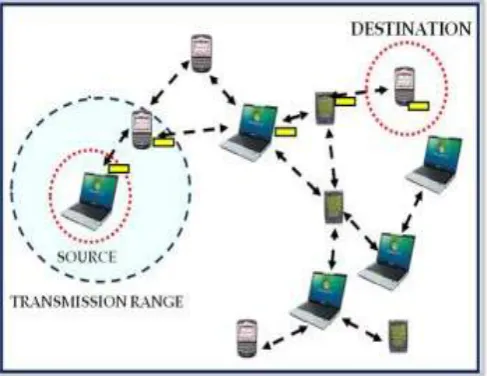
other node regardless it’s a member of the same network or not. The node is free to move randomly and can acts as a host or as a router which can route data between any two nodes in within the network. And routing traffic actually is a serious problem in wireless network [1]. Atypical network is shown in figure 1.
There are several types of routing protocols those could be working in a MANET, and the study discuss only two main classes or groups of protocols as the proactive protocols and the reactive protocols .
Fig .1 Example of MANET network
International Journal in IT and Engineering, Impact Factor- 4.747
also the cost of network overhead by refreshing a wide range of records became a disadvantage [2]-[4].
The reactive protocols (or on – demand protocols) are acting similar to the proactive ones except that they only update the needed records on-demand basis. The main advantage is reduce the cost of maintaining routes, since they will not been used for the requested session. Examples of this group of protocols are AD– HOC on demand Distance Vector routing protocol (AODV) and Dynamic Source Routing protocol (DSR).
This paper evaluates the performance of AODV, DSR, OLSR and GRP routing protocols using FTP traffic. Different sizes of networks were used to simulate traffic. The performance was analyzed by means of throughput, delay, load and data dropped. The simulator software used in the scenarios was OPNET Modeler 14.5.
The paper was organized as follows: Section II, presents an overview of MANET routing protocols, Section III, describes the simulation environment and the performance metrics, Section IV show the simulation, and Section V conclude this paper.
II OVERVIEW OF MANET ROUTING PROTOCOLS
The routing is one of the most significant challenges in MANET. There are three criteria’s is measure the performance and utilization of the used protocol.
First, nodes in MANET are allowed to move in an uncontrolled manner. Such node mobility results in a highly dynamic network with rapid topological changes causing frequent route failures. A good routing protocol for this network environment has to dynamically adapt to the changing network topology. Second, the wireless channel working as a shared medium thus, the available bandwidth per node is low. So routing protocols should be bandwidth-efficient by expending a minimal overhead for computing routes so that much of the remaining bandwidth is available for the actual data communication. Third, nodes run on batteries which have limited energy supply, so the used protocol must be a power-efficient. [5].
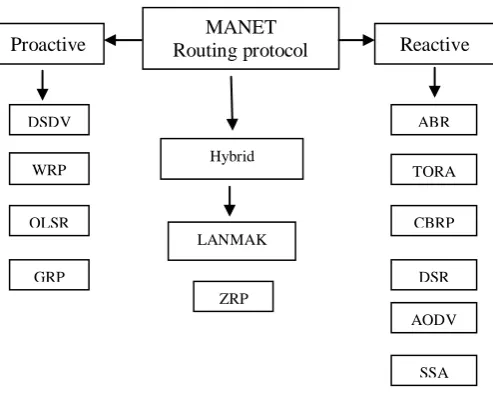
In MANET the routing protocol is classified into three main categories shown in figure 2. We have study deeply two protocols from proactive and reactive classified.
Fig. 2 MANET routing protocol
In proactive routing protocols every node in the network has one or more routes to any possible destination in its routing table at any given time. But in the reactive routing protocols every node in the network obtains a route to a destination on a demand fashion. In Hybrid routing protocols every node acts reactively in the region close to its proximity and proactively outside of that region, or zone.
A. Proactive Ad-hoc Protocols:
1. Optimized link state protocol (OLSR):
OLSR is a proactive routing protocol which means that the routes are always available when we need. OLSR is a pure link state protocol and if the topology of network has changed, it will flood informational messages to all nodes in network. OLSR using two types of messages Hello messages and topology control messages. The OLSR reduces the overhead on the network by using a Multipoint Relays MPRs, which multicasting the Hello messages to neighborhood nodes using one hop count, and broadcasting TC messages to all nodes on the network as periodically bases. In fact, the topology control messages only can send by the MBRs. The Hello messages are broadcasted for the neighbor sensing, assume that we have two nodes A & B, so when node (A) receives a Hello message from node (B) it sets node (B) status to asymmetric in the routing table, then node (A) send the second Hello message includes that it linked to the node (B) as symmetric, node (B) sets the first node status to symmetric in own routing table finally when node (B) sends third Hello message where the status of the link for the first node (A) is indicates as
MANET Routing protocol Proactive
Hybrid
Reactive
DSDV
WRP
LANMAK
OLSR CBRP
TORA ABR
GRP
ZRP
DSR
AODV
International Journal in IT and Engineering, Impact Factor- 4.747
a symmetric then node (A) change the status from asymmetric to symmetric [6].
2. Geographic routing protocol (GRP)
Geographic Routing Protocol (GRP) is a proactive protocol; it depends on the position of the mobile node. In GRP, the global positioning system (GPS) is used to record the location of node and the quadrants optimize flooding. When a node move or change its position then the flooding will update by the new position. The network is divided into quadrants to reduce flooding, the entire world is divided into quadrants from lat long (-900, - 1800) to lat long (900, 1800). The concept of sending data from node A to node B , node A finding the closer neighbor to destination ( node B ) then forward the data.
B. Reactive AD – hoc protocols
1. AD–HOC On demand Distance Vector routing protocol
AODV is a reactive protocol, and also a table drive-routing protocol. On – demand means to create or discover the routes as needed, the mechanism in AODV to maintain routing information it uses routing table (one route to destination).
When one node needs to communicate with other node that doesn’t have routing information in the routing table, then the node will send a broadcast to the neighbors as a Route Request Package (RREQ). RREQ Structure:<src-addr, src-sequence- number, broadcast – id, dest-addr, dest- sequence –number, hop-cont>Src-addr and Broadcast –id uniquely identifies a RREQ, if one node receives a RREQ that has the same src-addr and broadcast _id of any table record it will be dropped immediately. The src –sequence –number is used to maintain freshness information about the reverse route to the source, dest – sequence –number indicates how a fresh route must be before it can be accepted by the source. Every node forward the RREQ to anther node until find the route, and then the source node will receive a Route Request Replay (RRER). RRER Structure:<src –addr, dest – addr , dest –sequence- number,hop –cont ,life time >
In AODV each node maintains at most one node per destination (single path protocol), it create a new route discovery only when the path from the source to destination fails [7].
2. Dynamic Source Routing protocol (DSR)
DSR is a reactive routing protocol designed specifically for use in multi-hop wireless ad–hoc networks for mobile nodes those has a mechanisms work together allowing the discovery and maintenance. The route discovery and route maintenance when the node needs to send a packet to anther node. First, it will search the route in its cache and if the route find the node (source node) will add a header contain the sequence of hops that the packet should follow on its way to distention. But if no, then node will use the route discovery. The node (source node) will send route request RREQ by flooding to all nodes until find the destination node. Each RREQ contains dest –addr unique request –id and a record listing the address of each intermediate node from source to destination. When node (destination node) receives RREQ it replies by rote reply RRER. The source node after receives RRER immediately it caches in its route cache for use in sending packed to this destination [8].
III SIMULATION ENVIRONMENT AND PERFORMANCE
METRICS
A. Simulation tool (OPNET)
The network simulations are implemented using OPNET modeller14.5. OPNET Modeler is commercial network simulation environment for network modeling and simulation. It allows the users to design and study communication networks, devices, protocols, and applications with flexibility and scalability. It simulates the network graphically and gives the graphical structure of actual networks and network components. It provides a variety of toolboxes to design, simulate and analyze a network topology, routing protocols on the basis of various network parameters. MANET toolbox has been used in this work to simulate the network [3].
B. Simulation setup
International Journal in IT and Engineering, Impact Factor- 4.747
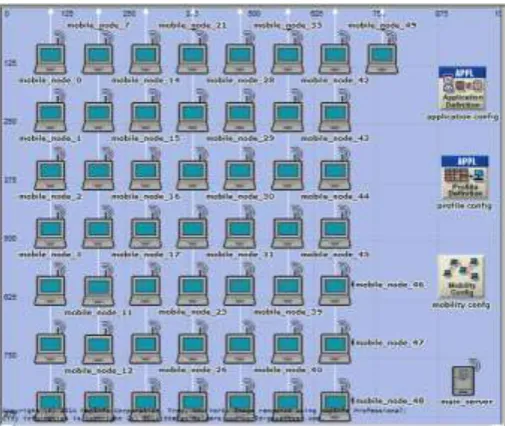
random waypoint for this simulation. The simulation parameters used are listed in Table 1. Figure 3 shows a sample network with 50 mobile nodes.
Parameters Value
Maximum simulation time
3600 sec
Environment size 1000*1000
No. of nodes 10,15,25,50,75and 100 Routing protocol AODV, DSR, OLSR and GRP
Data rate 11 Mbps
Packet size 4096 bit
Traffic type File transfer protocol (ftp) Mobility model Random way point mobility
Table. 1 simulation parameters
Fig.3 sample network with 50 nodes
C. Performance metrics
The performance metrics can be used for evaluating the performance of MANET routing protocol, we have used the following metrics to evaluating the performance of four routing protocols (AODV, DSR, OLSR and GRP):
1.Throughput: The total number of packet successfully received by all destinations over the duration of simulation time. The throughput can be calculated by the equation:
Throughput (k bits /sec) = N * M*L
N: number of node in the network. M: data rate.
L: length of the packets.
2. Average end to end delay: This includes all possible delay caused by buffering during route discovery latency, can be calculated by the following equation:
T= t transmit + t propagation + t processing g + t queuing
3. Packet Losses: The number of packets it dropped at both the network layer and Mac layer during simulation that means the minimum value of packets dropped the best protocol performance.
4. Load: Load represents the total load in bit/sec that all higher layers submit to wireless LAN layers in all WLAN nodes of the network.
IVSIMULATION RESULTS
In this section we analyze the performance of routing protocol based on the results obtained after simulation experiments are conducted on routing protocols. The main object of this paper is to evaluate the performance and behavior of each routing protocol with respect to the effect of increasing the number of nodes with FTP traffic. The results are based on evaluation metrics of delay, load, throughput and data dropped.
A. Delay
Figure 3 shows the mean delay with variable network size 10, 15, 25, 50, 75, and 100 nodes for FTP application. The OLSR protocol shows least delay in all size of Network. Because it usually stores and updates its routes so when a route is needed, it present the route immediately without any initial delay, followed by AODV in size 10, 15, 25 and 50 (minimum delay) and GRP, but in large network the GRP outperforms AODV. The DSR protocol shows highest delay, because it on demand routing protocol.
B. Throughput
International Journal in IT and Engineering, Impact Factor- 4.747
for FTP application. From the result we find in size 10 nodes and 15 nodes (small network) the GRP protocol show high throughput followed by OLSR and AODV. But in size 50, 75 nodes and 100 nodes the OLSR show high throughput. The DSR protocol shows lowest throughput.
Fig. 3 The delay versus number of nodes
Fig. 4 The throughput versus number of nodes
C .Load
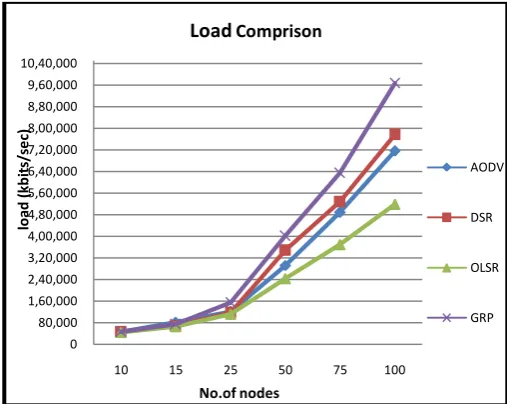
Figure 5 shows the load (k bits/sec) with variable network size 10, 15, 25, 50, 75 and 100 nodes for FTP application. The OLSR protocol show high load, this result due to the mobility of the nodes, there is a frequent change in the link state and this result in the change in MPR node due to random mobility. This results due to periodic broadcast of “Hello‟ message and Topology Control (TC) messages in order to discover neighborhood nodes. In addition, OLSR is a link state protocol which uses a table driven approach. Therefore, it generates more communication overhead and takes more maintenance time which adds to the overall load
in the network. Following by GRP and AODV and the DSR show the lowest load.
Fig .5 the load versus number of nodes
D. Packets dropped
Figure 7 shows the entire packets dropped with variable networks size for 10, 15, 25, 50, 75and 100 nodes for FTP. In the GRP scenarios with network size 50,75and 100 used non geographic mode, because the protocol depend on position.From result below the DSR record the higher packets dropped in the large network (50,75and 100), but in small network (10,15and 25) the GRP show higher result. The OLSR show the lowest packets dropped approximately zero.
Fig .5 the packets dropped versus number of nodes 0.000 0.010 0.020 0.030 0.040 0.050 0.060 0.070 0.080 0.090 0.100 0.110 0.120 0.130 0.140 0.150 0.160 0.170 0.180 0.190 0.200
10 15 25 50 75 100
d el ay (se c) Delay Comprison AODV DSR OLSR GRP no.of nodes 0 800 1,600 2,400 3,200 4,000 4,800 5,600 6,400 7,200 8,000 8,800 9,600 10,400
10 15 25 50 75 100
th ro u gh p u t( b it s\ se c) Throughput Comprison AODV DSR OLSR GRP 0 80,000 1,60,000 2,40,000 3,20,000 4,00,000 4,80,000 5,60,000 6,40,000 7,20,000 8,00,000 8,80,000 9,60,000 10,40,000
10 15 25 50 75 100
lo ad ( kb it s/ se c) No.of nodes
Load Comprison
AODV
DSR
OLSR
International Journal in IT and Engineering, Impact Factor- 4.747
V.CONCLUSIONANDFUTUREWORK
A .conclusion
In this paper, we performed the comparison between four routing protocols AODV, GRP, DSR and OLSR with traffic loads FTP in terms of delay, load, throughput and packets dropped. Weconcluded that: AODV, OLSR and GRP shows the least delay but as the number of nodes is increased the delay for AODV increases. OLSR shows highest throughput when increased number of nodes followed by GRP and AODV protocol. GRP shows highest load following by DSR and AODV. The DSR protocol show highest data drop.
B. Future work
In further continuance to this study will be integrating mobile AD- hoc network and UMTS to development the mobile ad hoc network.
REFERENCES
[1] Prasantmohapatra, Srikanth Krishnamurthy, “Ad-hoc network technologies and protocols”, 2005.
[2] Geethajayakumar, gopinathganapathy “performance comparison of mobile ad-hoc network routing protocol”, IJCSNS international journal of computer science and network security ,vol.7, 2007
[3] Harmanpreetkaur, Er.Jaswindersingh , “Performance comparison of OLSR, GRP and TORA using OPNET” , International Journal of Advanced Research in Computer Science and Software Engineering, Volume 2, Issue 10, 2012.
[4] Gagangeet Singh, Aujla1andSandeep Singh Kang2, “Comprehensive Evaluation of AODV, DSR, GRP, OLSR and TORA Routing Protocols with varying number of nodes and traffic applications over MANETs”, IOSR Journal of Computer Engineering (IOSR-JCE),2278-8727Volume 9, Issue 3, 2013.
[5] ManijehKeshtgary and VahideBabaiyan, “Performance Evaluation of Reactive, Proactive and Hybrid Routing Protocols in MANET”, International Journal on Computer Science and Engineering (IJCSE), Vol. 4, 2012.
[6] PankajPaltaand SoniaGoyal, “Comparison of OLSR and TORA Routing Protocols Using OPNET Modeler”, International Journal of Engineering Research & Technology (IJERT), Vol. 1 Issue 5, 2012.
[7] M.Chandrika andN.Papanna, “A Survey on Reactive Protocols in Mobile Ad Hoc Networks”, International Journal of Advanced Research in Computer Science and Software Engineering, Volume 3, Issue 1, 2013. [8] Anju Gilland ChanderDiwaker, “Comparative Analysis