Analysis Of Filter Bank Multicarrier Modulation
Schemes For Future Wireless Communications
Ramaswamy.T ,Vangeti Amulya Reddy , D.Vishnu Vardhan,
Abstract: Potential wireless network systems(i.e.[5G]) require higherinformation rates wireless communication. Currentphysical layertechniques ofwireless connectivity, such as conventional OFDM-basedmulti-carrier communications, are very hard to support traditional applications in huge connection and the sensory Internet. The major reason is that conventional OFDM devices use rectangular time-domain windows withvery poor frequency localization.Furthermore,to safeguard strict orthogonality, flexibleadjustment ofsystem parameters such as subcarrier frequency and spacing is quite hard, which indicates that conventional OFDM systems are very hard to use in future wireless technology with diverse equipment in a massively linked environment.CP-OFDM has poor OOB emissions. The existing techniques in OFDM, like filtering and windowing, reduce the Out of band emissions (OOB), but these will be effective and efficient only when the number of subcarriers is large. Usage of a large number of subcarriers in future wireless systems, in every case is not possible. So FBMC is chosen and considered as the solution for future wireless systems, due to its better spectral properties. I offer a good cohesive structure, rational discussion and success assessment of FBMC in this article and contrast it with systems based on OFDM.
Index Terms: 5G, OFDM,FBMC, QAM, OQAM,CP-OFDM, OOB Emissions.
————————————————————
1 INTRODUCTION
Futuremobile devices will be extremely diverse and will feature a wide variety of feasible applications. We have to have a versatile distribution of the available time-frequency resources to effectively sustain such varied use applications. Ultimately, for 5G OFDM was selected with changes.By considering alternative models over OFDM we don‘t expect huge amounts of efficiency and gain. We do it to know about the pro‘s and con‘s of existing modulation schemes by employing a fair comparison. We make a comparison of OFDM with Filter Bank Multicarrier (FBMC), which produces much better spatial properties. Var ious versions of Filter bank Multi Carrier systems exit but w e will concentrate primarily on Offset QAM (OQM) as it offer s the greatest spatial properties. The two findigs due to which FBMC is considered as the feasible option are: First, FBMC can be made to provide excellent localization in frequency and as well as in time, which results in efficient time-frequency resource allocation. It possesses small delay spread which will ensure that easy one-tap equalizers will be adequate to obtain optimal performance. We demonstrate that FBMC enables effective coexistence within the same band between distinct usage instances and that it can be used effectively in small-latency transmissions.
2 MULTICARRIER MODULATION
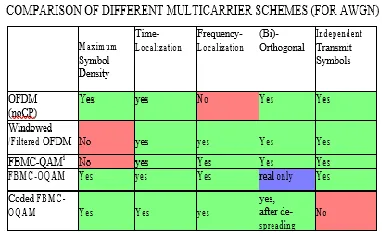
Information is transferred over pulses in multi-carrier schemes that generally overlap in time and frequency. Tiny bandwidths are allotted to these pulses, thus transforming frequency selective channels into various sub-channels (sub-carriers) with negligible interference, nearly frequency flat. According to the Balian-Low theorem, multi-carrier systems have to fulfill some constraints, which are mathematically difficult to be achieved at the same time. Table I illustrates the following.
TABLE I
Anmulticarrier system should have maximum symbol density TF=1,time localization σt<∞,frequency localization σf<∞ and also satisfy strict orthogonality condition (gl1,k1(t),gl2,k2(t))=δ(l2−l1),(k2−k1),(δ denotes the
Kronecker delta function).
2.1 CP-OFDM
Applied in WLAN and 4G communication systems, OFDM is the most prominent multi-carrier system. CP-OFDM uses rectangular transmission and receives pulses that significantly decrease the complexity of the computatio n. The presence of CP implies that the pulse transmitted is mildly larger than the received pulse, maintaining orthogonality in selective frequency transmissions.
————————————————
Ramaswamy. T is an Associate Professor in the ECE Department at Sreenidhi Institute of Science and Technology, INDIA.PH-8919639675
Vangeti Amulya Reddy is currently pursuing masters degree program in Digital systems and computer electronics in Sreenidhi Institute of Science and Technilogy, INDIA,PH-8125100456. Email:[email protected]
D. Vishnu Vardhan is an Assistant Professor in ECE Department from Jawaharlal Nehru Technological University, Anantapur.
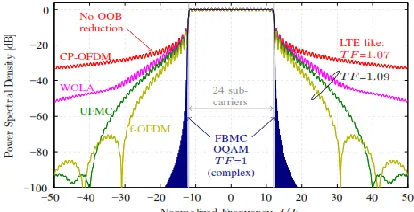
Fig. 1.The figure shows the simulation results comparing
CP OFDM , FBMC,UFMC,WOLA and FBMC OQAM. and depicts that FBMC will have better spectral properties compared to OFDM techniques and also maintains the maximum symbol density TF = 1(complex). (In this simulation we have considered the PHYDAS prototype filter in FBMC).In CP OFDM (Bi)-Orthogonality condition will be :T = T0 + TCP; F = 1/T0 with Localization
σt = T0 + TCP ; σf = ∞, 2√3
Where T0 is the time-scaling parameter which depends on the time spacing of the desired subcarrier. Unfortunately, in the frequency domain, the rectangular pulse is not located, resulting in elevated OOB emissions as in Figure 1. This becomes the greatest drawback of CP-OFDM. Furthermore, in frequency-selective channels, the addition of CP (Cyclic prefix) simplifies equalization but decreases spectral efficiency. No CP is required in an AWGN channel. We are presently discussing filtering and windowing to decrease the OOB emissions.
2.2 Windowed OFDM(WOLA)
We consider the windowing technique in OFDM called ‗Weighted Over-Lap and Add‘ (WOLA-OFDM). The rectangular pulse edges are windowed (replaced) at the transmitter by a smoother function(windowing) and then WOLA symbols of the neighborhood are overlapped in time. Windowing is applied even at the receiver, and the add, overlap operations are performed within the same WOLA symbol, which results in reduced inter-band interference. Cyclic Prefix should be considered long enough for both the transmitter window and the receiver to account for.
2.3 FILTER BASED OFDM TECHNIQUES:
Two techniques are suggested for the OFDM system with filtering concept. First, Universal Filtered Multi-Carrier(UFMC) in which the Dolph-Chebyshev window is applied for every subband. The receiving filter is just as essential as the transmission filter. Filtering of subbands has to be applied even at the receiver side. Orthogonality is ensured by giving time-frequency spacing of TF= 1.14. Spectral efficiency is enhanced by reducing the time-frequency spacing to TF= 1.09 and enable tiny self-interference.Considered another OFDM based on filtering technique is f-OFDM. In this scheme, the we consider large number of subcarriers per a subband which will be usually much higher than that of UFMC. This scheme considers a filter which is based on a sinc pulse i.e ideal rectangular filter which is multiplied by a Hann window; it is also feasible to use other filters. Usually the filters are longer in f-OFDM compared to those which are considered in
Universal Filtered Multi carrier systems. From simulation results shown in Fig 1 we can see that filtering and windowing schemes used in OFDM will decrease the elevated Out Of Band emissions in CP-OFDM, but comprises the spectral efficiency .Filtering and windowing techniques try to reduce the Out Of Band emissions but can‘t achieve as low as in FBMC, which even provides maximum symbol density(TF) = 1.
2.4 FBMC-QAM.
Some researchers sacrifice frequency localization in order to define FBMC QAM, which in terms of OOB emissions makes the FBMC-QAM scheme even worse than OFDM. Others compromise orthogonality to achieve time-frequency localization and time-frequency spacing (TF) equal to one. In our analysis of FBMC-QAM, we consider a time-frequency spacing (TF) equal to two, i.e compromising spectral efficiency to achieve all the other required properties as listed in Table I. The elevated time-frequency spacing in a dual-selective channel improves the general robustness. The primary motive for selecting TF= 2 is for the direct implementation in Filter bank multi-carrier scheme employing-Offset QAM. A Hermite pulse is the most prominent prototype filter for FBMC-QAM.In FBMC-QAM using hermite pulse we have Orthogonality condition as T = T0; F = 2/T0 →
TF = 2 with Localization :σt = 0.2015 T0; σf = 0.403 T0−1 . In frequency and time, such Hermite pulses possess the same shape, permitting us to utilize symmetries. It focuses on Gaussian pulse and consequently has a decent joint time-frequency localization σtσf = 1.021/4, nearly as excellent as the bound of σtσf ≥ 1/4~ 0.08 (achieved by the Gaussian pulse), which makes it comparatively resistant to double-selective circuit.We then consider another important filter, which is the PHYDYAS prototype filter built with Orthogonal condition as :T = T0; F = 2/T0 → TF = 2 and Localization :σt = 0.2745 T0; σf = 0.328 T0−1.
Usage of PHYDYAS filter will give stronger frequency-localization but worse time-frequency-localization compared to the Hermite prototype filter. Even worse is the joint time-frequency localization.
3 FILTER BANK MULTI-CARRIER SYSTEM
WITH OFFSET-QAM
Offset QAM(FBMC OQAM) is FBMC-QAM related, whereas it will have the same density of symbols as in OFDM without CP. The complex
condition of orthogonality
<gl1,k1(t),gl2,k2(t)>=δ(l2−l1),(k2−k1) is swapped with the
less stringent condition of orthogonality
R{<gl1,k1(t),gl2,k2(t)>}=δ(l2−l1),(k2−k1).In FBMC-OQAM we first
Design a p(t)= p(−t) prototype filter which will be orthogonal for a time spacing of T= T0 and a frequency spacing of F= 2/T0, resulting in TF= 2.
Then we reduce the time-frequency spacing (orthogonal) by a factor of 2, i.e. T= T0/2 and F= 1/T0.
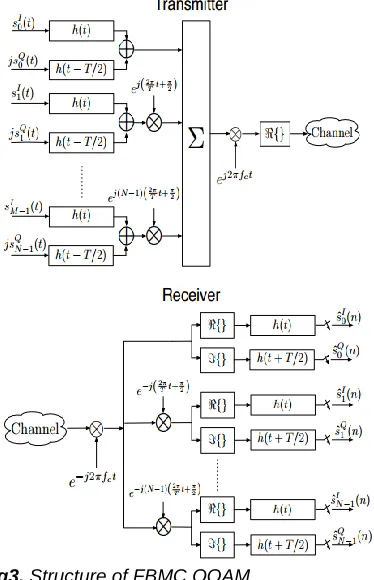
symbols and we require another cycle so that complex information symbols are also transmitted, resulting in a time-frequency spacing (TF) equivalent to one for complex symbols. Generally, a complex symbol's real-part is mapped in the first time-slot and then the imaginary-part is mapped in the second time-slot, so it is called offset-QAMIn the OQAM process, we introduce a half symbol delay between I and Q components of QAM symbols. We introduce this delay to achieve baud-rate spacing between subsequent subcarriers, removing the requirement of CP to remove the inter-symbol and inter-carrier interference. Thereby Offset QAM will have more bandwidth efficiency than OFDM. In OQAM N parallel data streams are first fed to N filters and then I and Q components are altered in time by half symbol duration, T/2. Outputs from these filters have to be modulated with N subcarriers, whose frequencies are separated by 1/T.
Fig3. Structure of FBMC OQAM
For a complex symbol
(1)
s [n]is in-phase component and s [n] is quadrature
component of the kth Subcarrier and nth symbol.
3.1 OQAM Pre-Processing
The FBMC Offset QAM technique requires prior-processing and end-processing sections to generate FBMC signals. Figure 4 shows the pre-processing block that converts the signal from QAM to Offset QAM. Given complex input signal ck,l, is converted into the real domain by separating real and complex parts into two new symbols dk,2l and dk,2l+1. For odd number and even number of subchannel,
the transformation is distinct. The sample rate is raised by 2 in
complex to real transformation followed by the multiplication of these symbols by the sequence of θk,n.
Fig 4 QAM to Offset QAM conversion process
3.2 OQAM Post Processing
Now we have to reconvert the Offset QAM signal back to the QAM signal. There are two steps in this conversion process as shown. The input is multiplied by a sequence of θk,n and then the real part of this signal is taken. Then it is fed to real-complex-conversion block, in which the sampling rate is decreased by 2 and then two successive complex-valued symbols (with one multiplied by j) gives a real symbol ĉkn. FBMC-OQAM compromises strict orthogonality to real orthogonality, thereby losing complex orthogonality. This is the main disadvantage of the Offset QAM based FBMC technique. So we have tried to recover complex orthogonality by using a new technique called as ‗Coded FBMC-OQAM‘
Fig 5. OQAM to QAM reconversion process.
4.CODED FBMC-OQAM:
Coded FBMC OQAM in which symbols are spread in frequency or time.We use easy one-tap equalizers that can be used until the channel is either flat in time (if we spread over time) or frequency (if we distribute in
frequency). On the other
side, the primary disadvantage will be the enhanced sensiti vity to doubly-selective channels.
Fig.6.Simulation results which show that Coded FBMC OQAM and OFDM have the same BER
5 PERFORMANCE EVALUATION
We have compared the various OFDM schemes with FBMC schemes in terms of SIR, BER, and throughput to find the best modulation scheme for 5G systems
5.1THROUGHPUT
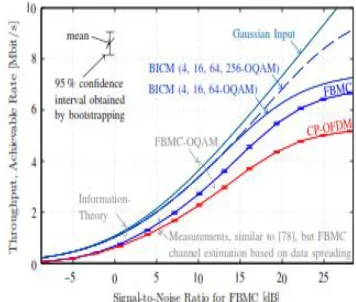
The efficient utilization of bandwidth and removal of cyclic prefix, makes FBMC have greater throughput compared to the Orthogonal frequency division multiplexing technique. The channel estimate in Fig.7 is focused on the data propagation strategy in conjunction with an average moving-block interpolation, i.e. all pilot measurements within a time-frequency scope of 15 (complex-valued) time signs and 12 subcarriers are averaged to achieve an information location estimate. Such a technique of interpolation is feasible because in moment and frequency the channel is extremely linked. OFDM and FBMC have the same transmitting energy that results in a 0.82 dB lower FBMC SNR relative to OFDM as the energy is distributed over a bigger bandwidth. A significant remark here is the saturation of the throughput. If one raises the SNR from 0dB to 10dB, i.e. a factor of 10 increase in SNR results in a 300% increase in throughput. But after a certain level i.e Now if the SNR is expanded from 20dB to 30dB, which is also mathematically a factor of 10, We find that output will only increase by 20%. Even if a sign alphabet up to 256-OQAM is considered, the reachable level only rises by 40%. Thus, a large SNR offers only a tiny increase in throughput but needs considerably greater energy and hardware expenses.
Fig.7 shows that FBMC will have larger throughput compared to OFDM due to higher available bandwidth and removal of Cyclic Prefix.
5.2 SIGNAL-TO-INTERFERENCE RATIO:
Fig.8. The figure shows that FBMC will have higher SIR than OFDM, which means that we can employ much smaller guard bands.. Windowed (WOLA) and filtered(UFMC, F-OFDM) OFDM will show efficient results only when windowing and filtering operations are applied at the receiver also.
6CONCLUSION
Once the amount of subcarriers is elevated, Orthogonal frequency division multiplexing based systems (filtered-OFDM, WOLA, Universally filtered multicarrier systems) will have a comparatively elevated spectral efficiency. Not all feasible cases for potential wireless devices will utilize such a large amount of subcarriers. FBMC becomes much more efficient than OFDM for a tiny amount of subcarriers, especially when the transmission band is split among distinct use cases. Also, Practically, one-tap equalizers will be sufficient if channel statistics is matched with the subcarrier spacing (pulse shape). Moreover, we can move from an FBMC-Offset QAM transmission to an FBMC-QAM transmission in extremely double-selective channels, i.e sacrificing spectral efficiency if we want to acquire robustness. This results in a SIR that is even greater than in CP-OFDM. Although FBMC's computational complexity is indeed greater than in windowed OFDM, both techniques involve the same fundamental activities, enabling us to reuse the parts of hardware.
REFERENCES
[1] V R Sadasivam, Dr K Duraisamy , R Mani Bharathi:‖ Association Rule Mining And Frequent Pattern Mining Applications On Crime Pattern Mining: A Comprehensive Survey‖: International Journal Of Innovative Research In Science, Engineering And Technology Vol. 4, Special Issue 6, May 2015 [2] Society in motion: Challenges for LTE and beyond
mobile communications,‖ IEEE Commun. Mag., Feature Topic:LTE Evolution, vol. 54, no. 5, 2016. [3] TSG RAN; study on scenarios and requirements for
next generation access technologies; (release 143GPP, Oct. 2016.
[4] ―Filtered-OFDM-enablerfor flexible waveform in the 5th generation cellular networks,‖ by X. Zhang, M. Jia, L. Chen, J. Ma, and J. Qiu, in IEEEGlobal Communications Conference (GLOBECOM), 2015, pp. 1–6.
[5] Subcarrier spacing-how to make useof this degree of freedom,‖ F. Schaich, T. Wild, and R. Ahmed, in
IEEE Vehicular Technology Conference(VTC Spring), 2016, pp. 1–6.
[6] ―Bit error probability for pilot-symbol aidedchannel estimation in FBMC-OQAM‖ by R. Nissel and M. Rupp,,‖ in IEEE International Conferenceon Communications (ICC), KualaLumpur, Malaysia, May 2016.