A SCHOOL BASED INTERVENTION PROGRAMME ON HIV/AIDS AWARENESS FOR ADOLESCENT GIRLS OF AGRA DISTRICT: A STUDY OF EFFECTIVENESS
DR.DOLLY RANI RESEARCH ASSOCIATE
PDF, UGC
DEPARTMENT OF EXTENSION, COMMUNICATION AND MANAGEMENT, INSTITUTE OF HOME SCIENCE,
DR.B.R. AMBEDKAR UNIVERSITY, AGRA, UTTAR PRADESH
ABSTRACT
HIV/AIDS still remains a threat to development of people of all age and Nationalities. It is pandemic, now at the beginning of its third decade, is one of the most devastating diseases, currently. It deprives families, communities and entire nations of people at their most productive ages. Globally, 36.9 million people were living with HIV at the end of 2014.
HIV continues to profoundly affect women and girls across all regions. For example, in sub-Saharan Africa, the region most severely affected by HIV, women represent 58% of the people living with HIV and bear the greatest burden of care (UNAIDS, 2012). India was the second largest population infected with HIV/AIDS and over 29.23 percent of all reported AIDS cases were women (NACO 2012). The figures in India as well as all over the world show that HIV/AIDS victims amongst girls will increase faster than the boys
The vulnerability of HIV infection in adolescent girls increases due to the biological factors and due to the limited information on growing up and sexuality issues. At such age girls are not so much aware about contracting HIV/AIDS and it’s after effects, which creates the problem. This makes adolescence a crucial period in her life time. This calls for not only health education and health promotion in general, but also for HIV prevention and AIDS education specifically for which intervention programme should be organized.
In this context, the author made a scientific attempt to intervene adolescent girls to protect themselves from AIDS and to find out the level of awareness and changes in the level of awareness about HIV/AIDS which occurred as a result of intervention programme. This study was conducted among two hundred adolescent girls of Agra district.
It is concluded from the study that the respondent's awareness regarding basic facts about HIV/ AIDS, causes of HIV infection, prevention against HIV infection and government programme and policy against HIV/AIDS was high before the intervention programme. While regarding to the sexually transmitted infections, symptoms of HIV/AIDS, progression stages of HIV/AIDS and medical tests and treatment for HIV/AIDS, the awareness level in most cases was low. Overall level of awareness regarding HIV/AIDS of most of the respondents was at medium level. Intervention programme was highly effective in creating awareness regarding different aspects of HIV/AIDS. Significant differences were observed (0.1 level of probability) in awareness level of adolescent girls regarding different aspects of HIV/AIDS before and after the intervention programme.
INTRODUCTION
Acquired Immune Deficiency Syndrome or AIDS, as it is popularly known as, is the new scourge of the last two decades of the twentieth century. AIDS is a disease caused by a virus named HIV (Human Immuno deficiency Virus). HIV weakens the immune system or the body’s own defense system but this process is slow. It takes years after being infected for a person to notice that he/she has been infected. HIV+ve mean that the person has the virus and is harboring HIV infection. Specialists have identified four major mediums of HIV/AIDS transmission viz. intimate sexual contact, exposure of infected blood, shared uses of infected needles/syringes and transmission from an infected pregnant woman to her fetus.
HIV/AIDS still remains a threat to development of people of all age and Nationalities. It is pandemic, now at the beginning of its third decade, is one of the most devastating diseases, currently. It deprives families, communities and entire nations of people at their most productive ages. This epidemic is deepening poverty, affecting human development achievements, worsening gender inequalities, and eroding the ability of governments to maintain essential services, reducing labour productivity, supply, and hampering economics growth in the Countries worst affected for decades to come (UNAIDS, 2005).
Globally, 36.9 million people were living with HIV at the end of 2014. An estimated 0.8% of adults aged 15-49 years worldwide are living with HIV, although the burden of the epidemic continues to vary considerably between countries and regions. Sub-Saharan Africa remains most severely affected, with nearly 1 in every 20 adults (4.9%) living with HIV and accounting for 69% of the people living with HIV worldwide. After sub-Saharan Africa, the regions most heavily affected are the Caribbean and Eastern Europe and Central Asia, where 1.0% of adults were living with HIV in 2011(UNAIDS, 2012).
The situation of AIDS in Asia is as a "ticking bomb" with scarce statistics and perspectives, considering the potential catastrophes of India and China. Unfortunately, India fails within the high-risk region of South Asia and South-East Asia, which is just next to Sub-Sahara African region as regards the number of HIV infected cases, are concerned.
India's socio-economic status, traditional social ill, cultural myths on sex and sexuality and a huge population of marginalized people make it extremely vulnerable to the HIV epidemic. Thus the epidemic has become the most serious public health problem faced by the country since independence.
The first AIDS case in India was detected in 1986 and since then HIV infection has been reported in all states and union territories. Now India has the third largest number of people living with HIV/AIDS. As per the 2012-13 HIV estimates, there are an estimated 2.1 million people currently living with HIV/AIDS in India.(UNAIDS 2012-13).
HIV continues to profoundly affect women and girls across all regions. For example, in sub-Saharan Africa, the region most severely affected by HIV, women represent 58% of the people living with HIV and bear the greatest burden of care (UNAIDS, 2012). India was the second largest population infected with HIV/AIDS and over 29.23 percent of all reported AIDS cases were women (NACO 2012). The figures in India as well as all over the world show that HIV/AIDS victims amongst girls will increase faster than the boys
The vulnerability of HIV infection in adolescent girls also increases due to the biological factors and due to the limited information on growing up and sexuality issues. At such age girls are not so much aware about contracting HIV/AIDS and it’s after effects, which creates the problem. This makes adolescence a crucial period in her life time. This calls for not only health education and health promotion in general, but also for HIV prevention and AIDS education specifically for which intervention programme should be organized. Intervention approach is very useful in carrying out educated functions. It is a coordinated communication and educational effort, which focuses attention on the problem of HIV/AIDS. As quoted the World Bank (2004) by the author, it is necessary to reinforce that “AIDS education is a social vaccine to protect people from getting infected. Education is one of the most effective and cost effective HIV preventive strategies. Education has strong potential to make a difference sight against HIV/AIDS”. It has been observed from various studies relating to HIV/AIDS and related aspects that mass media campaigns and intervention programme have succeeded in raising the level of awareness in the general population.
Kharpade (1997) reported in his study that intervention brought increase in knowledge on reproduction, HIV/AIDS and STDs. Acceptance of condoms in premarital sex increased after the intervention.
Bhatia et al. (2001) reported in their study that overall AIDS awareness increased from 58.2 percent in the pre-intervention phase to 70 percent in post-intervention phases. The increase in awareness levels about the modes of transmission was good regarding blood transfusion (from 22.8 percent to 46 percent) and unhygienic needles/syringes (from 35.6 percent to 51.8 percent), but was low regarding mother to child transmission (from 10 percent to 17 percent). Awareness regarding multiple sex partners remained high at around 70 percent in both phases. The major gain was noticed in males regarding blood transfusion and in females regarding unhygienic syringes and needles.
After the intervention the overall awareness about prevention of AIDS improved. More persons knew about the benefits of condoms (from 42 percent to 61.2 percent), having sex with a single partner (from 59 percent to 72.3 percent), using safe blood (from 14.9 percent to 29 percent) and using sterile needles and syringes (from 18.1 percent to 33.9 percent). Over 90 percent of the participants considered AIDS a dangerous disease, most commonly because no treatment is available (57.3 percent), because there is no vaccine (20.1 percent) or because patients die within a few years (26.9 percent), according to the post-camp evaluation study.
It is in this context, the author made a scientific attempt to intervene adolescent girls to protect themselves from AIDS and to find out the level of awareness and changes in the level of awareness about HIV/AIDS which occurred as a result of intervention programme.
RESEARCH METHODOLOGY
The design adopted for the study entitled "A School Based Intervention Programme on HIV/AIDS Awareness for Adolescent Girls of Agra District: A Study of Effectiveness" was "before and after without control experimental design".
In such a design a single test group or area is selected and the dependent variables are measured before the introduction of the experiment. Then the experiment is introduced and the dependent variables are measured again after the experiment.
The experiment was undertaken through four phases in the present study as given below Phase – 1: Administration of Baseline Questionnaire (Before Intervention)
Phase – 4: Administration of baseline questionnaire (After intervention)
A multistage sampling technique was used to select the ultimate unit of the sample with a view to get a representative sample of the area. The present study was conducted in Agra district. Agra district is divided into two areas as Agra rural and Agra urban. The research was conducted in Agra urban. Agra urban comprises of Nagar Nigam, Nagar Palika and Nagar Panchayat. Agra city comes under Nagar Nigam. Thus Agra city (Nagar Nigam) was selected purposively for present study.
List of Intermediate colleges of Agra city were collected from D.I.O.S. office, Panchkuiya, Agra. According to this list there were total 117 Hindi medium colleges and 23 English medium colleges.Out of these colleges two Hindi medium colleges namely "Tulsi Devi Girls Inter College" and "K.G. Inter College" and two English medium Colleges namely "Agra Public School" and "St. Anthony Junior College" were selected randomly for the study. Fifty adolescent girls of 11th and 12th class from each Intermediate college were selected for the present study randomly. Thus total 200 respondents were taken as a sample.
For the present study HIV/AIDS education was given through a well prepared intervention programme. Mixed media approach was used for intervening. The following methods and tools were used for the presentation of intervention programme:
Methods
1. Lecture method
2. Discussion method
Tools
1. Computer presentation (PowerPoint presentation) 2. Booklet for distribution
For using the methods and tools the whole sample was divided into two experiment groups. These two experimental groups were provided information for creating awareness regarding HIV/AIDS by the following methods:
First experiment group: In the first experiment group, lecture and discussion method was used for imparting awareness regarding HIV/AIDS to the adolescent girls. Lectures were given with the help of computer presentation (slide presentation on PowerPoint with the help of L.C.D. projector). At the end of intervention programme booklet was distributed to each of the students of this experiment group.
Second experiment group: In the second experiment group, lecture and discussion method
was used. Lectures were given with the help of computer presentation. The difference in first experiment group and second experiment group was that in second experiment group booklets were not distributed.
The data was collected from primary as well as secondary sources. Secondary data was collected from different libraries, organization, agencies and Internet etc. Primiary data was collected through a well constructed questionnaire.
RESULT AND DISCUSSION
The results obtained were thoroughly examined, interpreted and discussed with all care. After statistical analysis the results have been presented under the following heads according to the objectives of the study:
Awareness regarding different aspects of HIV/AIDS
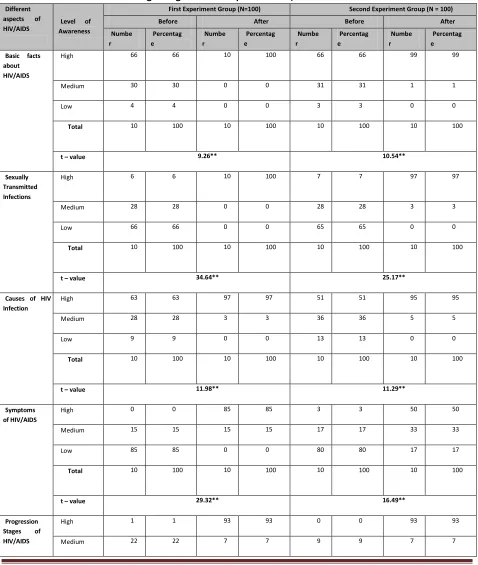
The following table gives a clear picture regarding awareness about different aspects of HIV/AIDS. The findings have been presented showing the comparative results between before intervention period and after intervention period. They clearly show the effectiveness of intervention programme.
Table 1: Awareness regarding different aspects of HIV/AIDS
Different aspects of HIV/AIDS
Level of Awareness
First Experiment Group (N=100) Second Experiment Group (N = 100)
Before After Before After
Numbe r Percentag e Numbe r Percentag e Numbe r Percentag e Numbe r Percentag e Basic facts
about HIV/AIDS
High 66 66 10
0
100 66 66 99 99
Medium 30 30 0 0 31 31 1 1
Low 4 4 0 0 3 3 0 0
Total 10
0
100 10
0
100 10
0
100 10
0
100
t – value 9.26** 10.54**
Sexually Transmitted Infections
High 6 6 10
0
100 7 7 97 97
Medium 28 28 0 0 28 28 3 3
Low 66 66 0 0 65 65 0 0
Total 10
0
100 10
0
100 10
0
100 10
0
100
t – value 34.64** 25.17**
Causes of HIV Infection
High 63 63 97 97 51 51 95 95
Medium 28 28 3 3 36 36 5 5
Low 9 9 0 0 13 13 0 0
Total 10
0
100 10
0
100 10
0
100 10
0
100
t – value 11.98** 11.29**
Symptoms of HIV/AIDS
High 0 0 85 85 3 3 50 50
Medium 15 15 15 15 17 17 33 33
Low 85 85 0 0 80 80 17 17
Total 10
0
100 10
0
100 10
0
100 10
0
100
t – value 29.32** 16.49**
Progression Stages of HIV/AIDS
High 1 1 93 93 0 0 93 93
Low 77 77 0 0 91 91 0 0
Total 10
0
100 10
0
100 10
0
100 10
0
100
t-value 32.23** 36.79**
Prevention against HIV Infection
High 53 53 96 96 51 51 97 97
Medium 38 38 04 04 27 27 2 2
Low 09 09 0 0 22 22 1 1
Total 10
0
100 10
0
100 10
0
100 10
0
100
t-value 13.81** 11.17**
Medical Tests and Treatment for HIV/AIDS
High 02 02 92 92 0 0 75 75
Medium 16 16 08 08 3 3 19 19
Low 82 82 0 0 97 97 06 06
Total 10
0
100 10
0
100 10
0
100 10
0
100
t-value 35.90** 30.09**
Governmen t Programme and Policies against HIV/AIDS
High 56 56 99 99 67 67 83 83
Medium 33 33 1 1 22 22 14 14
Low 11 11 0 0 11 11 3 3
Total 10
0
100 10
0
100 10
0
100 10
0
100
t-value 11.72** 7.66**
** Significant at 1 percent level of significance
Table 1. reveals the awareness regarding different aspects of HIV/AIDS. Awareness regarding basic facts about HIV/AIDS shows that before the intervention programme most of the respondents (66 percent) had high level of awareness among both experiment groups separately. While after the intervention programme 100 percent of the respondents from first experiment group and 99 percent respondents from second experiment group reached in high level of awareness.
The data related to the awareness about sexually transmitted infections reported that before the intervention programme 66 percent and 65 percent had low level of awareness amongst first and second experiment groups respectively. While after the intervention programme a highly increased in awareness level was reported that 100 percent of the respondents from first experiment group and 97 percent respondents from second experiment group reached in high level of awareness.
have improved from 63 percent to 97 percent among first experiment group and 51 percent to 95 percent among second experiment group.
Regarding awareness about symptoms of HIV/AIDS maximum number of the respondents (85 percent and 80 percent) had low level of awareness among first and second experiment groups respectively before the intervention programme. After the intervention programme high level of awareness was scored by 85 percent of the respondents among first experiment group and 50 percent respondents among second experiment group.
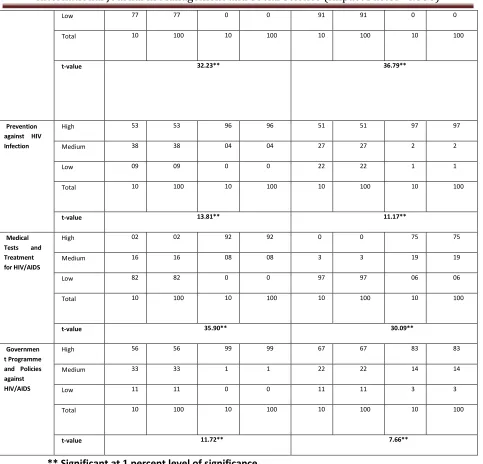
Related to the progression stages of HIV/AIDS, 77 percent and 91 percent respondents had low level of awareness among first and second experiment group respectively before the intervention programme. After the intervention programme most of the respondents 93 percent scored high level of awareness score among both experiment groups separately.
Regarding to the prevention against HIV infection, the findings show that before the intervention programme high level of awareness reported by 53 percent of the respondents from first experiment group and by 51 percent of the respondents from second experiment group. After the intervention programme an improvement was reported from 53 percent to 96 percent among first experiment group and 51 percent to 97 percent among second experiment group.
Regarding to the awareness about medical tests and treatment for HIV/AIDS, it is clearly shows that before the intervention programme most of the respondents (82 percent from first experiment group and 97 percent from second experiment group) reported low level of awareness. While after intervention programme 92 percent of the respondents from first experiment group and 75 percent respondents from second experiment group scored high level of awareness score.
As regards to the awareness about government programme and policy against HIV/AIDS the result indicates that before the intervention programme 56 percent and 67 percent of the respondents had high level of awareness among first and second experiment groups respectively. While after the intervention programme 99 percent respondents from first experiment group and 83 percent respondents from second experiment group shifted at high level of awareness.
Significant differences were seen in awareness level between before and after intervention programme among both experiment groups regarding different aspects of HIV/AIDS.
Total Level of Awareness Regarding HIV/AIDS
Till now the researcher has discussed the awareness regarding various aspects of HIV AIDS. The following table shows the total level of awareness (all aspects included) achieved by the respondents regarding HIV/AIDS. The results are being presented for the both experiment groups before and after the intervention programme.
Table2. Total level of awareness regarding HIV/AIDS
Level of Awareness
First Experiment Group (N = 100) Second Experiment Group (N = 100)
Before After Before After
Numbe
r Percentage
Numbe
r Percentage
Numbe
r Percentage
Numbe
r Percentage
High 3 3 100 100 4 4 97 97
Medium 80 80 0 0 68 68 3 3
Low 17 17 0 0 28 28 0 0
Total 100 100 100 100 100 100 100 100
t-value 42.49** 30.31**
The analysis carried out with the data obtained by both experiment groups of respondents on total level of awareness regarding different aspects of HIV/AIDS before and after the intervention programme presented in Table 2. appears to be quite interesting.
First experiment group - Results reveal that 80 percent of the respondents possessed medium level of awareness, while 17 percent and 3 percent of the respondents possessed low and high level of awareness respectively. But after the intervention programme all the respondents (100 percent) shifted at high level of awareness from medium and low levels.
Second experiment group - More than half of the respondents (67 percent) had medium level of awareness, 28 percent low level of awareness and 4 percent of the respondents remained in high level of awareness before the intervention programme. After the intervention programme its impact reveals an improvement of awareness level from 4 percent (before intervention programme) to 97 percent (after intervention programme). Only 3 percent of the respondents remained in medium level of awareness.
The 't' value were found to be significant at 0.1 level of probability among both experiment groups before and after the intervention programme. Thus it was seen that the intervention programme had an impact on the respondents as it was successful in creating awareness regarding different aspects of HIV/AIDS.
SUMMARY AND CONCLUSION
It is concluded from the study that socio-economic status of maximum number of the respondent was high. In context to the awareness regarding different aspects of HIV/ AIDS, it is concluded from the study that the respondent's awareness regarding basic facts about HIV/ AIDS, causes of HIV infection, prevention against HIV infection and government programme and policy against HIV/ AIDS was high before the intervention programme. While regarding to the sexually transmitted infections, symptoms of HIV/ AIDS, progression stages of HIV/AIDS and medical tests and treatment for HIV/AIDS, the awareness level in most cases was low. Overall level of awareness regarding HIV/AIDS of the most of the respondents was at medium level. Intervention programme was highly effective in creating awareness regarding different aspects of HIV/AIDS.
REFERENCES
Bhatia, V.; Swami, H.M. and Kaur, A.P. (2001). “An intervention study to enhance AIDS awareness among underprivileged population in Chandigarh”, Department of community Medical College, Chandigarh, Dermatology journal from India (2004), 70 (2): 87–91 available at http://www.ijdvi.com.
Kharpade et al. (1997–99) "To develop a progeamme for AIDS prevention education among adolescent boys and girls from Urban Slums of Mumbai (India)", family welfare training and research centre.
NACO (2011-12). National AIDS prevention and control policy: 7-8, available at http://www.naco.nic.in