www.euacademic.org
Impact of in-service training on the performance of
extension field staff and their problems regarding
the training program
M. HAMMAD RAZA MUNIR AHMAD GHAZANFAR ALI KHAN BABAR SHABAZ
1Institute of Agri. Extension and Rural Development
University of Agriculture, Faisalabad
Pakistan
NOWSHAD KHAN SHAFIQUE QADIR MEMON1
NADEEM ABBAS RAEES ABBAS
Allama Iqbal Open University, Islamabad Pakistan
Abstract:
Agricultural sector occupies a conspicuous place in the economy of Pakistan. The overall objective of agricultural sector is to enhance agricultural productivity in the country on sustainable basis, so that farmers income may be enhanced, domestic requirements be met and reasonable surplus commodities be made available for export. In this scenario agricultural extension has key role to play. Unless it has a competent field force with leadership qualities, it may not be able to perform this gigantic task. Realizing this, Government of Punjab initiated “Human Resource Development Project” for strengthening the competencies of extension field staff. The responsibility of running this programme was entrusted to the Barani Agricultural Training Institute Rawalpindi. The present study was conducted with the objective to find out the beneficial and shortcomings of that
programme. So as 128 Field Assistants have been provided in-service training under this project. A sample of 97 participants of the said training programme was selected. The data were collected through a validated interview schedule. The data was statistically analyzed with the help of SPSS (Statistical Package for Social Sciences). The study reveals that most of the respondents were in favor of training programme because in-service training is a good effort to enhance their skills and knowledge. According to the respondents due to this in-service training programme have great impact on their technical knowledge, working capability and in communication, some problems were also being faced at different stages of training.
Key words: In-service training, Importance of in-service training, Extension Services, Impact of Training.
Introduction
result of absence of information tailored to local needs and lack of technical knowledge at the farm level. Agricultural production is a very complex system. It depends on several inter related components such as development of appropriate production technology, dissemination of modern technology to the end users, and the formulation of farmer friendly agricultural policies (Govt. of Pak., 2010). Agriculture extension acts as a link between research and the farming community. It is responsible for translating, processing and taking the scientific knowledge from researcher to the farmers and provides feedback to the research scientists (Idrees 2003). Agriculture extension plays an important role in the training of farmers and also promotes agriculture development by providing the extension functionaries and the farmers with information, training and other extension support on continuous basis regarding improved production technologies (Adams, 1994).
time (Roberts and Dyer, 2004). There is a need for appropriate and timely in-service training for extension educators to ensure that they are properly equipped to contend with changing conditions in agriculture. In-service education programs need to be revised and expanded to develop more competent field force in Agriculture Extension (Joerger, 2002). Because agricultural technologies change rapidly and extension worker may lack needed expertise, competencies and inspiration. In this condition competency based programming and in-service training can be used to strengthen the professional skills and abilities of extension workers and specialists. (Vijayaragavan et al., 2005). In this perspective the main objectives of this paper are:
o To determine the training methodologies and their
impact on job performance
o To find out the impact of training on the job performance
of Field Assistants.
o To determine the problems of respondents concerning training programme.
Materials and Methods:
drawing respondents. The data were collected through personal interviews with the help of interview schedule. The data, thus, collected were analyzed by using computer software “statistical package for social sciences” (SPSS).
Results and Discussions:
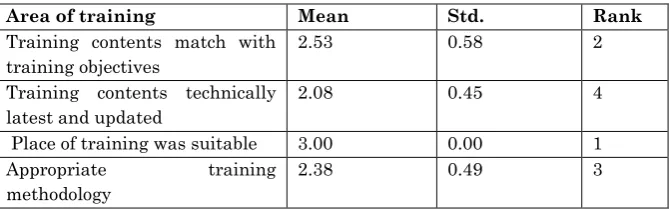
Training is an important tool that involves the transfer of new technologies, skills, behavior and attitude to develop and maintain the workers’ competencies to perform their assigned role more effectively and efficiently. Similarly farmers need training to increase yield per unit area because agricultural machinery/ technology is constantly changing and farmers need to keep abreast of new technologies. Respondents were asked to narrate their satisfaction level by using 3 point likert scale. The information regarding the satisfaction of training attended by the respondents is given in Table 1.
Table 1 Response of the respondents according to their level of satisfaction regarding training areas
Area of training Mean Std. Rank
Training contents match with training objectives
2.53 0.58 2
Training contents technically latest and updated
2.08 0.45 4
Place of training was suitable 3.00 0.00 1
Appropriate training
methodology
2.38 0.49 3
covered during the training programme was not up dated and only recall their previous knowledge but little gain new information regarding agriculture.
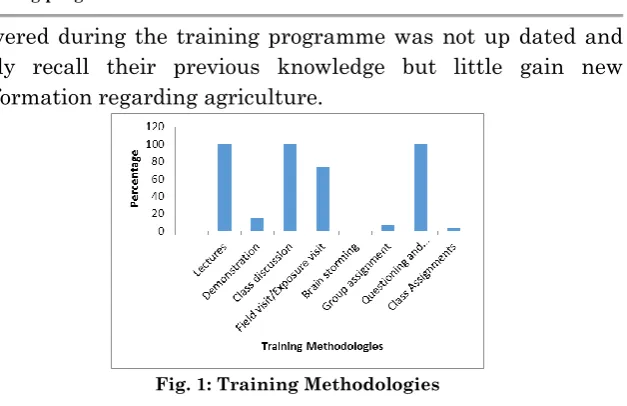
Fig. 1: Training Methodologies
Fig. 1 reveals that lectures, class discussion and questioning and answering were the most prominent methods used during trainings. Demonstration is effective method of teaching whereas this method was less used with only 14.4% of respondents. While “field visit, group assignment and class assignment reported by 73.2, 7.2 and 3.1% of respondents respectively, but during the whole training brain storming activities was not used. Above figure show that during the in-service training programme mostly lecture method was used but practically demonstration was not used, while practically demonstration is an important method for learning and have great impact on the job performance of extension field staff.
0 20 40 60 80 100 120 T e ch n ica l kn o w le d g e W o rki n g ca p a b il it y B e h a vi o r w it h fa rm e rs D e m o n st ra ti o n ski ll s F ie ld vi si ts G ro u p m e e ti n g p e rf o rm a n ce R e g u la ri ty in w o rk M o ti va ti o n a l ski ll s C o m m u n ica ti o n ski ll s
Impact of training
P e r c e n ta g e
Fig. 2 Impact of Training
The data provided in the Fig. 2 indicate that the respondents have 100% positive response in the areas like improvement in technical knowledge, working capability, behavior with farmers, field visits, regularity in work, motivational skills and communication skills. While in the group meeting performance and demonstration skills was reported 75.8% and 73.6% respectively.
Problem faced during Training programme:
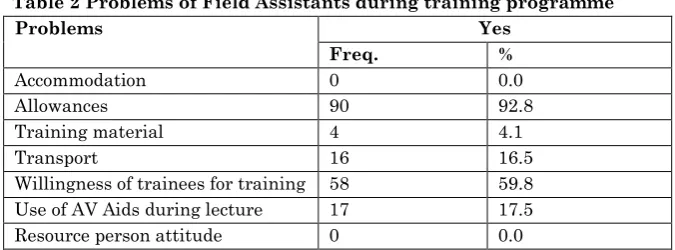
Respondents were asked to identify the problems faced during the training programme. The data regarding this aspect is given in Table 2
Table 2 Problems of Field Assistants during training programme
Problems Yes
Freq. %
Accommodation 0 0.0
Allowances 90 92.8
Training material 4 4.1
Transport 16 16.5
Willingness of trainees for training 58 59.8
Use of AV Aids during lecture 17 17.5
The data presented in Table 2 indicate that field assistant faced different problems during the training programme. Majority of the respondents (92.8%) reported that they have major problem regarding the training allowances. After the training, allowances were not provided to the field assistants in mostly training badges if in some badges provide the amount was only Rs 200/ day which was very less than their expenses of travelling because some field assistants had attend the training from far off Distracts. Another major problem was the willingness of field assistant for the training 59.8% of the respondents have faced this problem. During the training programme different AV Aids were used but in badges these aids was not used and used only lecture technique so only 17.5% respondents have problem about the use of AV Aids during the training programme. About 4.1% respondents have problem concerning the training material which was used during the training. In the training program field visit of National Agriculture Research center (NARC) and Zarai Tarakiate Bank Limited (ZTBL) were also arranged regarding the transport facility 16.5% respondents have problem. While the accommodation and attitude of resource person during the lecture no one can have problem because Institute have own residential hostels.
Conclusion:
because during the training programme in the mostly lectures previous technologies were delivered and only refresh the previous knowledge of the field assistants. During the whole training course practical demonstration and field visits were less focused techniques.
Recommendation:
Training is one of the most important tools for upgrading and updating Field Assistant knowledge. Training programmes need to be strengthened by organizing extensively and vigorously training courses covering various techniques and skills of agricultural production, protection and farm management. BATI may need to rethink about the training methodology and to focus on using more participatory training techniques and field visits. After the training, participants should be provided printed material for future use and also pay timely and reasonable incentives, As well as also need to assess the need and interest of field assistant before announcing them as the participant of training.
REFERENCES
Adams, M.E. (1994). Agricultural extension in developing countries. Longman Group, Harlow, Essex. Longman House, Burnt Mills, UK.
Fitz-gibbon, C.T. and L.L. Morris. (1987). How to design program evaluation. Newburry Park,CA: Sage
Govt. of Pakistan. (2010). Economic survey of Pakistan. Economic advisor wing, finance division, Islamabad. Govt. of Pakistan. (2013). Pakistan Economic Survey. Economic
Idrees, M. (2003). Developing a strategy for mobilizing rural youth for the development of agriculture in NWFP, Pakistan. Unpublished Ph.D. thesis, Dept. of Agri. Ext. University of Agriculture Faisalabad, Pakistan.
Joerger, R.M. (2002). A comparison of the in-service education needs of two cohorts of beginning Minnesota agricultural education teachers. J. of Agric. Educ. 43(3): 11-24.
Marquardt M. J. (1996). Building the learning organization, McGraw Hill companies Inc.
Qayyum, O., R.B.M. Yusoff, K. Azam and A. Khan. (2011). Relationship of training program effectiveness and behaviour of teaching staff. World J. Soc. Sci. 1(4): 207-216.
Roberts, T.G., Dyer. (2004). In-service needs of traditionally and alternatively certified agricultural teachers. J. Agri. Ext. 45(4): 57-70.
Swanson, B.E., R.P. Bentz and A.J. Sofranko, (1998). Improving agricultural extension. A reference manual FAO Rome. Vijayaragavan, K., Singh, Wason. (2005). Developing training