Hybrid Method of Semi-supervised Learning and Feature Weighted
Learning for Domain Adaptation of Document Classification
Hiroyuki Shinnou, Liying Xiao, Minoru Sasaki, Kanako Komiya Ibaraki University, Department of Computer and Information Sciences
4-12-1 Nakanarusawa, Hitachi, Ibaraki JAPAN 316-8511 [email protected], {14nm721x, minoru.sasaki.01, kanako.komiya.nlp}
@vc.ibaraki.ac.jp
Abstract
In regard to document classification, semi-supervised learning using the Naive Bayes method and EM algorithm was a great suc-cess, and we refer to this method as NBEM in this paper. Although NBEM is also effec-tive for domain adaption of document classifi-cation, there is still room for improvement be-cause NBEM does not employ valuable infor-mation for this task, that is the difference be-tween source domain and target domain. Here, according to the similarity between the label distribution of the feature on source domain and the estimated label distribution of the fea-ture on target domain, we set the weight on the features to reconstruct the training data. We use this reconstructed training data to per-form document classification by NBEM. As a result of experiment by using a part of 20 Newsgroups, the effect of this method was confirmed.
1 Introduction
In this paper, for the domain adaption problems of document classification, we propose a hybrid method of semi-supervised learning and feature weighted learning. In many of the tasks of natural language processing, supervised learning has been a great success. However, if we want to use a su-pervised learning for real problems, there is often problems in domain adaptation. In general, the su-pervised learning is used to create a classifier which is usually using a learning algorithm such as support vector machine (SVM) by labeled training data, then
it is possible to identify the label of the test data us-ing this classifier. In this case, the problem is that the domain of training data and test data is different, so it is a problem of domain adaptation (Søgaard, 2013).
As a typical example, there is a sentiment analy-sis task to judge whether a review article for a com-modity is positive or not (Blitzer et al., 2007). For example, if we use review articles for ”book” as the training data to make a classifier, the classifier can not correctly identify the review articles for ”movie” which is in another domain. In addition to the emo-tion analysis, supervised learning such as morpho-logical analysis (Mori, 2012), parsing (Sagae and Tsujii, 2007), word sense disambiguation (Shinnou et al., 2015) (Komiya and Okumura, 2012) (Komiya and Okumura, 2011) is utilized in all tasks, it is pos-sible that the domain adaptation problems come into being.
In general, the method of the domain adapta-tion can be divided into instance-based method and feature-based method (Pan and Yang, 2010). Instance-based method is a method of learning us-ing weighted trainus-ing data. Learnus-ing under covari-ate shift (Sugiyama and Kawanabe, 2011) is typ-ical in this method. The covariate shift means the assumption that PS(x) 6= PT(x), PS(y|x) =
Target Domain Unlabeled data
Source Domain labeled data
NBEM
Classifier apply
STFW
Source Domain
labeled data with feature weight
NBEM
Final Classifier
S
L
S
L'
T
U
Figure 1: Hybrid method of NBEM and STFW
Notevnew= 0ifvold= 0in the equation 10. Chen’s method uses a correlation coefficient
ρS(xf, yx) ρT(xf, y0x)to define the weight. Be-cause the label is a categorical value, in fact, only bi-nary classification can be targeted. Based on Chen’s method here, it is defined of weighting that it also can be used in the multi-class classification. The weight Chen defined can be regarded that measured the similarity of the label distributionPsof featuref in source domain and label distributionPtof feature
f in target domain. ThePsis the distribution of the following set:
{yx|x in Source data set, xf >0}. (11)
ThePtcan be defined by the same way.
Therefore, in this paper, first, define the distance
d(f)betweenPsandPtas following:
d(f) =|Ps−Pt|. (12)
Then set the weight by usingd(f). However, our
task is document classification. We use Naive Bayes as a learning algorithm, so the value of feature be-comes frequency. Therefore, the value of feature (i.e. the weight) is desirably an integer of 0 or more. As a result, we define the new valuevnewof the fea-ture as follows:
vnew=
vold+ 1 if d(f)< θ1, vold>0
vold−1 if d(f)> θ2, vold>0 vold if others
However, ifvnew is a negative number after minus 1, vnew = 0. In the experiments of this paper, the parameter θ1 andθ2 was set to 0.2 and 1.5 respec-tively. These values were obtained through some experiments3.
Also because there is no label of the data in tar-get domain, Pt can not simply obtained. Chen la-beled the data in target domain by self-learning, and
3The parameterθ
seekingPt only on reliable data. In this paper, we do not use self-learning, but the classifier learned by NBEM. And it is not only limited to those reliable data, all of the data will be used to estimatePt.
3.3 Combination of NBEM and STFW
In this paper we propose an method that uses a com-bination of NBEM and STFW, referring to Figure 1. First, we learn a classifier by using the NBEM against labeled training data LS of the source do-main and unlabeled data UT of the target domain. Use this classifier to estimate the label ofUT.
Using this label estimated, we set a weight to the feature ofLs by STFW, and construct new training dataL0S.
4 Experiment
It took out a 20 Newsgroups data set4from the doc-ument group of following six categories in our ex-periment. Symbols in parentheses refer to the class name.
A: comp.sys.ibm.pc.hardware (comp) B: rec.sport.baseball (rec)
C: sci.electronics (sci)
D: comp.sys.mac.hardware (comp) E: rec.sport.hockey (rec)
F: sci.med (sci)
We suppose the dataset of (A,B,C) to domain X, and the dataset of(D,E,F)to domain Y. Each domain has become a dataset of the document clas-sification that L = {comp, rec, sci} is the class label set.
The document number (the number of data) of each document group is shown in Table 2. Although the class distribution of labeled training data is uni-form in each domain, Class distribution of the test data which can fit the problem of reality was set to be different in each domain.
On the one hand, in domain adaption which is from domain X to domain Y, labeled data of A, B, C becomes training data (a total of 300 documents), and the unlabeled data of D, E, F is unlabeled data(a total of 900 documents) which can be used. Then the test data of D,E,F is used as test data (a total of 600 documents). On the other hand, in domain adap-tion which is from domain Y to domain X, labeled
4
http://qwone.com/˜jason/20Newsgroups/
data of D, E, F becomes training data (a total of 300 documents), and the unlabeled data of A, B, C is un-labeled data(a total of 900 documents) which can be used. Then the test data of A, B, C is used as test data (a total of 600 documents).
Table 2: Number of data of each document group Labeled data Unlabeled data Test data
A 100 400 300
B 100 300 200
C 100 200 100
D 100 200 100
E 100 400 300
F 100 300 200
The results of the experiment is shown in table1.
The column of NB (S-Only) learns the classifier only from the training data of the source domain by Naive Bayes, has been written of the accuracy rate of test data identified. The column of NBEM is the accuracy rate using the training data and unlabeled data by NBEM, the column of NBEM+STFW is ac-curacy rate by hybrid method of NBEM and STFW proposed in this paper. The effect of the method pro-posed in Table1 can be confirmed. Also as reference accuracy rate that it learn the classifier from training data of target domain by Naive Bayes is shown in NB (T-Only). These values have shown the accuracy rate of supervised learning in the case of the usual problems of domain adaption have not occurred.
5 Discussion
5.1 Comparison with transductive method
Like semi-supervised learning, transductive learning is another method using unlabeled data in order to improve the classifier learned through labeled data. And then as a representative method of transduc-tive learning, there is Transductransduc-tive-SVM (TSVM) (Joachims, 1999).
Table 1: Experimental results (%)
NB (S-only) NBEM NBEM+STFW NB (T-only)
X→Y 72.83 90.00 92.33 94.67
Y→X 81.17 82.67 82.83 90.00
Table 3: Another method using unlabeled data
NB NBEM SVM TSVM
X→Y 72.83 90.00 75.83 66.50
Y→X 81.17 82.67 71.16 70.83
Generally SVM has a higher accuracy than NB. However, NB sometimes has high accuracy in the case of document classification. In fact, in domain adaption of Y→ X, NB is better than SVM. When using NB for document classification, it is better that documents simply represent by a bag of words. Thus, using SVM, it becomes necessary to make some processing. In the experiment using SVM above, we set the vector value by TF*IDF, and fi-nally normalize the size of the vector to 1.
TSVM does not improve the accuracy of the SVM, conversely the accuracy become lower. It is because that TSVM assumes that the class distribu-tion of test data and training data is the same, but this assumption is not satisfied in our experiments.
5.2 Comparison with other methods of domain adaption
The method of domain adaption can be classified to feature-based method and instance-based method. In this section we apply a feature-based method and an instance-based method, and compare them with our proposed method.
As a feature-based method, we use the structural correspondence learning (SCL) (Blitzer et al., 2006). This is the representative feature-base method. On the other hand, the typical instance-based method is learning by covariate shift. In learning by covariate shift, the calculation of the probability density ratio become the key point. Here we use a density calcu-lation method named Unconstrained Least Squares Importance Fitting (uLSIF) (Kanamori et al., 2009). The result of experiment is shown in Table 4. NBEM+STFW in the table is the our proposed method.
Table 4: Other domain adaptation methods
NBEM+STFW SVM SCL uLSIF
X→Y 92.33 75.83 74.33 73.67 Y→X 82.83 71.16 71.83 72.17
As a result of SCL and uLSIF has not changed a lot that both of them is based of SVM, there is a high overwhelmingly accuracy toward NBEM+STFW. Here we can see the great difference of the results is because that whether the base of the learning al-gorithm is SVM or NB. NB made a higher accuracy than SVM just in our task. Both of SCL and uL-SIF are transductive method, although the test data in target domain is used in the process of learning, the unlabeled data are not used. On the other hand, NBEM+STFW does not use test data, but unlabeled data. Test data is also unlabeled data, but the for-mer is smaller than the latter. In this experiment, the amount of unlabeled data is 1.5 times of the amount of test data. Therefore it can be considered one rea-son that NBEM+STFW is better than SCL and uL-SIF.
5.3 Weighting to feature
In this paper we give a weight to the feature likely to be valid for identification in domain adaption, sub-tract the weight of the feature likely to make an ad-verse effect on identification.
Here we examined the points following:
• Weighting to Test Data
• Size of the Added Weight
• Negative Weights
We show results of the experiment in turn below.
Weighting to Test Data
test data. The result of the experiment is shown in Table 5.
Table 5: Weighting to Test Data (TW)
NBEM+STFW NBEM+STFW
(without TW) (with TW) our method
-X→Y 92.33 91.17
Y→X 82.83 83.00
Weighting to the test data is effective to domain adaption of Y→X, but it is not effective of X→Y.
Size of the Added Weight
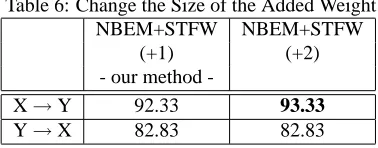
In this paper, giving a weight means to plus 1, here we change it to plus 2, and the result of the experiment is shown in Table 6.
Table 6: Change the Size of the Added Weight
NBEM+STFW NBEM+STFW
(+1) (+2)
our method
-X→Y 92.33 93.33
Y→X 82.83 82.83
While we make the twice of the weight, it is ef-fective in domain adaption of X → Y, but it is not effective in Y→X.
Negative Weights
In domain adaption, there may be some labeled data which creates an adverse result in learning. This is called ‘negative transfer’ (Rosenstein et al., 2005). Our method is designed on the based on ‘neg-ative transfer.’ That is, if the difference between class distributions of feature on the source domain and the target domain is quite big, we assign the fea-ture negative weight (−1), In order to investigate the effect of negative weights here, we make an experi-ment which did not assign negative weight. And its result is shown in Table7.
Table 7: The Effect of Negative Weight (NW)
NBEM+STFW NBEM+STFW
(with NW) (without NW) our method
-X→Y 92.33 93.00
Y→X 82.83 82.67
Without negative weight, although it is effective in domain adaption of X→Y, it is not effective of Y→X.
It can be confirmed that the accuracy is subtly changed by the way of setting weight and its value.
6 Conclusion
In this paper, for the domain adaption problems of document classification, we proposed a hybrid method of semi-supervised learning and feature weighted learning. NBEM is used to learn a clas-sifier, and then the learned classifier and SFTW re-construct training data, and then the final classifier is learned by using the reconstruct training data and NBEM again. As a result of experiment by using a part of 20 Newsgroups, the effect of our method was confirmed. As for challenges in the future, we need to discover an more appropriate setting way and a better size of weight.
References
John Blitzer, Ryan McDonald, and Fernando Pereira. 2006. Domain adaptation with structural correspon-dence learning. In EMNLP-2006, pages 120–128. John Blitzer, Mark Dredze, Fernando Pereira, et al. 2007.
Biographies, bollywood, boom-boxes and blenders: Domain adaptation for sentiment classification. In
ACL, volume 7, pages 440–447.
Olivier Chapelle, Bernhard Sch¨olkopf, Alexander Zien, et al. 2006. Semi-supervised learning, volume 2. MIT press Cambridge.
Minmin Chen, Kilian Q Weinberger, and John Blitzer. 2011. Co-training for domain adaptation. In
NIPS-2014, pages 2456–2464.
Wenyuan Dai, Gui-Rong Xue, Qiang Yang, and Yong Yu. 2007. Transferring Naive Bayes Classifiers for Text Classification. In AAAI-2007.
Thorsten Joachims. 1999. Transductive inference for text classification using support vector machines. In
ICML, volume 99, pages 200–209.
Takafumi Kanamori, Shohei Hido, and Masashi Sugiyama. 2009. A least-squares approach to direct importance estimation. The Journal of Machine Learning Research, 10:1391–1445.
Kanako Komiya and Manabu Okumura. 2011. Auto-matic Determination of a Domain Adaptation Method for Word Sense Disambiguation using Decision Tree Learning. In IJCNLP-2011, pages 1107–1115.
Kanako Komiya and Manabu Okumura. 2012. Au-tomatic Domain Adaptation for Word Sense Disam-biguation Based on Comparison of Multiple Classi-fiers. In PACLIC-2012, pages 75–85.
Shinsuke Mori. 2012. Domain adaptation in natural lan-guage processing (in japanese). The Japanese Society
for Artificial Intelligence, 27(4):365–372.
Kamal Nigam, Andrew McCallum, Sebastian Thrun, and Tom Mitchell. 2000. Text Classification from Labeled and Unlabeled Documents using EM. Machine
Learn-ing, 39(2/3):103–134.
Sinno Jialin Pan and Qiang Yang. 2010. A survey on transfer learning. Knowledge and Data Engineering,
IEEE Transactions on, 22(10):1345–1359.
Piyush Rai, Avishek Saha, Hal Daum´e III, and Suresh Venkatasubramanian. 2010. Domain adaptation meets active learning. In NAACL HLT 2010 Workshop
on Active Learning for Natural Language Processing,
pages 27–32.
Michael T Rosenstein, Zvika Marx, Leslie Pack Kael-bling, and Thomas G Dietterich. 2005. To transfer or not to transfer. In NIPS 2005 Workshop on Transfer
Learning, volume 898.
Kenji Sagae and Jun’ichi Tsujii. 2007. Dependency pars-ing and domain adaptation with lr models and parser ensembles. In EMNLP-CoNLL-2007, pages 1044– 1050.
Burr Settles. 2010. Active learning literature survey.
University of Wisconsin, Madison.
Hiroyuki Shinnou, Yoshiyuki Onodera, Minoru Sasaki, and Kanako Komiya. 2015. Active Learning to Re-move Source Instances for Domain Adaptation for Word Sense Disambiguation. In PACLING-2015, pages 156–162.
Anders Søgaard. 2013. Semi-Supervised Learning and
Domain Adaptation in Natural Language Processing.
Morgan & Claypool.
Masashi Sugiyama and Motoaki Kawanabe. 2011.
Ma-chine Learning in Non-Stationary Environments: In-troduction to Covariate Shift Adaptation . MIT Press.
Songbo Tan, Xueqi Cheng, Yuefen Wang, and Hongbo Xu. 2009. Adapting Naive Bayes to Domain Adapta-tion for Sentiment Analysis. In Advances in