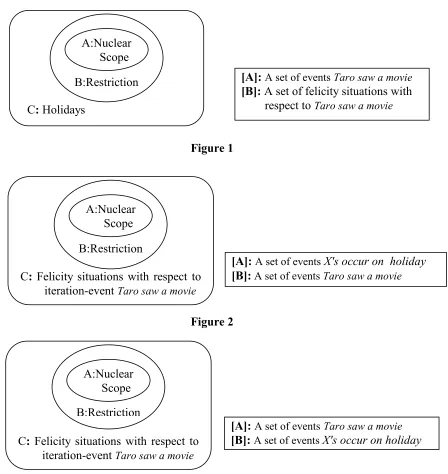
C: Holidays
B:Restriction A:Nuclear
Scope
[A]:A set of events Taro saw a movie [B]: A set of felicity situations with
respect to Taro saw a movie
Figure 1
C: Felicity situations with respect to
iteration-event Taro saw a movie
B:Restriction A:Nuclear
Scope
[A]: A set of events X's occur on holiday [B]: A set of events Taro saw a movie
Figure 2
C: Felicity situations with respect to
iteration-event Taro saw a movie
B:Restriction A:Nuclear
Scope
[A]: A set of eventsTaro saw a movie [B]: A set of events X's occur on holiday
Figure 3
(1) Kyuzitu-ni Taro-ga tokidoki eiga-o mi-ta.
holiday-on Taro-NOM sometimes movie-ACC see-PAST
“On holiday(s), Taro sometimes saw a movie.”
The first distinction in meanings involves the ambiguity in number (singular/plural) attributed
to Japanese nouns. The noun kyuzitu is ambiguous in this sense, meaning either a series of holidays
or a single holiday. In the first case, the adverbial phrase kyuzitu-ni provides a duration of time
While Nakamura regards the hierarchical structure primarily as a semantic one, we take this as being reflected as a syntactic structure.
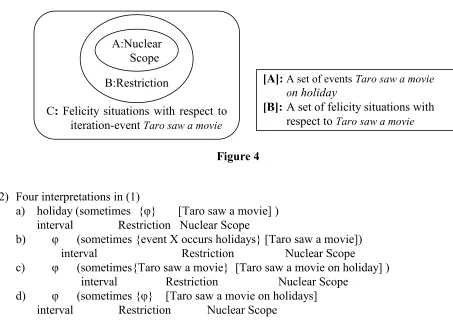
(4) is the syntactic structure we pose for the interpretation (2a) of sentence (1). The temporal
AdvP kyuzitu-ni, appearing at PP2, the uppermost position of the sentence structure and the place
for the 2nd Stratum accounted for in (3), provides a duration of time during which the events of
Taro’s seeing a movie are repeated. Note again that the noun kyuzitu is not marked for plurality.
(4) The syntactic structure for (2a)
(5) is the syntactic structure for other interpretations (2b, c, d) for sentence (1).
(5) The syntactic structure for (2b-d)
Presupposition in (2b) indicates ;
{event e occurs on holiday| e œ a set of events}
œ a set of events}). 4) Map alternatives on syntactic structure, after syntactic structure converge (see
(10))1. 5) Specify the variable x from the uttered sentence.
(10) "alternatives" structure in (2b)
According to this notation, we can determine the presupposition in (2c) as follows, whereas (2d) has no presupposition; in other words, all arguments are new information.
(11) Presupposition in (2c)
a. P-sets: a set of events.
b. Alternatives:{taro saw a movie on e| e œ a set of events}
From the analysis in alternative semantics, it is clear that the sentence with association with focus has two arguments. One is "alternative"(Presupposition) and the other is "the uttered sentence" (Proposition). Based on the discussion above, we can now specify the meaning of the
frequency ADVP tokidoki as follows:
(12) Given that P = [X [Y]F]1 and [[P]] = $eΠ,
Tokidoki(E, [[P]]) = Sometimes-When(E, λeΠ, Presupposition ([[P]])),
where Presupposition ([[P]]) is obtained by the procedure explained above.
5. Analysis for multiple meanings FAS in Japanese
From the discussions we have made so far, it is now apparent how the multiple ambiguity in sentences with a frequency adverb is derived; while there exists ambiguity as to the interval of repetition vs. temporal point of a single event denoted by the temporal AdvP, different focus interpretation further adds to ambiguity. The last task left to us is how to deal with the `frequency’ meant by the adverbs involved.
Åqvist et al. (1980) regards these adverbs, including always, sometimes, never, often, and
seldom, as an operator which takes as its arguments two predicates. Each operator specifies a proportion between two sets of relevant temporal units. Based on this framework, we formulate the semantics of some representative frequency adverbs as follows:
1Notice that we use "Presupposition" instead of "alternatives" avoiding confusion. Hereafter we use
References
Åqvist, L., Hoepelman, J., and Rohrer, C. Adverbs of Frequency. Time, Tense, and quantifiers, ed.
Rohrer. C. Max Niemeyer Verlag. Tübingen
Nakamura, C. 2001. Nihonfo-no Zikan Hyougen, Kuroshio Publishers, Tokyo
Rooth, M. 1985. Association with Focus. Ph.D. Thesis, University of Massachusetts at Amherst.
Amhrest MA.