Supervised and Semi-supervised Methods
based Organization Name Disambiguity
Shu Zhanga, Jianwei Wub, Dequan Zhengb, Yao Meng a, Yingju Xia a, and Hao Yu a
a
Fujitsu Research and Development Center
Dong Si Huan Zhong Rd, Chaoyang District, Beijing and 0086, China {zhangshu, mengyao, yjxia, yu}@cn.fujitsu.com
b
School of Computer Science and Technology, Harbin Institute of Technology No.92, Xidazhi Street, Harbin 150001, China
{jwwu, dqzheng}@mtlab.hit.edu.cn
Abstract. Twitter is a widespread social media, which rapidly gained worldwide popularity. Pursuing on the problem of finding related tweets to a given organization, we propose supervised and semi-supervised based methods. This is a challenging task due to the potential organization name ambiguity. The tweets and organization contain little information. The organizations in training data are different with those in test data, which leads that we could not train a classifier to a certain organization. Therefore, we induce external resources to enrich the information of organization. Supervised and semi-supervised methods are adopted in two stages to classify the tweets. This is a try to utilize both training and test data for this specific task. Our experimental results on WePS-3 are primary and encouraging, they prove the proposed techniques are effective in performing the task.
Keywords: Twitter, name ambiguity, online reputation management.
1
Introduction
Twitter is an online social networking and microblogging service, which rapidly gained worldwide popularity, with 200 million users as of 20111, generating over 200 million tweets and handling over 1.6 billion search queries per day2. How to manage this information to grasp the response of people to governmental policies, the feedback and comment of people on commercial products have received considerable attention in research community. There are some researches such as opinion mining, online reputation management, which focus on monitoring user generated media. One of the essential things of these researches is first to get the information which is related to the studied entity, such as product, company, or certain event.
This paper focuses on finding related tweets to a given organization. This is a challenging task due to the potential organization name ambiguity. For example, the name of company “Apple” which has a separate meaning fruit apple. The word “Amazon” could be used to refer
river or company. Filtering spurious name matches is important to effectively detect and analyze relevant contents that people say about the organization.
To overcome the problem that the tweets and organizations contain little information, we induce external resources to enrich the information of organization. The organizations in training data are different with those in test data, which leads that we could not train a classifier to a certain organization. Therefore, supervised and semi-supervised methods are adopted in
1
http://www.bbc.co.uk/news/business-12889048
2 http://blog.twitter.com/2011/08/your-world-more-connected.html
25th Pacific Asia Conference on Language, Information and Computation, pages 615–621
two stages to classify the tweets. This is a try to utilize both training and test data for this specific task.
The remainder of the paper is organized as follows: Section 2 describes the related work on name disambiguity. Section 3 gives overview of the problem and our methods. Section 4 presents supervised method to classify tweets. Section 5 introduces semi-supervised method to classify the tweets which is a step of modifying initial classification results gotten by supervised method. Section 6 gives the experiments and results. Finally section 7 summarizes this paper.
2
Related work
In recent years, online social networks such as Twitter have attracted much interest from the research community. Twitter differs from the traditional user generated media. It allows users to generate each message with no more than 140 characters. Little context information is available. Therefore, it is a challenge for monitoring and analyzing them.
Dan et al. (2011) focus on identifying relevant tweets for social TV, they propose a bootstrapping algorithm which uses a small manually labeled dataset, a large dataset of unlabeled messages, and some domain knowledge to derive a classifier to filter microblogging messages which discuss television show. They extract features which contain general terms commonly associated with watching TV.
WePS-3 Online Reputation Management3 held in 2010, aimed to identify tweets which are related to a given company. It provides standard training and test dataset that enable researchers to carry out and evaluate their methods (Amigó et al., 2010). For this task, the research of (Yerva et al., 2010) shows the best performance in the evaluation campaign. They adopt support vector machines (SVM) classifier with external resources, which includes Wordnet, metadata profile, category profile, Google set, and user feedback. To overcome the problem of tweets containing little context information, they create several profiles with external resources as a model for each company. Yoshida et al. (2010) classify organization names into “organization-like names” or “general-word-like names”. They categorize each query in the first stage, and categorize each tweet in the second stage using the rules customized for each class of queries. Kalmar (2010) adopts bootstrapping method to classify the tweets. The research of (García-Cumbreras et al., 2010) shows the named entities in tweets are appropriate for certain company names. Tsagkias et al. (2010) prove that a general classifier can be employed to predict the presence of any company in Twitter.
Perez-Tellez et al. (2011) propose term expansion to the ambiguous words and words which highly co-occur with it.
Our work is different from theirs: supervised and semi-supervised methods are utilized in different stages for the classification of tweets. For the task, the set of organization names in the training and test corpora are different. The model could not be trained for a certain organization. Therefore, our method aims to utilize both training data and the test data to improve the accuracy of the performance. In detail, the tweets are firstly classified by Maximum Entropy classifier trained on training data. Then Label Propagation Algorithm is utilized to classify tweets based on the test data.
3
Overview
3.1
Problem Statement
Given a set of tweets and an organization name, the task is to judge that each tweet in the set is related to the organization or not.
3
http://nlp.uned.es/weps/
The input information per tweet contains: the tweet identifier, the entity name, the query used to retrieve the tweet, the author identifier and the tweet content. For each organization in the dataset, it gives the organization name and its homepage URL.
The output per tweet is True or False tag corresponding to related or non-related with the given organization.
Compared with the traditional classification task, this task has some challenges. One is tweets and organization name contain little information, context information is limited. The other is the set of organization names in the training and test data are different. That means no organization is present in both training data and test data, the features or model built on training data is not very suitable for the test data.
3.2
Our Method
Overcome the challenges of this task, we import external resources to get more information about the organization, such as related homepage, related Wikipedia page, and GoogleSet. We propose to combine supervised and semi-supervised methods to classify the tweets, aims to utilize the training data and at the same time dig out the proper information in the test data. The system includes the following parts:
(1) Features extraction and representation. It includes both the features from the tweets and the features of organization from external resources.
(2) Maximum entropy classifier. It is trained with the features extracted in Step (1) on the training data.
(3) Label Propagation. It includes two parts: seeds selection and graph construction. We select seeds based on the result gotten in Step (2). For one certain organization, we construct graph based on the relationship between each tweets on test data.
(4) Rule-based modification. Here, we only give one rule which processes the organization name containing more than one word, such as “Yale University”. We think that “Yale University” contains more semantic information to distinguish it from other entity. The rule is if the tweet contains the full entity name (more than one word) then it is tagged as “True”, treated as related with the organization.
In the following section, we give the details on how to represent and extract feature, how to build a Maximum entropy classifier and how to utilize Label Propagation algorithm to mine the test data to improve the accuracy of the performance.
4
Supervised Classifier
With the training data, we aim to train a classifier with generic features. The features should not be too general with the preference to tag tweets as True, or too narrow with the preference to tag tweets as False. Furthermore, the features should be generated automatically, with no manual labelling.
4.1
Features Extraction
The features extraction includes tweets features and organization features. In this step, we pay more attention to the organization information, which is expanded with external resources. We induce related homepage, related Wikipedia page, and GoogleSet in the following way to get the features to represent the organization.
Homepage
The URL of each organization is provided in the input. The words in homepage are more related and indicative to the organization. Therefore, these words (removed the stopwords) are chosen to represent the organization. However, some organization webpages are created by java-scripts or even flash, no text information could be extracted from them at present. Therefore, we try to get other external resources.
semi-Table 1: Performance of Classification
System P+ R+ F+ P- R- F- Acc
Baseline 1 1 0 0 0.57 1 0.66 0.57 Baseline 2 0.43 1 0.53 1 0 0 0.43 ME 0.64 0.45 0.44 0.63 0.81 0.66 0.71 ME+LP 0.62 0.54 0.48 0.64 0.65 0.57 0.74 ME+LP+Rule 0.63 0.57 0.49 0.65 0.64 0.58 0.75
Two Baseline systems have been induced, which tags all tweets as related (True) or non related (False). Compare our three systems, the performance is improved by adding LP algorithm and rule step by step. For the F-measure of related tweets, it improves 4%. The recall is improved 9% with a little loss of precision. The whole accuracy is also improved by 3%. It proves that combining supervised and semi-supervised methods is effective. The rule described in Section 3.2: if organization name consisting of more than one word, then the tweet contains full name is treated as related to this organization. Though only one piece of rule is used, it really improves almost all measurement value. It shows that important keywords are good features to distinguish entity.
Compared our systems with WePS participant system, our systems performance are less than the system of (Yerva et al., 2010). Its accuracy value is 0.83. Its system induces manually constructed UserFeedback profile. With only homepage as features, its F-measure of related tweets is 0.3. Different from theirs, our systems are all automatically.
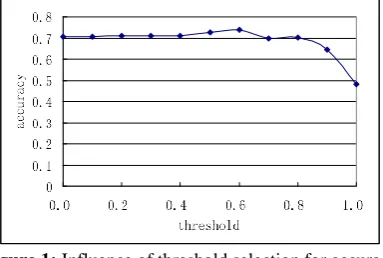
Figure 1 shows the influence of threshold selection for the accuracy, the threshold is described in formula (3).
Figure 1: Influence of threshold selection for accuracy
From Figure 1, it is concluded that the performance is decreased by choosing all organizations to be classified again by LP algorithm. As we known, the performance of supervised methods is better than semi-supervised methods. The selection of organization to be classified by LP is important.
7
Conclusion
In this paper, we probe into the problem of finding related tweets to a given organization. This is a challenging task due to the potential organization name ambiguity. This task is more challenging caused by two problems: the tweets and organization contain little information, and the organizations in training data are different with those in test data. We induce external resources to enrich the information of organization. Supervised (ME) and semi-supervised (LP) methods are adopted in two stages to classify the tweets. This is a try to utilize both training and test data for this specific task. Our experimental results on WePS-3 are primary and encouraging, they prove the proposed techniques are effective in performing the task.
There is still a gap needed to be filled by further improving these techniques. For example, the performance can be improved through the semantic expansion of words using Ontology.
References
García-Cumbreras, M. A., M. García-Vega, F. Martínez-Santiago, and J. M. Peréa-Ortega. 2010. SINAI at WePS-3: Online Reputation Management. Proceedings of the Third Web People Search Evaluation Workshop.
Yerva, S. R., Z. Miklós, and K. Aberer. 2010. It was Easy, when Apples and Blackberries were only Fruits. Proceedings of the Third Web People Search Evaluation Workshop.
Tsagkias, M., and K. Balog. 2010. The University of Amsterdam at WePS3. Proceedings of the Third Web People Search Evaluation Workshop.
Kalmar, P.. 2010. Bootstrapping Websites for Classification of Organization Names on Twitter. Proceedings of the Third Web People Search Evaluation Workshop.
Yoshida, M., S. Matsushima, S. Ono, I. Sato, and H. Nakagaw. 2010. ITC-UT: Tweet Categorization by Query Categorization for On-line Reputation Management. Proceedings of the Third Web People Search Evaluation Workshop.
Zhu, X. J., and Z. Ghahramani. 2002. Learning from Labeled and Unlabeled Data with Label Propagation. Technical Report CMU-CALD-02-107, Carnegie Mellon University.
Amigó, E., J. Artiles, J. Gonzalo, D. Spina, B. Liu, and A. Corujo. 2010. WePS-3 Evaluation Campaign: Overview of the Online Reputation Management Task. Proceedings of the Third Web People Search Evaluation Workshop.
Jaynes, T.. 1957. Information Theory and Statistical Mechanics. Physics Reviews, (106), 620-630.
Perez-Tellez, F., D. Pinto, J. Cardiff, and P. Rosso. 2011. On the Difficulty of Clustering Microblog Texts for Online Reputation Management. Proceedings of the 2nd Workshop on Computational Approaches to Subjectivity and Sentiment Analysis, ACL-HLT, pp. 146-152. Dan, O., J. Feng, and B. D. Davison. 2011. A Bootstrapping Approach to Identifying Relevant
Tweets for Social TV. Proceeding of fifth International AAAI Conferenc Weblogs and Social Media (ICWSM), pp. 462-465.