A Corpus-based Approach to the Interpretation of
Unknown Words with an Application to German
Stefan Klatt
∗∗Austrian Research Institute for Artificial Intelligence
Freyung 6/6, A-1010 Vienna, Austria [email protected]
Abstract
Usually a high portion of the different word forms in a corpus receive no reading by the lexical and/or morphological analysis. These unknown words constitute a huge problem for NLP analysis tasks like POS-tagging or syntactic parsing. We present a parameterizable (in principle language-independent) corpus-based approach for the interpretation of unknown words that only needs a tokenized corpus and can be used in both offline and online applications. In combination with a few linguistic (language-dependent) rules unknown verbs, adjectives, nouns, multiword units etc. are identified. Depending on the recognized word class(es), more detailed morphosyntactic and semantic information is additionally identified in opposite to the majority of other unknown word guessing methods, which only uses a very narrow decision window to assign an unknown word its correct reading respective Part-of-Speech tag in a given text. We tested our approach by experiments with German data and received very promising results.
1.
Introduction
According to (Schmid et al., 2004), usually 15-25% of the different word forms in a corpus receive no reading by the lexical and/or morphological analysis. These unknown words constitute a huge problem for NLP analysis tasks like POS-tagging or syntactic parsing.
In recent years several approaches were suggested to over-come this problem. Among them are symbolic approaches such as automatic rule induction (Mikheev, 1997) and de-cision tree-based methods (Orphanos and Christodoulakis, 1999) as well as statistical methods of different kinds. The approach of (Nakagawa et al., 2001) relys on support vector machines with substrings and surrounding context as rele-vant features. Comparing their approach on English data with the one of (Brants, 2000), they perform slightly bet-ter, which is also not surprising since the latter approach only uses a linear interpolation approach of suffixes with fixed length. (Tseng et al., 2005) propose a variety of new morphological unknown-word features based on an ana-lytic study of POS tagging of different varieties of Man-darin Chinese. With an averaging character length of 2.4 compared to 7.7 for English, approaches like the former one seems to be inappropriate for such languages.
Nominating the winner of these approaches is impossible because of the following two reasons. Firstly, not all ap-proaches were evaluated on the same language and cor-pus data. Secondly, some of the approaches define an un-known word (UW) in different ways. In this work, we de-fine an UW as a word that receives no reading by the lexical and/or morphological analysis. (Nakagawa et al., 2001) and (Tseng et al., 2005) define UWs as words of the test set that do not occur in the training set. This also explains the given distribution of UWs in (Tseng et al., 2005) of their German experiment (more than 50% ordinary nouns) that totally dif-fers of the one in our experiments (more than 50% proper nouns). Furthermore our approach differs from the former ones in that we are not interested in assigning an UW its correct reading in a text. In our opinion this could be done better by using a state-of-the-art POS tagger by offering the
possible readings of which the POS tagger has to choose the best solution. We are mainly interested in identifying all readings of an UW as well as other of its morphosyn-tactic and semantic features. As a result of this we are able to compute derived word forms of UWs with regular in-flection patterns and extend the lexical knowledge by these informations in a semi-automatically way.
For such tasks we consider approaches that only uses a one word respective affix window as inappropriate. To our knowledge (i) it would be impossible to interpret unknown German attributive adjectives (ADJA) with the suffixes -e or -en correctly since these suffixes are also possible Ger-man verb suffixes, and (ii) if a word has more than one read-ing only the one with the most probable readread-ing will be as-signed in all cases. But if we combine simple corpus-based information with some linguistic knowledge it will be no problem to assign the ADJA hehren (engl. noble) and the verb wehren (engl. resist) their correct readings.
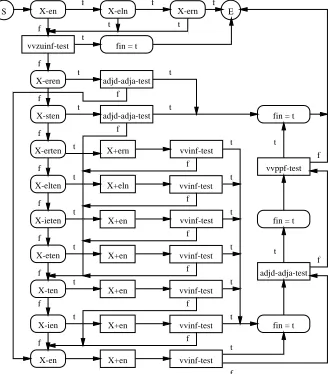
The remainder of this paper is organized as follows: In the next section we describe several tests for identifying differ-ent subclasses (e.g. finite and infinite verb forms) of open word classes such as nouns (N), lexical verbs (VV) and ad-jectives (ADJ). In Section 3 we give a sketch how these tests are integrated into the whole system, before we eval-uate our approach in Section 4. Section 5 concludes with some worthwhile extensions.
2.
Architecture of Our Approach
Our approach consists of several corpus-based tests that
only need a tokenized corpus. The tests are combined
depending on given orthographical and/or morphological properties as well as on the so-far received results during the application history. Due to space limitations we can only describe the most important tests in this paper.
2.1. Word class tests
2.1.1. Tests for adjective readings
(1) das sch¨one/ADJA Genua
the beautiful Genoa
(2) Genua ist sch¨on/ADJD.
Genoa is beautiful.
In the majority of the cases an adjective occur more often as ADJA with one of the five suffix endings -e, -em, -en, -er, and -es than as ADJD. Furthermore an ADJA is mostly left adjacent to a noun. Since a German noun usually starts with
an uppercase letter we developed the testadjd-adjafor
identifying an ADJD reading that has to fulfill the condi-tions that are indicated in (3). The corresponding parame-ters were determined by several test runs.
(3)
Parameter Threshold
pos-ratio 50.0
neg-ratio 10.0
adjd-adja-ratio 100
For a given ADJD candidate it will be computed how ten it occurs and its five possible ADJA forms and how of-ten the ADJA forms are followed by an uppercase writof-ten word (assuming to be a noun) in the chosen corpus (cf. the
values of:adja#,:adjd#, and:adja+n-percin the
examples).
If the condition :adjd#:adja# ≥adjd-adja-ratioholds the
test will be immediately terminated without assigning an ADJD reading to the word, that would be the case for the adverb schließlich (engl. finally) in (4). The test will be positively terminated if an uppercase written word follows
in more thanpos-ratio% of the cases as for the
candi-date hehr (engl. noble) as in (5)1. Otherwise the test will
also be neatively terminated if not more thanneg-ratio
% of the right adjacent words are uppercase written words as for the candidate wehr (verb stem of engl. resist) in (6).
(4) (adjd-adja-test "schließlich") nil 0.0 (:lemma "schließlich") (:loop 1 :adja+n-perc 0.0
:adjd# 7935 :adja# 3)
(5) (adjd-adja-test "hehr") "ADJD" 1.0 (:lemma "hehr") (:loop 1 :adja+n-perc 94.48
:adjd# 4 :adja# 145)
(6) (adjd-adja-test "wehr") nil 0.0 (:lemma "wehr") (:loop 1 :adja+n-perc 0.49
:adjd# 4 :adja# 611)
In German, many adjectives have also a verb reading. In such a case the former test fails, since verb readings are not very often followed by an uppercase written word. There-fore we extended the test by deleting all words that ends with a possible verb suffix (-en and -e) and apply the same
1
A result of any of our tests is a three or a four tupel with (i) the categorial result of the test respective the valuenilif the test failed, (ii) a confidence factor (abbreviated as CF from now on) ranging from 0.0 to 1.0, (iii) further morphosyntactic information (optional), and (iv) frequency values of relevant test values.
procedure as before to the remaining candidate set in a
sec-ond loop2. This enables us to assign the word erkannt (engl.
recognized) an ADJD reading as in (7) as well as different
verbal readings by some of our verbal tests described in Section 2.1.2.
(7) (adjd-adja-test "erkannt") "ADJD" 1.0 (:lemma "erkannt") (:loop 2 :adja+n-perc 100.0
:loop 1 :adja+n-perc 17.46 :adjd# 1126 :adja# 504))
2.1.2. Tests for verb readings
In opposite to German ADJA readings that usually have a regular inflection paradigm, some German finite verbs (VVFIN) and past participle forms (VVPP) have an irreg-ular inflection pattern, for which the development of good recognition strategies is much more difficult than for regu-lar verb forms. In case of reguregu-lar VVFIN candidates our goal is to find a derived word form in a secure context. Therefore we cut off possible verbal suffixes and try to find
more than n occurrences (e.g.n >1) of the infinitive form
with a preceding infinitive marker (e.g. zu wehren next to a sentence end marker) in the corpus (cf. (8)). If the verb candidate starts with a known separable prefix we have to incorporate the infinitive marker into it (e.g. einzukehren (engl. to stop for a bite to eat), cf. (9)).
(8) (uwi "wehren") (("VVFIN" 1.0
(:lemma "wehren" :inf-suffix "en" :num pl :pers (1 3) :tempus praes ...)) ("VVINF" 1.0
(:lemma "wehren" ...)))
(9) (uwi "einkehrte") (("VVFIN" 1.0
(:vpfx "ein" :lemma "einkehren" :inf-suffix "en" :num sg
:pers (1 3) :tempus praet...)))
In (8) and (9), we combined the relevant corpus-based tests in (10) and (11) by stripping off linguistically relevant suf-fixes as part of our unknown word interpreter (uwi) that combines the several tests as described in more detail in Section 3.
(10) (vvinf-test "wehren") "VVINF" 1.0
(:lemma "wehren" :inf-suffix "en") (:zu-matches 67 :matches 573)
(11) (vvizu-test "einzukehren") "VVIZU" 1.0
(:lemma "einkehren" :vpfx "ein") (:matches 57))
In the case of irregular VVFINs we consider a secure con-texts as the one in which the finite verb occurs in verb sec-ond position after an uppercase written personal pronoun
2
(assuming to be in sentence-initial position) of the set{Ich Du Er Es Man Wir}or before the lowercase written pro-noun er. Since we do not find many of such configurations in a corpus, we have also defined other more insecure con-texts such as lowercase-written personal pronouns to the immediate left or reflexive pronouns to the immediate right (see (12)).
(12)
Parameter Threshold
left-sure-forms {Ich...}
left-unsure-forms {ich...}
right-sure-forms {er}
right-unsure-forms {sich...}
right-sz-forms {. ,}
nearly-sure-ratio 7.0
sure-ratio 0.25
sz-right-ratio 30.0
Given a context window of 1 to the left and
to the right, the number of adjacent words
in the subsets left-(un)sure-forms and
right-(un)sure-forms are assigned to the value
(un)sure-matches as well as the numbers of
right-sz-formsto the valuesz-matches. The test positively terminates with CF 1.0 if one of the following two conditions is fulfilled.
(C1) sure−matches∗100
|cand| ≥sure-ratio
(C2) (sure−matches+unsure|cand|−matches)∗100 ≥nearly-sure-ratio
In (13) this leads to the correct assignment of one irregular VVFIN form of the lemma blasen (engl. blow).
(13) (vvfin-test "bl¨ast") "VVFIN" 1.0
(:num sg :pers (2 3)
:modus (konj ind) :tempus praet) (:sure-matches 9 :unsure-matches 21
:sz-matches 30 :matches 171)
If the test fails, then it will be assigned a VVFIN reading with a CF of 0.6 if both conditions (C3) and (C4) are ful-filled (assuming to find a verb with a separable verb prefix in verb end position as in (14)).
(C3) The word starts with a known separable verb prefix.
(C4) (sz−matches+unsure|W ortargument−matches)| ∗100 ≥sz-right-ratio
(14) (vvfin-test "abkamen") "VVFIN" 0.6
(:num pl :pers (1 3)
:modus (konj ind) :tempus praet) (... :sz-matches 2 :matches 3)
The test for the identification of verb participle readings (tag VVPP) works in a similar way as the last test, since it also occurs in verb end position with a comma, sentence end marker or other typical element to its right. Due to the limited space of this paper it is impossible to explain the relevant parameter settings here in detail. Instead we
present some correct interpretations and explain why the correct reading was assigned.
In (15) we stripped off the circumfix ge-t (as one of two possible regular past participle circumfixes in German) from the candidate, before we successfully applied the test vvinf-test(cf. (8)) to the rest of the string. In seven cases this word was followed by the word worden, the past participle form of the passive auxiliary werden that tells us that its left adjacent word is definitely a passivizable VVPP reading that builds the perfect with the auxiliary have, a very simple and elegant judgement that is superior to any statistical approaches. For the same reasons we correctly assign a VVPP reading to the word zusammengestellt (engl.
putting together) in (16) by additionally stripping off the
known separable verb prefix zusammen. In (17) we also as-sign the correct reading, but are not able to identify the base form because of an orthographic irregularity.
(15) (vvpp-test "gesteigert") "VVPP" 1.0
(:lemma "steigern" :inf-suffix "n" :av "haben" :passiv 7)
(16) (vvpp-test "zusammengestellt") "VVPP" 1.0
(:lemma "zusammenstellen" :vpfx "zusammen"
:av "haben" :passiv 14)
(17) (vvpp-test "zusammengefaßt") "VVPP" 1.0
(:av "haben" :passiv 7)
2.1.3. Tests for noun readings
In the case of possible noun readings we developed tests for identifying multiword units (MWUs), locations (LOC), and to distinguish proper noun readings (NE) from ordinary noun readings (NN). In the latter case we make use of the observation that NNs are often preceded by a determiner in opposite to NEs. As a consequence we developed the testnn-testthat counts how often a noun candidate is preceded by an determiner element.
If this is true for more thandet-left-max%(currently
10%), then a NN reading with CF 1.0 will be assigned. If
it is less than det-left-min% (currently 1%), then a
NE reading with CF 1.0 will be assigned. If it is in
be-tween these two values, then both readings are assigned3
(cf. the correct interpretations the person names Berlusconi and Kohl, the NN readings of Kohl (engl. cabbage) and
Salat (engl. salad) in (18)-(20). An interpretation of other
morphosyntactic noun features (e.g. the automatic identifi-cation of plural suffixes of NNs) is a more complex problem because of several reasons. But we are looking forward to determine a few of them (e.g. gender) by an extension of this test in the near future.
(18) (nn-test "Berlusconi") "NE" 1.0
(:det-hits 0 matches 76)
3
4.1. Experiment 1
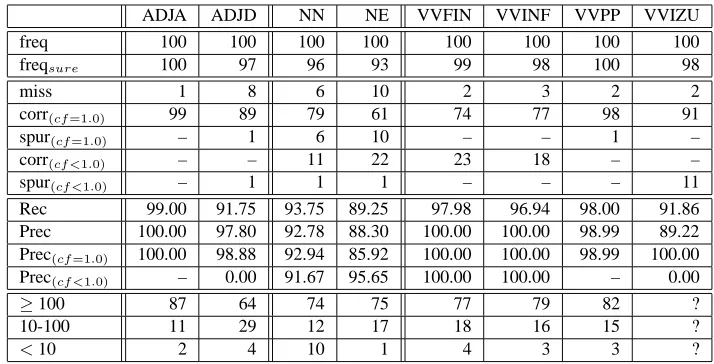
Table 1 shows the result of the first experiment. The first row show the major POS tags of different ADJ, N and VV readings. For each of such a tag we selected the first 100 different word forms of the STZ corpus that were tagged by the TreeTagger (Schmid, 1999) accordingly (row freq). The row freq-sure show how many of these words were cor-rectly tagged by the TreeTagger. The next nine rows show the number of missing, correct and spurious analyses (dis-tinguishing analyses with a CF of 1.0 from lower ones) and
the corresponding recall (corrcorr+miss∗100%) and precision
(corrcorr+spur ∗100%) rates. The last three rows show how
often these words occur in the given frequency intervals in the STZ corpus.
The results for ADJA, VVFIN, VVINF, and VVPP are nearly perfect. Considering the eight missing ADJD read-ings, we had one irregular form, one with a major ADV reading, and one that only occur two times in our test set. Furthermore we had five words, for which we were able to assign correct ambiguous readings (VVFIN, VVPP und VVIMP). Since we know that VVPP have often an addi-tionally ADJD reading we can increase the recall for ADJD prognoses by a corresponding extension. The reason for the missing and spurious NN and NE assignments is mainly the distribution of the left adjacent determiners. We had a few plural NN forms in the test set that were preceded by only a few determiners. On the other hand we had some NEs that are usually preceded by a determiner (country names as die Schweiz (engl. Switzerland) and river names as der
Rhein (engl. rhine)). Furthermore it is difficult to assign
the correct reading to words that occur less than 10 times in a corpus.
4.2. Experiment 2
Approx. 29 000 tokens of the STZ corpus are unknown to the morphology component DMOR. In this experiment we randomly selected five 100 word subsets of these UWs that occur in one of five specified frequency ranges that are in-dicated in the first column of Table 2. We manually an-notated each of these words by its major reading (although ambiguous readings are sometimes possible). In ten cases (e.g. Joke as foreign material (FM) and as loan word (NN)) we assigned more than one reading as indicated in the sec-ond column. The next five columns contain the number of correct, missing, and spurious assignments and the corre-sponding precision and recall rates as computed as before. As the scores show we only see significiant poorer results for the last subset that is also not surprising. Assigning every word that only occur one or two times in a corpus its correct reading is nearly an impossible task.
The hardest problem in this experiment was the distinc-tion between NN and NE readings. Furthermore 416 words of the whole test corpus belongs to one of these readings. Therefore we evaluated these 416 words once again
sep-arately. Table 3 shows the corresponding results. The
first column contains the manually annotated tags. There we find the two coarse-grained tags NN and NE, but also more fine-graided ones as locations NE(LOC). We anno-tated nouns that can be sometimes also assigned a FM tag by NE(FM) und NN(FM) like Brookfields/NE(FM) and
freq corr miss spur Rec Prec UW100−500 100 87 13 37 87.00 70.16
UW51−100 105 95 10 40 90.48 70.37
UW26−50 102 92 10 38 90.20 70.77
UW11−25 102 91 11 25 89.22 78.45
UW1−10 101 76 25 32 75.25 70.37
P
510 438 72 146 85.88 75.00
Table 2: Evaluation of real UWs of the STZ corpus
Hardliner/NN(FM), NEs with a NN base morphem by the
tag NE(NN) and NEs that usually preceded by a determiner by the tag NE(DEF). NEs as part of company name were annotated as NE(CO) and acronyms as NE(ABK). Spelling errors were annotated by the tags NE(RF) and NN(RF). The number of the correct NE resp. NN assignments are indicated in the first column of the five two partitioned columns, the number of wrong assignments in the second
column. Looking at the subset freq101−500, this would
mean that 60 of the 70 given NE readings were correctly recognized as well as all six NN readings.
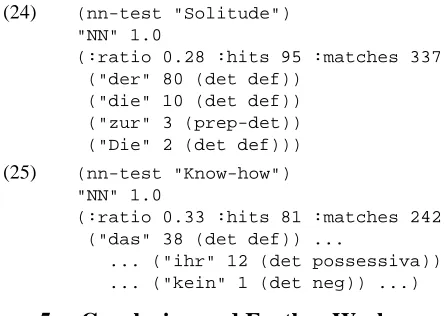
Comparing the wrong analysis in (24) with the correct one in (25), we see how we can avoid such errors in the fu-ture. Instead of only counting left adjacent determiners, it would be better to partition them into definite (def) and non-definite ones and take special care of the latter ones.
(24) (nn-test "Solitude") "NN" 1.0
(:ratio 0.28 :hits 95 :matches 337 ("der" 80 (det def))
("die" 10 (det def)) ("zur" 3 (prep-det)) ("Die" 2 (det def)))
(25) (nn-test "Know-how") "NN" 1.0
(:ratio 0.33 :hits 81 :matches 242 ("das" 38 (det def)) ...
... ("ihr" 12 (det possessiva)) ... ("kein" 1 (det neg)) ...)
5.
Conclusion and Further Work
We presented a simple parameterizable corpus-based ap-proach that only needs a tokenized corpus for the interpre-tation of unknown words and demonstrated its adequacy for German data. Depending on the recognized word class other relevant morphosyntactic and semantic information is identified. As a worthwhile extension we plan to integrate more sophisticated recognition strategies to identify addi-tional information (e.g. gender information of nouns). Fur-thermore we believe that this approach is also very helpful for the task of named entity recognition. Therefore we have to define tests for the recognition of person and organisation names.
Acknowledgements
ADJA ADJD NN NE VVFIN VVINF VVPP VVIZU
freq 100 100 100 100 100 100 100 100
freqsure 100 97 96 93 99 98 100 98
miss 1 8 6 10 2 3 2 2
corr(cf=1.0) 99 89 79 61 74 77 98 91
spur(cf=1.0) – 1 6 10 – – 1 –
corr(cf <1.0) – – 11 22 23 18 – –
spur(cf <1.0) – 1 1 1 – – – 11
Rec 99.00 91.75 93.75 89.25 97.98 96.94 98.00 91.86 Prec 100.00 97.80 92.78 88.30 100.00 100.00 98.99 89.22 Prec(cf=1.0) 100.00 98.88 92.94 85.92 100.00 100.00 98.99 100.00
Prec(cf <1.0) – 0.00 91.67 95.65 100.00 100.00 – 0.00
≥100 87 64 74 75 77 79 82 ?
10-100 11 29 12 17 18 16 15 ?
<10 2 4 10 1 4 3 3 ?
Table 1: First 100 different word forms of selected POS classes from the STZ corpus
freq101−500 freq51−100 freq26−50 freq11−25 freq1−10 freq1−500
NE NN NE NN NE NN NE NN NE NN NE NN
NE 31 – 45 1 44 1 34 1 32 4 186 7
NE(LOC) 21 – 17 – 17 1 14 – 10 1 80 2
NE(FM) 7 – 3 – 4 1 12 4 5 4 31 9
NE(NN) – 4 – 4 – – – 2 2 2 2 10
NE(DEF) – 4 – 1 – 2 – 1 – 1 – 9
NE(CO) 1 1 – 1 – – 2 2 – 1 3 5
NE(ABK) – 1 – 2 1 1 – – – – 1 4
NE(RF) – – – – – – – – – 1 – 1
P
NE 60 10 65 9 66 6 63 10 49 12 303 47
NN NE NN NE NN NE NN NE NN NE NN NE
NN 3 – 9 – 10 1 11 – 10 4 43 4
NN(FM) 3 – 3 – 2 2 1 – 2 – 11 2
NN(RF) – – – – – – – – – – 2 3
P
NN 6 – 12 – 12 4 12 – 14 7 56 10
Table 3: Evaluation of unknown nouns
6.
References
T. Brants. 2000. TnT - a Statistical Part-of-Speech Tagger. In Proc. of the 6th Applied Natural Language Processing
(ANLP-2000), Seattle.
S. Klatt. 2005. Kombinierbare Textanalyseverfahren
f¨ur die Korpusannotation und Informationsextraktion.
Ph.D. thesis, Universit¨at Stuttgart.
A. Mikheev. 1997. Automatic Rule Induction for
Unknown-word Guessing. Computational Linguistics, 23(3).
T. Nakagawa, T. Kudoh, and Y. Matsumoto. 2001. Un-known Word Guessing and Part-of-Speech Tagging Us-ing Support Vector Machines. In Proc. of the Sixth
Nat-ural Language Processing Pacific Rim Symposium (NL-PRS2001), Tokyo, Japan.
G. S. Orphanos and D. N. Christodoulakis. 1999. POS Disambiguation and Unknown Word Guessing with De-cision Trees. In Proceedings of the 9th Conference on
European Chapter of the Association for Computational Linguistics, Bergen, Norway.
A. Schiller. 1995. DMOR: Benutzeranleitung. Technical
report, Institut f¨ur maschinelle Sprachverarbeitung, Uni-versit¨at Stuttgart.
H. Schmid, A. Fitschen, and U. Heid. 2004. SMOR: A German Computational Morphology Covering Deriva-tion, ComposiDeriva-tion, and Inflection. In Proc. of the 4th
International Conference on Language Resources and Evaluation (LREC 2004), Lisbon, Portugal.
H. Schmid. 1999. Improvements in part-of-speech tag-ging with an application to German. In S. Armstrong, K.W. Church, P. Isabelle, S. Manzi, E. Tzoukermann, and D. Yarowsky, editors, Natural Language Processing
Using Very Large Corpora. Kluwer, Dordrecht.
H. Tseng, D. Jurafsky, and C. Manning. 2005. Morpholog-ical features help POS tagging of unknown words across language varieties. In Proc. of the Fourth SIGHAN
Work-shop on Chinese Language Processing, Jeju Island,