Automatic Detection of Well Recognized Words in Automatic Speech
Transcriptions
Julie Mauclair, Yannick Est`eve, Simon Petit-Renaud, Paul Del´eglise
Laboratoire d’Informatique de l’Universit´e du Maine Le Mans, France
{mauclair,esteve,petit-renaud,deleglise}@lium.univ-lemans.fr
Abstract
This work adresses the use of confidence measures for extracting well recognized words with very low error rate from automatically transcribed segments in a unsupervised way. We present and compare several confidence measures and propose a method to merge them into a new one. We study its capabilities on extracting correct recognized word-segments compared to the amount of rejected words. We apply this fusion measure to select audio segments composed of words with a high confidence score. These segments come from an automatic transcription of french broadcast news given by our speech recognition system based on the CMU Sphinx3.3 decoder. Injecting new data resulting from unsupervised treatments of raw audio recordings in the training corpus of acoustic models gives statistically significant improvement (95% confident interval) in terms of word error rate. Experiments have been carried out on the corpus used during ESTER, the french evaluation campaign.
1.
Introduction
Confidence measures are used on various applications of speech processing like speech recognition(Wessel and Ney, 2005; Cox and Dasmahapatra, 2002), dialog (San-Segundo et al., 2001) and language identification (Metze et al., 2000). They help to decide if an hypothesis is right or wrong.
Moreover, to train models for a new recognition system, we need large amounts of speech data. Nowadays, large collections of speech data are available but unfortunately, most of them are without transcriptions and has to be tran-scribed manually. Manual transcription of audio recordings is high-cost, which limits the size of the training corpora for the models. Performances of a speech recognition system rise mainly from the quality of the acoustic models. These stastistical models are more robust as their training corpora are important and close to the application task. A low-cost method to increase the size of the training corpora is to add automatic transcriptions (Del´eglise et al., 2005) but this method can introduce ’noise’ in modeling due to errors in the recognizer transcriptions. For filtering those tran-scriptions, we can use closed captions (Chen et al., 2004). But this method imposes additional information about tran-scriptions. To avoid this problem, we can use confidence measures to select training hypothesis. In (Wessel and Ney, 2005), the authors use confidence measure estimated with posterior probabilities given by the recognizer. A disad-vantage of word posteriors is the strong sensitivity of this measurement to the topology of the search space on which it is computed. This topology is affected by heurisitcs used during the search space generation to reduce its size and make the recognition possible on a reasonable time. More-over, non negligible time processing is needed to compute word posteriors.
We propose in this article a preliminary study for automatic detection of well recognized words with confidence mea-sures which are easilly computable and not affected by the search space size before testing word posteriors as
confi-dence measure for the same task. Those measures come from two parts of the recognizer in order to merge them usefully. While the first measure is based on acoustic like-lihood, the other one is computed from the language model thanks to the observation of the back-off behavior. We de-velop a fusion method to use a single metric for filtering. We evaluate the measures quality (fusion and single ones) on french broadcast news by using the Normalised Cross Entropy (NCE). We compare them by testing their ability to minimize the WER at constant rejection rate. We use the best fusion measure to choose audio segments which are automatically transcribed by our recognizer. The add of these data resulting from automatic treatments in the train-ing corpus of acoustic models is used to improve our system performances. Finally, we show a new measure improving word posteriors taken as a confidence measure in terms of NCE which let us believe further future improvements for filtering data.
2.
Confidence measures
Let a set composed ofNrecognized words{w1, . . . , wN}. Each wordwis associated with a confidence measurem(w)
following suitable properties: the measure should be in the usual domain[0,1]and the measure should be interpretable as a probability that the wordwis correct. In consequence of the last property, we have: N1 PN
i=1m(wi) ≈ CWRR,
where CWRR (Correct Word Retained Rate) is the correct recognition rate on the emitted words (deletions are not counted).
2.1. Acoustic confidence measure
This measure is based on the comparison of the acoustic likelihood provided by the speech recognition system for a given hypothesis to the one that would be provided by an unconstrained phone loop model (Cox and Dasmahapatra, 2002):
m∗ac(w) = 1
wherewis the recognized word withNf frames,Y is the sequence of acoustic observations,P(Y|λC)is the acoustic score given by the recognizer model, andP(Y|λL)is the acoustic score given by an unconstrained phone loop. The measure proposed above does not belong to [0,1]. Thus, we propose to add a new normalization using the sigmoid-like transformation presented at equation 2:
mac(w) =
expmac(w)−µ σ
+a
expmac(w)−µ σ
+ 1
(2)
whereµ,σ are the average and the standard deviation of the initial acoustic measure anda= 2CWRR−1: the ond property approximation (see the begining of the sec-tion) with the development corpus.
2.2. Language confidence measure
Usually, a speech recognition system combines scores pro-vided by acoustic models with probabilities given by a n-gram language model. Section 2.1. presented a confidence measure to evaluate the relevance of the acoustic models. It seems interesting to have an equivalent measure for the language model. In this part, we introduce a new measure designed for back-offn-gram language models.
In the linguistic confidence measure we introduce, we propose to use as information the LM back-off behavior (LMBB) (Uhrick and Ward, 1997): a given word recog-nized with a given left context is associated with the highest order ofn-grams seen in the training corpus with this word and this context. For example, if the sequence of words ’it is the ninth time’ is recognized using a quadrigram model and if the quadrigram [is the ninth time] was observed in the training corpus, ’time’ will be associated with the or-der 4. But if this quadrigram was not observed, whereas the trigram [the ninth time] was, ’time’ will be associated with the order 3. This is recurrent down to order 1 (or 0 if out-of-vocabulary words can be processed).
Moreover, it is known that an error occurring on a word has an impact on the correctness of the words located in the immediate context of this erroneous word. According to that, and assuming that the LM back-off behavior is an acceptable criterion to predict the correctness of a word, our measure considers the LM back-off behavior of left and right neighbors of a word in addition to the highest order of n-grams this word is associated with.
So, each word of a recognized hypothesis is associated with three values: the highest order of observedn-grams which the left neighbor word and its context are associated with, the corresponding word order itself and its context, and the corresponding order of the right neighbor word and its con-text.
These triplets can be used as classes. In order to reduce the number of classes, each word of a recognized hypothesis is finally associated with a three components label:
1. the symbol -, =, or + when the highest order ofn-gram associated with its left neighbor word is respectively lower than, equal to, or higher than the highest order ofn-gram associated with the considered word,
2. the highest order of observedn-grams which the word and its context are associated with
3. the symbol -, =, or + when the order of the right neigh-bor word is respectively lower than, equal to, or higher than the one of the considered word.
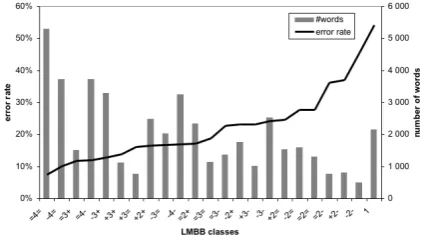
This label corresponds to a class of recognized words, de-coded in the same context in terms of LM behavior. By comparing a set of automatic transcriptions with words labeled with these triplets, with a manual transcription of the same set of sentences, we compute the error rate of each class of words. The error rate is the ratio of the number of misrecognized words (substitutions or insertions) included in this class vs. the number of recognized words in this class. The estimated error rate for a given class will later be used as the confidence measure for words of this class dur-ing processdur-ing of test data. This measure will be called the LMBB confidence measure, and the value of this measure for a wordwwill be notedmlmbb(w).
Figure 1 shows that there is a correlation between the LM back-off behavior around a recognized word and the WER.
Figure 1: Error rate and word distribution per LM back-off behavior (LMBB) class on the training data
3.
Corpus and system training
Experiments have been carried out on the ESTER corpus. ESTER is an evaluation campaign of french broadcast news transcriptions systems which started in 2003 and completed in January 2005 (Galliano et al., 2005). The system used there by the Laboratoire d’Informatique de l’Universit´e du Maine (LIUM) is based on the CMU Sphinx 3.3 decoder. The data were recorded from six radios: France Inter,
France Info, RFI, RTM, France Culture and Radio Clas-sique. The data are divided into three sets; only the two
first ones are annotated1. Shows (10 minutes up to 60 min-utes) from those two first sets contain few silence, music and advertisements. The majority of the shows contains prepared speech like news and few conversational speech like interviews. Only 15% of the corpus is narrow band speech. Those data are split in three corpora:
• The training corpus calledEST ERtraincorresponds to 81h (150 shows) composed of 8547 segments in which 3297 full names are detected.
1
• A development corpus2 corresponds to 12.5h (26 shows) split into 2294 segments containing 920 full names.
• A test corpus called EST ERtest contains 10h (18 shows) split into 1417 segments in which 507 full names are detected. it corresponds to the official ES-TER evaluation corpus. This corpus contains two ra-dios that are not present in the training corpus. It was also recorded 15 months after the previous data.
This system was competitive: it reached the second position in the ESTER evaluation campaign with 23.6% word error rate (Del´eglise et al., 2005; Galliano et al., 2005).
3.1. Acoustic and language models
The vocabulary used by the LIUM system (Del´eglise et al., 2005) contained about 65K words. Acoustic models were trained usingΩcontaining 81h of data with manual transcriptions from four different radios. Those broadcast news are generally wide band but are also composed of phone speech (narrow band). Trigram and quadrigram lan-guage models were trained using manual transcriptions of 81 hours of radiophonic broadcast news provided by the ESTER organization resulting in 1.35M words. We add articles from french newspaper “Le Monde” resulting in 319M words.
3.2. Training parameters for confidence measures
Confidence measures are estimated from 4h of same radio stations composing the training corpus for acoustic and lan-guage models. We will note this new corpus CTrain. It is independent of the training corpus and we have its man-ual transcription. We have also an automatic transcription thanks to the recognizer. From the two transcriptions at the same time, we can compute the various features of our measures. For the acoustic confidence measure, we ob-tain the parametersµ,σandaof the equation 2. For the LMBB confidence measure, we compute the confidence scores from the error rate obtained with the various LMBB classes (see figure 1).
4.
Merging confidence measures
Combining multiple features to result in a single metric can be made in many ways (Schaaf and Kemp, 1997). The most popular used operators are: minimum, maximum, (arithmetic) average, product (or geometric average) and quadratic average. The resulting measure is:m(w) =O(m1(w), . . . , mK(w))
whereOis the respective operation. As we have noticed before, our combination rule should respect several con-straints. Particularly, the final confidence measure should not alter the global prediction of the average probability of an hypothesis word is correct. The minimum, maximum and product operators do not respect this constraint but can be used when the resulting bias is acceptable.
2
it is the official ESTER phase I development corpus merged with the official ESTER phase II development corpus
To take into account the quality of each measure, we can use the weighted average:
m(w) = 1
K N X
i=1
qkmk(w), with K X
k=1
qk = 1.
In this case, the weights qk can be learnt empirically by cross-validation with the results of the obtained measure on the Normalized Cross Entropy (NCE) on CTrain. This metric is used by NIST to assess the quality of a confi-dence measure and to score evaluations. This is an esti-mation of how much additional inforesti-mation the confidence tags provide (Evermann and Woodland, 2000; Maison and Gopinath, 2001). Thanks to this metric, we will be able to know the most relevant measures to merge with to obtain a better one.
We can also choose approaches of merging coming from the evidence theory the and probability theory. In fact, we tried this different approaches during our experiments: the approach giving the best results on CTrain in terms of NCE during our experiments on merging the LMMB measure and the acoustic measure probability was a simple linear interpolation:mAC/LM BB(w) =ν∗mAC(w) + (1−ν)∗ mLM BB(w). With CTrain, we obtainν= 0.7.
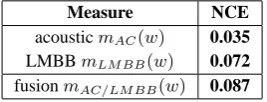
Table 1 shows that, on CTrain, acoustic and LMBB mea-sures give real information on the word correctness. By merging them, we hope to improve qualities of each one of them. We take the fusion which gives the best results with NCE. This fusion improves the performances ofmac and mlmbb.
Measure NCE
acousticmAC(w) 0.035 LMBBmLM BB(w) 0.072 fusionmAC/LM BB(w) 0.087
Table 1: Comparison of confidence measures on CTrain
5.
Validation of confidence measures
Before filtering words and thus carrying out a new step in training the acoustic models, we check the influence of the confidence measure on the error rate3 (deletions are not counted) on the test corpusEST ERtest.5.1. Evaluation with reject rate vs. error rate
To evaluate the relevance of our fusion measurem(table 1), we put a threshold on the scores to accept only the words which confidence score is higher than it. Thus, we can ob-serve the misrecognized words which should have been re-jected among the words we have nevertheless accepted. Figure 2 shows the rejection and error rates on the test data. The words are accepted/rejected using a threshold on their confidence score withmmeasure. For example, rejecting
3in this paper, ’errors rate’ term refers to insertions and
Figure 2: Rejection rate and error rate for the accepted words onEST ERtestaccording to the threshold value.
33% of the words with a threshold at 0.82 means an im-provement of the WER from approximately 42% in rela-tive.
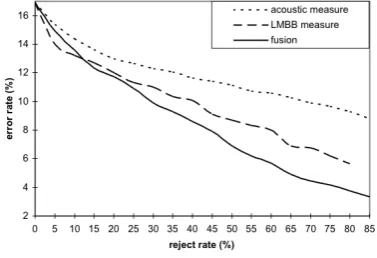
Figure 3: Error rate vs. Reject rate: comparison of confi-dence measures onEST ERtest.
Figure 3 shows the comparison between the fusion measure and the two measures which compose it. The fusion mea-sure is more effective: by rejecting less words or the same quantity, this measure reaches a better error rate than each of two measures taken one by one.
6.
Word-segment based filtering
In this part, we select the best audio segments recognized from a data set of audio files by applying a threshold to each word confidence score (Wessel and Ney, 2005). We noticed during our experiments that the hypotheses with less error rate were made of high confidence word groups. More-over, it seems better for training algorithms of the acoustic models to preserve long duration segments. This is why we keep only segments of more than 5 seconds and which words have confidence scores higher than a threshold noted α. Plus, if only one word comes to disturb this high-score group with a score slightly lower than the threshold (less than 4%), we preserve it in the segment.Indeed, we checked that the acceptance of only one word among a high-score group enables us to preserve more rel-evant segments with only a slight increase of error rate. For example on test data, table 2 shows that segments of more than 5 seconds and for which all the words have con-fidence scores higher than0.7represents 62.3% of the rec-ognized words. This set of segments is noted SEG1. The
Words Acceptation rate Error rate
no filtering 100.0% 16.9%
with filtering α >0.7 α >0.77 α >0.7 α >0.77
no Seg 92.0% 79.0% 14.3% 11.8%
SEG1 62.3% 35.7% 11.9% 6.9%
SEG1* 71.4% 42.0% 12.5% 8.8%
Table 2: Acceptation and error rates of recognized words according to the filtering method on test data. SEG1 is the set of words which are included in segments during more than 5 seconds and composed only by words whose the con-fidence scores are greater than a thresholdα. SEG1* has the same constraints as SEG1, but accepts only one word by segment with a score slightly lower thanα.
error rate for the words of SEG1 is 11.9% (the entire rec-ognized words have an error rate of 16.9%). Adding seg-ments whose only one word has a confidence score smaller than 0.7, and verifying that this word has a confidence score higher than 0.672 (4% of 0.7), the acceptation rate repre-sent 71.4% of the recognized words, for an error rate of 12.5%. This set of segments is noted SEG1*. We can no-tice that the constraint on the minimal duration of confident word-segment is restrictive: table 2 shows that according to the same value ofα, the acceptation rate of SEG1* is very smaller than the acception rate of SEG1. On the other side, the error rate of recognized words decreased too. This con-firms that the confidence score of the context of a word is helpful to process this word.
7.
Injecting recognized words into training
data
In this part, we select the best audio segments recognized on a new data set of 54h from various radio stations by applying a the confident word-segment-based filtering de-scribed above. These segments are added to the training corpus of acoustic models, getting then a more significant training corpus for parameters estimation.
The method to choose the value of thresholdαxfor filtering is simple:αxis the value which allows to obtain an accepta-tion rate ofx%. We have used this way to avoid to choose a value too close to the development corpus used to tune parameters of confident measures. So we expect that the more we reject recognized words, the more the error rate of accepted words is low, as shown in results in sections 5.1. and 6.. Here, we cannot evaluate the error rate of accepted words because manual transcriptions are not avalaible for this 54h of data.
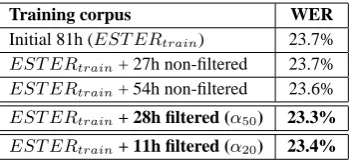
significant according to the 95% confidence interval: com-puted with a word error rate of 23.7% and a set of data composed by 114,000 words, the 95% confidence interval is included in [23.45; 23.95]. Results with a word error rate included in this interval are considered as non-statistically significant ones (Simonin et al., 1998).
Training corpus WER
Initial 81h (EST ERtrain) 23.7%
EST ERtrain+ 27h non-filtered 23.7%
EST ERtrain+ 54h non-filtered 23.6%
EST ERtrain+ 28h filtered (α50) 23.3%
EST ERtrain+ 11h filtered (α20) 23.4%
Table 3: Final WER on test data according to injected seg-ments on training corpus of acoustic models
Injecting about the best 50% automatically transcribed data in terms of confident measure allows a gain of 0.4% abso-lute (1.69% relative) word error rate which is a statisticaly significant result. More interesting, injecting only the best 20% automatically transcribed data improve the word error rate too. These results show the importance of the quality of the injected data compared to their amount. Another in-teresting result is the fact that the filtering concerns narrow-and wide- bnarrow-and both as shown in table 4.
Training corpus Narrow band Wide band
Initial 81h (Ω) 12h 69h
Ω+ 28h filtered (α50) 15h (+25%) 94h (+36%) Ω+ 11h filtered (α20) 14h (+17%) 78h (+13%)
Table 4: Repartition of training corpus according to the bandwidth
8.
Improvements
After a preliminary study for automatic detection of well recognized words with confidence measures which are eas-illy computable and not affected by the search space size, we try to improve the results by merging measures with word posteriors. As they come from different parts of the system, they should offer complementary information about the word correctness.
8.1. Word posterior probability
Word posterior probabilities can be computed from N-best lists (Stolcke et al., 1997), word-lattices (Evermann and Woodland, 2000) or confusion networks (Mangu et al., 2000). Roughly, the word posterior probability is the ra-tio of thea priori probability of a word and the sum of the
a priori probabilities of all the alternatives. Thesea priori
probabilities are given by a combination of values given by acoustic and language models. Thus, word posteriors can be seen as a summarization of acoustic scores, linguistic scores and search space topology.
In N-best lists, the word posterior probability of a word is approximated with the ratio of the sum of thea priori prob-abilities of the occurrences of this word in the N hypotheses
in a given position, and the sum of all thea priori probabili-ties of occurrences of words in this same position, including occurrences of the given word.
In word-lattices- and confusion networks- based ap-proaches, the word posterior probability can be seen as a generalization of the N-best approach, where word-segmentations and search space deepth are better consid-ered.
Unfortunately, this measure is affected by pruning heuris-tics reducing the size of pruned word-lattices generated dur-ing the recognition process and in practice the use of this measure can be biased. To overcome this problem, a deci-sion tree can be trained to transform the posterior probabil-ities in better confidence scores (Evermann and Woodland, 2000).
In this paper, we use a confusion networks based approach directly derived from (Mangu et al., 2000) to compute word posteriors.
8.2. Fusion
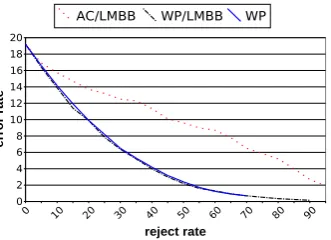
Techniques for merging confidence measures are the same than in section 4. The approach giving the best results terms of NCE on CTrain was also a simple linear interpola-tion between only the LMBB measure and word posteriors (WP), the acoustic measure is not discriminative enough for word correctness (see table). This fusion measure is called WP/LMBB:mW P /LM BB(w) =λ∗mW P(w) + (1−λ)∗ mLM BB(w). On CTrain, we obtain,λ= 0.7.
Measure CTrain EST ERtest
acousticmAC(w) 0.022 0.019 LMBBmLM BB(w) 0.081 0.063 word posteriorsmW P(w) 0.169 0.187 fusionmAC/LM BB(w) 0.087 0.072 fusionmW P /LM BB(w) 0.276 0.270
Table 5: Comparison of related confidence measures on train and test data for confidence measure using normalized cross entropy (NCE)
Table 5 shows that on both corpora, the word posterior probability gives real information on the word correctness in a really better way than the single LMBB measure. But, merging this two measures into the WP/LMBB measure provide a very good measure which outperforms the sin-gle word posterior probability with a NCE value of 0.270 compared to 0.187 onEST ERtest. This can be explained by the fact that LMBB and word posterior probability of-fer complementary information. Plus, we observed a high amount of words for word posteriors scores beyond 0.9 which were not correct. One explanation is that those words do not have much competition in the search space and nevertheless obtain a high word posteriors score. But those word can have a low confidence level according to the LMBB. Thus, the LMBB measure can help word posteriors to be more discriminative.
0 5 10 20 30 40 50 60 70 80 90
0 2 4 6 8 10 12 14 16 18 20
AC/LMBB WP/LMBB WP
reject rate
e
rr
o
r
ra
te
Figure 4: Error rate vs. Reject rate: comparison of confi-dence measures on test data.
the measure AC/LMBB. This new measure let us believe a bigger impact on large scale filtering data.
9.
Conclusion
In this article, we propose new confidence measures based on the back-off behavior of language model, a normaliza-tion of an existing acoustic confidence measure: their fu-sion by linear interpolation improves their capacities to de-tect and reject incorrect words. Separately, thes two first measures are not expensive in computing time, as well as their fusion. We introduce a word-segment -based filtering using the fusion of these confident measures and show that this filtering can extract recognized words with very low rate from automatically transcribed segments in a unsuper-vised way. In this paper, we use filtered words from audio data with no manual transcription available to increase the size of the training corpus of acoustic models. But other ap-plications exploiting this kind of filtering can be proposed, particularly applications processing the ouput of a auto-matic speech recognition system (dialog system, named entities extraction, topic detection, ...). Experimental re-sults show a statistically significant improvement of the fi-nal word error rate compared to results obtained by using only the initial corpus or by adding data without filtering. A confidence measure improving word posteriors abilities is also presented, improving results of the first fusion. It seems relevant to continue our work to measure the impact of our method on a large scale with our new measure merg-ing word posteriors with an language model-based mea-sure: it should be interesting to know what amount of data filtered in a very restrictive way is necessary to reach the limit of possible improvements.
10.
References
L. Chen, L. Lamel, and J.-L. Gauvain. 2004. Lightly super-vised acoustic model training using consensus network. In Proc. of ICASSP, International Conference on
Acous-tics, Speech, and Signal Processing, Montreal, Canada,
May.
S. Cox and S. Dasmahapatra. 2002. High-level approaches to confidence estimation in speech recognition. IEEE
Transactions on Speech and Audio Processing, 10(7).
P. Del´eglise, Y. Est`eve, S. Meignier, and T. Merlin. 2005. The LIUM speech transcription system: a CMU Sphinx
III-based system for french broadcast news. In Proc. of
Eurospeech, European Conference on Speech Communi-cation and Technology, Lisbon, Portugal, September.
G. Evermann and P.C. Woodland. 2000. Posterior proba-bility decoding, confidence estimation and system com-bination. In Speech Transcription Workshop.
S. Galliano, E. Geoffrois, D. Mostefa, K. Choukri, J.F. Bonastre, and G. Gravier. 2005. The ESTER phase II evaluation campaign for the rich transcription of french broadcast news. In Proc. of Eurospeech, European
Con-ference on Speech Communication and Technology,
Lis-bon, Portugal, September.
B. Maison and R. Gopinath. 2001. Robust confidence an-notation and rejection for continuous speech recognition. In Proc. of ICASSP, International Conference on
Acous-tics, Speech, and Signal Processing, Salt Lake City,
USA, May.
H. Mangu, E. Brill, and Stolcke A. 2000. Finding con-sensus in speech recognition: Word error minimization and other applications of confusion networks. Computer
Speech and Language, pages 4373–400.
F. Metze, T. Kemp, T. Schaaf, T. Schultz, and H. Soltau. 2000. Confidence measure based language identifica-tion. In Proc. of ICASSP, International Conference
on Acoustics, Speech, and Signal Processing, Istanbul,
Turkey, June.
R. San-Segundo, B. Pellom, K. Hacioglu, W. Ward, and J. Pardo. 2001. Confidence measures for spoken dia-logue systems. In Proc. of ICASSP, International
Con-ference on Acoustics, Speech, and Signal Processing,
Salt Lake City, USA, May.
T. Schaaf and T. Kemp. 1997. Confidence measures for spontaneous speech recognition. In Proc. of ICASSP,
In-ternational Conference on Acoustics, Speech, and Signal Processing, pages 875–878, Munich, Allemagne, April.
J. Simonin, L. Delphin-Poulat, and G. Damnati. 1998. Gaussian Density Tree Structure in a Multi-Gaussian HMM-Based Speech Recognition System. In Proc. of
ISCLP, International Conference on Spoken Language Processing.
A. Stolcke, Y. Konig, and M. Weintraub. 1997. Explicit word error minimization in N-best list rescoring. In
Proc. of Eurospeech, European Conference on Speech Communication and Technology, volume 1, pages 163–
166, Rhodes, Greece.
C. Uhrick and W. Ward. 1997. Confidence metrics based on n-gram language model backoff behaviors. In Proc.
of Eurospeech, European Conference on Speech Commu-nication and Technology, Rhodes, Greece, September.
F. Wessel and H. Ney. 2005. Unsupervised training of acoustic models for large vocabulary continous speech recognition. IEEE Transactions on Speech and Audio