
Experiments in Topic Detection
Yllias Chali
Department of Mathematics and Computer Science University of Lethbridge
4401 University Drive Lethbridge, AB T1K 3M4, Canada
E-mail: [email protected]
Abstract
Dividing documents into topically-coherent units and discovering their topic might have many uses. We present a system that proceeds in two steps: (1) the input text is segmented at places where there is a probable topic shift, (2) lexical chains are extracted from each segment as indicators of its topic. Two implementations, based on public domain resources, are presented: one based on WordNet and the second one based on Roget’s thesaurus. An evaluation of the algorithm shows that lexical chains are acceptable as topic indicator with
of precision and
of recall.
1. Introduction
Dividing documents into topically-coherent units and discovering their topic might have many uses. (1) In in-formation retrieval, documents in many collections likely address multiple topics and various aspects of the primary topic. Indexing and clustering these documents based on topical words, instead of frequent phrases, can be exploited to improve the accuracy of an information retrieval system. (2) In text summarization, the primary problem is detecting the relevant portions of texts. Characterizing those portions by their topic will improve the summarization task, espe-cially when the purpose of the summary is user-focused (Mani and Maybury, 1999). (3) In text understanding, the scope of several phenomena is intersentential, the topic can take account of such a scope and hence can help in their res-olution, e.g., in resolving anaphora and ellipsis (Kozima, 1993). (4) In structuring text with regard to its discourse hierarchy (Halliday and Hasan, 1976; Hahn, 1990; Morris and Hirst, 1991). (5) In improving document navigation and hypertext links (Green, 1997; Pratt et al., 1999).
Much research has been devoted to the task of struc-turing text - that is dividing texts into units based on in-formation within the text. Existing work falls roughly into one of the two categories: linear text segmentation aims to discover the topic boundaries, and discourse segmentation focuses on identifying relations between utterances. Meth-ods for finding the topic boundaries include word repetition within a sliding window (Hearst, 1997), lexical cohesion based on word similarity (Morris and Hirst, 1991; Kozima, 1993), entity repetition with regard to its position within the paragraph (Kan et al., 1998), word frequency algorithm and maximum entropy model (Reynar, 1999), context vec-tors (Kaufmann, 1999), feature induction model (Beefer-man et al., 1999), divisive clustering (Choi, 2000). On the other hand, discourse segmentation is fined-grained, (Lit-man and Passonneau, 1995) combine multiple knowledge sources for discourse segmentation using decision trees, and (Marcu, 2000) uses rhetorical parsing and decision tree to build up the discourse structure based on relations.
The approach that we are proposing to pursue below is a step further to the approaches intending to identify
the boundaries between paragraphs in a text where the text changes topic. We present a system that proceeds in two steps: (1) the input text is segmented at places where there is a probable topic shift using one of the following public domain segmenters:TextTilingsystem (Hearst, 1997), Seg-mentersystem (Kan et al., 1998), or Choi’s system (Choi, 2000), (2) lexical chains are extracted from each segment, using either WordNet or Roget’s thesaurus, as indicators of its topic. In this paper, we will present each of these steps, then we will evaluate the whole system. We describe an algorithm for identifying the topic of unrestricted texts. The algorithm takes as input segments of text that represent grouping of contiguous portions of the text, and discovers lexical chains as indicator of their topics. Two implemen-tations, based on public domain resources, are presented: one based on WordNet and the second one based on Ro-get’s thesaurus. The evaluation of the algorithm shows that lexical chains are acceptable as topic indicator with
of precision and of recall, using WordNet.
2. System Overview
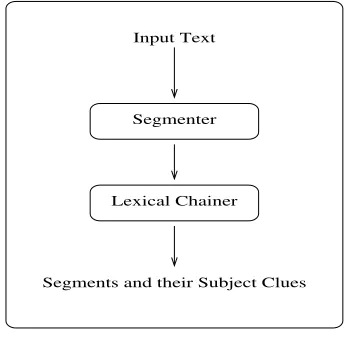
The overall architecture of the system is shown in Fig-ure 1. It consists of two independent modules organized as a pipeline.
Segments and their Subject Clues Input Text
Segmenter
Lexical Chainer
3. Text Segmenting
The linear segmentation task is motivated by the ob-servation that comprehension of longer texts benefits from automatic chunking of cohesive sections. This task in-volves breaking input text into segments that represent some meaningful grouping of contiguous portions of the text. The input text is divided into a linear sequence of adja-cent segments and segment boundaries are found at various paragraph separations which identify one or more subtopi-cal shifts.
Multi-paragraph subtopic segmentation should be use-ful for many text analysis tasks, including information re-trieval and summarization, especially, text segmentation is interesting for the following purposes:
Segmentation is intended to identify the boundaries between paragraphs in a text where the text changes topic. Thus, a text can comprise merely a single seg-ment, or perhaps several different segments, when it touches on several different topics.
It helps in processing the user needs when they are specified as terms in the sense that only segments that are relevant to the terms specified by the user are cho-sen (Reynar, 1999; Chali et al., 1999). When the topically-coherent units (i.e., text segments) are rep-resented by a set of topical clues, a content-based pro-cess of matching the user’s terms against the segment’s clues will determine the relevancy of the segments, i.e., the segments with the highest matches are selected as answers to the user’s query.
We are using three public domain segmenters TextTil-ingsystem (Hearst, 1997),Segmentersystem (Kan et al., 1998), and Choi’s system (Choi, 2000).
Segmentation is followed by the characterization of the segment in terms of lexical chains as clues of the segment topic.
4. Lexical Chaining
Structural theories of text are concerned with identify-ing units of text that are about the “same thidentify-ing”. When this happens, there is a strong tendency for semantically related words to be used within that unit. The notion of cohesion, introduced by (Halliday and Hasan, 1976), is a device for “sticking together” different parts of the text to function as a whole. It is achieved through the use ofgrammatical cohe-sion, i.e., reference, substitution, ellipsis and conjunction, andlexical cohesion, i.e., semantically related words. Lexi-cal cohesion occurs not only between two terms, but among sequences of related words, calledlexical chains (Morris and Hirst, 1991). Lexical chains (1) provide an easy-to-determine context to aid in the resolution of ambiguity and in the narrowing to specific meaning of a word, (2) tend to delineate portions of text that have a strong unity of mean-ing. We investigate how lexical chains can be used as an indicator of the text segment topic. The steps of the algo-rithm of the lexical chain computation are as follow:
1. We select the set of candidate words. To this end, we run a part-of-speech tagger (Brill, 1992) on a text
seg-ment, and only the open class words that function as noun phrases or proper names are chosen.
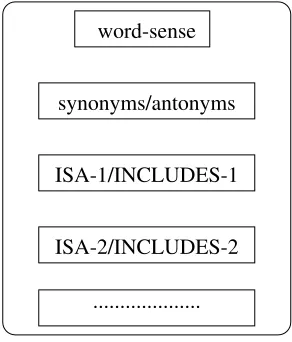
2. The set of the candidate words are exploded into senses, the senses are given by the thesaurus in use, at this step all the senses of the same word are consid-ered. In the actual implementation, we are using two different thesauri: Roget’s thesaurus (Chapman, 1988) and WordNet thesaurus (Miller et al., 1993). From this step each word sense is represented by distinct sets (seeFigure 2) considered as levels, the first one con-stitutes the set of synonyms and antonyms, the second one constitutes the set of first hypernyms/hyponyms and their variations (i.e. meronyms/holonyms, etc.), and so on.
word-sense
synonyms/antonyms
ISA-1/INCLUDES-1
ISA-2/INCLUDES-2
...
Figure 2: Word sense representation
3. We find the semantic relatedness among the set of senses according to their representations. A semantic relationship exists between two word senses if com-paring two sense representation of two distinct words, a matching exists, i.e., a non-empty intersection exists between the sets of words. To each semantic related-ness is associated a measure which indicates the length of the path taken in the matching with respect of the levels of the compared two sets.
4. We build up chains which are sets such as
! "#$%&#$' ( )*#$%&#$' ,+) --./
)
+"#$%&#$ +0 )*#$%&#$ +(+) --./
)
--1
in which 2
-#$%&#$ 23
is semantically related to
4
-#$%&#$5476
for8:9 ;=<
, and > and? correspond
to the senses of 2
and 4
, respectively. 5. We retain longest chains relying on the following
pref-erence criterion:
@$(AB$CED7CEDE %GF
#
?
%H % ?IKJL
%MC, % ?I
F
NOQPSRUT
J
NVXWZY\[Z]_^`RUT F NOQPSRba
J
NVXWZY\[Z]_^cRda
F
such as WordNet, and which can be applicable for unre-stricted texts.
Lexical chains has been proposed by (Morris and Hirst, 1991) as indicator of the structure of text. (Barzilay and Elhadad, 1997) investigate the production of summaries based on lexical chaining. The summaries are built using scoring which is based on chain length and the extraction of significant sentences is based on heuristics using chain distribution, for example, choose the sentence that con-tains the first appearance of a chain member in the text. (Yarowsky, 1992) presented statistical models using lexical chains for the purpose of word-sense disambiguation. (Ell-man, 2000) uses the lexical chains to determine the similar-ity of texts. In this paper, we investigated the production of lexical chains to account for the topic of the text segment.
The described algorithm for the lexical chaining was implemented in C++. Its primary purpose is to extract from the text segments meaningful clues as indicator of the seg-ment’s topic. This technique has many uses in processing and searching of information.
The results reported in this paper suggest that we may refine the process of lexical chaining. Instead of choosing any content word tagged as noun or proper noun as candi-date for the computation of the chains, it seems that restrict-ing the set of candidate words will improve the precision of the chains.
7. Conclusion
Topic detection and identification is an important area of research, addressing many application needs. It presents new and interesting technical challenges.
We presented an algorithm for detecting the topic of un-restricted texts based on an efficient use of lexical chains acquired from common lexical knowledge. The results show that the algorithm is promising for many applications where an efficient access to large quantities of information is needed.
Acknowledgments
This work was supported by the Natural Sciences and Engineering Research Council (NSERC) research grant and the Alberta Heritage Foundation for Science and Engi-neering Research under the Research Excellence Envelope funding.
8. References
R. Barzilay and M. Elhadad. (1997). Using lexical chains
for text summarization. In ACL/EACL Workshop on
Intelligent Scalable Text Summarization, pages 10-17, Madrid.
D. Beeferman, A. Berger, and J. Lafferty. (1999). Statis-tical models for text segmentation. Machine Learning, Special Issue on Natural Language Processing, 34(1 -3):177 - 210.
E. Brill. 1992. A simple rule-based part of speech tagger. InProceedings of the Third Conference on Applied Nat-ural Language Processing, ACL, pages 152-155, Trento. C. Buckley, G. Salton, and J. Allan. (1994). The effect of adding relevance information in a relevance feedback
environment. InProceedings of the 17th International ACM SIGIR Conference on Research and Development in Information Retrieval, pages 292-300.
Y. Chali, S. Matwin, and S. Szpakowicz. (1999). Query-biased text summarization as a question-answering tech-nique. InProceedings of AAAI Symposium on Question-Answering Systems, pages 52-56, Massachusetts. AAAI Press.
R. Chapman. (1988). Roget’s International Thesaurus.
Longman, London.
F. Y. Y. Choi. (2000). Advances in domain independent linear text segmentation. InProceedings of the 1st North American Chapter of the Association for Computational Linguistics, pages 26 - 33, Seattle, Washington.
G. DeJong. (1982). An overview of the frump system. In Wendy G. Lehnert amd Martin H. Ringle, editor, Strate-gies for natural language processing, pages pages 76-49. Lawrence Erlbaum Associates.
J. Ellman. (2000). Using Roget’s Thesaurus to Determine the Similarity of Texts. Ph.D. thesis, School of Comput-ing EngineerComput-ing and Technology, University of Sunder-land.
S. J. Green. (1997). Automatically Generating Hypertext by Computing Semantic Similarity. Ph.D. thesis, Depart-ment of Computer Science, University of Toronto. U. Hahn. (1990). Topic parsing: Accounting for text
macrostructures in full text analysis. Information Pro-cessing and Management, 26:135 - 170.
M. Halliday and R. Hasan. (1976). Cohesion in English. Longman, London.
M. A. Hearst. (1997). Texttiling: Segmenting text into multi-paragraph subtopic passages. Computational Lin-guistics, 23(1):33-64.
T. Joachims. (1997). A probabilistic analysis of the rocchio algorithm with tfidf for text categorization. In Proceed-ings of the 14th International Conference on Machine Learning, pages 143-151.
T. Joachims. (1998). Text categorization with support vec-tor machines: Learning with many relevant features. In
Proceedings of the European Conference on Machine Learning.
M. Y. Kan, K. R. McKeown, and J. L. Klavans. (1998). Linear segmentation and segment relevance. In Proceed-ings of 6th International Workshop of Very Large Cor-pora (WVLC-6), pages 197-205, Montr´eal.
S. Kaufmann. (1999). Cohesion and collocation: Using context vectors in text segmentation. InProceedings of the 37th Annual Meeting of the Association for Compu-tational Linguistics (Students Session), pages 591 - 595, College Park, Maryland.
H. Kozima. 1993. Text segmentation based on similar-ity between words. InProceedings of the 31th Annual Meeting of the Association for Computational Linguis-tics, pages 286-288.
D. D. Lewis, R. E. Schapire, J. P. Callan, and R. Papka. (1996). Training algorithm for linear text classifiers. In
Proceedings of the 19th International ACM SIGIR Con-ference on Research and Development in Information Retrieval, pages 298-306.
C. Y. Lin and E. Hovy. (2000). The automated acquisition of topic signatures for text summarization. In Proceed-ings of 18th International Conference in Computational Linguistics, Saarbr¨ucken, Germany.
D. J. Litman and R. J. Passonneau. (1995). Combining multiple knowledge sources for discourse segmentation. InProceedings of the 33rd Annual Meeting of the Asso-ciation for Computational Linguistics, pages 108 - 115, Cambridge, Massachusetts.
I. Mani and M. Maybury. (1999). Advances in Automatic
Text Summarization. MIT Press.
D. Marcu. (2000).Theory and Practice of Discourse Pars-ing and Summarization. MIT Press.
A. McCallum and K. Nigam. (1998). A comparison of event models for naive bayes text classifiers. In Proceed-ings of AAAI Workshop on Learning for Text Categoriza-tion.
G. A. Miller, R. Beckwith, C. Fellbaum, D. Gross, and K. Miller. (1993). Five papers on wordnet. CSL Re-port 43, Cognitive Science Laboratory, Princeton Uni-versity.
J. Morris and G. Hirst. (1991). Lexical cohesion computed by thesaural relations as an indicator of the structure of text.Computational Linguistics, 17(1):21-48.
W. Pratt, M. A. Hearst, and L. M. Fagan. (1999). A knowledge-based approach to organizing retrieved docu-ments. InProceedings of the Sixteenth National Confer-ence on Artificial IntelligConfer-ence, Orlando, Florida. D. R. Radev and K. R. McKeown. (1998). Generating
nat-ural language summaries from multiple on-line sources.
Computational Linguistics, 24(3):469-500.
J. C. Reynar. (1999). Statistical models for topic segmen-tation. InProceedings of the 37th Annual Meeting of the Association for Computational Linguistics, pages 357 -364, College Park, Maryland.
E. Riloff and J. Lorenzen, (1999). Generating
domain-specific role relationships automatically, chapter Natu-ral Language Information Retrieval, Tomek Strzalkowski editor. Kluwer Academic Publishers.
E. Wiener, J. O. Pederson, and A. S. Weigend. (1995). A neural network approach to topic spotting. In Proceed-ings of the 4th Symposium on Document Analysis and Information Retrieval.
Y. Yang. (1994). Expert network: Effective and efficient learning from human decisions in text categorization and retrieval. InProceedings of the 17th International ACM SIGIR Conference on Research and Development in In-formation Retrieval, pages 13-22.
![Law’s empire : English legal cultures at home and abroad [Review Article]](data:image/gif;base64,R0lGODlhAQABAIAAAP///wAAACH5BAEAAAAALAAAAAABAAEAAAICRAEAOw==)