Annotated Bibliographical Reference Corpora in Digital Humanities
Young-Min Kim
Patrice Bellot
Elodie Faath, Marin Dacos
LIA, University of Avignon LSIS, Aix-Marseille University CLEO, Centre for Open Electronic Publishing
84911 Avignon France 13397 Marseille France 13331 Marseille, France
[email protected] [email protected] {elodie.faath, marin.dacos}@revues.org
Abstract
In this paper, we present new bibliographical reference corpora in digital humanities (DH) that have been developed under a research project, Robust and Language Independent Machine Learning Approaches for Automatic Annotation of Bibliographical References in
DH Books supported by Google Digital Humanities Research Awards. The main target is the bibliographical references in the articles
of Revues.org site, an oldest French online journal platform in DH field. Since the final object is to provide automatic links between related references and articles, the automatic recognition of reference fields like author and title is essential. These fields are therefore manually annotated using a set of carefully defined tags. After providing a full description of three corpora, which are separately constructed according to the difficulty level of annotation, we briefly introduce our experimental results on the first two corpora. A popular machine learning technique, Conditional Random Field (CRF) is used to build a model, which automatically annotates the fields of new references. In the experiments, we first establish a standard for defining features and labels adapted to our DH reference data. Then we show our new methodology against less structured references gives a meaningful result.
Keywords: Bibliographical reference, Automatic annotation, Digital Humanities, Bilbo, Conditional Random Field, TEI
1.
Introduction
In this paper, we present new bibliographical reference cor-pora in digital humanities area. The corcor-pora have been developed under a research project, Robust and Language Independent Machine Learning Approaches for Automatic Annotation of Bibliographical References in DH(Digital Humanities) Books supported by Google Digital Human-ities Research Awards. It is a R&D program for in-text bib-liographical references published on CLEO’s OpenEdition platforms1 for electronic articles, books, scholarly blogs and resources in the humanities and social sciences. The program aims to construct a software environment enabling the recognition and automatic structuring of references in academic digital documentation whatever their biblio-graphic styles (Kim et al., 2011).
Most of earlier studies on bibliographical reference anno-tation are intended for the bibliography part at the end of scientific articles that has a simple structure and rela-tively regular format for different fields. On the other side, some methods employ machine learning and numerical ap-proaches, by opposite to symbolic ones that require a large set of rules that could be very hard to manage and that are not language independent. Day et al. (2005) cite the works of a) Giles et al. (1998) for the CiteSeer system on computer science literature that achieves a 80% accuracy for author detection and 40% accuracy for page numbers (1997-1999), b) Seymore et al. (1999) that employ Hid-den Markov Models (HMMs) that learn generative models over input sequence and labeled sequence pairs to extract fields for the headers of computer science papers, c) Peng and McCallum (2006) that use Conditional Random Fields (CRFs) (Lafferty et al., 2001) for labeling and extracting fields from research paper headers and citations. Other ap-proaches employ discriminatively trained classifiers such
1
http://www.openedition.org
as Support Vector Machine (SVM) classifiers (Joachims, 1999). Compared to HMM and SVM, CRF obtained better labeling performance.
The main interest of our project is to provide automatic links between related references, articles and resources in OpenEdition site, which is composed of three different sub-platforms, Revues.org, Hypotheses.org and Calenda. The automatic link creation involves essentially automatic recognition of reference fields, which consist of author, ti-tle and date etc. Based on the correctly separated and rec-ognized fields, different techniques can be applied for the creation of cross-links. The initial work of this project mainly consists of the corpora construction, especially the manual annotation of reference fields. This is concerned with a detailed analysis of target data in OpenEdition. We start with Revues.org journal platform because it has the most abundant resources in terms of bibliographic refer-ences. Faced with the great variety of bibliographical styles present on the three platforms and the dissemination of references within texts, we have implemented a series of stages corresponding to the various issues encountered on the platforms. In the paper, we first detail the nature of Re-vues.org data that justifies our methodology, then describe the corpora construction process and finally we discuss the experimental results.
In brief, we construct three different types of corpus with a detailed manual annotation using TEI guidelines. They will be a new valuable resource for research activities in natural language processing. There is no equivalent resource to date, neither in size nor in diversity.
2.
Revues.org document properties
sociol-ogy, geography and archaeology. The original language is French but it has been designed for the electronic publish-ing on an international scale. About 10% of articles are in a different language besides French. Beyond the commit-ment in favor of open access (more than 40,000 articles in open access), the platform is based on a model of appro-priation of the electronic publishing process by publishers and producers of content. The online publication is made through the conversion of articles into XML TEI format and then into XHTML format and allows the viewing of the full text in web browsers. The specific technical quality needed for the publishing of scientific texts is provided by many functions: metadata management, multiple indexes, man-agement of endnotes, automatic table of contents, number-ing of paragraphs and attribution of DOI.
Apart from the well organized technical functions, the bib-liographical reference parts of the articles on Revues.org are rather diverse and complicated compared to that of sci-entific research papers. One main reason of this complex-ity is the diverscomplex-ity of source disciplines that makes various styles in reference formatting. Moreover, even on a same discipline or journal, we can easily find quite different ref-erence forms caused by the absence of a strict format rec-ommended. Another important difficulty is also from the irregularity of reference part that sometimes arises in foot-note or body of articles. Especially, reference in the latter case usually has no particular form but is just integrated in a sentence such that even segmentation of bibliographic part is not easy.
Considering these difficulties that occur depending mainly on the physical position of reference, we divide biblio-graphical references into three different types as in Figure 1. The first type of references are located at the end of ar-ticle under a heading “Bibliography”, “Citation’, etc. They are traditional targets of bibliographical reference treatment (Giles et al., 1998; Peng and McCallum, 2006; Councill et al., 2008). The second type of references are found in foot-notes (henceforth called foot-notes) of article and are less for-mulaic compared to the first type. A typical particularity in this type is that note can have non-bibliographical text such as adjective phrases before a citation. The third type in-cludes partial bibliographical references found in the body of articles. It is the most difficult type for both manual and automatic annotations. Even finding the beginning and end of a suitable bibliographical reference is difficult.
3.
Manual annotation of Corpora
In this section, we detail the manual annotation process of our corpora. Against the difficulties introduced above, we first well define TEI XML tags to tag the bibliographic parts, then construct three different corpora according to the type of reference. We try to take into account the speci-ficity of target data as well as the generality of the digital humanities area.
3.1. TEI and tags for manual annotation
TEI is a consortium that develops, defines and maintains a markup language for describing structural, renditional and conceptual features of texts. And in our case, TEI guide-lines are used for describing the fields of bibliographic
ref-In Bibliography
In Notes
In the body of articles
Figure 1: Different types of bibliographic references
erences. There are three possible levels of description for this kind of information :
• <bibl>: for all bibliographical elements.
• <biblStruct>: it structures the reference with prede-fined elements and it can be found on other electronic archives such HAL and TEL.
• <biblFull> : it uses only elements allowed under
<fileDesc>.
In our corpus, we use the standard description <bibl>to freely tag references. Indeed, OpenEdition presents a vari-ety of bibliographic styles that<biblStruct>or<biblFull>
can not describe. Another reason is that this standard de-scription can be adapted for special references such as the case of inclusion or to indicate a working paper or pub-lished in a forthcoming scientific event.
Table 1 lists the defined tags for the manual annotation of our reference corpora. We try to encode as much infor-mation as possible in case of the reuse of the corpora for other objectives. Let us elaborate the ‘Author or Editor’ row, which shows an important particularity of our way. We tag author name with<surname>,<forename>and
Table 1: Defined tags for manual annotation
Type sub-type tag name @attribute value Reference Reference <bibl>
Included Ref. <relatedItem>
Author or Author <author>
Editor Editor <editor>@role editor translator Surname <surname>
Forename <forename>
Gen. name <genName>
Name link <nameLink>
Org. name <orgName>
Title Title <title>@level a (article) j (journal) m (monograph) u (unpublished work) s (series)
Confernce or <meeting>
Symposium
Publication Date <date>
Mark Place <pubPlace> <settlement> <country> <region>
Publisher <publisher> <distributor> <sponsor>
Edition <edition>
Page extent <extent>
Edition detail <biblScope>@type vol (volume) pp (pages) issue (journal num.) issn
part Punctuation Punctuation <c> @type point
comma
(other punctuation marks) Pre-citation Special term <w>
Link between references
<link>
Etc. Abbreviation <abbr>@type contraction acronym Web page <ref>
when the occurring position of author or editor field is flex-ible as in note data, this separation would be more useful. We expect that by identifying person name with surname and forename instead of author and editor, the specificity of each field will be strengthened in learning process then the automatic annotation will become easier. Second dis-tinction is that a name token is attached by two different but hierarchical tags. We allow this kind of multi-tagging in our manual annotation that enables rich information en-coding. But in our current automatic annotation system, we estimate just a single label to a token.
There are many other distinguishable aspects compared to the traditional methods. Titles are classified into five differ-ent categories : article, journal, monograph, unpublished work, and series. We also detailed place with four different tags, pubPlace, settlement, country and region. Publisher is tagged with publisher, distributor, and sponsor. Another distinguishable strategy is concerned with the treatment of punctuation. The annotator, a specialist in a humanities-related field, have annotated the punctuation marks, which play a role for the separation of reference fields, with the tag <c> . Finally, note that we introduce an important tag <w>, which signifies that the tagged word is a spe-cial term or expression indicating a previously cited refer-ence. The tag is exclusive to note data, and the most fre-quent terms wrapped by this tag are ‘Ibid.’, ‘op. cit.’, ‘ouv. cit´e’, ‘supra’, etc.
3.2. Three corpora with different difficulty levels
Corpus construction starts with selecting some representa-tive references from the Revues.org site. To keep diversity of bibliographic reference formats of various journals pub-lished on Revues.org, we try to select only one article for a specific journal. As pointed out in Section 2., three corpora have been constructed according to the difficulty level of annotation identified by type of reference as illustrated in Figure 1.
Corpus level 1
We first construct the corpus level 1, which is relatively simple than the others, however needs the most prudent an-notation because it offers the standard for the construction of next corpora. Considering the diversity,32journals are randomly selected and38sample articles are taken. Total 715 bibliographic references are identified and recognized using TEI guidelines. Figure 2 shows an example of the corpus level 1. All present tags in this figure are explained in Table 1 except the <hi>tag with an attribute value of ‘italic’. It is a default element provided by TEI guidelines that is used to mark words with emphasis. In the example, the journal name is highlighted by italic characters. There are other tags used for emphasis but only italic characters are considered as valid ones for the reference annotation.
Figure 2: An example of reference in corpus level 1
Corpus level 2
Figure 3: An example of reference in corpus level 2
a recited note example whose original reference identifier is ‘Sarto Schumacher2005’.
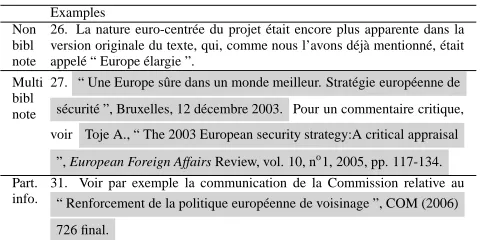
Besides the above property, the corpus level 2 naturally has a segmentation issue for the extraction of exact bibliograph-ical parts. Notes are originally intended for describing any supplementary information of a part of text. Therefore there can exist obviously non-bibliographical notes. Moreover, even a note having citation information is more freely writ-ten than formal references in corpus level 1, then it can probably have non-bibliographical phrases. We call this kind of problem a segmentation problem. Table 2 depicts several examples in this issue. The examples are extracted from same article2 in a political sociology journal. Note no. 26 is an example without any citation in it whereas note no. 27 has two different references (in grey) separated by a short phrase. Note no. 31 has a non-bibliographic phrase at the beginning of note.
Table 2: Segmentation problem in the notes
Examples Non
bibl note
26. La nature euro-centr´ee du projet ´etait encore plus apparente dans la version originale du texte, qui, comme nous l’avons d´ej`a mentionn´e, ´etait appel´e “ Europe ´elargie ”.
Multi bibl note
27. “ Une Europe s ˆure dans un monde meilleur. Strat´egie europ´eenne de
s´ecurit´e ”, Bruxelles, 12 d´ecembre 2003. Pour un commentaire critique,
voir Toje A., “ The 2003 European security strategy:A critical appraisal
”, European Foreign Affairs Review, vol. 10, no1, 2005, pp. 117-134.
Part. info.
31. Voir par exemple la communication de la Commission relative au “ Renforcement de la politique europ´eenne de voisinage ”, COM (2006)
726 final.
We select41journals from a stratified selection then choose 42articles. Note that the selected articles reflect the pro-portion of two different note types where one includes bib-liographic information while the other does not. Since the objective of the initiated project is totally automated annotation of bibliographical references, the detection of bibliographic note should be preceded before annotating notes. For this purpose, we design the corpus level 2 to be composed roughly by two groups: manually anno-tated reference notes similar to the corpus level 1 and
non-2
http://conflits.revues.org/index2471.html
bibliographical notes, which do not need any manual anno-tation. Figure 3 is an example of the first group. The begin-ning phrase, which is not part of reference, is just excluded from manual annotation. Consequently, we have1147 bib-liographical notes and385non-bibliographical notes.
Corpus level 3
Since the target of corpus level 3 is diffused throughout the body of article, manual annotation of this corpus is much more difficult than the previous corpora. Even if the basic tags have been already defined through the construction of corpus level 1 and 2, we need another standard to well an-notate the third one. The most urgent problem is that we have no guidelines for accepting a phrase as a bibliograph-ical reference. Therefore, we first observe in detail the na-ture of phrases, which seem to be an implicit reference. The same specialist who constructed the previous corpora again analyzes the implicit citations for this third level of corpus. We decide to examine not only the body of article but also the notes, because some notes having scattered reference fields had been ignored in the construction of corpus level 2. That is, any annotated reference in corpus 2 does not have an interrupted part, that is, non-bibliographical part. After a careful analysis, we categorize implicit references into the following three sub-groups:
• The first group includes the implicit references located in the body of article. They can be also found in the notes of the article at the same time.
• The second group includes the implicit references composed by only the author name and date. They can be found either in the body of the article or in the notes of the article. The difference with similar refer-ences in corpus level 2 is that their original referrefer-ences are located in the bibliography part of article.
• The third group includes the implicit references lo-cated in the notes. The difference with the similar references in corpus level 2 is that they have an in-terrupted part annotated as non-bibliographical part.
The upper example of Figure 4 is part of an article that contains an implicit reference of the first sub-group. It is well integrated in the content with the title and publisher information only. Sometimes, one or more fields of a bib-liographical note are integrated in the body of the article. We also treat this case as an implicit reference in the first group. To make a link between the recognized implicit ref-erence and its original note, we add an identifier as in the corpus level 2.
The lower example of the same figure contains an implicit reference composed by the author name and date. It is a typical form of a shorten reference in the second sub-group, which has its full description in another formal reference marked by an identifier, in this case, ‘Delannoy1997’ in the bibliography part. Sometimes this kind of short reference is only found at the notes part. We could have classified the latter case to the corpus level 2, but we decide to include it in the corpus level 3, because this reference can not be complete within the notes but needs the bibliography part in addition.
Figure 5 shows a note example, which includes an implicit reference of the third sub-group. The manually annotated bibliographical part begins right after the phrase ‘´ecrivait dans’ (‘wrote in’ in English). The reference fields are not continuous, instead interrupted by the words ‘un’ and ‘sign´e’, and by a phrase between<author>and<title>. It signifies that the segmentation problem becomes more complicated than the corpus level 2. We gather some ex-pressions such as ‘´ecrivait dans’ that can be a sign of an implicit reference, expecting that we can find some useful patterns.
Figure 5: Implicit reference example in the third group of the corpus level 3
There are many cases that can not be exactly classified to one of the sub-groups. And we are also faced with several practical problems such that different levels of references rise simultaneously in an article. The division between the corpus level 1 and level 2 is simple, whereas target area of the corpus level 2 and level 3 are somewhat overlapped. Another important problem in corpus level 3 is to decide which elements are essential for an implicit reference. For
that we suppose a situation that we should find a reference via a search engine. We can then select five different el-ements, ‘title’, ‘author’, ‘date’, ‘place’, and ‘publisher’ as necessary ones. A search with these five elements would give an accurate result. Besides, if we search a publication using author name without title, it would be difficult to ob-tain a desired result, even if other elements are also given. So, the main criteria to accept a phrase as an implicit ref-erence is the possibility to find a result given information. That is why we accept a phrase including only title as an implicit reference.
For the corpus level 3, we select 34 articles considering the properties of implicit reference in the body of the articles and 8 articles having discontinuous reference notes. From these selected articles, we have 553 references of the first sub-group, 447 references of the second one, and 43 refer-ences of the third one.
4.
Automatic annotation of reference
In this section we briefly introduce the main tool used for automatic annotation of reference fields. We use one of the most popular techniques in sequence annotation problem, Conditional Random Field (Lafferty et al., 2001; Peng and McCallum, 2006).
4.1. Conditional Random Fields
Automatic annotation can be realized by building a CRF model that is a discriminative probabilistic model devel-oped for labeling sequential data. By definition, a discrimi-native model maximizes the conditional distribution of out-put given inout-put features. So, any factors dependent only on input are not considered as modeling factors, instead they are treated as constant factors to output (Sutton and Mc-Callum, 2011). This aspect derives a key characteristic of CRFs, the ability to include a lot of input features in model-ing. The conditional distribution of a linear-chain CRF for a set of label y given an input x is written as follows :
p(y|x) = 1
Z(x)exp{
K X
k=1
θkfk(yt, yt−1,xt)}, (1)
where y = y1...yT is a state sequence, interpreted as a
label sequence, x = x1...xT is an input sequence,θ =
{θk} ∈RK is a parameter vector,{fk(yt, yt−1,xt)}Kk=1is
a set of real-valued feature functions, andZ(x)is a normal-ization function. Instead of the word identityxt, a vector
xt, which contains all necessary components of x for
com-puting features at timet, is substituted. A feature function often has a binary value, which is a sign of the existence of a specific feature. A function can measure a special char-acter of input token xt such as capitalized word. And it
also measures the characteristics related with a state tran-sitionyt−1 →yt. Thus in a CRF model, all possible state
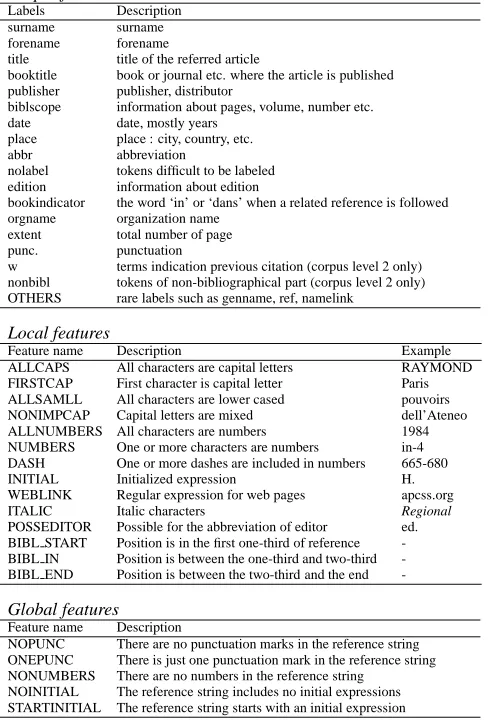
these detailed treatments were always somewhat negative in terms of accuracy. Moreover, as we seek a simpler de-scription of the features for a generalization, marking punc-tuation with an identical label seems reasonable.
For the scientific research purpose, the manually annotated three corpora will be distributed through a research blog3, which records the progress of the project. The distribution modalities are now under discussion.
6.
Conclusion
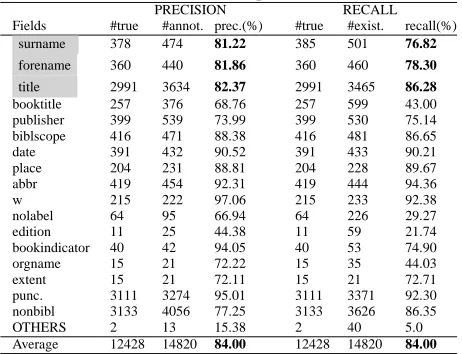
Three different levels of bibliographical reference corpora in digital humanities have been constructed. The target is the articles of Revues.org site, which is the oldest French online journal platform. The corpus construction involves a manual annotation of reference fields, that are then auto-matically estimated via machine learning techniques. Ac-cording to the difficulty level of each corpus, we should em-ploy an adapted methodology to well apply a CRF model. For the corpus level 1, we focus on finding the most effec-tive set of tokenization basis, output levels and local fea-tures to establish a standard for the treatment of our DH reference data. We have obtained about 90% of overall ac-curacy. For the corpus level 2, we use another machine learning technique, SVM to select only the bibliographical notes, then we apply a CRF model to the selected ones. The accuracies have decreased compared to that of the previous corpus, but the model gives around 80% of accuracy for the three important fields. The construction of corpus level 3 is already finished, and it remains to develop a series of adapted methods to handle this corpus.
We are now testing several methods to improve the perfor-mance of CRF on corpus level 2. As the first step, we try to integrate proper noun lists into modeling to improve the au-thor name and place fields. The most interesting part of the future work will be the treatment of corpus level 3. Topic models (Hofmann, 1999; Blei et al., 2003) will be appro-priate tools to provide a semantic structure of the contents of the articles in corpus level 3 that can be useful for the extraction of implicit bibliographical part.
7.
Acknowledgements
This work was supported by the French Agency for Scien-tific Research (Agence Nationale de la Recherche) under CAAS project (ANR 2010 CORD 001 02), and by Google with the Digital Humanities Research Awards that initiated the project.
8.
References
David M. Blei, Andrew Y. Ng, and Michael I. Jordan. 2003. Latent dirichlet allocation. J. Mach. Learn. Res., 3:993– 1022, March.
Isaac G. Councill, C. Lee Giles, and Min yen Kan. 2008. Parscit: An open-source crf reference string parsing package. In LREC. European Language Resources As-sociation.
Min-Yuh Day, Tzong-Han Tsai, Lung Sung, Cheng-Wei Lee, Shih-Hung Wu, Chorng-Shyong Ong, and Wen-Lian Hsu. 2005. A knowledge-based approach to
3
http://bilbo.hypotheses.org/
citation extraction, information reuse and integration. In Proceedings of IRI -2005 IEEE International Confer-ence, pages 50–55.
C. Lee Giles, Kurt D. Bollacker, and Steve Lawrence. 1998. Citeseer: an automatic citation indexing system. In International Conference on Digital Libraries, pages 89–98. ACM Press.
Thomas Hofmann. 1999. Probabilistic latent semantic in-dexing. In Proceedings of the 22nd annual international ACM SIGIR conference on Research and development in information retrieval, SIGIR ’99, pages 50–57. ACM. Thorsten Joachims, 1999. Making large-scale support
vec-tor machine learning practical, pages 169–184. MIT Press, Cambridge, MA, USA.
Young-Min Kim, Patrice Bellot, Elodie Faath, and Marin Dacos. 2011. Automatic annotation of bibliographical reference in digital humanities books, articles and blogs. In Proceedings of the CIKM 2011 BooksOnline11 Work-shop, pages 41–48.
Young-Min Kim, Patrice Bellot, Elodie Faath, and Marin Dacos. 2012. Automatic annotation of incomplete and scattered bibliographical references in digital humanities papers. In Proceedings of the COnfrence en Recherche d’Information et Applications (CORIA 2012). To appear. John D. Lafferty, Andrew McCallum, and Fernando C. N. Pereira. 2001. Conditional random fields: Probabilistic models for segmenting and labeling sequence data. In Proceedings of the Eighteenth International Conference on Machine Learning, ICML ’01, pages 282–289, San Francisco, CA, USA. Morgan Kaufmann Publishers Inc.
Andrew Kachites McCallum. 2002. Mallet:
A machine learning for language toolkit. http://www.cs.umass.edu/ mccallum/mallet.
Fuchun Peng and Andrew McCallum. 2006. Information extraction from research papers using conditional ran-dom fields. Inf. Process. Manage., 42:963–979, July. Kristie Seymore, Andrew Mccallum, and Ronald