http://dx.doi.org/10.4236/am.2015.63042
Regular Elements of the Complete
Semigroups
B
X
( )
D
of Binary Relations of
the Class
Σ
2
(
X
, 8
)
Nino Tsinaridze, Shota Makharadze
Department of Mathematics, Faculty of Mathematics, Physics and Computer Sciences, Shota Rustaveli Batumi State University, Batumi, Georgia
Email: [email protected], [email protected]
Received 10 February 2015; accepted 28 February 2015; published 3 March 2015
Copyright © 2015 by authors and Scientific Research Publishing Inc.
This work is licensed under the Creative Commons Attribution International License (CC BY).
http://creativecommons.org/licenses/by/4.0/
Abstract
As we know if D is a complete X -semilattice of unions then semigroup BX
( )
D possesses aright unit iff D is an XI-semilattice of unions. The investigation of those α-idempotent and
regular elements of semigroups BX
( )
D requires an investigation of XI-subsemilattices ofse-milattice D for which V D
(
,α
)
= ∈ ΣQ 2(
X, 8)
. Because the semilattice Q of the class Σ2(
X, 8)
are not always XI-semilattices, there is a need of full description for those idempotent andregu-lar elements when V D
(
,α
)
=Q. For the case where X is a finite set we derive formulas bycal-culating the numbers of such regular elements and right units for which V D
(
,α
)
=Q.Keywords
Semilattice, Semigroup, Binary Relation
1. Introduction
Let X be an arbitrary nonempty set, recall that the set of all binary relations on X is denoted BX. The binary operation " " on BX defined by for α β ∈, BX
( )
x z, ∈α β
⇔( )
x y, ∈α
and( )
y z, ∈β
, for some y∈X is associative and hence BX is a semigroup with respect to the operation " " . This semigroup is called the semigroup of all binary relations on the set X. By ∅ we denote an empty binary relation or empty subset of the set X.Let D be a X-semilattice of unions, i.e. a nonempty set of subsets of the set X that is closed with re-spect to the set-theoretic operations of unification of elements from D, f be an arbitrary mapping from X into D. To each such a mapping f there corresponds a binary relation αf on the set X that satisfies the condition f
(
{ } ( )
)
x X
x f x
α
∈
=
× . The set of all such αf(
f :X →D)
is denoted by BX( )
D . It is easy to prove that BX( )
D is a semigroup with respect to the operation of multiplication of binary relations, which is called a complete semigroup of binary relations defined by a X-semilattice of unions D (see ([1], Item 2.1), ([2], Item 2.1)).Let x y, ∈X , Y⊆X ,
α
∈BX( )
D , T∈D, ∅ ≠D′⊆D andY D
t D Y
∈
∈ =
. We use the notations:{
}
(
)
{
}
{
}
(
)
(
)
{
}
{
}
{
}
{
}
, , , , ,
, \ , ,
, .
y Y
T T t
T T
y x X y x Y y V D Y Y D X T T X
l D T D D Y x X x T D Z D t Z
D Z D T Z D Z D Z T
α
α α α α α α
α
∗ ∈
= ∈ = = ∈ = ∅ ≠ ⊆
′ = ∪ ′ ′ = ∈ = ′= ′∈ ′ ∈ ′
′ = ′∈ ′ ⊆ ′ ′ = ′∈ ′ ′⊆
Let
α
∈BX( )
D , YTα ={
x∈X xα=T}
and[ ]
(
)
(
)
(
)
(
)
{ }
(
)
, , if ;
, , if , ;
, , if , and .
V X D
V V X V X
V X V X D
α
α α α
α α
∗
∗ ∗
∗ ∗
∅ ∉
= ∅ ∈
∪ ∅ ∅ ∉ ∅ ∈
In general, a representation of a binary relation α of the form
(
)
[ ] T
T V
Yα T
α
α
∈
=
× is called quasinormal.Note that for a quasinormal representation of a binary relation α, not all sets YTα
(
T∈V[ ]
α)
can be dif-ferent from an empty set. But for this representation the following conditions are always fulfilled:a) YTα∩YTα′ = ∅, for any T T, ′∈D and T≠T′;
b)
[ ] T
T V
X Yα
α ∈
=
(see ([1], Definition 1.11.1), ([2], Definition 1.11.1)).Let
ε
∈BX( )
D . ε is called right unit of the semigroup BX( )
D . If α ε α = for anyα
∈BX( )
D . An element α taken from the semigroup BX( )
D called a regular element of the semigroup BX( )
D if in( )
X
B D there exists an element β such that α β α α = (see [1]-[3]).
In [1] [2] they show that β is regular element of BX
( )
D iff V[ ]
β
=V D(
,β
)
is a complete XI-semilat- tice of unions.A complete X-emilattice of unions D is an XI-emilattice of unions if it satisfies the following two con-ditions:
(a) ∧
(
D D, t)
∈D for any t∈D; (b)(
, t)
t Z
Z D D
∈
=
∧ for any nonempty element Z of D (see ([1], Definition 1.14.2), ([2], Definition1.14.2) or [4]). Under the symbol ∧
(
D D, t)
we mean an exact lower bound of the set Dt in the semilattice D.Let D′ be an arbitrary nonempty subset of the complete X-semilattice of unions D. A nonempty element T is a nonlimiting element of the set D′ if T l D T\
(
′,)
≠ ∅ and a nonempty element T is a limiting ele-ment of the set D′ if T l D T\(
′,)
= ∅ (see ([1], Definition 1.13.1 and Definition 1.13.2), ([2], Definition 1.13.1 and Definition 1.13.2)).the family of sets of pairwise nonintersecting subsets of the set X. If
ϕ
is a mapping of the semilattice D on the family of sets C D( )
which satisfies the condition ϕ( )
D =P0 andϕ
( )
Zi =Pi for any i=1, 2,,m−1and DˆZ =D\
{
T∈D Z⊆T}
, then the following equalities are valid:( )
0 1 2 1 0
ˆ
,
Zi
m i
T D
D P P P P− Z P ϕ T
∈
= ∪ ∪ ∪ ∪ = ∪
( )
•In the sequel these equalities will be called formal.
It is proved that if the elements of the semilattice D are represented in the form
( )
• , then among the para- meters Pi(
i=0,1, 2,,m−1)
there exist such parameters that cannot be empty sets for D. Such sets Pi(
0< ≤ −i m 1)
are called basis sources, whereas sets Pj(
0≤ ≤ −j m 1)
which can be empty sets too are called completeness sources.It is proved that under the mapping
ϕ
the number of covering elements of the pre-image of a basis source is always equal to one, while under the mappingϕ
the number of covering elements of the pre-image of a com-pleteness source either does not exist or is always greater than one (see ([1], Item 11.4), ([2], Item 11.4) or [5]).The one-to-one mapping
ϕ
between the complete X-semilattices of unionsφ
(
Q Q,)
and D′′ is called a complete isomorphism if the condition(
)
( )
1
1
T D
D T
ϕ ϕ
∈
′
∪ =
Is fulfilled for each nonempty subset D1 of the semilattice D′ (see ([1], definition 6.3.2), ([2], definition 6.3.2) or [6]) and the complete isomorphism
ϕ
between the complete semilattices of unions Q and D′ is a complete α-isomorphism if (b)(a) Q=V D
(
,α
)
;(b)
ϕ
( )
∅ = ∅ for ∅ ∈V D(
,α
)
andϕ
( )
Tα
=T for all T∈V D(
,α
)
(see ([1], Definition 6.3.3), ([2], Definition 6.3.3)).Lemma 1.1. Let D by a complete X-semilattice of unions. If a binary relation ε of the form
{ } (
)
(
, t)
(
(
\)
)
t D
t D D X D D
ε
∈
= × ∧ ∪ ×
is right unit of the semigroup BX( )
D , then ε is the greatest right unit of that semigroup (see ([1], Lemma 12.1.2), ([2], Lemma 12.1.2)).Theorem 1.1. Let Dj=
{
T T1, 2,,Tj}
, X and Y—be three such sets, that ∅ ≠ ⊆Y X. If f is such mapping of the set X, in the set Dj, for which f y( )
=Tj for some y∈Y, then the numbers of all those mappings f of the set X in the set Dj is equal to s= jX Y\ ⋅(
jY − −(
j 1)
Y)
(see ([1], Theorem 1.18.2), ([2], Theorem 1.18.2)).Theorem 1.2. Let D be a finite X-semilattice of unions and α σ α α = for some α and σ of the semigroup BX
( )
D ; D( )
α be the set of those elements T of the semilattice Q=BX( ) { }
D \ ∅ which arenonlimiting elements of the set QT. Then a binary relation α having a quasinormal representation of the form ( , )
T T V D
Yα T
α
α
∈
=
× is a regular element of the semigroup BX( )
D iff the set V D(
,α
)
is a XI-semilattice of unions and for α-isomorphismϕ
of the semilattice V D(
,α)
on some X-subsemilattice D′of the semilat- tice D the following conditions are fulfilled:(a)
ϕ
( )
T =Tσ
for any T∈V D(
,α
)
;(b)
( )
( )T T
T D
Yα T
α
ϕ
∈
⊇
for any T∈D( )
α
;(c) YTα∩
ϕ
( )
T ≠ ∅ for any element Tof the set( )
TD
α
(see ([1], Theorem 6.3.3), ([2], Theorem 6.3.3) or [6]).2. Results
Let D is any X-semilattice of unions and Q=
{
T T T T T T T T7, 6, 5, 4, 3, 2, ,1 0}
⊆D, which satisfies the following con- ditions:7 5 2 0 7 4 2 0 7 4 1 0
6 4 2 0 6 4 1 0 6 3 1 0
7 6 4 5 4 2 4 3 1 2 1 0
1 2 2 1 3 4 4 3
3 5 5 3 4 5 5 4
, , , , , , , , , , \ , \ , \ , \ , \ , \ , \ , \
T T T T T T T T T T T T
T T T T T T T T T T T T
T T T T T T T T T T T T
T T T T T T T T
T T T T T T T T
⊂ ⊂ ⊂ ⊂ ⊂ ⊂ ⊂ ⊂ ⊂
⊂ ⊂ ⊂ ⊂ ⊂ ⊂ ⊂ ⊂ ⊂
∪ = ∪ = ∪ = ∪ =
≠ ∅ ≠ ∅ ≠ ∅ ≠ ∅
≠ ∅ ≠ ∅ ≠ ∅ ≠
6 7 7 6
, \ , \ .
T T T T
∅
≠ ∅ ≠ ∅
(1)
The semilattice Q, which satisfying the conditions (1) is shown in Figure 1. By the symbol Σ2
(
X,8)
we denote the set of all X-semilattices of unions whose every element is isomorphic to Q.Let C Q
( )
={
P P P P P P P P7, 6, 5, 4, 3, 2, 1, 0}
is a family sets, where P P P P P P P P7, , , , , , , 6 5 4 3 2 1 0 are pairwise dis- joint subsets of the set X and7 6 5 4 3 2 1 0
7 6 5 4 3 2 1 0
T T T T T T T T
P P P P P P P P
ψ =
is a mapping of the semilattice Q into the family sets C Q
( )
. Then for the formal equalities of the semilattice Q we have a form:0 0 1 2 3 4 5 6 7
1 0 2 3 4 5 6 7
2 0 1 3 4 5 6 7
3 0 2 4 5 6 7
4 0 3 5 6 7
5 0 1 3 4 6 7
6 0 5 7
7 0 3 6
, , , , , , , .
T P P P P P P P P
T P P P P P P P
T P P P P P P P
T P P P P P P
T P P P P P
T P P P P P P
T P P P
T P P P
= ∪ ∪ ∪ ∪ ∪ ∪ ∪ = ∪ ∪ ∪ ∪ ∪ ∪ = ∪ ∪ ∪ ∪ ∪ ∪ = ∪ ∪ ∪ ∪ ∪ = ∪ ∪ ∪ ∪ = ∪ ∪ ∪ ∪ ∪ = ∪ ∪ = ∪ ∪ (2)
here the elements P P1, , , 2 P P3 5 are basis sources, the element P P P P0, , , 4 6 7 are sources of completenes of the semilattice Q. Therefore X ≥4 and
δ
=4.Theorem 2.1. Let Q=
{
T T T T T T T T7, 6, 5, 4, 3, 2, ,1 0}
∈ ∑2(
X,8)
. Then Q is XI-semilattice, when T5∩T3= ∅. Proof. Let t∈T0, Qt ={
T∈Q t∈T}
and ∧(
Q Q, t)
is the exact lower bound of the set Qt in Q. Then of the formal equalities( )
2 follows, that{
}
{
}
{
}
{
}
{
}
{
}
{
}
05 2 0 1
3 1 0 2
7 5 4 2 1 0 3
5 3 2 1 0 4
6 4 3 2 1 0 5
7 5 4 3 2 1 0 6
6 5 4 3 2 1 0 7
, if , , , , if , , , , if , , , , , , , if , , , , , , if , , , , , , , if , , , , , , , , if , , , , , , , , if ,
t
Q t P
T T T t P
T T T t P
T T T T T T t P
Q
T T T T T t P
T T T T T T t P
T T T T T T T t P
T T T T T T T t P
∈ ∈ ∈ ∈ = ∈ ∈ ∈ ∈
(
)
5 1 3 2 7 3 6 5, if , , if , ,
, if , , if ,
t
T t P
T t P
Q Q
T t P
T t P
Figure 1. Diagram of Q.
We have Q
{
(
Q Q, t)
t T0}
{
T T T T7, 6, 5, 3}
∧ = ∧ ∈ =
and ∧
(
Q Q, t)
∉Q if t∈ ∪P0 P4∪ ∪P6 P7. So, from the definition XI-semilattice follows that Q is not XI-semilattice.If P0=P4=P6=P7= ∅ (since they are completeness sources), then ∧
(
Q Q, t)
∈Q for all t∈T0 and4 7 6
T =T ∪T , T1=T7∪T3, T2=T6∪T5. Of the last conditions and from the Definition XI-semilattice follows that Q is XI-semilattice. Of the equality P0=P4 =P6=P7= ∅ follows that
(
) (
)
5 3 0 1 3 4 6 7 0 2 4 5 6 7 0 4 6 7
T ∩ =T P ∪ ∪ ∪ ∪ ∪P P P P P ∩ P ∪ ∪ ∪ ∪ ∪P P P P P =P ∪ ∪ ∪P P P = ∅
Of the other hand, if T5∩T3= ∅ then by formal equalities follows that P0=P4=P6 =P7= ∅. Therefore, semilattice Q is XI-semilattice.
The Theorem is proved.
Lemma 2.1. Let Q=
{
T T T T T T T T7, 6, 5, 4, 3, 2, ,1 0}
∈ ∑2(
X,8)
and T5∩T3= ∅. Then following equalities are true:3 7, 5 6, 2 3\ 2, 1 5\ 1
P =T P =T P =T T P =T T
Proof. The given Lemma immediately follows from the formal equalities (2) of the semilattice Q. The lemma is proved.
Lemma 2.2. Let Q=
{
T T T T T T T T7, 6, 5, 4, 3, 2, ,1 0}
∈ ∑2(
X,8)
and T5∩T3= ∅. Then the binary relation(
T7 T7) (
T6 T6) (
(
T5\T1)
T5)
(
(
T3\T2)
T3)
(
(
X T\ 0)
T0)
ε= × ∪ × ∪ × ∪ × ∪ ×
is the largest right unit of the semigroup BX
( )
D .Proof. By preposition and from Theorem 2.1 follows that Q is XI-semilattice. Of this, from Lemma 1.1, from Lemma 2.1 and from Theorem 1.3 we have that the binary relation
{ } (
)
(
)
(
(
)
)
(
) (
) (
) (
) (
(
)
)
(
0) (
) (
(
)
)
(
(
)
)
(
(
)
)
0 0 3 7 5 6 1 5 2 3 0 0
7 7 6 6 5 1 5 3 2 3 0 0
, \ \
\ \ \ .
t t T
t Q Q X T T P T P T P T P T X T T
T T T T T T T T T T X T T
ε
∈
= × ∧ ∪ × = × ∪ × ∪ × ∪ × ∪ ×
= × ∪ × ∪ × ∪ × ∪ ×
is the largest right unit of the semigroup BX
( )
D . The lemma is proved.Lemma 2.3. Let Q=
{
T T T T T T T T7, 6, 5, 4, 3, 2, ,1 0}
∈ ∑2(
X,8)
and T5∩T3= ∅. Binary relation α having quazi-normal representation of the form(
Y7 T7) (
Y6 T6) (
Y5 T5) (
Y4 T4) (
Y3 T3) (
Y2 T2) (
Y1 T1) (
Y0 T0)
α α α α α α α α
α = × ∪ × ∪ × ∪ × ∪ × ∪ × ∪ × ∪ ×
where Y7α, , , Y6α Y5α Y3α∉ ∅
{ }
and V D(
,α
)
= ∈ ∑Q 2(
X,8)
is a regular element of the semigroup BX( )
D iff for some complete α isomorphism 7 6 5 4 3 2 1 07 6 5 4 3 2 1 0
T T T T T T T T
P T T T T T T T
ϕ=
of the semilattice Q on some
X-subsemilattice Q′ =
{
T T T T T T T T7, 6, 5, 4, ,3 2, ,1 0}
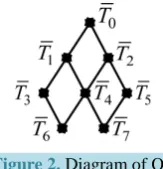
(see Figure 2) of the semilattice Q satisfies the following conditions:7 7, 6 6, 7 5 5, 6 3 3, 5 5 , 3 3 Yα ⊇T Yα ⊇T Yα∪Yα ⊇T Yα∪Yα ⊇T Yα∩ ≠ ∅T Yα∩ ≠ ∅T
Figure 2.Diagram of Q’.
( )
{ }
( )
{ }
( )
{
}
( )
{
}
( )
7{
}
( )
6{
5}
( )
{
4}
3 2 1
7 6 7 5 7 6 4
6 3 7 6 5 4 2 7 6 4 3 1
, , , , , , , , , , , , , , , , , , .
T T T T
T T T
Q T Q T Q T T Q T T T
Q T T Q T T T T T Q T T T T T
α α α α
α α α
= = = =
= = =
By Statement b) of the Theorem 1.2 follows that the following conditions are true:
(
) (
)
7 7 6 6 7 5 5 7 6 4 4 6 3 3
7 6 5 4 2 2 7 6 4 3 1 1
7 6 4 7 6 4 4 4 4
7 6 5 4 2 7 5 7 6 4 2 5 4 2 2 2
, , , , ,
, ;
,
Y T Y T Y Y T Y Y Y T Y Y T
Y Y Y Y Y T Y Y Y Y Y T
Y Y Y T T Y T Y T
Y Y Y Y Y Y Y Y Y Y Y T T Y T Y
α α α α α α α α α
α α α α α α α α α α
α α α α α
α α α α α α α α α α α α α
⊇ ⊇ ∪ ⊇ ∪ ∪ ⊇ ∪ ⊇ ∪ ∪ ∪ ∪ ⊇ ∪ ∪ ∪ ∪ ⊇ ∪ ∪ ⊇ ∪ ∪ = ∪ ⊇ ∪ ∪ ∪ ∪ = ∪ ∪ ∪ ∪ ∪ ⊇ ∪ ∪ = ∪
(
) (
)
27 6 4 3 1 7 6 4 6 3 1 4 3 1 1 1 1
, ,
T
Yα Yα Yα Yα Yα Yα Yα Yα Yα Yα Yα T T Yα T Yα T
⊇
∪ ∪ ∪ ∪ = ∪ ∪ ∪ ∪ ∪ ⊇ ∪ ∪ = ∪ ⊇
i.e., the inclusions Y7α∪Y6α∪Y4α ⊇T4, , Y7α∪Y6α∪Y5α∪Y4α∪Y2α ⊇T2 Y7α∪Y6α∪Y4α∪Y3α∪Y1α ⊇T1 are always hold. Further, it is to see, that the following conditions are true:
(
)
(
{ }
)
(
)
(
)
(
{ }
)
(
)
(
)
(
{ }
)
(
)
(
)
(
{ }
)
(
)
(
)
(
{ }
)
7 7 7
6 6 6
5 5 5
3 3 3
4 4
7 7 7 7 7
6 6 6 6 6
5 5 7 5 5 5 7
3 3 6 3 3 3 6
4 4 , \ , \ , \ ; , \ , \ , \ ; , \ , \ , \ ; , \ , \ , \ ; , \
T T T
T T T
T T T
T T T
T T
l Q T Q T T l Q T T
l Q T Q T T l Q T T
l Q T Q T T T l Q T T T
l Q T Q T T T l Q T T T
l Q T Q T
= ∪ = ∅ = ∅ ≠ ∅ = ∪ = ∅ = ∅ ≠ ∅ = ∪ = = ≠ ∅ = ∪ = = ≠ ∅ = ∪ =
(
)
(
)
(
{ }
)
(
)
(
)
(
{ }
)
(
)
42 2 2
1 1 1
4 4 4 4 4
2 2 2 2 2 2 2
1 1 1 1 1 1 1
, \ , \ ; , \ , \ , \ ; , \ , \ , \ ,
T
T T T
T T T
T T l Q T T T
l Q T Q T T T l Q T T T
l Q T Q T T T l Q T T T
= = ∅ = ∪ = = = ∅ = ∪ = = = ∅
i.e., T7, , , T6 T5 T3 are nonlimiting elements of the sets
( )
7
T
Q α ,
( )
6
T
Q α ,
( )
5
T
Q α and
( )
3
T
Q α respec-tively. By Statement c) of the Theorem 1.2 it follows, that the conditions Y7α∩T7≠ ∅, Y6α ∩T6≠ ∅,
5 5
Yα∩ ≠ ∅T and Y3α∩ ≠ ∅T3 are hold. Since Z7⊂Z5, Z6⊂Z3 we have Y5α∩ ≠ ∅T5 and Y3α∩ ≠ ∅T3 . Therefore the following conditions are hold:
7 7, 6 6, 7 5 5, 6 3 3, 5 5 , 3 3 Yα ⊇T Yα ⊇T Yα∪Yα ⊇T Yα∪Yα ⊇T Yα∩ ≠ ∅T Yα∩ ≠ ∅T The lemma is proved.
Definition 2.1. Assume that Q′∈ Σ2
(
X,8)
. Denote by the symbol R Q( )
′ the set of all regular elementsα of the semigroup BX
( )
D , for which the semilattices Q′ and Q are mutually α-isomorphic and(
,)
V D
α
=Q′.It is easy to see the number q of automorphism of the semilattice Q is equal to 2.
Theorem 2.2. Let Q=
{
T T T T T T T T7, 6, 5, 4, 3, 2, ,1 0}
∈ ∑2(
X,8)
, T5∩T3= ∅ and Σ2(
X,8)
=m0. If X be( )
(
5\1) (
3\ 2)
\00
2 2T T 1 2T T 1 8X T
R Q′ = ⋅m ⋅ − ⋅ − ⋅
Proof. Assume that
α
∈R Q( )
′ . Then a quasinormal representation of a regular binary relation α has the form(
Y7 T7) (
Y6 T6) (
Y5 T5) (
Y4 T4) (
Y3 T3) (
Y2 T2) (
Y1 T1) (
Y0 T0)
α α α α α α α α
α = × ∪ × ∪ × ∪ × ∪ × ∪ × ∪ × ∪ ×
where Y7α, , , Y6α Y5α Y3α∉ ∅
{ }
and by Lemma 2.3 satisfies the conditions: X7 7, 6 6, 7 5 5, 6 3 3, 5 5 , 3 3
Yα ⊇T Yα ⊇T Yα∪Yα ⊇T Yα∪Yα ⊇T Yα∩ ≠ ∅T Yα∩ ≠ ∅T (3) Let fα is a mapping the set X in the semilattice Q satisfying the conditions fα
( )
t =tα
for all t∈X. 1fα, f2α, f3α, f4α, f5α are the restrictions of the mapping fα on the sets T7, , \T6 T3 T2, \T5 T X T1, \ 0 respectively. It is clear, that the intersection disjoint elements of the set
{
T T T7, 6, \3 T T2, \5 T X T1, \ 0}
are empty set and T7∪ ∪T6(
T3\T2) (
∪ T5\T1) (
∪ X T\ 0)
=X .We are going to find properties of the maps f1α, f2α, f3α, f4α, f5α.
1) t∈T7. Then by Property (3) we have t∈T7⊆Y7α, i.e., t∈Y7α and tα=T7 by definition of the set Y7α. Therefore f1α
( )
t =T7 for all t∈T7.2) t∈T6. Then by Property (3) we have t∈ ⊆T6 Y6α, i.e., t∈Y6α and tα =T6 by definition of the set Y6α. Therefore f2α
( )
t =T6 for all t∈T6.3) t∈T3\T2. Then by Property (3) we have t∈T3\T2 ⊆T3 ⊆Y6α∪Y3α, i.e., t∈Y6α∪Y3α and t
α
∈{
T T6, 3}
by definition of the sets Y6α and Y3α. Therefore f3α
( )
t ∈{
T T6, 3}
for all t∈T3\T2. Preposition we have that Y3α∩ ≠ ∅T3 , i.e. t3α =T3 for some t3∈T3. If t3∈T2, then3 7 6 5 4 2
t ∈Yα∪Yα∪Yα∪Yα∪Yα. So t3
α
={
T T T T T7, 6, 5, 4, 2}
by definition of the sets Y7α, , , , Y6α Y5α Y4α Y2α. The condition t3α
={
T T T T T7, 6, 5, 4, 2}
contradict of the equality t3α =T3, while T3∉{
T T T T T7, 6, 5, 4, 2}
. Therefore,( )
3 3 3
fα t =T for some t∈T3\T2.
4) t∈T5\T1. Then by Property (3) we have t∈T5\T1⊆T5⊆Y7α∪Y5α, i.e., t∈Y7α∪Y5α and t
α
∈{
T T7, 5}
by definition of the sets Y7α and Y5α. Therefore f4α
( )
t ∈{
T T7, 5}
for all t∈T5\T1. Preposition we have that Y5α∩T5≠ ∅, i.e. t4α =T5 for some t4∈T5. If t4∈T1, then4 7 6 4 3 1
t ∈Yα∪Yα∪Yα∪Yα∪Yα. So t4
α
={
T T T T T7, 6, 4, 3, 1}
by definition of the sets Y7α, , , , Y6α Y4α Y3α Y1α. The condition t4α
={
T T T T T7, 6, 4, 3, 1}
contradict of the equality, t4α =T5, while T5∉{
T T T T T7, 6, 4, 3, 1}
. Therefore,( )
4 4 5
fα t =T for some t∈T5\T1.
5) t∈X T\ 0. Then by definition quasinormal representation binary relation α and by Property (3) we have
0 7 6 5 4 3 2 1 0
\
t∈X T ⊆X =Yα∪Yα∪Yα∪Yα∪Yα∪Yα∪Yα∪Yα, i.e. t
α
∈{
T T T T T T T T7, 6, 5, 4, 3, 2, ,1 0}
by definition of the sets Y7α, , , , , , , Y6α Y5α Y4α Y3α Y2α Y1α Y0α. Therefore f5α( )
t ∈{
T T T T T T T T7, 6, 5, 4, 3, 2, ,1 0}
for all t∈X T\ 0.Therefore for every binary relation
α
∈R Q( )
′ exist ordered system(
f1α,f2α,f3α,f4α,f5α)
. It is obvious that for different binary relations exist different ordered systems.Let f1:T7 →
{ }
T7 , f2:T6 →{ }
T6 , f3:T3\T2→{
T T6, 3}
, f4:T5\T1→{
T T7, 5}
, f5:X T\ 0→Q are such mappings, which satisfying the conditions:)
6 f t1
( )
∈{ }
T7 for all t∈T7;)
)
8 f3
( )
t ∈{
T T6, 3}
for all t∈T3\T2 and f t3( )
3 =T3 for some t3∈T3\T2;)
9 f4
( )
t ∈{
T T7, 5}
for all t∈T5\T1 and f4( )
t4 =Z4 for some t4∈T5\T1;)
10 f5
( )
t ∈{
T T T T T T T T7, 6, 5, 4, 3, 2, ,1 0}
for all t∈X T\ 0.Now we define a map f of a set X in the semilattice Q, which satisfies the following condition:
( )
( )
( )
( )
( )
( )
1 7
2 6
3 3 2
4 5 1
5 0
, if , , if , , if \ , , if \ , , if \ .
f t t T
f t t T
f t f t t T T
f t t T T
f t t X T
∈
∈
= ∈
∈
∈
Now let
(
{ } ( )
)
x X
x f x
β
∈
=
× , Yiβ ={
t tβ =Ti}
(
i=1, 2,, 5)
. Then binary relation β is written in the form(
Y7 T7) (
Y6 T6) (
Y5 T5) (
Y4 T4) (
Y3 T3) (
Y2 T2) (
Y1 T1) (
Y0 T0)
β β β β β β β β
β = × ∪ × ∪ × ∪ × ∪ × ∪ × ∪ × ∪ ×
and satisfying the conditions:
7 7, 6 6, 7 5 5, 6 3 3, 5 5 , 3 3 Yβ ⊇T Yβ ⊇T Yβ ∪Yβ ⊇T Yβ∪Yβ ⊇T Yβ∩ ≠ ∅T Yβ ∩ ≠ ∅T From this and by Lemma 2.3 we have that
β
∈R Q( )
′ .Therefore for every binary relation
α
∈R Q( )
′ and ordered system(
f1α,f2α,f3α,f4α,f5α)
exist one to one mapping.By Theorem 1.1 the number of the mappings f1α, , , , f2α f3α f4α f5α are respectively:
3\2 5\1 \0
1, 1, 2T T −1, 2T T −1, 8X T (see ([1], Corollary 1.18.1), ([2], Corollary 1.18.1)).
The number of ordered system
(
f1α,f2α,f3α,f4α,f5α)
or number regular elements can be calculated by the formula( )
(
5\1) (
3\ 2)
\00
2 2T T 1 2T T 1 8X T
R Q′ = ⋅m ⋅ − ⋅ − ⋅
(see ([1], Theorem 6.3.5), ([2], Theorem 6.3.5)). The theorem is proved.
Corollary 2.1. Let Q=
{
T T T T T T T T7, 6, 5, 4, 3, 2, ,1 0}
∈ ∑2(
X,8)
, T5∩T3= ∅. If X be a finite set and ( )r( )
X
E Q be the set of all right units of the semigroup BX
( )
Q , then the following formula is true ( )r( )
(
2T T5\1 1) (
2T T3\2 1 8)
X T\0X
E Q = − ⋅ − ⋅
Proof: This corollary immediately follows from Theorem 2.2 and from the ([1], Theorem 6.3.7) or ([2], Theorem 6.3.7).
The corollary is proved.
References
[1] Diasamidze, Ya. and Makharadze, Sh. (2013) Complete Semigroups of Binary Relations. Monograph. Kriter, Turkey, 1-520.
[2] Diasamidze, Ya. and Makharadze, Sh. (2010) Complete Semigroups of Binary Relations. Monograph. M., Sputnik+, 657 p. (In Russian)
[3] Lyapin, E.S. (1960) Semigroups. Fizmatgiz, Moscow. (In Russian)
[4] Diasamidze, Ya., Makharadze, Sh. and Rokva, N. (2008) On XI-Semilattices of Union. Bull. Georg. Nation. Acad. Sci.,
2, 16-24.
4319.
[6] Diasamidze, Ya., Makharadze, Sh. and Diasamidze, Il. (2008) Idempotents and Regular Elements of Complete Semi-groups of Binary Relations. Journal of Mathematical Sciences, 153, 481-499.