Pattern Learning for Event Extraction using Monolingual Statistical
Machine Translation
Marco Turchi, Vanni Zavarella, Hristo Tanev
European Commission - Joint Research Centre (JRC), IPSC - GlobeSec Via Fermi 2749, 21020 Ispra (VA) - Italy
{vanni.zavarella, hristo.tanev}@ext.jrc.ec.europa.eu
Abstract
Event extraction systems typically take ad-vantage of language and domain-specific knowledge bases, including patterns that are used to identify specific facts in text; techniques to acquire these patterns can be considered one of the most challenging is-sues. In this work, we propose a language-independent and weakly-supervised algo-rithm to automatically discover linear pat-terns from texts. Our approach is based on a phrase-based statistical machine transla-tion system trained on monolingual data. A bootstrapping version of the algorithm is proposed. Our method was tested on patterns with different domain-specific se-mantic roles in three languages: English, Spanish and Russian. Performance shows the feasibility of our approach and its ca-pability of working with texts in various languages.
1 Introduction
Multilingual event extraction task consists of re-trieving information about particular facts from text documents in different languages and produc-ing event-description templates, which typically contain slots about event participants, location, time and means.
In this work we use an event extraction sys-tem which aims at identifying violent events, man made and natural disasters and humanitar-ian crises, in title and first sentence of news re-ports. An event is represented as a template, whose main slots correspond toevent-specific se-mantic roles, such as: event-type, killed-victims,
injured-victims, perpetrators, and others. Slot fillers are typically extracted by matching linear patterns in text. For example, killed < PERSON-GROUP>represents a sample pattern for the se-mantic role DEAD-VICTIM. It will match text
snippets likekilled five people, wherefive people
fills the pattern slot <PERSON-GROUP>1. In this paper, we are concerned with surface-level, one-slot patterns which accept as slot fillers person names/descriptions such astwo Italian women.
Building a lexicon of linear patterns is a crucial step in the development and customization of an event extraction system, particularly in news texts which are characterized by an open domain and a large vocabulary. Different approaches have been proposed but most of them require a large man-ual effort and linguistic expertise. Moreover, due to lexical and syntactic variability and to Zipf’s law-based word distribution in language, acquired patterns can only partially cover the range of lin-guistic constructions. These are serious obstacles faced by every effort to adapt an event extraction system across domains or languages.
In order to address these problems, we put for-ward a novel language-independent and weakly-supervised algorithm to automatically learn linear event extraction patterns from an unannotated cor-pus of texts. The method allows knowledge-poor pattern acquisition without any data annotation. It is based on the noisy-channel model developed for Phrase-Based Statistical Machine Translation (PBSMT).
For a particular event-specific semantic role (e.g. DEAD-VICTIM) a pattern is proposed as seed. The most frequent person group fillers are selected both automatically from a document collection running an event extraction grammar (Tanev et al., 2009) or manually. Then, a monolin-gual PBSMT system, separately trained on pairs of comparable sentences from the same language, is used to translate the associations: filler-seed. The new patterns are extracted from the top transla-tions using the mean reciprocal rank (Voorhees,
1
Notice that“X pattern” and“pattern X”are two differ-ent patterns, withX occupying a different position wrt the pattern.
2000). This process is bootstrapped passing iter-atively the new patterns and the fillers to the algo-rithm.
Such an approach depends on availability of a corpus of monolingual sentence pairs conveying approximately the same information. The solu-tion we explore is to use pairs composed by the title and the first sentence of a news article. The main idea is that they report about the same con-tent expressed in different ways. A PBSMT sys-tem trained on this data produces, as output of the translation process, lexical or morphological vari-ations of the initial seed.
Our algorithm was tested on three languages, namely English, Spanish and Russian, belonging to three different language groups. Manual and application-based evaluations show the adaptabil-ity of our approach across languages and domains.
2 Related Work
Systems for automatic event detection and ex-traction typically use some form of language and domain-specific patterns. Many event extraction systems use syntactic patterns, (Riloff, 1993), or combinations of patterns and statistical classifiers, (Grishman et al., 2005). In the multilingual con-text, where syntactic parsers are not always avail-able, automatically learned linear patterns are an important resource for event detection and can reach a reasonable level of performance, as shown in (Tanev et al., 2009).
The first pattern learning systems, such as CRYSTAL, (Soderland et al., 1995), and Au-toSlog (Riloff, 1993), use manually-annotated cor-pora. (Riloff, 1996) proposes a weakly super-vised method which is an improved version of Au-toSlog. This method requires as input a set of text documents, which are manually classified as rele-vant or irrelerele-vant to a topic. Although this is less demanding than annotating the document content, it is still a time-consuming task. Weakly super-vised methods, reported so far, require much less human input than annotating a corpus, but they strongly depend on linguistic knowledge, prevent-ing them from easy adaptation between domains and languages.
Relevant to our work, the multilingual weakly supervised approaches, (Tanev and Wennerberg, 2008) and (Tanev et al., 2009), are based on anno-tation propagation in semantically consistent doc-ument clusters. They share some features with
our approach: they use bootstrapping; they only weakly depend on the language; they are do-main independent. The disadvantage of these ap-proaches is that clustering is computationally ex-pensive, which prevents this method from scaling to very large corpora.
Another research area, significant to our work is the unsupervised discovery of paraphrases. (Barzilay and Lee, 2003) proposes an approach, which is based on aligned comparable corpora. Unfortunately, such corpora are not easy to be ac-quired, especially in the multilingual context. In order to go around this obstacle, some approaches use distributional similarity for paraphrase acqui-sition: For example TEASE, (Szpektor et al., 2004), learns syntactic patterns which paraphrase a seed pattern, but it uses a full syntactic parser, thus making not applicable in a multilingual con-text. A language independent algorithm to para-phrase English sentences using a Statistical Ma-chine Translation (SMT) system is proposed by (Quirk et al., 2004), where training data are ex-tracted from Web pages and parallel sentences identified using edit distance.
Compared to the aforementioned approaches, our algorithm is more adaptable across languages, since it does not use any language-specific pro-cessing. Moreover, our training corpora are easy-to-acquire and more focused on the type of text analysed by the event extraction system, which al-lowed us to significantly extend training data sets compared to other algorithms based on monolin-gual machine translation.
3 Monolingual Phrase Based Statistical
Machine Translation
es-timated counting the frequency of the phrases in the parallel corpus.
In classical PBSMT, a system is trained using parallel data: each sentence in a source language is associated with correctly translated sentence in a target language. In our approach, we use monolin-gual comparable data: source and target sentences are respectively the first sentence of the body and the title of a news article in a selected language, for example:
First Sentence:Twenty-five people were killed in the latest round of Afghan violence this week.
Title: 25 civilians dead as Taliban intensifies attacks in Afghanistan.
The main idea is that the two sentences convey the same information in different style, e.g. Twenty-five people were killedand25 civilians dead. This is grounded on a well-established news writing practice, the so called “inverted pyramid” method, which suggests to re-state the core factual content of a news story at the opening of the article body, (Bell, 1991).
Consequently, a translation in our monolingual PBSMT consists of finding the most probable sen-tence in the “title” style that contains the same in-formation of the input sentence in the “content” style. In this work, the PBSMT technique allows the extraction of patterns that are indistinctly con-stituted by either a sequence of words (phrase) or a single word.
4 Pattern Learning Algorithm
The proposed method for pattern acquisition con-sists of two parts. The first one is the core algo-rithm with an initial pattern (seed) and a set of fillers, produces a set of reliable new linear pat-terns. To increase the number of patterns, the core algorithm is then embedded in a bootstrap-ping schema where it is repeatedly called. In the next Sections, these methods are described in de-tail.
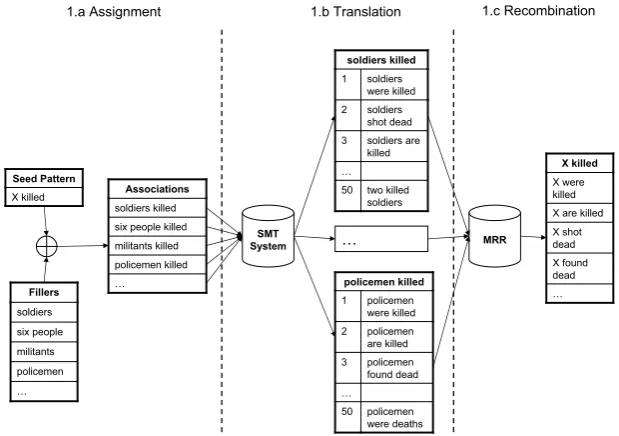
Core Approach The basic algorithm takes ad-vantage of a monolingual PBSMT system to find lexical and morphological variants of a seed and it is made of three phases: association, translation
andrecombination. In the first phase, see Fig. 1.a, a set of associations is created pairing the seed,
X killed, with a set of person/person group fillers,
soldiers, ... policemen, which can be either pro-vided manually or extracted by a person recogni-tion grammar. Each single associarecogni-tion is passed
to a monolingual translation system, see Fig. 1.b, that produces the top fifty best translations of the association ranked according top(e|f).
Each seed could be translated by itself, indepen-dently from the fillers. However, some initial ex-periments showed that the filler text snippets help the algorithm to contextualize the translation, e.g.
shot Xwith the fillerciviliansorpictures. Without any person group context, the extracted variants may end up covering different meanings. Further-more, filler position crucially defines who or what is doing or undergoing an action in transitive verb group patterns (e.g. A soldier shot orshot a sol-dier) so that translating them alone can generate patterns with event roles in inverted position.
In terms of machine translation, the usage of the person group requires the translation of the full as-sociation, person group plus seed, rather than us-ing the translation model as a look-up table for the seed only. This means that the SMT may also pro-duce a variation of the person group adding ex-tra noise to the output. To reduce the impact of the presence of the person group, each association is passed to the SMT system with an option that forces PBSMT not to modify the filler in the out-put, but to use it to contextualize the translation, e.g. soldiers and policemen are present in their original form in Fig. 1.b.
For a single seed, sets of translations are gener-ated according to the number of associations, and the same new pattern can be ranked in a differ-ent position inside differdiffer-ent sets, e.g. are killedas shown in Fig. 1.b. The last step consists of ex-tracting all the new patterns from the sets of trans-lations and re-ranking them in a reliability order, see Fig. 1.c. To make the new patterns comparable across sets, in each translation the person group is substituted by a X. The recombination of the pat-terns in a unique list can be done merging and re-ranking all of them using a mathematical opera-tor based onp(e|f), e.g. average, butp(e|f)is a local property of each set of translations because includes the contribution of the filler.
! "
Figure 1: Extraction of new patterns using the seed “X killed”.
rankis the rank of the first correct answer.
MRR= 1|Q| Q
i=1
1 ranki
(1)
MRR(np) =|A1| A
i=1
1 ranki(np)
(2) We adapt the MRR in the following way: the number of queries is the number of associations, and the answers to a query are the fifty transla-tions of a certain association. The MRR of a new pattern,np, is shown in Eq. 2, whereAis the num-ber of associations for a seed andranki(np)is the position of npin the set of translations of the as-sociationi.
High rank of a new pattern in a set of transla-tions guarantees its correctness while MRR based on the ranked translations guarantees that those new patterns that are on top positions in various sets received a high rank in the final list. Top pat-terns are selected from the final list by picking up those that have MRR value bigger than 10% of the MRR value of the best pattern.
Bootstrapping. The core algorithm is embed-ded in a bootstrapping framework. Starting from the original seed, called “root seed”, each new pat-tern produced by the core algorithm can be consid-ered an input seed for another instance of the core algorithm. This procedure can be iterated over all the new patterns.
This approach increases the number of retrieved patterns, but can create unwanted noise. At each bootstrapping step, the produced patterns can be
semantically divergent from the “root seed” be-cause a seed can be semantically ambiguous or polysemous and one of the fillers can be too generic to pick up a unique sense. We tackle this problem by introducing a stop criterion in the bootstrapping framework, whose goal is to select only those new patterns that are semantically sim-ilar to the “root seed”. The selected patterns are only propagated to the next iteration and the seed that produced them is added to the final results.
The concept of semantic similarity between a surface pattern and the seed is modelled by sim-ply using set intersection.We assume that the new patterns produced by the expansion of the “root seed” are the most semantically similar to it. This is confirmed by the value of the macro-precision of the produced patterns in English which is equal to 82%. According to this, we consider the expan-sion of the “root seed” as a gold standard,GS, for the bootstrapping approach.
bootstrapping iterations. Otherwise the bootstrap-ping is stopped, npt is not considered a reliable pattern and not included in the final results. The stop criterion forces each new pattern at iterationt to be validated using information produced at iter-ationt+ 1before being added to final results.
The stop criterion is not highly restrictive, it re-duces the number of computations and guarantees a semantic similarity between the “root seed” and new patterns. The final output of the bootstrap-ping process is the union without duplicates of all the new patterns that are evaluated as correct by the stop criterion.
5 Experimental Setup
In this work, we use Moses, (Koehn et al., 2007), a complete phrase-based translation toolkit for re-search purposes.
Training data are extracted from a title and first sentence of news articles gathered during a one year time span from 01/07/2008 to 01/07/2009. We perform experiments in three languages: En-glish, Russian and Spanish. For each language, we respectively use ∼2,87M, ∼2,19M and ∼1,48M sentence pairs. Nine event predicates are chosen, which are important for analysis of political, cri-sis and violence-related news (for example DEAD-VICTIM). For each of them a highly frequent and unambiguous linguistic realization is selected as a single-slot seed pattern, for each of the three lan-guages: X sentenced (1), criticized X (2), X vis-ited (3),X were killed(4),X met with(5),X were evacuated (6), X were wounded (7), supported X (8) and X launched an attack (9) 2. In each language, seed patterns are integrated with per-son/person group recognition rules, as proposed in (Tanev et al., 2009), and run on a news corpus to extract a set of person/person group fillers: the 20 most frequent are then paired with the seed pattern and fed to the PBSMT system3.
6 Evaluation and Results
We evaluate by running only four iterations of bootstrapping, where the fourth is used to validate the new patterns extracted at iteration 3. An av-erage of about 55, 74 and 39 new patterns over
2
In the next Sections, we refer to each pattern using the number close to it.
3
Notice that fillers could have been manually produced as well, so that the overall algorithm is not really dependent on the person recognition grammar.
all the predicates are acquired for English, Rus-sian and Spanish, respectively. There were rates of 3.6%, 0.3% and 4.8% ungrammatical patterns. For a seed that was not in the test set, X was kid-napped, we experimented running more iterations of bootstrapping, finding that at each iteration the number of correct patterns grew about 1.5 times on average, at the cost of a small decrease of pre-cision (about 20%). The number of new patterns is relatively small, because we wanted to test the generative power of the algorithm when fed with a minimal input of only one seed pattern.
We performed a direct evaluation of the output pattern Accuracy and then we evaluated indirectly the Precision and Recall via running an extraction system. Ungrammatical patterns are considered inapplicable and discarded from accuracy evalua-tion while we keep them for evaluating extracevalua-tion performance.
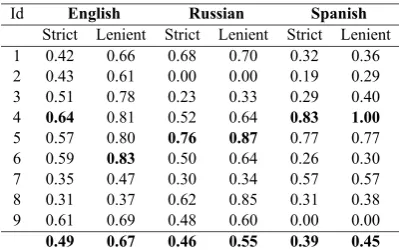
Pattern Accuracy. Pattern Accuracy evalu-ation was performed by asking a language ex-pert to rate each pattern as either “correct” (se-mantically sound and non-ambiguous), “correct-in-context” (partially ambiguous but semantically sound in some linguistic context) or “incorrect”. A “lenient” Accuracy score was computed as the ratio of both the “correct” and “correct-in-context” patterns over the total, while “strict” accuracy only includes “correct” patterns.
Id English Russian Spanish
Strict Lenient Strict Lenient Strict Lenient
1 0.42 0.66 0.68 0.70 0.32 0.36
2 0.43 0.61 0.00 0.00 0.19 0.29
3 0.51 0.78 0.23 0.33 0.29 0.40
4 0.64 0.81 0.52 0.64 0.83 1.00
5 0.57 0.80 0.76 0.87 0.77 0.77
6 0.59 0.83 0.50 0.64 0.26 0.30
7 0.35 0.47 0.30 0.34 0.57 0.57
8 0.31 0.37 0.62 0.85 0.31 0.38
9 0.61 0.69 0.48 0.60 0.00 0.00
0.49 0.67 0.46 0.55 0.39 0.45
Table 1: Manual evaluation of pattern accuracy. Highest values are highlighted.
anno-tation task is grounded and performed it with one single annotator for Spanish and Russian.
Pattern Accuracy scores for each predicate are shown in Table 1 together with macro-averages. Among correct patterns in all the seeds, morpho-logical variants can be observed (including mood, tense, number) as well as lexical shifts and a few verb form alternations (e.g. active-passive). A common source of noise is the assignment of the filler position to a wrong verb argument (e.g. X were killed → X kills;supported X →X favour). This is due to the reordering model in the PBSMT system that considers the incorrect position of the filler as probable as the correct one, so forcing the translation system to output the wrong pattern.
Overall, pattern Accuracy figures closely corre-lates with the size of the training corpora for the PBSMT systems in the three languages.
Extraction systems based on the same schema (initial seed plus bootstrapping approach in a un-supervised manner) have accuracy on new patterns from 40% to 50% (e.g. the Web-based system by (Szpektor et al., 2004)), consequently we consider the performance of our method for pattern learn-ing really encouraglearn-ing.
Event Extraction Precision and Recall. In order to measure Recall and Precision of the new pattern sets, we compared performance of a base-line extraction system (BL), containing person en-tity grammar and the single seed extraction pat-tern, against a target system (TG), that adds the set of the discovered patterns to the seed, and then against a clean target system (CT), that adds only those discovered patterns that are human-evaluated as “correct” and “correct-in-context”.
Recall was measured in the following way: for each event predicate, a set of 20 news article sen-tences reporting about that event type were man-ually collected then the person/person group en-tity expressions were replaced in text with a con-stant expression detectable by the person recogni-tion grammar, so as to make the results unaffected by the performance of the grammar itself. Then the number of successful detections of that filler was checked.
As for the Precision, the baseline and target systems were both run on a corpus of titles and first sentences of news articles collected during 10 days, resulting in about 5.79M, 3.29M and 700k words for English, Russian and Spanish respec-tively. From all the system outputs, a set of 20
were randomly collected, discarding duplicates, and the correctness of extracted fillers were man-ually evaluated. Answers were rated as correct when at least one of the fillers extracted was at least partially overlapping with the full person en-tity expression actually in text4.
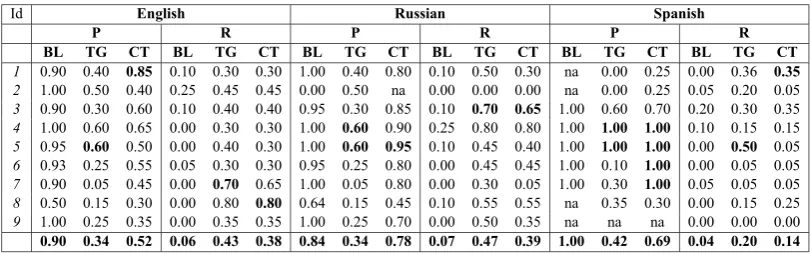
Table 2 shows Precision and Recall scores of the discovered patterns in an extraction task5. The Recall of the TG system is raising constantly from the baseline values across all the predicates and for each language. Recall can be improved raising the number of correct patterns added to the system. This, as mentioned in Section 6, can be done by in-creasing the number of bootstrapping steps. Preci-sion of the TG system is also constantly dropping. However, this decrease can be significantly limited via human pattern selection, as can be seen from the performance of the CT. system Overall, the automatic approach proposed here, coupled with a lightweight human post-processing step, gener-ates a good quality pattern lexicon for information extraction.
For the TG system, performance seems to be largely variable across predicate types, and this partially correlates with the pattern accuracy fig-ures too. However, performances seem to be in-dependent from domain variation, with the best results spreading over the violent, political or ju-dicial event domains. This suggests that domain adaptation of an event extraction system can be easily achieved in our method by providing a suit-able amount of training data in the corresponding subject domain, so as to reduce the ambiguity of the language.
7 Conclusions
We proposed a language-independent and weakly-supervised bootstrapping algorithm to learn linear patterns from text, based on a phrase-based statis-tical machine translation system trained on mono-lingual data.
Among the different methods that have been proposed for extracting linear patterns from text, our approach is completely language independent, and it relies on freely available data such as news articles. Training data for the SMT system do not require any heavy pre-processing and such
sen-4
E.g.soldiersis taken as a correct system answer for the injured-victimrole in a sentence like “3 German soldiers were wounded”
5
Id English Russian Spanish
P R P R P R
BL TG CT BL TG CT BL TG CT BL TG CT BL TG CT BL TG CT 1 0.90 0.40 0.85 0.10 0.30 0.30 1.00 0.40 0.80 0.10 0.50 0.30 na 0.00 0.25 0.00 0.36 0.35 2 1.00 0.50 0.40 0.25 0.45 0.45 0.00 0.50 na 0.00 0.00 0.00 na 0.00 0.25 0.05 0.20 0.05
3 0.90 0.30 0.60 0.10 0.40 0.40 0.95 0.30 0.85 0.10 0.70 0.65 1.00 0.60 0.70 0.20 0.30 0.35
4 1.00 0.60 0.65 0.00 0.30 0.30 1.00 0.60 0.90 0.25 0.80 0.80 1.00 1.00 1.00 0.10 0.15 0.15
5 0.95 0.60 0.50 0.00 0.40 0.30 1.00 0.60 0.95 0.10 0.45 0.40 1.00 1.00 1.00 0.00 0.50 0.05
6 0.93 0.25 0.55 0.05 0.30 0.30 0.95 0.25 0.80 0.00 0.45 0.45 1.00 0.10 1.00 0.00 0.05 0.05
7 0.90 0.05 0.45 0.00 0.70 0.65 1.00 0.05 0.80 0.00 0.30 0.05 1.00 0.30 1.00 0.05 0.05 0.05
8 0.50 0.15 0.30 0.00 0.80 0.80 0.64 0.15 0.45 0.10 0.55 0.55 na 0.35 0.30 0.00 0.15 0.25
9 1.00 0.25 0.35 0.00 0.35 0.35 1.00 0.25 0.70 0.00 0.50 0.35 na na na 0.00 0.00 0.00
0.90 0.34 0.52 0.06 0.43 0.38 0.84 0.34 0.78 0.07 0.47 0.39 1.00 0.42 0.69 0.04 0.20 0.14
Table 2: Pattern performance in an extraction task. “na” values for Precision mean that there were no extracted fillers for that test set. For each language, the biggest improvement (or smallest decrease) over the pattern types compared to the baseline is underlined.
tence pair collections can be easily built for any language and target domain from the news.
The new extracted patterns, in the “title” style, contain exactly the kind of variation in linguistic constructions that the event extraction system has to deal with during the detection process on title and first sentence of a news article. Performance analysis confirms this assumption and shows the feasibility of the approach both across languages and domains.
From an evaluation of the output patterns we noticed a degradation of the Accuracy after the first iteration of the algorithm. It is our intention to investigate the role of the bootstrapping criterion and model the similarity condition with some ro-bust measure of distributional similarity between pattern sets.
Acknowledgments
Special thanks go to Francesca Torti from Univer-sity of Parma for her essential statistical support.
References
Barzilay R., and Lee L. (2003) Learning to Para-phrase: An Unsupervised Approach Using Multiple-Sequence Alignment.Proceedings of HLT-NAACL, 16–23. Edmonton, Canada.
Bell A. (1991)The Language of News Media. Black-well Publishers, Oxford.
Brown P.F., Della Pietra S., Della Pietra V.J., and Mer-cer R.L. (1994) The Mathematic of Statistical Ma-chine Translation: Parameter Estimation. Computa-tional Linguistics, 19(2) 263–311.
Fleiss J.L. (1981)Statistical methods for rates and pro-portions. John Wiley, New York, USA.
Grishman R., Westbrook D., and Meyers A. (2005) NYU’s English ACE 2005 system description. Pro-ceedings of the ACE, Evaluation Workshop.
Koehn P., Och F.J., and Marcu D. (2003) Statistical phrase-based translation. Proceedings of NAACL, 48–54, Morristown, USA.
Koehn P., Hoang H., Birch A., Callison-Burch C., et al. (2007) Moses: Open source toolkit for statistical machine translation.Proceedings of ACL, 45(2).
Lapata, M. (2006) Automatic evaluation of information ordering: Kendall’s tau.Computational Linguistics, 32(4) 471–484.
Quirk C., Brockett C., and Dolan W. (2004) Monolin-gual machine translation for paraphrase generation.
Proceedings of EMNLP, 149. Barcelona, Spain.
Riloff E. (1993) Automatically Constructing a Dictio-nary for Information Extraction Tasks.Proceedings of the Eleventh National Conference on Artificial In-telligence, 811–816. Seattle, USA.
Riloff E. (1996) Automatically Generating Extraction Patterns from Untagged Text.Proceedings of AAAI, 1044–1049. Portland, USA.
Soderland S., Fisher D., Aseltine J., and Lehnert W. (1995) CRYSTAL: Inducing a conceptual dictio-nary.Proceedings of IJCAI, 1314–1319. Canada.
Szpektor I., Tanev H., Dagan I., and Coppola B. (2004) Scaling Web-based Acquisition of Entailment Rela-tions.Proceedings of EMNLP, 41–48. Spain.
Tanev H., and Wennerberg P. (2008) Learning to Pop-ulate an Ontology of Politically Motivated Violent Events.Mining Massive Data Sets for Security, IOS Press, 311–322.
Tanev H., Zavarella V., Linge J., Kabadjov M., et al. (2009) Exploiting Machine Learning Techniques to Build an Event Extraction System for Portuguese and Spanish.Linguamatica, 2(1) 55–66.