Finding the Best Approach for Multi-lingual Text Summarisation: A
Comparative Analysis
Elena Lloret
University of Alicante Apdo. de Correos 99 E-03080, Alicante, Spain
Manuel Palomar
University of Alicante Apdo. de Correos 99 E-03080, Alicante, Spain
Abstract
This paper addresses the problem of multi-lingual text summarisation. The goal is to analyse three approaches for generat-ing summaries in four languages (English, Spanish, German and French), in order to determine the best one to adopt when tack-ling this issue. The proposed approaches rely on: i) language-independent tech-niques; ii) language-specific resources; and iii) machine translation resources ap-plied to a mono-lingual summariser. The evaluation carried out employing the JRC corpus – a corpus specifically created for multi-lingual summarisation – shows that the approach which uses language-specific resources is the most appropriate in our comparison framework, performing better than state-of-the-art multi-lingual summarisers. Moreover, the readability assessment conducted over the resulting summaries for this approach proves that they are also very competitive with respect to their quality.
1 Introduction
In the current society, information plays a crucial role that brings competitive advantages to users, when it is managed correctly. However, due to the vast amount of available information, users cannot cope with it, and therefore research into new meth-ods and approaches based on Natural Language Processing (NLP) is crucial, thus resulting in con-siderable benefits for the society. Specifically, one of these NLP research areas is Text Summarisa-tion (TS) which is essential to condense informa-tion keeping, at the same time, the most relevant facts or pieces of information. However, to pro-duce a summary automatically is very challeng-ing. Issues such as redundancy, temporal dimen-sion, coreference or sentence ordering, to name a
few, have to be taken into consideration especially when summarising a set of documents (multi-document summarisation), thus making this field even more difficult (Goldstein et al., 2000). Such difficulty also increases when the information is stated in several languages and we want to be ca-pable of producing a summary in those languages, thus not restricting the summariser to a single lan-guage (multi-lingual summarisation). The gener-ation of multi-lingual summaries improves con-siderably the capabilities of TS systems, allowing users to be able to understand the essence of doc-uments in other languages by only reading their corresponding summaries.
Therefore, the aim of this paper is to carry out a comparative analysis of several approaches for generating extractive1multi-lingual summaries in four languages (English, French, German and Spanish). These approaches comprise the use of: i) independent techniques; ii) language-specific resources; and iii) machine translation re-sources applied to a mono-lingual summariser. In this way, we can study the advantages and lim-itations of each approach, as well as to deter-mine which is the most appropriate to adopt for this type of summaries. Although the language-specific resources are limited and perform differ-ently for each language, the results indicate that this approach is the best to adopt, since for each language, more specific information could be ob-tained, benefiting the final summaries.
The remaining of the paper is organised as fol-lows. Section 2 introduces previous work on multi-lingual TS. Section 3 describes the pro-posed approaches for generating multi-lingual summaries in detail. Further on, the corpus used, the experiments carried out, the results obtained together with an in-depth discussion is provided
1Extractive approaches are those ones which only detect
important sentences in documents and extract them, without performing any kind of language generation or generalisa-tion.
in Section 4. Finally, the conclusions of the pa-per together with the future work are outlined in Section 5.
2 Related Work
Generating multi-lingual TS is a challenging task, due to the fact that we have to deal with mul-tiple languages, each of which has its peculiari-ties. Attempts to produce multi-lingual summaries started with SUMMARIST (Hovy and Lin, 1999), a system which extracted sentences from docu-ments in a variety of languages, by using English, Japanese, Spanish, Indonesian, and Arabic prepro-cessing modules and lexicons. Another example of multi-lingual TS system is MEAD (Radev et al., 2004), able to produce summaries in English and Chinese, relying on features, such as sentence po-sition, sentence length, or similarity with the first sentence.
More recently, research in multi-lingual TS has been focused on the analysis of language-independent methods. For instance, in (Litvak et al., 2010b) a comparative analysis of 16 meth-ods for language-independent extractive summari-sation was performed in order to find the most efficient language-independent sentence scoring method in terms of summarisation accuracy and computational complexity across two different languages (English and Hebrew). Such methods relied on vector-, structure- and graph-based fea-tures (e.g. frequency, position, length, title-based features, pagerank, etc.), concluding that vector and graph-based approaches were among the top ranked methods for bilingual applications. From this analysis, MUSE – MUltilingual Sentence Ex-tractor (Litvak et al., 2010a) was developed, where other language-independent features were added and a genetic algorithm was employed to find the optimal weighted linear combination of all the sentence scoring methods proposed. In (Patel et al., 2007) a multi-lingual extractive language-independent TS approach was also suggested. The proposed algorithm was based on structural and statistical factors, such as location or identification of common and proper nouns. However, it also used stemming and stop word lists, which were dependent on the language. This TS approach was evaluated for English, Hindi, Gujarati and Urdu documents, obtaining encouraging results and showing that the proposed method performed equally well regardless of the language.
News-Gist (Kabadjov et al., 2010) is a multi-lingual summariser that achieves better performance than state-of-the-art approaches. It relies on Singular Value Decomposition, which is also a language-independent method, so it can be applied to a wide range of languages, although at the moment, it has been only tested for English, French and German.
Furthermore, Wikipedia2 is a multi-lingual re-source, which has been used for many natural lan-guage applications. It contains more than 18 mil-lion articles in more than 270 languages, which have been written collaboratively by volunteers around the world. This valuable resource has also been used for developing multi-lingual TS approaches. For instance, (Filatova, 2009) took advantage of Wikipedia information stated across different languages with the purpose of creating summaries. The approach was based on the Pyra-mid method (Nenkova et al., 2007) in order to ac-count for relevant information. The underlying idea was that sentences were placed on different levels of the pyramid, depending on the number of languages containing such sentence. Thus, the top levels were populated by the sentences that ap-peared in the most languages and the bottom level contained sentences appearing in the least number of languages. The summary was then generated by taking a specific number of sentences starting with the top level, until the desired length was reached. Moreover, although the multi-lingual ap-proach proposed in (Yuncong and Fung, 2010) aimed at generating complete articles instead of summaries, it is very interesting and it can be per-fectly applied to TS. Basically, this approach took an existing entry of Wikipedia as content guide-line. Then, keywords were extracted from it, and translated into the target language. The translation was used to query the Web in the target language, so candidate fragments of information were ob-tained. Further on, these fragments were ranked and synthesised into a complete article.
Different to the aforementioned approaches, in this paper we carried out a comparison between three approaches: i) a language-independent ap-proach; ii) a language-specific apap-proach; and iii) machine translation resources applied to a mono-lingual TS approach. Our final aim is to analyse them in order to find which is the most suitable for performing multi-lingual TS.
3 Multi-lingual Text Summarisation
The objective of this section is to explain the three proposed approaches for generating multi-lingual summaries in four languages (English, French, German and Spanish). We developed an extractive TS approach for each case. In particular, we anal-ysed: i) language-independent techniques section 3.1); ii) language-specific resources (Sub-section 3.2); and iii) machine translation resources applied to a mono-lingual summariser (Subsection 3.3). Next, we describe each approach in detail.
3.1 Language-independent Approach
As a language-independent approach for tack-ling multi-tack-lingual TS, we computed the relevance of sentences by using the term frequency tech-nique. Term frequency was first proposed in (Luhn, 1958), and, despite being a simple tech-nique, it has been widely used in TS due to the good results it achieves (Gotti et al., 2007), (Or˘asan, 2009), (Montiel et al., 2009).
The importance of a term in a document will be given by its frequency. At this point, it is worth mentioning that stop words, such as “the”, “a”, “you”, etc. are not taken into account; other-wise the relevance of sentences could be wrongly calculated. In order to identify them, we need a specific list of stop words, depending on the lan-guage used. The lanlan-guage-specific processing in this approach is minimal, so it can be considered language-independent, since given a new language it would be very easy to obtain automatic sum-maries through this approach.
For determining the relevance of sentences, a matrix is built. In this matrixM, the rows repre-sent the terms of the document without consider-ing the stop words, whereas the columns represent the sentences. Each cell M[i, j]contains the fre-quency of each termiin the document, provided that such term is included in the sentence; other-wise the cell contains a 0. Then, the importance of sentenceSj is computed by means of Formula 1:
ScSj =
∑n
i=1M[i, j]
|T erms| (1)
where
ScSj = Score of sentencej
M[i, j]= value of the cell[i,j]
|T erms|= total number of terms in the docu-ment.
Once the score for each sentence is calculated, sentences will be ranked in descending order, and the top ones up to a desired length will be chosen to become part of the summary.
Apart from its simplicity, the advantage of this techniques is that it can be used in any language. However, its main limitation is that the relevance of the sentences is only determined through lexical surface analysis, and therefore, semantics aspects are not taken into account.
3.2 Language-specific Approach
Our second proposed approach is very similar to the first one, but instead of term frequency, it em-ploys language-specific resources for each of the target languages. For determining the relevance of sentences, this approach analyses the use of Named Entity Recognisers (NER) and the identi-fication of concepts, by means of their synsets in WordNet (Fellbaum, 1998) or EuroWordNet (Ell-man, 2003). On the one hand, named entities can indicate important content, since they refer to spe-cific people, organisations, places, etc. that may be related to the topic of the document. On the other hand, the identification of concepts involves semantic analysis, and therefore, we can identify synonyms or other types of semantic relationships. These types of resources (NERs and resources like Wordnet) have been commonly employed for generating specific types of summaries (Has-sel, 2003), (Bellare et al., 2004), (Chaves, 2001). Moreover, in (Filatova and Hatzivas-siloglou, 2004) it was proven that approaches that took into consideration named entities as well as frequent words were appropriate for TS. In light of this, we decided to develop a similar approach, but relying on named entities and concepts.
In particular, we focus on four languages (En-glish, French, German and Spanish). The named entities are identified using different NERs, de-pending on the language. In this way, we use LingPipe3 for English, the Illinois Named Entity Tagger4(Ratinov and Roth, 2009) for French, the NER for German5proposed in (Faruqui and Pad´o, 2010), and Freeling6 for Spanish. For detecting concepts, we rely on WordNet for English and Eu-roWordNet for the remaining languages. Thanks
3http://alias-i.com/lingpipe/ 4
http://cogcomp.cs.illinois.edu/page/software view/4
5
http://www.nlpado.de/ sebastian/ner german.html
to these types of resources, this approach uses se-mantic knowledge, instead of only lexical, as in the case of the term frequency in the language-independent approach.
For computing the relevance of the sentences, a matrix (M) is also built, where the rows repre-sent the entities or concepts of the document and the columns, the sentences. Each cellM[i, j] con-tains the frequency of appearance of either each entity or concept. As in the previous approach, stop words are not taken into consideration, and in those cases where neither the entity nor the con-cept is included in the sentence, a 0 is assigned to the cell. Once the matrix has been filled in, For-mula 2 is then used to compute the relevance of sentences:
ScSj =
∑n
i=1M[i, j]
|N E+Concepts| (2)
where
ScSj = Score of sentencej
M[i, j]= value of the cell[i,j]
|N E + Concepts| = total number of named entities and concepts in the document.
The highest scored sentences, up to a specific length, will be extracted to build the final sum-mary.
The advantages of this approach with respect to the previous one (i.e. the language-independent) is that semantic analysis is applied by using re-sources such as WordNet or EuroWordNet. This allows us to group synonyms under the same con-cept. For instance, the words harassment and
molestation represent the same concepts (since they both belong to the same synset in WordNet), so they are grouped together in this approach, whereas in the previous one, where only the fre-quency of terms is taken into consideration, they are considered two distinct words. In contrast, the drawback of this approach is that such kind of re-sources may not be available for all languages, and therefore we might have problems in applying this approach. Moreover, the error these resources in-troduce (e.g. NERs) may negatively affect the per-formance of the summariser.
3.3 Machine Translation Resources applied to a Mono-lingual Approach
The idea behind this approach is to use an exist-ing mono-lexist-ingual summariser for a specific
lan-guage and then employ a machine translation sys-tem for obtaining the summaries in the different languages. In particular, we employ the TS ap-proach proposed in (Lloret and Palomar, 2009) that generates extractive summaries for English. The reason for employing such summariser is its competitive results achieved compared to the state of the art. Briefly, the main features of this ap-proach are: i) redundant information is detected and removed by means of textual entailment; and ii) the Code Quantity Principle (Giv´on, 1990) is used for accounting relevant information from a cognitive perspective. Therefore, important sen-tences are identified by computing the number of words included in noun-phrases, taking also into consideration the relative frequency each word has in the document. Once the summaries have been generated, Google Translate7 is used to translate the summaries into the different target languages (i.e., French, German and Spanish), since it is a free online language translation service that can translate text in more than 50 languages.
The advantage of this approach is that we do not have to develop a particular approach for each language, because we can rely on existing mono-lingual summarisers. Although machine transla-tion has been made great progress in the recent years, and they can translate text into a wide range of languages, the disadvantage associated to us-ing such tools concerns their performance, since wrong translations can negatively affect the qual-ity of the resulting summary.
4 Experimental Framework
The goal of this section is to setup an experimen-tal framework, thus allowing us to analyse the aforementioned approaches in a specific context. Therefore, the corpus employed and the languages used are described in Subsection 4.1. Then, the evaluation methodology proposed and the results obtained together with a discussion is provided in Subsection 4.2.
4.1 Corpus
We used the JRC multi-lingual summary eval-uation data8 for carrying out the experiments, in order to determine which approach should be more appropriate for the task of multi-lingual summarisation. The corpus consists of 20
docu-7
http://translate.google.com/
English French German Spanish
No. of words 16,398 18,329 16,837 18,547 Avg. words/document 819.9 916.45 841.45 928.7 Max. words/document 973 1,157 1,025 1,144
Min. words/document 617 698 645 708
No. of NE 511 254 345 326
Avg. NE/document 25.6 12.7 17.25 16.3
Max. NE/document 44 22 37 32
Min. NE/document 3 6 1 1
No. of concepts 3,405 2,376 2,115 3,580 Avg. concepts/document 170.25 118.8 105.75 179 Max. concepts/document 1,353 159 136 231 Min. concepts/document 222 90 78 138
Table 1: Statistical properties of the JRC corpus.
ments grouped into four topics (genetics, Israel-and-Palestine-conflict, malaria and science-and-society). Each document is available in seven lan-guages (Arabic, Czech, English, French, German, Russian and Spanish), and the corpus also contains the manual annotation of important sentences, so it is possible to have four model summaries for each of the documents. Four our purposes, four lan-guages were selected (English, French, German and Spanish), thus dealing with 80 documents.
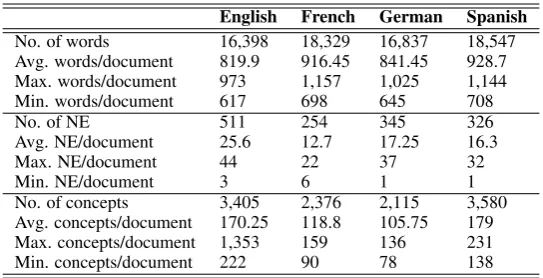
The type of documents contained in the JRC corpus pertained to the news domain. Table 1 shows some properties of the corpus.
As it can be seen from the table, all the doc-uments have a similar length, the shortest ones having more than 600 words, whereas the longest ones around 1,000 words. Regarding the statis-tics about the words, it is worth noting that the documents in Romance languages (Spanish and French) have similar characteristics. Analogously, the same happens for the Germanic languages (En-glish and German). However, the highest differ-ences between languages can be found in the num-ber of NE and concepts detected. Whereas for En-glish, the average number of NE is 25, for the re-maining languages is at most 17. This depends on the NER employed. The language-specific re-sources used for detecting concepts (WordNet and EuroWordNet) also influence the number of con-cepts identified. In this way, Spanish and English are the languages with more concepts.
4.2 Results and Discussion
The JRC corpus was used to generate extractive summaries in four languages (English, French, German, and Spanish), following our three pro-posed approaches. We generated 20 summaries for each approach and language, thus evaluating
240 different summaries in the end. Two types of evaluation were conducted. On the one hand, the content of the summaries was evaluated in an au-tomatic manner (Subsubsection 4.2.1), whereas on the other hand, their readability was manually as-sessed (Subsubsection 4.2.2). In addition, a com-parison with current multi-lingual TS systems was also carried out (Subsubsection 4.2.3).
4.2.1 Content Evaluation
The automatic summaries were compared to the model ones, using ROUGE (Lin, 2004), a widespread tool for evaluating TS. In this way, the content of the summaries was assessed, since this tool allows to compute recall, precision and F-measure with respect to different metrics, all of them based on how much vocabulary overlap there is between an automatic and model summary. Ta-ble 2 shows the F-measure value for ROUGE-1 ROUGE-1), ROUGE-2 2), and ROUGE-SU4 (R-SU4) for each of the proposed multi-lingual TS approaches. R-1 computes the number of com-mon unigram between the automatic and model summary; R-2 computes the number of bi-grams, whereas R-SU4 accounts for the number of bi-grams with a maximum distance of four words in-between.
Language Approach R-1 R-2 R-SU4
English
LI 0.53097 0.31777 0.34873
LS 0.56530 0.37568 0.39828
TS 0.52823 0.33011 0.35832
French
LI 0.55758* 0.33777* 0.36116*
LS 0.55638* 0.35119* 0.37316*
TS+MT 0.50054 0.20505 0.24204
German
LI 0.47886* 0.29219* 0.30646*
LS 0.52614* 0.36849* 0.38002*
TS+MT 0.41716 0.15985 0.18180
Spanish
LI 0.57920* 0.36234* 0.39296*
LS 0.62351* 0.42975* 0.45653*
TS+MT 0.52886 0.24362 0.28623
Table 2: F-measure results for the con-tent evaluation using ROUGE (LI=language-independent; LS=language-specific; TS= mono-lingual; TS+MT=mono-lingual and machine translation).
obtains better results than the LI approach, in all ROUGE metrics, except R-1 for French, where LI and LS obtain very similar results. In addition, the differences between them are statistically sig-nificant for German and Spanish. As it can also be seen, the LS obtains the best results for English and Spanish. This may happens because these lan-guages have a lot of specific resources for deal-ing with them. In contrast, the performance for French and German linguistic resources may not be as accurate as for the other languages, thus af-fecting the results. Moreover, it is also worth not-ing that the performance of the LI approach for German is quite low with respect to the other lan-guages. This is due to the fact that the way of writing in German differs from the others in that it is more agglutinative (e.g. arbeitstag9); conse-quently, the frequency for some of the words in the documents will be computed separately (in the previous exampletagandarbeitstagwill have dif-ferent frequencies). This occurs because in the LI approach we do not rely on any specific resources, such as tokenisers or stemmers; we only use the corresponding stop word list for each language.
4.2.2 Readability Evaluation
From Table 2 we can conclude that the LS ap-proach is the most appropriate to tackle multi-lingual TS. However, we are interested in carry-ing out a readability assessment, so that the sum-maries generated by our best approach (LS) can be also assessed with respect to their quality. For conducting this type of assessment, we followed
9day at work
the DUC guidelines10, and we asked four people (two natives of Spanish and German and two with very advanced knowledge of English and French) to manually evaluate each summary, assigning val-ues from 1 to 5 (1=very poor. . . 5=very good) with respect to five quality criteria: grammaticality, re-dundancy, clarity, focus and coherence. Results are shown in Table 3.
English French German Spanish
Grammaticality 3.4 4.3 4.6 3.1
Redundancy 3.8 5.0 4.3 4.8
Clarity 3.6 3.9 4.6 3.8
Focus 4.4 3.9 4.6 4.6
Coherence 4.0 3.5 4.0 3.5
Table 3: Readability Assessment of the language-specific (LS) multi-lingual TS approach.
In general terms, the results obtained in the readability assessment are very good. This means that using the language-specific approach, the re-sulting summaries are also good with respect to their quality. Concerning this issue, German sum-maries obtains the best results, all of them above 4 out of 5. The summaries in the remaining lan-guages perform also very good in the coherence and redundancy criteria. It is worth noting that we generated single-document summaries (i.e., the summaries were produced taking only a document as input), so the chances of redundant information decrease. However, in this criteria we also mea-sured the repetition of named entities, so in this sense, despite relying on named entities and con-cepts, there was not much repeated information in the summaries.
4.2.3 Comparison with Current Multi-lingual Summarisers
With the purpose of widening the analysis and ver-ifying our results, we compared our LS approach to several current multi-lingual TS systems, that also produce extractive summaries as a result. In particular, we selected:
• Open Text Summarizer11 (OTS). This is a multi-lingual summariser able to generate summaries in more than 25 languages, such as English, German, Spanish, Russian or He-brew. In this approach, keywords are identi-fied by means of word occurrence, and
sen-10
http://duc.nist.gov/duc2007/quality-questions.txt
tences are given a score based on the the key-words they contain. Some language-specific resources, such as stemmers and stop word lists are employed. It has been shown that this system obtains better performance than other multi-lingual TS systems (Yatsko and Vishnyakov, 2007).
• MS Word 2007 Summarizer12(MS Word). This summariser is integrated into Microsoft Word 2007 and it also generates summaries in several languages. Since it is a commercial system, the implementation details are not re-vealed.
• Essential Summarizer13 (Essential). This TS system is a commercial version of the one presented in (Lehmam, 2010). It relies on lin-guistic techniques to perform semantic analy-sis of written text, taking into account discur-sive elements of the text. It is able to produce summaries in twenty languages.
For conducting such comparison, summaries were generated using the aforementioned TS sys-tems in the four languages we dealt with. Then, they were evaluated using ROUGE. Table 4 shows the F-measure results for the ROUGE-1 metric. As before, we performed a t-test in order to anal-yse the significance of the results for a 95% con-fidence level (significant results are marked with a star). In most of the cases, our LS approach per-forms better than the other multi-lingual TS sys-tems, except the OTS which performs slightly bet-ter for French and German. Our approach (LS) and OTS performed statistically better than the Es-sential summariser for German, increasing the re-sults by 20% compared to it. Moreover, for Span-ish, LS improves the results of MS Word and Es-sential summarisers by 9% and 16%, respectively, and this improvement is also statistically signifi-cant.
English French German Spanish
LS 0.56530 0.55638 0.52614* 0.62351*
OTS 0.55732 0.57745 0.53451* 0.60591* MS Word 0.53591 0.54046 0.48427 0.57396 Essential 0.52622 0.51819 0.43727 0.53978
Table 4: Comparison with current multi-lingual TS systems (F-measure results for ROUGE-1).
12
http://www.microsoft.com/education/autosummarize.aspx
13https://essential-mining.com/es/index.jsp?ui.lang=en
5 Conclusion and Future Work
This paper presented a comparative analysis of three widespread multi-lingual summarisation ap-proaches in order to determine which one would be more suitable to adopt when tackling this task. In particular, we studied: i) a language-independent approach using the term frequency technique; ii) a language-specific approach, re-lying on specific linguistic resources for each of the target language (named entities recognisers and semantic resources); and finally, iii) a mono-lingual text summariser for English, whose output was then inputted to a machine translation system in order to generate summaries in the remaining languages. The experiments carried out in En-glish, French, German and Spanish showed that by employing language-specific resources, the re-sulting summaries performed better than most of the state-of-the-art multi-lingual summarisers.
In the future, we plan to extend our analysis to other languages as well as to investigate other ways of generating multi-lingual summaries, for instance, employing Wikipedia, as in (Filatova, 2009). This would be the starting point to address cross-lingual summarisation, task that we would like to tackle in the long-term.
Acknowledgments
This research is funded by the Spanish Govern-ment thorugh the FPI grant (BES-2007-16268) and the projects TIN2006-15265-C06-01 and TIN2009-13391-C04-01; and by the Valencian Government (projects PROMETEO/2009/119 and ACOMP/2011/001). The authors would like to thank also Ra´ul Bernabeu, Hakan Ceylan, Sabine Klausner, and Violeta Seretan for their help in the manual evaluation of the summaries..
References
Kedar Bellare, Anish Das Sarma, Atish Das Sarma, Navneet Loiwal, Vaibhav Mehta, Ganesh Ramakr-ishnan, and Pushpak Bhattacharyya. 2004. Generic text summarization using wordnet. InProceedings of the 4th International Conference on Language Resources and Evaluation.
Rui Pedro Chaves. 2001. Wordnet and automated text summarization. In Proceedings of the 6th Natural Language Processing Pacific Rim Symposium, pages 109–116.
database with lexical semantic networks. Natural Language Engineering, 9:427–430.
Manaal Faruqui and Sebastian Pad´o. 2010. Train-ing and evaluatTrain-ing a german named entity recog-nizer with semantic generalization. InProceedings of KONVENS 2010, Saarbr¨ucken, Germany.
Christiane Fellbaum. 1998. WordNet: An Electronical Lexical Database. The MIT Press, Cambridge, MA.
Elena Filatova and Vasileios Hatzivassiloglou. 2004. Event-Based Extractive Summarization. In Text Summarization Branches Out: Proceedings of the ACL-04 Workshop, pages 104–111.
Elena Filatova. 2009. Multilingual wikipedia, summa-rization, and information trustworthiness. In Pro-ceedings of the IGIR Workshop on Information Ac-cess in a Multilingual World.
Talmy Giv´on, 1990. Syntax: A functional-typological introduction, II. John Benjamins.
Jade Goldstein, Vibhu Mittal, Jaime Carbonell, and Mark Kantrowitz. 2000. Multi-document Summa-rization by Sentence Extraction. InNAACL-ANLP Workshop on Automatic Summarization, pages 40– 48.
Fabrizio Gotti, Guy Lapalme, Luka Nerima, and Eric Wehrli. 2007. Gofaisum: A symbolic summarizer for duc. In Proceedings of the Document Under-standing Workshop.
Martin Hassel. 2003. Exploitation of named entities in automatic text summarization for swedish. In Pro-ceedings of the 14th Mnordic Conference on Com-putational Linguistics.
Eduard Hovy and Chin-Yew Lin. 1999. Automated text summarization in summarist. InInderjeet Mani and Mark Maybury, editors,Advances in Automatic Text Summarization, pages 81–94. MIT Press.
Mijail Kabadjov, Martin Atkinson, Josef Steinberger, Ralf Steinberger, and Erik Van Der Goot. 2010. NewsGist: a multilingual statistical news summa-rizer. In Proceedings of the European conference on Machine learning and knowledge discovery in databases: Part III, pages 591–594.
Abderrafih Lehmam. 2010. Essential summarizer: in-novative automatic text summarization software in twenty languages. In Adaptivity, Personalization and Fusion of Heterogeneous Information, pages 216–217.
Chin-Yew Lin. 2004. ROUGE: a Package for Auto-matic Evaluation of Summaries. InProceedings of Association of Computational Linguistics Text Sum-marization Workshop, pages 74–81.
Marina Litvak, Mark Last, and Menahem Friedman. 2010a. A new approach to improving multilingual summarization using a genetic algorithm. In Pro-ceedings of the 48th Annual Meeting of the Associa-tion for ComputaAssocia-tional Linguistics, pages 927–936.
Marina Litvak, Mark Last, Slava Kisilevich, Daniel Keim, Hagay Lipman, and Assaf Ben Gur. 2010b. Towards multi-lingual summarization: A compara-tive analysis of sentence extraction methods on en-glish and hebrew corpora. In Proceedings of the 4th Workshop on Cross Lingual Information Access, pages 61–69.
Elena Lloret and Manuel Palomar. 2009. A grad-ual combination of features for building automatic summarisation systems. InProceedings of the 12th International Conference on Text, Speech and Dia-logue, pages 16–23.
Hans Peter Luhn. 1958. The automatic creation of lit-erature abstracts. InInderjeet Mani and Mark May-bury, editors,Advances in Automatic Text Summa-rization, pages 15–22. MIT Press.
Romyna Montiel, Ren´e Garc´ıa, Yulia Ledeneva, and Rafael Cruz Reyes. 2009. Comparaci´on de tres modelos de texto para la generaci´on autom´atica de res´umenes. Sociedad Espa˜nola para el Proce-samiento del Lenguaje Natural, 43:303–311.
Ani Nenkova, Rebecca Passonneau, and Kathleen McKeown. 2007. The pyramid method: Incorpo-rating human content selection variation in summa-rization evaluation. ACM Transactions on Speech and Language Processing, 4(2):4.
Constantin Or˘asan. 2009. Comparative Evaluation of Term-Weighting Methods for Automatic Sum-marization. Journal of Quantitative Linguistics, 16(1):67–95.
Alkesh Patel, Tanveer Siddiqui, and U. S. Tiwary. 2007. A language independent approach to multi-lingual text summarization. InLarge Scale Semantic Access to Content (Text, Image, Video, and Sound), RIAO ’07, pages 123–132.
Dragomir Radev, Tim Allison, Sasha Blair-Goldensohn, John Blitzer, Arda Celebi, Elliott Drabek, Wai Lam, Danyu Liu, Jahna Otterbacher, Hong Qi, Horacio Saggion, Simone Teufel, Michael Topper, Adam Winkel, and Zhu Zhang. 2004. MEAD - A Platform for Multidocument Multilin-gual Text Summarization. InProceedings of the 4th International Conference on Language Resources and Evaluation.
Lev Ratinov and Dan Roth. 2009. Design challenges and misconceptions in named entity recognition. In
Proceedings of the 13th Conference on Computa-tional Natural Language Learning, pages 147–155.
Viatcheslav Yatsko and Timur Vishnyakov. 2007. A method for evaluating modern systems of automatic text summarization. Automatic Documentation and Mathematical Linguistics, 41:93–103.