ISSN 2348 – 7968
An Energy-efficient Multi-channel MAC Protocol for Cluster
Based Wireless Sensor Networks
Shreenath KN and Dr. Srinivasa KG
Computer science department, Siddaganga Institute of Technology, Tumkur, Karnataka, India -572013
Computer science department, MS Ramiah Institute of Technology, Bangalore, Karnataka, India
Abstract
The research on wireless multimedia sensor networks (WMSNs) becomes more popular recently because multimedia sensor nodes largely improve the capability of wireless sensor networks for event description. WMSNs need large bandwidth to deliver multimedia contents effectively using energy-constrained sensor nodes because transmitting multimedia contents, such as video or audio clips, involves a large amount of data. In this paper, we propose an energy efficient, scalable and collision free multi-channel medium access control protocol for cluster-based WMSNs to achieve high throughput, low medium access delay and high energy efficiency. The proposed MAC integrates the merits of frequency and time division principles to effectively utilize channels and timeslots assigned to sensor nodes. The proposed MAC also uses energy efficient techniques to reduce the number of nodes needed to send data to the cluster head. The proposed MAC is based on clustered network topology, and the protocol employs a simple algorithm for assigning channels among clusters to enable simultaneous non-interfering data collection. Intra-cluster transmissions are scheduled by cluster head (CH) based on time slot. CHs aggregate the gathered data and forward it over inter-CH paths to the base-station based on minimum spanning tree routing. Distinct channels are adopted by the independent branches of the inter-CH routing tree. The proposed MAC minimizes energy consumption by allowing nodes to stay in sleeping mode for the longest duration. Simulation demonstrated superiority of proposed MAC in terms of convergent rate, throughput and delay performance when compared with well-known protocol MMSN. With the low MAC delay feature, our protocol is suitable for applications of real time multimedia traffic sensing and transmitting, such as remote monitoring of hospital patients and fire spots.
Keywords: Wireless multimedia sensor networks, distributed coordination, TDMA/FDMA, multi-channel MAC
1. Introduction
The wireless sensor network (WSN) is comprised of a large number of energy-constrained sensor nodes, which communicate with each other and have low processing ability. Nowadays, due to enhancements of sensor nodes and wireless communications, it is getting popular for WSNs to transmit multimedia streaming data, such as video or audio, because it can largely improve the event
description for WSNs [1]. Different from the traditional WSN, the wireless multimedia sensor network (WMSN) usually needs much higher bandwidth and high network throughput to transmit large amount of multimedia data to the remote sink rapidly. Currently, sensor nodes such as MICAz and WINS supports multiple channels communication. However, data rates provided by existing commercial products, e.g., 250Kbps in MICAz, are not sufficient to support such requirements. Thus, if we can develop an energy efficient multi-channel MAC protocol, which can effectively utilize available channels and reduce energy consumption, we can achieve a better support for multimedia applications which require high network throughput.
The medium access control protocols for the sensor networks can be classified broadly into two
categories: Contention based and Schedule based. The contention based protocols relax time synchronization requirements and can easily adjust to the topology changes as some new nodes may join and others may die few years after deployment. These protocols are based on Carrier Sense Multiple Access (CSMA) technique and have higher costs for message collisions, overhearing and idle listening. CSMA/CA is a contention based protocol which is suitable for networks with light traffic load.
The schedule based protocol can avoid collisions, overhearing and idle listening by scheduling transmit & listen periods but have strict time synchronization requirements. TDMA is a contention free protocol which is suitable for networks with heavier traffic load. It creates a schedule for each node to transmit its data on a specific timeslot in a radio channel. Though no channel contention will occur, if there is a node which has no data to send, the timeslot is wasted.
ISSN 2348 – 7968
battery power; some protocols differentiate between small and long data messages. Long data messages are assigned scheduled slots with no contention, whereas small periodic control messages are assigned random access slots. Other hybrid techniques adjust the behavior of MAC protocol between CSMA and TDMA depending on the level of the contention in the network. The greatest advantage of the hybrid MAC protocols comes from its easy and rapid adaptability to traffic conditions which can save a large amount of energy, but this advantage comes at the cost of the protocol overhead and complexity caused by the TDMA structure which limits the scalability and applicability range of the protocol.
In this paper, in order to support multimedia transmissions over WSNs effectively, we combine the merits of frequency and time division techniques and propose an energy efficient, scalable, collision free multi-channel medium access control protocol for cluster-based WMSNs. The WMSNs are organized as three-layer hierarchical clustering, a data sink at the top layer(base station), a large number of cluster members in the bottom layer ( multimedia sensor nodes), and a relatively small number of cluster heads in the middle layer. Each cluster head has multiple transceivers and it can communicate with multiple nodes simultaneously. Sufficient power supply is assumed for each cluster head. Each cluster member has only one transceiver, but it is able to switch among channels managed by the cluster head. We assume all the cluster members can communicate with the cluster head directly [2]. Then, we propose an energy efficient cluster-based multi-channel MAC protocol to increase network throughput, decrease medium access delay and prolong network life time.
The rest of this paper is organized as follows. In Section 2, we review existing multi-channel MAC protocols. We present the proposed MAC protocol in detail in Section 3. In Section 4, we show simulation results that include comparison with MMSN in terms of network throughput, medium access delay. In Section 5, we conclude this paper and outline future work.
2.Related work
Based on the principle of operation multi-channel MAC protocols are classified into four categories. They are :
1. Dedicated Control Channel (DCC) 2. Common Hopping (CH)
3. Spilt Phase (SP)
4. Parallel Rendezvous (PR) protocols
In DCC, every node has two radios. One of the radio is tuned to a control channel and the other switches among all data channels. The contention of the control channel and
the number of data channels limits the efficiency of these protocols. Examples of DCC protocols are Dynamic Channel Allocation (DCA) [4], DCA with Power Control (DCA-PC) [5], and Dynamic Private Channel (DPC) [6].
In CH, every sensor node follows a common hopping sequence through different channels. If two nodes want to communicate with each other, then they make an agreement before sending data and pause hopping and remain on the same channel during data transmission. They rejoin the common hopping sequence once the data transmission is complete. CH provides better performance than DCC because it uses all channels for data transmission and it uses only one transceiver per device. Examples of CH protocols are Channel Hopping Multiple Access (CHMA) [7] and Channel Hopping Access with packet Trains (CHAT) [8].
In SP, TDMA concept is used. Time is divided into control and data transfer phases. During the control phase, all the nodes tune to the control channel and try to make agreements for channels to be used in the data transfer phase with other nodes. Once two nodes achieve agreement with each other, they can send data to each other during the data transfer phase. Examples of SP are Multi-channel MAC (MMAC) [9] and Multi-channel Access Protocol (MAP) [10].
In PR, all channels can be used as control channels and nodes can make agreements with each other simultaneously on distinct channels. These protocols require special coordination between two nodes that increases control overhead, because these protocols are parallel rendezvous protocols. An example of PR is Slotted Seeded Channel Hopping (SSCH) [11].
ISSN 2348 – 7968
bounded delay. We propose an energy efficient mechanism to choose a node to send its multimedia data. This will increase the lifetime of the sensor network. The proposed MAC handles both intra & inter cluster communication effectively. The proposed MAC protocol provides supports scalability as the available channels are assigned to clusters based on the size of cluster.
3.Proposed Efficient Multi-channel MAC
Protocol
3.1.Network architecture
A WMSN consists of several powerful nodes (cluster heads) located at the center of different monitoring areas, a number of stationary homogeneous multimedia sensor nodes surrounding cluster heads, and a base station which stores multimedia contents for future use. Sensors are grouped into disjoint clusters by applying a distributed randomized clustering algorithm such as EECS[13]. An Energy Efficient Clustering Scheme( EECS) is a clustering algorithm in which cluster head candidates compete for the ability to elevate to cluster head for a given round. This competition involves candidates broadcasting their residual energy to neighboring candidates. If a given node does not find a node with more residual energy, it becomes a cluster head. Cluster formation is different than that of LEACH. LEACH forms clusters based on the minimum distance of nodes to their corresponding cluster head. EECS extends this algorithm by dynamic sizing of clusters based on cluster distance from the base station. The result is an algorithm that addresses the problem that clusters at a greater range from the base station requires more energy for transmission than those that are closer. Ultimately, this improves the distribution of energy throughout the network, resulting in better resource usage and extended network lifetime. The Cluster head node is responsible for controlling the channel access between sensor nodes and collects sensory data from them. The members of cluster acquire useful information from surroundings and then transmit to the CH. Minimum spanning tree routing [14] is adopted by CHs to forward collected data over inter- CH paths to the base-station (BS). Each node can only join one cluster. To avoid CH’s energy being exhausted quickly, nodes will act as CHs alternatively. The network topology is illustrated in Figure 1, within which arrows represent shortest route from CHs to BS.
3.2 Assumptions
1. There are N different channels available for use, which have the same bandwidth. N is greater than or equal to number of clusters.
2. Each multimedia sensor node is equipped with a single half-duplex transceiver, which means a sensor node is unable to transmit and receive data at the same time. 3. A multimedia sensor node can only transmit or receive on one channel at a time. It is able to switch among channels dynamically.
4. Base station and each cluster head is equipped with N half-duplex transceivers, which means a cluster head can transmit or receive on N channels simultaneously. In addition, they have sufficient power supply and better processing ability. Base station lies in the center of the monitoring area and its radio range can cover the whole area.
5. All the cluster members are synchronized by its related cluster head and each cluster member can communicate with its cluster head directly.
6. Each node can only join one cluster and communicate with its CH directly. The CH’s sending
capacity is 1.5 times of other nodes, which ensures inter-CH connection and they can forward collected data to Base Station.
7. Each cluster has an ID that is sequentially numbered from 0. The ID of Base Station is 0.
3.3 Protocol Design
This section describes the proposed efficient multi-channel medium access control protocol for WMSNs is described. We assume the clustering process has been completed by some existing clustering protocol and all the multimedia sensor nodes have joined the nearest cluster head. The proposed protocol works in three phases.
1. Centralized Channel allocation phase 2. Intra Cluster Communication phase
ISSN 2348 – 7968
Centralized Channel allocation phase
After the setting up of clustered network, the base station comes to know how many clusters are formed (NC) and the size of each cluster. Then the base station assigns ID’s for the clusters depending on the size of the cluster. The cluster having the maximum size will get the ID as 1 and the cluster having the minimum size will get the ID equal to the number of clusters (NC). After assigning the unique ID’s to each cluster, the base station allocates the available channels to different clusters depending on the size of the cluster. The cluster having the maximum size will get more channels than the cluster having the minimum size. The advantage of this technique is it reduces the delay in sending the sensed information to the cluster head, because more than one member of the cluster can send the data to the cluster head at the same time. It also reduces the communication overhead by avoiding the several control messages exchanged between the clusters for channel allocation. The channel allocation to different clusters is as follows.
1.The base station allocates one channel to each cluster starting from cluster1 (max. size). Since the number of channels is greater than or equal to number of clusters, every cluster will get one channel.
2.If the number of channels are greater than number of clusters, then the base station starts allocating the channels starting from cluster 1.
3.The base station stops the allocation of channels when all available channels are allocated.
The base station maintains the channel ID’s & allocated channels in the form of a table. The base station broadcasts this information through public channel so that all cluster heads maintain this information. Each CH knows its own as well as others CHs’ ID and the allocated channels.
Intra cluster communication phase
After obtaining information about the allocated channels from the base station, the CH first assigns the available channels to its members. Each member in a cluster will have a unique ID assigned by the CH. The CH assigns the allocated channels to its members as follows.
1. If the number of channels is equal to or greater than the number of members in the cluster, then each member will get a separate channel to communicate with the cluster head.
2. If the number of channels is less than the number of members in the cluster, then same channel will be assigned to more than one member. For
example, if there are 8 members in a cluster and two channels are allocated to that cluster by the base station, then each channel is assigned to four members in a cluster. They have to send the sensed information to the cluster head using four different timeslots.
After channel assignment, each member tunes its transceiver to the assigned channel. To meet communication requirements of the cluster with most nodes, the base station broadcasts the maximum time slots of cluster communication. Frame length of intra-cluster communication is determined by the intra-cluster with most nodes. Therefore, cluster head with only a few nodes can sleep after its intra-cluster communication stops.
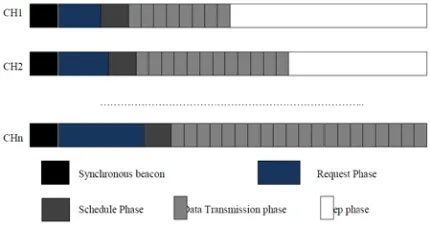
CH collects data from its member nodes in the intra-cluster communication stage. TDMA is adopted within cluster for channel access to avoid collision caused by multiple nodes sending data to CH at the same time. The time frame structure of each cluster in the intra-cluster communication stage is shown in
Figure 2.
The time frame consists of five phases. They are Synchronous beacon phase, Request phase, Schedule phase, Data transmission, and Sleep phase.
Synchronous beacon Phase: In the synchronous beacon phase, CH broadcasts synchronous beacon within its cluster channel, and synchronize with its member nodes.
Request Phase: In the request phase, any node that sensed an event can send a REQ message to the cluster head. This message contains the node ID, size of multimedia data to be transmitted, energy level,
ISSN 2348 – 7968
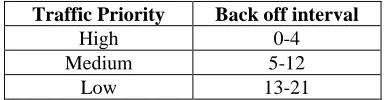
message to CH with CSMA method in a contention-based manner. In order to avoid possible collisions, sliding contention window mechanism is employed in each sensor node. This mechanism lets a request message with a higher priority get a contention window that results in a smaller back off interval, whereas a request message with a lower priority receive a contention window that results in a longer back off interval. In this way, the channel
contention probability decreases and the throughput increases .The back off interval for the different types of traffic are shown in the table 1.
Traffic Priority Back off interval
High 0-4
Medium 5-12
Low 13-21
Table 1. Back off interval for the different types of traffic
Scheduling Phase: In the scheduling phase, the CH starts to select nodes to send sensed multimedia data and become active nodes according to the received REQ messages. The energy level of the node can be used to select active nodes. In Figure 3, nodes 1 and 2 monitor one room, and nodes 3 and 4 monitor another room. If some event happened, both the nodes in the corresponding room will sense the event and send REQ messages to the CH. Assume node 1’s energy level is higher than node 2’s energy level and node 3’s energy level is higher than node 4’s energy level. The Ch will choose nodes 1 and 3 to send the sensed multimedia data back. In this way, the number of nodes in a room that need to send multimedia data can be reduced and the lifetime of sensor nodes can be extended. After a cluster head chooses active nodes for data transmission, the cluster head starts to schedule the data transmission of the active nodes.
CH schedules the time for node members based on priority of the data. The member with the high priority data will send multimedia data first. If more than one member is having the same priority then data transmission is based on data size. A node with the smallest data size will be allowed to transmit first. To decide the actual number of timeslots required, the CH divides the number of active nodes by number of channels allocated. Then the CH creates the schedule for all active nodes and broadcasts the schedule to all the members.
Figure 3. Multiple sensor nodes
Data Transmission Phase: After receiving a scheduling message from the CH, a cluster member will check if it is allowed to send back the sensed data. If yes, it becomes an active node, tunes the transceiver to the assigned channel, wakes up in the corresponding time slot and starts to send the sensed multimedia data. If no, it will ignore the scheduling message.
Sleep Phase: During the data transmission phase, if the cluster member is an active node then it will wake up only in the specific timeslot; otherwise, it will sleep in all time slots.
The length of request, data transmission and sleeping time are different for different clusters with different numbers of nodes. CH of the cluster which has most nodes enters inter-cluster communication stage immediately after its intra-cluster communication.
Cluster Head – Base Station Communication phase
After the completion of inter cluster communication in all clusters, intra cluster communication begins. In this phase, a CH forwards the aggregated data to the BS . After intra-cluster communication, each CH has to switch to one of the allocated channel to communicate with the base station. The multimedia data transmission from all CH’s to Base station takes in parallel using different channels.
3.
Simulation environment
ISSN 2348 – 7968
1) Convergence rate of Centralized channel assignment algorithm: The convergence rate is defined as the average number of iterations needed for all clusters being assigned separate channels for transmissions. Figure 4 illustrates relationship between the total sensors number, the average number of iterations, and the number of clusters. It can be seen from the figure, as the number of sensors increased from 100 to 500, the number of clusters increased from 10 to 25, and the average number of iterations slightly grew from 5 to 8. While the scale of network increased largely, the iteration of channel assignment ended after limited numbers due to the parallelism of the algorithm. Therefore, it can be concluded that the algorithm has good convergence rate and scalability for large scale network.
Figure 4. Convergence Rate
2) Aggregate MAC throughput: The throughputs of proposed protocol and MMSN are compared in Figure 5 by varying number of sensor nodes. When the network load was low, the throughputs of the two protocols were similar. When the number of nodes grows, the throughput of the proposed protocol is better because of the increased collisions MMSN. In MMSN, the same channel is being assigned to multiple nodes and causes channel access collision. The number of collisions increases with increased network nodes, which resulted in decreased network throughputs.
Figure 5. Aggregate MAC throughput
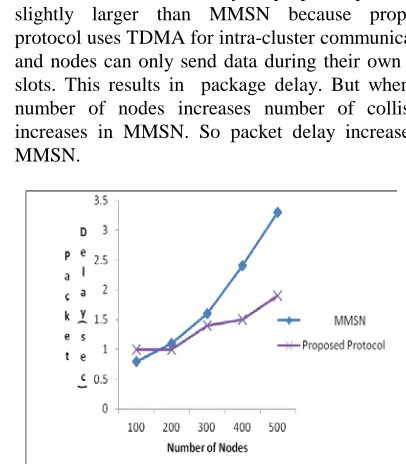
3) Package delay: The packet delay of proposed protocol and MMSN are compared in Figure 6 by varying number of sensor nodes. When the nodes number was 100, the delay of proposed protocol is slightly larger than MMSN because proposed protocol uses TDMA for intra-cluster communication and nodes can only send data during their own time slots. This results in package delay. But when the number of nodes increases number of collisions increases in MMSN. So packet delay increases in MMSN.
Figure 6. Packet delay
5.Conclusions
ISSN 2348 – 7968
completed in limited number of iterations, even with high number of sensor nodes. Hence the channel assignment algorithm has good scalability. Simulations results shows that the protocol has better package delay and throughput compare to MMSN.
6.References
[1] I. F. Akyildiz, T. Melodia, and K. R. Chowdry, ‘‘A Survey on Wireless Multimedia Sensor Networks,’’ Computer Networks, March 2007, pp.921-960.
[2] C. Li, P. Wang, H. Chen, and M. Guizani, "A Cluster Based On-demand Multi-Channel MAC Protocol for Wireless Multimedia Sensor Networks," in Proc. IEEE International Conf. on Communications, May 2008, pp. 2371-2376.
[3] J. Mo, Hoi-Sheung W. So and J. Walrand, ‘‘Comparison of Multi-Channel MAC Protocols,” IEEE Trans. Mobile Computing, vol. 7, no. 1, pp. 50-65, Jan. 2008.
[4] S. L. Wu, Y. Lin, Y. C. Tseng, and J. P. Sheu, “A New Multi-Channel MAC Protocol with On-Demand Multi-Channel Assignment for Mobile Ad Hoc Networks,” in Proc. IEEE International Symposium on Parallel Architectures, Algorithms and Networks, Dec. 2000, pp. 232-237.
[5] S. L. Wu, C. Y. Lin, Y. C. Tseng, C. Y. Lin, and J. P. Sheu, “A Channel MAC protocol with Power Control for Multi-Hop Mobile Ad Hoc Networks,” The Computer Journal, vol. 45, no. 1, pp. 101-110, 2002.
[6] W. C. Hung, K. L. E. Law, and A. Leon-Garcia, “A Dynamic Multi-Channel MAC for Ad Hoc LAN,” In Proc. 21st Biennial Symp. Comm., June 2002, pp. 31-35.
[7] A. Tzamaloukas and J.J. Garcia-Luna-Aceves, “Channel-Hopping Multiple Access,” In Proc. IEEE Int’l Conf. Comm., June 2000, pp. 415-419.
[8] A. Tzamaloukas and J. Garcia-Luna-Aceves, “Channel-Hopping Multiple Access with Packet Trains for Ad Hoc Networks,” In Proc. IEEE Device Multimedia Comm., Oct. 2000.
[9] J. So and N. Vaidya, ‘‘Multi-channel MAC for Ad Hoc Networks: Handling Multi-channel Hidden Terminals Using a Single Transceiver,’’ in Proc. ACM MobiHoc, May 2004, pp. 222-233.
[10] J. Chen, S. Sheu, and C. Yang, “A New Multichannel Access Protocol for IEEE 802.11 Ad Hoc Wireless LANs,” In Proc. 14th IEEE Int’l Symp. Personal, Indoor and Mobile Radio Comm., vol. 3, Sept. 2003, pp. 2291-2296.
[11] P. Bahl, R. Chandra, and J. Dunagan, “SSCH: Slotted Seeded Channel Hopping for Capacity Improvement in IEEE
802.11 Ad Hoc Wireless Networks,” In Proc. ACM MobiCom, Sept. 2004.
[12] S. Misra, M. Reisslein and X. Guoliang, “A Survey of Multimedia Streaming in Wireless Sensor Networks,” IEEE Communications Surveys & Tutorials, Vol. 10, 2008, pp. 18-39.
[13] Mao Ye, Chengfa Li, Guihai Chen and Jie Wu, "EECS: An Energy efficient Clustering Scheme in Wireless Sensor Networks," .