Available online:
https://edupediapublications.org/journals/index.php/IJR/
P a g e | 1871Seismic Study of Selfsupporting Telecommunication
Tower Mounted On Roof Top
Aditya Sharma & Arpit Chawda
M-Tech scholor, Assistant professor Department of civil engineering, RKDF SOE, Indore
ABSTRACT
The availability of land in urban areas is
extremely limited for satisfying the ideal
installation of tower thus giving no
alternative but to adopt roof top towers.
The location of these towers is specified in
terms of latitude and longitude with height
of mounted antenna dictated by functional
requirements of the network. The analysis
has been performed on the tower located
on roof of the existing structure by varying
position of tower and analyzing the
displacement at various heights of existing
structure and tower.
As tower plays a significant role for
wireless communication network, the
failure of such structure in a disaster is a
major concern therefore utmost important
has been given considering the effect of
wind & the seismic effect acting on the
tower and existing structure . The seismic
effect has been done for different seismic
zone IV. The analysis is also done at
different properties of soil (soft soil, hard
soil & medium soil), and it is observed that
the displacement is different at various
height of structure and telecommunication
tower and different position of
telecommunication tower i.e. the deflection
is greater at tower and minimum at
building. The results obtained from the
above analysis are tabulated, compared
and conclusions is drawn that
displacement is minimum when the
position of tower is at the centre of
existing structure .
KEYWORDS seismic effect, roof top tower, types of soil, different position of tower, displacement compression
INTRODUCTION
Available online:
https://edupediapublications.org/journals/index.php/IJR/
P a g e | 1872plan or it may be triangular in plan. The major cause of failures of telecommunication tower throughout the world though still remains to be high intensity winds (HIW).therefore several studies has been done in telecommunication towers taking into consideration the wind as well as static effect. These structures are generally designed to carry wind load as well as seismic load, which acts as cantilever trusses. As they cover less base area in towers, they are suitable in many situations but these structures demands more steel. The installation of these towers requires the availability of land depending and the location and availability of fund. The use of these towers is more in urban areas, but due to limited availability of land in urban areas, the concept of roof top tower is adopted in which tower is installed of the roof top of the building. Thus by this, the problem of land requirement can be removed and it serves efficiently.
Based on placement of tower:-
Based on this placement, communication towers are classified as follows:
1)
Green field towers2)
Roof top towers1. Green field tower:-
Green field towers are erected on natural ground with suitable foundation. Generally, the height of green field tower is 30-200m. Basically, it is placed in rural areas.
2. Roof top tower:-
Roof top towers are erected on existing building with raised columns and tie beams. Basically, height of the roof top tower is 9-30 m and it is placed in urban areas. It is more economical compare than to green field towers. Roof top tower is a tall skeleton steel structure with relatively small cross-section having larger ratio between height & maximum width. Such towers have their base or foundation on the roof of building or structures, therefore named as ROOF TOP tower.
Objective of the study –
The present study investigates that the telecommunication tower is placed on roof of a building at different positions under seismic effects along with the wind effects on the roof top tower
The main objectives of the present study are –
Available online:
https://edupediapublications.org/journals/index.php/IJR/
P a g e | 18732) To study the behavior of roof top telecommunication tower when subjected to lateral loads.
3) To study the roof top lattice tower for seismic zone-IV
METHODOLOGY
Seismically deficient buildings and their rehabilitation are major problems for earthquake regions of India. Recently, the target of building rehabilitation and firmness has gained research attention and various techniques have been developed to achieve this. However, many of the techniques for strengthening raise problem for the occupants, who must have to vacate the building during renovation. In this study the proposed solution is to rehabilitate an existing structure which is seismically deficient.
In the proposed project, the tower is building manually and the wind load is calculated. After this study, the dimensions of building are assumed. Now, the collected data is fed into STAAD PRO, and the analysis is carried.
Various cases are studied in this project. Firstly, the zone is selected and the positions of tower are changed at different parts of building and then the displacement is calculated.
In order to achieve the above mentioned objective following methodology is adopted:-
1. Selection of a building that is designed only for gravity loads. 2. Study the behavior of building
under the effect of earthquake. 3. Application of different position of
tower on the selected building. 4. Study the effects displacement at
various positions of tower for zone IV, generated at the time of earthquake.
5. A comparison of displacement, different position of tower.
RESULTS AND CONCLUSION
Available online:
https://edupediapublications.org/journals/index.php/IJR/
P a g e | 1874Comparison of displacement at different
position of tower
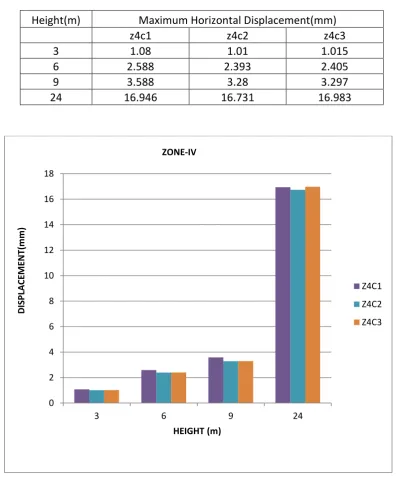
In this section, comparison is carried for zone IV but at different position of tower
on the structure. Following table shows the comparison of displacement for different height and different position at zone IV.
Table no.1 Displacement table of zone IV
Height(m) Maximum Horizontal Displacement(mm) z4c1 z4c2 z4c3 3 1.08 1.01 1.015 6 2.588 2.393 2.405 9 3.588 3.28 3.297 24 16.946 16.731 16.983
0 2 4 6 8 10 12 14 16 18
3 6 9 24
D
IS
PL
A
CE
M
EN
T(m
m
)
HEIGHT (m) ZONE-IV
Available online:
https://edupediapublications.org/journals/index.php/IJR/
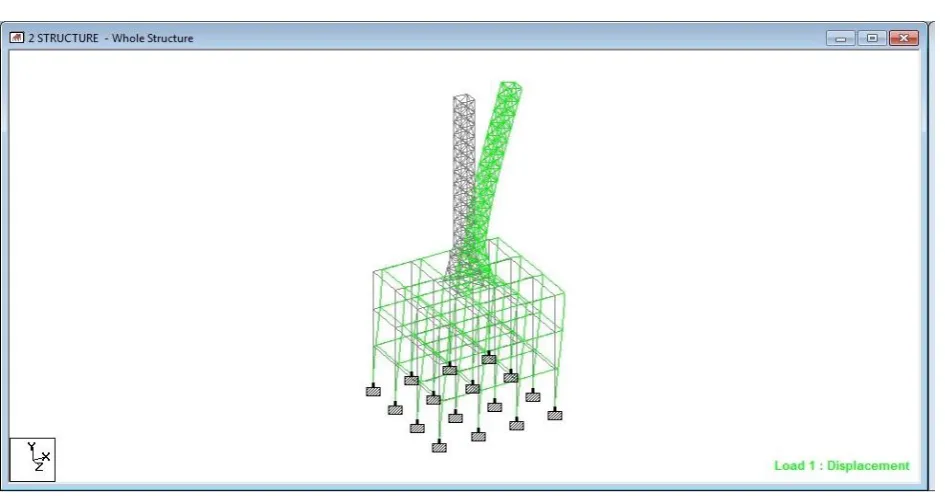
P a g e | 1875Figure 1 sway mode (case-1)
Available online:
https://edupediapublications.org/journals/index.php/IJR/
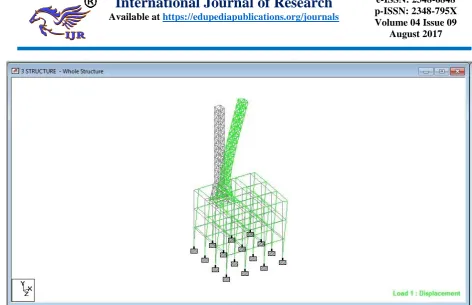
P a g e | 1876Figure 3 sway mode (case-3)
Comparison of displacement by
changing soil type
The soil type is changed in STAAD PRO and the displacement measurement is compared. The types of soil used are soft soil, medium soil and hard soil. The result is found that the displacement is minimum for hard soil. Mathematical expression used is
Ah = ZISn / 2Rg
This expression is from clause no 6.4.2 (IS 1893 (Part 1) - 2002). In the expression, Sn
/g is average response acceleration coefficient which is dependent on soil property and time period (Clause no 6.4.5 from 1893 (Part 1) - 2002).
Following is the table showing the comparison of displacement with the types of soil for different zones.
Table no 2 Displacement according to soil type for case 2
ZONE-4
Height Types of soil
Available online:
https://edupediapublications.org/journals/index.php/IJR/
P a g e | 1877CONCLUSION
As per the objective of this project, the analysis of lattice tower at different positions on rooftop and configurations of related structure was done for the seismic load. The following conclusions are drawn from the above analysis.
1. The displacement is directly proportional to the increasing height of structure.
2. Horizontal displacement of the telecommunication tower was analyzed by considering different positions on rooftop using STAAD PRO software. As a result of this study the minimum value of displacement will be achieved when it is placed at the centre of the existing structure.
3. Also the variations are observed at variety of soils affecting the height of structure.
REFERENCES
[1] Jithesh Rajasekharan, S. Vijaya (2014): “Analysis of Telecommunication Tower Subjected to Seismic & Wind Loading” International journal of advancement in engineering technology, management & applied science, Volume 2, Issue 2 July 2014,ISSN:2349-3224 ,68-79.
[2] Siddesha.H (2010): “Wind Analysis of Microwave Antenna Towers”. International Journal of Applied
0 2 4 6 8 10 12 14
3 6 9 24
d
isp
lac
e
m
e
n
t(
m
m
)
HEIGHT(m)
ZONE- IV
Available online:
https://edupediapublications.org/journals/index.php/IJR/
P a g e | 1878Engineering Research, Dindigul, Volume 1, No 3,ISSN:0976-4259,574-584.
[3] Ghyslaine McClure, Laura GEORGI and Rola ASSI (2004): “Seismic Considerations for Telecommunication Towers Mounted on Building Rooftops”13th World Conference on Earthquake Engineering Vancouver, B.C., Canada,19-88
[4] Nitin Bhosale, Prabhat Kumar, PandeyA.D (2012):“Influence of host
structure characteristics on response of rooftop telecommunication towers”.International Journal of Civil and Structural Engineering Volume 2, No 3, ISSN 0976-4399, 737-748.
[5] G. Ghodrati Amiri* and S.R. Massah(2007): “ seismic response of 4-legged self-supporting