International Journal of Research (IJR)
e-ISSN: 2348-6848, p- ISSN: 2348-795X Volume 2, Issue 06, June 2015 Available at http://internationaljournalofresearch.org
Banking Queue Simulation and Optimization – A Review
Neeru
1& Ms. Garima Garg
21M. Tech scholar, SGI, Samalkha, Haryana
2Assistant Professor, Computer Science deptt, SGI Samlkha
ABSTRACT
Purpose – Many models have been proposed
to counter Bulk customer congestion. Most of them are inefficient and does not reduce load on the main server. Proposed model calculates performance of a customer queue under varying servers and optimizes the performance of a queuing system. It also provides with a tool to automate the whole system.
Methodology used - Simulating system
response to randomly generated customers with varying servers.
Findings – Proposed model gives methods
that can be used to optimize the queue length and manage the average queue length of the costumers. It automates the behavior of queue according to varying servers for
processing the customers. Model not only
simulates a random and variable queue of customers but it also calculates average queue length of customers.
CHAPTER 1
1. INTRODUCTION -
Queuing theory plays an important role in modeling real life problems involving congestions in vide areas of applied sciences. Applications of queuing with impatience can be seen in traffic modeling, business and industries, computer-communication, health sectors and medical sciences etc. Queues with discouraged arrivals have applications in computers with batch job processing where job submissions are discouraged when the system is used frequently and arrivals are modeled as a Poisson process with state dependent arrival rate. The discouragement
affects the arrival rate of the queuing system. Morse considers discouragement in which the arrival rate falls according to a negative exponential law. We consider a single-server queuing system in which the customers arrive in a Poisson fashion with rate depending on the number of customers present in the system at that time i.e. (n 1)λ. (Kumar et al., 2014)
International Journal of Research (IJR)
e-ISSN: 2348-6848, p- ISSN: 2348-795X Volume 2, Issue 06, June 2015 Available at http://internationaljournalofresearch.org
In modern computer communication
networks, queuing theory is a useful tool to
analyze node-to-node communication
parameters. This is especially true in Packet
Switched Computer Communication
Systems. Nodes of many networks can be analyzed in terms of a standard M/G/1 queuing system. However, some situations require researchers to investigate complex M/G/1 queuing systems. Daigle. Illustrates how the M/G/1 paradigm can be used to obtain fundamental insight into the behavior of a slotted-time queuing system that represents a statistical multiplexing system. Most queuing models assume that customers are served singly. But this assumption is far from the truth when we consider those numerous real-world situations in which customers are served in batches. In such queues, customers are served by a single server
(Multiple servers) in batches of maximum size “b” with a minimum threshold value “a.”
Such type of service rule is referred to as general bulk service (GBS) rule. The bulk service queues have potential applications in many areas, for example, in loading and unloading of cargoes at a seaport, in traffic signal systems, and in computer networks, jobs are processed in batches with a limit on the number of jobs taken at a time for processing. However, there are many instances where, after the completion of the service of a batch, if the server finds less than “a” customers in the queue, he leaves for a vacation. This time may be utilized by the server to carry out some additional work. On return from a vacation, if he finds “a” or more customers waiting, he takes them for service. Otherwise, he may remain idle (dormant) and continue to do so until the queue length reaches “a.” In queuing literature, such types of queues are known as bulk service queues with single vacation. Bulk service queues are, generally speaking, hard to analyze. Often the finite capacities in the bulk service queues increase the complexities of the solution and it becomes more complex if vacation(s) is taken into consideration.
International Journal of Research (IJR)
e-ISSN: 2348-6848, p- ISSN: 2348-795X Volume 2, Issue 06, June 2015 Available at http://internationaljournalofresearch.org
CHAPTER 2
LITERATURE REVIEW
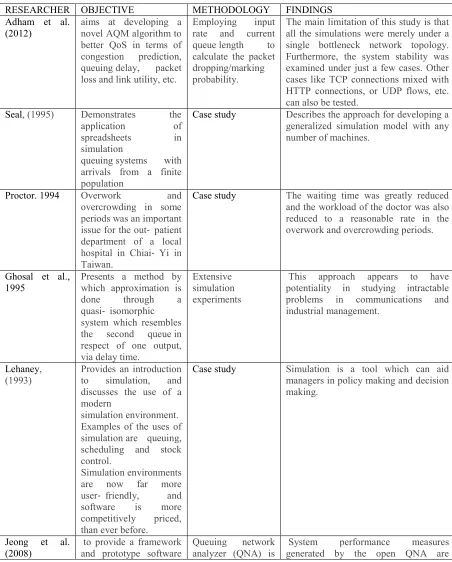
Table 1 : Work done by different researchers on queue simulation over the years.
RESEARCHER OBJECTIVE METHODOLOGY FINDINGS Adham et al.
(2012) aims at developing a novel AQM algorithm to better QoS in terms of congestion prediction, queuing delay, packet loss and link utility, etc.
Employing input rate and current queue length to calculate the packet dropping/marking probability.
The main limitation of this study is that all the simulations were merely under a single bottleneck network topology. Furthermore, the system stability was examined under just a few cases. Other cases like TCP connections mixed with HTTP connections, or UDP flows, etc. can also be tested.
Seal, (1995) Demonstrates the
application of
spreadsheets in
simulation
queuing systems with arrivals from a finite population
Case study Describes the approach for developing a generalized simulation model with any number of machines.
Proctor. 1994 Overwork and overcrowding in some periods was an important issue for the out‐ patient department of a local hospital in Chiai‐ Yi in Taiwan.
Case study The waiting time was greatly reduced and the workload of the doctor was also reduced to a reasonable rate in the overwork and overcrowding periods.
Ghosal et al.,
1995 Presents a method by which approximation is
done through a
quasi‐ isomorphic system which resembles the second queue in respect of one output, via delay time.
Extensive simulation experiments
This approach appears to have potentiality in studying intractable problems in communications and industrial management.
Lehaney,
(1993) Provides an introduction to simulation, and discusses the use of a modern
simulation environment. Examples of the uses of simulation are queuing, scheduling and stock control.
Simulation environments are now far more user‐ friendly, and
software is more
competitively priced, than ever before.
Case study Simulation is a tool which can aid managers in policy making and decision making.
Jeong et al. (2008)
to provide a framework and prototype software
Queuing network analyzer (QNA) is
System performance measures
International Journal of Research (IJR)
e-ISSN: 2348-6848, p- ISSN: 2348-795X Volume 2, Issue 06, June 2015 Available at http://internationaljournalofresearch.org
to use IDEF3
descriptions as a knowledge base from
which a
queuing network (QN) analysis is performed to
compute system
performance measures as part of quick response manufacturing
compared to the simulation through case studies.
reasonably close to the values obtained from simulation, particularly when the system utilization is low.
Proctor, (1994) Considers computer simulation as a method for studying the behavior of business systems under a variety of assumed conditions for
analyzing the
simultaneous interaction of many variables to
produce valuable
insights into problems
Case study Looks at how simulation can help to provide answers to complex decisions and problems which cannot be solved by conventional methods
Huarng et al.
(1996) Describes a study which focused on the utilization of doctors and staff in the out‐ patient department, the time spent in the hospital by an out patient, and the length of the out patient queue
Case study Results show that the waiting time was greatly reduced and the workload of the doctor was also reduced to a reasonable rate in the overwork and overcrowding periods.
Daniel et al.
(1996) Notes attending that patients public outpatient departments in Hong Kong spend a long time waiting for a short consultation, that clinics are congested and that both staff and patients are dissatisfied
Computerized
simulation modeling Demonstrates some ways in which managers in health care facilities can benefit from the use of computerized simulation modeling. Specifically, shows the effect of changing the duration of consultation and the effect of the application of an appointment system on patients’ waiting time.
Warwick,
(2009) To reflect 40 years of queuing theory in application to library
modeling and
management. It suggests that these models have not had the impact that the early modeling’s promised and suggests some reasons as to why.
snapshots of library
queuing models paper suggests that there is an urgent need to find ways to bridge the practitioner/researcher gap, broaden the application base of OR methodology within libraries, engage in constructive debate around library OR to build a consensus view as to the value of OR interventions, and identify directions for future collaborative work in libraries
2. Predicting Traffic Congestion
Mobility is an indispensable activity of our daily lives and road transport is one popular approach to mobility. However road
International Journal of Research (IJR)
e-ISSN: 2348-6848, p- ISSN: 2348-795X Volume 2, Issue 06, June 2015 Available at http://internationaljournalofresearch.org
value problem framework. The approach is used to describe performance measure parameters, allowing the prediction of the level of queue built up at a signalized intersection as an insight into road vehicular congestion there and how such congestion occurrence can be efficiently managed. It is aimed demonstrate a modeling of traffic evolution on an arterial road to Milam highway that serves surrounding suburbs and communities. Other possible benefit of this work is that it serves as a basis to other interesting investigations to characterize traffic congestion and the results obtained may serve as vital inputs to decisions that seek to improve traffic control and management. The objective therefore is to investigate the problem of congestion on the road segment and subsequently build upon this investigation to develop efficient tools capable of predicting and providing intelligent information on vehicular traffic flow.
CHAPTER 3
3. METHODOLOGY USED IN THE PAPER
1. FORMULATING A BLOCK TO
GENERATE N RANDOM
CUSTOMRS ARRIVING AT ANY INSTANT OF TIMES.
2. GENERAING A FIFO QUEUE
3. GENERATING A SINGLE
SERVER TO PROCESS N
CUSTOMESRS
4. CALCULATING THE OUTPUT
GIVING AVERAGE QUEUE
LENGHTH AT A GIVE INSTANT OF TIME USING SIMULINK
5. PLOTTING THE OUTPUT WITH
SINGLE SERVER
6. INCREASING THE NUMBER OF
SERVER TO REDUCE THE
AVERAGE QUEUE LENGTH
AND LOAD ON THE SERVER
7. PLOTTING THE OPTIMIZED
OUTPUT USING SIMULINK
8. AUTOMATING THE NUMBER
OF SERVERS USING MATLAB CODE.
CHAPTER 4
4. PROBLEM FORMULATION Customers in a queue are an important attribute of any real time system.
1. Simulation of a real time queuing system
2. calculation of average queue length of customer
3. plotting average queue length of the customer
4. varying the number of servers to manage server load
5. Optimizing queuing system
6. Automation of multiple servers
CHAPTER 5
CONCLUSION AND FUTURE SCOPE
CONCLUSION
We have studied the single server queuing networks, when successive service times are different (or not) without breaking up the busy periods from stage-to-stage, leading to a great approximate simplification" the existence of an equivalent tandem queue effect.
It is very evident and concluded that a discrete system works well with a limited load for small amount of time. When the system is stress tested i.e. load is increased we observe that performance of system degrades considerably.
International Journal of Research (IJR)
e-ISSN: 2348-6848, p- ISSN: 2348-795X Volume 2, Issue 06, June 2015 Available at http://internationaljournalofresearch.org
increased which reduces load from the servers and hence optimizes the performance of discrete systems.
Due to the possible correlation between two successive local arrivals from the same incoming path, a curious model appears..
These theories assumed the local
combination of distinguishable customers (with distinguishable queuing delay), instead of parts of upstream busy periods with indistinguishable
customers (and indistinguishable queuing delay depending on the maximum sojourn time initiating the new downstream busy period). These theories cannot be consistent with the concept of the equivalent tandem queue. Some significant consequences appear, since any link overload comes from a given incoming path which generates the tandem queue effect (i.e., correlation between local inter arrival time and upstream service time). The usual queuing standards (related to long queues) cannot protect against subsequent, significant overloads in the buffers due to some possible "agglutination phenomenon" (related to short queues). Usual network management methods should be revised, and should monitor the partial traffic streams loads (and not only the server load).
CHAPTER 6
REFERENCES
[1.]Kumar (2009), A single server
markovian queuing system with discouraged arrivals and retention of reneged customers., Yugoslav Journal of Operations Research, 24 (2014) Number 1, 119-126
[2.]Muh (1993), A bulk queuing system under n policy with bi-level service delay discipline and start up time, Journal of Applied Mathematics and
Stochastic Analysis, 6 Number 4, 359-384
[3.]Gupta et al. (2004, )a finite capacity bulk capacity service queue with single vacation and markovian arrival process (2004).
[4.]Taha (2011), Sample-Path Analysis of Single-Server Queue with Multiple Vacations, International Scholarly Research Network ISRN Applied Mathematics
[5.]Lartey (2014), Predicting Traffic Congestion: A Queuing Perspective Open Journal of Modeling and Simulation, 2014, 2, 57-66
[6.]Wang et. Al. (2009), On the Scalable Fairness and Efficient Active Queue
Management of RED, I. J.
Communications, Network and
System Sciences, 1, 1-89
[7.]Zadeh et al. (2012), A Batch Arrival Queue System with Coxian-2 Server
Vacations and Admissibility
Restricted, American Journal of Industrial and Business Management, 2, 47-54
[8.]Baruah et. Al. (2013), A Two Stage Batch Arrival Queue with Reneging during Vacation and Breakdown Periods , American Journal of Operations Research, 3, 570-580
International Journal of Research (IJR)
e-ISSN: 2348-6848, p- ISSN: 2348-795X Volume 2, Issue 06, June 2015 Available at http://internationaljournalofresearch.org
[10.] Peschansky et. Al. (2011),
Stationary Characteristics of the Single-Server Queue System with Losses and Immediate Service
Quality Control Applied
Mathematics, 2011, 2, 403-409
[11.] Gandole (2011), Computer
Modeling and Simulation of
Ultrasonic System for Material
Characterization, Modeling and
Numerical Simulation of Material Science, 1, 1-13
[12.] Yu (2010), Steady-State
Queue Length Analysis of a Batch Arrival Queue under N-Policy with Single Vacation and Setup Times, Intelligent Information Management, 2010, 2, 365-374
[13.] Kukla (2008), Rationalization
of foundry processes on the basis of simulation experiment, Archives of foundry engineering, Volume 8 Issue 3
[14.] Kumar (2014), A single server
markovian queuing sytem with
discouraged arrivals and retention of reneged costumers, Yugoslav Journal of Operations Research 24 , Number 1, 119-126
[15.] Muh (1993), A bulk queuing
system under n policy with bi-level service delay discipline and start up time, Journal of Applied Mathematics and Stochastic Analysis Number 4, 359-384
[16.] Gupta et.Al. (2004), A finite capacity bulk service queue with single vacation and markovian arrival process
[17.] Taha (2011), Sample-Path
Analysis of Single-Server Queue with Multiple Vacations, International Scholarly Research Network ISRN Applied Mathematics, 12 pages
[18.] vow Church, Andrew J.
Newman, (2000) "Using simulations in the optimisation of fast food
service delivery”, British Food