Thermal Performance Analysis of the Solar Water Heater with
Circular and Rectangular Absorber Fins
Sethuraman Ramasamy1 and Pakkirisamy Balashanmugam2
1
Department of Mechanical Engineering, Annamalai University, Chidambaram, Tamilnadu, India.
2
Department of Mechanical Engineering, Annamalai University, Chidambaram, Tamilnadu, India.
Abstract
The topic of the research of solar energy has become a matter of great concern due to energy crisis all over the world. Several techniques have been implemented for heat transfer augmentation in heat transfer device. The implementation of the micro fin tube is one of the promising heat transfer enhancement methods since the technique offers an excellent improvement of heat transfer rate. Here fins played its major part in the enhancement of the temperature of the solar water heater so we implemented fins for the purpose to obtain better temperature output. The main objective of the experiment is to maintain the velocity at the outlet and the better outlet water temperature by selecting the correct shape and measurement of fins. Maintaining the pressure drop, increasing the heat transfer rate by increasing the area of the tube is also the main motto of the conducting this experiment. The expected temperature enhancement lies in the range of 16 to17 ºC. As the fins placing inside the thin water tube creates water hindrance,so by placing the appropriate fins regarding its size and shape we have definitely come across the problem of velocity drop as well as pressure drop inside the tube of the solar water heater.
Keywords: solar water heater, rectangular fins, parabolic trough collector, absorber plate.
1. Introduction
Over the last two decades a wide variety of solar energy technologies have been developed through research and development, demonstration and large-scale promotion during the eighties and nineties. One of the most widespread uses of solar thermal technology is solar water heating. India is blessed with good sunshine. The country receives solar radiation amounting to over 5x10¹⁵ kWh per annum with the daily average incident energy varying between 4-7 kWh per m2 depending on the location. Solar water heating systems have now been used for more than 60 years. Solar energy is free, environmentally clean, and their fore is recognized as one of the most promising alternative energy resource s options. Its total available value is seasonal and is dependent on the meteorological conditions of the location. The solar energy can be more attractive and reliable if
associated with heat storage system .The storage of energy in suitable forms, which can conventionally be converted into the required form, is at present day challenged to the technologists.
The modern era, now termed as Space age or computer age will be nothing, if we imagine energy as a non existing one. The flam voyance of human being will be cut down to pieces and his great dreams will be shattered if energy makes a mark absence. So, there will be no human if there is no energy. Therefore the people of the modern world must never stop looking for sources of energy and we too. Since we are using the fossil fuel from our ancient age, and the sources of these fossil fuels are getting limited and it approximated that in coming days these sources will vanish, so regarding this major problem we have already made our step toward the adaptation of solar energy. Solar water heater is one of the promising sources from which we can easily utilize the solar energy. The implementation of fins in solar water heater is one of the promising techniques the enhances the heat transfer rate from set up to water .Basically the fin is a surface that extends from an object to increase the heat transfer to or from the environment by increasing conviction. The amount of conduction, convection, or radiation of an object determines the amount of heat it transfers. Increasing the temperature difference the object and the environment, increasing the convection heat transfer coefficient, or increasing the surface area of the object increases the heat transfer.
2. Solar Energy
radiation is needed in application fields dealing with the exploitation of solar energy. An important input parameter is the global solar radiation received. This in turn is a function of several variables such as the nature and extent of cloud cover, water vapor content and other atmospheric constituents such as O2, N2, CO2, O3, dust etc., It is therefore not always possible to predict the actual of irradiant for a given location. Nevertheless the analysis of long term meteorological data on solar radiation makes it possible not only the interrelationship between its components, but also the types of parameters governing the statistics of their characteristic distributions. Attempts have been made to determine the hourly values of total radiation through its relationship with the daily solar radiation. Accurate methods of determining incident and transmitted solar radiation values on inclined surfaces from horizontal solar data are usually required in the design, dynamic performance evaluation and control of solar energy systems and devices. Most meteorological data give only the global or total radiation on horizontal surfaces. In order to determine the radiation values on inclines surfaces from horizontal total solar radiation data, correlation procedure is required to separate the direct and diffuse components of the horizontal global radiation. The direct and diffuse radiation has quite distinct characteristics of their collection and transmission of transparent materials comparison of the performance and relative cost different stationary reflector design are required for prospective manufactures of stationary solar collectors. For many applications (for domestic hot water, low pressure steam for industry) a symmetrical reflector is appropriate. Hence a thorough study about the structure, energy of the sun becomes very essential.
2.1. Solar Water Heater
Solar Water Heater is a device that helps in heating water by using the energy from the SUN. This energy is totally free. Solar energy (sun rays) is used for heating water. Water is easily heated to a temperature of 60-80 °C. Solar Water Heaters (swhs) of 100-300 liters capacity are suited for domestic use. Larger systems can be used in restaurants, canteens, guest houses, hotels, hospitals etc. A 100 liters capacity SWH can replace an electric geyser for residential use and may save up to 1500 units of electricity annually. The use of 1000 swhs of 100 liters capacity each can contribute to a peak load saving of approximately 1 MW. A SWH of 100 liters capacity can prevent the emission of 1.5 tons of carbon- dioxide per year. Solar water heating or solar hot water is water heated by the use of solar energy. Solar heating systems are generally composed of solar thermal collectors, a fluid system to move the heat from the collector to its point of usage. The system may use electricity for pumping the fluid, and have a reservoir or tank for heat storage and subsequent use. The systems may be used to heat water for a wide variety
of uses, including home, business and industrial uses. Heating swimming pools, under floor heating or energy input for space heating or cooling are more specific examples.
In many climates, a solar heating system can provide up to 85% of domestic hot water energy. This can include domestic non-electric concentrating solar thermal systems. Residential solar thermal installations can be subdivided into two kinds of systems: compact and pumped systems. Both typically include an auxiliary energy source (electric heating element or connection to a gas or fuel oil central heating system) that is activated when the water in the tank falls below a minimum temperature setting such as 50 °C. Hence, hot water is always available. The combination of solar water heating and using the back-up heat from a wood stove chimney to heat water can enable a hot water system to work all year round in cooler climates, without the supplemental heat requirement of a solar water heating system being met with fossil fuels or electricity.
2.2. Working of a Solar Water Heater
The Sun’s rays fall on the Collector Panel (a component of Solar Water Heater). A black absorbing surface (absorber) inside the collector absorbs solar radiation and transfers the heat energy to water flowing through it. Heated water is collected in a tank which is insulated to prevent heat loss. Circulation of water from the tank through the collectors and back to the tank continues automatically due to thermo siphon principle. A Solar Water Heater consists of a Collector panel to collect solar energy and an Insulated Storage Tank to store hot water.
2.3. Type of Solar Water Heater
Solar water heating systems can be classified in different ways:
The type of collector used
The location of the collector - roof mount, ground mount, wall mount.
The location of the storage tank in relation to the collector
The requirement for a pump - active vs passive The method of heat transfer - open-loop or
closed-loop (via heat exchanger)
Photovoltaic thermal hybrid solar collectors can be designed to produce both hot water and electricity.
2.4. Solar Collectors
Four types of solar collectors are used for residential applications:
Flat-plate collector
Integral collector-storage systems Batch system
3. Flat-Plate Collector
Flat plate collectors are designed to heat water to medium temperatures (approximately 140 degrees Fahrenheit).Figure 1 shows the schematic diagram of flat plate collector.
Figure 1:Flat plate collector
Flat plate collectors typically include the following components:
1. Enclosure: A box or frame that holds all the components together.
2. Glazing: A transparent cover over the enclosure that allows the sun’s rays to pass through to the absorber. Most glazing is glass, but some designs use clear plastic.
3. Glazing Frame: Attaches the glazing to the enclosure. Glazing gaskets prevent leakage around the glazing frame and allow for contraction and expansion.
4. Insulation: Material between the absorber and the surfaces it touches that blocks heat loss by conduction thereby reducing the heat loss from the collector enclosure.
5. Absorber: A flat, usually metal surface inside the enclosure that, because of its physical properties, can absorb and transfer high levels of solar energy.
6. Flow Tubes: Highly conductive metal tubes across the absorber through which fluid flows, transferring heat from the absorber to the fluid, 3.1 Solar Water Heater Applications
Domestic: Flats, Bungalows and Apartments. Commercial: Hotels, Hospitals, Hostels and
Dormitories.
Industrial: Process Industries, Preheating boiler feed water.
In the domestic sector, hot water is used for bathing, washing of clothes & utensils etc. The requirement may, however, vary with the season of the year & number of
family members. Our experience says hat on an average 30 to 35 liters of water at 50 to 55° C is consumed by an individual. Thus, for a family of 4 members, 125 LPD Solar Water Heating System is quite sufficient.In commercial & industrial sectors, where a large quantity of water is required at fairly high temperature.
3.2 Usage of solar water heater:
Hot water heated by the sun can be used to:
Heat water (e.g. for sanitary purposes such as showering, washing,)
Generate electricity
Designs suitable for hot climates can be much simpler and cheaper, and can be considered an appropriate technology for these places. The global solar thermal market is dominated by China, Europe, Japan and India.
The typical 50 gallon electric water heater uses 11.1barrels of oil a year, which translates into the same amount oil used by a typical 4 door sedan driven by the average consumer. Electric utility companies often provide electricity by burning and releasing energy from fuels such as oil, coal and nuclear energy. An electrical home hot water heater sits on an electrical grid and may be driving the use of unclean fuels on the other end of the grid
3.3 Fins
The study of heat transfer, a fin is a surface that extends from an object to increase the rate of heat transfer to or from the environment by increasing convection. The amount of conduction, convection or radiation of an object determines the amount of heat it transfers. Increasing the temperature difference between the object and the environment, increasing the convection heat transfer coefficient, or increasing the surface area of the object increases the heat transfer. Sometimes it is not economical or it is not feasible to change the first two options. Adding a fin to an object, however, increases the surface area and can sometimes be an economical solution to increase the heat transfer.
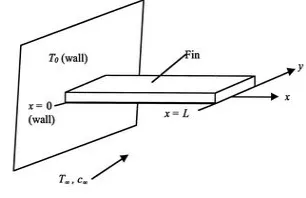
Figure 2: Rectangular fins 3.4 Rectangular fins
plane (or rectangular) fin extending from a base, maintained at temperature Tb.The fin is exposed to an environment at temperature through a combined convective/radiative heat transfer coefficient h. If a constant flow of heat is maintained to the base, then, eventually, the temperature field in the fin can become independent of time. In fin problems it is this steady-state behavior that is of interest to the engineer. Figure 2 shows the rectangular fins.
3.5 Uses of fins
Fins are most commonly use d in heat exchanging devices such as radiators in cars, computer CPU Heatsinks, and heat exchangers in power plants. They are also used in newer technology such as hydrogen fuel cells. Nature has also taken advantage of the phenomena of fins. The ears of jackrabbits and Fennec Foxes act as fins to release heat from the blood that flows through them.
Fins are used in a large number of applications to increase the heat transfer from surfaces. Typically, the fin material has a high thermal conductivity. The fin is exposed to a flowing fluid, which cools or heats it, with the high thermal conductivity allowing increased heat being conducted from the wall through the fin. The design of cooling fins is encountered in many situations and we thus examine heat transfer in a fin as a way of defining some criteria for design.
4. Previous Work
For commercial applications, ability of the drier to process continuously is very important to dry the end products for their safe storage to maintain the quality and nutrient values of the product. Normally thermal storage systems are employed to store thermal energy, which includes sensible heat storage, chemical energy storage and latent heat storage.
In recent years, few authors have studied different feature of solar collector systems using various approaches. For example, Kurtbas and Durmus (2004) have studied the solar air heater for different heating purposes whereas; Luminosua and Farab (2005) and Torres-Reyes et al (2003) have studied the optimal thermal energy conversion and design of a flat plate solar collector using exergy analysis. On the other hand, Bakos et alKaushik et al(2001) and Tyagi et al(2007) have studied the optimum design of a parabolic trough collector (PTC) and gave some fruitful results, especially, the mass flow rate of the moving fluid and the concentration ratio of PTC collector.
Use of solar energy for water heating is the most common application, mostly three types of solar collectors based solar water heaters (SWH) are available in the market viz. flat plate collector (FPC), evacuated tube collector (ETC), compound parabolic collectors (CPC). Dharuman et al
(2006) designed, constructed and did the experiments on water heating device and its performance was evaluated under various typical operating conditions. Nahar (2002) did the comparative analysis of Cu– Al fin with Cu–Cu fin in flat-plate collectors to test solar water heater.
Anant et al. (2009) investigated and analysed the performance of thermal energy storage based solar water heater.
Rakesh and Rosen (2010) worked on the thermal performance evaluation of an integrated solar water heater with a corrugated absorber surface.
Morrison et al. (2005) evaluated the characteristics of evacuated tube based solar water heaters also made an assessment of the circulation rate through single ended tubes. Assuming that there was no interaction between adjacent tubes in the collector array they developed a numerical model of the heat transfer and fluid flow inside a single ended evacuated tube and the simulation study had been performed.
Budihardjo et al (2007) developed a correlation for natural circulation flow rate through single ended water-in-glass evacuated tubes mounted over a diffuse reflector. Further, the numerical simulation showed that when the heat input was concentrated on the top circumference of the tube, as in the case with collectors mounted over a diffuse reflector. The effect of circumferential heat flux distribution on the circulation flow rate through the tubes was not significant; therefore, the correlation could be used to predict the flow rate at any time of day. Different flow structures were observed in the tube when a concentrating reflector was used underneath the collector. Ceylan (2012) developed a new temperature controlled solar water heater (TCSWH) and studied it based on energetic and exergetic analyses. Experiments have been carried out at 40 ºC, 45 ºC, 50 ºC and 55 ºC and the designed system was also compared with the thermo siphon system. A detailed comparison between TCSWH and thermo siphon system were performed by calculating stored energy, storage tank water temperatures, amount of water in the storage tank and system efficiencies for both of the systems. The highest amount of water had been found to
be 108 kg by setting the control device at 40 ºC. The average energetic efficiency was found to be 65% for the TCSWH and 60% for the thermo siphon system respectively, thus, TCSWH was found to be better than that of thermo siphon system for the same set of operating parameters.
5. Experimental Setup
black paint to increase the absorbtivity. The aluminium foil is attached, just below the copper water tubes for better heat absorption purpose. The puff is attached just below the alluminium foil supported by the alluminium sheet of 1.5 mm thick. The total set up (includes absorber plate, glass plate) is placed 16 degree from horizontal .Feed water passes through the stepped absorber plate and it is heated by solar energy.
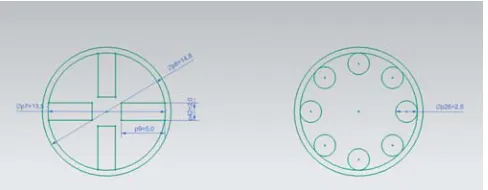
The number of copper tube used in the experiment is nine among which four tubes are incorporated with circular rod fins of outer diameter of 2.5mm, four tubes having rectangular rod fins of its length 180mm, width 2mm, height 5mm and a single tube having without fins, so that we can have a comparative analysis of temperature between all the three tubes. Figure 3 and 4 shows the two dimentional diagram of the circular and rectangular fin used in the the experimental work.
The circular fined rod tube consists of eight circular rod fins and the rectangular rod fined tube consists of four rectangular rods. The temperature of rectangular, circular and without fined tube is measured by T type of thermocouple. It is heated by solar energy.
The number of copper tube used in the experiment is nine among which four tubes are incorporated with circular rod fins of outer diameter of 2.5mm, four tubes having rectangular rod fins of its length 180mm, width 2mm, height 5mm and a single tube having without fins, so that we can have a comparative analysis of temperature between all the three tubes. The circular fined rod tube consists of eight circular rod fins and the rectangular rod fined tube consists of four rectangular rods. The temperature of rectangular, circular and without fined tube is measured by T type of thermocouple.
Figure 4: The two dimentional diagram of the circular and rectangular fin used in the the experimental work.
Figure 4: The two dimentional diagram of the circular and rectangular fin.
5.1 SPECIFICATIONS
Collector size : 2.06m X 1.05m X 0.12m Number : 9 Copper tube specification
Outer diameter : 14.8mm Inner diameter : 13.4 Thickness of glass plate : 4mm Gap between glass plate and tube: 20mm
Fin used in tube : Rectangular fin, circular fin Rectangular fin specifications
Length : 180mm Breath : 2.5mm Width : 5mm Circular fin specifications
Length : 180mm Outer diameter : 2.5mm Number of circular fined rod : 8 Number of rectangular fined rod: 4
Inclination of set up : 16degree (from horizontal) Width of aluminium foil : 1mm
Width of aluminium sheet : 1.6mm Header tube specifications
Length : 1.12m Internal diameter : 0.02m Riser tube specifications
Length : 0.75m Internal dia : 0.03m Coupling specifications
Outer dia : 0.03m Internal dia : 0.02m Tank specifications
Outer dia : 0.75m Internal dia : 0.5m
6.Results and discussion
0 20 40 60
9:40 10:45 11:45 12:45 13:45 14:45 15:35
Ef
fi
ci
e
n
cy
in
pe
rc
e
n
ta
ge
Time in minutes
Efficiency without fins Efficiency with fins
Figure 5: Comparison of efficiency with and without rectangular fins
Here we have tabulated the readingsas shown in table 1(without fins only),regarding time,radiation,heat available,inlet temperature ,outlet temperature ,heat gain with particular fin and fin efficiency of solar water heater with circular fins, rectangular fins and without fins with the duration of one hour in a particular day.
0 20 40 60 80 100
9:40 10:45 11:45 12:45 13:45 14:45 15:35
Tem
p
er
atu
re
in
◦
C
Time in minutes
Inlet temp. in◦C Outlet temp. in ◦C
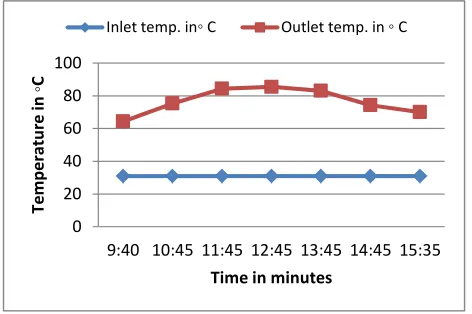
Figure: 6 Comparison of inlet and outlet temperature without fins It is obserbed that the copper tube having circular finned rod having more efficiency then that of rectangular finned rod tube anad without finned rod tube. Figure 5 shows the comparison of efficiency with and without rectangular fins. Figure 7 shows that the Comparison of inlet and outlet temperature without fins.
0 20 40 60 80 100
9:40 10:45 11:45 12:45 13:45 14:45 15:35
Te
m
p
e
rat
ur
e
in
◦
C
Time in minutes
Inlet temp. in◦C Outlet temp. in ◦C
Figure 8:Comparison of inlet and outlet temperature with fins.
Figure 9 shows that the Comparison of inlet and outlet temperature with fins.The outlet temperature will increase from morning to afternoon period and then reduced.This is mainly due to the intensity of solar radiation.The maximum outlet temperature reached was 85.25◦C.The heat available and radiation will also increased and then reduced from this period as shown in the figure 8 and 9.
Figure 8: Time vs radiation
Table 1: Result tabulation without fins
Time Heat available
Inlet temp. in
(ºC)
Outlet temp. in
(ºC)
Heat gain without Fins
Efficien cy without Fins
9:40 4850 31 61 1832.59 37.78
10:45 6264.2 31 71.3 2461.78 39.29
11:45 7092.8 31 81.3 3072.64 43.32
12:45 7007.1 31 80.7 3035.99 43.32
13:45 6550 31 77.2 2822.19 43.08
14:45 5578.5 31 69.6 2357.9 42.26
15:35 4485.7 31 56.1 1533.62 34.18
7. Conclusion
The readings were taken on the day when the intensity of sunlight is high to get more efficiency and heat gain. We can see from the graphs that regarding the efficiency and heat gain from the morning to evening. In the morning, due to low intensity, the efficiency is very low and nearly same in both cases i.e. with fins and without fins. But in the afternoon, there is a great difference in the efficiency, radiation and heat gain. We can see that the solar water heater with fins is more efficient than the solar water heater without fins. Initially the set up was made and the readings were taken. With the help of graphs and tabulated values the following inferences are drawn:
1. The radiation, heat gain and efficiency of the solar water heater are more when fin is used. In the morning, it is nearly same but in the afternoon, the graph goes high. 2. In general view, during 11am to 2pm, at this place, the solar intensity is high. Also, the solar water heater performed well in this condition and received almost all heat. This is the reason behind the increase in the efficiency..
3. Solar water heaters with fins have better efficiency than that of without fins.
We have implemented the circular fins and rectangular fins among which the circular fins have more efficiency than that of rectangular fins. Normally the found temperature difference between the solar water heater with fins and without fins is (7-8) degree Celsius in normal conditions.
References
1. Kurtbas I., Durmus A. (2004). Efficiency and exergy analysis of a new solar air heater. Renewable Energy, 29:1489-1501
2. Luminosu I., Fara L. (2005). Determination of the optimal operation mode of a flat solar collector by exergetic analysis and numerical simulation. Energy,30:731-747
3. Torres-Reyes J.J., González N., Zaleta-Aguilar A., Gortari J.G.C. (2003).Optimal process of solar to thermal energy conversion and design of irreversible flat plate solar collectors. Energy, 28:99-113
4. Bakos C., Ioannidis I., Tsagas N.F., Seftelis I. (2001). Design optimization and conversion efficiency determination of a line-focus-parabolic-trough solar collector. Applied Energy, 68:43-50
5. Kaushik S.C., Singhal M.K., Tyagi S.K. (2001). Solar collector technologies for power generation and space air conditioning applications – a state of the art internal report. Centre for Energy Studies; Indian Institute of Technology; Delhi: India.
6. Tyagi S.K., Wang S.W., Kaushik S.C., Singhal M.K., and Park S.R. (2007) .Exergy analysis and parametric study of concentrating type solar collectors. International Journal of Thermal Sciences, 46:1304-1310
7. Ozturk H.H., Demirel Y. (2004). Exergy-based performance analysis of 50 packed-bed solar air heaters. International Journal of Energy Research, 28:423–432.
8. Dharuman C., Arakeri J.H., Srinivasan K. (2006). Performance evaluation of an integrated solar water heater as an option for building energy conservation, Energy and Buildings, 38:214–219.
9. Nahar N.M. (2002). Capital cost and economic viability of thermosyphonic solar water heaters manufactured from alternate materials in India, Renewable Energy, 26:623–635 10. Anant S., Buddhi D., Sawhney R.L. (2009). Solar water
heaters with phase change material thermal. Renewable and Sustainable Energy Reviews, 13: 2119–2125.
11. Rakesh K., Rosen M.A. (2010). Thermal performance of integrated collector storage solar water heater with corrugated absorber surface. Applied Thermal Engineering, 30:1764–1768.
12. Morrison G.L., Budihardjo I., Behnia M. (2005). Measurement and simulationof flow rate in a water-in-glass evacuated tube solar water heater. Solar Energy, 78:257– 267.
13. Xiaowu W., Ben H. (2005). Exergy analysis of domestic-scale solar water heaters. Renewable and Sustainable Energy Reviews, 9:638–645.
14. Luminosu I., Fara L. (2005). Determination of the optimal operation mode of a flat solar collector by exergetic analysis and numerical simulation. Energy, 30: 731–747.
15. Budihardjo I., Morrison G. L., Behnia M. (2007). Natural circulation flow through water-in-glass evacuated tube solar collectors. Solar Energy, 81: 1460–1472.
16. Ceylan I. (2012). Energy and exergy analyses of a temperature controlled solar water heater. Energy and Buildings, 47:630–635.
17. Suhas P Sukhatme, 2008, SOLAR ENERGY- Principles of
18. I. Budihardjo, G.L.Morrison, ‘’Performance of water-in-glass evacuated tube solar water heaters’’
19. B.J.Huanga, J.P.Leea, J.P. Chyngb, ‘’Heat-pipe enhanced
solar-assisted heat pump water heater’’
20. P.M.E. Koffia, H.Y. Andoha, P. Gbahaa, ‘’Theoretical and
experimental study of solar water heater with internal exchanger using thermosiphon system’’
21. Rakesh Kumar, MarcA.Rosen, 2010 ‘’Thermal performance
of integrated collector storage solar water heater with
corrugated absorber surface’’Channels” IEEE transactions on
components and packaging technologies, vol. 27, no. 4, December 2004.
22. Sahiti, N., Lemouedda, A., Stojkovic, D., Durst, F., and Franz, E., 2006, “Performance Comparison of Pin Fin In-Duct Flow Arrays with Various Pin Cross-Sections,” Appl. Therm. Eng., 26, pp. 1176–1192.
23. Sahiti, N., Durst, F., and Dewan, A., 2005, “Heat Transfer Enhancement by Pin Elements,” Int. J. Heat Mass Transfer, 48, pp. 4738–4747.
24. Sahiti, N., Durst, F., and Dewan, A., 2006, “Strategy for Selection of Elements for Heat Transfer Enhancement,” Int. J. Heat Mass Transfer, 49, pp. 3392–3400.
25. Jiang, P. X., Li, M., Lu, T. J., Yu, L., and Ren, Z. P., 2004, “Experimental Research on Convection Heat Transfer in Sintered Porous Plate Channels,” Int. J. Heat Mass Transfer, 47, pp. 2085–2096.
26. Hadim, A., 1994, “Forced Convection in a Porous Channel with Localized Heat Sources,” ASME J. Heat Transfer, 116, pp. 465–472.
27. Hadim, A., and Bethancourt, A., 1995, “Numerical Study of Forced Convection in a Partially Porous Channel with Discrete Heat Sources,” ASME J. Electron. Package, 117, pp. 46–51.
28. Martin RH, Perez-Garcia J, Garcia A, Garcia-Soto FJ, Lopez-Galiana E. Simulation of an enhanced flat-plate solar liquid collector with wire-coil insert devices. Solar Energy 2011;85:455–69.
29. Kemp CM. US patents no 451384, April 28, 1891. (Patent Records). [6] Brooks FA. Solar energy and its use for heating water in California, Agricultural Bulletin 602. California Agricultural Experiment Station. Berke- ley, CA, USA: University of California; 1936. (Bulletin).
30. Tanishita I. Present situation of commercial solar water heaters in Japan, Transactions on the use of Solar Energy. Tucson, Arizona: The Scientific Basis; 1955 67-78. (Article).
31. Burns S, Zeenni E, Guven HM. Stratification and
performance of a solar bread box water heater, Proceedings of the American solar energy con- ference, San Diego, CA, USA 1985 p. 430–435. (Conference Paper).