A Review on Various Approaches of Shape Based
Features in Face Recognition
Amandeep Sharma
Rakesh Kumar Kamaljeet Kainth
Research Scholar Dept. of Computer Science & Engineering Dept. of Computer Science & Engineering Sachdeva Engg .College Sachdeva Engg. College Sachdeva Engg. College For Girls, Gharuan (Mohali) For Girls, Gharuan (Mohali) For Girls, Gharuan (Mohali)
[email protected] [email protected] [email protected]
Abstract — Face recognition is a technique used for security purpose. Face recognition is a biometric system. It is used world widely in various real time fields. Face recognition is a biometric system which uses various algorithms or techniques for the purpose of identification and security [1]. Face recognition is a n advancement in the field of image analysis. The reason behind the trend of face recognition system is advancements in commercial and law enforcement field and existence of such a feasible and dynamic technology [2]. It is a computer based automatic system which identifies the person by matching the inputted digital image with the saved patterns. A database is used to save the facial characteristics. The digital device is used which scans the individuals face. A biometric facial recognition system is used for the purpose of security normally in those areas where people are the centre of attraction [3]. Face recognition is a center of attraction for the researchers also due to its increased usability.
Keywords— PCA, Linear Discriminant Analysis, Biometric, ANN
I.
I
NTRODUCTIONFace recognition is a biometric system which is used for the purpose of identification of an individual. Growing use of biometrics has increased the research work done in the field of face recognition. Face recognition is a section of pattern recognition. IN face recognition system an individual’s face is scanned by a digital device. Along with the face other characteristics are also scanned like fingerprints, Iris recognition. Face Recognition system is much popular in many of the fields the main and the important one is recognition or can say as the security or authentication purpose. Researchers found this topic very interesting that they use to do lots of researches in this field. There are some conventional techniques used for face recognition. Earlier
PCA was used for face recognition. The disadvantage of existing techniques was that it used only PCA that worked with small data sets but proved to be inefficient when it comes to working on large data sets. To overcome this limitation a technique named as PCA and K-mean clustering is used. This technique is combination of K-mean algorithm along with PCA. Other techniques used for biometric face recognition are like LDA, KPCA (Kernel PCA). PCA will give significant results for small data-sets and K-mean clustering approach is efficient for large data sets. This combined technique works better for task of face recognition on both small as well as large data sets and hence is an efficient technique for face recognition [1].
II.
T
ECHNIQUES OFF
ACER
ECOGNITION Various techniques have been used till date for the process of face recognition and each had its own advantages and disadvantages. Some of the techniques for face recognition has been described below:Principal Component Analysis (PCA)
PCA is a mathematical tool or technique which transforms the correlated variables to a number of uncorrelated variables. This technique is widely used in image compression and image classification. It includes process namely principal components which are used to transform the correlated variables. It computes a compact and optimal description of the data set.
the data set because it does not have a inbuilt set of basis vectors like FFT, DCT and wavelet etc.
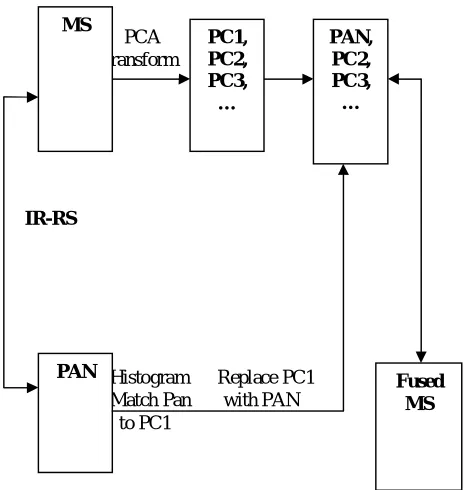
The principal component analysis (PCA) is the alternative or subsequent method of IHS-based methods. Whereas MS band may correlate. The PCA converts the correlated MS bands into a set of uncorrelated components; say PC1, PC2, and PC3… The first principle component (PC1) also refers to the PAN image. Therefore, the fusion schemes of PCA and HIS is similar:
(1) Perform IR to PAN and MS, and resample MS.
(2) Convert the MS bands to PC1, PC2, PC3… by using PCA transform.
(3) Match the histogram of PAN to the histogram of PC1. (4) Replace PC1 with PAN.
(5) Change PAN, PC2, PC3 … back by reverse PCA.
PCA transform
IR-RS
Histogram Replace PC1 Match Pan with PAN to PC1
Figure 1 Fusion Scheme of PCA
LDA (Linear Discriminant Analysis)
LDA is an approach used for face recognition. It is a statistical approach used to compare the unknown patterns with known patterns. This method use variables like continuous independent and category based dependent variable. This approach also used PCA for low dimension representation.
LDA use classes which are based on the database by dividing the database into number of classes. On the basis of segmented classes LDA perform various operations. The classes are randomly created by using sample database. Two approaches are used in this LDA method as follows:[21]
Class dependent transformation: It is used to increase the ratio between scatter within variance and scatter between variance.
Class independent transformation: It is used to increase the overall ratio.
Biometric Systems
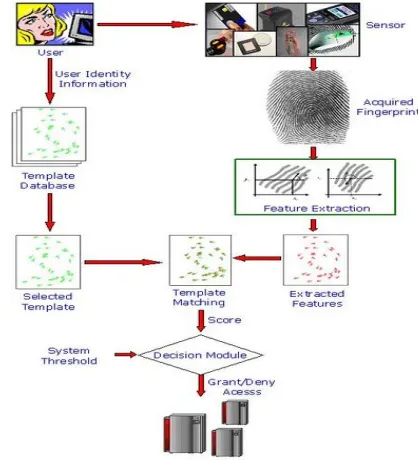
A biometric system is a computer System which performs the Biometric recognition Algorithms for biometric Technique. Sensing, Feature Extraction and Matching Modules are the mai8n components of a biometric System. A biometric sensor senses the biometric parameter such as fingerprints sensors and digital camera gives the output in the Digital form. The irrelevant information is discarded form the acquired samples by using the feature of Extraction the remaining extracted and discriminatory information is normally used for Matching Process. During the process of Matching, A Query is generated by the biometric Sample that is matched with the reference information stored in the database and generates the identity associated with the Query.
Normally the operations of biometric system are divided into two stages as Follows:
Enrollment
Recognition
Enrollment is a Stage in which the biometric information related to a person is stored in a database. This reference information can be in the form of templates or biometric sample itself. Templates contain the extracted features from the biometric sample or parameters of mathematical models that best characterizes the extracted features. In some application biometric parameters such as name, id is also stored along with biometric references. In case of loss of personal identity information such as unknown latent prints lifted from crime scene, anonymous authentication etc. the reference is used with system generated Id for future use.
In Recognition Stage, firstly the scanning of users biometric traits is done, Secondly extraction takes place and then the process of Matching is performed corresponding to the reference biometric information stored in the database. A high similarity score between the query and the reference data results in the user’s authentication and identification. The fingerprints matching System is a best Example to know the working of any biometric system. Minutiae are the most
MS
PC1, PC2, PC3,
…
PAN, PC2, PC3, …
commonly used features of fingerprint System. In a fingerprint image, these are defined as:
1. Ridge ending 2. Ridge bifurcation
A minutia is represented in terms of a triplet (x, y, θ), where
(x, y) locates its position and θ represents the local orientation
of the ridge at that minutia. According to the position of the user’s finger on the sensor and characteristics of fingerprint sensor (e.g., sensor area), there are 20 to 70 minutiae in a fingerprint image.
According to the Query and Reference represents in term of minutiae the matching module has to monitor that whether the prints are impressions of the same finger or not. Figure 2 illustrates the process of matching. The number of minutiae may vary in two fingerprints in case of variations in finger placement and pressure on the sensor. Besides this, , the fingerprints need to be aligned (or registered) also. After aligning the two fingerprints, the number of matched (or corresponding) minutiae is determined and a similarity, or match score, is defined in terms of the number of alternate minutiae. In ideal finger imaging situations, not all minutiae from query and template prints from the same finger can be matched. So the matcher has to use the threshold (a system parameter) to match the pair of minute .It is declared that both the patterns are of same individual when the match score exceeds the threshold.
Figure 2 Biometric System Operations
Biometric System Operation: Fingerprint Case Study
Functions performed by Biometric recognition systems are as follows:
(a) Verification (“whether the claimed identity is true or invalid?”).
(b) Identification (“Is this person in the database?”) Verification: Verification can be understand with the help o following example, Suppose a person claims that he is John Doe and use his fingerprint; then by comparing or matching the offered pattern (query or input) and the existing pattern (reference) associated with the claimed (John Doe) identity , the Claim can be accepted or rejected by the recognition system. The fields where verification is applied are as follows:
Physical fields like entrance to a building, Logical access control like computer login, Transactions at a bank ATM,
Purchases of credit cards, Management of medical records.
Identification: By using the pre-defined biometric samples, the system matches that whether this pattern is according to the largely enrolled patterns or not. Two identification Scenarios are as follows:
Positive identification Negative identification
In Positive Identification, the person insists that the biometric system knows him. Whereas in Negative Identification the scenario is totally opposite, in this the user or individual claims that system does not know him. In both of the cases , the system firstly gathers individual’ biometric samples and compare with all the templates in database and then either can refuse or accept the individual’s acclaim. Examples of positive identification systems are Pin-Less access control and welfare disposal schemes. Driver license issuance and watch-list surveillance are some related examples of negative identification systems.
III.
RELATED
WORK
methods, three linear subspace analysis schemes are presented, and several non-linear manifold analysis approaches for face recognition are briefly described. The model-based approaches are introduced, including Elastic Bunch Graph matching, Active Appearance Model and 3D Morphable Model methods. A number of face databases available in the public domain and several published performance evaluation results are digested. Future research directions based on the current recognition results are pointed out.
Vijay H Mankar, (2012) [2], In this paper author defines that Face recognition has gain large popularity among users due to its quality of providing security. Face recognition is a technique applied for the purpose of security and it widely used for real time applications. Over few last year’s many algorithms or techniques have been developed by the researchers. It use many algorithm for the purpose of authentication and identification. Some techniques like PCA, LDA, ICA, SVM. Gabor wavelet like Artificial Neural Network is used for recognition purpose. Above techniques solve the problems related to face recognition like illumination, face expressions, change in posture..
Faizan Ahmad, (2012) [3] In this paper author explains the face recognition system as the part of image or video. Face recognition system is used for those applications or fields where the centre of attraction is people. The images or videos are stored in the surveillance digital camera. Then various features of characteristics are used for the purpose of pattern matching. Face recognition system has many advantages or disadvantages. The main advantage of face recognition system is the acceptance and uniqueness. In this paper author evaluated face detection algorithms and techniques. All the used algorithms are the solution to the various pr9blems related to the face detection technology and provide the highly accurate output. Solution is proposed based on performed tests on various face rich databases in terms of subjects, pose, emotions, race and light.
Renu Bhatia et al. (2013) [4] in this paper author defines that face recognition is Biometrics system. The people use this for the purpose of security. It has widely used for real time applications. The examples are use in forensic laboratories, for criminal security system. It is a system which compares the existing patterns with inputted patterns. It uses the following characteristics for the purpose of identification like fingerprints of individual, voice recognition, retina scan etc. All the biological characteristics are used in pattern matching for identification and authentication. In this paper author defines the biometric techniques like face recognition, iris-retina scans.
NAVNEET JINDAL ET AL. (2013) [7] In this author defines that face recognition system is a biometric system. It is used for authentication and identification. face recognition system used large database to store pre-defined patterns. the inputted patterns are compared with the already existing patterns. if patterns are matched then to authenticate the identity otherwise it will be discarded. many techniques and algorithms are used for this purpose. in this paper extraction process is defined along with pca based eigen face computation methods. author also defines the process of detection along with multi layered feed forward ann with the help of back propagation.
Seema Verma, (2013) [8] in this author defines that biometric system is widely used in many real world fields. Lots of researches are still going on about this. In this paper author suggests many biometric techniques of face recognition. Many algorithms and techniques are used for face recognition system. Some algorithms are defined and used in this paper.
IV.
C
ONCLUSIONnon-intrusiveness) [13]. In this paper, we've got given an introductory survey for the face reputation technology. Various techniques of face recognition have been reviewed and various related papers have been studied.
References
[1] Lu, Xiaoguang. "Image analysis for face recognition." personal notes, May 5 (2003).
[2] Vijay H Mankar, “A Review Paper on Face Recognition Techniques”, International Journal of Advanced Research in Computer Engineering & Technology10/2012; 1(8):339-346.
[3] Faizan Ahmad, “Image-based Face Detection and Recognition: “State of the Art””, IJCSI International Journal of Computer Science Issues, Vol. 9, Issue 6, No 1, November 2012, pp 169-172
[4] Renu Bhatia , “Biometrics and Face Recognition Techniques”, IJARCSSE, Volume 3, Issue 5, May 2013 , pp 93-99
[5] W. ZHAO, “Face Recognition: A Literature Survey”, ACM Computing Surveys, Vol. 35, No. 4, December 2003, pp. 399–458.
[6] G. M. Beumer, “A landmark paper in face recognition”, IEEE, Automatic Face and Gesture Recognition, 2006. FGR 2006. 7th International Conference, April, 2006, pp 6-78
[7] Navneet Jindal , “Enhanced Face Recognition Algorithm using PCA with Artificial Neural Networks”, IJARCSSE, Volume 3, Issue 6, June 2013, pp 864-872
[8] Seema Verma, “A Study on “A Soft Biometric Approach: Face Recognition”, IJARCSSE, Volume 3, Issue 3, March 2013, 403-409
[9] Peter N. Belhumeur, “Eigenfaces vs. Fisherfaces: Recognition Using Class Specific Linear Projection”, IEEE TRANSACTIONS ON PATTERN ANALYSIS AND MACHINE INTELLIGENCE, VOL. 19, NO. 7, JULY 1997, pp 711-720
[10] P. J. Phillips, “The FERET evaluation methodology for face-recognition algorithms”, IEEE Transactions on Pattern Analysis and Machine Intelligence, Volume:22 , Issue: 10, pp 1090-1104
[11] Sujata G. Bhele1 and V. H. Mankar2,” A Review Paper on Face Recognition Techniques”, IJARCET, Vol 1,Pp 339-346, 2012
[12] W. ZHAO, “Face Recognition: A Literature Survey”
[13] AnkurBansal, MukeshAgarwal,” A Review Paper on FACIAL RECOGNITION”,IJRITCC, Vo 1, Pp 224-228, 2013.
[14] Ben Niua,(2008), “Two-dimensional Laplacian faces method for face recognition” ELSEVIER, Vol 41 , Pp 3237 – 3243
[15] C Nagaraju, May 2013, “An efficient Facial Features extraction Technique for Face Recognition system Using Local Binary Patterns”, International Journal of Innovative Technology and Exploring Engineering (IJITEE), Volume-2, Issue-6, May, Pp 74-78
[16] Grafsgaard, Joseph F., Joseph B. Wiggins, Kristy Elizabeth Boyer, Eric
N. Wiebe, and James C. Lester. "Automatically Recognizing Facial Expression: Predicting Engagement and Frustration." In EDM, Pp. 43-50. 2013.
[17] Hehua Chi a, , “Facial expression recognition based on cloud model “The International Archives of the Photogrammetric”, Remote Sensing and Spatial Information Sciences, Vol. 38, Part II, Pp 124-128
[18] Hiremath, Vinay, and Ashwini Mayakar. "Face recognition using Eigenface approach." In IDT workshop on interesting results in computer science and engineering, Sweden. 2009.Jeremiah r. Barr (2012), “face recognition from video review”, International Journal of Pattern Recognition and Artificial Intelligence, Volume 26, Issue 05
[19] Liao, ShengCai, Zhen Lei, XiangXin Zhu, Zhenan Sun, Stan Z. Li, and
Tieniu Tan. "Face recognition using ordinal features.",In Advances in Biometrics, pp. 40-46. Springer Berlin Heidelberg, 2006. Springer, Pp 40-46
[20] Mayank Agarwal, August, 2010, “Face Recognition Using Eigen Faces and Artificial Neural Network”, International Journal of Computer Theory and Engineering, Vol. 2, No. 4, Pp 624-629
[21] , Walaa, Mohamed Heshmat, Moheb Girgis, and Seham Elaw. "A new Method for Face Recognition Using Variance Estimation and Feature Extraction."
[22] Nagi, Jawad, Syed Khaleel Ahmed, and Farrukh Nagi. "A MATLAB based face recognition system using image processing and neural networks." In 4th International Colloquium on Signal Processing and its Applications, Pp. 83-88. 2008.”
[23] Navneet Jindal, (June 2013), “Enhanced Face Recognition Algorithm uses PCA with Artificial Neural Networks” , International Journal of Advanced Research in Computer Science and Software Engineering, Volume 3, Issue 6, Pp 846-872
[24] N.G.Chitaliya, (2010), “An Efficient Method for Face Feature Extraction and Recognition based on Contourlet Transform and Principal Component Analysis using Neural Network”, International Journal of Computer Applications ,Volume 6– No.4, Pp 28-32
[25] Pawan Sinha, (2006) , “Face Recognition by Humans: Nineteen Results All Computer Vision Researchers Should Know About” , Proceedings of the IEEE Vol. 94, No. 11, Pp1948-1962
[26] Ribarić, Slobodan, and Marijo Maračić. "Eigenphase-based face recognition: a comparison of phase-information extraction methods.", In Nineteenth International Electro technical and Computing Science Conference ERK 2010
[27] Tayal, Yogesh, Pramod Pandey, and D. B. V. Singh. "Face Recognition using Eigenface.", International Journal of Emerging Technologies in Computational and Applied Sciences (IJETCAS) 3, no. 1 (2013): 50-55.
[28] Teja, Ravi.s, April 2012, “Face recognition using subspaces techniques”, Recent Trends In Information Technology (ICRTIT), International Conference , Vol 19 issue 21 , Pp103 – 107
[29] Soninder Singh Garcha ,( 2013) ,“ A robust technique implementation for facial recognition under Eigen feature extraction”, Journal of Global Research in Computer Science (JGRCS) ,Vol 4, No 8