The Work Stresses and Their Relation to Job
Satisfaction
ASGHAR FADIL WELI
M.P.ED, Department of physical Education University College of Science, Osmania University, India Abstract:
The aim of this study was to examine
levels of work stress and motivation and
their contribution to job satisfaction.
Analysis of differences between
expectations and sources of job
satisfaction may provide understanding
of career benefits and sources of
dissatisfaction. Time pressures and
organizational support and involvement
were sources of stress. Multivariate
analyses showed an inverse relationship
between stress and job satisfaction.
Information about job satisfaction and
work stress and their correlates may be
used to develop strategies to improve the
recruitment and retention. There were
significant differences in some subscales
of work stress and work motivation by
some of the socioeconomic
characteristics. Levels of overall stress
perception and scores on all five work
stress subscales were higher in
dissatisfied workers relative to satisfied
workers. However, levels of overall
motivation perception and scores on the
career development, responsibility and
recognition motivation subscales were
higher in satisfied respondents relative to
dissatisfied respondents. The main
determinants of job satisfaction were
occupation; age; title; income; the career
development, and wages and benefits
subscales of work stress; and the
recognition, responsibility and financial
subscales of work motivation.
INTRODUCTION:
Today, teaching in Physical
Education has become a demanding
skills. Physical education teaches have to
play a very vital role and their work
involves a number of duties such as
planning, teaching, evaluative,
administrative and various unclassified
ones. A physical education teacher
requires a greater variety of talents than
any other teaching area. His
responsibilities are diverse and the
society looks up to him as a leader who
can create and maintain general fitness
of the sedentary people on one hand and
help produce sports persons at grass root
level, on the other. As a result, physical
education teachers working in schools
feel their workload heavier, strenuous
and difficult too. Some of them feel that
in proportion to the expectations of the
society they are not given due place,
recognition, autonomy, pay, working
conditions, opportunities for growth and
advancement and so on. All this leads to
job dissatisfaction or low job satisfaction
among teachers in general and physical
education teachers in particular in many
developing countries around the world.
The effects of this trend include reduced
ability to meet students' needs,
significant incidences of psychological
disorders leading to absenteeism and
stress-related illnesses. Most
importantly, though teacher
dissatisfaction appears to be a main
factor in teachers leaving the profession
in many countries including India.
Job satisfaction has been
considered to be a function of the
perceived relationship between that one
wants from one's job and what he
perceives it is offering. Certain factors, if
present, contribute to job satisfaction and
if absent, contribute to job
dissatisfaction, and vice-versa.
Developed two - factor theory of job
satisfaction and concluded that there
that, if present, acted as job satisfiers
(motivators) and other conditions that
acted as job dis-satisfiers. Several
research studies have attempted to
replicate and/or apply Herzberg's (1959)
study in educational settings. Although a
lot of research has been done on job
satisfaction among teachers much has
not been done on job satisfaction among
physical education teachers whose job
has been intensified to a great extent as
discussed earlier. Therefore, the present
study has been undertaken to investigate
job satisfaction among physical
education teachers working in Haryana
schools and to find out the difference in
job satisfaction among physical
education teachers working in the two
categories of schools. The present study,
on the basis of this objective,
hypothesized that there would exist
significant differences among the group
-1 & group-2 schools physical education
teachers regarding their job satisfaction.
Job satisfaction has been
considered to be a function of the
perceived relationship between that one
wants from one's job and what he
perceives it is offering (Locke, 1969).
Certain factors, if present, contribute to
job satisfaction and if absent, contribute
to job dissatisfaction, and vice-versa.
Developed two - factor theory of job
satisfaction and concluded that there
were certain conditions of employment
that, if present, acted as job satisfiers
(motivators) and other conditions that
acted as job dissatisfiers (hygiene
factors). Several research studies have
attempted to replicate and/or apply
Herzberg's (1959) study in educational
settings. Although a lot of research has
been done on job satisfaction among
teachers much has not been done on job
teachers whose job has been intensified
to a great extent as discussed earlier.
Therefore, the present study has been
undertaken to investigate job satisfaction
among physical education teachers
working in schools and to find out the
difference in job satisfaction among
physical education teachers working in
the two categories of schools. The
present study, on the basis of this
objective, hypothesized that there would
exist significant differences among the
group -1 & group-2 schools physical
education teachers regarding their job
satisfaction. the fulfillment of his desires
and achievement in the various areas of
his life activities. Job satisfaction is the
positive orientation of an individual
towards the work role, which he is
presently occupying. It refers to an
employee's general attitude towards the
job.
Today, teaching in Physical
Education has become a demanding
profession which requires exceptional
skills. Physical education teaches have to
play a very vital role and their work
involves a number of duties such as
planning, teaching, evaluative,
administrative and various unclassified
ones. A physical education teacher
requires a greater variety of talents than
any other teaching area. His
responsibilities are diverse and the
society looks up to him as a leader who
can create and maintain general fitness
of the sedentary people on one hand and
help produce sports persons at grass root
level, on the other. As a result, physical
education teachers working in schools
feel their workload heavier, strenuous
and difficult too. Some of them feel that
in proportion to the expectations of the
society they are not given due place,
conditions, opportunities for growth and
advancement and so on. All this leads to
job dissatisfaction or low job satisfaction
among teachers in general and physical
education teachers in particular in many
developing countries around the world.
WORK STRESS:
Stress isn’t always bad. Stress within
your comfort zone can help you stay
focused, energetic, and able to meet new
challenges in the workplace. Stress is
what keeps you on your toes during a
presentation or alert to prevent accidents
or costly mistakes at work. But in
today’s hectic world, the workplace can
often seem like an emotional roller
coaster. Long hours, tight deadlines, and
ever increasing demands can leave you
feeling worried, uncertain, and
overwhelmed by stress. When stress
exceeds your comfort zone, it stops
being helpful and can start causing major
damage to your mind and body as well
as your job satisfaction. But no matter
what you do for a living, or how
stressful your job is, there are plenty of
things you can do to reduce your overall
stress levels and regain a sense of
control at work.
JOB SATISFACTION:
Job satisfaction is one of the most
researched variables in the area of
workplace psychology, and has been
associated with numerous ranging from
leadership to job design. This article
seeks to outline the key definitions
relating to job satisfaction, the main
theories associated with explaining job
satisfaction, as well as the types of and
issues surrounding the measurement of
job satisfaction. While it is also
important to explore what factors
precede and are impacted by job
satisfaction, this is covered in a separate
Due the popularity of job satisfaction
within the field of occupational and
organisational psychology, various
researchers and practitioners have
provided their own definitions of what
job satisfaction is. However, the two
most common definitions describe job
satisfaction as: “the pleasurable
emotional state resulting from the
appraisal of one’s job as achieving or
facilitating the achievement of one’s job
values”; and “the extent to which people
like (satisfaction) or dislike
(dissatisfaction) their jobs”.
In general, most definitions cover the
affective feeling an employee has
towards their job. This could be the job
in general or their attitudes towards
specific aspects of it, such as: their
colleagues, pay or working conditions.
In addition, the extent to which work
outcomes meet or exceed expectations
may determine the level of job
satisfaction. However, job satisfaction is
not only about how much an employee
enjoys work. Taber and Alliger found
that when employees of an American
educational institute rated how much
they enjoyed individual tasks within
their role, their scores were moderately
correlated to satisfaction with the work
itself, and associated (although weakly)
with global job satisfaction. Taber and
Alliger also found that other measures
(such as, level of concentration required
for the job, level of supervision, and task
importance) all had no impact on
satisfaction. This study demonstrates
that the accumulating enjoyment of work
tasks added up to overall job
satisfaction. However, the low
relationship does suggest that other
factors, besides enjoyment, contribute to
how satisfied employees feel at work.
METHODOLOGY
For the purpose of present study 80
Physical Education Teachers (TGT
Grade) of Board schools were selected
randomly as the subjects for the study.
The age of the subjects were ranging
from 24 – 35 years.
Table- 1: Details of the Subjects
Distribution with regard to group-1 and
group-2 school teachers.
Teacher Number of Subjects
Physical Education Teachers (TGT) 80
Tool Used
The criterion measure chosen to test the
hypothesis was the scores obtain in
job-satisfaction scale (JSC) Inventory.
Administration of Test
The job-satisfaction questionnaire was
distributed to teachers. To ensure
maximum cooperation from the subjects
the research scholar had a meeting with
selected subjects. Subjects were oriented
and explained regarding the purpose and
the procedure of the questionnaire.
Job-satisfaction scale has 30 items. Each
items has five suitable options from
which a respondent has to choose any
one. The scale has both positive and
negative items in which 06 items were
negative and 24 were positive. The
positive items carrys weightage of
4,3,2,1 & 0 and the negative items carry
weightage of 0,1,2,3 & 4. The total score
gives a quick measure of
satisfaction/dissatisfaction of a
respondents towards the job. The score
gives a quick measure of
satisfaction/dissatisfaction of a
respondents towards the job.
Statistical Method
Descriptive statistics were used to
measure the level of job satisfaction. To
compare the degree of job-satisfaction of
school teachers Independent sample
t-test were used. The level of significance
was set at 0.05.
RESULT:
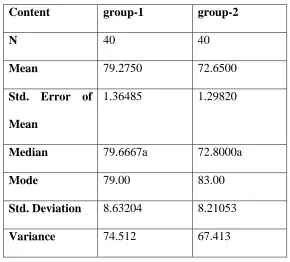
Table -2: Descriptive statistics of
physical education teachers of group-1
and group-2 schools in relation to
job-satisfaction
Content group-1 group-2
N 40 40
Mean 79.2750 72.6500
Std. Error of
Mean
1.36485 1.29820
Median 79.6667a 72.8000a
Mode 79.00 83.00
Std. Deviation 8.63204 8.21053
Variance 74.512 67.413
Table 3: Comparative analysis of physical education teachers of group -1 & group-2
schools in relation to job-satisfaction.
School N Mean Std.
deviation Std.
Error
Mean
t –Value p -Value
Group -1 40 79.275 8.63204 1.36485 3.517* 0.001
Group - 2 40 72.650 8.21053 1.29820
Table-3 reveals that there was significant
difference found between group-1 and
group-2 school physical education
the calculated t-value (3.517) is found
higher than the tabulated t-value (1.99)
so the null hypothesis is rejected at 0.05
level of significance and p-value (0.001)
was found less than criterion value of
0.05.
GROUP MEAN (group
-1)
MEAN
(group-2)
STAT. DF
Group-1 84.69 80.67 1.229 NS 206
Group-2 84.69 74.21 3.718** 206
Table 2: Post Hoc Test Comparison of
Means on Job Satisfaction among
Physical Education Teachers working in
Group-1 & 2 Schools
DISCUSSION
A comparison of government, group-1
and group-2 school Physical Education
teachers on the variable job satisfaction.
The results presented indicate that there
is a significant difference in job
satisfaction among the three categories
of physical education teachers working
in group-1 and group-2 schools as the
obtained F value 5.78 was found higher
than the table value of 4.68 required to
be significant at 0.01 level of
confidence. Further, to confirm the
significant differences between the
paired means, Scheffe's Post-hoc Test
has been applied. The obtained results
given in clearly indicate that physical
education teachers working in
government schools are having higher
mean score (84.69) as compared to the
mean scores of those working in group
-1 (80.67) & group-2 (74.2-1) schools.
The table further shows that this
difference is significant between
government and public school physical
education teachers at 0.01 level of
confidence. It means that the teachers
better in terms of job satisfaction than
those working in the other two
categories of schools but the difference
in job satisfaction is significant only
between two groups i.e. government and
public schools physical education
teachers.
The better job satisfaction among
government school physical education
teachers may be attributed to factors
such as better service conditions, job
security and prestige along with many
more. There are aspects such as feeling
of the sense of achievement and
independence, autonomy, feedback on
quality of performance and completion
which might be the contributing factors
for higher job satisfaction among
physical education teachers working in
government schools than their other two
counterpart groups. These teachers have
a better position in their job in terms of
higher pay scales, job security, more
freedom, decision making power, less
interference by managements and
manageable class sizes. There is lesser
role ambiguity and role conflict also
which is more common among teachers
in group -1 & group-2 schools. It was
hypothesized that there would be
significant difference in job satisfaction
among physical education teachers
working in group -1 & group-2; as most
of the previous studies have shown that
teachers working in group -1 schools
have more job satisfaction than group -1
& group-2 school teachers. Keeping this
in view, it was predicted that group -1 &
group-2 school physical education
teachers would differ significantly as far
as job satisfaction in concerned. On the
basis of the results discussed above, the
hypothesis that significant difference
would exist on job satisfaction among
the physical education teachers working
Result of the study revealed that the
significant difference was found between
physical education teachers of group-1
and group-2 schools in relation to job
satisfaction. The result shows that, the
degree of group-1 and group-2 schools
teachers of job satisfaction had more
than the group-2 schools teachers. On
the basis of norms of job satisfaction
scale we can say that the physical
education teachers of group-1 and
group-2 school were fall in Extremely
satisfied category because their mean
value (79.275) is above the 74 and
group-2 school teachers were fall in
Very satisfied category because their
mean value (72.65) is between the
63-73.on the basis of norms and result we
can say that the physical education
teachers of group-1 and group-2 schools
were more satisfied than group-2 school
teachers with their jobs.
CONCLUSION
In this study, we examined levels of
work stress and motivation according to
demographic characteristics and levels
of job satisfaction; additionally, the key
predictors of job satisfaction were
identified using logistic regression
analysis. The results indicated that
community health workers rated wages
and benefits highest among five
subscales of work stress, and workers’
extrinsic motivation was higher than
their intrinsic motivation. The career
development, and wages and benefits
subscales of work stress and financial
motivation were significant negative
predictors of job satisfaction, while the
recognition and responsibility subscales
of work motivation were significant
positive determinants. On the basis of
the findings it was found that the group
-1 school physical education teachers
have significantly better satisfaction with
education teachers. On the basis of mean
value of job satisfaction it was found
that the group -1 physical education
teachers were fall in the extremely
satisfied category and group-2 school
physical education teachers were fall in
Very satisfied category
REFERENCE:
1. Spector, P. E., & Jex, S. M. (1998).
Development of four self-report
measures of job stressors and strain:
interpersonal conflict at work scale,
organizational constraints scale,
quantitative workload inventory, and
physical symptoms inventory.
Journal of occupational health
psychology, 3(4), 356.
2. Kasl, S. V. (1978). Epidemiological
contributions to the study of work
stress. Stress at work, 3, 48.
3. Beehr, T. A., & Newman, J. E.
(1978). Job stress, employee health,
and organizational effectiveness: A
facet analysis, model, and literature
review1. Personnel psychology,
31(4), 665-699.
4. Johnson, S., Cooper, C., Cartwright,
S., Donald, I., Taylor, P., & Millet,
C. (2005). The experience of
work-related stress across occupations.
Journal of managerial psychology,
20(2), 178-187.
5. Hoogendoorn, W. E., Bongers, P.
M., De Vet, H. C. W., Ariens, G. A.
M., Van Mechelen, W., & Bouter, L.
M. (2002). High physical work load
and low job satisfaction increase the
risk of sickness absence due to low
back pain: results of a prospective
cohort study. Occupational and
environmental medicine, 59(5),
323-328.
6. Faragher, E. B., Cass, M., & Cooper,
C. L. (2005). The relationship
between job satisfaction and health:
environmental medicine, 62(2),
105-112.
7. Cooke, R. A., & Rousseau, D. M.
(1984). Stress and strain from family
roles and work-role expectations.
Journal of Applied Psychology,
69(2), 252.
8. Bacharach, S. B., Bamberger, P., &
Conley, S. (1991). Work‐home
conflict among nurses and engineers:
Mediating the impact of role stress
on burnout and satisfaction at work.
Journal of organizational Behavior,
12(1), 39-53.
9. Misra, R., & McKean, M. (2000).
College students' academic stress
and its relation to their anxiety, time
management, and leisure
satisfaction. American Journal of
Health Studies, 16(1), 41.
10.Kivimäki, M., Leino-Arjas, P.,
Luukkonen, R., Riihimäi, H.,
Vahtera, J., & Kirjonen, J. (2002).
Work stress and risk of
cardiovascular mortality: prospective
cohort study of industrial employees.
Bmj, 325(7369), 857.
11.Allen, T. D., Herst, D. E., Bruck, C.
S., & Sutton, M. (2000).
Consequences associated with
work-to-family conflict: a review and
agenda for future research. Journal
of occupational health psychology,
5(2), 278.
12.Feather, N. T., & Rauter, K. A.
(2004). Organizational citizenship
behaviours in relation to job status,
job insecurity, organizational
commitment and identification, job
satisfaction and work values. Journal
of occupational and organizational
psychology, 77(1), 81-94.
13.Pugliesi, K. (1999). The
consequences of emotional labor:
Effects on work stress, job
Motivation and emotion, 23(2),
125-154.
14.Spector, P. E., Dwyer, D. J., & Jex,
S. M. (1988). Relation of job
stressors to affective, health, and
performance outcomes: a
comparison of multiple data sources.
Journal of Applied Psychology,
73(1), 11.
15.Bond, F. W., & Bunce, D. (2003).
The role of acceptance and job
control in mental health, job
satisfaction, and work performance.
Journal of applied psychology,
88(6), 1057.
16.Spector, P. E., & Jex, S. M. (1998).
Development of four self-report
measures of job stressors and strain:
interpersonal conflict at work scale,
organizational constraints scale,
quantitative workload inventory, and
physical symptoms inventory.
Journal of occupational health