An industry oriented math teaching strategy for the Metro
Group BEngTech program
Ken Louie a, Daphne Robson b, Frank Cook c, Debbie Hogan a and Ziming Tom Qi d
Christchurch Polytechnic Institute of Technology b, Otago Polytechnic d, Waikato Institute of Technology a Wellington Institute of Technology c
Corresponding Author Email: [email protected]
Structured Abstract
BACKGROUND
With traditional mathematical teaching methodologies in tertiary education, the conventional pathway is to build student understanding through mathematical content alone. Applications which utilise the mathematics then possibly follow in later courses. The problem with this traditional methodology of learning is that there is no close relationship with industry requirements for mathematical preparation. Industry oriented education is an approach to learning from an industry perspective.
PURPOSE
Taking into account the Bachelor of Engineering Technology student profile of vocationally orientated students this research is to trial the implementation of industry oriented math teaching and learning within the BEngTech program at Christchurch Polytechnic Institute of Technology, Otago Polytechnic, Waikato Institute of Technology and Wellington Institute of Technology as an alternative to the current method used of theoretical based teaching.
DESIGN/METHOD
In this research, a formative test within the BEngTech program at Christchurch Polytechnic Institute of Technology, Otago Polytechnic, Waikato Institute of Technology and Wellington Institute of
Technology has been designed in the existing teaching plan for the MG5004 Engineering Maths 1. We have not modified any teaching content and learning outcomes in this class. The formative test comprised two questions relating to matrices: the first was generic (theoretical) and the second industry-oriented.
RESULTS
Since the first question was generic and the second question industry-oriented and major specific, we separated the results of students who are studying the majors of mechanical, civil, or electrical engineering into 3 groups. For each group we summarized the marks from the first question and second questions. These results show that the students did well in the first question which is theoretical based. However, most of the students were not confident in applying their theoretical knowledge to solve an industry-oriented question.
CONCLUSIONS
This study proved that the students lack knowledge of the industry application in the engineering math class and also there is a “disconnect” in students minds between a mathematics problem and an industry problem i.e. this study has clearly shown the need to close gaps in the BEngTech curriculum. A major outcome of this study is to have identified the nature of the gaps and hence point the way for further research to investigate how to include these in the BEngTech with appropriate integration of mathematics and engineering courses.
KEYWORDS
Introduction and Background
Integration of mathematics and engineering courses at tertiary level has been discussed for many years. Practicing engineers report that engineering students need to be aware of how mathematics relates to real world problems (Tosmur-Bayazit & Ubuz, 2013). But
mathematics can be a barrier for students and its integration with engineering courses is often proposed as a solution to difficulties that engineering students have with mathematics as well as improving engagement, recruitment and retention.
In an attempt to identify the difficulties faced by students, a study was carried out at MIT in the Department of Aeronautics and Astronautics (Willcox & Bounova, 2004). All courses in the engineering qualifications were analysed for mathematical content. Mathematical topics were listed and courses identified in which these topics were used, reviewed, or taught. As well as identifying gaps in content, a major recommendation from this study was that mathematics and engineering teachers needed to develop resources together.
With the goal of increasing student success in mathematics, as well as student motivation and retention, Klingwell, Mercer, Rattan, Raymer & Reynolds (2004) proposed a more hands-on approach to further integration of mathematics and engineering courses with laboratory based classes. Mathematical topics, important for engineering, were identified and each was linked to an engineering application. Students carried out an experiment in a laboratory, collected data and made observations. They then learnt to develop mathematical relationships from the data and to use mathematical tools to analyse their data. A pilot study was carried out and encouraging results were attributed to the hands-on approach.
Other examples of pilot trials integrating mathematics and engineering courses include incorporating the requirements and perspectives of industry into a traditional 4-year
engineering undergraduate program(Qi, 2008a), and a “bridging” course designed for the first year students in a Master of Design program before they started their industry projects (Qi 2008b, 2009).
In a related area of research, Treacy and O’Donoghue (2014) report that despite much discussion and many successful pilot trials, there is still no widely recognised model for integrating mathematics and science courses in schools. They propose a model called “Authentic Integration” which comprises rich tasks, real world scenarios, focused inquiry, knowledge, synthesis and application. The general nature of this model makes it applicable to the integration of mathematics into other technical courses such as engineering, but as yet, it has not had time to be widely considered or recognised.
Thus integration of mathematics and engineering continues to be widely seen as an important direction for improving engineering education, but there is still a need for investigation into how to achieve this in an educationally and cost-effective manner. This paper seeks to contribute to this goal.
Setting
The Metro Group Bachelor of Engineering Technology (BEngTech) program is a
collaboration by New Zealand Metro Polytechnics and has provisional accreditation towards the Sydney Accord of the International Engineering Alliance from the Institution of
Professional Engineers, which ensures it meets national and international standards. The Metro Group comprises New Zealand’s six major metropolitan Institutes of Technology based in Auckland, Hamilton, Wellington, Christchurch and Dunedin.
It has been assumed that the first year Engineering Mathematics course provides students with sufficient mathematical and problem solving skills for industry-oriented problems that arise in their engineering courses in Years 2 and 3.
Study Design
In this research, a formative test within the BEngTech program at Christchurch Polytechnic Institute of Technology, Otago Polytechnic, Waikato Institute of Technology and Wellington Institute of Technology has been designed in the existing teaching plan for the MG5004 Engineering Maths 1. We have not modified any teaching content and learning outcomes in this course. The formative test (see Appendix) was broken into two parts:
• The first question (Q1) is generic and involves finding the determinant and inverse of a matrix, and to solve a system of simultaneous equations.
• The second question (Q2) allows the students to choose from a) electrical, b) mechanical, c) civil industry oriented questions but all involve setting up and solving a system of simultaneous equations using any matrix method.
We compared the students’ results in the first question to the second question. This research is to identify whether the industry-based question used in the test benefits students. The results are separated and analysed by student major of mechanical, civil, or electrical engineering. We examined the results after all tests were completed so there is no way of matching the test results to specific students, and any results of the study will only report the anonymized data.
Data Analysis and Discussion
The collated data from the four participating Metro institutes is shown in Table 1.
Table 1 Collated Data from the four institutes
Student category Number
Q1 mean score
(%)
Q2 mean score (%)
All 76 70 35
Attempted BOTH questions 46 79 59 Attempted Q1 only 30 56
Mechanical attempted both
questions 18 73 61
Electrical attempted both
questions 8 83 67
Civil attempted both
questions 20 82 54
1. Students did a lot better on Q1 than Q2 scoring an average of 70% on Q1 and 35% on Q2 and the difference is statistically significant (p<0.00000001).
2. If we only consider those students who attempted Q2, it can still be seen that they did better on Q1 than Q2 although the difference is less marked. Their average scores were 79% for Q1 and 59% for Q2 and once again the difference is statistically significant (p<0.001).
Table 2 Correlation coefficient, r, between Q1 and Q2
r (Q1 and Q2)
Mechanical 0.48
Electrical 0.22
Civil 0.13
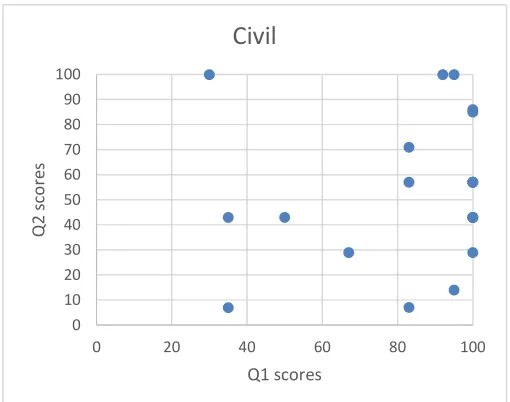
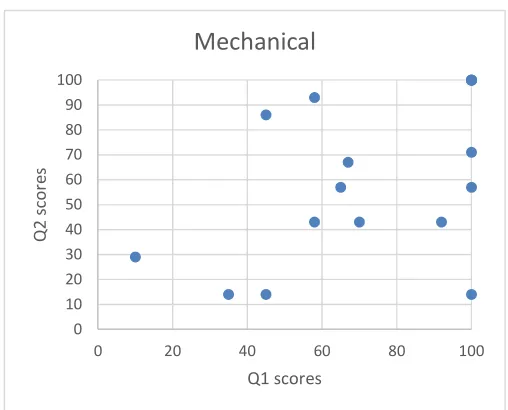
3. There is very little correlation between Q1 and Q2 for any of the groups of students as the correlation coefficients are Mechanical 0.48, Electrical 0.22, and Civil 0.13 as shown in Table 2. More information about the relationship between scores in Q1 and Q2 is shown in the graphs in Figures 1 to 3.
Figure 1 Student scores-Civil Q2a vs Q1
Figure 2 Student scores-Electrical Q2b vs Q1 0
10 20 30 40 50 60 70 80 90 100
0 20 40 60 80 100
Q
2
s
co
re
s
Q1 scores
Civil
0 10 20 30 40 50 60 70 80 90 100
0 20 40 60 80 100
Q
2
s
co
re
s
Q1 scores
Figure 3 Student scores-Mechanical Q2c vs Q1
4. Many students did not appear to have enough confidence to apply skills shown in Q1 to the industry-oriented application in Q2.
5. About half the students used the inverse matrix method for Q1 part (d), and about half used the Gaussian method, although parts (a) to (c) guided them towards the inverse matrix method. A few students only used their calculator, although full working had been requested.
6. In Q2, most students used the Gaussian method. It appears to be the most popular of the three matrix methods taught in the course.
Nature of the industry oriented questions
For industry oriented Q2, students needed skills that were additional to those needed for Q1 where the equations were given in standard textbook form and early parts of the question guided students towards a particular method. In Q2 however, students needed to rewrite the equations in standard textbook form and received no guidance towards a method. Thus they needed to read, understand, and interpret both words and diagrams.
In addition, the three options for Q2 had other characteristics that made them harder than Q1. These are shown in Table 3.
Table 3 Characteristics of Q2
Q2a
Civil
Needed to show where the equations came from. Needed to deal with zero coefficients.
One equation needed rearranging.
Q2b
Electrical
Needed to substitute values. Needed to know Kirchoff’s Laws.
Q2c
Mechanical
There were four unknowns.
Needed to deal with zero coefficients.
Needed to substitute values and these were not given until part (ii) of the question.
0 10 20 30 40 50 60 70 80 90 100
0 20 40 60 80 100
Q
2
s
co
re
s
Q1 scores
Conclusions
As students found industry oriented Q2 much harder than the traditional Q1, it appears that students are lacking the skills to apply their mathematical knowledge to an industry oriented question. As they are in their first year of study, it could be that they lack knowledge of the industry application. It could also be that there is a “disconnect” in students minds between a mathematics problem and an industry problem. Traditional mathematics teachers would expect to teach the mathematics and assume that students would be taught how to apply this to industry applications in their engineering courses. However, there are a number of
additional skills needed to “use mathematics” and it appears that these skills, some of which are identified in this study, are not being taught in either the mathematics or the engineering courses.
Mathematics teachers are willing, indeed keen, to teach these skills but although they understand the engineering, they are not confident or competent to teach the engineering. Similarly, engineering teachers understand the mathematics they use but are not confident about teaching that aspect.
Thus, this study has clearly shown the need to close gaps in the BEngTech curriculum. A major outcome of this study is to have identified the nature of the gaps and hence point the way for further research to investigate how to include these in the BEngTech with appropriate integration of mathematics and engineering courses.
References
Klingbell, N. W., Mercer, R. E., Rattan, K. S., Raymer, M. L., & Reynolds, D. B. (2004). Rethinking engineering mathematics education: A model for increased retention, motivation, and success in engineering. Paper presented at the 2004 American Society for Engineering Education Annual Conference & Exposition.
Qi, T. Z. (2008a). Industry Oriented Teaching and Learning strategies applied to the course within traditional engineering technology undergraduate program. Paper presented at the Frontiers in Education Conference, 2008. FIE 2008. 38th Annual.
Qi, T. Z. (2009). Work in progress - a course design for a Master of Design program linked to the electronic and computer engineering graduates. Paper presented at the Frontiers in Education Conference, 2009. FIE '09. 39th IEEE.
Qi, T. Z. (2008b). Work in progress - a Master of Design program collaborating with Electronic engineering and technology. Paper presented at the Frontiers in Education Conference, 2008. FIE 2008. 38th Annual.
Tosmur-Bayazit, N., & Ubuz, B. (2013). Practicing engineers' perspective on mathematics and mathematics education in college. Journal of STEM Education, 14(3).
Treacy, P., & O'Donoghue, J. (2014). Authentic integration: a model for integrating mathematics and science in the classroom. International Journal of Mathematical Education in Science and Technology, 45(5), 770-718. doi: 10.1080/0020739X.2013.868543
Willcox, K., & Bounova, G. (2004). Mathematics in engineering: Identifying, enhancing and linking the implicit mathematics curriculum. Paper presented at the 2004 American Society for Engineering Education Annual Conference & Exposition.
Acknowledgements
Copyright statement
Copyright © 2014 Ken Louie, Daphne Robson, Frank Cook, Debbie Hogan and Ziming Qi: The authors assign to AAEE and educational non-profit institutions a non-exclusive licence to use this document for personal use and in courses of instruction provided that the article is used in full and this copyright statement is reproduced. The authors also grant a non-exclusive licence to AAEE to publish this document in full on the World Wide Web (prime sites and mirrors), on Memory Sticks, and in printed form within the AAEE 2014 conference proceedings. Any other usage is prohibited without the express permission of the authors.
Appendix: Formative Test
Test part 1: Matrices and Simultaneous Equations
Students are required to complete below standard questions:
1) This question refers to the following system of equations:
− + 3 = 3 2 + + = 7 −3 + + 4 = 9
a) Write the system of equations in the form Ax = b (1 mark)
b) Calculate det A, (determinant of A) (2 marks)
c) Find inv(A), (inverse of A) (2 marks)
d) Use any matrix method to solve the system of equations.
Clearly show your process to obtain full marks. (5 marks)
Part 2 Industry oriented questions
Students are encouraged to select one of below industry-oriented questions.
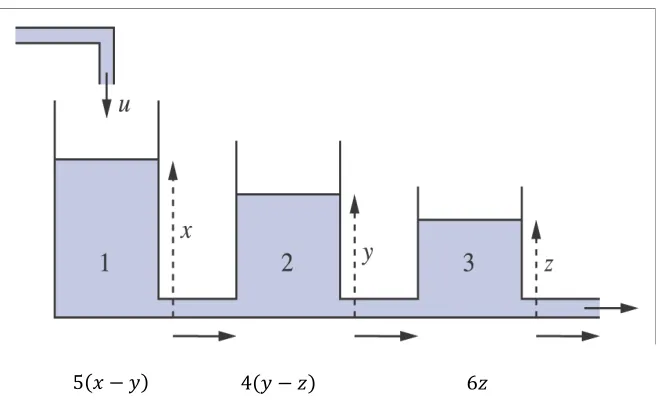
a) A civil industry-oriented application:
Figure 1 an industrial process water flows through three tanks
i. Show that the equations of the system in the steady flow situation are
= 5 − 5 0 = 5 − 9 + 4
0 = 4 − 10
(2 marks) ii. By solving this system of linear equations find , and .
(5 marks)
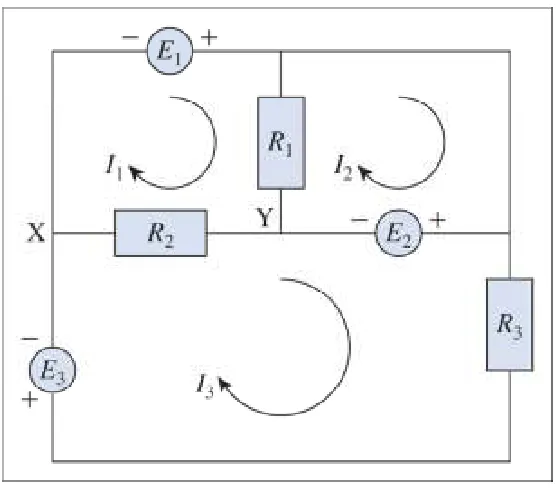
b) An electrical industry-oriented application:
The figure illustrates an electrical network with mesh currents , and shown.
i. By applying Kirchhoff’s voltage law show that the matrix equation for , and is given by
+ −− −0
0 −+
=
−
(2 marks)
ii. Calculate , and given = 5 V, = 6 V and = 12 V, = 15 , = 5 Ω and = 10 .
(5 marks)
Figure 2 an electrical network with mesh currents
c) A Mechanical industry-oriented application:
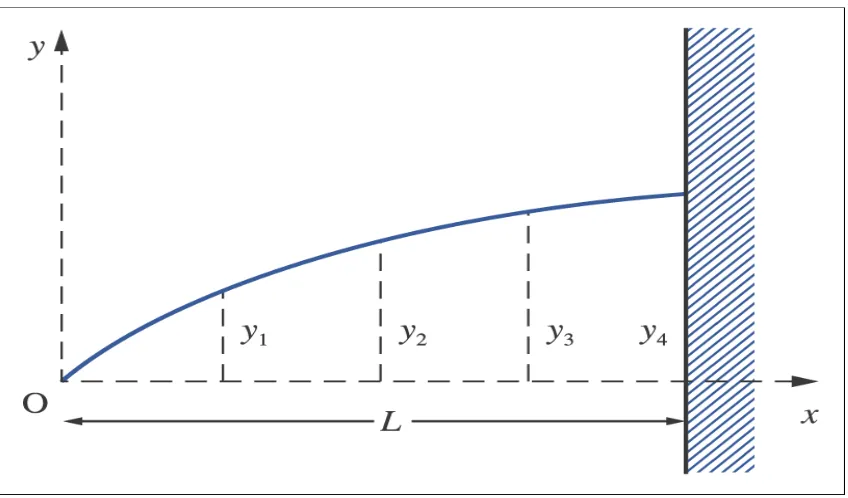
A cantilever beam bends under a uniform load per unit length and is subject to an axial force at its free end. For small deflections a numerical approximation to the shape of the beam is given by the set of equations
−
+
= −
−
+
= −4
−
+
!= −9
2
−
!= −16
Figure 3 A cantilever beam bends under a uniform load
i. Write the set of equations in matrix form
(1 mark)
ii. Use any method you know to solve these equations when the parameter values are = 1 and = 3.