Available online:
https://edupediapublications.org/journals/index.php/IJR/
P a g e | 1640Age Classification Based On Rotational Invariant Local Binary Pattern
Vutpala Shravya & Dr. G. Vishnu Murthy1M-Tech (CSE) Anurag Group Of Institutions Ghatkesar TS.
2Professor, HOD, Dept. of CSE Anurag Group Of Institutions Ghatkesar TS.
Mail Id: - [email protected] & Mail Id: [email protected]
Abstract
Age arrange has various valuable bundles, for
example, finding lost youths, age-based
thoroughly confront gathering, surveillance
checking, and go up against affirmation. That is
the reason modified age portrayal has developed
to end up plainly out to be one of the looking at
assignments as of past due and got package of
thought from the paper foundation. The blessing
paper chose a rotational invariant technique by
method for considering the rotational invariant
near to parallel illustration (riLBP) that gets the
area insights of the facial pix inside and out. On
this, frame features are surveyed utilizing textons.
On this GLCM features are induced to hold age
in to four social affairs making utilization of
particular classifiers. The outcomes are
differentiated and particular methodologies and a
relationship is made among the distinctive
classifiers.
Keywords: -Local binary pattern, Textons, Grey
level co-occurrence matrix features, Classifiers,
FG-NET data base
1. INTRODUCTION
Picture affiliation, research and division methods
expect a critical part in go up against exam and
request procedures. The tastefulness of facial
systems consolidate essentially go up against
affirmation procedures, outward look affirmation
methods, age gathering techniques, et cetera.
These systems have a top to bottom sort of
business venture, articulation and direction
necessity applications, as an occurrence, smart
cards, get the opportunity to control, visit papers,
rate playing cards, driving licenses, biometric
affirmation, video surveillance, and data
wellbeing, among others. Along these follows,
the above facial systems have become essentially
additional thought from each the educational and
mechanical associations as of past due and it has
turned into a recognized quarter of paper in
design affirmation and PC vision and besides by
utilizing psychophysicists and neuroscientists.
Currently, the paper related on age estimation
using face previews is more fundamental than
whenever in late memory, since it has various
bundles, for instance, a web get the opportunity to
Available online:
https://edupediapublications.org/journals/index.php/IJR/
P a g e | 1641use age-based absolutely recovery of face
photographs and age gauge structures for going
over lost children and face affirmation generous
to age movement. Also, the evaluated time of
customers who look at rate sheets is used as a
piece of age particular objective publicizing as
customer demeanors appraisal particularly
through age. Age estimation systems are for the
most segment proposed to use two phases: a
developing spotlight extraction and a detail
gathering. Feature extraction is imperative in age
estimation, for the reason that isolated features
perceptibly affect the game plan execution.
Henceforth, various effort has been composed
nearer to the extraction of discriminative
developing features. These features might be
composed into close by and overall features, and
1/2 breed features, which are a blend of the
worldwide and neighborhood features.
Neighborhood features involve the total and
significance of wrinkles; pores and skin
developing using spots and age spots, hair
shading and the geometry of facial sections. The
area features have been every now and again used
to mastermind individuals into age
businesses(e.G. Little children, young developed
joined statesand senior adults) as they've one of a
sort qualities that comprehend particular age
social affairs. For example, wrinkles are seen in
adulthood instead of in pre-adulthood, and
geometric features, as a case, the detachment
extents among features, as a case, the eyes, the
complete of the nose, and the edges of the mouth,
are noticeably altered in youths rather than in
adulthood. Subsequently, these features are more
guaranteed to applications requiring an age
collect gathering.
2. METHODOLOGY
The blessing paper is a blend of LBP, textons and
GLCM features. LBP decides near to
measurements of a facial age precisely and that is
the thought process LBP are connected. There are
a couple of central focuses with LBP. LBP is
direct to execute, holds neighborhood properties
on a very basic level, impenetrable to lighting or
lighting apparatuses up influences, just holds the
relative forces, less delicate to lighting up sorts,
jam repair brilliant place data (subsequently, LBP
is vivacious to affiliation misstep) and invariant
to monotonic diminish degree trade. Age
affiliation essentially issue to configuration
changes of a facial skin. These adjustments in
facial skin outlines are reasonably stuck by means
of textons in the present paper. Textons addresses
surface frame primitives, that are situated with
particular positions rules called textons are used
for unmistakable portrayals, examination division
and in phenomenal issues. Textons are shape
features chose a near to group. The darkish stage
Available online:
https://edupediapublications.org/journals/index.php/IJR/
P a g e | 1642honest to goodness technique, transformed into
provided with the guide of Haralick et al.
Moreover, prepared to portray surfaces in
perspective of the spatial association between
diminish tones in a photo .Its improvement was
excited by methods for the speculated from Julesz
. The human face is managed as a story.
Consequently GLCM features are alright for a
real exam and course of action of human
appearances for changed projects
3. Features of GLCM
The GLCM P(i,j|d,ø) is a moment mastermind
joint probability thickness artistic creations P of
diminish degree coordinates inside the photo for
each angle in co-occasion structure by methods
for apportioning each factor with Ng. From the
composition assess, the overarching examination
found the 'dull level co-occasion network'
(GLCM) is a benchmark approach for keeping
separated Haralick features, as a case, (dapper
second moment, separate, association, vacillation,
inverse appraisal minute, general standard,
general change, aggregate entropy, entropy,
contrast distinction, assessment entropy, records
measures of relationship and maximal association
coefficient), or Conners' features (idleness,
association shading, bundle incredible fine, near
to homogeneity, imperativeness and entropy).
These features have been regularly connected as a
major aspect of the exam, gathering and
clarification of remotely identified realities.
4. EXPERIMENTAL RESULTS
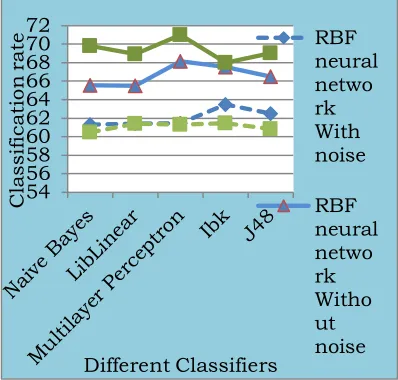
Fig.1: Average age classification rate on three
data bases: Child age group.
Fig. 2: Average age classification rate on three
data bases: Young age group. 54
56 58 60 62 64 66 68 70
Na
iv
e
Ba
ye
s
L
ib
L
in
ea
r
M
u
lti
la
ye
r…
Ibk J48
Cl
as
si
fi
ca
ti
on
r
ate
Different Classifiers RBF neural netwo rk With noise
RBF neural netwo rk Witho ut noise
54 56 58 60 62 64 66 68 70 72
Cl
as
si
fi
ca
ti
on
r
ate
Different Classifiers
RBF neural netwo rk With noise
Available online:
https://edupediapublications.org/journals/index.php/IJR/
P a g e | 1643Fig.3: Average age classification rate on three
data bases: Middle age group.
Fig.4: Average age classification rate on three
data bases: Senior age group.
5. CONCLUSION
The present idea surmised rotational invariant
LBP (riLBP) features. The proposed riLBP is
impenetrable to lighting or lights up influences,
substantially less fragile to lighting up
assortments, jam rebuilding shrewd zone
information ( close by these follows, LBP is
capable to course of action misstep) and invariant
to monotonic dim stage trade of facial pics. To
decide shape spotlight feasibly and to survey the
association among the endowments of
neighboring pixels textons are deduced in the
blessing contemplates on riLBP coded facial
photographs. For convincing age course of action
the GLCM features are resolved on the riLBPT
facial picture. The blessing approach finished an
enormous age gathering occurs by making
utilization of particular device classifiers. The
multi-layer notoriety classifier has demonstrated
over the top request comes to fruition finished the
others.
6. REFERENCE
[1].D. Harwood,T.Ojala, M.Pietikäinen,
S.Kelman, S.Davis, Texture Classification by
Center-Symmetric Auto-correlation, Using Kull
back Discrimination of Distributions, Technical
Report, CAR-TR-678,Computer Vision
Laboratory, Center for Automation Research,
University of Maryland, College Park,
Mary-land, 1993.
[2].H.V.NguyenandL.Bai, Cosine similarity
metrics learning for face verification, Computer
Vision, Springer, (2011) 709-720.
[3].C.Ben and P.Griffin, Comparing and
combining depth and texture cues for face 54 56 58 60 62 64 66 68 70 72 74 Na iv e Ba ye s L ib L in ea r M u lti la ye r…
Ibk J48
Cl as si fi ca ti on r ate Different Classifiers RBF neural networ k With noise RBF neural networ k Withou t noise 54 56 58 60 62 64 66 68 70 72 Na iv e Ba ye s L ib L in ea r M u lti la ye r…
Ibk J48
Available online:
https://edupediapublications.org/journals/index.php/IJR/
P a g e | 1644recognition, Image &Vision Computing, 23(3)
(2005) 339-352.
[4].Y. Fu, G. Guo, and T.S. Huang. Age synthesis
and estimation via faces: A survey. IEEE Trans.
Pattern Anal. Mach. Intell., 32:1955–1976,
November 2010.
[5].He, C., Ahonen, T., Pietikäinen, M., “A
Bayesian local binary pattern texture descriptor”,
Proc. International Conference on Pattern
Recognition, pp. 1–4, 2008.
[6].V. VijayaKumar ,Jangala. SasiKiran ,
G.S.Murthy, Pattern based dimensionality
reduction model for age classification,
International journal of computer applications
(IJCA), Vol.79, No.13, pp. 14-20, Oct-2013,
ISSN: 0975–8887.
[7].Yun Fu, Ye Xu, Thomas S. Huang.,
“Estimating human age by manifold analysis of face pictures and regression on aging features”,
International Conference on Multimedia and
Expo, pp.1383-1386, 2007.
[8].N. Ramanathan and R. Chellappa, “Modeling
age progression in young faces”, in Proc. IEEE
Conf. CVPR, Vol. 1, pp. 387–394, 2006.
[9].Y. H. Kwon and N. da Vitoria Lobo, “Age
Classification from Facial Images”, Computer
Vision and Image Understanding Journal, Vol.
74, no. 1, pp. 1–21,1999.
[10].X. Geng, Z.-H. Zhou, Y. Zhang, G. Li, and
H. Dai, “Learning from facial aging patterns for
automatic age estimation”, Proc. ACMConf.