Active Learning for Coreference Resolution
Florian Laws1 Florian Heimerl2 Hinrich Sch ¨utze1
1 Institute for Natural Language Processing (IMS)
Universit¨at Stuttgart
2 Institute for Visualization and Interactive Systems
Universit¨at Stuttgart
Abstract
We present an active learning method for coreference resolution that is novel in three re-spects. (i) It uses bootstrapped neighborhood pooling, which ensures a class-balanced pool even though gold labels are not available. (ii) It employs neighborhood selection, a selection strategy that ensures coverage of both posi-tive and negaposi-tive links for selected markables. (iii) It is based on a query-by-committee selec-tion strategy in contrast to earlier uncertainty sampling work. Experiments show that this new method outperforms random sampling in terms of both annotation effort and peak per-formance.
1 Introduction
Coreference resolution (CR) – the task of determin-ing if two expressions in natural language text re-fer to the same real-world entity – is an important NLP task. One popular approach to CR is super-vised classification. This approach needs manually labeled training data that is expensive to create. Ac-tive learning (AL) is a technique that can reduce this cost by setting up an interactive training/annotation loop that selects and annotates training examples that are maximally useful for the classifier that is being trained. However, while AL has been proven successful for many other NLP tasks, such as part-of-speech tagging (Ringger et al., 2007), parsing (Osborne and Baldridge, 2004), text classification (Tong and Koller, 2002) and named entity recogni-tion (Tomanek et al., 2007), AL has not been suc-cessfully applied to coreference resolution so far.
In this paper, we present a novel approach to AL for CR based on query-by-committee sampling and bootstrapping and show that it performs better than a number of baselines.
2 Related work
Coreference resolution. The perhaps most widely
used supervised learning approach to CR is the mention-pair model (Soon et al., 2001). This model classifies links (pairs of two mentions) as corefer-ent or disrefercorefer-ent, followed by a clustering stage that partitions entities based on the link decisions. Our AL method is partially based on the class balancing strategy proposed by Soon et al. (2001).
While models other than mention-pair have been proposed (Culotta et al., 2007), none performs clearly better as evidenced by recent shared evalu-ations such as SemEval 2010 (Recasens et al., 2010) and CoNLL 2011 (Pradhan et al., 2011).
Active learning. The only existing publication
on AL for CR that we are aware of is (Gasperin, 2009). She uses a mention-pair model on a biomed-ical corpus. The classifier is Naive Bayes and the AL method uncertainty sampling (Lewis and Gale, 1994). The results are negative: AL is not bet-ter than random sampling. In preliminary experi-ments, we replicated this result for our corpus and our system: Uncertainty sampling is not better than random sampling for CR. Uncertainty sampling can fail if uncertainty assessments are too unstable for successful example selection (cf. Dwyer and Holte (2007)). This seems to be the case for the decision trees we use. Naive Bayes is also known to give bad uncertainty assessments (Domingos and Pazzani,
1997). We therefore adopted a query-by-committee approach combined with a class-balancing strategy.
3 Active learning for CR
The classifier in the mention-pair model is faced with a severe class imbalance: there are many more disreferent than coreferent links. To address this im-balance, we use aneighborhood pool or N-pool as proposed by Soon et al. (2001).
Generation of the N-pool. The neighborhood
of markable x used in N-pooling is defined as the set consisting of the link between x and its closest coreferent markabley(x) to the left and all disref-erent links in between. For a particular markablex, lety(x)be the closest coreferent markable forxto the left ofx. Betweeny(x)andx, there are disref-erent markables zi, so we have a constellation like
y(x), z1, . . . , zn, x. The neighborhood ofx is then
the set of links
{(y, x),(z1, x). . . ,(zn, x)}
This set is empty if x does not have a coreferent markable to the left.
We call the set of all such neighborhoods the N-pool. The N-pool is a subset of the entire pool of links.
Bootstrapping the neighborhood. Soon et al.
(2001) introduce N-pooling for labeled data. In AL, no labeled data (or very little of it) is available. In-stead, we employ the committee of classifiers that we use for AL example selection for bootstrapping the N-pool. We query the committee of classifiers from the last AL iteration and treat a link as coref-erent if and only if the majority of the classifiers classifies it as coreferent. We then construct the N-pool using these bootstrapped labels to determine the coreferent markablesy(x)and then construct the neighborhoods as described above.
If this procedure yields no coreferent links in an iteration, we sample links left of randomly selected markables instead of N-pooling.
Example selection granularity. We use a
query-by-committee approach to AL. The committee con-sists of 10 instances of the link classifier of the CR system, each trained on a randomly chosen subset of the links that have been manually labeled so far.
In each iteration, the N-pool is recomputed and a small subset of the N-pool is selected for label-ing. We experiment with two selection granularities. Inneighborhood selection, entire neighborhoods are selected and labeled in each iteration. We define the utility of a neighborhood as the average of the vote entropies (Argamon-Engelson and Dagan, 1999) of its links.
Inlink selection, individual links with the highest utility are selected – in most cases these will be from different neighborhoods. Utility is again defined as vote entropy.
Our hypothesis is that, compared to selection of individual links, neighborhood selection yields a more balanced sample that covers both positive and negative links for a markable. At the same time, neighborhood selection retains the benefits of AL sampling: difficult (or highly informative) links are selected.
4 Experiments
We use the mention-pair CR system SUCRE (Kob-dani et al., 2011). The link classifier is a deci-sion tree and the clustering algorithm a variant of best-first clustering (Ng and Cardie, 2002). SUCRE results were competitive in SEMEVAL 2010 (Re-casens et al., 2010). We implemented N-pool boot-strapping and selection methods on top of the AL framework of Tomanek et al. (2007).
We use the English part of the SemEval-2010 CR task data set, a subset of OntoNotes 2.0 (Hovy et al., 2006). Training and test set sizes are about 96,000 and 24,000 words. Since we focus on the coref-erence resolution subtask, we use the true mention boundaries for the markables.
The pool for example selection is created by pair-ing every markable with every precedpair-ing markable within a window of 100 markables. This yields a pool of 1.7 million links, of which only 1.5% are labeled as coreferent. This drastic class imbalance necessitates our bootstrapped class-balancing.
neighbor-20,000 links 50,000 links
MUC B3 CEAF mean MUC B3 CEAF mean
(1) random entire pool 49.68 86.07 82.34 72.70 48.81 86.00 82.24 72.34
(2) N-pooling 61.60 85.00 82.85 76.48 62.60 85.99 83.44 77.33
[image:3.612.83.537.59.144.2](3) AL link selection 55.65 86.91† 83.67† 75.41 55.84 86.94† 83.70 75.49 (4) neighborhood sel. 63.07† 86.94† 84.42† 78.14† 63.81† 87.11† 84.33† 78.42†
Table 1: Performance of different methods. All measures areF1measures.
hoods and focus on the performance of random sam-pling. Hence, this is a very strong random baseline. The performance with bootstrapped neighborhoods would likely be lower.
We run 10 runs of each experiment, starting from 10 different seed sets. These seed sets contained 200 links, drawn randomly from the entire pool, for ran-dom sampling; and 20 neighborhoods for neighbor-hood selection, with a comparable number of links. We verified that each seed set contained instances of both classes.
5 Results
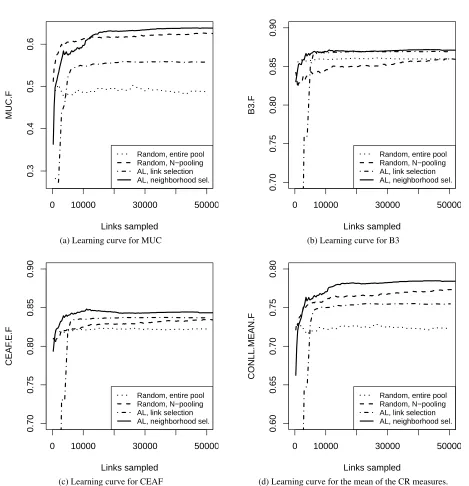
We determine the performance of CR depending on the number of links used for training. The results of the experiments are shown in Table 1 and Fig-ures 1a to 1d. We show results for four coreference measures: MUC, B3, entity-based CEAF (hence-forth: CEAF), and the arithmetic mean of MUC, B3 and CEAF (as suggested by the CoNLL-2011 shared evaluation).
In all four figures, the AL curves have reached a plateau at 20,000 links. At this point, neighborhood selection AL (line 4 in Table 1) outperforms random sampling from the N-pool (line 2) for all coreference measures, with gains from 1.47 points for MUC to 1.94 points for B3.
At 20,000 links, the N-pooling random baseline (line 2) has not yet reached maximum performance, but even at 50,000 links, neighborhood selection AL still outperforms the baselines. (AL and baseline performance will eventually converge when most links from the pool are sampled, but this will hap-pen much later, since the pool has 1.7 million links in total).
†
Statistically significant atp < .05compared to baseline 2 using the sign test (N= 10,k≥9successes).
Link selection AL (line 3) outperforms the base-lines for B3 and CEAF, but is performing markedly worse than the N-pooling random baseline (line 2) for MUC (due to low recall for MUC) and meanF1.
Link selection yields a CR system that proposes a lot of singleton entities that are not coreferent with any other entity. The MUC scoring scheme does not give credit to singletons at all, thus the lower recall. Neighborhood selection AL initially has low MUC, but starts to outperform the baseline at 15,000 links (Figure 1a). For B3 and CEAF, neighborhood selection AL outperforms the baselines much ear-lier, at a few 1000 links (Figures 1b and 1c). It thus shows more robust performance for all evaluation metrics.
Neighborhood selection AL also performs at least as well as (for B3) or better than (MUC and CEAF) link selection AL. Learning curves of neighborhood selection AL are consistently above the link selec-tion curves. We therefore consider neighborhood se-lection AL to be the preferred AL setup for CR.
6 Conclusion
Acknowledgments
Florian Laws is a recipient of the Google Europe Fellowship in Natural Language Processing, and this research is supported in part by his fellowship. Florian Heimerl was supported by the Deutsche Forschungsgemeinschaft as part of the priority pro-gram 1335 ‘Scalable Visual Analytics’.
0 10000 30000 50000
0.3
0.4
0.5
0.6
Links sampled
MUC.F
Random, entire pool Random, N−pooling AL, link selection AL, neighborhood sel.
(a) Learning curve for MUC
0 10000 30000 50000
0.70
0.75
0.80
0.85
0.90
Links sampled
B3.F
Random, entire pool Random, N−pooling AL, link selection AL, neighborhood sel.
(b) Learning curve for B3
0 10000 30000 50000
0.70
0.75
0.80
0.85
0.90
Links sampled
CEAF
.E.F
Random, entire pool Random, N−pooling AL, link selection AL, neighborhood sel.
(c) Learning curve for CEAF
0 10000 30000 50000
0.60
0.65
0.70
0.75
0.80
Links sampled
CONLL.MEAN.F
Random, entire pool Random, N−pooling AL, link selection AL, neighborhood sel.
[image:4.612.74.543.186.672.2](d) Learning curve for the mean of the CR measures.
References
S. Argamon-Engelson and I. Dagan. 1999. Committee-based sample selection for probabilistic classifiers. JAIR, 11:335–360.
A. Culotta, M. Wick, R. Hall, and A. McCallum. 2007. First-order probabilistic models for coreference reso-lution. InHLT-NAACL 2007.
Pedro Domingos and Michael J. Pazzani. 1997. On the optimality of the simple bayesian classifier under zero-one loss. Mach. Learn., 29(2-3):103–130.
K. Dwyer and R. Holte. 2007. Decision tree instability and active learning. InECML.
C. Gasperin. 2009. Active learning for anaphora resolu-tion. InProceedings of the NAACL HLT 2009 Work-shop on Active Learning for Natural Language Pro-cessing.
E. Hovy, M. Marcus, M. Palmer, L. Ramshaw, and R. Weischedel. 2006. Ontonotes: The 90% solution. InHLT-NAACL.
H. Kobdani, H. Sch¨utze, M. Schiehlen, and H. Kamp. 2011. Bootstrapping coreference resolution using word associations. InACL.
D. Lewis and W. Gale. 1994. A sequential algorithm for training text classifiers. InSIGIR.
V. Ng and C. Cardie. 2002. Improving machine learning approaches to coreference resolution. InACL. M. Osborne and J. Baldridge. 2004. Ensemble-based
active learning for parse selection. InHLT-NAACL. S. Pradhan, L. Ramshaw, M. Marcus, M. Palmer,
R. Weischedel, and N. Xue. 2011. Conll-2011 shared task: Modeling unrestricted coreference in ontonotes. InCoNLL.
M. Recasens, L. M`arquez, E. Sapena, M. A. Mart´ı, M. Taul´e, V. Hoste, M. Poesio, and Y. Versley. 2010. Semeval-2010 task 1: Coreference resolution in multi-ple languages. InProceedings of the 5th International Workshop on Semantic Evaluation.
E. Ringger, P. McClanahan, R. Haertel, G. Busby, M. Carmen, J. Carroll, K. Seppi, and D. Lonsdale. 2007. Active learning for part-of-speech tagging: Ac-celerating corpus annotation. InLinguistic Annotation Workshop at ACL-2007.
W. M. Soon, D. Chung, D. Chung Yong Lim, Y. Lim, and H. T. Ng. 2001. A machine learning approach to coreference resolution of noun phrases. Computa-tional Linguistics, 27(4).
K. Tomanek, J. Wermter, and U. Hahn. 2007. An ap-proach to text corpus construction which cuts annota-tion costs and maintains reusability of annotated data. InEMNLP-CoNLL.