Beqa Gentiana, Elezi Abdullah, Elezi Gresa. The impact of powerful programed exercises on fitness, on body composition. Journal of Education, Health and Sport. 2019;9(8):950-961. eISNN 2391-8306. DOI http://dx.doi.org/10.5281/zenodo.3408563
http://ojs.ukw.edu.pl/index.php/johs/article/view/7438
The journal has had 5 points in Ministry of Science and Higher Education parametric evaluation. § 8. 2) and § 12. 1. 2) 22.02.2019. © The Authors 2019;
This article is published with open access at Licensee Open Journal Systems of Kazimierz Wielki University in Bydgoszcz, Poland
Open Access. This article is distributed under the terms of the Creative Commons Attribution Noncommercial License which permits any noncommercial use, distribution, and reproduction in any medium, provided the original author (s) and source are credited. This is an open access article licensed under the terms of the Creative Commons Attribution Non commercial license Share alike.
(http://creativecommons.org/licenses/by-nc-sa/4.0/) which permits unrestricted, non commercial use, distribution and reproduction in any medium, provided the work is properly cited. The authors declare that there is no conflict of interests regarding the publication of this paper.
Received: 01.09.2019. Revised: 14.09.2019. Accepted: 15.09.2019.
THE IMPACT OF POWERFUL PROGRAMED EXERCISES ON
FITNESS, ON BODY COMPOSITION
Name Gentiana Beqa
Affiliation University of Prishtina
Faculty of physical education and sport
Country Albania
Bio Statement —
Name Abdullah Elezi
Affiliation University of Prishtina
Faculty of physical education and sport
Country Albania
Bio Statement —
Principal contact for editorial correspondence.
Name Gresa Elezi
Affiliation University Clinical Centre of Kosova
Country Kosovo
Abstract
The definition of body composition refers to the constituents of the tissues that make up the body and is usually used to indicate the relative percentage of body fat and non-fat tissue. The health interest is the recognition of the relative amount of body fat relative to non-fatty body tissue and the distribution of body fat, with additional interest in changes in these components under the influence of physical exercise. The purpose of this study is to validate the effects of a fitness program with strength exercises on female body composition. The population sampled for this research was defined as female populations Mean age = 23.28 years, SD = 2.18. The test sample consisted of 25 women who for the first time expressed a desire to practice at the “Gettfit Center” fitness center in Prishtina. The calculation of body composition parameters was done with the measuring instrument “TANITA” BC-601. Are calculated: Body Weight (BWEG), Body Fat (BOFA), Muscle Mass (MAMU), Bone Mass (BOMA), Body Mass Index (BMIN), Daily Caloric Intake (DCIN), Metabolic Age (MEAG), Body Water ( BWAT) and Visceral Fat (VIFA). Training sessions lasted 4 weeks with 1-12 workouts with 60% 1RM max loads, and 12 second 13 - 24 weeks training sessions with 80-85% 1RM loads, number of repetitions 8- 12. Quantitative analysis (Paired Sample T-Test) was applied to confirm the impact of the training treatment. The results show that exercise training for two months produced a significant positive effect at the level of p <0.0, in all parameters that determine body fat level and increase in muscle mass.
Key words: body composition; exercise programs; effects; women
Introduction
in these components. Physical inactivity is one of the main causes of weight gain. In the elderly, weight gain is conditioned by slow walking speed and functional limitations. One of the most up-to-date methods for measuring body composition, the bioelectric impedance (BIA) method, is based on the knowledge that the electrical current passes faster through tissues that have a greater amount of water in their composition (Ostojić, 2005). Since the fatty tissue in its composition has less water, the body's resistance to electrical current is consistent with the amount of fat tissue in the body. Therefore, electrical resistance is the index of total body fat, and based on different formulas, the percentage of body fat and other body components is calculated. The purpose of this study is to validate the effects of a fitness program with strength exercises on female body composition.
Methods
(BOMA), Body Mass Index (BMIN), Daily Caloric Intake (DCIN), Metabolic Age (MEAG), Body Water (BWAT) and Visceral Fat (VIFA)
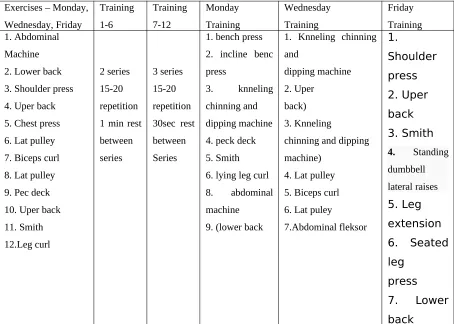
Table 1. Reflection of the exercises that the respondents did during the first 4 weeks of 1-6 training and 7-12 training 60% 1RM max loads, and the second 4 weeks 13 - 24 weeks, 80-85% 1RM loads, number of repetitions 8 -12. (Jukić & Marković, 2005)
Exercises – Monday, Wednesday, Friday Training 1-6 Training 7-12 Monday Training Wednesday Training Friday Training 1. Abdominal Machine 2. Lower back 3. Shoulder press 4. Uper back 5. Chest press 6. Lat pulley 7. Biceps curl 8. Lat pulley 9. Pec deck 10. Uper back 11. Smith 12.Leg curl
2 series 15-20 repetition 1 min rest between series
3 series 15-20 repetition 30sec rest between Series
1. bench press 2. incline benc press
3. knneling chinning and dipping machine 4. peck deck 5. Smith 6. lying leg curl 8. abdominal machine 9. (lower back
1. Knneling chinning and
dipping machine 2. Uper
back) 3. Knneling
chinning and dipping machine)
4. Lat pulley 5. Biceps curl 6. Lat puley
7.Abdominal fleksor 1. Shoulder press 2. Uper back 3. Smith 4. Standing dumbbell lateral raises 5. Leg extension 6. Seated leg
press 7. Lower back
For the processing of the data, basic statistical parameters were applied, minimum score (Min) maximum score (Max), arithmetical mean (Mean), standard deviation (Std.Dev), measure of asymmetry distribution (Skewness) degree of homogeneity of distribution (Kurtosis). For the assessment of the difference between two dependent groups in arithmetical averages, the t-testing (Paired Sample T-Test) has been applied.
Result
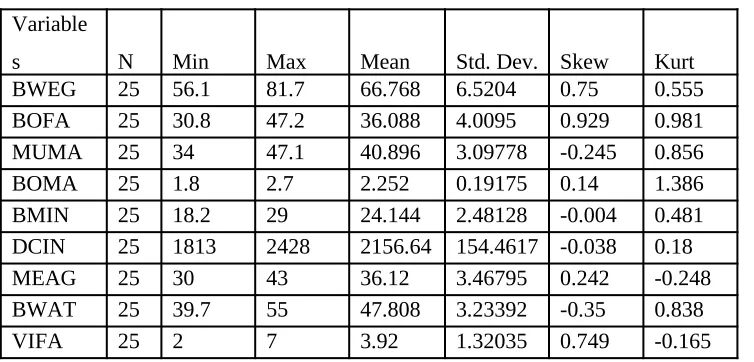
Table 2. Basic statistical indicators of body composition parameters before exercise treatment - the initial state
Variable
s N Min Max Mean Std. Dev. Skew Kurt BWEG 25 56.1 81.7 66.768 6.5204 0.75 0.555 BOFA 25 30.8 47.2 36.088 4.0095 0.929 0.981 MUMA 25 34 47.1 40.896 3.09778 -0.245 0.856 BOMA 25 1.8 2.7 2.252 0.19175 0.14 1.386 BMIN 25 18.2 29 24.144 2.48128 -0.004 0.481 DCIN 25 1813 2428 2156.64 154.4617 -0.038 0.18 MEAG 25 30 43 36.12 3.46795 0.242 -0.248 BWAT 25 39.7 55 47.808 3.23392 -0.35 0.838 VIFA 25 2 7 3.92 1.32035 0.749 -0.165
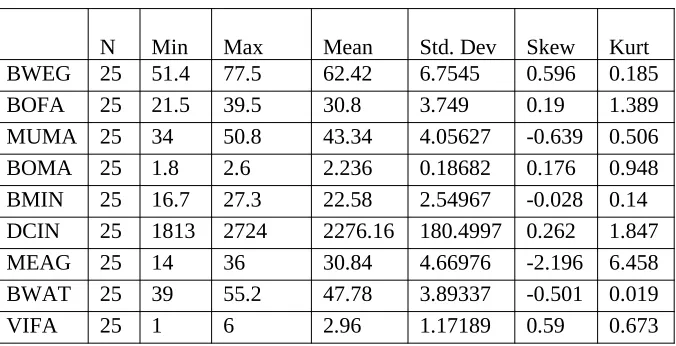
Table 3. Basic statistical indicators of body composition variables after exercise training with force training - the final state
N Min Max Mean Std. Dev Skew Kurt BWEG 25 51.4 77.5 62.42 6.7545 0.596 0.185 BOFA 25 21.5 39.5 30.8 3.749 0.19 1.389 MUMA 25 34 50.8 43.34 4.05627 -0.639 0.506 BOMA 25 1.8 2.6 2.236 0.18682 0.176 0.948 BMIN 25 16.7 27.3 22.58 2.54967 -0.028 0.14 DCIN 25 1813 2724 2276.16 180.4997 0.262 1.847 MEAG 25 14 36 30.84 4.66976 -2.196 6.458 BWAT 25 39 55.2 47.78 3.89337 -0.501 0.019 VIFA 25 1 6 2.96 1.17189 0.59 0.673
The curve with expressed distribution elongation (leptokurtic) was obtained at the parameter Metabolic Age (MEAG) Kurt = -6.458. Normal elongation distribution curve with positive sign (mesokurtic) was obtained on eight body composition parameters: body weight (BWEG) Kurt = 0.555, Body Fat (BOFA) Kurt = 0.555, Muscle Mass (MAMU) Kurt = 0.856, Bone Mass (BOMA) Kurt = 1.386, Body Mass Index (BMIN) Kurt = 0.481, Daily Caloric Intake (DCIN) Kurt = 0.180, Body Water (BWAT) Kurt = 0.838 and Visceral Fat (VIFA) Kurt = 0.673.
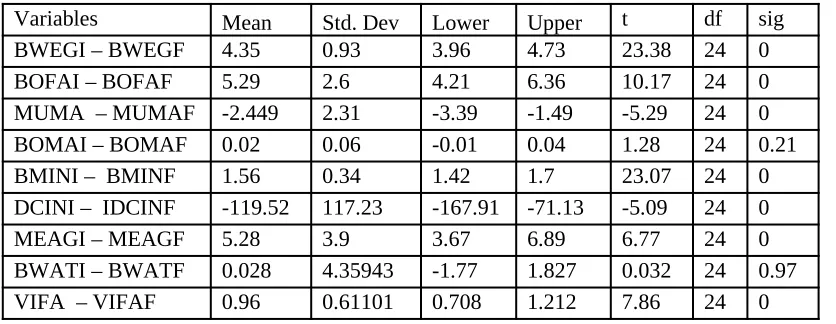
Table 4. Difference between arithmetic averages of body composition variables pre- and post-force training
Variables Mean Std. Dev Lower Upper t df sig BWEGI – BWEGF 4.35 0.93 3.96 4.73 23.38 24 0 BOFAI – BOFAF 5.29 2.6 4.21 6.36 10.17 24 0 MUMA – MUMAF -2.449 2.31 -3.39 -1.49 -5.29 24 0 BOMAI – BOMAF 0.02 0.06 -0.01 0.04 1.28 24 0.21 BMINI – BMINF 1.56 0.34 1.42 1.7 23.07 24 0 DCINI – IDCINF -119.52 117.23 -167.91 -71.13 -5.09 24 0 MEAGI – MEAGF 5.28 3.9 3.67 6.89 6.77 24 0 BWATI – BWATF 0.028 4.35943 -1.77 1.827 0.032 24 0.97 VIFA – VIFAF 0.96 0.61101 0.708 1.212 7.86 24 0
In Bone Mass (BOMA) variable with a difference between initial and final mean = 0.02%; sig = 0.21 and Body Water (BWAT) with a difference between initial and final state Mean = 0.28%; sig = 0.97 no statistically significant difference was obtained between initial and final condition p> 0.05.
Discussion
Based on the results obtained, it can be concluded that all body composition variables, in the first measurements, before the start of the three-week exercise training for two months and in the second measurements, after the end of the exercise program in the fitness had normal asymmetry and no deviation from normal distribution. Such results indicate that the body composition variables obtained through the TANITA apparatus are suitable for such research and are also a good prerequisite for further statistical processing. In further elaboration, the results of the evaluation (Table 4) show that the process of fitness training produced statistically significant improvements in all measured variables except for the variables of Bone Mass (BOMA) and Body Water (BOMA). BWAT) p <0.05. We obtained a statistically significant difference at the significance level of 0.01 in seven variables of body composition: Body weight (ABOWE), Body Fat (BOFA), Muscle Mass (MAMU), Body Mass Index (BMIN), Daily Caloric Intake (DCIN) , Metabolic Age (MEAG), Metabolic Age (MEAG), Visceral Fat (VIFA).
[image:9.612.76.494.109.271.2]of exercises applied during first 4 weeks of 1-6 training and 7-12 exercises with 60% 1RM max loads, and 12 second 13 - 24 weeks training sessions with 80-85% 1RM loads, number of repetitions 8-12 . (Jukić & Marković, 2005) has led to positive changes and significant reduction in body fat. The results obtained regarding the impact of force exercises on body fat reduction are inconsistent with some research by other authors (Willis et al., 2012), which point out that force exercises alone, without combination with other motoric exercises is not an efficient method of reducing body fat.
This research has shown that duration of experimental treatment, intensity and extension of execution produced a positive effect on increasing muscle mass in females and that this effect was statistically significant. Research by some authors conducted over a long period of time has yielded statistically significant changes in muscle mass in the female population and the results were in line with expectations, meaning that there was a statistically significant increase in muscle mass under the influence of force exercises. (Bottero et al., 2013).
Conclusion
Overweight not only in women but also in men of all ages is a global epidemic that poses a serious threat to population health. Research is increasingly focusing on finding ways to prevent this epidemic and finding more effective methods to reduce body fat. The results of this study showed that an organized and planned fitness program with strength exercises can bring about significant changes and improvements in body composition in women. In addition to the practical application of fitness programs with the exercises that women applied, they also received useful information that influenced their motivation and habits for systematic physical exercise. Of course, we can conclude that three exercises per week with strength exercises are enough to improve bodybuilding, especially fatty substances, that excessive amounts are a permanent risk for many cardiovascular diseases. Adaptation to exercise means a change in lifestyle, in all areas of life for better health. This research has also shown that longitudinal character research is irreplaceable compared to transversal character research which requires high motivation on the part of the tested people.
Refernces:
1. Beedie C. J., Terry P. C., Lane A. M. (2000). The Profile of Mood States and athletic performance: two meta-analyses. J. Appl. Sport Psychol. 12, 49–68. 2. Bompa, T.O., Haff, G.G. (2009). Periodization, Theory and Methodoly of Training: Human Kinetics.
3. Botero, J. P., Shiguemoto, G. E., Prestes, J., Marin, C. T., Do Prado, W. L., Pontes, C. 4. S., Guerra, R. L., Ferreia, F. C., Baldissera, V., Perez, S. E. (2013):Effects of longterm 5. periodized resistance training on body composition, leptin, resistin and muscle 6. strength in elderly post-menopausal women. Journal of Sports Medicine and Physical
7. Fitness, 53, 289-94.
8. Durstine, L., Grandjean, P. W., Davis, P. G., Ferguson, M. A., Alderson, N. L., & DuBose, K.D. (2001). Blood Lipid and Lipoprotein Adaptations to Exercise-A Quantitative Analysis.
Sport medicine, str. 1033-1062.
9. Jukić, I., & Marković, G. (2005):Kondicijske vježbe s utezima. Zagreb: Kineziološki fakultet
Sveučilišta u Zagrebu.
researches. Pristina: Faculty of Physical Education. 11. Ng, M., Fleming, T., Robinson, M., Thomson, B., Graetz, N., Margono, C., . . . al., e. (2013). Global, regional, and national prevalence of overweight and obesity in children and adults during 1980–2013: a systematic analysis for the Global Burden of Disease Study 2013. The Lancet, str. 766-781.
12. Perez, B. i Greenwood-Robinson, M. (2009). Zumba: Ditch the workout, join the party! The Zumba weight loss program. United States of America: Maggie Greenwood-Robinson. 13. Peterson, M. D., Sen, A., Gordon, P. M. (2011): Influence of Resistance Exercise on Lean Body Mass in Aging Adults: A Meta-Analysis. Medicine and Science in Sports and Exercise,43, 249–258.
14. Ross, R., & Janssen, I. (2001). Physical activity, total and regional obesity: dose-response considerations. Medicine & Science in Sports & Exercise, str. S521-S527. 15. Trapp, G. E., Chisholm, D. J., Freund, J., & Boutcher, S. H. (April 2008). The effects of high- intensity intermittent exercise training on fat loss and fasting insulin levels of young
women. International journal of obesity, str. 684-691.
16. WHO, W. H. (january 2015). WHO Obesity and overweight 2015 Updated january 2015.
Dohvaćeno izhttp://wedocs.unep.org/bitstream/handle/ 20.500.11822/18767/WHO_
Obesity_and_ ov erweight.pdf?sequence=1&isAllowed=y