R E S E A R C H
Open Access
On the complexity-performance trade-off in
soft-decision decoding for unequal error
protection block codes
Rebecca C de Albuquerque
1, Daniel C Cunha
2*and Cecilio Pimentel
3Abstract
Unequal error protection (UEP) codes provide a selective level of protection for different blocks of the information message. The effectiveness of two sub-optimum soft-decision decoding algorithms, namely generalized Chase-2 and weighted erasure decoding, is evaluated in this study for each protection class of UEP block codes. The performances of both algorithms are compared to that of the maximum likelihood algorithm in order to evaluate the performance loss of each protection class provided by less complex algorithms as well as their complexities are evaluated according to the number of arithmetic operations performed at each decoding step. Finally, numerical results and examples are provided which indicate that a trade-off between performance and complexity for each protection class is obtained. The results of this study can be used to select appropriate UEP coding and decoding schemes in
applications that demand low energy consumption.
Keywords: Block codes, Bit error probability, Unequal error protection, Soft-decision decoding, Computational complexity
1 Introduction
One of the main challenges in the design of battery-supplied wireless devices is the minimization of their energy consumption [1-4]. It is known that forward error correction (FEC) decoders are responsible for a large part of energy consumption of such devices [5,6]. Since max-imum likelihood (ML) decoding is often infeasible due to its complexity of exponential order, it is of interest to investigate sub-optimum decoding techniques in search of less complex alternatives.
Concerning block codes, a class of sub-optimum algo-rithms that deserves attention is composed of reliability-based soft-decision decoding techniques [7]. In this category, Chase-2 and weighted erasure decoding (WED) algorithms are recognized by their ease of implemen-tation and reduced complexity when compared to the ML algorithm. The performance of the Chase-2 decoding
*Correspondence: [email protected]
2Department of Computing Systems, Centro de Inform´atica, Federal University of Pernambuco (CIn/UFPE), 50740-560, Recife-PE, Brazil Full list of author information is available at the end of the article
algorithms applied to Bose–Chaudhuri–Hocquenghem codes is analyzed in [8].
In a number of wireless protocols, the importance of dif-ferent bits in the information sequence often varies and certain blocks of this sequence need higher protection level than other blocks. This property is called unequal error protection (UEP) and can be obtained either by hier-archical modulation techniques [9,10] or by FEC schemes [11,12]. Such UEP methods have been applied to wireless and mobile computing applications [13-15], apart from several video and image coding standards as set parti-tioning hierarchical trees [16], ITU-T H.264 [17], and its extensions [18], and joint photographic expert group 2000 (JPEG 2000) [19]. Concerning UEP coding, the analysis of suboptimal decoding algorithms applied to UEP block codes has not been considered in the literature.
In this study, the effectiveness of sub-optimum soft-decision decoding algorithms (generalized Chase-2 algo-rithm [20] and WED algoalgo-rithm [21]) for each protection class of UEP block codes is evaluated using binary trans-mission over an additive white Gaussian noise (AWGN) channel. Performances of both algorithms are compared
to that of the ML algorithm in order to evaluate the per-formance loss of each protection class provided by less complex algorithms. We also analyze the arithmetic decoding complexity of each algorithm to decode a received sequence. In addition, an analysis of the trade-off between performance and complexity of the algorithms for each protection class is done. Based on this analysis, we discuss the choice of the parameters of the decoder with the best complexity-performance trade-off, such as the number of test patterns, the error-correcting capabil-ity of the binary decoder, and the number of quantization levels.
The remainder of this article is structured as follows: In Section 2, concepts related to UEP coding are described. The soft-decision decoding algorithms are defined in Section 3, while the analysis of their decoding com-plexity in terms of mathematical operations is presented in Section 4. Section 5 presents simulation results. A trade-off between performance and complexity for both decoding algorithms is established in this section. Finally, conclusions are drawn in Section 6.
2 UEP block codes
Consider a binary linear codeCj(n,k,d)in whichnis the codeword length,k is the dimension of the code, andd
is the minimum Hamming distance of Cj. The genera-tor matrix ofCjis denoted byGj. Assume thatw(uGj)is the Hamming weight of the codewordx = uGj related to the information vectoru. The separation vector ofCj, sj =[s0j,. . .,sij,. . .,skj−1], measures the UEP provided by the codeCjfor ML decoding [22]. Theith position ofsjis given by [22]
sij=min{w(uGj):u∈GF(2)k,ui=0}, 0≤i≤k−1, (1)
where GF(2)is the binary Galois field. The smallest ele-ment ofsj is the minimum Hamming distance ofCj. A codeCj is said to have equal error protection capability if all elements ofsjare equal, otherwiseCjhas the UEP property. The error-correcting capability of the codeCjis denoted bytj∗.
To illustrate these concepts, consider the linear block codesC1(16, 5, 5)andC2(25, 8, 5)with generator matrices G1andG2(calculated using the method proposed in [23]) given by
G1=
⎡ ⎢ ⎢ ⎢ ⎢ ⎣
0 0 0 1 1 1 1 1 1 0 0 0 0 1 0 1 0 0 0 1 1 1 0 0 0 1 1 1 0 0 1 1 1 0 0 1 0 0 1 0 0 1 0 0 1 0 0 0 0 1 0 0 1 0 0 1 0 0 1 0 1 0 0 0 0 0 1 0 0 1 0 0 1 0 0 1 1 0 0 0
⎤ ⎥ ⎥ ⎥ ⎥ ⎦ (2)
G2=
⎡ ⎢ ⎢ ⎢ ⎢ ⎢ ⎣
0 0 0 0 0 0 1 1 1 1 1 1 1 1 1 1 1 1 0 0 0 0 0 0 0 0 0 0 0 0 0 1 1 1 1 1 1 0 0 0 0 0 0 1 1 1 1 1 1 0 1 0 0 0 0 0 1 0 0 0 0 0 1 0 0 0 0 0 1 0 0 0 0 0 1 0 1 0 0 0 0 0 1 0 0 0 0 0 1 0 0 0 0 0 1 0 0 0 0 1 0 0 1 0 0 0 0 0 1 0 0 0 0 0 1 0 0 0 0 0 1 0 0 0 1 0 0 0 1 0 0 0 0 0 1 0 0 0 0 0 1 0 0 0 0 0 1 0 0 1 0 0 0 0 1 0 0 0 0 0 1 0 0 0 0 0 1 0 0 0 0 0 1 0 1 0 0 0 0 0 1 0 0 0 0 0 1 0 0 0 0 0 1 0 0 0 0 0 1 1
⎤ ⎥ ⎥ ⎥ ⎥ ⎥ ⎦ . (3)
Their separation vectors ares1=[ 8, 8, 5, 5, 5] ands2 = [ 12, 12, 5, 5, 5, 5, 5, 5], respectively. Thus, we can say that both codes are UEP codes with two distinct protection classes, denoted bycp1(higher protection class) andcp2
(lower protection class).
3 Soft-decision decoding algorithms
Two decoding algorithms that deal with the least reliable positions of the received sequence, namely the generalized Chase-2 (GC-2) [20] and the WED [21] algorithms, are described in this section.
3.1 Generalized Chase-2 decoding algorithm
The GC-2 algorithm uses the sequence of real val-ues observed at the output of the matched filter, r = [r0,r1,. . .,rn−1], and the binary sequence y obtained by a hard quantization of r. For the AWGN chan-nel, the real values of the sequence r correspond to the reliabilities αi such that αi = |ri|. Thus, the higher the value of αi, the lower the probability that the corresponding symbol had been strongly affected by the noise.
Let pbe the number of least reliable positions of the sequence r, i.e., the positions that have the least values of αi. The value ofpdetermines the set of test patterns
Sb= {bi},i=0,. . ., 2p−1, with cardinality|Sb| =2p. At first, the GC-2 algorithm applies a binary decoder (with error-correcting capability t) to find an error pattern z associated to the sequenceyi = y⊕b
i, in which⊕ rep-resents sum modulo-2. If an error pattern zis obtained by the binary decoder,ait is added to the test patternbi, resulting the patternzi = z⊕bi. After that, the analog weightWαof the patternziis figured out according to
Wα(zi)= n−1
k=0
αkzik. (4)
Ifzis not found by binary decoding, the next test pattern biis selected. The objective of the GC-2 algorithm is to find the patternzi with minimum analog weightWα to estimate the transmitted codewordx, asx=y⊕zi. When a pattern zi is not selected (for all test patterns), then x=y.
Table 1 Description of the steps of the GC-2 algorithm
Step Description
1 Get the sequenceyfrom the sequence
r. Doi=0. Select a test patternbi
2 Obtain the sequenceyi=y⊕b
i
3 Compute the syndrome associated with
the sequenceyi(binary decoding)
and search the corresponding error pat-ternz
4 Ifzis found, then get the patternzi = z⊕bi, compute its analog weight
Wα, store the patternzi that has the
minimum analog weight, and go to the Step 5. Otherwise, go to Step 5 5 If there is still test patterns to generate,
doi=i+1, selectbi, and go to
Step 2. Otherwise, go to Step 6 6 If a patternzi was stored, obtain the
estimatex=y⊕zi. Otherwise,x=y
Example 1.Consider the Hamming code C(7, 4, 3) whose error-correcting capability is equal to one. Assume that the codeword x = [1, 0, 0, 1, 0, 1, 1] is BPSK modulated and is transmitted over the AWGN chan-nel. Suppose that the received sequence is r = [1.5, 0.05,−0.8, 2.2, 0.1, 1.2, 0.3].
According to the first step of the GC-2 algorithm, the sequencey=[ 1, 1, 0, 1, 1, 1, 1] is obtained by hard quan-tization ofr. Let us assume that p = 2, so the two least reliable positions are the second and the fifth ones. Thus, considering all the combinations of 0’s and 1’s in these two least reliable positions, we have four test patternsb according to the set
Sb= {b0,b1,b2,b3}
= {0000000, 0100000, 0000100, 0100100}.
To obtain the sequencey0, the test patternb0is selected, resulting iny0 = y⊕b0 = [1, 1, 0, 1, 1, 1, 1]. After com-puting the syndrome associated to thisy0, we get the error patternz = [0, 0, 1, 0, 0, 0, 0]. Since the error pattern z exists, the sequence z0 = z ⊕b
0 = [0, 0, 1, 0, 0, 0, 0] is achieved and its analog weightWα(z0)is 0.8, accord-ing to (4). Repeataccord-ing this procedure with the other test patterns from Sb, the algorithm stores zi
= z2 =
[0, 1, 0, 0, 1, 0, 0] as the sequence with the minimum ana-log weight (Wα(z2) = 0.15). Finally, the estimate x = y⊕z2 = [1, 0, 0, 1, 0, 1, 1] is obtained, characterizing the correct codeword.
3.2 WED Algorithm
The WED algorithm is based on the quantization of the sequencerinQ= 2mregions that are uniformly spaced
by the quantization stepδ. Figure 1 illustrates the quan-tization regions (denoted by RDj, 0 ≤ j ≤ Q− 1) for
Q = 8(m = 3). The optimal value ofδ, denoted byδop, that minimizes the bit error probability, can be obtained algebraically [25] or through computer simulations.
Givenr andQ, two sequences (vandq) are obtained. First, consider the sequence v =[v0,. . .,v,. . .,vm−1], where each componentvis given by
v= 2 m−−1
Q−1 , 0≤≤m−1. (5)
TheQ-ary sequenceq = [q0,q1,. . .,qi,. . .,qn−1],qi ∈
{0,. . .,Q−1}is defined such thatqi=j, ifri∈RDj. Then, a matrixAof dimensionsm×nis determined such that theith column ofAis the binary representation ofqi.
Next, a matrixA having the same dimensions ofAis obtained from the binary decoding of the rows ofA. The syndrome of each row ofAis computed in order to find its associated error pattern. If an error pattern is found, it is added to the row of A to generate the row of A. Otherwise, the row ofAis equal to the row ofA.
We also define the vector f =[f0,. . .,f,. . .,fm−1], where each componentfis the number of positions of the th row ofAthat differs from theth row ofA. Usingf, the reliabilityRof theth row ofAis computed as [21]
R=max0,d−2f. (6)
In the WED algorithm proposed in [21], the error-correcting capability of the binary decoder ist = t∗ = (d−1)/2 . To allow the use of an arbitrary value oft, we propose a new reliabilityRgiven by
R=max0, 2t+1−2f. (7)
It is assumed thatR = 0 if the binary decoder cannot find the error pattern associated with the syndrome of the th row of A. This consideration is intended to reduce the reliability of sequences in which the high number of errors has made impossible the binary decoding. Also, the candidate sequences with fewer errors are favored.
LetS0i corresponds to the set of indices of the rows ofA containing the bit 0 inith column andSi1, the set of indices for the presence of the bit 1 inith column. Theith bit is decoded as 0 if
∈Si 0
Rv> ∈Si 1
Rv
0 1 2 D3 D4 D5 D6 D7
−3δ −2δ −δ 0 +δ +2δ +3δ
or as 1 if
∈S0i Rv<
∈Si1 Rv.
If ∈Si 0R
v = ∈Si1R
v, theith bit is obtained by hard-decision decoding of the componentri.
A detailed description of the WED algorithm is found in [21], and a summary of its steps is presented in Table 2. For a better understanding of this algorithm, we con-sider in the following example the same code, transmitted codeword, and received sequence of Example 1.
Example 2.Assume the mapping ofrinto four quan-tization regions (Q = 4) with δ = 0.2. According to the first step of the WED algorithm, the sequences q =[3, 2, 0, 3, 2, 3, 3] andv= [0.666, 0.333] are obtained. Givenq, the matrixAis obtained as
A=
1 1 0 1 1 1 1 1 0 0 1 0 1 1
. (8)
Next, applying a binary decoding (witht=1) to each row
ofA, we obtain the matrixAas
A=
1 1 1 1 1 1 1 1 0 0 1 0 1 1
. (9)
FromAandA, we obtainf= f0,f1= [1, 0]. Assuming
t=1, the reliabilities of the rows of theAareR0=1 and
R1 =3. For the first column ofA, we haveS00 = {∅}and
S01= {0, 1}, resulting inxˆ0=0. For the second column of A,S10= {1}andS11= {0}. SinceR1υ1>R0υ0(1>0.666), we havexˆ1 = 0. Continuing with the decoding, the esti-matexˆ = [1, 0, 0, 1, 0, 1, 1] is obtained. This is the correct codeword as it was obtained in the GC-2 algorithm.
Table 2 Description of the steps of the WED algorithm
Step Description
1 Quantize the sequence r in Qlevels,
obtaining the sequencesvandq 2 Construct the matrixAaccording to the
binary representation of the sequenceq
3 Decode themrows of the matrixAby
binary decoding obtaining the matrixA
4 Get the vectorfand computeR
5 Get the setsSi
0 andSi1. Make
compar-isons∈Si 0R
v∈Si 1R
v, obtain-ingxˆ
4 Arithmetic complexity of the GC-2 and WED algorithms
The complexity of both algorithms considered in this arti-cle is evaluated according to the number of arithmetic operations performed at each decoding step.b Consider
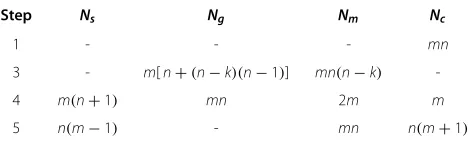
Ns,Ng, Nm, andNc, the number of additions, additions modulo-2, multiplications and comparisons, respectively. Table 3 indicates the number of operations performed at each step of the GC-2 algorithm, as described in Table 1, for each decoded sequence. In Step 3, mul-tiplications and additions modulo-2 correspond to the syndrome computing. Also in Step 3, we assume that there is no arithmetic operations associated to the search of an error pattern z (a lookup table may be used for this purpose). Operations related to Steps 1, 5, and 6 are omitted because either they are not performed for each test pattern or do not require arithmetic operations. Thus, they represent a very small percentage of the whole operations.
It is noteworthy that the operations in Step 4 depend on the result obtained in Step 3, i.e., depend on the success of the binary decoder in the search for an error patternz associated with the sequenceyi. Thus, it is necessary to estimate the average value of the operations performed in Step 4. For this, we define the relative frequency of com-putingWα asfA=NW/2p, in whichNW is the number of times that the analog weightWαis computed in the main loop of the algorithm. This value is evaluated via computer simulations in the next section (see also [26]).
In the case of the WED algorithm, defined Q and δ, the implementation of the algorithm follows the steps described in Table 2. The computing of the sequence v depends only onQand does not need to be executed for each received sequence. Therefore, these operations are not considered in Table 4 that relates the number of oper-ations required to implement the WED algorithm for each decoded sequence. In Step 1, it is considered the binary tree mapping [27], in which, forQregions,mcomparisons are needed to the quantization of a component ri. Step 2 is omitted, because it does not require mathematical operations.
Finally, in Step 5, depending on the sequence that is being decoded, it may be necessary either(m−1)or(m−
2) additions to perform the comparison ∈Si 0R
v
Table 3 Number of mathematical operations performed in the GC-2 algorithm for each decoded sequence
Step Ns Ng Nm Nc
2 - n2p -
-3 - 2p(n−k)(n−1) 2p(n−k)n
Table 4 Number of mathematical operations performed in the WED algorithm for each decoded sequence
Step Ns Ng Nm Nc
1 - - - mn
3 - m[n+(n−k)(n−1)] mn(n−k)
-4 m(n+1) mn 2m m
5 n(m−1) - mn n(m+1)
∈Si1R
v. It is considered the worst case for alln posi-tions, totalizingn(m−1)additions per decoded sequence.
5 Numerical results
The performance of three decoding algorithms (ML, GC-2, and WED) is evaluated via computer simulations for the two UEP codes defined in Section 2 using binary transmission over the AWGN channel. Various config-urations of the GC-2 and WED algorithms are consid-ered by changing their parameters (t and p for GC-2;
t and Q for WED), in order to compare their perfor-mance to that of the ML algorithm for each protection class. Using these results together with the operations in Tables 3 and 4, a trade-off between performance and complexity for both decoding algorithms is also estab-lished. In the following sections, the GC-2 and the WED algorithms will be denoted by GC-2(t,p)and WED(t,Q), respectively.
5.1 GC-2 decoding algorithm
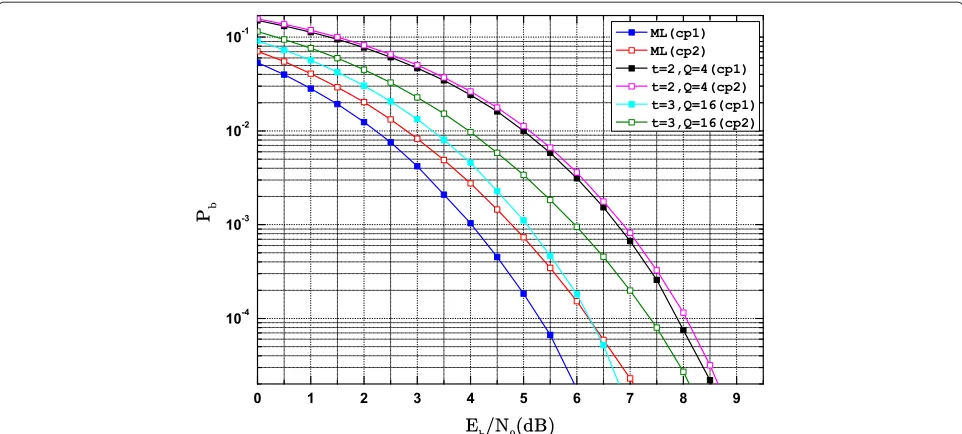
Figure 2 shows the curves of the bit error probability (Pb) versus signal-to-noise ratio (SNR)Eb/N0, in whichEb is the energy per information bit andN0is the power spec-tral density of the noise, of the GC-2(2, 2)and GC-2(3, 4) algorithms for both classes of the UEP codeC1. For this code, the maximum value of the error-correcting capabil-ity of the binary decoder (t) is assumed equal to 3 and the maximum value ofpis such that the cardinality ofSb is always lower than the search set of the ML algorithm (|Sb|<2k−1).
For the GC-2(2, 2)algorithm, we observe that there is virtually no performance difference between the classes
cp1 and cp2. In addition, considering Pb = 10−4, the SNR difference compared to the ML algorithm is approximately 2 and 1.1 dB for the classescp1andcp2, respectively. For the GC-2(3, 4) algorithm, the SNR dif-ference to the ML algorithm is 0.1 dB (cp1) and 0.03 dB (cp2).
To assess the complexity of the GC-2 algorithm, it is necessary to evaluate fA, as mentioned in Section 4. Figure 3 illustrates the values offAas a function ofEb/N0 for GC-2(2, 2), GC-2(2, 7), GC-2(3, 2), GC-2(3, 7), GC-2(6, 2), and GC-2(6, 7) algorithms applied to the UEP
code C2. For p = 2 and considering t = 2, t = 3, and t = 6, fA reaches its maximum value (it is esti-mated for all test patterns bi), when Eb/N0 = 9.5, 8, and 4 dB, respectively. The reduction of SNR occurs due to the increased possibility of an error pattern z be found, a consequence of the increasing of the error-correcting capability of the binary decoder. We observe that fort = 2 andt = 3 (p = 7), there are test pat-ternsbwhich do not produce calculations ofWα (fA < 1), even in regions of high SNR (Eb/N0 > 7.5 dB). For example, considering the GC-2(2, 7) algorithm and
Eb/N0 > 7.5 dB, it is very probable that the bit inver-sion resulting from the addition of test patternsbicauses errors in the sequencey. As the binary decoder used is able to correct only 2 errors in this algorithm, 31 esti-mates of Wα(NW = 31) occur, which represents the sum of all test patterns of weight less than 2, resulting in
fA=31/1280.242.
Finally, it is analyzed the compromise between perfor-mance and complexity of the GC-2 algorithms in terms of the SNR difference with respect to the ML algo-rithm related to the classcpi (forPb = 10−4), namely i (dB), and the number of mathematical operations executed in the algorithm, defined as a 4-tuple MO = [Ns;Ng;Nm;Nc]. For the estimation of MO, it is necessary to determine in Step 4 of Table 3 the value of fA used to weight the number of operations. Provided the GC-2 algorithm and the protection classcpi,i = 1, 2, the SNR value corresponding toPb = 10−4is determined. With this SNR, we can identify the correspondent value offA (see Figure 3).
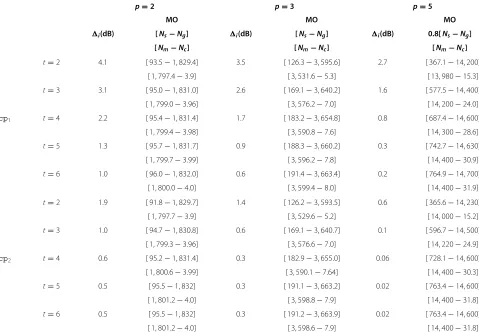
Tables 5 and 6 summarize the complexity-performance trade-off for various configurations of the GC-2 algo-rithm applied to the UEP codes C1 and C2, respec-tively. For each intersection of a row (t) with a column (p), the values ofi (dB) and MO required to achieve
Pb = 10−4 are shown for each protection class. For both codes, these results indicate that an increasing inp
Figure 2Performance of ML and GC-2(t,p)decoding algorithms for UEP codeC1(16, 5, 5)considering the use of binary antipodal modulation and AWGN channel.
of the error-correcting capability of the binary decoder is more advantageous than the increase of the num-ber of test patterns of the GC-2 algorithm. Also, it is possible to observe (analyzing Tables 5 and 6) that, in most of the cases, 2 is smaller than 1, indicat-ing that the performance achieved by the class cp2
is closer to the ML one than the obtained by the classcp1.
5.2 WED algorithm
The WED(t,Q)algorithm uses the reliability R defined in (7). The number of quantization regions considered is Q = 4, 16 and 1024. Table 7 illustrates the opti-mal value of the quantization step, δop, (in the sense of minimizingPb) for the WED(2,Q)algorithm (classcp1) applied to the codes C1 and C2. In general, increasing the number of quantization regions causes a decrease
Figure 3Relative frequency of the execution of the calculation of the analog weightWαin the GC-2(t,p)algorithm applied to the code
C2(25, 8, 5)as a function ofEb/N0.Parameters of the GC-2 algorithm: (black square symbol):t=2,p=2; (red square symbol):t=2,p=7;
Table 5 Results of performance and arithmetic complexity of the GC-2(t,p)algorithms applied to the UEP codeC1(16, 5, 5)
p=2 p=3 p=4
MO MO MO
i(dB) [Ns−Ng] i(dB) [Ns−Ng] i(dB) [Ns−Ng]
[Nm−Nc] [Nm−Nc] [Nm−Nc]
t=2 2.0 [ 58.3−786.2] 1.4 [ 101.4−1, 556.1] 0.8 [ 159.6−3, 100.0]
[ 766.2−3.9] [ 1, 516.1−6.8] [ 3, 000.0−10.6]
cp1 t=3 0.9 [ 59.5−787.4] 0.5 [ 116.6−1, 573.8] 0.1 [ 218.6−3, 130.0]
[ 767.4−4.0] [ 1, 533.8−7.8] [ 3, 050.0−14.6]
t=4 0.6 [ 60.0−788.0] 0.2 [ 119.6−1, 575.6] 0.1 [ 238.8−3, 150.0]
[ 768.0−4.0] [ 1, 535.6−8.0] [ 3, 070.0−15.9]
t=2 1.1 [ 58.4−786.3] 0.6 [ 102.0−1, 556.8] 0.3 [ 162.2−3, 070.0]
[ 766.3−3.9] [ 1, 516.8−6.8] [ 3, 000.0−10.8]
cp2 t=3 0.5 [ 59.7−787.7] 0.1 [ 118.0−1, 570] 0.03 [ 223.2−3, 130.0]
[ 767.7−4.0] [ 1, 530.0−7.9] [ 3, 050.0−14.9]
t=4 0.4 [ 60.0−788.0] 0.1 [ 119.9−1, 575.8] 0.0 [ 239.3−3, 150.0]
[ 768.0−4.0] [ 1, 535.8−8.0] [ 3, 070.0−15.9]
Table 6 Results of performance and arithmetic complexity of the GC-2(t,p)algorithms applied to the UEP codeC2(25, 8, 5)
p=2 p=3 p=5
MO MO MO
i(dB) [Ns−Ng] i(dB) [Ns−Ng] i(dB) 0.8[Ns−Ng]
[Nm−Nc] [Nm−Nc] [Nm−Nc]
t=2 4.1 [ 93.5−1, 829.4] 3.5 [ 126.3−3, 595.6] 2.7 [ 367.1−14, 200]
[ 1, 797.4−3.9] [ 3, 531.6−5.3] [ 13, 980−15.3]
t=3 3.1 [ 95.0−1, 831.0] 2.6 [ 169.1−3, 640.2] 1.6 [ 577.5−14, 400]
[ 1, 799.0−3.96] [ 3, 576.2−7.0] [ 14, 200−24.0]
cp1 t=4 2.2 [ 95.4−1, 831.4] 1.7 [ 183.2−3, 654.8] 0.8 [ 687.4−14, 600]
[ 1, 799.4−3.98] [ 3, 590.8−7.6] [ 14, 300−28.6]
t=5 1.3 [ 95.7−1, 831.7] 0.9 [ 188.3−3, 660.2] 0.3 [ 742.7−14, 630]
[ 1, 799.7−3.99] [ 3, 596.2−7.8] [ 14, 400−30.9]
t=6 1.0 [ 96.0−1, 832.0] 0.6 [ 191.4−3, 663.4] 0.2 [ 764.9−14, 700]
[ 1, 800.0−4.0] [ 3, 599.4−8.0] [ 14, 400−31.9]
t=2 1.9 [ 91.8−1, 829.7] 1.4 [ 126.2−3, 593.5] 0.6 [ 365.6−14, 230]
[ 1, 797.7−3.9] [ 3, 529.6−5.2] [ 14, 000−15.2]
t=3 1.0 [ 94.7−1, 830.8] 0.6 [ 169.1−3, 640.7] 0.1 [ 596.7−14, 500]
[ 1, 799.3−3.96] [ 3, 576.6−7.0] [ 14, 220−24.9]
cp2 t=4 0.6 [ 95.2−1, 831.4] 0.3 [ 182.9−3, 655.0] 0.06 [ 728.1−14, 600]
[ 1, 800.6−3.99] [ 3, 590.1−7.64] [ 14, 400−30.3]
t=5 0.5 [ 95.5−1, 832] 0.3 [ 191.1−3, 663.2] 0.02 [ 763.4−14, 600]
[ 1, 801.2−4.0] [ 3, 598.8−7.9] [ 14, 400−31.8]
t=6 0.5 [ 95.5−1, 832] 0.3 [ 191.2−3, 663.9] 0.02 [ 763.4−14, 600]
Table 7 Values of optimal quantization stepδopof the classcp1for the WED(2,Q)algorithm and different values ofEb/N0
δop
C1(16, 5, 5) C2(25, 8, 5)
Eb/N0(dB) Q=4 Q=16 Q=1024 Q=4 Q=16 Q=1024
0 0.31 0.07 0.0011 0.27 0.05 0.0011
1 0.37 0.09 0.0013 0.23 0.07 0.0011
2 0.37 0.09 0.0013 0.27 0.07 0.0011
3 0.37 0.09 0.0013 0.27 0.07 0.0011
4 0.39 0.09 0.0013 0.33 0.07 0.0011
5 0.45 0.09 0.0015 0.29 0.07 0.0011
6 0.47 0.11 0.0015 0.35 0.09 0.0013
7 0.51 0.11 0.0015 0.37 0.09 0.0013
8 0.67 0.11 0.0017 0.49 0.11 0.0017
9 0.67 0.15 0.0017 0.57 0.09 0.0019
in the value of δop, reducing even more the spacing between adjacent regions. In addition, we can observe that the higher the value of Q, the lower the varia-tion of δop over the range of SNR considered. This behavior indicates that as Q increases, the optimal value of the quantization step becomes approximately constant.
Figure 4 shows the curves of Pb versus Eb/N0 of the WED(2, 4)and WED(3, 16)algorithms for both classes of the UEP codeC1. Similarly to observed in the GC-2(2, 2) algorithm, there is no performance difference between the two classes for the caset = 2, while fort = 3, the SNR difference to the ML algorithm is 0.9 dB (cp1) and 1.2 dB (cp2).
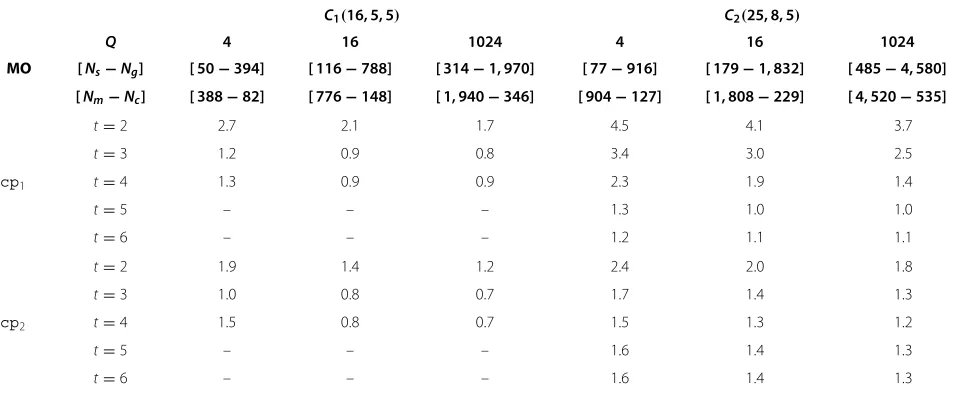
Table 8 summarizes the complexity-performance trade-off for various configurations of the WED algorithm applied to the UEP codes C1 and C2. For each inter-section of a row (t and cpi) with a column (Q and a codeCj), we havei (dB) forPb = 10−4. For codeC1, the error-correcting capability of the WED algorithm is
t = 2, 3 and 4, while for code C2, t = 2, 3, 4, 5 and 6, as it was considered for the GC-2 algorithm. Thus, considering the complexity-performance trade-off, it is more advantageous to increase t, as in the GC-2(t,p)
algorithm, than increase the number of quantization regionsQ.
Finally, we compare both soft-decision decoding algo-rithms for a specific protection class, such as the higher
Table 8 Results of performance (iin dB) and arithmetic complexity (MO) of the WED(t,Q)algorithms applied to the UEP codesC1(16, 5, 5)andC2(25, 8, 5)
C1(16, 5, 5) C2(25, 8, 5)
Q 4 16 1024 4 16 1024
MO [Ns−Ng] [ 50−394] [ 116−788] [ 314−1, 970] [ 77−916] [ 179−1, 832] [ 485−4, 580] [Nm−Nc] [ 388−82] [ 776−148] [ 1, 940−346] [ 904−127] [ 1, 808−229] [ 4, 520−535]
t=2 2.7 2.1 1.7 4.5 4.1 3.7
t=3 1.2 0.9 0.8 3.4 3.0 2.5
cp1 t=4 1.3 0.9 0.9 2.3 1.9 1.4
t=5 – – – 1.3 1.0 1.0
t=6 – – – 1.2 1.1 1.1
t=2 1.9 1.4 1.2 2.4 2.0 1.8
t=3 1.0 0.8 0.7 1.7 1.4 1.3
cp2 t=4 1.5 0.8 0.7 1.5 1.3 1.2
t=5 – – – 1.6 1.4 1.3
t=6 – – – 1.6 1.4 1.3
protection one (cp1). To do this, we define a binary decoding ratio, denoted byγ, as
γ = 2p
log2Q. (10)
The parameterspandQare associated with the number of binary decodings that the GC-2(t,p)and WED(t,Q) algo-rithms, respectively, execute. When decoding a received sequence, the GC-2(t,p)algorithm does 2pbinary decod-ings, while the WED(t,Q) algorithm does log2Q ones. Thus, for making a fair comparison of the algorithms, we choose configurations where γ ∼= 1. In this case, the WED algorithm can offer a performance closer to the ML curve (for the higher protection class), but at the price of increased complexity. For γ = 1 and codeC2, we can see this comparing GC-2(5, 2) and WED(5, 16) algorithms (see Tables 6 and 8). For the GC-2(5, 2) algo-rithm,1 = 1.3 dB and MO[ 95.7; 1, 800; 1, 800; 3.99], while for the WED(5, 16) one, 1 = 1.0 dB and MO
[ 179; 1, 832; 1, 808; 229]. Another example is verified if the GC-2(4, 3)and WED(4, 1024)are compared (γ =0.8 and codeC2). For the GC-2(4, 3) algorithm, 1 = 1.7 dB and MO[ 183; 3, 655; 3, 591; 7.63], while for the WED one,1 = 1.4 dB and MO[ 485; 4, 580; 4, 520; 535]. It should also be observed in Table 8 that the performance of the WED algorithm degrades whentis high. The authors conjecture that this behavior is due to some limitation of the reliabilityRadopted.
6 Conclusions
In this study, the effectiveness of two sub-optimum soft-decision decoding algorithms (GC-2(t,p)and WED(t,Q)
algorithms) was investigated for each protection class of UEP block codes using binary transmission over an
AWGN channel. It was verified the performance of both algorithms compared to that of the ML one. The behav-ior of the GC-2 algorithm was investigated for estimating the analog weight (Step 4) according to the variation of its parameters (t andp), while the WED algorithm was examined for a new proposed reliability according to the variation of its parameters (tandQ). To estimate the com-plexity of each algorithm, it was computed the number of arithmetic operations per decoded sequence. An anal-ysis of the trade-off between performance and complexity of the algorithms was performed for each protection class assuming various configuration options. These analyses led us to conclude that, when choosing the parameters of the algorithms, the increase of the error-correcting capa-bility of the binary decoder (t) was more advantageous in both cases. In addition, choosing the values of pandQ
such thatγ is close to one (for a fixed value oft), it was verified that the GC-2 algorithm is less complex, while the WED algorithm can offer (depending on the code adopted) a performance closer to the ML one.
Endnotes
aError pattern z associated with the syndrome of the
sequenceyi.
bThe complexity of decoding algorithms should be taken
into consideration additional factors besides the arith-metic operations (like memory reads and writes). Since these factors are architecture dependent, we omit their contribution in this article.
Competing interests
The authors declare that they have no competing interests.
Author details
1Third Center for Integrated Air Defense and Air Traffic Control (CINDACTA III),
Inform´atica, Federal University of Pernambuco (CIn/UFPE), 50740-560, Recife-PE, Brazil.3Department of Electronics and Systems, Federal University of
Pernambuco (DES/UFPE), 50740-530, Recife-PE, Brazil.
Acknowledgements
This study was supported in part by the State of Pernambuco Research Foundation (FACEPE) under Grant APQ-1060-3.04/10 and the Brazilian Council for Scientific and Technological Development (CNPq) under Grant
302535/2010-1.
Received: 6 August 2012 Accepted: 1 February 2013 Published: 21 February 2013
References
1. T-H Lin, WJ Kaiser, GJ Pottie, Integrated low-power communication system design for wireless sensor networks. IEEE Commun. Mag.42(12), 142–150 (2004)
2. E Niewiadomska-Szynkiewicz, P Kwasniewski, I Windyga, Comparative study of wireless sensor networks energy-efficient topologies and power save protocols. J. Telecommun. Inf. Technol.3, 68–75 (2009)
3. J G ´omez-Vilardeb ´o, AI P´erez-Neira, M N´ajar, Energy efficient communications over the AWGN relay channel. IEEE Trans. Wirel. Commun.9(1), 32–37 (2010)
4. Y Zhu, W Wu, J Pan, Y Tang, An energy-efficient data gathering algorithm to prolong lifetime of wireless sensor networks. Comput. Commun.33(5), 639–647 (2010)
5. SL Howard, C Schlegel, K Iniewski, Error control coding in low-power wireless sensor networks: when is ECC energy-efficient? EURASIP. J. Wirel. Commun. Netw.2, 1–14 (2006)
6. F Kienle, N Wehn, H Meyr, On complexity, energy- and
implementation-efficiency of channel decoders. IEEE Trans. Commun.
59(12), 3301–3310 (2011)
7. M Fossorier, S Lin, J Snyders, Reliability-based syndrome decoding of linear block codes. IEEE Trans. Inf. Theory IT-44, 388–398 (1998) 8. J Singh, D Pesch, Application of energy efficient soft-decision error
control in wireless sensor networks. Telecommun. Syst. (Springer Netherlands) (2011) doi:10.1007/s11235-011-9588-z, pp. 1–11
9. YC Chang, SW Lee, R Komiya, A low complexity hierarchical QAM symbol bits allocation algorithm for unequal error protection of wireless video transmission. IEEE Trans. Consum. Electron.55(3), 1089–1097 (2009) 10. HX Nguyen, HH Nguyen, T Le-Ngoc, Signal transmission with unequal
error protection in wireless relay networks. IEEE Trans. Veh. Technol.59(5), 2166–2178 (2010)
11. C Pimentel, RD Souza, BF Uch ˆoa-Filho, ME Pellenz, Generalized punctured convolutional codes with unequal error protection. EURASIP J. Adv. Signal Process.2008, Art. ID 280831, 1–6 (2008)
12. S Borade, B Nakiboglu, L Zheng, Unequal error protection: an information-theoretic perspective. IEEE Trans. Inf. Theory.55(12), 5511–5539 (2009)
13. S Zhang, VKN Lau, A novel unequal error protection (UEP) scheme using D-STTD for multicast service. IEEE Trans. Wirel. Commun.8(2), 978–984 (2009)
14. SS Arslan, PC Cosman, LB Milstein, Coded hierarchical modulation for wireless progressive image transmission. IEEE Trans. Veh. Technol.60(9), 4299–4313 (2011)
15. K Kang, WJ Jeon, Differentiated protection to video layers to improve perceived quality. IEEE Trans. Mobi. Comput.11(2), 292–304 (2012) 16. N Thomos, NV Boulgouris, MG Strintzis, Wireless image transmission using
turbo codes and optimal unequal error protection. IEEE Trans. Image Process.14(11), 1890–1901 (2005)
17. Q Qu, JW Modestino, An adaptive motion-based unequal error protection approach for real-time video transport over wireless IP networks. IEEE Trans. Multimed.8(5), 1033–1044 (2006)
18. H Ha, C Yim, Layer-weighted unequal error protection for scalable video coding extension of H.264/AVC. IEEE Trans. Consum. Electron.54(2), 736–744 (2008)
19. W Zhang, X Shao, M Torki, A HajShirMohammadi, IV Bajic, Unequal error protection codes for JPEG2000 images using short block length turbo codes. IEEE Commun. Lett.15(6), 659–661 (2011)
20. NN Tendolkar, CRP Hartman, Generalization of Chase algorithms for soft decision decoding of binary linear codes. IEEE Trans. Inf. Theory.IT-30(5), 714–721 (1984)
21. E Weldon Jr, Decoding binary block codes on Q-ary output channels. IEEE Trans. Inf. Theory.17(6), 713–718 (1971)
22. B Masnick, J Wolf, On linear unequal error protection codes. IEEE Trans. Inf. Theory.IT-3(4), 600–607 (1967)
23. WJ van Gils, On linear unequal error protection codes.
EUT-Rep-82-WSK-02, Department of Mathematical and Computing Science. Eindhoven University of Technology, 1982
24. D Chase, A class of algorithms for decoding block codes with channel measurement information. IEEE Trans. Inf. Theory.IT-18(1), 170–182 (1972) 25. WHJ Chen, MPC Fossorier, S Lin, inProceedings of the IEEE International
Conference on Communications (ICC). Optimum quantizer design for the weigthed erasure decoding algorithm (Vancouver, Canada, June 1999), pp. 838-842
26. RC Albuquerque, DC Cunha, C Pimentel, inProceedings of the IEEE 3rd Latin-American Conference on Communications (LATINCOM). An evaluation of the generalized Chase-2 algorithm applied to unequal error protection block codes (Bel ´em-PA, Brazil, October 2011), pp. 1-6
27. AM Tenenbaum, Y Langsam, MJ Augenstein,Data Structures Using C. (Facsimile edition, Prentice Hall, 1989)
doi:10.1186/1687-6180-2013-28
Cite this article as:de Albuquerqueet al.:On the complexity-performance trade-off in soft-decision decoding for unequal error protection block codes.EURASIP Journal on Advances in Signal Processing20132013:28.
Submit your manuscript to a
journal and benefi t from:
7Convenient online submission 7Rigorous peer review
7Immediate publication on acceptance 7Open access: articles freely available online 7High visibility within the fi eld
7Retaining the copyright to your article