Multiresolution Motion Estimation for Low-Rate
Video Frame Interpolation
Hezerul Abdul Karim
Faculty of Engineering, Multimedia University, 63100 Cyberjaya, Selangor, Malaysia Email:[email protected]
Michel Bister
Division of Engineering, The University of Nottingham, Malaysia Campus, Wisma MISC, 50450 Kuala Lumpur, Malaysia
Email:[email protected]
Mohammad Umar Siddiqi
Faculty of Engineering, Multimedia University, 63100 Cyberjaya, Selangor, Malaysia Email:[email protected]
Received 22 October 2003; Revised 18 February 2004; Recommended for Publication by C. C. Jay Kuo
Interpolation of video frames with the purpose of increasing the frame rate requires the estimation of motion in the image so as to interpolate pixels along the path of the objects. In this paper, the specific challenges of low-rate video frame interpolation are illustrated by choosing one well-performing algorithm for high-frame-rate interpolation (Castango 1996) and applying it to low frame rates. The degradation of performance is illustrated by comparing the original algorithm, the algorithm adapted to low frame rate, and simple averaging. To overcome the particular challenges of low-frame-rate interpolation, two algorithms based on multiresolution motion estimation are developed and compared on objective and subjective basis and shown to provide an elegant solution to the specific challenges of low-frame-rate video interpolation.
Keywords and phrases:low-rate video frame interpolation, multiresolution motion estimation.
1. INTRODUCTION
Low frame rates, for example 10 frames per second (fps), are of interest in low-bit-rate video compression. Reducing the frame rate to 5 fps and interpolating it back to 10 fps at the receiver helps to reduce the transmission bit rate. In order to achieve very low data rates for video communication such as in plain old telephone service, it is necessary to skip im-ages at the transmitter, which then have to be reconstructed at the receiver end. The reconstruction of the images can be achieved through frame interpolation. Interpolation of video frames simply means inserting or adding new frames be-tween the video frames. Given the previous and next frames, the task is to insert a new frame between the two. In gen-eral, frame interpolation can be performed as illustrated in Figure 1.
Without motion estimation, video frames can be inter-polated by averaging the previous and next frames or by re-peating the previous frame. The performance of frame inter-polation will improve if motion estimation is included in the process. Motion estimation is used to estimate the motion
vectors between frames. Pixels are then interpolated along the path of the motion vectors.
In recent years a number of frame interpolation algo-rithms have been developed [1,2,3,4,5,6,7,8,9,10,11,12,
13,14,15,16]. Most of them concentrate on high-frame-rate
video as shown inTable 1[1,2,3,4,5,6,7,8,9,10,11,12,13]
and part of [16]. In such cases, motion estimation can be
achieved by simple block-matching technique. The diff
er-ence between the algorithms lies mainly in block size, search space, and search technique. Much less work has been done
on low frame rates ([14,15] and part of [16]).
In [14], transmitted motion vectors and segmentation
information from an object-based video codec are used to interpolate the skipped frames. In the algorithms presented in this paper, the transmitted motion vectors are not used be-cause for frame interpolation, true motion vector is needed
for every pixel [17]. The transmitted motion vectors are not
the true motion vectors and they are also produced for every
(16×16)- or (8×8)-pixel block as in the case of H.263 video
Previous
Figure1: Frame interpolation algorithm.
Table1: Frame rates for frame interpolation.
Frame interpolation algorithms Frame-rate conversion (fps)
[1] 50 to 75
A frame interpolation scheme for talking head sequence
was proposed in [15]. The foreground and background of
previous and next frames are segmented. The foreground area is interpolated using active mesh frame interpolation and the background area is interpolated using averaging. Other areas are interpolated using covered and uncovered technique. Detection and rendition of lip movement is uti-lized to provide synchronization of lip motion and voice of a person. A good result is produced for simple talking head se-quences. Problems may arise if sequences other than talking head are used. The use of multiresolution motion estimation (MRME) for low-rate frame interpolation was investigated
in [16,17]. However, it did not consider the problems that
arise in the multiresolution pyramid method due to its rigid
structure [18].
In this paper, the basic concept of motion estimation in frame interpolation is described first. A brief review of multiresolution algorithms is presented next, followed by the frame interpolation challenges in low-rate video frames. The algorithms used for frame interpolation are then explained, including the two algorithms based on multiresolution. One of the multiresolution algorithms managed to overcome the rigid pyramid-like structure problem. Results for 5 to 10 fps frame interpolation, discussions, and conclusions are given at the end of the paper.
2. MOTION ESTIMATION
Motion estimation is a process of determining the movement of objects within a sequence of image frames. Block
match-ing is a widely used technique for translation movement
es-timation. In this method, a block of pixels from framen−1
(previous frame) is matched to a displaced block of pixels in
the search area in framen+ 1 (next frame). The block that
gives minimum matching error will be assigned a displace-ment value called motion vector.
The minimum matching error can be calculated using criteria like mean square error (MSE) and mean absolute dif-ference (MAD) as follows:
1)th frame,Bxis the vertical size of the pixels block, andBy
is the horizontal size of the pixels block. For both MSE and
MAD,|dx| ≤(Sx−1)/2,|dy| ≤(Sy−1)/2, whereSxis the
vertical size of the search area andSyis the horizontal size of
the search area.
MAD is the most commonly used criterion [19] and has
lower complexity compared to MSE [20]. Hence, MAD is
used for the block-matching algorithms in this paper.
The motion vector or the displacement (dx,dy) that
gives minimum MAD is then obtained as follows:
The selected motion vector (dxm,dym) is then used to
inter-polate the missing pixel in framen(frame to be interpolated)
as follows:
capabilities of multiresolution pyramid structures in order
to beat the combinatorial explosion problem (seeSection 4)
of block-matching techniques at a single level of resolu-tion. Global (and large) motion is first estimated at a coarse level of resolution with reduced sampling rate as allowed by the Nyquist criterion. The results of the coarse-level es-timates are then propagated to successively higher resolu-tion levels (higher sampling rates) by taking the moresolu-tion evaluated at the coarse level as an initial estimate for the motion at the next level. This is done iteratively until the full-resolution level is reached. Not only does the MRME approach reduce the computational time in comparison with the single-resolution block-matching methods, but it also achieves better picture quality. Many variations of the MRME are available in the literature and are henceforth discussed according to a general classification into six cate-gories.
(i) MRME in wavelet video encoder. Researchers in [21] have initiated an approach of video coding based on MRME at the encoder side. Their method uses the wavelet transform to decompose a video frame into a set of subframes with different resolutions. MRME is utilized to estimate motion at different resolutions of video frame.
(ii) MRME in subband video coding. In [22], the frames of the input video are split into seven spatial subbands. Hierarchical motion estimation is used to generate motion vectors for each subband. The initial motion vectors are estimated only in band 1, and are scaled to generate motion vectors for other subbands.
(iii) Top-down approach of MRME. The application of
top-down MRME for motion and disparity estimation was
evaluated in [23]. The motion is estimated at a coarse
resolution and is refined at higher resolution level(s). It is better compared to the full search method. (iv) Bottom-up approach of MRME. Several researchers
in-vestigated the possibilities of the bottom-up approach.
In [24], for example, the motion information
ex-tracted at high resolution was preserved, and the in-formation at low resolutions was used only selectively to improve the motion estimates.
(v) Multigrid structure in MRME. In [25], the multilevel structure is built on a set of grids with different sizes (multigrid structure). So, it is not a multiresolution approach in the classical sense.
(vi) Threshold in MRME. In [26], a thresholding technique is applied in a two-level pyramid to reduce the com-putation time by preventing blocks whose estimated motion vectors give satisfactory motion compensation from further processing.
From the papers mentioned, it can be concluded that the variants of the fundamental MRME technique differ in terms of the representation of the multiresolution images, the levels of the pyramid, the block size and search space at each level, the motion estimation technique at each level, and general data flow (coarse-to-fine or fine-to-coarse).
4. CHALLENGES IN LOW-RATE VIDEO
FRAME INTERPOLATION
To illustrate the challenges of interpolation at low-rate video
frames, we took a successful algorithm [1] for high frame rate
and applied it to low frame rate with and without adapting the parameters. Then, a new contribution is presented.
When the frame rate is reduced by a factor of N, the
search space has to be increased. This means Sx ×N and
Sy×N. However, this also increases the risk for false matches between unrelated regions in the search space. Therefore the
block size has to be increased byN. This meansBx×Nand
By×N. With these adjustments, the complexity increases by
N4. This large amount of computation has to be performed
in the available time, which has increased byN. The increase
of complexity byN4because of the speed reduction byNis
known as the combinatorial explosion problem.
For example, in 50 to 100 fps interpolation, the algorithm has 20 milliseconds to interpolate between frames. For 5 to 10 fps interpolation, the time available to interpolate between frames is 200 milliseconds. It seems ten times easier than 50 to 100 fps because more time is available. However, using the same video sequence, the movement in 5 fps is ten times larger than the movement in 50 fps. Therefore, the search
space and block size have to be increased ten times (Sx×10,
Sy×10,Bx×10,By×10). So, 10 000 times more computations
are needed in ten times longer time interval.
5. OVERVIEW OF ALGORITHMS USED
Several algorithms to interpolate the low-rate video frames
are evaluated. These algorithms are Averaging, Castagno [1],
and Adapted Castagno. An approach of MRME is developed and extended (EMRME) to overcome observed artifacts.
5.1. Averaging algorithm
The simplest method to do frame interpolation is by averag-ing. The previous frame and next frame are averaged at every pixel location in the image according to
Fn(x,y)=Fn−1(x,y) +Fn+1(x,y)
2 , (4)
where (x,y) is the pixel position,Fn(x,y) is the pixel value at
coordinates (x,y) in the frame to be interpolated,Fn−1(x,y)
is the pixel value at coordinates (x,y) in the previous frame,
andFn+1(x,y) is the pixel value at coordinates (x,y) in the next frame.
5.2. Castagno algorithm
The block-matching approach of [1] was designed to
inter-polate frame rate from 50 to 75 fps. It uses block size of 3×5
and the search space is limited to 5×9 ((−2,. . ., +2)
verti-cally and (−4,. . ., +4) horizontally) for the first pixel of every
row. For other pixels, the motion vector is found by searching
around a 3×3 neighborhood of the previous pixel’s motion
using weighted MAD. The MAD is weighted according to
MADweighted=MAD×
1 +K×dx2,dy2, (5)
whereKis the elastic constant and the range is suggested to
be within 0.05 to 0.02. This formula is discussed in [1].
Ba-sically, it allows the motion vector to move to extreme posi-tions only when it is necessary, and tries to bring it back to a more neutral configuration as often as possible. The motion vector that gives minimum weighted MAD is chosen to be the motion vector for the current pixel. This is repeated for every pixel. When all the pixels’ motion vectors have been es-timated, a motion vector field is produced, which is
postpro-cessed using 3×3 median filter to remove inconsistent
tion vectors. Interpolation is performed based on these
mo-tion vectors using the averaging formulas presented in [1],
which is slightly different from (3).
5.3. Adapted Castagno algorithm
To adapt the method of [1] to lower frame rates, the
follow-ing modifications were introduced: (1) instead of evaluatfollow-ing only nine motion vectors, all of the motion vectors in the search range are evaluated for all pixels; (2) the block and the search range are adapted to a low frame rate of 5 fps, which is ten times lower than the frame rate of Castagno.
The search space is increased to (−25,. . ., +25) vertically
and (−45,. . ., +45) horizontally, about ten times the original
search space of Castagno. The block size to do block
match-ing is set to 9×15 pixels, three times the original block size
of Castagno, which should be ten times according to the ex-planation before.
However, it was found that increasing the block size fur-ther than this did not improve the results and it is reason-able for the size of the search space. This setting is achieved by calculating the fastest motion between previous and next frames of a sequence (e.g., Susie sequence). Clearly, the com-putational complexity for this method is higher than before as more motion vectors need to be evaluated (4641 motion vectors for every pixel). In this method, weighting is not im-plemented. Weighting of the MAD makes the algorithm favor vectors that are closer to (0, 0). Hence, it will not choose the large motion vector. Favoring motion vector (0,0) makes the performance of the algorithm almost similar to Averaging al-gorithm during the frames with fast motion.
5.4. Multiresolution motion estimation
(MRME) algorithm
In the MRME algorithm that we propose, the image is filtered using a 7th-order lowpass filter and subsampled to produce successively reduced-resolution versions. Using QCIF images
(176×144 pixels), five levels of resolution are considered,
the lowest one having 11×9 pixels. For input images with
different size, the number of levels in the pyramid may be different. Motion is estimated at the coarsest resolution first
to find the global motion. Block size is 9×9 and full search
is used. To improve the consistency of the motion field, it is
postprocessed with a 3×3 median filter. This motion field
is then used as an initial estimate in the next finer resolution.
The search space for each pixel is set to 3×3 around the initial
estimate.
The block size is maintained at 9×9 at each level. The
estimate produced at each level is again submitted to a 3×3
median filter before passing on to the next level. In this way, the motion vectors are refined through the pyramid levels until the highest resolution at the lowest level. The motion vectors at the finest level are then used to interpolate the
lu-minance levels according to the formulas used in [1].
An advantage of the MRME algorithm is that motion de-tection at high resolution allows for dede-tection of large motion with small search space on low-resolution images, requiring only a small block size. In the high-resolution image, a small search space is also used around the previous estimate, hence also requiring only a small block size.
5.5. Extended multiresolution motion estimation
(EMRME) algorithm
5.5.1. EMRME and MRME algorithms formulation
Problems arise in the multiresolution pyramid algorithm due
to its rigid structure, as has been documented in [18]. The
same problems arise in MRME, and can be alleviated by making the search space extended and adaptive. An
exam-ple is given in Figure 2, which illustrates an object sliding
from left to right. Previous and next frames are visualized in a particular region of interest. To visualize the pyramid better, only two levels have been represented.
We assume that on the higher level (level k + 1), the
movement is already estimated and median filtered asdx(k+
1,x,y),dy(k+ 1,x,y). At levelk, the initial estimate for the
motion vector is twice the motion vector and level k+ 1 :
dx0(k,x,y)=2×dx(k+1,x,y) anddy0(k,x,y)=2×dy(k+
1,x,y).
For MRME, the search range is 3×3 around the initial
estimate:dx0(k,x,y)−1≤dx(k,x,y)≤dx0(k,x,y) + 1 and dy0(k,x,y)−1≤dy(k,x,y)≤dy0(k,x,y) + 1. For EMRME, the search range is made adaptive based on the previously
used 3×3 space and extended to encompass the initial
mo-tion estimates of the four neighboring pixels as follows:
mindx0(k,x,y)−1,dx0(k,i,j)
5.5.2. EMRME and MRME example
In the example shown inFigure 2, the movement is already
estimated and median filtered on the higher level (levelk+1).
Levelk+ 1
(0,0) (0,0) (0,0) (0,0)
(0,0) (?,?) (2,0) (?,?)
(0,0) (0,0) (0,0) (0,0)
Levelk
P R
Framen−1
(0,0) (0,0) (0,0) (0,0) (0,0)(0,0) (0,0) (0,0) (0,0) (0,0) (0,0)(a, b) (c, d)(0,0) (0,0) (0,0) (0,0) (0,0) (?,?) (e, f) (4,0) (4,0) (?,?) (?,?) (0,0) (0,0) (?,?) (?,?) (4,0) (4,0) (?,?) (?,?) (0,0) (0,0) (0,0) (0,0) (0,0)(0,0) (0,0) (0,0) (0,0) (0,0) (0,0) (0,0) (0,0)(0,0) (0,0) (0,0)
Motion vectors (framen)
P R
Framen+ 1
Figure2: EMRME illustration.
(?,?), which are covered and uncovered pixels. The lower level
(levelk) has twice the number of pixels of the higher level.
One pixel at levelk+ 1 corresponds to four pixels at levelk.
So, the initial motion vectors at levelkare equal to the
mo-tion vectors of levelk+ 1 multiplied by two.
Motion estimation is performed based on the initial
es-timate. Motion vectors shown inFigure 2for levelkare the
resulting motion vectors after the motion estimation on the initial estimate. For four black pixels in the middle, the ini-tial estimate is (4, 0). In case of MRME, the search range is
3×3 around this initial estimate on a motion search space
(−1 ≤ dx ≤ 1,−1 ≤ dy ≤ 1). So, for example, the
mo-tion vector candidates for pixel R are (3,−1), (4,−1), (5,−1);
(3, 0), (4, 0), (5, 0); (3, 1), (4, 1), (5, 1). Motion vector (4, 0) will be chosen as its match.
5.5.3. Problem in MRME
The problem occurs for pixel P, who has initial motion vector of (0, 0). The correct motion vector for pixel P is (4, 0). The
motion vector search space is (−1≤dx≤1,−1≤dy≤1),
hence, the motion vector candidates are (−1,−1), (−1, 0),
(−1, 1); (0,−1), (0, 0), (0, 1); (1,−1), (1, 0), (1, 1). It is clear
that this search range is insufficient to match the correct pixel
in the next frame. The solution to this problem that has been developed in this work is based on an adaptive search space,
based on the previously used 3×3 space, but extended to
en-compass the initial motion estimates of the four neighboring pixels.
The initial estimate of the motion vector (c,d), for exam-ple, has been influenced by its three neighbors who make up
the pixel on the next higher level. Other examples are motion vectors (a,b) and (e,f). The rigidity of the pyramid structure did not allow for a border between white and black pixels to be located at any other place but at the limits between the next higher pixels. The problem occurs because the
move-ment of pixel P is larger than the 3×3 search space. This
mea-surement was well detected at lower resolution levels. How-ever at this low resolution the border could not be accurately located because it is misaligned with the pyramid grid by one
pixel. The original 3×3 search space of pixel P made it
im-possible to match it with its corresponding pixel in the next frame.
5.5.4. Solution by EMRME
However, now we extend the search space of pixel P to en-sure that the initial estimates of the four neighboring pixels
are included. In the illustration shown inFigure 2, the search
space for pixel P is extended to make it a rectangle that en-compasses the initial estimate of the motion vector for neigh-boring pixels, including pixel R. So, the search space for pixel
P is extended from (−1 ≤ dx ≤ +1,−1 ≤ dy ≤ +1) to
(−1≤dx≤+5,−1≤dy≤+2). Hence, the correct motion
vector for pixel P, (4, 0), is included in this new search space. With this extended search space, it is indeed possible to find a motion vector that matches the pixel P with its match in the next frame. The motion vectors at the finest level are then used to interpolate the luminance levels according to the
for-mulas used in [1].
30 fps
pass a pixel in the interpolated frame, that is, when the mo-tion vectors with one or both odd components (e.g., (3, 0) and (3, 1)) have been estimated. Performing a spatial inter-polation by a factor of two, vertically and horizontally, of the two input frames is a possible solution. The
interpola-tion formulas in [1] solve this problem by using only
origi-nal pixels in the motion estimation procedure and the spa-tially interpolated pixels are only used in the actual interpo-lation.
As a summary, for both MRME and EMRME algorithms,
the search space for each pixel is initially set to 3×3, but
for EMRME it is then extended to encompass the initial esti-mates of its neighbors. In this way, pixels that are located just at a (rigid) boundary of the pyramid structure do not get isolated in their movement from the pixels that are just on the other side of the boundary, and the rigidity of the pyra-mid structure is overcome.
6. RESULTS AND DISCUSSIONS
The results for the algorithms are compared objectively and
subjectively using a simulation setup as shown inFigure 3.
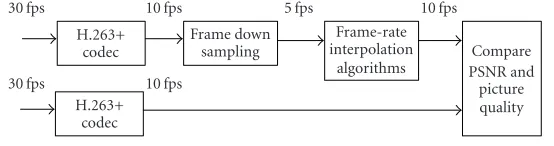
The original image sequences at 30 fps is compressed us-ing H.263+ to 10 fps. The quantization parameter in the H.263+ encoder is fixed to default value of 13 and variable bit rate is used. Downsampling is performed on the 10 fps to get the 5 fps image sequence. The 5 fps is then interpolated to 10 fps using the algorithms discussed. The interpolated 10 fps is finally compared with the originally compressed 10 fps in terms of peak signal to noise ratio (PSNR) and subjective pic-ture quality. The PSNR for comparison is calculated as fol-lows:
terpolated frame at position (x,y),Nx is the vertical size of
frame, andNyis the horizontal size of frame. Simulations are
performed on a large number of image sequences that have
different sizes. The sizes are 176×144 (QCIF), 352×240
(SIF), and 352×288 (CIF). InFigure 3, frame interpolation
is performed after the H.263+ decoder with the aim to re-duce jerkiness of the motion in the decoded 5 fps image
se-quence by interpolating it to 10 fps. Experiments on frame interpolation using uncompressed image sequence have also
been done and are reported in [27]. Simulation set up in
Figure 3is reasonable because the main objective is to sim-ulate the decoded 5 fps image sequence and interpolate it to 10 fps.
6.1. Typical results
Figures4and5show the typical results of interpolation from
5 to 10 fps for QCIF (Claire, Carphone, and Coastguard), SIF (Flower Garden and Football), and CIF (Mobile & Cal-endar) compressed image sequences. The original image
se-quences can be downloaded from (http://ise.stanford.edu/
video.html) and (http://www.cipr.rpi.edu). Claire is a slow-moving sequence. Carphone, Coastguard, and Mobile & Cal-endar are fast-moving sequences. Flower Garden and Foot-ball are very fast-moving sequences.
Averaging produced overlapped images since it did not take into account the motion between frames. The over-lapped image is more obvious in very fast-moving sequences like Flower Garden and Football. Castagno algorithm per-forms better than Averaging in Claire and Carphone. How-ever, since the block size and search space are too small in Castagno, it fails to interpolate those fast- and very-fast-moving sequences correctly. It is also due to the weighting of MAD in Castagno and hence the algorithm favors (0, 0) motion vectors, which produced the same results as
Averag-ing algorithm (seeSection 5.3). Although the weighted MAD
in Castagno algorithm provides a solution for two overlap-ping objects between previous and next frames, it does not perform well at low-frame-rate interpolation and in cam-era tilting such as in the Coastguard sequence. At one stage in the simulation, the weighted MAD was incorporated in our EMRME algorithm, but it did not improve the algo-rithm since it favors (0, 0) motion vectors. However, fur-ther simulation studies are needed to confirm this observa-tion.
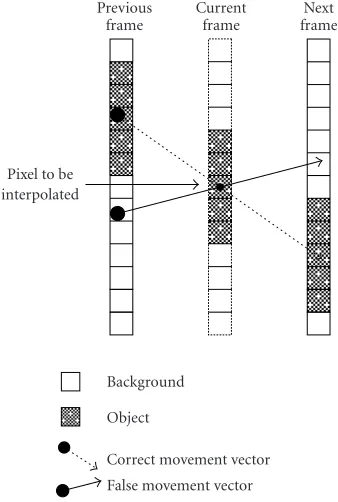
Adapted Castagno gives sharper images compared to Av-eraging and Castagno, but there are lots of artifacts due to false matches. The problem of false matches is illustrated for
the one-dimensional case inFigure 6. In the image, a gray
Original compressed
Averaging
Castagno
Adapted Castagno
MRME
EMRME
(a) (b) (c)
Original compressed
Averaging
Castagno
Adapted Castagno
MRME
EMRME
(a) (b) (c)
Figure5: Typical results for interpolation on SIF and CIF image sequences. (a) Flower Garden. (b) Football. (c) Mobile & Calender.
arrow, resulting in a white pixel value. This kind of situation typically occurs with large movements as in the Flower Gar-den image sequence. It occurs because of the very large block size and search area in Adapted Castagno algorithm, which in turn largely increases the computational time of the algo-rithm.
Previous
Figure6: Problem with false matches.
sequences (Flower Garden and Football), EMRME performs better than MRME due to its search space extension and adaptation.
6.2. Quantitative comparison
The objective evaluation (PSNR) of the image sequences in-terpolated using various interpolation algorithms is shown in Table 2. The best algorithm for each sequence is highlighted in gray in the table and has highest PSNR. For example, for Miss America, EMRME is the best because it has the highest PSNR.
The objective evaluation (PSNR,Table 2) reveals that the
EMRME is the best in most cases. Only in a few cases is MRME slightly better. For the Container sequence, Aver-aging is better—which can be explained by the very slow motion in that particular sequence. For Table Tennis se-quence, where the scene has a camera zooming out action, Castagno is slightly better. This probably shows the positive effects of the weighting procedure in Castagno, however it is only for one sequence. Further studies for EMRME are needed to tackle the problem in camera zooming out im-age sequence. For the Stefan sequence, Adapted Castagno is slightly better. These results are to be expected, since the algo-rithms were gradually improved, from Castagno to Adapted Castagno to MRME to EMRME, using the PSNR as measur-ing stick for improvement. The (nice) surprise comes from the fact that the algorithm development was done with one single sequence (Susie), but the results are consistent when using other sequences, and even other formats (SIF and CIF).
6.3. Qualitative comparison
According to [28], at least 15 observers are needed for
sub-jective evaluation of video quality. Therefore, a total of 15 respondents were used for the subjective evaluation of the in-terpolation. Nineteen image sequences were interpolated us-ing each of the algorithms. The results of the evaluation are
shown in Table 3. The algorithms are Averaging, Castagno,
Adapted Castagno, MRME, and EMRME.
The interpolated sequences were displayed randomly on computer monitor and respondents were asked to rate the image sequences compared to the original image sequence. The rate is between 0 and 5, with 0 being the worst and 5 about the same as original. The respondents did not know which interpolated sequences corresponded to which algo-rithm. The original sequence was displayed on the top left corner of the monitor for comparison. The procedure was repeated for each of the image sequences.
The algorithms preferred by the respondents are
high-lighted in gray in Table 3. For example, for Miss America,
EMRME is preferred over the others because the subjec-tive evaluation rate is the highest. This subjecsubjec-tive evaluation (Table 3) is more mitigated, although the average is still in favor of the EMRME algorithm. It is to be noted that the Adapted Castagno never comes out as the best algorithm. Av-eraging and Castagno are preferred in four cases (out of 19), while all the other cases carry MRME or EMRME as pref-erences. When MRME is preferred, the difference is usually marginal, while when EMRME is preferred, the difference is usually more significant.
The subjective evaluation is less overwhelmingly in fa-vor of EMRME, probably because of the artifacts. PSNR is a kind of “average” error, which does not care about lo-cal big errors, as long as the global impression is good,
while subjective evaluation is very much affected by local
big errors like artifacts. This is illustrated inFigure 7, which
shows two corrupted versions of an image of the Susie
se-quence. InFigure 7a, the error is limited to six pixels which
were put to zero, while in Figure 7b the error introduced
is a Gaussian error over the whole image with average zero and variance 0.0002. The PSNR is 39.54 and 36.94, respec-tively. Hence, the PSNR is clearly in favor of the first im-age, while the subjective evaluation is clearly in favor of the second one. The artifacts introduced in the Adapted Castagno, MRME, and EMRME, are of a nature like the error inFigure 7a, while the blur introduced by the Averaging and Castagno algorithms are more of the nature of the error in Figure 7b.
The global preference, even in the subjective evaluation, is still in favor of the EMRME algorithm, which shows that the improvement introduced, compared to the other
algo-rithms, more than offsets the disturbing artifacts.
6.4. Comparison of computational load
of the studied algorithms
The computational load for the EMRME algorithm is much less than for the Adapted Castagno algorithm.
Table2: Objective evaluation.
Sequences Algorithms
Averaging Castagno Adapted Castagno MRME EMRME
(1) Miss Americaa 36.09 38.48 28.50 39.19 39.26
(2) Clairea 37.39 38.10 23.00 38.39 38.42
(3) Grandmaa 40.02 40.75 37.51 41.10 41.10
(4) Akiyoa 38.82 39.32 37.63 40.04 40.01
(5) Containera 40.18 39.42 33.05 39.31 39.40
(6) Susiea 27.99 28.47 27.18 29.35 29.89
(7) Carphonea 29.67 30.08 22.74 30.45 30.51
(8) Foremana 25.01 26.09 22.38 26.43 27.27
(9) Salesmana 35.00 35.17 30.38 35.53 35.50
(10) Trevora 27.11 27.29 23.27 27.00 27.42
(11) Coastguarda 24.51 25.01 23.13 24.60 26.37
(12) Newsa 29.26 29.97 22.88 30.55 30.62
(13) Mother & Daughtera 32.43 32.56 29.80 32.61 32.62
(14) Hall-objectsa 32.49 32.93 27.18 32.55 34.00
(15) Silenta 30.31 30.37 27.83 30.52 30.52
(16) Flower Gardenb 13.72 13.91 16.75 15.76 18.10
(17) Table Tennisb 21.56 21.66 21.22 21.33 21.60
(18) Footballb 17.52 17.63 17.23 17.65 18.02
(19) Stefanc 18.21 18.29 19.29 17.71 19.08
Average 16.87 17.01 18.28 17.69 18.99
aQCIF (176×144) bSIF (352×240) cCIF (352×288)
where (Nx,Ny) is the image dimension, (Bx,By) is the block
size, and (Sx,Sy) is the search space. In the case of MRME, the
image dimension to be taken into account is the sum of the
image dimension at each level, namely, (144×176) + (72×
88) + (36×44) + (18×22) + (9×11), withBx = By =9
andSx = Sy =3. The resulting estimate of calculations to
interpolateoneimage is 58 164 480 operations for Castagno,
15 878 903 040 for Adapted Castagno (273 times more than Castagno!), and 24 610 311 for MRME (42% of Castagno). For EMRME, the search space is not fixed and is possi-bly larger than for MRME, so while the number of opera-tions will be larger than for MRME, no upper limit can be given.
Computational load of Castagno, Adapted Castagno, and
EMRME is shown inTable 4. The ratios are 1000 : 1 and 3 : 1
for Adapted Castagno and EMRME compared to Castagno, respectively. Although EMRME is slower possibly due to the fact that the lower-resolution images have to be calculated before starting the motion estimation, it is to be remem-bered that Castagno was designed for 50 to 75 fps (hence 40 millisecond time to do the calculation). EMRME was de-signed for 5 to 10 fps (hence 200 millisecond time to do the calculation), hence EMRME is still doing better than Castagno. In this computational load comparison, Castagno
algorithm is chosen as the performance metric because the frame interpolation using EMRME is developed based on Castagno algorithm that works well at high-frame-rate in-terpolation, but not at low-frame-rate interpolation. Per-formance difference with other real-time frame
interpola-tion schemes, such as [5], can be investigated provided that
the EMRME algorithm is optimized for real-time applica-tion.
7. CONCLUSIONS
Interpolation at low frame rate is a great challenge. Most existing algorithms interpolate at high frame rate (e.g., Castagno). The algorithms have to be adapted to assess fast motion (resulting in large frame-to-frame displacement) oc-curring at low frame rate. Classical block matching intro-duces combinatorial problems. Small block size and small search area cannot detect fast motion (e.g., Castagno). On the other hand, large block size and large search area pro-duce mismatches, which lead to artifacts and speed reduction (Adapted Castagno).
Table3: Subjective evaluation.
Sequences Algorithms
Averaging Castagno Applied Castagno MRME EMRME
(1) Miss Americaa 2.67 2.60 0.73 3.20 3.27
(2) Clairea 1.87 1.87 0.73 2.07 2.00
(3) Grandmaa 2.53 2.07 0.87 2.27 2.40
(4) Akiyoa 1.93 2.00 1.40 2.27 2.20
(5) Containera 2.93 2.93 0.87 2.47 2.67
(6) Susiea 1.80 2.00 1.13 2.67 2.33
(7) Carphonea 1.80 1.73 0.67 2.20 2.27
(8) Foremana 1.60 1.60 0.73 1.67 2.07
(9) Salesmana 2.07 2.00 0.60 1.80 1.80
(10) Trevora 1.60 1.53 0.40 1.93 1.93
(11) Coastguarda 2.67 2.60 0.87 1.87 2.53
(12) Newsa 2.20 2.80 1.00 2.80 2.40
(13) Mother & Daughtera 0.93 1.07 0.87 0.60 1.07
(14) Hall-objectsa 2.40 2.33 0.47 2.27 2.67
(15) Silenta 1.80 2.00 1.13 2.67 2.33
(16) Flower Gardenb 2.60 2.87 1.67 2.33 3.73
(17) Table Tennisb 1.53 1.93 1.27 1.60 1.47
(18) Footballb 2.60 2.20 1.07 2.73 3.13
(19) Stefanc 1.07 1.47 0.73 1.67 2.33
Average 1.95 2.12 1.18 2.08 2.67
aQCIF(176×144) bSIF(352×240) cCIF(352×288)
(a) (b)
Figure7: Susie image with (a) strong local error and (b) small global error.
and performs search only in a subset of the search space around the search solution from the previous hierarchi-cal level. It manages to reduce artifacts and long com-putation time introduced by the Adapted Castagno algo-rithm.
An improved version of MRME algorithm, called the EMRME algorithm, is also proposed. The EMRME
Table4: Computational load comparison for Pentium Pro II 350 MHz, 256 MB RAM.
Castagno Adapted Castagno EMRME
To interpolate 1 image of 176×144 2.4 s 40 min 7.2 s
To interpolate 25 images of 176×144 1 min 12 h 3 min
REFERENCES
[1] R. Castagno, P. Haavisto, and G. Ramponi, “A method for mo-tion adaptive frame rate up-conversion,”IEEE Trans. Circuits and Systems for Video Technology, vol. 6, no. 5, pp. 436–446, 1996.
[2] K. A. Bugwadia, E. D. Petajan, and N. N. Puri, “Progressive-scan rate up-conversion of 24/30 Hz source materials for HDTV,” IEEE Transactions of Consumer Electronics, vol. 42, no. 3, pp. 312–321, 1996.
[3] R. L. Lagendijk and M. I. Sezan, “Motion compensated frame rate conversion of motion pictures,” inProc. IEEE Int. Conf. Acoustics, Speech, Signal Processing (ICASSP ’92), vol. 3, pp. 453–456, San Francisco, Calif, USA, March 1992. [4] D.-W. Kim, J.-T. Kim, and I.-H. Ra, “A new video
interpola-tion technique based on mointerpola-tion-adaptive subsampling,”IEEE Transactions of Consumer Electronics, vol. 45, no. 3, pp. 782– 787, 1999.
[5] T.-Y. Kuo, J. Kim, and C.-C. J. Kuo, “Motion-compensated frame interpolation scheme for H.263 codec,” inProc. IEEE Int. Symp. Circuits and Systems (ISCAS ’99), vol. 4, pp. 491– 494, Orlando, Fla, USA, May-June 1999.
[6] R. Krishnamurthy, J. W. Woods, and P. Moulin, “Frame in-terpolation and bidirectional prediction of video using com-pactly encoded optical-flow fields and label fields,” IEEE Trans. Circuits and Systems for Video Technology, vol. 9, no. 5, pp. 713–726, 1999.
[7] Y.-K. Chen, A. Vetro, H. Sun, and S. Y. Kung, “Frame-rate up-conversion using transmitted true motion vectors,” inProc. 2nd IEEE International Workshop on Multimedia Signal Pro-cessing, pp. 622–627, Redondo Beach, Calif, USA, December 1998.
[8] B.-T. Choi, S.-H. Lee, Y.-J. Park, and S.-J. Ko, “Frame rate up-conversion using the wavelet transform,” inProc. IEEE In-ternational Conference on Consumer Electronics-Digest of Tech-nical Papers (ICCE ’00), pp. 172–173, Los Angeles, Calif, USA, June 2000.
[9] B.-T. Choi, S.-H. Lee, and S.-J. Ko, “New frame rate up-conversion using bi-directional motion estimation,” IEEE Transactions on Consumer Electronics, vol. 46, no. 3, pp. 603– 609, 2000.
[10] W. R. Sung, E. K. Kang, and J. S. Choi, “Adaptive motion estimation technique for motion compensated interframe in-terpolation,” IEEE Transactions on Consumer Electronics, vol. 45, no. 3, pp. 753–761, 1999.
[11] O. A. Ojo and G. de Haan, “Robust motion-compensated video upconversion,” IEEE Transactions on Consumer Elec-tronics, vol. 43, no. 4, pp. 1045–1056, 1997.
[12] G. de Haan, J. Kettenis, A. Loning, and B. De Loore, “IC for motion-compensated 100 Hz TV with natural-motion movie-mode,”IEEE Transactions on Consumer Electronics, vol. 42, no. 2, pp. 165–174, 1996.
[13] N. Grammalidis, D. Tzovarns, and M. G. Strintzis, “Temporal frame interpolation for stereoscopic sequences using object-based motion estimation and occlusion detection,” inProc.
IEEE International Conference on Image Processing (ICIP ’95), vol. 2, pp. 2382–2385, Washington, DC, USA, October 1995. [14] S.-C. Han and J. W. Woods, “Frame-rate up-conversion
us-ing transmitted motion and segmentation fields for very low bit-rate video coding,” inProc. IEEE International Conference on Image Processing (ICIP ’97), vol. 1, pp. 747–750, Santa Bar-bara, Calif, USA, October 1997.
[15] T. Chen, Y. Wang, H. P. Graf, and C. Swain, “A new frame in-terpolation scheme for talking head sequences,” inProc. IEEE International Conference on Image Processing (ICIP ’95), vol. 2, pp. 591–594, Washington, DC, USA, October 1995.
[16] R. Thoma and M. Bierling, “Motion compensating interpola-tion considering covered and uncovered background,”Signal Processing: Image Communications, vol. 1, pp. 191–212, 1989. [17] M. Bierling and R. Thoma, “Motion compensating field
in-terpolation using a hierarchically structured displacement es-timator,”Signal Processing, vol. 11, no. 4, pp. 387–404, 1986. [18] M. Bister, J. Cornelis, and A. Rosenfeld, “A critical view of
pyramid segmentation algorithms,” Pattern Recognition Let-ters, vol. 11, no. 9, pp. 605–617, 1990.
[19] G. Van der Auwera, G. Lafruit, and J. Cornelis, “Arithmetic complexity of motion estimation algorithms,” inProc. IEEE Benelux Signal Processing Chapter, Signal Processing Sympo-sium (SPS ’98), pp. 203–206, Leuven, Belgium, March 1998. [20] R. J. Clarke, Digital Compression of Still Images and Video,
Academic Press, London, UK, 1995.
[21] S. Zafar, Y.-Q. Zhang, and B. Jabbari, “Multiscale video rep-resentation using multiresolution motion compensation and wavelet decomposition,” IEEE Journal on Selected Areas in Communications, vol. 11, no. 1, pp. 24–35, 1993.
[22] J. Lee and B. W. Dickinson, “Subband video coding with scene-adaptive hierarchical motion estimation,” IEEE Trans. Circuits and Systems for Video Technology, vol. 9, no. 3, pp. 459–466, 1999.
[23] D. Tzovaras, M. G. Strintzis, and H. Sahinoglou, “Evaluation of multiresolution block matching techniques for motion and disparity estimation,” Signal Processing: Image Communica-tions, vol. 6, no. 1, pp. 59–67, 1994.
[24] I. Rhee, G. R. Martin, and R. A. Packwood, “A multiresolution block matching technique for image motion estimation,” in IEE Colloquium on Multiresolution Modelling and Analysis in Image Processing and Computer Vision, pp. 5/1–5/6, London, UK, April 1995.
[25] F. Dufaux and F. Moscheni, “Motion estimation techniques for digital TV: a review and a new contribution,”Proceedings of the IEEE, vol. 83, no. 6, pp. 858–876, 1995.
[26] Y. Q. Shi and X. Xia, “A thresholding multiresolution block matching algorithm,” IEEE Trans. Circuits and Systems for Video Technology, vol. 7, no. 2, pp. 437–440, 1997.
[27] H. A. Karim, “A study of motion estimation algorithms for interpolation of low rate video frames,” Master’s of Engineer-ing Science thesis, Multimedia University, Selangor, Malaysia, 2002.
Hezerul Abdul Karimreceived B.Eng. de-gree in Electronics with Communications from University of Wales Swansea, UK, in 1998. He was an intern at Bell Labs, Lu-cent Technologies, USA, from October 1999 to March 2000. He received his M.Eng. de-gree from Multimedia University, Malaysia in 2003. He worked as a Tutor and then as a Lecturer at the university from 1998 to 2003. He is currently on study leave for
his Ph.D. degree at Center for Communication Systems Research (CCSR), School of Electronics and Physical Sciences, University of Surrey, UK. His research interests include telemetry, image/video processing, motion estimation, and 3D video compression and transmission.
Michel Bisteris an Associate Professor at The University of Nottingham, Malaysia Campus. He worked on computer analysis of cardiac MR images in his Ph.D. degree, then supervised a group on artificial intelli-gence in diagnostic imaging at the Brussels University (VUB). After a passage in a small company, he joined the Nuclear Medicine Department of a regional hospital (St. Elis-abeth Hospital, Zottegem, Belgium), spent
a few years developing and improving systems for computer-aided diagnostics (CAD) in SPECT images of heart, brain, and kidney, where he coauthored a patent on a system for analyzing heart func-tion using 4D gated SPECT. Dr. Bister’s next step was three years at a private university (Multimedia University) in Malaysia, build-ing up an image processbuild-ing research group of a dozen persons. He is currently the Chairman of the Research Committee of the Engi-neering Division, The University of Nottingham Malaysia Campus, where he also chairs the Digital Signal Processing Group.