R E S E A R C H
Open Access
Direction-of-arrival of strictly non-circular
sources based on weighted mixed-norm
minimization
Weijie Tan
1*, Xi’an Feng
1, Xinrong Ye
2and Lianyou Jing
3Abstract
In this paper, a super-resolution direction-of-arrival (DoA) algorithm for strictly non-circular sources is introduced. The proposed algorithm is based on subspace-weighted mixed-norm minimization. Firstly, we augment the array aperture for efficiently exploiting the non-circularity of signal source. Then, we transform the augmented array matrix to the real array matrix due to the centro-Hermitian of the augmented array matrix. To this end, a subspace-weighted mixed-norm minimization problem is formulated for the DoA estimation. In the proposed algorithm, we utilize singular value decomposition (SVD) to reduce the dimension of matrix, which improves the computational efficiency. We design the weighted scheme by utilizing the orthogonality of the noise subspace and the array manifold dictionary, which increases the reliability of the sparse DoA estimation. As shown by simulations, the proposed algorithm outperforms the state-of-the-art algorithms in difficult scenarios, such as low signal-to-noise ratio, small snapshots, and correlated source. Moreover, the proposed algorithm exhibits a superior performance for the DoA estimation in the
underdetermined case.
Keywords: DoA estimation, Uniform linear array, Subspace-weighted mixed-norm minimization, Strictly non-circular source
1 Introduction
Direction finding has gained great interest in array sig-nal processing field over the past decades, which is widely used in radar, underwater acoustics, wireless commu-nication, and seismic [1–3]. In this area, most of the studies have assumed that the signal follows complex circular Gaussian distribution, such as multiple signal classification (MUSIC) [4], estimation of signal param-eters via rotational invariance technique (ESPRIT) [5]. However, this is not an accurate assumption; in prac-tical application systems, many signals follow complex non-circular Gaussian distribution, such as binary phase shift keying (BPSK), Mary amplitude shift keying (MASK), and binary pulse amplitude modulated (PAM). Therefore, how to exploit the second-order non-circularity of com-plex signals to improve the angle estimation performance becomes an urgent issue in signal processing [6–8].
*Correspondence:[email protected]
1School of Marine Science and Technology, Northwestern Polytechnical
University, 710072 Xi’an, People’s Republic of China
Full list of author information is available at the end of the article
So far, a large number of subspace-based parameter esti-mation algorithm, which exploited the non-circular prop-erty of the signal, had been proposed in the literatures, for example, non-circular multiple signal classification (NC-MUSIC) [9], polynomial rooting NC-MUSIC (NC-Root-MUSIC) [10], fourth-order NC-Root-MUSIC (NC-Root-FO-MUSIC) [11], and unitary ESPRIT for non-circular sources (NC-unitary-ESPRIT) [12], which aim to increase degree of freedom (DoF) and improve angular estima-tion accuracy. For example, the work in [13] utilized the conjugation information of the partial received signal to extend the virtual aperture as well as the joint virtual array, by using a forward spatial smoothing technique in order to handle the coherent source. The main challenge for the super-resolution direction-of-arrival (DoA) estima-tion is to resolve the closely spaced sources with small-size sample, and even to resolve the coherent source. Com-pared with the conventional high-resolution estimation algorithms, source localization algorithms which based on sparse signal recovery (SSR), showed the predominant
performance in the estimation accuracy [14–16]. Specif-ically, the authors in [17] proposed anl1-SVD algorithm which uses singular value decomposition (SVD) of the measurements to reduce the data dimension. The authors in [18] presented a subspace-weightedl2,1-SVD algorithm which exploits the MUSIC-like spectrum to design the weighted matrix. Furthermore, the authors in [19] pro-posed a unitary subspace-weightedl2,1-SVD algorithm by applying the spatial smoothing technique, which doubles the number of snapshots and benefits the DoA estima-tion accuracy. Moreover, by employing unitary transfor-mation, the unitary l2,1-SVD algorithm puts the sparse constraint on real-data matrix and further reduces the computational complexity. For the past two decades, the non-circular SSR-based algorithms have attracted a great number of researchers’ attention, [20–22], and by exploit-ing the non-circular property of the signal sources, the performance of the DoA estimation algorithms can be effectively improved.
In this paper, we propose a weighted subspace mixed-norm DoA estimation algorithm for non-circular signal. The algorithm makes the most of the non-circularity of the sources and formulates the DoA estimation as a weighted subspace mixed-norm minimization problem. The offered improvement mainly displays in two aspects: For one thing, the algorithm takes advantage of the strictly non-circular sources, enhances the DoF to two times of the number of sensors, which increases the number of detectable sources and decreases the estimation error. For another, the subspace weighting scheme exploits the rela-tionship between the over-complete dictionary and the noise subspace, which improves the reliability of weighted coefficient and further enforces the sparsity of the sig-nal. Results verify that our proposed algorithm provides superior performance thanl1-SVD and SW-l2,1-SVD algo-rithms under small snapshots and low SNR regime. More-over, the proposed algorithm offers the ability to estimate DoAs in underdetermined conditions.
The rest of the paper is organized as follows. In Section 2, we introduce the system model and problem description. In Section3, we present a weighted subspace mixed-norm DoA estimation algorithm. In Section4, we provide the detailed experimental simulations and discus-sion. Finally, we conclude the whole paper in Section6.
Notation: A vector and a matrix are denoted byaandA, respectively. For a matrixD,D∗denotes the conjugate,DT andDH account for transpose and conjugate transpose, respectively, [D]i,kis theith row and thekth column
ele-ment in matrixD,Di,·is the elements of theith row inD.
DFaccounts for the Frobenius norm, [u](l2)stands for a
vectoruwhoseith entries equals to thel2-norm of itsith row.IMdenotes anM×Midentity matrix.Maccounts
for the M×Mexchange matrix with elements1s in its
anti-diagonal and zeros elsewhere, and diag(u)represents
a diagonal matrix, whose diagonal elements consist of the vectoru.
2 System model and problem description
2.1 System model
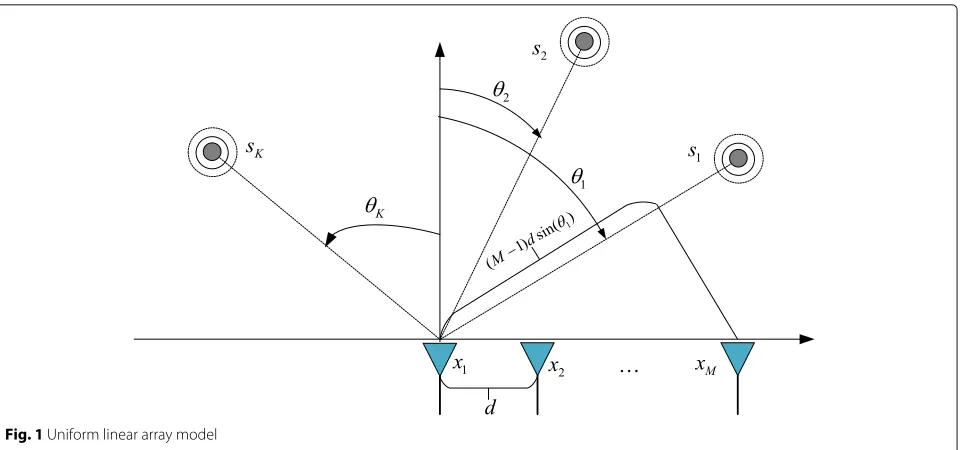
Consider an uniform linear array (ULA) withMisotropic elements, whose inter-element space is half-wavelength d = λ/2 and λ accounts for the carrier wavelength.K independent far-field narrowband sources impinge on the ULA sk(t) from the distinct directionsθ1,θ2,· · ·,θK, as
depicted in Fig. 1. Therefore, the received signal array vectory(t)is given by
array manifold matrix with M×K dimension, and
a(θk) =
1,ej2πdλsin(θk),· · ·,ej2π(M−1)dλsin(θk) T
accounts for an array steering vector with M × 1 dimen-sion, s(t) =[s1(t),· · ·,sK(t)]T is the non-circular
incident signal vector with M × 1 dimension, and n(t) =[n1(t),n2(t),· · ·,nM(t)]T∈ CM×1is the additive
noise vector, whose entries follow the circularly symmet-ric complex Gaussian distribution (CSCG) with zero mean and varianceσn2[23–25].
For convenience, the signtis omitted andNsnapshots are collected, then the model of (1) can be expressed as a matrix form, which holds that
Y=A(θ)S+N, (2)
in which Y = y(1),· · ·,y(N) is a received matrix of K×Ndimension, and the source symbol matrixSand the noise matrixNare defined the same way asY.
When the received signal is a strictly second-order non-circular signal, the complex symbol amplitudes of each received signal locate on a rotated line in the complex plane. According to this property, the signalSis denoted as an array form as follows:
S=(φ)Sr, (3)
where Sr accounts for a real-valued symbol vector of
K×1 dimension, and = diagejφ1,ejφ2,· · ·,ejφK, φk ∈[ 0◦, 180◦], andφφφ is the complex phase shift, called
non-circular phase [26, 27]. Here, we just consider the strictly second-order non-circular signal case with the non-circular phase is zero.
2.2 Problem description
Fig. 1Uniform linear array model
by discretizing the spatial angle range [−90◦, 90◦] at the
angular gridθθθ˜ =
˜
θ1,θ˜2,· · ·,θ˜P
T
, P is the number of atoms in dictionary. Assuming that the angle grid point is dense enough, in general P K, such that the true angle exactly lies in each grid. Then, theP×N dimen-sional row-sparse signal matrixS˜ =[s˜1,s˜2,· · ·,s˜P]T can
be defined as:
sTk = ˜s
T
p if θk= ˜θp
0 otherwise , (4)
where thekth row corresponds to the signal comes from a source at θ˜k. Obviously, when the rows ofS˜ are non-zero elements, the real DoA information can be attained. The system model in (2) can be formulated as a sparse representation problem
Y=A(θ)˜ S˜+N. (5)
Under the sparse representation framework, the matrix ˜
S in (5) can be solved by using the sparse constrained minimization problem, which satisfied the following expression
min ˜
S S˜
2,0 s.t.Y−A
˜
θS˜2F< η2, (6) where
X2,0
L
l=1
δ(Xi,·2>0), (7)
andδ(Xi,·2>0)is an indication function,
δ(x)= 10 ifotherwisex>0 , (8)
ηis an error fitting bound andη2≥ N2
F. Here, we select
the upper value ofN2with a 99% confidence interval as the value ofη.
Unfortunately, the problem in (6) is an NP-hard prob-lem and the optimal solution can be found only with an exponential complexity. However, we can arrive at a sub-optimal solution through a simpler way, by using a convex relaxation technique, which replaces thel2,0norm by its closest convex surrogatel2,1norm. In this case, (6) can be transformed to
min ˜
S S˜
2,1 s.t.Y−A
˜
θS˜2F< η2, (9)
where
X2,1
L
l=1
K
k=1
|[X]l,k|2
1 2
, (10)
This is al2,1mixed-norm which defined by the Eq. (10). The problem in (9) can be solved through standard convex optimization techniques.
Nevertheless, the SSR-based DoA algorithm in (10) does not take into account the non-circular property of the signal. It is necessary to make a deeper study on how to effectively exploit the statistic property of the sources to improve the estimation performance of the SSR-based DoA algorithm.
3 The proposed algorithm
first step is augmenting array matrix and spatial smooth-ing processsmooth-ing, the second step is real-value matrix trans-formation and reducing the dimension of the matrix via SVD, and the last step is utilizing the weighted mixed-norm minimization to estimate the DoAs.
3.1 Augmented array aperture and spatial smoothing processing
In order to take full use of non-circular property of sig-nal sources, we stack the received measurement matrix of the array and its complex conjugate counterpart and construct an augmented matrixY(nc)∈C2M×Nas:
which can be simplified as
Y(nc)=A(nc)(θ,φ)S0+N(nc). (12) Under the above consideration, we consider the first element on the left of the array as the phase reference. According to the center-symmetric characteristic of the ULAs [28], it holds that
MA∗=AA, (13)
whereAaccounts for a unitary diagonal matrix, which
is related to the phase reference of the array, whose non-zero elements consist of the last row ofA. Combined with the formula (13), the array manifold matrix of augmented array can be further simplified as
A(nc)(θ,φ)=
Herein, we consider the case that the non-circular phase is zero, then (14) can be converted to We observe that theB(nc)(θ)has the center-symmetric characteristic, soB(nc)(θ)holds that
2MB(nc)∗=B(nc)B(nc), (17)
in which B is a unitary diagonal matrix, in which the
definition is the same as the definition ofA.
Furthermore, incorporating the spatial smoothing tech-nique and with the help of identical formula in (17), the new measurement Y(nc) can be converted to a centro-Hermitian matrixZ∈C2M×2N as:
3.2 Unitary transformation and SVD
Aiming to reduce the computation complexity, we will utilize the centro-Hermitian ofZto convert the complex data to real data by unitary transformation. The received real-data matrix can be constructed as:
Zr QH2MZQ2T =QH2MB(nc)Sˆ0+ ˆN
(nc)
Q2T. (21) Here, we define the even-order unitary matrix as
Q2n= √1 real-value matrix due to the centro-Hermitian property of the matrixZ, whose unitary transformation is real matrix. Furthermore, in order to derive a reduced 2M × K dimensional signal space, we represent the dominant component by using theKlargest singular vectors of the matrixZr, which is corresponding to the signal subspace. We perform SVD operation on the matrixZrresults to
Zr =UVH =[Us,Un][Vs,Vn]H, (23)
whereis singular value matrix with the dimension the 2M×N,UandV are called left and right singular vec-tor matrix forZr, respectively, which are the orthogonal matrixes. The singular vectors of matrixUcorresponding to non-zero singular value form the signal subspace Us.
Ideally, the number of non-zero singular value of matrix Zr isK. The 2M−K singular vectors of matrixU cor-responding to the smaller singular values form the noise subspaceUn.
Now, we can apply the sparse recovery framework to this model that reduces the dimension of the equation.
3.3 DoA estimation based on weighted mixed-norm minimization
The same as the discussion in Section2.2, the array man-ifold dictionary Dθ¯ = B(nc)θ¯1
,· · ·,B(nc)θ¯L
gridθ¯1,θ¯l,· · ·,θ¯L
(L K). Now, the DoA estimation can be reformulated as a sparse signal recovery problem:
min
SV2Fwhich can be determined distribution with
χ2degrees of freedom 2M×Kand 99% probability [17]. As mentioned above, thel2,1norm is used in (26) as an approximation tol2,0norm; therefore, the solution is sub-optimal. In order to increase the accuracy of this solution, we adopt the subspace-weighted strategy. Specifically, in D(nc), there areKsteering vectors which corresponded to the actual targets. Based on the orthogonality between the steering vectorD(nc) and the noise subspaceUn, for the
true target DoA,θk holds that
Also, the vectorwcan be divided into the following two parts:
wherewscorresponds to the true DoAs, andwnconsists of the remaining elements of w. The reweighted vector can be written asw= [w1,w2,· · ·,w2M]T, withwibeing
the reweighted coefficient, andi=1, 2,· · ·, 2M. The val-ues inwsandwnsatisfyws(k) → 0 and 0 < wn(j) ≤ 1, respectively, andws(k) <wn(j).
Now, we can formulate a new weightedl2,1mixed-norm minimization for the DoA estimation as:
min
wlaccounts for thelth element ofw. It is worth noting that
(29) is treated as a second-order cone program (SOCP) problem, which is efficiently checked by utilizing standard software packages, as the CVX [29], which is used in this paper.
Once we attain the estimation ofSˆSV, the spatial
spec-trum can be caculated by averaging the rows ofSˆSV (i.e.,
the solution of (29))
The angular informationθˆ can be estimated by search-ing the non-zero rows ofSˆSV, which corresponding to the
K peaks ofpˆ. The proposed algorithm is summarized in Algorithm 1.
Algorithm 1The proposed sparse DoA estimation algo-rithm for non-circular signal source.
1: Input: array measurement matrix Y, the number of signal sourceK.
2: Calculate the augmented array matrixY(nc)by (11); 3: Spatial smoothing processing by (18);
4: Real value transformation by (21); 5: Reduce the matrix dimension by (24) ; 6: Calculate the weighted matrixwby (27); 7: Solve the convex problem (29);
8: Output: The DoA estimationθˆi(i=1, 2,· · ·,K).
3.4 Computational complexity analysis
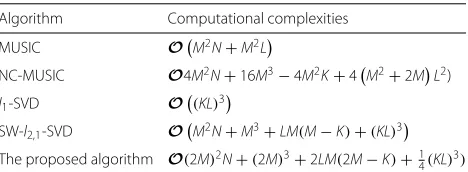
For the subspace-based algorithm, the computa-tional complexity of MUSIC is OM2N+M2L, whose main computational cost is the spectral search. The computational complexity of NC-MUSIC is O4M2N+16M3−4M2K+4M2+2ML2. For the l1-SVD algorithm, from the conclusion in [17], we know that the main computational cost is the sparse recovery process, which solves (9) via the SOCP, the computa-tional complexity of is O(KL)3. For the SW-l
Table 1Computational complexity
algorithms, it can work in the small-size snapshots and the underdetermined case.
4 Experimental simulations and discussion This section provides the Monte-Carlo simulations to val-idate the efficiency of the subspace-weighted mixed-norm algorithm and further compares the performance with the MUSIC [4], NC-MUSIC [9], l1-SVD [17], and SW-l2,1-SVD [18]. Experimental simulations are performed by Intel(R) Core(TM) i7-7700 CPU @ 3.60 GHz, RAM 8G, MATLAB 2017a.
In simulations, an ULA with number M = 10 of isotropic sensors is considered, and the inter-element spacing is half-wavelength. The non-circular signal is BPSK modulation signal. For each snapshot and individ-ual signal at the sensor, the input SNR is defined as SNR= 10 log10S2F/N2F. In all algorithm, the angle grid is uniform which divided from−90 to 90◦with step interval 0.1◦. Unless otherwise specified,N = 200 snapshots are collected.
To evaluate the DOA estimation performance, we use the root-mean-square error (RMSE) as the performance indicator, which is defined as:
RMSE=
whereθˆi andθi represent the estimated and true DoA of
theith signal in theqth trial, respectively.Qaccounts for the number of Monte-Carlo trials. All simulation results derived throughQ=500 Monte-Carlo trials.
We evaluate the DoA estimation performance of the proposed algorithm in the underdetermined case. In this simulation, 11 far-field narrowband BPSK signals uni-formly distribute between−55 to 55◦. The SNR is fixed to 0 dB. From Fig. 2, it can be seen that the proposed algorithm can work well in underdetermined DOA esti-mation, i.e., the proposed algorithm is capable of handling more sources than sensors. In general, we assume that the number of sources is smaller than the number of sen-sors in the subspace-based algorithms. When the number of sensors is M, the subspace-based algorithm at most identifies the M- 1 source, that is incapable of resolving more sources than sensors. From Fig.2, we can conclude
that the proposed algorithm presents better performance when the number of sources is greater than the number of sensors. The reason is that the proposed algorithm does not only increase the degree of freedom by exploiting the non-circular property of the signal source, but also employ the weighted scheme which utilizes the relationship of the noise subspace and array manifold dictionary and further enhances the reliability of the sparse DoA estimation.
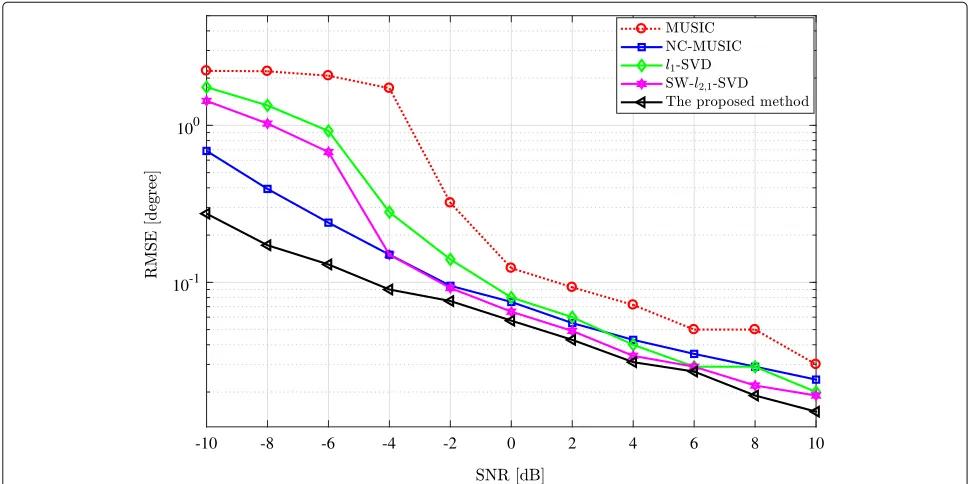
Figure 3 shows the RMSE of DoA estimation against the SNR for different algorithms. Three uncorrelated nar-rowband BPSK-modulated signals impinge on the ULA from [−10◦, 0◦, 8◦]. From Fig.3, it is observed that the proposed algorithm provides the optimal performance for the DoA estimation compared with the other algo-rithms since the proposed algorithm takes full advan-tage of the DoF of augmented array, which benefit from non-circular signal, and the proposed algorithm exploits the forward/backward spatial smoothing to improve the robust of the algorithm. We also observe that the pro-posed algorithm outperforms than SW-l1-SVD when the SNR is less than 0 dB; the reason for the improvement of the DoA estimation is benefited from the aperture extension and subspace weighting.
Figure 4 shows the RMSE versus the snapshots with the different algorithms. Three uncorrelated narrowband BPSK-modulated signals are located [−10◦, 0◦, 8◦]. The SNR is fixed to 0 dB, and we vary the number of snapshots from 20 to 200 with the step interval 20. From Fig. 4, it can be seen that the proposed algorithm achieves better performance of angle estimation compared to other algo-rithms for all snapshots, even in the small-size snapshot case. This indicates that the proposed algorithm improves the DoA estimation performance for different snapshots.
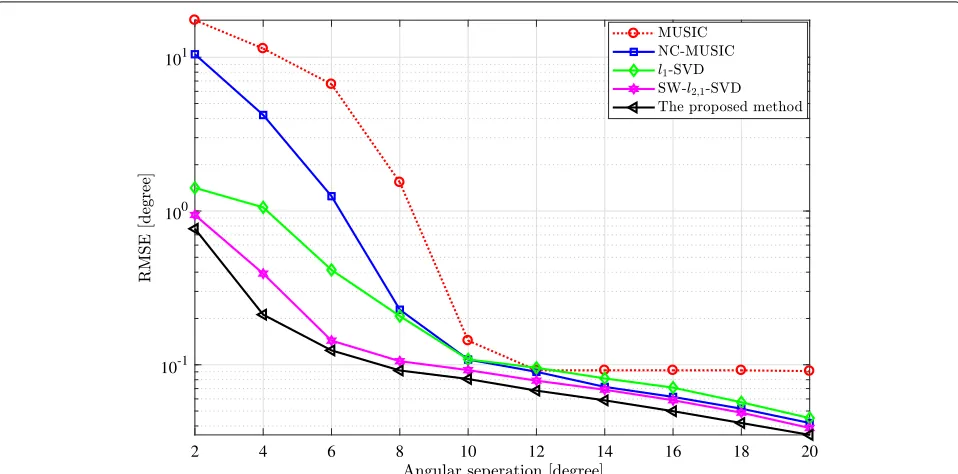
Figure5 depicts the RMSE of DoA estimation perfor-mance as a function of the angular separation between two targets. Two uncorrelated equal power BPSK sources is located atθ1= −10◦andθ1 = −10◦+ θ, whereθ varies from 2 to 20◦. From Fig.5, it is shown that the per-formance of DoA estimation is improved with the angular separation larger compared to MUSIC, NC-MUSIC, l1 -SVD, and SW-l2,1-SVD. For closely space targets, the pro-posed algorithm has the minimum RMSE, which indicates that the proposed algorithm can achieve higher spatial angle resolution than the other algorithms.
-60 -40 -20 0 20 40 60 -120
-100 -80 -60 -40 -20 0
Fig. 2Spatial spectral for NC-MUSIC, NC-l2,1-SVD, and the proposed algorithm
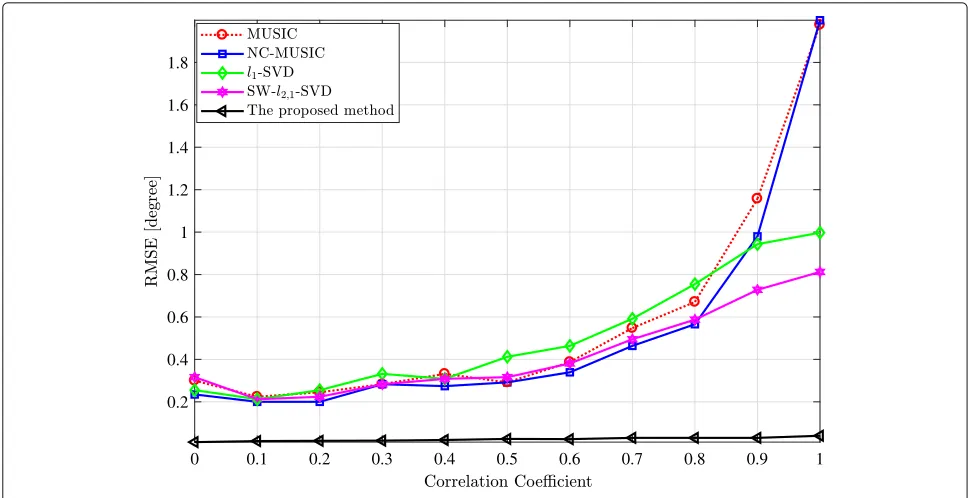
algorithms like the l1-SVD and SW-l2,1-SVD also are affected by correlation coefficient, but the performance of the sparse-based algorithms are better than that of the subspace-based algorithms. As indicated in Fig.6, the pro-posed algorithm have the best estimation performance among all the algorithms. The reason is that the pro-posed algorithm utilizes the spatial-smoothing process to
mitigate the impact of correlated source; in addition, the sparse-based algorithm also is robust to the correlated source.
5 Methods
A weighted subspace mixed-norm minimization DoA estimation algorithm is proposed for strictly non-circular
-10 -8 -6 -4 -2 0 2 4 6 8 10
10-1 100
20 40 60 80 100 120 140 160 180 200 10-1
100
Fig. 4RMSEs of MUSIC, NC-MUSIC,l1−SVD, SW−l2,1−SVD, and the proposed method as a function of the snapshots for SNR=0 dB
signal source. The proposed algorithm employs the non-circular property of signal source to extend the array aperture. Then, the spatial smoothing technique and the unitary transformation are implemented to handle the correlate source and convert the complex value matrix to real-value matrix. Furthermore, reducing the matrix dimension process is employed by SVD. In the end, the
DoA estimation formulated a weighted subspace mix-norm minimization problem. The SOCP is employed to solve the convex optimization problem.
6 Conclusions
A super-resolution SSR-based DoA estimation algorithm was proposed for strictly non-circular sources in this
2 4 6 8 10 12 14 16 18 20
10-1 100 101
Fig. 5RMSEs of MUSIC, NC-MUSIC,l1−SVD, SW−l2,1−SVD, and the proposed method as a function of the angular separation between two
0 0.1 0.2 0.3 0.4 0.5 0.6 0.7 0.8 0.9 1 0.2
0.4 0.6 0.8 1 1.2 1.4 1.6 1.8
Fig. 6RMSE versus the correlation coefficient with the SNR=0 dB,N=100
paper, which is based on weighted subspace mixed-norm minimization. The proposed algorithm increased the degree of array freedom by exploiting the non-circular property of the signal, transformed the array data to real-value domain by utilizing the centro-Hermitian of the augmented matrix, and reduced the dimension of matrix by SVD operation which effectively lower the computa-tional complexity. Last but not the least, we exploited the weighted strategy to enhance the liability of the sparse DoA estimation. The results showed that the proposed algorithm achieved the optimal performance of DoA esti-mation in the angular resolution and estiesti-mation accuracy and can well work in the underdetermined case. In the future, we will incorporate some other wireless communi-cation techniques such as [30–34] to further improve the performance of the 5G mobile communication system.
Abbreviations
5G: Fifth generation; BPSK: binary phase shift keying; CSCG: Circularly symmetric complex Gaussian distribution; DoF: Degree of freedom ; DoA: Direction-of-arrival; ESPRIT: Estimation of signal parameters via rotational invariance technique; MASK: Mary amplitude shift keying; NC-MUSIC: Non-circular multiple signal classification; NC-Root-MUSIC: Polynomial rooting NC-MUSIC; NC-Root-FO-MUSIC: Fourth-order NC-Root-MUSIC;
NC-unitary-ESPRIT: Unitary estimation of ESPRIT for non-circular sources; PAM: Binary pulse amplitude modulated; RMSE: Root-mean-square error; SNR: Signal-to-noise ratio; SSR: Sparse signal recovery; SVD: Singular value decomposition; SOCP: Second-order cone program; ULA: Uniform linear array
Funding
This work was supported in part by the National Natural Science Foundation of China under grants 61671378 and 61801132, the Natural Science Foundation of Guangdong Province of China under grant 2018A030310338, and the Project of Educational Commission of Guangdong Province of China under grant 2017KQNCX155.
Availability of data and materials
Mostly, the writing material was extracted from different journals as presented in the references. A MATLAB tool has been used to simulate the concept.
Authors’ contributions
WT designed the idea, performed the experiments, and wrote the manuscript. XF gave valuable suggestions on the structuring of the paper, XY assisted in processing the data, and LJ assisted in the revising and proofreading of the manuscript. All authors read and approved the final version of the manuscript.
Competing interests
The authors declare that they have no competing interests.
Publisher’s Note
Springer Nature remains neutral with regard to jurisdictional claims in published maps and institutional affiliations.
Author details
1School of Marine Science and Technology, Northwestern Polytechnical
University, 710072 Xi’an, People’s Republic of China.2College of Physics and Electronic Information, Anhui Normal University, 241002 Wuhu, People’s Republic of China.3School of information and communication engineering, Dalian University of Technology, 116024 Dalian, People’s Republic of China.
Received: 23 May 2018 Accepted: 27 August 2018
References
1. Z. Na, Y. Wang, X. Li, J. Xia, et al., Subcarrier allocation based simultaneous wireless information and power transfer algorithm in 5G cooperative OFDM communication systems. Phys. Commun.29, 164–170 (2018) 2. Z. Song, Z. Zhang, X. Liu, et al., Simultaneous cooperative spectrum
sensing and wireless power transfer in multi-antenna cognitive radio. Phys. Commun.29, 78–85 (2018)
3. W. Tan, M. Matthaiou, S. Jin, X. Li, Spectral efficiency of DFT-based processing hybrid architectures in massive MIMO. IEEE Wirel. Commun. Lett.6(5), 586–589 (2017)
5. Y. Dong, C. Dong, W. Liu, H. Chen, G. Zhao, 2-D DOA estimation for L-shaped array with array aperture and snapshots extension techniques. IEEE Signal Process. Lett.24(4), 495–501 (2017)
6. Z. Chen, Y. Ding, S. Ren, et al., A novel noncircular MUSIC algorithm based on the concept of the difference and sum coarray. Sensors.18(2), 344–348 (2018)
7. Y. Wang, M. Trinkle, W. H. Ngo, et al., Efficient DOA estimation of noncircular signals in the presence of multipath propagation. Signal Process.149(1), 14–26 (2018)
8. B. Liu, Q. Zhu, W. Tan, H. Zhu, Congestion-optimal WIFI offloading with user mobility management in smart communications. Wirel. Commun. Mobile Comput.2018, 1–15 (2018).https://doi.org/10.1155/2018/9297536/ 9. P. Gounon, C. Adnet, J. Galy, Localization angulaire de signaux non
circulaires. Traitement du Signal.15(1), 1821–1833 (1998)
10. P. Charge, Y. Wang, J. Saillard, inProc. IEEE ICASSP. A root-MUSIC algorithm for non circular sources, (2001), pp. 2985–2988
11. L. Shen, Z. Liu, X. Gou, Y. Xu, Polynomial-rooting based fourth-order MUSIC for direction-of-arrival estimation of noncircular signals. J. Syst. Eng. Electron.25(6), 942–948 (2014)
12. M. Haardt, F. Römer, inProc. IEEE ICASSP. Enhancements of unitary ESPRIT for non-circular sources, (2004), pp. 101–1044
13. M. Lin, L. L. Cao, J. Ouyang, inProc. IEEE WCSP. DOA estimation using virtual array technique for noncirlular signals, (Hangzhou, 2013), pp. 1–5 14. X. Xu, X. H. Wei, Z. F. Ye, DOA estimation based on sparse signal recovery
utilizing weightedl1-norm penalty. IEEE Signal Proc. Lett.19(3), 155–158 (2012)
15. W. Shi, J. Huang, Q. Zhang, J. Zheng, inProc. IEEE ICSPCC. DOA estimation in monostatic MIMO array based on sparse signal reconstruction, (2016), pp. 1–4
16. W. T. Li, Y. J. Lei, X. W. Shi, DOA estimation of time-modulated linear array based on sparse signal recovery. IEEE Antennas Wirel. Propagat. Lett.16(6), 2336–2340 (2017)
17. D. Malioutov, M. Cetin, A. S. Willsky, A sparse signal reconstruction perspective for source localization with sensor arrays. IEEE Trans. Signal Process.53(8), 3010–3022 (2003)
18. C. Zheng, G. Li, Y. Liu, X. Wang, Subspace weightedl2,1minimization for sparse signal recovery. EURASIP J. Adv. Signal Process.2012(1), 1–11 (2012) 19. C. Zheng, G. Li, X. Wang, Combination of weightedl2,1minimization with
unitary transformation for DOA estimation. Signal Process.93(12), 3430–3434 (2013)
20. X. M. Yang, G. J. Li, Z. Zheng, DOA estimation of noncircular signal based on sparse representation. Wirel. Pers. Commun.82(4), 2363–2375 (2015) 21. J. Steinwandt, F. Roemer, M. Haardt, inProc. IEEE Int. Conf. Acoust. Speech,
Signal Process. (ICASSP). Sparsity-based direction-of-arrival estimation for strictly non-circular sources, (Shanghai, 2016), pp. 3246–3250
22. W. J. Tan, X. Feng, W. Q. Tan, et al, inProc. IEEE ICCT. Direction finding for non-circular sources based on weighted unitary nuclear norm minimization, (2017), pp. 1–5
23. X. Lai, J. Xia, M. Tang, et al., Cache-aided multiuser cognitive relay networks with outdated channel state information. IEEE Access.6, 21879–21887 (2018)
24. X. Lai, W. Zou, D. Xie, X. Li, L. Fan, DF relaying networks with randomly distributed interferers. IEEE Access.5, 18909–18917 (2017)
25. L. Fan, R. Zhao, F.-K. Gong, N. Yang, G. K. Karagiannidis, Secure multiple amplify-and-forward relaying over correlated fading channels. IEEE Trans. Commun.65(7), 2811–2820 (2017)
26. W. Tan, S. Jin, C. K. Wen, J. Tao, Spectral efficiency of multi-user millimeter wave systems under single path with uniform rectangular arrays. EURASIP J. Wirel. Commun. Netw.181, 458–472 (2017)
27. W. Tan, X. Li, D. Xie, W. Tan, L. Fan, S. Jin, On the performance of three-dimensionalantenna arrays in millimetre wave propagation environments. IET Commun.12(14), 1743–50 (2018).
https://doi.org/10.1049/iet-com.2017.1071
28. A. Thakre, M. Haardt, K. Giridhar, Single snapshot spatial smoothing with improved effective array aperture. IEEE Signal Process. Lett.16(6), 505–508 (2009)
29. M. Grant, S. Boyd,CVX: Matlab Software for Disciplined Convex Programming Version 2.1, (2017).http://cvxr.com/cvx/
30. W. Tan, G. Xu, E. D. Carvalho, L. Fan, C. Li, Low cost and high efficiency hybrid architecture massive MIMO systems based on DFT processing. Wirel. Commun. Mob. Comput.2018, 1–11 (2018)
31. J. Yuan, S. Jin, W. Xu, W. Tan, M. Matthaiou, K. K. Wong, User-centric networking for dense C-RANS: high-SNR capacity analysis and antenna selection. IEEE Trans. Commun.65(5), 5067–5080 (2017)
32. M. Zhang, W. Tan, J. Gao, S. Jin, Spectral efficiency and power allocation for mixed-ADC massive MIMO system. China Commun.15(3), 112–127 (2018) 33. W. Tan, J. Xia, D. Xie, L. Fan, S. Jin, Spectral and energy efficiency of
massive MIMO for hybrid architectures based on phase shifters. IEEE Access.6, 11751–11759 (2018)