A Study of Deep Learning Technique and Its
Application in Medical Image Processing
Sumit Nirankari1, Shalini Vashisth2
M.Tech, Department of Computer Science and Engineering, Shri Ram College of Engineering and Management
(Palwal), J. C. Bose University of Science & Technology, YMCA, Faridabad, Haryana, India1
Assistant Professor, Department of Computer Science and Engineering, Shri Ram College of Engineering and
Management(Palwal), J. C. Bose University of Science & Technology, YMCA, Faridabad, Haryana, India.2
ABSTRACT: This paper design to explore the concept of deep learning techniques and its application, deep learning
has drawn more attention in recent years as institutions attempt to tap their student’s full learning potential. To additional fully build up student talents, many campuses are shifting from a traditional passive, instructor- dominated pedagogy to active, learner-cantered activities. Switching these features of human brain to a learning model, the model can deal with the high-dimensional data and support a fast and rational learning algorithm and perform well in the complicated. This paper explore a reviews history on deep learning, summarizing the components of Convolution Neural Networks (CNNs) Restricted Boltzmann performances in different applications. Machines. Together with their learning algorithms and their
KEYWORDS:- machine learning ,deep learning ,medical images, Convolution neural networks
I. INTRODUCTION
Introduction Deep learning is a subfield of machine learning, which aims to learn a hierarchy of features from input data. these days, researchers have intensively investigated deep learning algorithms for solving demanding trouble in many areas for example image categorization, speech recognition, signal processing, and natural language processing Convolution neural networks by means of lots of layers have newly been shown to achieve excellent results on numerous high-level tasks such as image organization, object detection and more recently also semantic segmentation. above all for semantic segmentation, a two stage modus operandi is repeatedly employed. Hereby, convolution networks are trained to make available good local pixel-wise features for the second step life form conventionally a supplementary global graphical model.
II. EEP LEARNING METHODS
III. LITERATURE REVIEW
Deng, Li, Gong [1] survey describe that deep learning is becoming a mainstream technology for speech recognition at
industrial scale. In this paper, we provide an overview of the work by Microsoft speech researchers since 2009 in this area focusing on more recent advances which shed light to the basic capabilities and limitations of the current deep learning technology. We organize this view along with feature-domain and model-domain dimensions according to the conventional approach to analyzing speech systems. Selected experiments results, including speech recognition and related applications such as spoken dialogue and language modelling are presented to demonstrate and analyze the strengths and weakness of the techniques described in the paper.
Deng, Platt[2]: survey presents that deep learning systems have dramatically improved the accuracy of speech
recognition and various deep architectures and learning techniques have been developed with distinct strengths and weaknesses in recent years. How can ensemble learning be applied to the various deep learning systems to achieve greater recognition accuracy is the focus of this paper. We develop and report linear stacking methods for ensembling learning with applications specifically to speech-class and long-linear stacking methods for ensemble learning with applications connected deep neural networks.
Gravier, Garg[3,10]:survey presents Visual speech information from the speaker‟s moth region has been successfully
shown to improve noise robustness of automatic speech recognizers , thus promising to expand their usability into the uman computer interface. In this paper, we review the main components of audio-visual automatic speech recognition and present novel contributions in two main areas: first, the visual front end design and later, we discuss new work on features and design fusion combination , the modeling of audio-visual speech asynchrony and incorporating modality reliability estimates to the bimodal recognition process
Das[4]: presents a brief survey on speech is the primary and the most convenient means of communication between
people. The communication among human computer interaction is called human computer interface. Speech has potential of being important mode of interaction with computer. This paper gives an overview of major technological perspective and appreciation of the fundamental progress of speech recognition and also gives overview technique developed in each stage of speech recognition. This paper helps in choosing the technique along with their relative merits and demerits. A comparative study of different techniques is done. This paper concludes with the decision on feature direction for developing technique in human computer interface system in different mother tongue and it also gives the various technique used in each step of a speech recognition process and attempts to analyze an approach for designing an efficient system for speech recognition . The objective of this review paper is to summarize and compare different speech recognition systems and identify research topics and applications where are at the front end of this exciting and challenging field. Dhameliya
Desai [7,8]: survey presents speech is the most natural form of human communication and speech processing has been
one of the most inspiring expanses of signal processing . Speech recognition is the process of automatically recognizing the spoken words of person based on information in speech signal. Automatic Speech Recognition(ASR) system takes a human speech utterances as an input and requires a string of words as output. This paper introduces a brief survey on Automatic Speech Recognition and discusses the major subjects and improvements made in the past 60 years of research , that provides technological outlook and a respect of fundamental achievement that have been accomplished in the important areas of speech recognition. Definition of various types of speech classes , feature extraction techniques, speech classifiers and performance evaluation are issues that require attention in designing of speech recognition system. The objective of this review paper is to summarize some of the well-known methods used in several stages of speech recognition system.
Gaikwad, Gawali and Yannawar [6,9] : The speech is most prominent and primary mode of communication among
perspective and appreciation of fundamental progress of speech recognition and also gives an overview technique developed in each stage of speech recognition. This paper helps in choosing the technique along with their merits and demerits. A comparative study of different techniques is done. This paper concludes with the decision on feature direction for developing technique in human computer interface system in Marathi language. Therese,
Lingam [5, 11]: Says that speech has evolved as a primary form of communication between humans. The advent of
digital technology gave us highly versatile digital processors with high speed, low cost and high power, which enable researchers to transform the analog speech signals into digital speech signals that can be significantly studied. Achieving higher recognition accuracy, low word error rate and addressing the issue of resources of variability are the major consideration for developing an effective automatic Speech Recognition System. . In speech recognition, feature extraction requires much attention because recognition performance depends heavily on this phase. In this paper, an effort has been made to highlight the progress made so far in the feature extraction phase of spec recognition system and an overview of technological perspective of Automatic Speech Recognition System is discussed.
IV. DEEP CONVOLUTIONAL NEURAL NETWORKS
Deep Convolution Neural Networks are productively applied in an assortment of areas. Regression, Classification, dimensionality reduction, modelling motion, modelling textures, information retrieval, natural language processing, robotics, fault diagnosis, and road crack detection.
A-DEEP LEARNING ALGORITHMS
Deep learning algorithms have been at length studied in recent years. As an outcome there are a large number of related approaches. normally exclamation these algorithms can be grouped into two category based on their architectures: 1. Restricted Boltzmann Machines (RBMS).
2. Convolution Neural Networks (CNNS).
1. RESTRICTED BOLTZMANN MACHINES (RBMS).
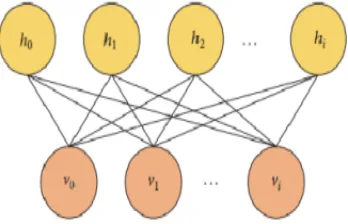
RBM is an energy-based probabilistic: generative model. This model composed of one layer of observable units and one layer of hidden units. The observable units correspond to the input vector of a data sample and the hidden units correspond to features that are abstracted from the visible units. each noticeable unit is connected to each and every hidden unit, while no association exists within the visible layer or hidden layer. Figure 1 illustrate the graphical model of limited Boltzmann machine
2-CONVOLUTIONAL NEURAL NETWORK. (CNNS).: Throughout the preceding seven years, the superiority of
image classification and object detection has been spectacularly improved due to the deep learning method. Convolution neural networks (CNNs) brought a revolution in the computer vision area. It not simply have been continuously advance the image classification accuracy , but this will also play an important role for generic feature extraction process such as scene classification, object detection, semantic segmentation, image retrieval, and image
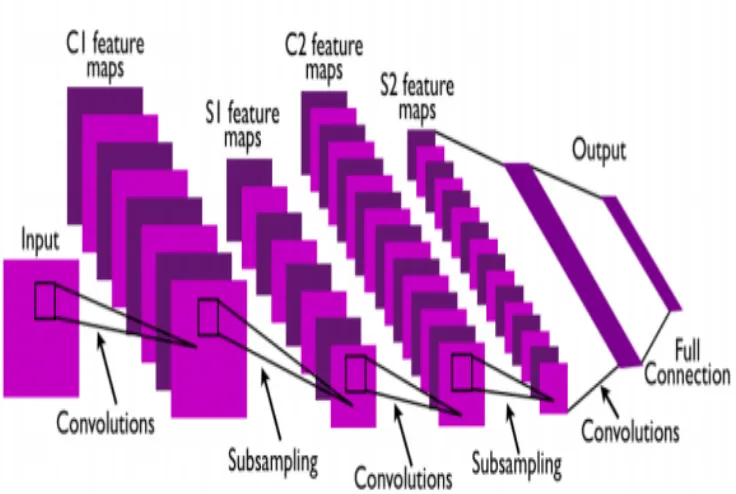
Caption. Convolution neural network (CNNs) is one of the most controlling classes of deep neural networks in image processing tasks. It is highly effective and frequently used in computer vision applications. The convolution neural network contains three types of layers define such as convolution layers, sub sampling layers, and full connection layers. The complete structural design of the convolution neural network is shown in Figure 2. A short foreword to every type of layer is provided in the following paragraphs.
A-CONVOLUTION LAYER. As Figure 3 shows, in convolution layer, the left matrix is the input, which is a digital
image, and the right matrix is a convolution matrix. The convolution layer takes the convolution of the input image with the convolution matrix and generates the output image.
B- SUBSAMPLING LAYER The sub sampling layer is an significant layer to the convolution neural network. This
layer is mostly to diminish the input image size in direct to give the neural network supplementary invariance and robustness. The for the most part used method for sub sampling layer in image processing tasks is max pooling. So the sub sampling layer is frequently called max pooling layer. The max pooling method is shown in Figure 5. The image is divided into blocks and the maximum value of each block is the corresponding pixel value of the output image. The cause to use sub sampling layer is as follows. First, the sub sampling layer has smaller amount parameters and it is faster to train. Second, a sub sampling layer makes convolution layer endure translation and rotation in the middle of the input pattern.
C-FULL CONNECTION LAYER.
Full connection layers are comparable to the traditional feed-forward neural layer. They build the neural network fed forward into vectors by means of a predefined length. We could fit the vector into convinced categories or obtain it as a depiction vector for additional processing
V.APPLICATIONS
Deep learning has been extensively applied in a range of fields, such as computer vision, signal processing, and speech recognition.
CNN-Based Applications in Visual Computing. CNN for Face Recognition.
VI. CONCLUSION
This paper represent an general idea of deep learning algorithms and their applications. Several classic deep learning algorithms such as classified Boltzmann machines and convolution neural networks are introduced. In adding up to deep learning algorithms, their applications are reviewed and compared by means of other machine learning methods. although deep neural networks achieve good performance on many tasks
VII. FUTURE SCOPE
The deep learning represents a more rational behaviour(learning features) compared with the other traditional machine learning. Architectures and the related learning algorithms are the two main components of deep learning. From the analysis above, we know that deep architectures like CNNs and RBMSs perform well in many tasks.
REFERENCES
1. D. Yu and L. Deng, “Deep learning and its applications to signal and information processing,” IEEE Signal Processing Magazine, vol. 28, no. 1, pp. 145–154, 2011
2. Deng, Platt Li Xavier Glorot, Antoine Bordes Domain Adaptation for Large-Scale Sentiment Classi_cation:A Deep Learning Approach vol. 15 no. 1, pp. 132–136, 2011
3. Gravier, Garg[ Dandan Mo, L. Stochastic gradient learning in neural networks: A survey on deep learning: one small step toward AI vol. 28, no. 4 , pp. 130–134, 2012.
4. Das, Thomas F. Nelson Laird et al. : Measuring Deep Approaches to Learning Using the National Survey of Student Engagement, vol. 10no. 1, pp. 112–118 2013
5. Lingam, A. University of Birmingham, Edgbaston,Birmingham, UK : Formative assessment: a key to deep learning? , vol. 7 no. 1, pp. 198– 105, 2010
6. Gaikwad, Gawali and Yannawar Ciresan, D. C., Meier, U., Gambardella, L. M., and Schmidhuber, J. Deep big simple neural nets excel on handwritten digit recognition. CoRR, vol.14, no. 1, pp. 141–147, 2012
7. Krishna Kant Singh , Akansha Singh,“A Study Of Image Segmentation Algorithms For Different Types Of Images”, IJCSI International Journal of Computer Science Issues, Vol. 7, Issue 5,September 2018
8. Qurat-Ul-Ain, L.G., Kaz mi, S.B., Jaffar, M.A ., Mirza, A.M.: ‘ Classifi cation andsegment ation of brain tumor using texture analysis’ , Recent Adv. Artif. Intell.Knowl. Eng. Data Bases, 10, pp. 147 –155,2015
9. Khalid, N.E.A., Ibrahim, S., Haniff, P.N.M.M.: ‘MRI brain abnormalitiessegmentation using K-nearest neighbors (k-NN) ’, Int. J. Comput. Sci. Eng.(IJCSE), , 3, (2), pp. 980 –990,2011
10. Aslam, H.A., Ramashri, T., Ahsan, M.I.A.: ‘A new approach to imagesegmentation for brain tumor detection using pillar K-means algorithm ’,Int. J. Adv. Res. Comput. Commun. Eng., , 2, (3), pp. 1429 –1436, 2013
11. Maity, A., Pruitt, A.A., Judy, K.D.: ‘Automated MS-lesion segmentation by K-nearest neighbor classification’, Midas J. MS Lesion Segmentation (MICCAI2008 Workshop)Cancer of the central nervous system’ (Clinical Oncology, 2008, 4th edn.)