Cloud-Based Mobicontext Hybrid
Framework
Sowmya M1, Shivakumari2, Ranjana V3
B.E. Student, Dept. of ISE, Rao Bahadur Y Mahabaleshwarappa Engineering College, Bellary, Karnataka, India1 B.E. Student, Dept. of ISE, Rao Bahadur Y Mahabaleshwarappa Engineering College, Bellary, Karnataka, India2 Assistant Professor, Dept. of ISE, Rao Bahadur Y Mahabaleshwarappa Engineering College, Bellary, Karnataka, India3
ABSTRACT: In recent years, recommendation systems have seen significant evolution in the field of knowledge engineering. Most of the existing recommendation systems based their models on collaborative filtering approaches that make them simple to implement. However performance of most of the existing collaborative filtering-based recommendation system suffers due to the challenges such as: (a) cold start, (b) data sparseness, and (c) scalability. In this paper we proposed Mobicontext, a hybrid cloud-based Bi-Objective Recommendation Framework (BORF) for mobile social networks. The mobicontext utilizes multi-objective optimization techniques to generate personalized recommendations. To address the issues pertaining to cold start and data sparseness, the BORF performs data pre-processing by using the Hub-Average (HA) inference model. Moreover, the Weighted Sum Approach (WSA) is implemented for scalar optimization and an evolutionary algorithm (NSGA-II) is applied for vector optimization.
KEYWORDS: Multi-objective optimization, collaborative filtering (CF), Non-dominated Sorting Genetic Algorithm (NSGA-II).
I. INTRODUCTION
The ongoing rapid expansion of the Internet and easy availability of numerous e-commerce and social networks services, such as Amazon, Foursquare, and Gowalla, have resulted in the sheer volume of data collected by the service providers on daily basis. The continuous accumulation of massive volumes of data has shifted the focus of research community from the basic information retrieval problem to the filtering of pertinent information [1], 1 thereby making it more relevant and personalized to user’s query. Therefore, most research is directed towards the designing of more intelligent and autonomous information retrieval systems, known as Recommendation systems.
II. RELATED WORK
In the past, most work focused on trajectory-based approaches for venue recommendation systems. The trajectory based approaches record information about a user’s visit pattern to various locations, the routes taken, and dwell times. A major drawback of such approaches is that they are unable to simultaneously consider other influential factors apart from simple GPS trace that makes them produce less optimal recommendations. To address such deficiency, we utilized multi-objective optimization in our proposed framework. The authors performed a weighted combination of numerous recommendation algorithms and applied optimization to find appropriate weights for the constituent algorithms. To address the issues like cold start, scalability and data sparseness we proposed a hybrid approach over a cloud architecture that combines the benefits of memory-based and model-based collaborative filtering along with multi-objective optimization to obtain an optimal list of venues to be recommended. Moreover, our proposed framework presents a solution for scalability, data sparseness, and cold start issues.
III. SCOPE OF RESEARCH
attraction of a large number of subscribers. It allows user to perform a “check-in” that is a small feedback about the place visited by the user [1], [2], [4]. Venue-based Recommendation systems (VRS) systems were developed to perform recommendation of venues to users. A major research challenge for such systems is to process data at the real-time and extract preferred venues from a massively huge and diverse dataset of user’s historical check-ins. In scientific literature, several works, have applied collaborative filtering (CF) to the recommendation problems in VRS.
In summary, the contributions of the work are as follow:
We propose a cloud-based framework consisting of bi-objective optimization methods named as CF-BORF and greedy-BORF.
We introduce a pre-processing phase that performs data refinement using HA.
We perform extensive experiments on our internal Open Nebula cloud setup running
On 96 cores super micro Super Server SYS-7047GR-TRF systems. The experiments were conducted on real-world “Gowalla” dataset.
IV. PROPOSED SYSTEM AND DISCUSSION
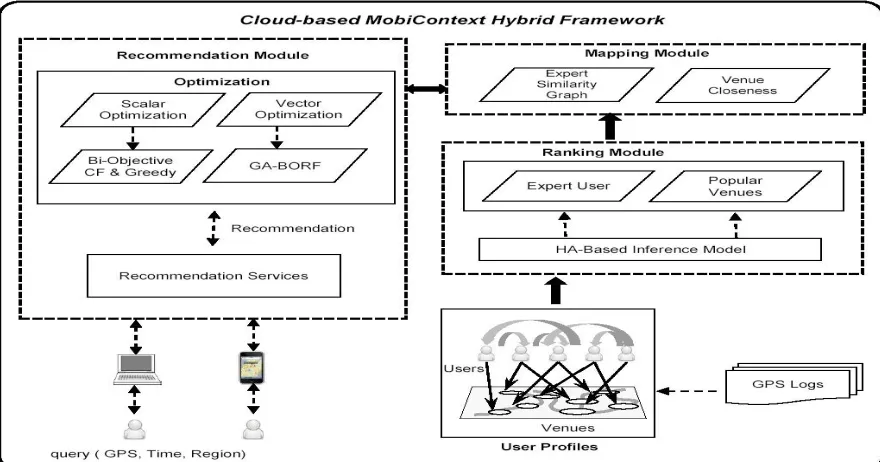
We propose a cloud-based framework consisting of bi-objective optimization methods named as CF-BORF and greedy-BORF. The genetic algorithm based BORF (GA-BORF) utilizes Non-dominated sorting genetic algorithm (NSGA-II) to optimize the venue recommendation problem. We introduce a pre-processing phase that performs data refinement using HA. We perform extensive experiments on our internal Open Nebula cloud setup running on 96 core Super micro Super Server SYS-7047GR-TRF systems. The experiments were conducted on real-world “Gowalla” dataset.
The Following are the modules:
User profiles: The mobicontext framework maintains records of user’s profiles for each geographical region.
Ranking module: The ranking module performs functionality during the pre-processing phase of data refinement. The pre-processing can be performed in the form of periodic batch jobs.
Mapping module: The mapping module computes similarity graphs among expert users for a given region during pre-processing phase.
V. EXPERIMENTAL RESULTS
We utilized “Gowalla” dataset consists of 6,442,890 check-ins performed by 150,734 users in total number of 1,280,969 venues. We used a standard 5-fold cross validation technique for evaluating the accuracy rate of the framework. We utilized the three standard performance evaluations metric to evaluate the proposed recommendation frameworks: (a) precision, (b) recall, and (c) F-measure.
Precision is given as: precision=tp/tp+fp
Recall is represented as: Recall=tp/tp+fn
F-measure is denoted as: F-measure=2*Precision*Recall/Precision+Recall
(a)
(c)
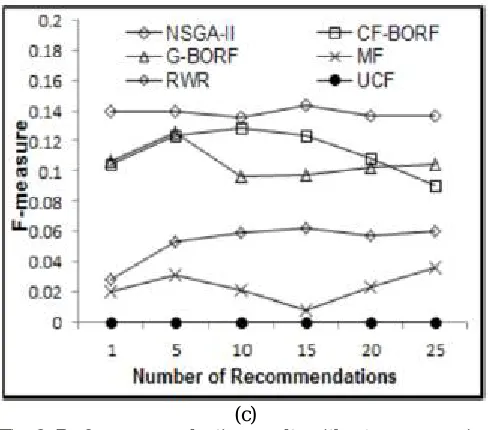
Fig. 2: Performance evaluation results without pre-processing
The above figure presents the precision, recall and f-measure results without incorporating the pre-processing phase. The tradeoff between precision and recall is depicted in fig. 2(b). Compared to other schemes, the GA-BORF indicates better performance in terms of the F-measure as presented in fig. 2(c).
(b)
(c)
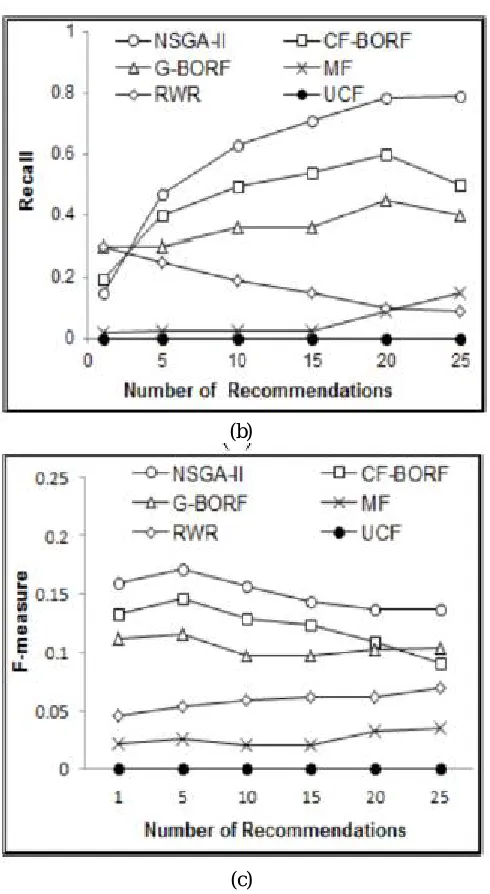
Fig. 3: Performance evaluation results with pre-processing
(a)
(c)
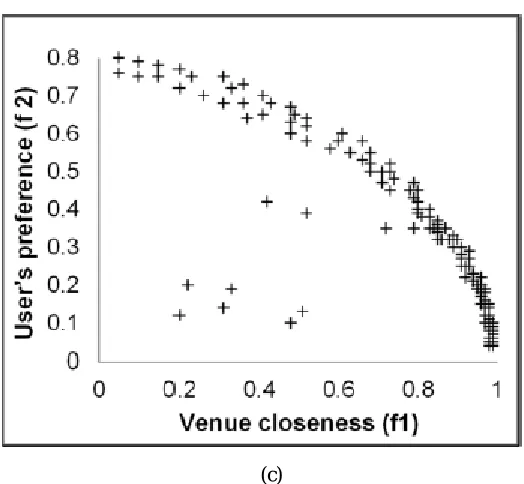
Fig. 4: Multi-objective Performance measure for NSGA-II
The above figures present the impact of user’s preferences and venue closeness on the recommendations. Fig (a) with the generation size of 5, the solutions are not converging. Fig (b) with generation size of 100, the solutions appear to converge slightly. Fig (c) with generation size of 200, the solution shows maximum convergence with improved solution quality.
Small generation size doesn’t yield good recommendations.
VI. CONCLUSION
We proposed a cloud-based framework Mobicontext that produces optimized recommendations by simultaneously considering the trade-offs among real-world physical factors, such as person’s geographical location and location closeness. In our proposed approach, data sparseness issue is addressed by integrating the user-to-user similarity computation with confidence measure that quantifies the amount of similar interest indicated by the two users in the venues commonly visited by both of them. Moreover, a solution to cold start issue is discussed by introducing the HA inference model that assigns ranking to the users and has a precompiled set of popular unvisited venues that can be recommended to the new user.
VII. ACKNOWLEDEMENT
We hereby, would like to thank our guide Asst Prof Ranjana V and as well as our parents for supporting in helping us to produce this research paper.
REFERENCES
[1] P. G. Campos, F. Diez, I. Cantador,”Time-aware Recommender Systems: A Comprehensive Survey and Analysis of Existing Evaluation Protocols, ”User Modeling and User-Adapted Interaction, vol.24, no.1-2, pp.67-119,2014.
[2] B. Hidasi, and D. Tikk, “Initializing Matrix Factorization Methods on Implicit Feedback Database, “Journal of Universal Computer Science, vol.19, no.12, pp.1835-1853, 2013.
[3] C. Chitra and P. Subbaraj, “A Non-dominated Sorting Genetic Algorithm for Shortest Path Routing Problem in Computer Networks ”Expert Systems with Applications,vol.39,no. 1, pp.1518-1525,2012.
[4]J. Bobadilla, F. Ortega, A. Hernando, A. Gutierrez, ”Recommender Systems Survey”, Knowledge-Based Systems,vol.46,pp.109-132,2013. [5]J. Abimbola,” A Non-linear Weights Selection in Weighted Sum for Convex Multi-Objective Optimization, ”Mathematics and Information, vol.27, no.3, 2012.
BIOGRAPHY
Sowmya M pursuing her B.E. in Information Science & Engineering From RYM Engineering College Bellary, Karnataka at Visveshvaraya Technological University Belgaum. Hobbies include playing indoor games, interested in doing Technical works, dancing, and interested in doing any arts.