Energy Efficient A-Leach Routing Protocol
Bhushan Sharma1, Harish Kumar Saini2, Avinash Bansal3
M.Tech Student, Department of CSE, Guru Nanak Institute of Technology (Kurukshetra University), Mullana
(Ambala), India
Associate Professor, Department of CSE, Guru Nanak Institute of Technology (Kurukshetra University), Mullana
(Ambala), India
Asst. Professor, Department of CSE, Guru Nanak Institute of Technology (Kurukshetra University), Mullana (Ambala),
India
ABSTRACT: Leach was the first most Routing Protocol used clustering concept in wireless sensor networks. Leach algorithmre-clustering process play vital role to gather data in cycles known as round. During each round a specific percentage of total nodes are elected as cluster heads (CHs). Each node get chance to become CH according to their probability in particular round. It is possible that not a single node is selected as CHs and few of nodes have to act as forced CH by ignoring residual energy, nodes location, and other significant parameter, which is the main reason for CH failure. Therefore to overcome this limitation Energy Efficient A-Leach Routing protocol is proposed which uses the forward/backward multi hop path approaches to increase the lifetime of WSNs and allow CHs to transmit their gathered data to Base Station (BS).
KEYWORDS: Leach, Ant-Leach(A-Leach), Base Station(BS), Cluster Head(CH),Ant Colony Optimization( ACO),Genetic Algorithm( GA), Gravitational Search Algorithm(GSA), Wireless Sensor Network(WSN).
I.INTRODUCTION
Wireless communication is based on the development of low-power, low-cost, multifunctional and very small nodes. These nodes are responsible for Sensing, data processing and communicating. The Sensor nodes are scattered in one area which sense the surrounding environment and collect the information from the surrounding environment and communicate through wireless links. The collection of Sensor nodes is known as wireless Sensor networks [1] [2]. The basic goals of Wireless Sensor Networks (WSNs) are:
Gathering the information of surrounding environment like temperature of storage room.
Count how many times temperature fall below 30 degree.
Estimate parameters of the detected event.
Classify detected object with other object.
Sensor nodes are those sensors which are responsible for gathering information by sensing and routing and then sending this information back to sink or BS. In WSNs nodes are connected to each other by direct or indirect links. Sensors provide information gathering ability from the physical world by converting physical phenomena to electrical signals. It is made up of two sub components: Sensors and simple to advance converters(ADCs). There are two types of sensors: Simple sensor and computerized sensor. Also there exist mix type of sensor that measure ecological parameters, such as temperature, light intensity, applied force, sound location, and type of object. The WSNs provide better understanding of the environment [3].
II. RELATED WORK
S. Aravindh. et.al (2012) proposed a combined hybrid algorithm approach is proposed in which ACO and GA
U. Hari et.al (2013) proposed approach is to minimize the energy consumption of network by using multi-hop routing process with using Dijkstra's shortest path algorithm is used for data transmission. Proposed algorithm use unequal size cluster concept with parameters like distance between nodes and base station , degree of nodesand results shows it improve networks life time and performance matrix.
N.K. Sharad et.al (2013) proposed a comparison paper on ACO, GA and SA approach by solving travelling salesmen problem. ACO gives better result in dynamic scenarios only for local optimization. With increases in number of iteration GA will provide better Energy Efficient Routing Protocol for Wireless Sensor Networksolutions and provide global solution. SA algorithm consume more computation time.This paper concludes that GA gives over all better result than ACO and SA.
S. Haidar. et.al (2014) proposed highly conserved to extend the WSNs lifetime. One method is to deploy the multiple sinks, which are more capable nodes in comparison to sensors. These increased the area coverage and reduce the communication distance between sensors and sinks.
III. ROUTING PROTOCOL FOR WSNs
Wireless sensor networks, is a self-establishing multi-hop wireless network, which works as a decentralized system and it does not pose fixed infrastructures. Conventional routing protocols do not compatible with at present WSN requirements: Sensors have low battery power, limited memory. The routing tables raise up with the network size and don’t support diffusion communication. This is the main reasons to build more an energy efficient routing protocol for WSNs. [4] [5]
Characteristics of Routing Protocols
It should be specific to the application.
It should be data centric.
It should be capable to perform data aggregation function.
It must optimally use network resources such as bandwidth, computation power, and battery power etc.
It should be capable of providing certain level of QoS as application demanded bynetwork.
End to end delay must be less.
The number of packets collisions should be minimum.
III. CLASSIFICATION OF ROUTING PROTOCOLS
A WSNs might be classified in four ways, routing path establishment, network structure, protocol operation based,initiator of communication and application design of network [7][10]. As shown in table
Network Structure Protocol Operation
1. Flat Based 2. Hierarchical Based 3. Location Based
1. Negotiation Based 2. Query Based 3. Multipath Based
4. QoS Based 5. Coherent Based
Table 1: Classification of Routing Protocol
Proactive protocol: It evaluates all the possible routes before they are essentiallyneeded them and store these route information in a routing table. Routing tablesstore in nodes memory unit. When a route changes, its information has to bepropagated throughout the network and time to time sensor nodes required to updatetheirrouting table. WSN consist of thousands of nodes, it’s very difficult for nodesto maintain huge amount of routing information due to limited memory therefore proactive routing protocols are not well suit to WSN. Proactive protocolsalso called table driven routing protocols.
Reactive protocols:Protocols that falls under this type of category also called ondemandrouting protocols, because they only compute routes when it is required. Thistype of routing protocols do not exchange routes information periodically.
Location Based Protocol:This protocol find the location of the sensor nodes depending upon the incoming signal strengths from source nodes. It generally track the location of nodes by using location of neighbor node and other is through GPS.
Hierarchical Protocols:The main design concern for any WSN is scalability.Thousands of sensor nodes are present in the network. Sensor are not enough capableto communicate over large distance. To overcome this issue hierarchical approach issued. Hierarchical routing works in two layers, first one is used for clustering and otherlayer used for routing. The nodes having low energy is used for sensing activity and high energy are used for processing and sending information to other nodes. It increases the network life time, energy efficiency,delay etc.
Flat-based Protocols:No global identification number assign to nodes due to lessnumber of nodes present in network field. Every node plays same type of role. This protocol is also called data centric routing, the sink node transmits queries packet to certain regions and wait for reply.
Coherent Protocols:The local data handling on the nodes can be differentiate betweenthe coherent (minimum processing) and the non-coherent (full processing) routingprotocols. The data is forwarded to sink node after minimum processing like timestamping, duplicate suppression etc. when all source nodes sends their data to sink at the same time, large amount of energy consumed. To overcome this problem limitednumber of source nodes sends data to sink node.
Multipath based Protocols: It uses multiple paths rather than single path for improvingthe WSN performance. For example the fault tolerance can be improved by maintainingmultiple paths between the source and sink. It increases the cost of energy consumptionand generates more traffic. The alternate paths are kept alive by sending periodicsignals.
Negotiation-based routing: It is used for eliminating the redundant data transmission. This consumed more energy, battery power, communication power, memory etc. To overcome this problem negotiation based routing protocol is used, Sink or next node sends a negotiation messages before transmission begins.
Query based protocols:The destination Sensors nodes propagate the query for data from a node through the network. A node having same data sends back reply messageto the initiate’s node. This sort of query used natural language and high level querylanguage.
QoS-based protocols:When the process of data transmission performed with the helpof this routing, it balances the networks energy consumption and data quality throughcertain level of QoS metrics such as delay time, energy used or the bandwidth.
IV. REVIEW OF LITERATURE
In WSNs, sensors nodes are organized into clusters. Each cluster is handled by cluster head. The nodes of each cluster transmit their information with respect to their cluster head and these CHs transmit information to a base station or Sink by using two hops count distance. BS acts as back bone connected to a wired network.
LEACH
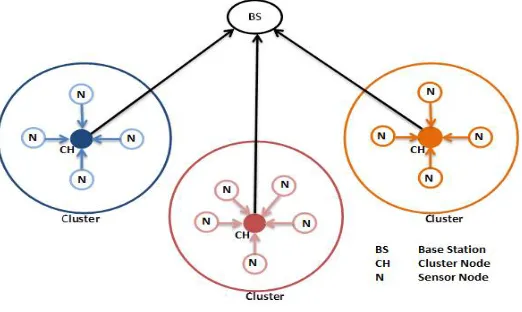
In this paper the main focus is on the hierarchical protocol LEACH. [6] [7]. Clustering is a type of energy-efficient communication protocol that can be used by the nodes to report sensed data to the sink. We have described layered protocols in which anetwork is composed of several clusters of sensors as shown in figure4.1, different clusters are shown having different Cluster Head (CH) and Base station (BS). CH is responsible for organizing the data transmission events of all non CH nodes in its cluster. Nodes are arranged into a cluster with a cluster head that is responsible for routing from the cluster to the other cluster heads or to base stations. Data travels from a lower clustered layer to a BS. While, it hops from one node to another nodes but as it hops from one layer to another and cover larger distances. It helps to move the data information faster to the base station. Clustering provides inherent optimization capabilities at the cluster heads [7].
The design goal performed by Leach are:
The Randomized rotation of cluster heads nodes selection and the corresponding clusters.
The Global communication reduction by the use of local compression.
The Localized co-ordination and control for cluster configure and operation.
Lower energy media access control.
Application-specific data processing task
The Leach process is categorized into number of rounds and each of these rounds havemainly two different phases and these are known as:
Setup phase
• All the nodes are deployed randomly in the area
• Evaluated the nodes probability to become a cluster head by using
( ) = 1− ( )
0 ℎ
Where p is probability, r is number of round,G is set of nodes that have not beenCHs in the last 1/p rounds. • The Advertisement of the cluster heads to its different individual cluster nodes.
• Transmission of the schedules plan that has been created during the setup phase. Steady state
• The process of data aggregation within the separate clusters in the network.
• Compression of the sensed information that is sensed by the non-cluster headnode into its different cluster head within the cluster range.
• Transmission of the aggregated data to the base station through all electedcluster heads
Fig. 1: Leach Protocol Advantages of LEACH Protocol:
Scalability of the WSNs is easy
Single-hop Routing is possible from Sender node to cluster head for transmitting information.
Role of CH can be distributed to other CH if required.
Doesn’t require the information of sensor node to create new cluster.
Suitable for the application that needs constant monitoring of environment. Disadvantages of LEACH Protocol:
Relies on CH andCHs are not uniformly distributed.
Require high range of transmission power in the network.
Energy consumption is not considered.
Doesn’t work well with application that requires large area of coverage network.
Ant Colony Optimization [16]: ACO algorithm in which sensor nodes act like artificial ants, opt their basic featureslike forward and backward path construction, pheromone values evaporation rate toevaluate the fitness function of node by using three functions self-adaption, co-operationand competition. After number of iterations a single optimized path is constructed.
Genetic Algorithm
In GA nodes initialize as pollution by opting genetic behaviour, best fitness functionresult is considered as best pollution, to calculate fitness value three steps (crossover,mutation, selection) are repeated for particular number of generations to find localsolution. It is best in case when we have two options for a solution.
Basic terminology used in Genetic Algorithm
Chromosome: It is a set of genes that contains the solution in the form of genes.For e.g. 98150 is a chromosome value then 9,8,1,5 and 0 are its genes.
Population: The total number of individuals or chromosome with same number ofgenes.
Fitness: It is a value that assigned to an individual based on readiness of anindividual to provide solution. Greater the fitness value, more appropriate solutionwill obtained.
Fitness function: It is an application oriented objective function which assignsfitness value to the individual.
Crossover: Taking two fit individuals and then performs intermingling process togenerate new two
individuals.
Mutation: It is a process of changing random genes in an individual value.
Selection: The process of selecting individual to generate the new generation.
Gravitational Search Algorithm
GSA is a physical phenomenal based upon Law of Gravity and Law of Motion to findglobal optimized solution. Working of ACO and GSA is somewhat similar butcomputation functions are totally different. ACO selects one best solution among twodifferent entities whereas GSA provides all over one best solution among population.The Gravitational Search Algorithm considered as an isolated system for small artificial world of masses which obeying the Newton Law of gravitation and motion.
Law of gravity
It state that each particle attracts every other particle and the gravitational forcebetween two particles is directly proportional to the product of their masses andinversely proportional to the distance between them [11]
=
G is the gravitational constant, 1 and 2 mass of two particles and R is the distancebetween these two particles
Law of motion:
The current velocity of mass is equal to the sum of the fraction of its previous velocityand the variation in the velocity. Variation in the velocity or acceleration of any mass isequal to the force acted on the system divided by mass of inertia [11]. An accelerationis depend on force and its massEnergy Efficient Routing Protocol for Wireless Sensor Network
=
F is force applied on an object, M is the mass, a is the acceleration
Fitness function computed from following equation
= ( ) ( )( )∗ ( ) ( )− ( )
Best fitness function computed as follow Minimization Problems
( )= ( ) (1 … … … )
( ) = ( ) (1 … … … )
Maximization problems
( ) = ( ) (1 … … … )
( ) = ( ) (1 … … … )
( )represents the fitness values of the agent at iteration t, best(t) and worst(t)represents the best and worst fitness at iteration t.
Computation of Gravitational constant (G) ( )=
∝
and are initialized at the starting, T is the total number of iterations.
Compute Masses of the agents
( ) = ( )− ( )
( )− ( )
( ) =∑ ( )
( )
Compute Accelerations of agents
( ) = ( ) ( )
Acceleration of the agents at iteration t
( ) = ( )
,
is the total force acting on agents. Kbest is set of first K agents values with thebest fitness value and biggest mass.
Energy consumption model
WSN use an energy attenuation model depending on the distance value between twonodes (Sender and Receiver). The transmitter transmits k bits data to another node, d isthe meter distance between two nodes.
The energy consumption calculation formula
( , ) = + <
+ ≥
( ) =
( ) =
is multi path length energy value for transmission data , is for fixed path lengthenergy value for transmission, is the energy consumption used to compressed dataunit. is transmission energy of sender, is received energy of the receiver, isthe critical distance between two nodes.
V. RESEARCH METHODOLOGY
In pervious works firstly cluster heads selected randomly then a probability parameter isused to select cluster heads. In proposed work cluster heads are select with the help ofGA process which give us more appropriate value of node to become a cluster head. There is one issue in Leach protocol when no node get chance to become a cluster head [21]. GA approach also removes no cluster head formation issue. The major characteristics are:
GA use probabilistic transition rules rather than non-deterministic rules.
GA use application oriented objective functions rather than not derivatives or otherprevious knowledge.
GA sets parameter according to application rather than using predefined parameters.
We also try to bind limited range edge node with the GSA approach the major characteristics are following
GSA proved us one best solution by evaluating overall force obtained by all particlesrather than selecting best one from two particles.
GSA consumes less memory as compare to others.
Most of an optimization algorithms works on social behaviours while GSA inspiredby a physical phenomenon of forces
Our proposed Methodology is divided in two parts setup phase and steady phase:
Fig.2: Proposed model of Wireless Sensor Networks • BS is Base Station
• Four CH is selected Cluster Head in different clusters
• RZ either a node which is not in the range or not registered under any cluster Setup phase
Sensor nodes and base station are deployed in the sensor field.
Invitational parameters are provided to sensor nodes so that they can start working.
Cluster head is selected with the help of GA and sends the information about clusterto the base station. The information from base station is sent back to all nodes sothat they can select their cluster heads.
If any node is found out off range (RON) and not able to register itself under anycluster head then the gravitational search approach is used to find the path. WhenRON finds next hop it will automatically bind with cluster head by using the multihopconcept.
After step up phase complication we establish a cluster head link with base stationand base station also have information about all node id’s and their respective clusterheads.
Steady Phase
VI. RESULTS AND DISCUSSIONS
The proposed routing protocol is simulated using MATLAB tool. Experiments areperformed on simulations with different numbers of sensor nodes uniformly distributedin a 100 m×100 m. Base station is located at position [75,100].
Max_Round No of Max Round 99999
ctrPacket_L Length of packet that sent for nodes to CH 200 bits
Packet_L Length of Packet that Sent for CH to BS 6400 bits
Initial energy of each node 0.5 nJ
Energy for transferring of each bit (ETX) 50 nJ/bit
Energy for receiving of each bit(ERX) 50 nJ/bit
Energy of free space model 10e-12 J/bit
Energy of multi path model 1.3e-15J/bit
Data aggregation energy 5e-9 J/bit
Table 2: Simulation Parameters Performance parameters
1. Network life time: The total number of nodes which are alive at end of all cycles of thealgorithm.The below figure shows the number of rounds in which a node can become a CH in wireless network.
Fig. 3: Number of Rounds
2. Average Throughput: It is defined as the total number of packets delivered over the total simulation time (bits/sec.)
ℎ ℎ =( )
Where N is the total number of packets delivered to base station, t is the total time takenby data packet to transmit over network, r is the total number of cycles.
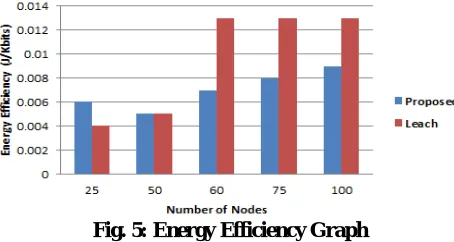
3. Energy efficiency: It is the total energy consumed in delivering 1000 bits of data to thebase station (j/Kbits).
Fig. 5: Energy Efficiency Graph
5. Packet delivery ratio: It is defined as ratio of total packets received at base station tototal packet generated by sender. We denoted it in %.
= ∗ 100
Where N is the total number of packets delivered to base station, n is total number ofpackets transmitted by all nodes.
VII. CONCLUSION
Packet delivery ratio, delay time, average throughput of network, average energyconsumption and network durability improvement is the main concern of the study.Along this we also try to find the best combination of technique which improves theperformance parameters of network wireless network with the help of this researchmethodology.we are able to implement a hybrid routing protocol for wireless sensornetwork. Leach protocol limitation are overcome with this hybrid concept and result weget an energy efficient routing protocol which improve network life time, packetdelivery ratio.
REFERENCES
1. Anjali Singhal and Ravi Kant Sahu, “Energy Efficient Routing B-Leach Routing Protocol”, “IJARCSSE” volume 5, Issue 5, May 2015. 2. A.-K. Jamal and E. K. Ahmed, “Routing Techniques in Wireless Sensor Networks: A Survey,” vol. 11, pp. 6-28, Dec 2004. 3. Jamalipour, Z. Jun and Abbas, Wireless Sensor Networks: A Networking Perspective, John & Sons, Inc and IEEEE, 2009.
4. Younis, A. Kemal and Mohamed, “A Survey on Routing Protocols for Wireless Sensor,” Ad hoc Networks, vol. 3, pp. 325-349, May 2005.
5. N. Bulusu,J. Heidemann and D. Estrin, “GPS-less Low Cost Outdoor Localization for Very Small,” IEEE Personal Communication Magazine, pp. 2834, 2000. 6. C.Subhas,W. Isaac and S. Misra, “Guide to Wireless Sensor Networks,” Computer Communications and Networks, 2009. M. P. Singh. D. K. Singh. Shio Kumar Singh,“Routing Protocols in Wireless Sensor Networks –,” International Journal of Computer Science & Engineering Survey, vol. 1, no. 2, Nov 2010.
7. Neetika and S. kaur,“Review on Hierarchical Routing in Wireless Sensor Networks,” International Journal of Smart Sensors and Ad- Hoc Networks, vol. 2, no. 3,4, pp. 85-90, 2012.
8. F. A. Ian, S. Weilian and S. Yogesh, “Wireless Sensor Network: A survey,” Computer Neworks, vol. 38, no. 4, pp. 393-422, 2003.
9. J.Gnanambigai, Dr.N.Rengarajan and K.Anbukkarasi, “Leach and Its Descendant Protocols: A Survey,” International Journal of Communication and Computer Technologies, vol. 1, no. 2, pp. 15-21, 2012.
10. S. M.G and R. G, “Hierarchical Routing Protocols for Wireless Sensor Network– A survey,” International Journal of Smart Sensors and Ad Hoc Networks, vol. 2, no. 1, pp. 71-75, 2012.
11. N. Ali and H. Z. Abdul, “An Integrative Comparison of Energy Efficient Routing Protocols in Wireless Sensor Network,” vol. 4, no. 3, pp. 65-75, March 2012. 12. K. Ravneet, S. Deepika and K. Navdeep, “Comparative Analysis of Leach and its Descendant Protocols in Wireless Sensor Network,” International Journal of P2P Network Trends and Technology, vol. 3, no. 1, 2013.
13. K. Parminder and K. Mamta, “The Energy-Efficient Hierarchical Routing Protocols for Wireless Sensor: Review,” International Journal of Advanced Research in Computer Science and Software Engineering, vol. 2, no. 11, Nov 2012.
14. B. Wendi, P. C. Anantha and B. Hari, “An Application-Specific Protocol Architecture for
Wireless Micro sensor Networks,” IEEE Transactions on Wireless Communication, vol. 1, no. 4, Oct 2004.
15. Y. Jennifer, M. Biswanath and G. Dipak, “Wireless sensor network survey,” Computer Networks, vol. 52, p. 2292–2330, 2008.
16. W. Lin, Z. Ruihua and G. Shichai, “An energy-balanced ant-based routing protocol for wireless sensor networks,” WiCOM'09 Proceedings of the 5th International Conference on Wireless communications, networking and mobile computing, pp. 3556-3559, 2009.
17. A.Bara’a and A. K. Enan, “A new evolutionary based routing protocol for clustered heterogeneous wireless sensonnetwok,” Applied Soft Computing, vol. 12, p. 1950– 1957, 2012.
18. B. Alakesh and G. R. Umapathi, “A Comparative Study on Advances in LEACH Routing Protocol for Wireless Sensor Networks: A Survey,” International Journal of Advanced Research in Computer and Communication Engineering, vol. 3, no. 2, 2014.